My Neighbor Caught Me Looking at Her… Then She Asked Me Something Unexpected
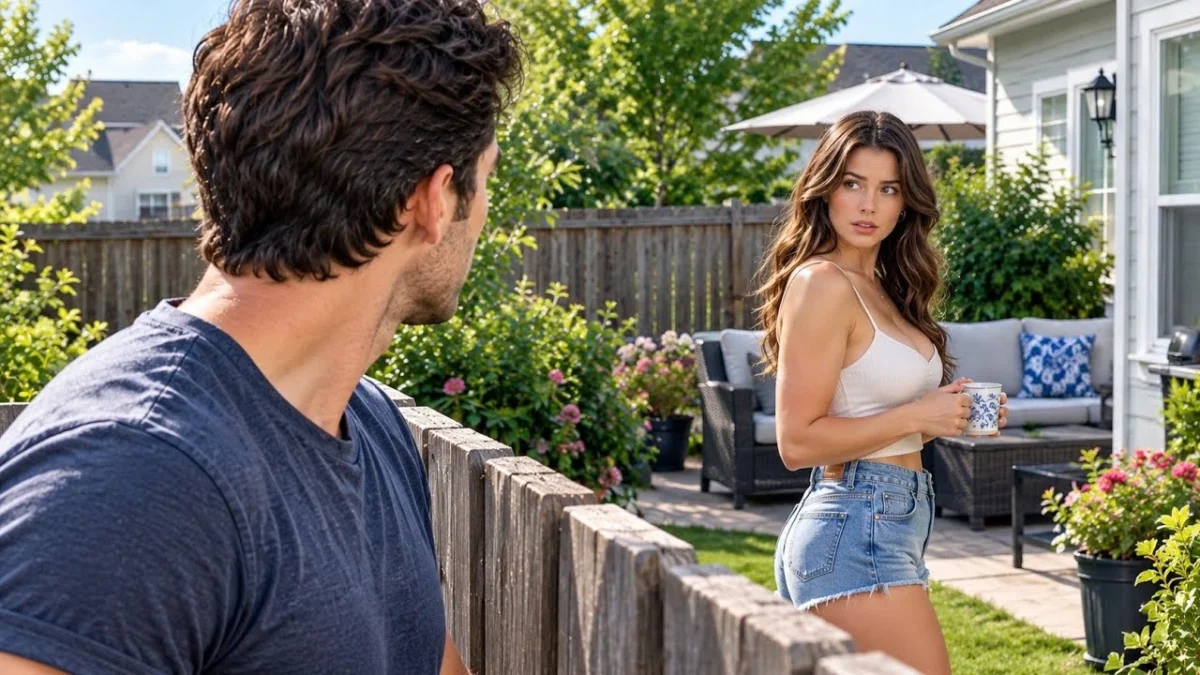
The warm mid-afternoon sun cast long, lazy shadows across the manicured lawns of the quiet suburban cul-de-sac.
In his backyard, thirty-four-year-old Mark leaned against the weathered wooden fence that separated his property from the adjacent lot.
A heavy steel screwdriver rested in his right hand as he worked to tighten a loose post, but his attention was hopelessly divided.
Mark lived alone, working quiet hours as a specialized medical equipment technician.
His work was precise, solitary, and methodical, mirroring the quiet routine he had built around himself over the last few years.
For six months, his peaceful routine had been subtly altered by the quiet presence of his neighbor, Natalie.
She was roughly his age, soft-spoken, and remarkably reserved.
She rarely had visitors, spending most of her late afternoons on her covered back patio with an open hardcover book and a steaming mug of coffee.
They had exchanged polite nods over the fence and brief comments about the changing weather, but their connection had never progressed beyond neighboring courtesy.
That afternoon, however, the silence felt remarkably heavy.
Mark glanced sideways toward Natalie’s house and saw her standing near the sliding glass doors of her patio.
She wore a simple white tank top and worn blue jeans, her dark hair pulled loosely over her right shoulder.
She was staring intently at something resting in her palm, her posture stiff and distant.
Mark hesitated, lingering over his toolbox, when she suddenly lifted her head.
Their eyes locked directly across the narrow expanse of green grass.
Mark felt a sudden, sharp pang of embarrassment and jerked his gaze back down to the loose screw on his wooden fence, attempting to appear intensely focused on his work.
A few seconds passed in agonizing quiet.
Then, the soft metallic latch of the wooden gate clicked open.
Mark swallowed hard, wiping his sweat-stained hands against his jeans as the faint sound of footsteps approached along the grass.
Natalie stopped just a few feet away on her side of the fence, crossing her arms loosely over her chest.
“You know,” Natalie said quietly, her voice carrying a soft, wry edge, “you’re really bad at pretending you weren’t looking.”
Mark cleared his throat, feeling a sudden heat rise up his neck.
“I’m sorry,” Mark said, setting the screwdriver down on the top rail. “I really didn’t mean to make you uncomfortable or stare.”
Natalie studied his face for a long, quiet moment, her brown eyes surprisingly gentle.
“You didn’t make me uncomfortable,” Natalie replied, shaking her head slowly.
Mark blinked, caught off guard by her calm response.
She pointed a delicate finger toward the rear exterior wall of her house.
“So, I want to ask you something,” Natalie continued, leaning her weight against the sturdy fence post. “Have you ever noticed that my back porch light stays on every single night?”
Mark turned his head slightly, eyeing the glass fixture mounted beside her sliding patio doors.
“Yeah,” Mark nodded slowly. “I’ve seen it. Honestly, I just figured you preferred keeping the yard well-lit at night.”
A faint, sad smile flickered across her lips.
“That’s what I wanted people to think,” Natalie said softly.
There was a peculiar shift in her tone, a quiet heaviness that immediately wiped away any lingering awkwardness between them.
Mark wiped his brow and took a step closer to the wooden barrier.
“What do you mean?” Mark asked quietly.
Natalie turned her head toward the darkened glass of her windows, her expression growing distant.
“Because my husband used to leave it on,” Natalie said.
Mark froze in place, his breath catching in his chest.
In all the six months she had lived next door, he had never seen a man at her home, nor had he ever seen a second car parked in her driveway.
Before he could form a question, Natalie continued, her voice remaining steady despite the sadness beneath it.
“He died eleven months ago,” Natalie whispered.
“I’m so sorry,” Mark said, his voice dropping into a sincere, hushed tone. “I… I had no idea.”
“You weren’t supposed to know,” Natalie replied softly.
She walked toward the edge of her patio chairs, pulling out a wrought-iron seat and sitting down.
After a brief pause, Mark walked around the low fence gate, crossing into her yard and taking a seat on the wooden bench across from her.
“His name was Caleb,” Natalie said, staring down at her folded hands. “He died very suddenly from an undetected heart condition while we were visiting his parents out of state. We had been married for seven years.”
Mark listened in silence, giving her space to speak without interruption.
“Caleb always left that back porch light on whenever he knew I was coming home late from work or errands,” Natalie explained, a faint tremor entering her breath. “He said a home should never look cold to the person coming back to it. After he died and I moved here… I just couldn’t bring myself to flip the switch off. It felt like admitting he was never coming home.”
Mark rubbed the back of his neck, struggling to find words that wouldn’t sound hollow.
“Why are you telling me this today?” Mark asked gently.
Natalie lifted her chin, her eyes locking onto his with surprising directness.
“Because you’ve been looking at that light, too,” Natalie said quietly.
Mark felt his chest tighten, a sudden wave of self-consciousness hitting him.
“Natalie, I wasn’t trying to pry—” Mark began.
“I noticed you a few weeks ago,” Natalie interrupted gently, shaking her head. “You would come outside after finishing your work, sit on that old chair on your porch, and just look over toward my yard. Sometimes you’d stay out there for ten or fifteen minutes in the dark.”
Mark ran a hand over his jaw, looking down at the grass between them.
“I wasn’t watching you,” Mark admitted honestly. “I promise.”
“I know you weren’t,” Natalie replied quietly.
Her answer caught him completely unprepared.
“You were watching the light,” Natalie said softly.
Mark sat back against the wooden bench, the weight of her words sinking deep into his thoughts.
He remembered all those quiet evenings after long days spent fixing intricate circuit boards and hydraulic lines in his solitary workshop.
He had often sat outside, staring at the warm amber glow on her patio, feeling a strange, magnetic pull toward it that he had never bothered to analyze.
“My dad used to leave a light on,” Mark said, the words slipping out before he could second-guess himself.
Natalie tilted her head, watching him closely. “He did?”
“When I was a kid, my parents went through a terrible divorce,” Mark said, looking back up at her. “My dad moved three states away to a tiny rented house. Every night for years, whenever I visited him, he left the yellow light above his front door burning continuously. He told me it made an empty house feel like someone was inside waiting for you.”
Natalie smiled sadly, her eyes reflecting a shared understanding.
“What happened to him?” Natalie asked gently.
“He passed away two years ago,” Mark replied quietly. “And I guess… every time I looked at your porch light, it reminded me of him. It felt peaceful. But it felt lonely, too.”
For a long time, neither of them spoke.
The quiet breeze rustled the leaves of the oak trees above them, filling the space between two strangers who had unexpectedly discovered they were carrying the exact same kind of grief.
From that afternoon onward, the dynamic between them shifted completely.
It was not a dramatic or sudden romance; there were no grand declarations or theatrical gestures.
Instead, a quiet, comfortable routine began to form naturally between them.
Some evenings, Natalie would walk to the wooden fence carrying two mugs of fresh coffee.
Other times, Mark would sit on her patio steps, telling her absurd stories about his difficult clients and malfunctioning medical devices.
In return, Natalie slowly began to share pieces of her former life—recounting Caleb’s terrible attempts at baking bread, his passion for vintage records, and his habit of singing off-key while washing dishes.
They spent dozens of hours sitting beneath the pale glow of the porch light, talking until the night sky turned deep purple.
Yet, despite their growing closeness, Mark noticed there was one boundary Natalie never crossed.
She never spoke about the actual night Caleb died, nor did she speak about the life she had left behind in her previous city.
Mark respected her boundary completely, never pressing her for details she wasn’t ready to give.
That changed on a chilly Tuesday evening in late September.
Mark pulled his work van into his driveway and immediately noticed a dark blue sedan parked awkwardly across Natalie’s driveway.
Standing near the open driver’s side door was a tall man in a dark jacket, waving his arms aggressively as he shouted at Natalie on the front lawn.
Mark killed his engine and stepped out of his vehicle, his heart instantly hammering against his ribs.
He couldn’t hear every word over the rustling wind, but he clearly saw the man reach out and forcibly grab Natalie by her wrist.
Mark slammed his door and began marching toward the fence line with quick, deliberate strides.
“Hey!” Mark called out, his voice sharp and cutting.
Before Mark could cross the gate, Natalie violently jerked her arm free from the man’s grip, stepping back with her chin held high.
“Don’t you ever come back here!” Natalie shouted, her voice shaking with rage.
The man sneered, pointing a finger directly at her face.
“You can’t keep hiding from this, Natalie!” the man yelled back. “This isn’t over!”
He turned, climbed into the blue sedan, slammed the door shut, and sped out of the cul-de-sac, his tires screeching loudly against the asphalt.
Natalie stood frozen on the driveway, her entire body trembling as the taillights disappeared down the street.
Mark quickly unlatched the gate and crossed the lawn to her side.
“Natalie, are you okay?” Mark asked urgently, stopping a few feet away so as not to startle her. “Do you need me to call anyone?”
Natalie nodded rapidly, taking a harsh, shallow breath.
“I’m okay,” Natalie gasped out, rubbing her wrist where the skin was slightly red. “I’m fine.”
“Who was that?” Mark asked gently, his posture remaining protective and alert.
“That was Julian,” Natalie said, her jaw tightening. “My husband’s younger brother.”
For the first time since he had met her, Mark saw sharp, protective anger flashing in her eyes instead of her usual quiet melancholy.
“What does he want?” Mark inquired softly.
“He thinks Caleb left him money,” Natalie said, letting out a harsh, humorless laugh. “He thinks there’s a massive inheritance that I’m keeping from him.”
“Did he?” Mark asked.
“No,” Natalie shook her head firmly. “Caleb ran a small, struggling landscaping business. All he left behind was a tiny life insurance policy that barely covered his medical debts and funeral expenses. Julian has been harassing me for months, demanding a cut of money that doesn’t exist.”
She paused, staring down at the grass, her breathing slowly leveling out.
“He thinks I moved away just to avoid him,” Natalie added quietly.
Mark stood beside her, waiting patiently for her to process her thoughts.
Natalie reached deep into the pocket of her light jacket and pulled out a thick, off-white envelope.
The paper was noticeably worn at the edges, as if it had been held and put away hundreds of times.
“He brought this up again today,” Natalie whispered, staring down at the envelope in her hands.
“What is it?” Mark asked gently.
“It’s a letter from Caleb,” Natalie said, her voice dropping into a barely audible murmur. “It was delivered to my old address about three weeks after his funeral. Caleb had set up a legal service to mail it in the event of his death, knowing his heart condition was risky.”
Mark frowned slightly, looking at the crisp handwriting on the front.
“What does it say?” Mark asked.
“I don’t know,” Natalie confessed, her eyes glistening with sudden tears.
Mark looked at her in surprise. “You haven’t read it?”
“It was delivered eleven months ago,” Natalie whispered, her fingers clutching the paper so tightly her knuckles turned white. “My name is written right there on the front in his handwriting. But I haven’t been able to make myself open it. Every time I touch it, I feel like… if I read his last words, it means he’s really gone forever. I’ve been terrified of what’s inside.”
Mark looked from the envelope up to her face, seeing the profound, agonizing weight she had been carrying all by herself.
“You don’t have to do this alone,” Mark said softly, his voice firm and steady.
Natalie looked up at him, her tear-filled eyes searching his face for a long moment before a small, fragile smile touched her lips.
“Will you sit with me?” Natalie asked softly.
“Of course,” Mark replied instantly.
They walked together to the back patio, sitting side-by-side on the wooden bench under the pale illumination of the porch light.
Natalie took a deep, trembling breath and carefully slid her thumb under the sealed flap of the envelope, tearing it open.
Inside was a single sheet of lined notebook paper, covered in neat, dark blue ink.
Her hands shook so violently that she couldn’t keep the page still, so Mark reached out gently, holding one side of the paper with her to steady it.
Natalie began to read aloud, her voice cracking with every sentence.
“Dear Natalie,” the letter began. “If you are reading this, it means my body finally gave out, and I am no longer there to hold your hand. I am so sorry for leaving you to carry the weight of this world by yourself.”
Natalie pulled in a ragged breath, tears spilling over her eyelashes and dripping onto her jeans.
“I know how much you fear being alone,” the letter continued. “I know how much you worry about empty rooms and quiet houses. But please listen to me, my love. Do not spend the rest of your life standing in the shadows of what we had. Do not spend your days waiting for someone who cannot come back.”
Mark kept his eyes fixed on the paper, holding the edge steady as Natalie wept quietly beside him.
Near the bottom of the page, Caleb’s handwriting grew slightly looser, as if written in a hurry.
“If you are reading this years from now,” Natalie read, her voice breaking completely, “I hope you have found the courage to move forward. And more than anything, I hope you have someone sitting beside you who makes the house feel full again.”
Natalie covered her face with her free hand, her shoulders shaking violently as months of repressed grief finally broke free.
Mark instinctively turned his face away, wanting to grant her a moment of privacy in such a vulnerable moment.
Before he could pull his hand back, Natalie’s fingers wrapped tightly around his wrist.
“Don’t,” Natalie whispered through her tears.
Mark turned his head back to look at her.
“Don’t look away,” Natalie repeated, her red-rimmed eyes locking onto his with profound intensity. “Please.”
Mark stayed right where he was.
He didn’t offer empty platitudes or generic comfort; he simply remained beside her, holding the letter steady in the quiet darkness until her sobbing slowly subsided into gentle, steady breaths.
The weeks following that night moved with a quiet, grace-filled momentum.
The blue sedan never returned to the cul-de-sac, and the oppressive shadow that had hung over Natalie’s life seemed to lift, inch by inch.
The yellow porch light on her patio still turned on every evening at dusk, but Natalie no longer sat beneath it in solitary isolation.
Her life gradually began to weave together with Mark’s in small, beautiful ways.
Sometimes she would bring ingredients over to his kitchen, laughing as they tried and failed to make homemade pasta from scratch.
Other times, Mark would bring his tools to her house, fixing sticking doors, squeaky floorboards, and noisy ceiling fans.
They shared long dinners, debated over old movies, and slowly uncovered all the small, ordinary details about each other that form the real foundation of human connection.
They learned how each other took their morning coffee, what songs made them feel nostalgic, and how they both carried quiet scars from losses that had once threatened to break them.
Almost a year to the day after Natalie had first moved into the neighborhood, Mark stepped out onto his back porch late in the evening.
The autumn air was crisp and cool, carrying the faint scent of fallen leaves and distant woodsmoke.
Across the lawn, Natalie was standing near her fence, leaning against the top rail as she watched the night sky.
Mark walked across the grass, stopping on his side of the barrier.
Natalie turned her head, a warm, genuine smile lighting up her face as their eyes met.
“You know why I asked you that day?” Natalie asked softly, her voice drifting across the cool air. “That first day when you caught me watching you?”
Mark smiled, placing his hands on the wooden rail. “About the porch light?”
Natalie nodded slowly.
“I wasn’t really asking why you were looking over here,” Natalie confessed, her eyes shining in the dim light.
“Then what were you asking?” Mark asked quietly.
Natalie took a slow, deep breath, stepping closer until only the width of the fence stood between them.
“I wanted to know if you were waiting for someone, too,” Natalie whispered.
Mark looked down into her face, feeling a profound sense of warmth expand in his chest, washing away the last lingering remnants of his own past isolation.
“I was,” Mark answered honestly.
Natalie stepped right up to the wooden boundary, her eyes searching his face with quiet hope.
“Who were you waiting for?” Natalie asked softly.
Mark smiled gently, reaching out to rest his hand on the wooden rail beside hers.
“I think I finally found her,” Mark said.
Natalie didn’t say a word.
Instead, a radiant smile spread across her face.
She reached over the top of the wooden fence, sliding her fingers firmly into his, closing the distance between them.
Behind her, mounted high on the brick wall of her patio, the porch light shone bright and steady against the dark autumn night.
For the first time since Mark had moved to the quiet neighborhood, the yellow light didn’t look like a beacon waiting for someone who was gone forever.
It looked like a light welcoming someone home.








