My son’s teacher called me to the school… She put the letters down and said, “He does this every day”
The autumn air of October carried a sharp, damp chill that bit through Owen Reed’s heavy wool coat as he pulled his sedan into the parking lot of Oakridge Elementary School.
At thirty-five, Owen spent his professional life as a structural engineer calculating the exact loadbearing capacities of steel, concrete, and timber, determining precisely how much weight a structure could sustain before its internal tension caused it to snap.
He understood the difference between a superficial cosmetic crack and a deep structural fracture that threatened total collapse.
He knew that some failures announced themselves months in advance with groaning beams and sagging foundations, while others remained completely silent until the exact moment they catastrophic failed.
When the call had come from his seven-year-old son Jake’s second-grade teacher earlier that afternoon, she hadn’t given any details over the phone.
She had simply asked him to come in after the final bell, stating calmly that there was something she needed him to see and that it could not wait until parent-teacher conferences.
Driving over, Owen’s mind had raced through every standard parental fear.
He worried about a playground fight, a sudden plummet in grades, a broken window, or a disciplinary infraction.
He had been entirely right about something being broken, but he had been completely wrong about what it looked like.
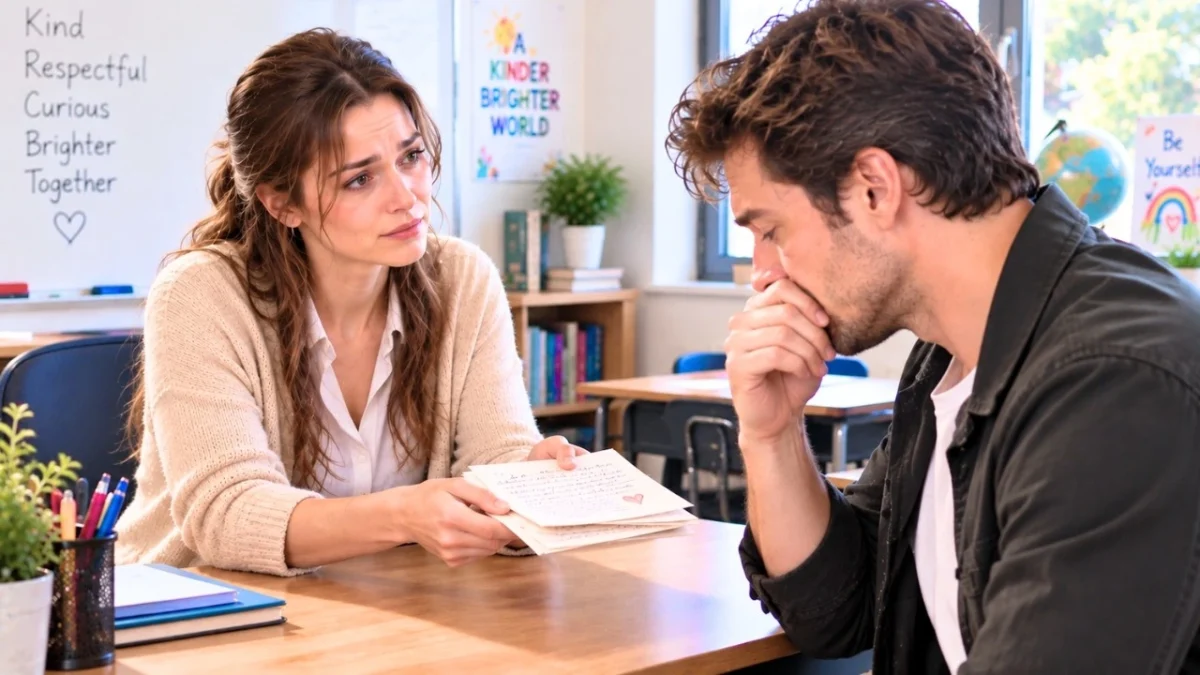
When he sat down across from Clara Reed in her quiet classroom after the other students had gone home, she didn’t begin with apologies or soft cushions.
Instead, she reached into the center of her polished wooden desk and placed a thick, neatly bound stack of folded papers held tightly together by a thick rubber band.
On the outside of each paper, written in the clumsy, earnest handwriting of a seven-year-old boy, were simple messages addressed to Sarah.
There were two hundred and nineteen letters in total.
To understand what those papers meant, Owen knew he had to look backward twenty-two months, to the exact moment the foundation of his family had been ripped away.
Sarah had been a landscape designer, a woman whose entire professional and personal existence revolved around understanding what living things needed to thrive.
She spent her days studying sunlight angles, soil compositions, moisture retention, and root systems, knowing instinctively which plants needed deep shade and which required unshielded light, which species would aggressively take over if left unchecked and which needed gentle, persistent encouragement.
She possessed that exact same intuitive brilliance when it came to people.
Sarah could look at Owen after a grueling twelve-hour day at a construction site and know instantly whether he needed absolute silence, a heavy meal, or someone to listen to him vent about municipal zoning laws.
She had been an extraordinary mother to Jake and an exceptional wife to Owen, making her sudden loss feel like an absolute structural failure of their entire universe.
She had gone in for a routine MRI to check persistent, mild migraines, an appointment they both treated as a bureaucratic formality.
She had never walked back out of the diagnostic ward with a clean bill of health.
The doctors found an aggressive glioblastoma, a fast-growing brain tumor that was already far too advanced to operate on by the time it triggered its first symptom.
They had been granted precisely eight months from the date of the diagnosis to the final breath, an interval of time that felt simultaneously cruel in its brevity and agonizing in its lingering agony.
Eight months was more than enough time to comprehend the absolute magnitude of what was being stolen from them, but it was nowhere near long enough to make peace with the impending devastation.
When Sarah died, Jake was six years old.
Now, at seven, his son had lived through more than a full year of conscious existence in a home where his mother’s presence was restricted to framed photographs on the mantelpiece and quiet echoes in the hallway.
Owen had spent those same twenty-two months trying desperately to figure out how to be a single father, attempting to patch over the gaping void left behind by the woman who had always held everything together.
He had convinced himself that they were managing reasonably well.
They were surviving.
Jake was eating his meals, maintaining steady grades, playing soccer on weekends, and participating in the routine rhythms of second-grade life.
If his son was significantly quieter than he used to be, if there were nights when Jake crept into Owen’s bedroom asking to sleep with the bedside lamp turned on, or if the boy occasionally wandered through the kitchen looking into empty corners where Sarah used to stand, Owen had simply told himself that this was normal grief.
He had reasoned that grief was an emotional state to be lived through rather than an engineering flaw to be repaired.
Yet, as he sat in the small plastic visitor’s chair staring down at the rubber-banded stack of letters on Clara’s desk, Owen realized how fundamentally mistaken his assessment had been.
“I haven’t read a single one of them, Mr. Reed,” Clara said softly, breaking the heavy silence in the classroom.
She was a composed woman in her mid-thirties with a steady, compassionate gaze that made people feel instantly safe.
“I want to make that completely clear before we go any further. Jake handed these to me on our very first week of school last year, right after the school year started. He told me they were private, that they were for his mom, and he asked me to hold onto them for him until he was ready. He made me promise not to open them, and I kept that promise for eleven months.”
Owen stared at her, his throat tightening as his fingers brushed the edge of the topmost paper.
“Why didn’t you tell me sooner?” Owen asked, his voice rough and stripped of its usual professional authority.
“Because he trusted me not to break his confidence, and because I wasn’t entirely sure what was happening myself,” Clara explained, leaning forward with her hands resting gently on top of the stack. “Every single morning, right after he arrives at school, Jake walks up to my desk and hands me a freshly folded letter. He does it quietly, without making a scene. But over the last few weeks, the stack grew so thick that I couldn’t ignore it anymore. And more importantly, Mr. Reed, I noticed a change in how he handed it to me last month. He held onto the paper for just a fraction of a second longer. It felt heavier. Not in physical weight, but in emotional cost. I realized then that he needed someone besides himself to acknowledge that these letters existed.”
“Two hundred and nineteen letters,” Owen whispered, the number echoing in the hollow chambers of his mind.
“Two hundred and nineteen,” Clara confirmed quietly. “Every single school day for nearly a full year. He wakes up early every morning, doesn’t he?”
“Yes,” Owen answered, a sudden wave of realization washing over him. “I always thought he just inherited Sarah’s early-rising habits. I had no idea he was using that time in the morning to write to her.”
“Children who experience profound loss often look for ways to ensure their connection to the departed parent doesn’t vanish into thin air,” Clara said, her eyes fixed steadily on Owen’s face. “They find unique ways to keep the relationship real, even when it’s entirely one-sided. Jake found a way to do it that protects you, too. He didn’t want to burden you with his deepest grief because he knew you were carrying your own heartbreak. So, he found an alternate route to keep talking to her, and he trusted me to witness it.”
Owen slowly reached out, his trembling fingers picking up the dense stack of papers.
The physical weight of the letters felt overwhelming, far heavier than any calculation of loadbearing stress he had ever computed in his engineering career.
He thanked Clara in a choked whisper, slid the stack securely into the inside pocket of his jacket, and walked out of the school building in a daze.
He sat in his parked car beneath the flickering amber streetlamps for nearly an hour, staring through the windshield at the darkening athletic field without starting the engine.
He felt a complicated mixture of guilt, profound sorrow, and a strange, aching tenderness toward his son.
When he finally drove home, the familiar domestic routine unfolded like a well-rehearsed play.
Jake came bounding through the front door, dropping his heavy canvas backpack onto the hallway floor with the loud, reassuring thud that Owen had grown to love because it proved his son was safely home.
They ate their customary Tuesday night pasta dinner, tackled second-grade math problems with methodical patience, and watched an educational documentary about migratory Arctic terns that Jake analyzed with genuine scholarly expertise.
Throughout the entire evening, Owen could feel the solid outline of the letters resting against his ribs inside his jacket pocket.
It wasn’t until bedtime, after the stories had been read, the glass of water placed on the nightstand, and the precise pillow arrangement adjusted to absolute perfection, that Owen sat down on the edge of his son’s mattress.
“Jake,” Owen began softly, breaking the comfortable silence of the dimly lit bedroom. “I went to see Miss Reed today after school.”
Jake remained completely still, staring up at the ceiling with his mother’s distinct composure.
“She told you about the letters,” the boy said without a trace of panic or defensiveness in his young voice.
“She did,” Owen replied gently. “Are you mad at me?” Jake asked, turning his head slightly to look into his father’s eyes.
“No, buddy,” Owen said, reaching out to brush a stray lock of hair from his son’s forehead. “Not even a little bit. But I want to understand. Why did you give them to Miss Reed instead of keeping them in your room?”
Jake thought carefully for a long moment, searching for the exact words that would capture his complex internal logic.
“Because she’s there every single day, and she knows me,” Jake explained quietly. “And… she’s not you, Dad. So I could give them to her without it being…”
He trailed off, unable or unwilling to finish the sentence.
“Without it being too much for both of us to handle at the same time,” Owen finished for him, his voice cracking slightly.
“Yeah,” Jake whispered, nodding against his pillow. “If I kept them all in my room or gave them to you, we would both start crying, and it would make the house too sad. Miss Reed is strong, and she just holds them for me so Mom can receive them.”
Owen felt a tear slip down his cheek, catching the warm light of the bedside lamp.
“Do you want me to read them, Jake?” Owen asked softly, offering the choice back to his son.
“No,” Jake answered immediately and firmly. “They’re for Mom. But you can know they exist. Miss Reed said you needed to know so you wouldn’t feel so alone.”
“She was entirely right,” Owen said, his chest aching with an intense surge of paternal love.
“Dad?” Jake asked after another brief pause. “Do you still talk to Mom?”
Owen thought about the question honestly, realizing his son deserved nothing less than complete sincerity.
“Sometimes,” Owen admitted. “In my head, mostly. When something happens during the day that I know she would find funny, or when I miss her too much, I talk to her.”
“What do you tell her?” Jake asked with quiet curiosity.
“Mostly, I talk to her about you,” Owen confessed.
A small, knowing smile crossed Jake’s face in the dim light.
“I tell her about you, too, in the letters,” Jake revealed quietly. “I tell her when you look okay, and I tell her when you don’t. Mom used to worry about you a lot when she was sick. She told me that you need someone to notice when you’re hurting because you hide it behind your work. So, I notice, and I write it down in the letters so she won’t worry.”
Owen sat completely paralyzed by his son’s words.
A seven-year-old boy had taken it upon himself to quietly monitor his grieving father’s emotional well-being, logging every heavy sigh and quiet evening into folded notes handed to a second-grade teacher every morning.
Owen leaned over and switched off the bedside lamp, plunging the room into comfortable shadows, and stretched out beside his son for a moment, listening to the steady, rhythmic breathing of the boy who had taught him more about emotional endurance than any engineering textbook ever could.
“Your mom would be extraordinarily proud of you, Jake,” Owen said into the darkness.
“I know,” Jake replied softly from beneath the covers. “I told her that in the letters, too. I wanted to make sure it was officially on the record.”
Owen let out a sudden, genuine laugh that broke through the lingering melancholy in the room, and a moment later, he heard Jake giggling quietly beside him, sharing the exact same musical laugh that belonged to Sarah.
Over the next few days, the heavy atmosphere in the house shifted into something lighter and more breathable.
The letters remained unread, resting safely in a small wooden box on Owen’s dresser where Jake had eventually agreed to keep them moving forward, now that the secret was out in the open and shared between them.
The following week, Owen walked back into Clara’s classroom after the final bell rang, wanting to express his gratitude once more now that he had processed the full scope of what she had done for his family.
Clara was busy straightening up a shelf of reading books, her movements unhurried and serene.
She turned around as he stepped through the open doorway, offering a warm, welcoming smile.
“He told me you might come back,” Clara said, stepping away from the bookshelf and walking over to sit down at her desk. “He said his dad wasn’t quite done thinking yet.”
“He’s remarkably accurate about those things,” Owen said, taking a seat in the visitor’s chair, which felt significantly less formal this time around. “I just wanted to thank you again, Clara. Not just for holding the letters, but for knowing instinctively when to step in before the weight became too much for him to carry alone.”
“Children possess an incredible radar for emotional honesty, Owen,” Clara said, using his first name with a natural ease that felt completely right. “They figure out very quickly which adults can handle the heavy truths of life and which ones will try to brush them away with false cheerfulness. Jake knew you were trying your best, but he also knew you were carrying your own grief. He found a safe harbor here, and all I did was provide a desk drawer.”
“He thinks the world of you,” Owen remarked, watching the way the late afternoon sunlight caught the edges of her hair.
“I think the world of him, too,” Clara replied honestly. “And for what it’s worth, Owen, you’re doing a remarkable job raising him. You’re allowed to lean on people, you know. Being a single parent doesn’t mean you have to be made of concrete.”
“I’m learning that structural integrity isn’t just about resisting pressure,” Owen said softly, a genuine smile touching his lips for the first time in months. “Sometimes, it’s about knowing how to bend without breaking, and letting the people around you help carry the load.”
Clara nodded approvingly, her gaze steady and warm.
“That sounds like a much better architectural model for life,” she said.
When Owen left the school that afternoon, the October air smelled crisp and clean, carrying the distinct scent of autumn leaves settling into the damp earth—a familiar reminder of things ending, but also of new foundations quietly taking root in the quiet spaces left behind.








