No Healer Could Close the Dying Chief’s Wound — the Scorned Settler Woman Said “I Need It Opened”
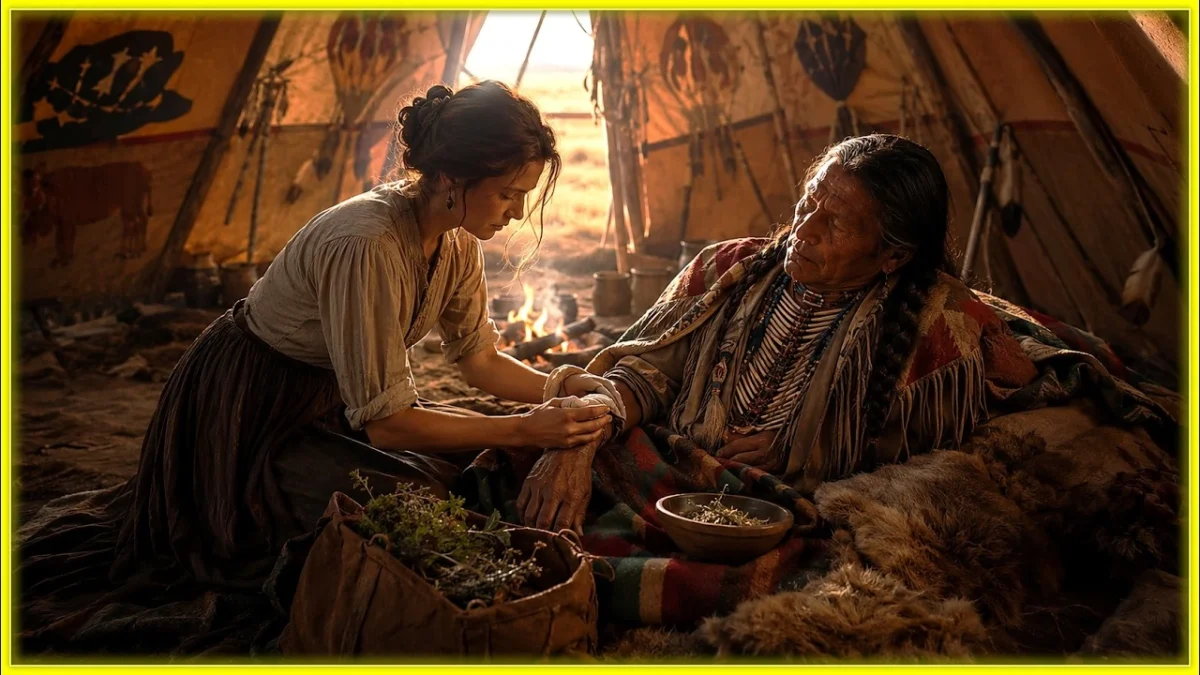
The midnight air at the edge of Miller’s Bend always carried the sour tang of damp earth and rotting pine, but to Naomi Colby, it tasted mostly of isolation.
She sat at her narrow pine table, the quiet hum of the tallow candle the only company she had kept for the better part of eleven years.
Her hands, calloused and stained pale green at the knuckles from crushed yarrow and wild willow, rested flat against the scarred wood.
In the small settlement three miles down the ridge, people spoke her name in hushed, guarded tones.
They called her a witch, a heathen, an unwed solitary woman who lived too close to the treeline and knew too much about the blood that flowed through human flesh.
Yet when their infants choked on croup or their men took an axe blade to the shin, they came to her quiet cabin under the dark cover of night, begging for the very herbs they decried by light of day.
Three sharp, heavy raps shattered the midnight silence.
Naomi’s heart leaped into her throat, her right hand instinctively reaching for the short iron poker resting beside the cold hearth.
No one came knocking at that hour with glad tidings.
She stood slowly, her grey wool skirt brushing against the floorboards, and approached the thick oak door.
“Who’s there?” she called out, her voice firm despite the pulse hammering in her ears.
“We seek the healer,” a heavy, accented voice answered through the timber.
“The woman who cured the trader Holloway when the fort doctor left him to die.”
Naomi paused, her fingers resting on the heavy iron latch.
She lifted the bar and drew the door open a few inches, holding the oil lantern high to cut through the mountain darkness.
Standing on her porch were two Lakota riders, their breath blooming in pale clouds in the crisp night air.
Their horses behind them were lathered with sweat, flanks heaving from a relentless gallop across the hard-scrabble territory.
A third rider waited near the tree line, holding the reins of a spare mount.
The elder of the two men stepped closer into the dim circle of yellow light.
His face was lined with deep, weather-carved grooves, his eyes fierce yet shadowed by an unmistakable, exhaustion-driven desperation.
“You are Naomi Colby,” he said, the English words carefully shaped, learned from long years of trading at the distant military posts.
“I am Hawk.”
“What do you want here, Hawk?” Naomi asked, her eyes darting to the rifles scabbarded along their saddles.
“Our chief is dying,” Hawk said plainly, his voice dropping into a register of stark, unvarnished grief.
“Our own medicine women have sung over him and applied poultices for three days running, but the spirit leaves him.
A trader told us of the settler woman at the edge of the bend who knows the deep secrets of the flesh.
We were told that if all else failed, we must bring you.”
Fear, sharp and instinctual, flared in Naomi’s chest.
A lone woman, miles from any neighbor, being summoned into the dark by armed men of a nation her own town painted as bloodthirsty savages—every rumor whispered at the dry goods store screamed at her to bolt the door.
Yet beneath that fear lay an older, far more familiar sensation: recognition.
It was the same raw, terrifying panic she heard in the voices of Miller’s Bend farmers when their wives bled too freely in childbirth.
It was the universal sound of human helplessness before the approach of death.
For eleven years, since her mother had passed and left her with a cupboard full of dried roots and a town’s quiet contempt, Naomi had known what it was to be hated until she was needed.
“What is the nature of the wound?” Naomi asked, stepping out onto the threshold, the cold night wind whipping her dark hair across her face.
“A rogue buffalo bull gored him three days past,” Hawk replied, his dark eyes never leaving hers.
“He fought it to save a boy who wandered too close to the herd.
The horn tore deep into his flank.
The skin was stitched tight by our elders to stop the bleeding, but now the area burns like molten iron.
It has closed over, but it swells tight as a drum, and he speaks less with every passing hour.”
Naomi closed her eyes for a brief moment, her mind racing through the medical pages her mother had hand-written in heavy ink.
A wound sealed too soon.
The outer flesh stitched shut over dirt, hair, and pocketed rot, trapping the poison inside a living tomb where it had nowhere to go but into the blood.
She had seen it twice in Miller’s Bend.
Both times, well-meaning neighbors had sewed up a deep tear out of fear of ugly scarring, only to watch the patient burn up with fever and perish in agony three days later.
“If the skin has closed over a deep pocket of infection, no herb or prayer will help him as he sits,” Naomi said softly, opening her eyes.
“It will poison his blood entirely within another day.”
“Can you save him?” the younger rider asked, his hands tight on his horse’s reins.
“I don’t know,” Naomi said honestly.
“If I am too late, he will die no matter what I do.
And if I go with you, I am placing my life entirely in your hands.”
Hawk bowed his head slightly, placing a heavy hand over his heart.
“You have the word of the Oglala.
No harm will come to you under our sky.
If you cannot save him, we will ride you back to this doorway unharmed.
But if you stay here, he dies for certain.”
Naomi looked back into her small, quiet cabin.
She thought of the town three miles away, where men turned their faces when she walked past their wagons, only to creep up her path at midnight when the fever struck.
She trusted the fierce, desperate honesty in Hawk’s eyes far more than she had ever trusted the polite hypocrisy of Miller’s Bend.
“I need five minutes,” she said.
“I must gather my bags, my scalpel, and my kettle.”
She turned back inside, her movements swift and practiced.
She packed her heavy leather satchel with dried yarrow, crushed juniper berries, clean linen strips, and her mother’s silver-handled lancet.
She wrapped her wool shawl tightly around her shoulders, blew out the candle, and locked her door behind her.
The ride through the midnight forest was fast and relentless.
The horses’ hooves thundered against the frozen earth, kicking up bits of brush and stone.
Naomi rode the spare horse, holding the reins tight, her eyes fixed on Hawk’s silhouette ahead.
As they rode, Hawk spoke to her over the rush of the wind, his voice steady despite the pace.
He told her of their chief, whose name was Otica.
He told her how Otica had led their band through six brutal winters without once raising a weapon against a settler who had not fired first.
He told her how Otica had turned away young, hot-blooded warriors eager for revenge after cattlemen had burned their winter stores, insisting that peace, no matter how costly or fragile, was cheaper than the blood of their children.
Hearing his words, Naomi felt a strange sensation settling in her chest.
All her life, the people of Miller’s Bend had spoken of the native tribes as mindless, violent shadows lurking in the timber, waiting for a chance to butcher innocent families.
Yet here was a man who had bled to save a child from a charging bull, a man who had staved off war out of love for his people.
She began to realize how many truths given to her by her own kind were nothing more than convenient lies constructed to justify their own hatred.
By the time the horizon began to pale into a cold, slate grey, they topped a high rise overlooking a wide valley.
Spread out below along the bends of a rushing creek was the Lakota camp.
It was larger and far more organized than anything Naomi had been led to expect.
Conical lodges were arranged in deliberate circles, smoke rising in thin, pale ribbons from early cook fires into the damp dawn air.
Yet an unnatural stillness hung over the camp—a quiet so profound that Naomi recognized it instantly.
It was the heavy, suffocating silence of a community holding its collective breath, waiting for a death it could not prevent.
As their horses galloped into the encampment, people emerged from the lodges.
Women holding young children close, old men with blankets draped over their shoulders, and young warriors standing with arms crossed, all watching the stranger with a mixture of desperate hope and sharp suspicion.
Naomi dismounted, her knees stiff from the long ride.
Before she could take three steps toward the central lodge, an older woman stepped out to block her path.
She was tall, her hair braided with silver threads, her dark eyes measuring Naomi with a sharpness that felt like a blade scraping against bone.
“I am Waikapi,” the woman said, her English clear, though spoken with a heavy, deliberate cadence.
“I have tended Otica since he was a boy chasing sparrows through the grass.
My herbs have cured snakebites and stopped the lung-rot.
I do not understand why my medicine should fail now, or why Hawk brings a settler woman who knows nothing of our ways to stand over our chief.”
Naomi met the older woman’s gaze, refusing to look down.
She knew this stance; she had faced it a hundred times from old country grandmothers who thought no young woman could teach them anything about healing.
“I do not doubt your skill, Waikapi,” Naomi said, her voice calm and respectful.
“You know the prairies better than I ever will.
But a wound that has been sealed before the poison is cleansed becomes a trap.
The body cooks in its own rot.
If I am wrong, you have lost nothing but an hour of patience.
If I am right, your chief will be dead before the sun reaches the top of the sky, not because his spirit was weak, but because his wound could not breathe.”
Waikapi stared at Naomi, her jaw working slightly.
For a long, tense moment, the only sound was the crackle of a nearby fire and the whistling of the morning wind through the lodge poles.
Then, slowly, the elder woman stepped aside and lifted the heavy buffalo-hide flap of the main lodge.
“Come,” Waikapi said softly.
The interior of the lodge was dim, smelled strongly of sweetgrass, old smoke, and the heavy, metallic stench of festering flesh.
Lying on a platform of soft furs near the central fire pit was Chief Otica.
Even in the grip of deep delirium, the man’s physical presence was formidable.
He was broad-shouldered, with thick black hair spreading across the pelts, his bronze skin now paled to an ashen grey.
Sweat beaded heavily across his forehead, and his chest heaved in short, ragged gasps.
A thick wool blanket was piled over him, but he shivered violently—a chill born not from the cold outside, but from the deep, scorching fever destroying his blood.
Naomi knelt beside him immediately, discarding her wool shawl.
She turned back the blanket to expose his left flank.
A jagged, four-inch tear ran along his ribs.
The skin had been tightly bound with leather sinew, but the flesh around the stitches was dark purple, swollen tight as a gourd, and burning hot to the touch.
When Naomi gently pressed her fingers near the edge of the wound, Otica groaned, a deep, primal sound of agony, though his eyes remained closed.
“Look here,” Naomi said to Waikapi, who had knelt on the opposite side of the furs.
“Feel the heat.
The skin has healed over on top, but underneath, the bad fluid is trapped against the bone.
It is poisoning his entire body.”
“What must be done?” Waikapi asked, her earlier hostility melting into grim concern as she looked at her chief’s face.
“I need it opened,” Naomi said firmly.
“Now.
We must cut the stitches, reopen the wound, and clean out the rot.
If we do not, he will not survive the night.”
A sharp intake of breath came from the lodge doorway.
A young warrior stepped inside, his hand resting tightly on the bone handle of a long knife at his belt.
Naomi had noticed him outside—his face was fierce, his eyes brimming with anger and distrust.
“You would cut him further?” the warrior demanded, his voice trembling with rage.
“He is already dying from a tear in his flesh, and you bring iron to cut him again?
How do we know you are not sent by the settlers to finish what the bull started?”
Naomi stood up slowly, facing the young warrior directly.
She did not back away, though the man towered over her.
“My name is Naomi Colby,” she said, her voice ringing clear through the lodge.
“I have no love for the men in Miller’s Bend who talk of war, and I was not sent by anyone.
I came because Hawk asked for my help.
I have done this exact work for men of my own blood who would have rotted in their beds otherwise.
If I wanted to kill your chief, I could have stayed in my cabin and let the fever finish the job for me.
I am here to save his life, but I cannot do it while you stand over me with a blade.”
The young warrior, whose name was Mato, glared at her, his knuckles white against his knife hilt.
“Let her work,” a raspy, weak voice commanded from the furs.
Everyone in the lodge froze.
Otica’s eyes were open now.
They were glassy with fever, yet a deep, commanding intelligence remained behind the haze.
He was looking directly at Naomi.
“Chief,” Mato stepped forward, “she is a settler…”
“She speaks with a tongue that does not bend,” Otica rasped, every word costing him a visible effort.
“I have heard the death-singing in my ears for two nights, Mato.
I would rather die fighting to live under her blade than die quietly in my bed out of pride.
Let the woman do what she came to do.”
Mato let out a slow, bitter breath, but he stepped back toward the entrance, his arms crossed over his chest, his gaze fixed on Naomi like a hawk watching a field mouse.
Waikapi looked across the furs at Naomi, her eyes filled with a quiet, solemn acceptance.
“Tell me what you need,” the old medicine woman said quietly.
“I need boiling water,” Naomi directed, opening her satchel.
“Clean cloth, a small dish to catch the fluid, and two strong men to hold his shoulders steady.
This will hurt him more than the buffalo did.”
For the next hour, the small lodge became a place of quiet, intense labor.
Hawk and Mato knelt near Otica’s head, pinning his powerful shoulders against the earth, while Waikapi tended the small fire, heating water and passing clean cloths.
Naomi sanitized her mother’s silver lancet in the flame of a candle.
She wiped the sweat from her own forehead with her sleeve, took a deep breath, and knelt over the chief’s flank.
“Hold him,” she murmured.
With a swift, precise motion born of years of practice, Naomi sliced through the tight leather sinew holding the wound shut.
She then inserted the tip of the narrow blade into the pocket of fluid beneath the skin.
Otica’s entire body went rigid.
A strangled gasp tore from his throat, his muscles straining so hard against Hawk and Mato that the thick lodge poles seemed to shake.
Waikapi immediately began to chant—a low, rhythmic melody in her native tongue, her hand resting gently on Otica’s brow.
The sound was soothing, filling the space with a strange, ancient comfort that steadied Naomi’s hand.
Dark, foul-smelling fluid burst from the incision, spilling into the birch-bark bowl Naomi held ready.
The relief in the room was instantaneous and palpable.
The intense, localized pressure on the chief’s ribs relaxed as the trapped infection drained away.
Naomi worked methodically, using warm, boiled water infused with crushed juniper to flush out the cavity, cleansing every corner of the deep tear until only clean, red blood flowed from the tissue.
She then applied a thick, soothing poultice of powdered yarrow root and wild honey—a remedy her mother had used to stop proud flesh from forming—and loosely packed the wound with clean linen, leaving an opening at the bottom so it could continue to drain freely.
By the time she finished tying the final bandage around his waist, the sun was high in the sky, casting bright streaks of yellow light through the smoke hole above.
Otica lay still on his furs, his face dripping with sweat, his eyes closed.
His breathing, though still shallow, was no longer the ragged, frantic gasp of a drowning man.
It had smoothed out into a deep, steady rhythm.
He drifted into a profound, healing sleep.
Naomi sat back on her heels, her hands trembling violently as the adrenaline left her body.
Her apron was stained with blood and water, her hair clinging to her neck.
She looked up to find Mato staring at her from the doorway.
The cold anger in the young warrior’s eyes had vanished, replaced by a stunned, solemn reverence.
He bowed his head slightly toward her, a gesture of profound respect, before stepping out of the lodge to carry the news to the waiting camp.
Waikapi handed Naomi a wooden cup filled with cold water.
“Drink,” the old woman said softly.
Naomi took the cup, her fingers brushing Waikapi’s warm hand.
“Thank you,” Naomi said, her voice barely a whisper.
“No,” Waikapi replied, her face softening into a rare, genuine smile.
“It is we who must thank you.
You have hands that know the bone and the blood, settler woman.”
Though the wound had been cleansed, the battle was far from over.
The fever that had settled deep into Otica’s bones refused to release its grip easily.
For two days and two nights, Naomi barely left the chief’s lodge.
She slept in brief, fitful two-hour stretches on a small bed of buffalo robes in the corner, waking at the slightest change in his breathing.
She spent the long hours sponging his broad chest with cool creek water, coaxing small spoonfuls of willow-bark tea down his dry throat, and constantly checking the dressing to ensure the infection was not returning.
During those quiet, late-night hours, while the rest of the camp slept and the fire burned low, Naomi got to know the man whose life she was holding in her hands.
In his fevered mutterings, Otica spoke not of glory or battle, but of his people.
He worried aloud about the winter stores, about an elder whose eyesight was failing, about the young boys who needed to learn how to hunt without taking unnecessary risks.
Waikapi, sitting beside Naomi through the long watches, translated his low, disjointed murmurings and filled in the stories behind them.
She told Naomi how Otica’s father had died when he was just fifteen, leaving him to carry the responsibility of a band during a terrible famine.
She told her how he had walked three days through a blinding blizzard to bring back a lost orphan girl, nearly freezing his own feet off in the process.
She showed Naomi a faint white scar above Otica’s left eyebrow, chuckling softly as she explained how he had gotten it falling out of a cottonwood tree while trying to reach a bird’s nest to impress his younger sister.
As Naomi listened, sitting in the quiet dark with the cool cloth in her hand, she felt something shifting deep within herself.
She looked at Otica’s strong, peaceful face, at the gentle rise and fall of his chest, and realized that her fierce devotion to keeping him alive had long since ceased to be a matter of professional pride.
“You watch him with soft eyes,” Waikapi remarked quietly on the second night, her dark eyes reflecting the dying embers of the hearth.
“I watch every patient closely when the fever is at its edge,” Naomi answered quickly, feeling a sudden heat rise in her cheeks.
“It is how I was taught.”
“I have seen many healers,” Waikapi said, stirring a pot of herbal broth.
“They look at the skin.
They look at the blood.
They do not look at the man with the quiet ache that sits in your eyes, Naomi.”
Naomi looked down at her lap, her fingers twisting the hem of her apron.
The silence between them stretched long, until the quiet honesty of the room compelled her to speak.
“In my town,” Naomi confessed, her voice barely audible over the crackle of the wood, “they look at me with disgust.
They call me a witch because my mother taught me how to use plants to ease suffering instead of relying only on church prayers.
They call me an outcast because I never took a husband, because I live alone at the edge of the trees.
Yet when their wives are dying in childbirth or their sons are burning up with ague, they come to my door in the dark, whispering for my help.
And when the sun comes up, they pass me on the road and pretend they do not know my name.”
She lifted her eyes to look at Waikapi.
“I had begun to believe that was all I was meant for in this life—a shameful necessity to be used when people are terrified, and forgotten the moment they are safe again.
No one in Miller’s Bend has ever thanked me out loud.
Not once in eleven years.”
Waikapi set down her spoon.
She reached across the small space between them and laid her weathered, calloused hand firmly over Naomi’s.
“Then your town is filled with fools who are blind to the treasure standing on their doorstep,” the old woman said fiercely.
“The Oglala do not forget those who walk into the dark to carry them back to the light.
We will not forget you, Naomi Colby.”
A strange, unfamiliar warmth unfurled in Naomi’s chest—a feeling of belonging so sharp it made her eyes sting with unshed tears.
Near dawn on the third morning, the shift finally came.
Naomi was sitting beside the bed, her head resting lightly against the lodge pole, when she felt a sudden change in the temperature of the air around the furs.
She placed her palm against Otica’s forehead.
His skin, which had felt like hot porcelain for three days, was cool and moist.
The fever had broken.
His pulse beneath her fingers was slow, heavy, and delightfully steady.
He had slipped from the dangerous, burning delirium into the deep, restorative sleep of a body that had conquered its poison.
A profound sigh of relief escaped Naomi’s lips.
She slumped back against the furs, a single tear escaping her eye and trailing down her cheek as the crushing weight of exhaustion finally claimed her.
She had barely closed her eyes to rest when the heavy hide flap of the lodge was thrown open with a violent snap.
Mato burst inside, his face pale, his breath coming in ragged, terrified gasps.
“Riders!” Mato shouted, his voice instantly rousing Waikapi from her corner.
“A settler militia from the valley!
They are a half-day’s ride out, moving fast toward our creek!”
Naomi sat up instantly, her fatigue vanishing.
“A militia?
Why?”
“Word reached the trading post yesterday that Chief Otica was gored and dying,” Mato said, his hands clenched into tight fists.
“The cattlemen think our camp is weak, leaderless, and paralyzed by grief.
They mean to strike us now, burn our lodges, and drive us into the mountains before the chief can recover!”
Naomi’s blood ran cold.
She knew the men of Miller’s Bend.
She had seen how quick they were to gather at the saloon, feeding each other’s fears with wild rumors of native uprisings, looking for any excuse to seize land and assert their dominance.
“How many warriors do you have who can fight?” Waikapi asked, her voice tight with alarm.
“Too few,” Mato admitted, his head dropping in shame.
“Our best hunters are still three days north, bringing back the meat from the buffalo hunt.
We have mostly elders, women, and children here.
If they attack us, it will be a massacre.”
For the first time, Naomi saw raw, unadulterated terror in the eyes of the young warrior who had watched her so fiercely two days prior.
He was not afraid for his own life; he was afraid for the helpless families sleeping in the lodges around them.
Suddenly, a low, commanding voice spoke from the center of the room.
“Then we must ensure… there is no fight to be had.”
Naomi turned to see Otica sitting up slowly on his furs.
He was pale, his face drawn with lingering weakness, but his dark eyes were bright, clear, and absolutely resolute.
“Chief,” Waikapi rushed to his side, “you cannot stand!
Your wound will reopen!”
“If I stay in this bed,” Otica said, his voice rising in strength, “the men from the valley will see only a dying camp and an opportunity for blood.
They must see their lie destroyed before they fire a single shot.
They must see that the chief of the Oglala is alive, standing on his feet, and ready to protect his people.”
He looked at Naomi, his gaze intense and unwavering.
“Help me stand,” he rasped.
“Otica, no,” Naomi pleaded, kneeling beside him and placing a hand on his chest.
“You have just survived a poison that almost took your heart.
If you strain yourself now, you could bleed to death internal…”
“Naomi,” he interrupted softly, using her name for the very first time.
His large, warm hand reached out and gently covered hers.
“If I do not stand today, my people will die.
I am not asking you as a healer.
I am asking you as a man who trusts you with his life.
Hold me up.”
The look in his eyes—a mixture of absolute faith, desperate urgency, and a quiet, profound respect—shattered whatever doubts remained in Naomi’s mind.
“All right,” she whispered, her chin lifting with sudden determination.
“I will hold you up.”
An hour later, the dust storm raised by thirty mounted men appeared on the southern horizon.
The settler militia rode hard, their rifles resting across their saddles, their faces grim and set with the cold arrogance of men who believed they were riding into an easy slaughter.
At the head of the column was Silas Garrity, a wealthy, hard-jawed cattle rancher from Miller’s Bend whose word was law among the local settlers.
As the riders crested the final rise leading down into the Lakota encampment, they brought their horses to a sudden, clattering halt.
Standing at the edge of the camp, framed by the bright morning sun, was a wall of people.
No weapons were raised.
No bowstrings were drawn.
There was only a quiet, imposing wall of dignity.
Standing directly in the center of the path was Chief Otica.
He wore his full buckskin shirt, his head held high, his stance broad and unyielding.
Braced firmly at his right side, her arm wrapped tightly around his waist to support his trembling weight, was Naomi Colby.
On his left stood Waikapi and Mato, with the elders and women of the camp arrayed in calm, silent lines behind them.
Silas Garrity reined his horse back hard, his eyes widening in utter disbelief as he took in the scene.
He looked at Otica, then at the woman standing beside him, his mouth falling open slightly.
“Mrs. Colby?” Garrity blurted out, his voice echoing across the open meadow.
“What in God’s name are you doing standing with these savages?”
Naomi took a step forward, taking a portion of Otica’s heavy weight with her, her voice carrying across the quiet space with the cutting clarity of a silver bell.
“I am standing here saving a man’s life, Mr. Garrity!” she called out, her eyes locking onto the rancher’s with cold fury.
“The exact same way I saved your brother’s life when his leg was crushed under his wagon two winters ago!
And the same way I delivered three of your own children in the middle of snowstorms when no doctor would ride out to your place!”
Garrity shifted uncomfortably in his saddle, his face flushing dark red beneath his hat brim.
The men behind him began to murmur among themselves, their rifles lowering inch by inch as they recognized the woman who had tended to nearly every family represented in their ranks.
“We heard the chief was dead!” Garrity shouted, trying desperately to regain control of his men.
“We heard they were gathering to raid the valley settlements!”
“Whoever told you that lied to you so they could watch you commit a murder!” Naomi shouted back, refusing to give an inch of ground.
“Chief Otica was injured three days ago defending a young child from a rogue bull!
He was never planning a raid on your valley, nor was anyone in this camp!
Look at him!
He is standing here on his own land, in broad daylight, offering you peace!”
She felt Otica’s body tremble violently against her side.
She knew the tremendous, agonizing price he was paying to maintain his erect stance, his muscles quivering under the immense strain, yet his face remained as impassive and terrifyingly calm as carved stone.
Naomi tightened her grip around his waist, using every ounce of her own strength to keep him from swaying.
“I have spent eleven years keeping the people of Miller’s Bend alive,” Naomi pressed on, her voice ringing with the authority of a woman who had faced death a hundred times.
“You know my word is good, Silas Garrity!
I tell you plainly, as the woman who has spent three sleepless nights pulling this man back from the grave: there is no war here!
There is only a leader who loves his people!
Now take your men, turn your horses around, and go back to your homes before you bring a curse down on your own heads!”
Silence descended over the meadow.
The militia’s horses blew and stamped their hooves in the cool morning air.
Garrity looked from Naomi’s fierce, unwavering eyes to the calm, commanding presence of Otica, who met his gaze without a single flicker of fear or anger.
Behind Garrity, a younger rancher lowered his rifle completely and turned his horse around.
“She’s right, Silas,” the man muttered loudly enough for everyone to hear.
“Naomi saved my boy’s arm last spring.
She don’t lie.
We’ve been dragged out here for nothing.”
Garrity looked around at his men, seeing the shame and hesitation written across their faces.
He knew he had lost.
With a bitter growl, he pulled his horse’s head around.
“Stand down!” Garrity barked angrily.
“Turn ’em around!
We’re going back!”
Without another word, the militia turned their mounts and galloped back up the ridge, the cloud of dust they raised retreating quickly into the distance until the prairie was quiet once more.
The moment the last rider disappeared over the rise, the tremendous willpower sustaining Otica collapsed.
His knees buckled, his heavy frame falling toward the earth.
Naomi, Mato, and Hawk caught him before he hit the ground, gently guiding him down to rest against a smooth cottonwood log near the edge of the path.
Otica sat back against the bark, his chest heaving as he fought for air, sweat pouring down his face in sheets.
Yet as he looked up at Naomi, his dark eyes were bright with an unguarded, overwhelming warmth.
“You saved my life twice in three days,” Otica rasped, a faint, genuine smile touching his lips.
“Once from the rot in my flesh, and once from a war that would have destroyed my home.”
“I only told the truth,” Naomi said softly, wiping the sweat from her own forehead with a trembling hand.
“I told it twice.”
“The truth is a rare and powerful medicine, Naomi Colby,” Otica said, his voice growing steady as he reached out and gently took her hand in his.
His fingers were large, rough, and wonderfully warm.
“Healers bring herbs, but you brought light into a dark room.”
He studied her face for a long, quiet moment, his thumb gently tracing the back of her calloused hand.
“Hawk told me what you said to Waikapi about your town,” Otica continued softly, his voice echoing the quiet peace of the valley.
“You spoke of a home where people take what you give in the dark, and cast you aside in the light.
You spoke of being tolerated only when you are useful.”
Naomi lowered her eyes, a familiar ache threatening to resurface in her chest.
“I have no home left there,” she whispered.
“They will never forgive me for standing beside you today.”
“Then do not go back,” Otica said firmly, his fingers tightening gently around hers.
Naomi lifted her head, her breath catching in her throat as she met his gaze.
“We are a people who know what it is to be hunted, to be misunderstood, and to be cast aside by those who should have treated us as kin,” Otica said, his eyes filled with a deep, unwavering sincerity.
“Stay with us, Naomi Colby.
Not merely as our healer—though our hearts would be glad of your wisdom.
Stay because I have walked close to the edge of death, and now that I have returned, I find I do not wish to walk through the days that remain without you by my side.”
Naomi sat frozen on the grass, the quiet breeze whispering through the leaves of the cottonwood above them.
She thought of her lonely cabin at the edge of Miller’s Bend.
She thought of the eleven long, bitter years spent waiting for a kind word that never came, of doors slammed in her face, of being useful but never valued.
Then she looked around at the circle of people surrounding her.
She saw Waikapi smiling at her with warm, maternal pride.
She saw Mato standing guard with a quiet, fierce devotion.
She saw the children of the camp watching her not with fear, but with wide, curious eyes filled with wonder.
And she looked down at the hand holding hers—strong, warm, and utterly honest.
“I have spent my whole life being tolerated,” Naomi said, her voice steady and clear as tears of pure, unadulterated joy finally overflowed down her cheeks.
“I find I would much rather, for once in my life, be chosen.”
“Then you are home,” Otica whispered softly.
Waikapi stepped forward, wrapping a soft, finely embroidered wool shawl around Naomi’s shoulders, welcoming her into the circle.
As the sun rose higher, bathing the green valley in a warm, golden light, the quiet camp rose into the glad, echoing sound of a people celebrating life, peace, and the arrival of a woman who was no longer a stranger, but one of their own.








