Nobody Wanted This 70-Acre Farm—Until She Found What the Previous Owner Had Been Hiding
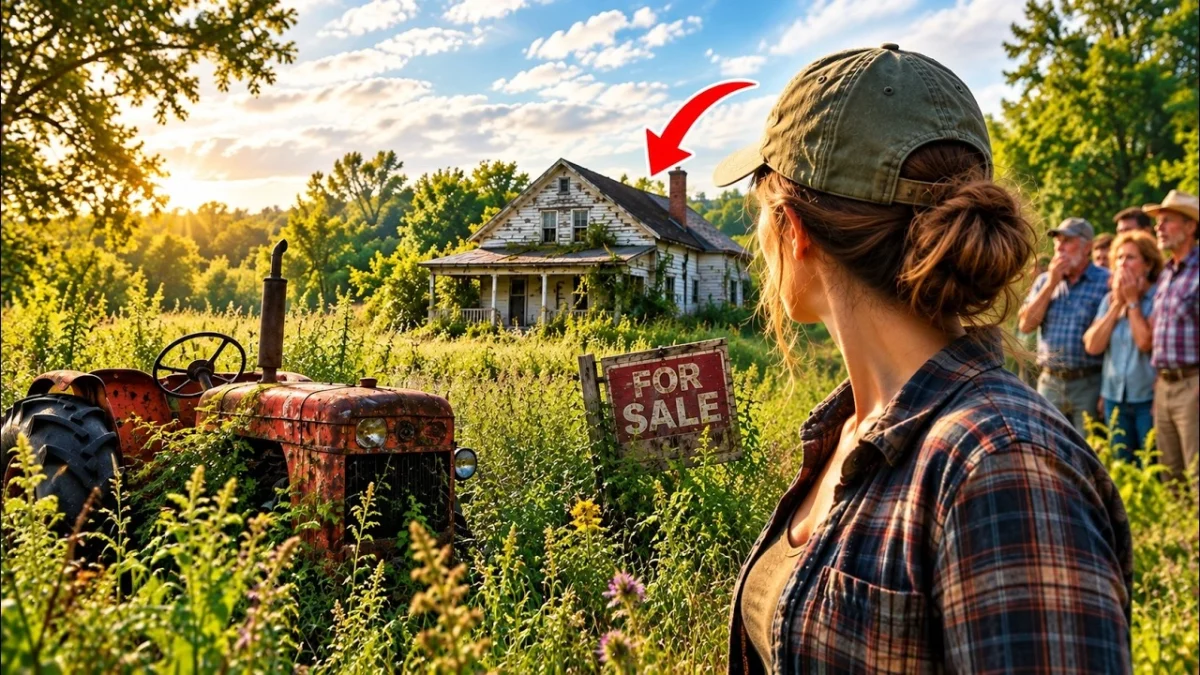
The old 1982 John Deere tractor groaned once, sputtered a dark cloud of diesel exhaust into the humid air, and died right in the middle of the back field.
Norah Whitfield sat motionless in the spring-cushioned vinyl seat, listening to the metallic ticking of the cooling engine.
Around her, eight-foot-tall grass swayed gently in the afternoon breeze, forming an impenetrable sea of green and purple stalk that she did not plant and could not name.
She had purchased the seventy-acre property four months earlier at a county tax auction for less than the price of a mid-sized used car.
Nobody else had placed a single bid.
The county treasurer simply wanted the twelve years of delinquent back taxes settled, the real estate agent had officially listed the land as “rough,” and the local farmers along Highway 14 used terms that were far less polite.
For more than a decade, the land had remained completely abandoned.
There were no active crops, no grazing livestock, no maintenance, and no clear trails—just a faded two-story farmhouse losing its white paint and a wooden “For Sale” sign that had rotted into the roadside ditch.
Everyone in the small town of Oak Creek agreed on one fundamental truth: whoever bought the old Coombs place was purchasing a massive, expensive liability.
Sitting on her dead tractor with thick overgrowth pressing in from every side, Norah wiped a smudge of black grease from her cheek and looked out over the swaying grass.
What the local townspeople did not know, and what Norah was only beginning to realize, was that the property’s previous owner had not abandoned the land out of laziness or senility.
Ellery Coombs had left the back fifty-five acres in that exact condition on purpose.
The question that would occupy Norah’s life for the next year was not why the farm had failed, but why a man had gone to such extraordinary lengths to make a flourishing sanctuary look like a complete disaster.
Norah climbed down from the tractor wheel, her work boots sinking slightly into the surprisingly soft topsoil beneath the dense sod.
She grabbed a pair of heavy leather gloves and a pair of hand shears from the tool tray, intending to clear the tangled stalks wrapping around the mower deck.
As she reached down to slice through a thick, fibrous stem, a voice called out across the boundary fence.
“Need a tow back to the lane, Miss Whitfield?”
Norah straightened up, shading her eyes against the bright sky.
Standing near a late-model pickup truck parked along the gravel road was Sam Vance, a neighbor who farmed three thousand acres of high-yield corn and soybeans on the adjacent property.
“Just a clogged air intake and a stubborn deck, Mr. Vance,” Norah called back, walking toward the fence wire. “I’ll get it turned over in a minute.”
Sam rested his forearms on the top wire of the fence, leaning over with a mixture of polite sympathy and obvious amusement. “You know, if you’re trying to clear that back fifty-five with that light-duty rig, you’ll be out here until winter. That stuff isn’t regular pasture grass. It’s woody, deep-rooted trash. Ellery let it go wild thirty years ago, and nature took it over.”
“It’s certainly tough,” Norah admitted, wiping sweat from her forehead with her sleeve. “My tiller blade snapped clean off in the mid-field yesterday.”
Sam chuckled, shaking his head gently. “That’s because you’re trying to farm a jungle, Norah. The front fifteen acres by the road are decent dirt. You could get a modest corn rotation going if you worked it hard. But that back acreage? It’s worthless overgrowth. If I were you, I’d hire a heavy bulldozer, scrape the whole fifty-five acres flat to the subsoil, burn the brush heaps, and lime it until the chemical balance resets.”
“Burn it all?” Norah asked, glancing back at the tall purple spikes towering over the tractor hood.
“It’s the only way to kill the weeds,” Sam said plainly. “Otherwise, those wild seeds will blow right into my clean soy fields. In fact, a few of us along the road were hoping you’d get a commercial crew in here sooner rather than later. It’s an eyesore, and it’s harboring pests.”
“I’m taking it one section at a time, Mr. Vance,” Norah said evenly. “I want to see what’s actually down there before I bring in heavy machinery.”
“Suit yourself,” Sam said, pushing off the fence post. “But dirt that doesn’t produce a crop is just a tax bill waiting to eat your savings.”
He climbed back into his truck, the diesel engine rumbling as he drove away down the dusty gravel road.
Norah stood by the fence for a long time after the dust settled.
She had grown up on a modest produce farm two states over and had spent the last seven years working as a commercial crew manager for a large landscaping firm in the city.
She knew what neglected land looked like.
Abandonment created chaotic patchworks of opportunistic invasive weeds—thistles, wild mustard, thorny multiflora rose, and ragged prickles competing violently for sunlight.
Yet as she walked deeper into the tall grass away from the road, the growth around her did not look chaotic.
It grew in distinct, sweeping bands across the rolling contours of the land.
There were tall, thick-stemmed grasses with seed heads resembling turkey feet standing alongside dense clusters of deep purple flowering spikes and small white umbrella-shaped blossoms.
When she knelt and pulled back the dense thatch layer at ground level, she found no bare, eroded dirt or compacted hardpan clay.
The soil beneath her fingers was dark, crumbly, rich with organic decay, and filled with earthworms.
The next morning, Norah made a decision that mildly irritated the local excavation contractor she had tentatively hired to clear the property.
She called him on the phone while standing in her kitchen with a cup of coffee.
“Wayne, it’s Norah Whitfield,” she said into the receiver.
“Morning, Norah,” the contractor replied over the crackle of a loud engine in the background. “I’ve got the brush-cutter loaded on the trailer. I can be at your back acreage by eight-thirty to start clearing.”
“Hold off on coming out today, Wayne,” Norah said firmly. “I need to postpone the land clearing for a week or two.”
There was a brief pause on the line before Wayne spoke again, his tone dripping with frustration. “Norah, that brush is going to get thicker the longer you wait. If we don’t scrape it now while the ground is dry, you’re going to lose the whole spring planting window.”
“I understand,” Norah said. “I’ll still pay you a deposit for holding the time, but I need to do some research first. Please don’t bring the equipment out yet.”
Wayne grunted into the phone. “It’s your money, Miss Whitfield. But you’re paying property taxes on a wilderness.”
After hanging up, Norah took several high-resolution photographs of the flowering spikes, the deep-rooted stalks, and the tall grass bands.
She posted the images to an online regional botanical forum, asking if anyone could identify the specific grass species and suggest the most efficient method for clearing them without destroying the subsoil structure.
Less than three hours later, her phone chimed with a direct message notification.
The sender was Dr. Harriet Delgado, a retired university botanist who specialized in historical Midwestern ecosystems.
“Miss Whitfield,” the message read. “Where exactly were these photographs taken? The tall grass with the blue-tinged stem in your third photo is *Andropogon gerardii*—Big Bluestem—growing in an unusually pure, undisturbed stand. The purple spikes are *Liatris pycnostachya*—Prairie Blazing Star. If these photos were taken in Knox County, you are looking at a remnant population of native tallgrass prairie that should not exist in that area.”
Norah sat down at her kitchen table, staring at the screen.
She typed back immediately, providing her general location and describing the seventy-acre layout.
Twenty minutes later, Harriet called Norah directly.
“Norah, may I come out to your farm today?” Harriet asked, her voice trembling with quiet excitement over the speakerphone. “If what I’m seeing in your photos is accurate, those fifty-five acres are not a weed patch.”
“Of course,” Norah replied. “I’ll meet you at the farm lane.”
By mid-afternoon, a modest blue hatchback pulled up to the weathered farmhouse.
Harriet Delgado stepped out, wearing a wide-brimmed sun hat, sturdy hiking boots, and carrying a leather-bound notebook alongside a brass soil probe.
She was a woman in her late sixties with sharp, observant eyes and a warm, deliberate manner.
“Thank you for letting me come, Norah,” Harriet said, shaking her hand warmly. “When I saw those photos, I couldn’t sit still in my office.”
“I’m glad you came,” Norah said, leading her toward the wooden gate that separated the front fifteen acres from the overgrown back parcel. “The local farmers are telling me to scrape it flat and burn it. They think it’s an invasive weed harbor.”
Harriet paused at the gate, looking out over the vast, undulating ocean of green and purple.
“They think that because they have spent their entire lives looking at land through the lens of industrial row crops,” Harriet said quietly. “To a corn farmer, anything that isn’t corn is a weed.”
They stepped through the gate and began walking single file through the narrow path Norah had cut with her hand shears.
As they moved deeper into the back acreage, Harriet stopped every few yards, crouching down to inspect individual leaves, seed heads, and root structures.
She touched the stems with delicate, practiced fingers, taking notes in her book.
“Look here, Norah,” Harriet said, pointing to a low-growing plant with delicate, silvery leaves tucked beneath the taller grass. “This is *Leadplant*. It’s a deep-rooted native legume. It takes nearly four years for a single plant to establish itself from seed. It only grows in stable, undisturbed prairie ecosystems.”
Harriet stood up, turning three hundred and sixty degrees as she scanned the horizon.
Her expression grew remarkably quiet.
“This isn’t an accidental weed field, Norah,” Harriet said softly.
“What do you mean?” Norah asked, watching the elderly botanist carefully.
“When commercial farmland is abandoned, aggressive invasive species like thistle, dandelion, and autumn olive invade immediately,” Harriet explained, gesturing across the field. “Invasive plants conquer disturbed soil because they are opportunistic. But what you have here is a balanced, highly complex ecosystem consisting of over thirty distinct native species coexisting in stable, organized patterns.”
“So someone planted this?” Norah asked.
“No,” Harriet replied, shaking her head. “It’s even more remarkable than that. Someone prevented this land from ever being plowed in the first place. Or, if it was plowed long ago, someone carefully restored and managed this specific fifty-five-acre tract over decades, protecting it from agricultural chemical runoff and heavy machinery.”
“Ellery Coombs owned this place for forty years,” Norah said thoughtfully. “The neighbors said he just gave up and let it rot.”
Harriet looked at Norah with a keen smile. “If Ellery Coombs let this land rot, he did it with the precision of a master conservationist. True neglect creates chaos. This field is demonstrating harmony.”
Over the next three weeks, Harriet returned to the farm multiple times, conducting a formal botanical survey across different quadrants of the back fifty-five acres.
Intrigued by Harriet’s findings, Norah decided to investigate the soil chemistry herself.
She took twelve core soil samples from various locations across the property—six from the front fifteen acres that had been traditionally farmed, and six from the dense back acreage.
She packed the samples into labeled paper bags and took them to the county agricultural extension office in town.
The extension agent, a young man named Mark Miller, took the bags with a casual smile.
“Back fifty-five of the old Coombs place, right?” Mark asked, writing her name on the intake form. “You’re probably going to find zero nitrogen and sky-high acidity. That ground hasn’t seen a lime spreader in fifteen years.”
“Just run the full organic matter, biological activity, and mineral compaction panel, please,” Norah said. “I want to know exactly what I’m working with.”
Four days later, Mark called Norah back to his office.
When she walked in, he was sitting at his desk, staring at two printed lab reports with a look of genuine confusion on his face.
“Sit down, Norah,” Mark said, gesturing to the chair across from him. “I’ve been running agricultural soil samples in this county for eight years, and I’ve never seen a contrast like this on a single property.”
“What did the tests show?” Norah asked, sitting down.
Mark tapped the first paper. “The front fifteen acres are typical for depleted land in our region. Organic matter is under 1.8 percent, soil compaction is high from years of heavy tractor traffic, and the microbial life is virtually dead. It would take three years of heavy cover cropping and chemical inputs to bring it back to average commercial productivity.”
He then picked up the second paper, holding it up to the light.
“The back fifty-five acres, however, are incredible,” Mark said, his voice filled with astonishment. “The organic matter content is sitting at 6.2 percent. The soil structure is loose, highly porous, and packed with active mycorrhizal fungi and beneficial soil bacteria. The nitrogen, phosphorus, and potassium levels are balanced naturally without a trace of synthetic fertilizer residue.”
“6.2 percent organic matter?” Norah repeated, knowing that average commercial cropland rarely exceeded 2 percent.
“It’s prime topsoil,” Mark said, shaking his head. “It looks like virgin prairie soil from two hundred years ago, before the first steel plow ever touched Indiana dirt. Whoever managed that back acreage kept it completely isolated from industrial agriculture.”
Driven by a growing need to understand the true history of her land, Norah visited the county recorder’s office in the basement of the courthouse.
She spent three afternoons searching through dusty leather-bound ledgers and microfiche archives, pulling property deeds, historical survey maps, and aerial photographs dating back to the late 1930s.
When she aligned the aerial photographs chronologically on a large viewing table, a clear historical pattern emerged.
In the 1939 aerial survey, neighboring farms showed clear grid patterns of plowed crops, but the back fifty-five acres of the Coombs parcel appeared dark, textured, and unplowed.
In the 1958 photograph, the front fifteen acres showed active corn rows, while the back fifty-five acres remained completely unchanged—a natural, sweeping expanse of native growth.
The 1975, 1988, and 2005 photographs revealed the exact same pattern.
For over eighty years, through world wars, agricultural booms, land consolidation, and modern chemical revolutions, every owner of that farm had actively worked the front fifteen acres while leaving the back fifty-five acres entirely untouched by the plow.
Ellery Coombs had not abandoned his farm out of neglect.
He had acted as the final guardian of an intentional, century-old pact to protect a rare piece of original living earth.
The dry, scorching summer of that year brought a severe drought to the region.
For six straight weeks, no rain fell across Knox County.
The midday temperatures hovered near ninety-five degrees Fahrenheit, baking the surrounding clay earth until it cracked open.
Sam Vance’s vast soybean fields turned a pale, sickly yellow, the leaves curling tightly under the relentless heat as his automated irrigation rigs struggled to pump water from lowering well levels.
Even the weeds in the roadside ditches withered and turned brown.
One evening, as the sun began to set, casting a warm golden light across the landscape, Norah walked out to her back acreage to check on the native plants.
While the grass on the front fifteen acres was dry and straw-like, the back fifty-five acres remained vibrant and resilient.
The deep roots of the native tallgrasses, stretching twelve to fifteen feet into the subterranean earth, were drawing moisture from deep aquifers that conventional crops could never reach.
As Norah walked along the western boundary, she noticed something extraordinary.
Running across an otherwise dry slope was a narrow, three-foot-wide band of grass that was strikingly, intensely green.
It looked as though an invisible hose were steadily watering that specific line.
Curious, Norah followed the bright green strip on foot.
It traversed the field in a nearly perfect straight line for roughly two hundred feet before curving gently toward a shallow, shadowed depression near the forest edge—a spot she had previously assumed was merely a natural low point in the terrain.
Norah returned to her house, grabbed a heavy flathead shovel and a hand trowel, and walked back to the depression.
She cleared away the dense thatch layer and began digging into the damp earth where the green strip terminated.
Eighteen inches down, her metal shovel blade struck something hard with a sharp, resonant clink.
It was not a random field stone.
Norah dropped to her knees, using her hands and the hand trowel to carefully brush away the dark, moist soil.
Beneath the dirt lay a flat, hand-chiseled limestone slab, clearly cut and fitted by human hands.
Working meticulously over the next three days, Norah excavated the area around the depression, clearing away decades of accumulated leaf litter and soil.
She uncovered a sophisticated, ancient water management system.
A buried subterranean channel, lined on both sides with carefully fitted fieldstones, carried water from a deep, natural underground spring across the slope.
At the center of the depression sat the partially collapsed stone foundation of an old springhouse, constructed from heavy limestone blocks joined with early lime mortar.
Harriet came out the following afternoon to inspect the discovery.
She knelt by the exposed stone channel, running her fingers over the hand-chiseled grooves in the limestone.
“This stonework is remarkably old, Norah,” Harriet said, her voice filled with reverence. “The quarry marks on these stones match the mason techniques used in this valley in the 1840s, long before Ellery Coombs’s grandfather ever purchased this property.”
“So whoever settled this land first built this springhouse to protect the water source?” Norah asked.
“Yes,” Harriet nodded, looking out over the verdant field. “And they built this stone channel to sub-irrigate the native meadow naturally without destroying the surface soil. They recognized that this land had an artesian water table. If you plow artesian clay, you ruin the natural drainage and create a stagnant swamp. The early settlers left the prairie intact because the prairie was holding the entire hydrological balance of this valley together.”
The discovery of the springhouse proved that the farm’s history was far richer than anyone in town knew.
However, historical appreciation did not pay property taxes or repair leaky roofs.
By late July, Norah’s personal savings were severely depleted.
The costs of purchasing the property at auction, paying the survey fees, repairing the farmhouse plumbing, and keeping her old tractor running had stretched her budget to its absolute limit.
She had less than eight hundred dollars left in her bank account, and the fall tax assessment was approaching.
One morning, an unfamiliar white luxury SUV pulled up the gravel driveway.
A well-dressed man in his late fifties stepped out, holding a leather folder.
It was Russell Whitaker, a prominent regional real estate developer who had been buying up surrounding farmland to build suburban housing subdivisions.
Norah met him near the porch steps.
“Miss Whitfield?” Russell asked, offering a polished smile and a firm handshake. “I’m Russell Whitaker of Whitaker Development.”
“Good morning, Mr. Whitaker,” Norah said cautiously. “What can I do for you?”
Russell leaned against the porch railing, looking out toward the back acreage.
“I’ll come straight to the point, Norah,” Russell said smoothly. “I was at the county auction when you bought this place, and frankly, I was surprised you took on the risk. I know you’ve been working hard out here, but I also know what it costs to maintain an unproductive property.”
“I’m managing,” Norah said quietly.
Russell opened his leather folder and pulled out a typed contract.
“I’d like to offer you an easy way out,” Russell said, handing her the paper. “I’m willing to purchase the back fifty-five acres from you outright for two thousand dollars an acre. That’s one hundred and ten thousand dollars cash.”
Norah looked at the figure printed on the page.
One hundred and ten thousand dollars would instantly pay off all her debts, fully restore her house, purchase modern farming equipment, and leave her with thirty clear acres on the front parcel to run a profitable small-scale market garden.
“That’s a very generous offer, Mr. Whitaker,” Norah said, her heart beating fast. “What would you do with the land?”
Russell waved his hand dismissively. “We’d bring in heavy dozers, clear the brush, fill the low spots, and put up twenty-five high-end residential home sites. The town needs housing, and that back acreage is just sitting there doing nothing.”
Norah looked past Russell toward the back field, where the purple Blazing Star spikes were swaying in the breeze, holding the water of an ancient spring deep within their roots.
“I need time to think about it,” Norah said softly.
“Of course,” Russell said, placing a business card on the table. “Take a few days. But keep in mind, cash offers like this don’t stay on the table forever, especially in a drought year when farm values are shaky.”
That evening, Norah sat at her kitchen table with the contract on one side and her bank statement on the other.
Harriet dropped by later that night, bringing a thermos of tea and a large binder filled with botanical data.
Norah showed her the developer’s offer.
Harriet read the paper carefully, then set it down with a quiet sigh.
“I understand why this is tempting, Norah,” Harriet said gently. “It’s a life-changing amount of money for someone in your position.”
“If I sell it, it gets turned into asphalt, manicured lawns, and septic tanks,” Norah said, staring out the window into the dark. “Eighty years of preservation gone in two weeks of bulldozing.”
“It is your land, my dear,” Harriet said softly. “Nobody would blame you for taking the money.”
Harriet then opened her binder, turning to a section filled with market charts and industry publications.
“Before you make your final decision, Norah, there is something else you should see,” Harriet said, tapping a page. “Something I’ve been researching since we completed the plant survey.”
“What is it?” Norah asked.
“Native prairie seed,” Harriet said, looking Norah in the eye. “Specifically, genetically local, high-purity native seed harvested from wild remnant populations.”
Harriet explained that over the past decade, state highway departments, county conservation districts, regional parks, and private land trusts had massively expanded their native habitat restoration projects.
Federal legislation now mandated that infrastructure development projects use native plant species along highway corridors and watershed basins to prevent soil erosion and support declining pollinator populations.
“The demand for native seed has skyrocketed,” Harriet explained. “Pathways, state parks, and conservation groups don’t want seed grown in commercial nurseries three states away. They require ‘ecotype’ seed—seed harvested from wild local plants that have adapted to this specific soil and climate over thousands of years.”
“Is there a market for local seed here?” Norah asked, leaning forward.
“The market is desperate for it,” Harriet said emphatically. “Commercial restoration companies are struggling to find sufficient quantities of pure, locally adapted seed. A single pound of clean, high-germination Big Bluestem seed sells for twenty to thirty dollars. Specialized species like Prairie Blazing Star or Leadplant can fetch anywhere from sixty to one hundred and twenty dollars per pound.”
Norah’s eyes widened. “And I have fifty-five acres of pure native stand.”
“You aren’t sitting on a weed patch, Norah,” Harriet said with a warm smile. “You are sitting on a living, self-replenishing seed reservoir.”
The realization hit Norah like a flash of clarity.
The value of the back fifty-five acres was not in destroying the land to build houses, nor was it in clearing the land to grow row crops.
The value lay in keeping the ecosystem exactly as it was, harvesting the natural biological yield that the land produced on its own.
The next morning, Norah picked up her phone and called Russell Whitaker.
“Mr. Whitaker, it’s Norah Whitfield,” she said.
“Morning, Norah,” Russell answered brightly. “Ready to sign the papers?”
“No, Mr. Whitaker,” Norah said clearly. “I’m calling to decline your offer. The back fifty-five acres are not for sale.”
There was a long silence on the line.
“Norah, you’re making a massive financial mistake,” Russell said, his tone turning cold. “That land is producing zero income.”
“It hasn’t produced income yet,” Norah replied calmly. “That changes this season. Thank you for your time.”
She hung up the phone before he could reply.
Launching a native seed harvesting business, however, proved to be an exhausting, steep learning curve.
Turning raw prairie into a commercial seed operation required precise timing, specialized handling, and immense physical labor.
Norah’s first attempt at harvesting seed heads in late August was an agonizing failure.
Eager to begin, she harvested several large stands of Big Bluestem too early, before the seeds had fully matured on the stalk.
When she spread the seed heads out to dry, she discovered that the germination embryos had not fully developed, rendering the entire first batch completely unviable for sale.
Storage presented another major obstacle.
Norah gathered a second batch of native wildflower seeds and stored them inside an ordinary wooden shed without proper ventilation.
Within a week, late summer humidity caused mold to spread through the bins, destroying three weeks of hard work in a matter of days.
Disencouraged and physically exhausted, Norah sat on her porch steps, looking at the ruined seed bins.
Harriet arrived that afternoon, assessing the damage with a practical eye.
“Don’t lose heart, Norah,” Harriet said firmly, placing a hand on her shoulder. “Every pioneer makes mistakes in their first season. Farming native seeds isn’t like harvesting corn. You cannot harvest everything at once with a heavy machine. You must learn the individual ripening window of each plant.”
Harriet spent the next month working alongside Norah in the field.
She taught Norah how to inspect individual seed heads, testing their firmness and moisture content before harvesting.
They built custom drying racks fitted with wire mesh screens and electric circulation fans inside the dry farmhouse basement to ensure proper airflow.
Instead of trying to strip the entire field, Norah focused on four key high-value species: Big Bluestem, Indiangrass, Prairie Blazing Star, and Purple Prairie Clover.
Working from dawn until dusk under the late autumn sun, wearing canvas aprons and using specialized hand-stripping combs, Norah and Harriet hand-harvested seed heads section by section, ensuring they left enough seed on the plants to allow the wild meadow to naturally regenerate itself for the following year.
By late October, after weeks of tedious cleaning, winnowing, and moisture testing, Norah had produced her first modest inventory: two hundred pounds of high-purity, cleaned, ecotype-certified native seed.
It was a modest batch compared to industrial farm yields, but every single seed was pure, viable, and locally adapted.
Norah contacted the Indiana Department of Natural Resources and a major regional habitat restoration firm that was managing a multi-million-dollar highway corridor beautification and erosion project fifty miles away.
Two days later, a chief procurement officer named David Miller drove out to the farm.
David was a serious, non-nonsense environmental engineer who had spent months searching for authentic local seed stocks.
Norah led him into the farmhouse basement, where the clean seed was stored in neatly labeled, breathable canvas sacks.
David opened the first bag containing Prairie Blazing Star seed, scooping a handful into his palm.
He held it under a bright lamp, inspecting the seed cleanliness and testing the fill rate with his fingernail.
“This is remarkably clean, Miss Whitfield,” David said, looking up with genuine surprise. “Zero weed contamination and exceptional seed coat maturity. Where did you source this?”
“Right out back,” Norah said, pointing toward the window. “It’s harvested from an undisturbed native remnant prairie.”
David took a small sample from each bag to run standard lab purity and germination tests.
“If these samples pass the state germination threshold,” David said, “I’ll take every pound you have right now.”
Three days later, the official lab results came back.
The seed sample recorded a staggering ninety-four percent germination rate—far exceeding the commercial industry standard of seventy percent.
David Miller returned to the farm with an official state purchase order.
He purchased the entire two-hundred-pound batch on the spot for a total of fourteen thousand eight hundred dollars.
When Norah held the official state check in her hand, she sat down on her porch steps and cried quiet tears of relief.
The money was more than enough to pay her property taxes, settle her debts, purchase professional seed-cleaning equipment, and secure her living expenses through the winter.
The back fifty-five acres had earned its very first legitimate income, proving that the land was far from worthless.
By the autumn of the following year, Norah’s small business, Whitfield Native Seed, had grown into a thriving, recognized regional operation.
She had designed a light-duty, specialized mechanical seed harvester that attached to her rebuilt John Deere tractor, allowing her to harvest seed heads efficiently without compacting the soil or damaging the deep root systems beneath.
Word of her success spread through Knox County in the way news always travels in small farming communities.
The local neighbors who had once openly mocked her purchase began to view the old Coombs place through an entirely different lens.
One crisp afternoon in early November, while Norah and a small hired crew were processing the late-season harvest near the barn, a line of farm trucks pulled up along the gravel shoulder of County Road 7.
Several neighboring farmers, including Dale Morris and Sam Vance, stepped out of their vehicles and walked over to the fence wire.
They did not come to offer patronizing advice or complain about weeds.
They came to watch.
Dale Morris, a gravel-voiced man who had farmed row crops in the county for forty years, rested his heavy boots on the lower fence wire, watching the clean seed pour smoothly into canvas transport bags.
“Afternoon, Norah,” Dale called out, leaning over the fence.
“Good afternoon, Mr. Morris, Mr. Vance,” Norah said, walking over to greet them with a polite smile.
Dale cleared his throat, looking past her toward the sweeping expanse of dark gold prairie grass that stretched across the rolling hills.
“We’ve been seeing those state transport trucks pulling out of your lane all month,” Dale admitted, rubbing the back of his neck. “Word around the grain elevator is that you sold your entire fall seed yield before it even hit the drying racks.”
“That’s right, Dale,” Norah said. “We signed a supply agreement with two regional conservation groups and the state highway department.”
Dale shook his head slowly, letting out a soft, appreciative whistle. “And you didn’t have to buy a single bag of commercial nitrogen or spray a drop of expensive pesticide?”
“Not a single drop,” Norah said proudly. “The land produces the crop on its own. My job is just to harvest it at the right time and keep the ecosystem healthy.”
Sam Vance stepped forward, looking down at his own pristine boots, then out toward the thriving prairie.
“Norah,” Sam said, his voice quiet and respectful. “I owe you an apology. When you bought this place, I told you to bring in a dozer and burn the back acreage flat. I thought you were just a city girl who didn’t know dirt.”
“You weren’t the only one who thought that, Mr. Vance,” Norah said gently.
“Well, I was wrong,” Sam said directly, looking her in the eye. “You saw something in this ground that the rest of us were too blind to see. You saved a piece of history, and you made a real business out of it.”
Dale chuckled, adjusting his cap. “Say, Norah… I’ve got about twenty acres of wet, low-lying clay in my back field that won’t grow corn worth a darn during dry years. Do you think some of that deep-rooted prairie grass of yours would take hold out there if we planted it?”
Norah smiled warmly, leaning against the fence post. “I think that’s a fine idea, Dale. Come by the house on Saturday, and we’ll talk about seed mixes.”
As the farmers drove away into the golden afternoon light, Norah walked back out into the center of the field.
She climbed to the top of the gentle ridge near the ancient springhouse, looking out over the seventy acres that had brought her home.
The mistake that almost everyone had made—including Norah herself during those first frustrating weeks with a broken tiller blade—was assuming that land without a neat row of commercial crops or a tidy fence line had no value.
The front fifteen acres and the back fifty-five acres had never been meant to serve the same purpose.
One was suited to traditional cultivation, while the other had spent decades quietly functioning as an invaluable, living sanctuary of native earth.
It had not survived because it was forgotten.
It had survived because long before Ellery Coombs, someone had recognized its true worth and made the deliberate, courage-filled choice to leave it wild.
Norah stood on the ridge as the crisp autumn wind rustled through the tall Big Bluestem grass, listening to the quiet, steady hum of a living prairie that would never be lost again.








