On A Ten-Hour Flight, The Woman Beside Me Asked Me To Pretend To Be Her Husband
The highway had a way of shrinking a man’s world until everything outside the cab faded into an endless stretch of asphalt, white lines, and yellow lines. For nineteen years, Cade Whitfield had lived in that small space. He was thirty-eight years old, with calloused hands, a steady jaw, and eyes that had spent nearly two decades watching the American landscape pass by through a dirt-streaked windshield. His father had driven a rig until his back gave out and his heart followed, leaving behind a stack of unpaid medical bills and a heavy mortgage. Cade had stepped into his father’s boots at twenty, swearing it would only be temporary, just long enough to clear the debt. But the road had a strange, silent gravity, and once he got behind the wheel, he never quite found a reason to step down.
His sister, Clara, was the only family he had left. She was ten years younger, living across the ocean in England, and preparing to marry a local carpenter she had met while studying abroad. For months, Clara had badgered him over late-night phone calls, begging him to cross the Atlantic for the wedding. Cade had hesitated. A working man did not easily take two weeks off, and the idea of sitting in a room full of dressed-up strangers, listening to toasts about lifelong love, felt like standing outside a warm house on a freezing night. Yet, after delivering a heavy load of industrial machinery to a port in Virginia, he sold his return freight, looked at the quiet cab of his truck, and finally said yes.
He bought the cheapest ticket available on a ten-hour transatlantic flight: Seat 24B, a middle seat near the rear lavatories.
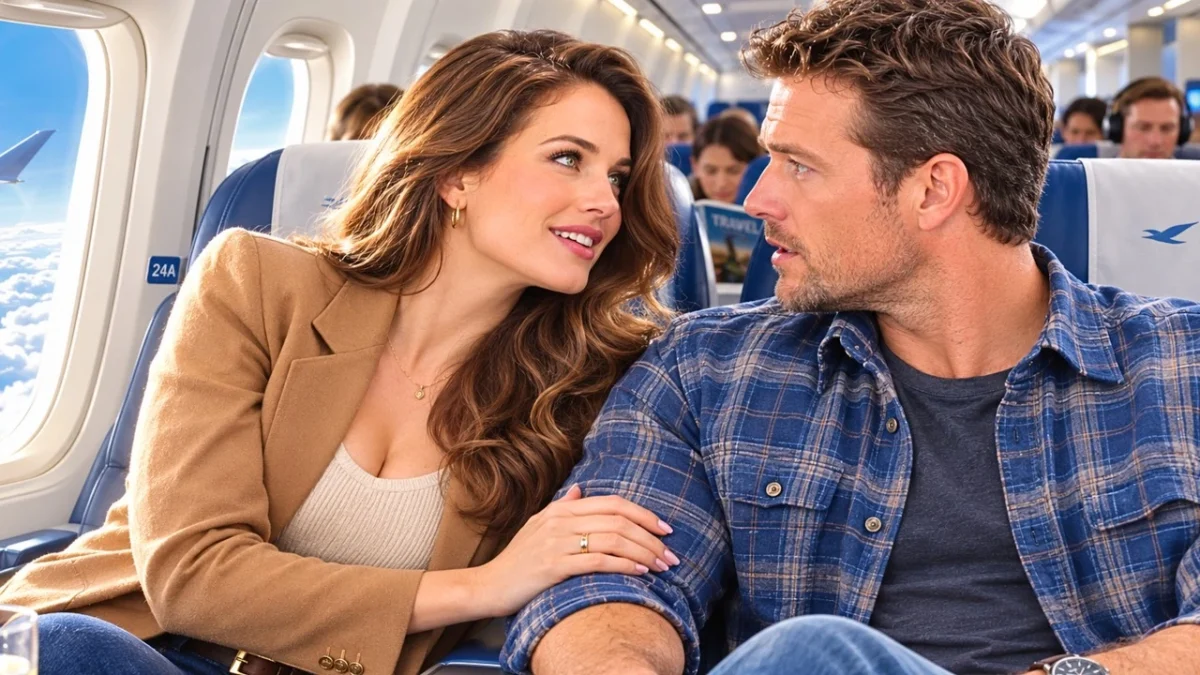
The air inside the Boeing 777 was thick with the scent of recycled oxygen, jet fuel, and the nervous energy of hundreds of passengers stowing overhead luggage. Cade squeezed his broad shoulders into the middle seat, trying to make himself as small as possible. In 24A, by the window, sat a woman holding a white boarding pass that she kept folding and unfolding into tight, precise creases. She wore a simple beige sweater, her dark hair pinned loosely at the back of her neck. Her posture was stiff, her hands trembling slightly despite the calm expression she attempted to hold.
Before Cade could even settle into his seat or adjust his seatbelt, she turned her head toward him. Her eyes were dark, sharp, and exhausted.
“If anyone asks, you’re my husband.”
Cade blinked, his hand freezing on the metal buckle of his belt. He looked at her, then glanced around to see if she was speaking to someone else behind him.
“Ma’am,” Cade said, his voice deep and slow, carrying the heavy accent of rural Texas. “I think you got the wrong—”
“Nope. Right seat, right man.”
Without waiting for his permission, her hand reached across the armrest and rested on his forearm. Her grip was warm, firm, and surprisingly desperate.
“Ten hours,” she whispered, her eyes locking onto his with absolute intensity. “One husband. No questions asked. Please.”
Cade stared at her hand on his flannel sleeve. He was a plain man who lived a quiet, solitary life. He ate his meals at greasy diner counters, slept in truck stops, and talked to himself when the radio static took over the night air. He did not get involved in other people’s drama, and he certainly did not play-act on international flights.
“Miss, I’m just a truck driver going to my sister’s wedding,” Cade said gently, trying to pull his arm back politely. “I don’t think I’m the man for whatever game you’re playing.”
“I picked you the second I saw you walk down the aisle,” she said, her voice dropping lower, tinged with a raw, undeniable honesty. “You have very kind eyes, Cade. And a wedding-appropriate flannel. And you were sitting alone. The universe hands you what you need sometimes, even in coach.”
Cade paused, surprised that she knew his name before remembering his luggage tag was dangling from the small bag under the seat in front of him. He looked closely at her face. Behind her sharp words, he saw a deep, overwhelming terror. It was the look of a person standing on the edge of a cliff with nowhere left to jump.
The heavy roar of the jet engines deepened as the aircraft began pushing back from the gate. The cabin lights dimmed, casting long shadows down the narrow aisle.
“My name is Delia,” she said, as if giving him a piece of valuable collateral. “Delia Vance.”
“Well, Delia,” Cade said, leaning back against the thin headrest as the plane taxied toward the runway. “If I’m going to be a husband for ten hours, I’m going to need to know why I got hired.”
Delia let out a long, ragged breath, her shoulders sagging slightly against the window. The tension in her frame did not leave, but it shifted from panic to profound weariness.
“My mother is on this flight,” Delia said, staring straight at the dark screen of the seatback entertainment system in front of her. “Three rows up. Seat 21C. And so is the man she’s spent two years trying to force me to marry. His name is Preston. He’s up in first class, where he belongs.”
Cade tilted his head slightly, watching her profile. “And why are you down here in coach if your suitor is up in first class?”
“Because I didn’t want to fly with him,” Delia replied, a bitter edge touching her words. “Everyone in my life thinks this flight is where I’m finally going to surrender. My mother thinks it. Preston thinks it. My entire family thinks it. A month ago, I couldn’t take the pressure anymore. I was sitting in my apartment, listening to my mother cry on the phone about how I was going to die alone because I turned thirty-four without a ring, and I just… I broke.”
She turned her face toward Cade, her dark eyes shiny with unshed tears.
“I told her I got married,” Delia whispered. “I told her I met someone, that we went to a justice of the peace, quietly, no fuss. I made him up, Cade. A whole husband. Just to make the phone calls stop. Just to stop feeling like the ultimate disappointment of the Vance family.”
Cade nodded slowly, the weight of her words settling heavily in his chest. “And now she’s three rows ahead of us.”
“And Preston is in seat 2B,” Delia added, pulling her knees together. “My imaginary husband was supposed to be waiting at the arrival gate in London. An hour ago, while we were sitting at the terminal, my mother told me Preston bought a ticket on this exact flight to ‘surprise’ me and help me navigate the connection. I realized I was trapped in a metal tube at thirty thousand feet with a massive lie and no husband to show for it.”
Cade rubbed the back of his neck, feeling the coarse fabric of his collar. He had spent nineteen years keeping his head down, avoiding trouble, and minding his own business. But he also knew what it felt like to be completely, utterly alone while everyone else seemed to have somewhere to belong.
“All right,” Cade said softly. “Then let’s build us a marriage.”
Delia blinked, startled by his sudden compliance. “Just like that?”
“Just like that,” Cade said. “But I’ll tell you right now, I cannot remember a lie to save my life. I’m a truck driver, not an actor. If your mother quizzes me on things we made up, I’ll mess it up in two minutes flat. So we’re going to keep this as close to the truth as possible. What’s true about you that I can just know?”
Delia stared at him, her lips parting slightly. “You want to know true things about me?”
“We’ve got ten hours,” Cade said, adjusting his position in the narrow seat. “And a husband ought to know his wife.”
For the next three hours, as the airliner climbed to its cruising altitude and carved its path into the dark night above the Atlantic Ocean, the two strangers built a life out of genuine truths.
Delia told him that she was a third-grade teacher at a public school in Richmond. She had wanted to study marine biology when she was a young girl, but her mother had dismissed the idea as impractical and frivolous. She told him about her failed relationships—men selected or approved by her mother, men who wanted a polished, quiet partner to accompany them to dinners, not a woman who got emotional over nature documentaries and could identify every species of fish in a municipal aquarium.
“Preston doesn’t know me,” Delia said, clutching a tiny plastic cup of white wine the flight attendant had handed her. “In two years of courting me—that’s the word my mother uses, ‘courting’—he has never asked me a single question about what I care about. He talks to my mother about me like I’m a piece of real estate he’s trying to acquire.”
She turned to Cade, her posture softening as the initial anxiety began to melt away. “Ask me something,” she said.
“Anything?” Cade asked.
“Anything,” Delia insisted. “I want to see what a man asks when he’s actually curious. It’s been a very long time.”
Cade thought for a moment, looking at the soft cabin lighting reflecting off her dark hair. “What’s the best day you ever had? Not a major milestone like a graduation or a promotion. Just an ordinary day you’d choose to live over again if you could.”
Delia went quiet. The defensive, high-strung energy that had defined her since she stepped onto the plane seemed to evaporate entirely. A small, genuine smile touched her lips.
“A Tuesday two years ago,” Delia said softly. “A third-grade field trip to the Virginia coast. Twenty-two eight-year-olds running around a tide pool. There was one little boy in my class—his name is Toby. He rarely spoke, never smiled, and struggled with almost every assignment I gave him. But while we were standing by the rocks, he found a sea star adhering to a stone. He held it up to me like it was made of solid gold, and he looked at me and said, ‘Miss Delia, it’s holding on. It’s just holding on.'”
Her voice cracked slightly, her eyes bright with remembered warmth.
“I think about that small moment all the time,” Delia continued, looking down at her hands. “Whenever I have a rough week or feel like I’m failing at everything, I hear that little boy’s voice. It’s holding on. Your turn. Same question.”
Cade leaned his head back against the seat, looking up at the dim reading lights.
“A Tuesday night outside Amarillo, Texas,” Cade said quietly. “A massive late-summer thunderstorm was rolling across the open plains. Lightning was cracking across the sky for a hundred miles in every direction. I pulled my rig over onto the shoulder, turned off the headlights, and sat in the cab with a cheap cup of gas station coffee. I just watched the sky come apart. I felt tiny, but in a good way. The kind of small that reminds you you’re part of something massive.”
He looked back at her. “Prettiest thing I ever saw through a windshield. And I’ve seen the whole country through one.”
“The dark green color in the sky right before a storm,” Delia said softly, her eyes locked onto his. “That’s my favorite color in the whole world. I’ve never told anyone that because people think it’s strange to like a storm.”
“It’s not strange at all,” Cade said. “It’s the color right before something big changes.”
Delia looked at him for a long moment, the hum of the jet engines filling the quiet space between them. “Yes,” she whispered. “It is.”
As the hours drifted by, Cade shared his own truths. He spoke about his father’s sudden illness, the debt that had trapped him in the driver’s seat at age twenty, and the heavy, quiet loneliness of driving four thousand miles a week without anyone waiting for him at the end of the trip. He confessed that he had almost skipped his sister’s wedding entirely because the thought of being surrounded by so much celebrated love made him feel like a man standing outside in the cold, staring through a window at a family enjoying a warm fire.
“That is the saddest and most beautiful thing anyone has ever said to me,” Delia said quietly.
She reached across the narrow gap between their seats and took his rough, calloused hand in hers. There was no one in the aisle watching them. Her mother was three rows ahead, asleep under a thin blanket, and the rest of the cabin was dark. She took his hand simply because she wanted to hold it.
“Cade Whitfield,” she said softly, “how is a man like you sitting alone in a middle seat in coach?”
“Same way a woman like you had to hire a husband off a boarding call,” Cade replied with a faint grin. “Guess neither of us got picked by the right people yet.”
Delia stared at him, her thumb lightly tracing the knuckles of his hand. “No,” she said gently. “I guess not.”
A flight attendant named Bianca moved quietly down the aisle, collecting trash from the sleeping passengers. As she passed their row, Cade instinctively lifted his arm and wrapped it around Delia’s shoulders, pulling her close to his side. Delia did not pull away. Instead, she leaned into his side, resting her head against his chest.
Around the sixth hour of the flight, the main cabin lights were lowered to pitch black, save for the faint blue glow along the floor. Most passengers had put on eye masks or turned their faces toward the plastic walls to sleep.
Delia’s head remained resting heavily on Cade’s shoulder. She stirred slightly, her voice thick with fatigue.
“Is this okay?” she murmured, her eyes closed. “The shoulder?”
“It’s fine,” Cade whispered back.
“Nobody’s watching,” she said softly. “I’m not doing this for show. You’re just warm, and I haven’t slept in two days, and you have a very solid shoulder.”
“I told you, it’s fine,” Cade said.
“I don’t usually do this,” Delia whispered, her breath warm against his collarbone. “I don’t lean on people. I’m the one everyone else leans on. My mother. My students. My friends. But you have this way about you… like you wouldn’t drop me if I let go.”
Cade stayed completely motionless, ensuring he didn’t shift an inch and disturb her rest.
“I wouldn’t drop you,” Cade said, his voice a steady, low rumble in his chest. “I’ve been hauling forty thousand pounds of freight down steep mountain grades for nineteen years, Delia. I don’t drop what I’m carrying. It’s about the only thing I’m absolutely sure of about myself.”
Delia remained silent for a few seconds. Then, so quietly he almost missed it over the background noise of the engines, she spoke.
“I think that might be the most attractive thing a man has ever said to me. And you don’t even realize you said it.”
She fell asleep shortly after, her breathing turning slow and rhythmic against his chest. For two full hours, Cade sat frozen in the dark cabin, refusing to reach for his water bottle or shift his legs. A man who had spent nineteen years isolated at the wheel of a semi-truck did not take for granted the weight of a person who trusted him enough to sleep on his chest. He simply sat there in the quiet dark, holding her, thinking that no matter what happened when the plane touched down, no one could take those hours away from him.
The calm was shattered near the eighth hour of the flight.
Cade heard the footsteps before he saw the person. A sharp, anxious female voice echoed from three rows ahead.
“Delia? Delia, honey?”
Delia stirred instantly, her eyes snapping open as she sat up straight in her seat. Her entire body went rigid with sudden tension.
Standing in the aisle was a small, impeccably dressed woman in her early sixties. She had dark hair streaked with silver, tailored clothes, and eyes identical to Delia’s, though currently clouded with intense worry and confusion.
“Mom,” Delia gasped, her hands clutching the armrests. “This… this is my husband, Cade. Cade, this is my mother, Eleanor.”
Eleanor Vance stood in the narrow aisle, her eyes darting between her daughter’s distressed expression and the broad-shouldered man in the red flannel shirt sitting next to her.
Cade did not panic. He had spent his entire adult life dealing with unexpected mechanical failures, sudden blizzards on mountain passes, and difficult dock managers. He looked Eleanor straight in the eye, unbuckled his seatbelt, and extended his large, rough hand.
“Mrs. Vance,” Cade said, his voice calm and respectful. “It’s an honor to finally meet you. Delia hasn’t told me nearly enough about you, mostly because she rarely talks about herself as much as she should—which is something I’m actively trying to fix. But I want you to know, she’s the absolute best thing that ever sat down next to me.”
Eleanor looked at Cade’s extended hand, then at her daughter’s pale face. She did not ask for a marriage certificate. She did not ask where they were married, who performed the ceremony, or why there had been no announcement.
She simply looked at the way Cade was holding Delia’s hand—firmly, protectively, and without hesitation.
Eleanor’s chin trembled slightly. She reached out and patted Cade’s hand with her small, cold fingers.
“He looks at you,” Eleanor said, her voice tight with emotion as she addressed her daughter, “the exact way your father used to look at me before he passed.”
Without another word, Eleanor turned around and walked quietly back to her seat in row 21.
Delia turned to Cade, her face pale, her eyes wide with overwhelming guilt.
“Oh no,” Delia whispered, covering her mouth with her hands. “Oh, Cade, she believes it. She really believes it. What have we done? What do we do now?”
“We don’t hurt her,” Cade said firmly, taking both of her shaking hands in his. “That’s the only job now. We get off this plane, we let her have a good trip, and you talk to her when the time is right. Gently. On your own terms. But we don’t destroy a mother’s heart at thirty thousand feet. We protect her.”
Delia stared at him, tears welling up in her eyes. “You’re a good man, Cade Whitfield,” she said softly. “A genuinely good man. I made you up a month ago to survive a phone call, and the universe went and made you real and put you in seat 24B.”
Ten minutes later, while Delia was up using the lavatory at the back of the plane, Eleanor returned. She walked down the aisle quietly and slipped into her daughter’s empty seat next to Cade.
She sat in silence for a moment, staring at the seatback ahead of them.
“Can I tell you something, Cade?” Eleanor asked quietly, her voice stripped of its earlier sharpness.
“Of course, ma’am,” Cade replied.
“My daughter has spent her entire life being told she was too much,” Eleanor said, her hands folding and unfolding in her lap in the exact same nervous rhythm Cade had observed in Delia hours earlier. “Too emotional. Too dreamy. Too much of herself. I did some of that telling, and I am deeply ashamed of it now. I told myself I was helping her, making her practical for the real world.”
She paused, swallowing hard.
“I pushed Preston on her for two years because he was financially secure, and I was terrified of her ending up alone in this world,” Eleanor continued. “Then last month she called me and said she had gotten married. Quietly. No ceremony. Do you know what I did? I cried. Not because I missed a wedding, but because for one brief moment on that phone, my daughter sounded truly happy. I hadn’t heard that sound in her voice in years.”
Eleanor turned her head and looked directly into Cade’s eyes.
“And now here you are,” Eleanor said. “And she has that sound back in her voice. So, whoever you really are to her, thank you for putting it there. Even if it’s only for the length of a flight.”
Cade sat quietly, the weight of the confession settling heavily upon him. He looked at this mother, who was simply terrified for her daughter’s future, and he gave her the only truth he had to offer.
“Ma’am, I met your daughter four hours ago,” Cade said honestly. “That’s the truth. She can explain the rest to you when she’s ready. But I will tell you this: in four hours, she has been the finest company I’ve had in nineteen years on the road. You didn’t raise a woman who is ‘too much.’ You raised a woman who is exactly enough. The men who couldn’t see that just weren’t paying attention.”
Eleanor’s lips trembled. She reached out, patted his forearm twice, and stood up just as Delia began walking back down the aisle. Eleanor walked past her daughter without saying a word, keeping the shared secret intact.
The quiet did not last long.
Shortly after Delia sat back down, a tall man in a tailored grey suit walked down the aisle from the front of the aircraft. His hair was meticulously styled, his leather shoes silent against the carpet, and a gold watch gleamed on his wrist under the cabin lights.
Preston had arrived.
He had heard rumors from the flight crew that Delia was sitting in coach with a man she was claiming as her husband, and he looked entirely displeased by the inconvenience. He stood in the narrow aisle, towering over seat 24B, looking down at Cade with open condescension.
“So,” Preston said, his voice dripping with smooth disdain. “This is the husband. The trucker.”
He pronounced the word *trucker* as if describing a unpleasant medical condition.
“Delia, be serious,” Preston said, ignoring Cade entirely and addressing her directly. “Your mother is confused and emotional. But you and I both know what this is. You panicked, and you hired some…” He gestured vaguely at Cade’s flannel shirt. “…some driver to play along with a ridiculous fantasy. It’s frankly pathetic. Get your bag and come sit up front with me. Let’s discuss this like adults.”
The air in the immediate rows grew instantly cold. Passengers nearby turned their heads to watch.
Cade did not rise from his seat. He did not clench his fists. He had spent nineteen years dealing with arrogant dispatchers, angry cargo managers, and wealthy motorists who thought they owned the highway. He knew that men like Preston drew their power from making others feel small.
“Preston,” Cade said, his voice low, steady, and entirely devoid of anger. “Let me save you some unnecessary trouble. You’ve spent two years pursuing this woman, and the first thing you do when you see her is call her pathetic in front of a plane full of strangers because she didn’t choose you.”
Preston stiffened, his eyes narrowing. “Excuse me?”
“You did it real smooth, real reasonable,” Cade continued, looking at him with calm, unblinking eyes. “The way a man does when he’s used to nobody ever telling him no. But here’s what you missed from your seat up in first class.”
Cade leaned forward slightly, resting his elbows on his knees.
“In the last six hours, I’ve learned that Delia wanted to be a marine biologist,” Cade said, his voice carrying clearly down the quiet aisle. “I learned that she cries at aquariums, that she can identify every fish in the sea, that she teaches third grade because she loves the kids everyone else gives up on, and that her favorite color in the whole world is the dark green in the sky right before a storm hits.”
Cade paused, letting the silence stretch.
“You’ve been chasing her for two years,” Cade said softly. “Do you know a single one of those things about her?”
Preston opened his mouth to speak, but no sound came out. His polished composure cracked, confusion and embarrassment flushing his face.
“That’s what I thought,” Cade said. “You don’t want Delia. You want a wife-shaped object to make your life look complete. But she is worth a thousand times more than that. And it took a stranger in a middle seat four hours to see it, while you couldn’t manage it in two years.”
Cade motioned casually toward the front of the plane.
“Now head on back to first class,” Cade added quietly. “The adults are finished talking.”
A few rows back, a passenger let out a soft chuckle. Bianca, the flight attendant, stood near the galley with a small, satisfied smile. Three rows ahead, Eleanor had turned completely around in her seat, watching Cade with tears of profound relief streaming down her cheeks.
Preston stared at Cade for three tense seconds, realized he had lost the room entirely, turned on his heel, and walked briskly back toward first class. He did not return for the remainder of the flight.
Delia turned to Cade, her face filled with absolute wonder.
“You remembered all of that,” she whispered, her voice trembling. “Every single detail. The fish. The storm green. The tide pool. I mentioned those things hours ago, just talking. And you remembered all of it.”
“I told you, I can’t remember a lie,” Cade said with a small smile. “Turns out I remember true things just fine. And every word I said to him about you was the absolute truth. That was the easiest defense I’ve ever made, because none of it was an act.”
Delia reached out, placed her hands on his face, and kissed him.
It was not a performance for her mother, nor was it meant for Preston or the passengers watching from their seats. It was simple, real, and entirely her choice.
At thirty thousand feet over the Atlantic Ocean, Cade Whitfield, a man who had driven every mile of American highway alone, felt as though he had finally arrived somewhere that mattered.
For the remaining two hours of the flight, they stopped pretending. They simply talked as two people who had spent a long time traveling alone and had finally encountered someone moving in the exact same direction.
“What scares you, Cade?” Delia asked quietly as the morning sun began to streak the horizon with pale pink and gold.
“Getting to the end of the road,” Cade admitted, looking out the tiny oval window. “And realizing I saw the whole country through a windshield, but never had anyone in the passenger seat to point things out to. You see something beautiful out there on the plains, and there’s nobody to say ‘Look at that’ with you. After a while, you stop looking. That’s what scares me. Getting all the way to the end and only ever talking to myself.”
Delia did not offer a trite consolation. She simply reached over, took his hand, and looked out the small window at the vast, featureless ocean below.
“Look at that,” Delia whispered.
Cade looked out the window, then back at her. “There’s nothing out there but dark water, Delia.”
“I know,” she said gently, squeezing his hand tight. “I just wanted you to have someone say it to you. Now it’s on the record. Cade Whitfield had someone in the passenger seat say ‘Look at that’ at least once over the Atlantic Ocean.”
She smiled up at him. “And it doesn’t have to be the only time.”
Cade turned his head toward the window, fighting back a sudden, overwhelming wave of emotion. He hadn’t cried since his father’s funeral nineteen years ago, but in that quiet moment, he had to stare hard at the clouds to keep his composure.
When the heavy tires of the Boeing 777 slammed onto the runway at London Heathrow, the cabin filled with the roar of reverse thrusters. The ten hours were officially over.
Delia sat quietly as the plane taxied toward the gate, staring at the seatback in front of her.
“So,” she said softly, her voice heavy with reluctant acceptance. “This is where the ten hours end. This is where the fake husband and the school teacher get off the plane and go back to their separate lives. I go explain everything to my mother, you go to your sister’s wedding, and…” Her voice broke. “…and I never sit next to a man with kind eyes in a middle seat again.”
Cade looked at her. For nineteen years, he had talked himself out of every opportunity, convincing himself that a rough truck driver had no business reaching for anything beyond the next haul.
He reached out and took her hand.
“Delia,” Cade said, “what does your sister-in-law’s cousin’s wedding have that mine doesn’t?”
Delia blinked, looking at him in confusion. “What do you mean?”
“My sister is getting married two towns over from this airport in three days,” Cade said steadily. “She told me to bring a plus-one, and I told her I didn’t have anyone in my life to bring.”
He leaned closer, holding her gaze.
“I’ve spent nineteen years walking off transports alone,” Cade said. “I don’t want to walk off this plane alone today. I’m not asking you to pretend to be my wife for ten hours. We already did that. I’m asking you to come to a wedding with me as yourself. And we’ll figure out the rest as we go. No lies this time. Just a truck driver asking a school teacher not to say goodbye at the gate.”
Delia pressed both of her hands over her mouth, tears spilling over her eyelashes.
Three rows ahead, Eleanor Vance, who had been listening to every word, stood up in the aisle before the seatbelt sign had even turned off. She looked down the row at the two of them and spoke loudly enough for the surrounding passengers to hear.
“Delia Marie,” Eleanor called out firmly, “you get off this plane with that man.”
They walked through the airport terminal together.
Delia attended Clara’s wedding three days later as Cade’s guest. She met his sister, laughed with his family, and never returned to the life she had left behind in Virginia.
Two years later, Cade still drove his truck—a man had to work, after all—but the long, quiet nights were no longer empty. There was a home waiting for him at the end of every route, and someone who answered the phone at three in the morning whenever he pulled into a snow-covered truck stop in Nebraska just to hear her voice.
They eventually told Eleanor the whole truth about that night on the plane—the fabricated story, the panic at the gate, and the middle seat in row 24.
Eleanor had simply smiled, sipping her tea, and said, “I knew the moment I turned around in that aisle. No man remembers a woman’s favorite color after four hours unless he’s already fallen in love with her. I wasn’t going to be the one to ruin it. Mothers always know.”
At their own wedding a year later, held in a quiet garden near Richmond, Eleanor sat in the front row, crying tears of quiet joy.
Among the guests was Toby, the quiet little boy from Delia’s third-grade class. Delia had sent him a special invitation, and he had come dressed in a small navy suit.
During the ceremony, when it came time for the rings, Toby walked slowly down the aisle, holding the small velvet pillow with absolute concentration. He stood before Cade, looking up at the tall truck driver with serious, dark eyes.
The boy, who rarely spoke to anyone, leaned in slightly and whispered five quiet words.
“You’re holding on to her.”
Cade knelt down, looked the boy in the eye, and smiled.
“Yeah, buddy,” Cade replied softly. “I sure am.”
Nineteen years of driving the lonely highways of America had led Cade Whitfield to a middle seat on a ten-hour flight across the ocean. He had boarded that plane with nothing but a carry-on bag and a quiet life, and he had walked off it with the only thing in the world worth holding onto.








