“Please… Give Me a Child,” She Begged a Stranger at Her Door—His Promise Changed Everything
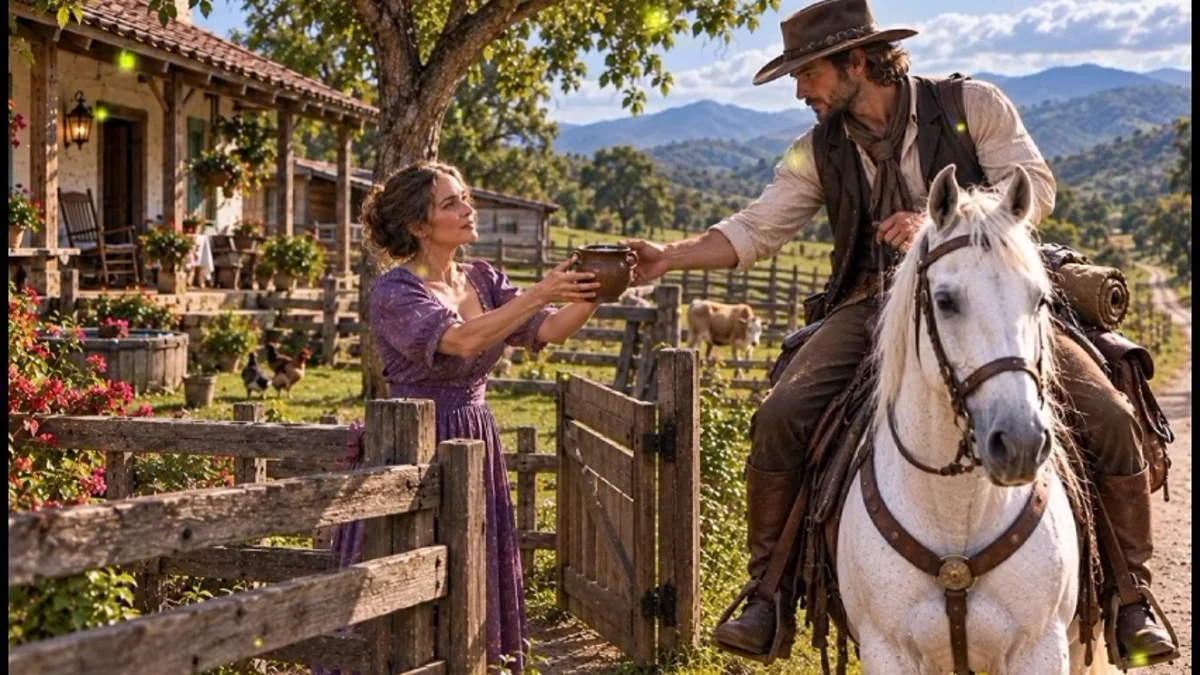
The morning wind off the Wind River Range carried the sharp, metallic tang of early winter snow.
It whistled through the gaps in the timber along the ridge, driving fine white dust across the frozen ruts of the trail that led up to Caleb Morgan’s porch.
At forty-one, Caleb was a man made almost entirely of stone and long silence.
His broad hands were calloused, scarred by cedar fence wire and heavy timber, and his dark wool coat carried the faint, perpetual smell of woodsmoke and damp pine.
He had spent the better part of twelve years learning how to exist without needing anyone, and more importantly, without allowing anyone to need him.
He had just ridden back from the far north pasture where he had spent three bitter hours checking the timber line for stray calves.
His bay gelding was breathing heavy, pale plumes of steam rising from its nostrils into the freezing air, when Caleb rounded the corner of the barn and pulled hard on the reins.
A figure was standing near the front door of his log cabin.
It was not a man from town, nor was it one of the wandering drift-riders who occasionally cut through the valley looking for day work.
It was a woman.
She stood perfectly still in the knee-deep drift beside the porch steps, clutching a thin, faded wool shawl around her shoulders as though it were the only thread holding her together against the wilderness.
She was not waving.
She was not shouting for help.
She simply stood there, watching him approach through the falling flakes with an intensity that made the skin on the back of Caleb’s neck go cold.
Caleb swung his leg over the saddle and dismounted, his heavy leather boots crunching deeply into the fresh crust of snow.
He kept his hand near his belt, his grey eyes narrowing under the brim of his slouch hat as he closed the distance between them.
“You’re a long way from the main road, ma’am,” Caleb said, his voice deep and rough from hours of disuse.
“The stage line doesn’t come up this creek, and town is twelve miles back.”
The woman lifted her head.
Her face was pale, thin, and stretched tight over fine bones, her lips bruised blue by the biting wind.
A small, faint scar ran through the tail of her left eyebrow, giving her tired face a strange, fierce dignity.
She looked him directly in the eyes without flinching, though her knees were noticeably trembling beneath the heavy wool of her skirts.
“Please… give me a child,” she said.
The words did not carry panic.
They carried the flat, terrifying weight of a final decision.
Caleb stopped dead in his tracks three paces away.
The wind howled softly around the eaves of the barn, but between the two of them, the silence felt as thick and heavy as a iron plate.
“What did you say?” Caleb asked softly.
“I am not asking for your heart, Mr. Morgan,” the woman said, her voice shaking only slightly as she swallowed hard.
“I am not asking for love, nor am I asking for a husband’s promises.
I am asking for a child.
I am asking for a chance to become a mother.”
Caleb stared at her for a long, unblinking moment, wondering if the freezing wind had finally played a trick on his mind.
He looked down at her scuffed leather boots, almost buried in the white drift, and then back up at her shivering frame.
“You’re out of your mind,” Caleb said flatly.
“Get on the porch before you freeze to death on my doorstep.”
He stepped past her, heavy boots thudding onto the wooden planks, and threw open the heavy oak door.
The woman lingered at the edge of the steps, her hands knotted tightly in the fringe of her shawl.
“I didn’t come here to cause trouble,” she whispered into the cold air.
“I can’t stay long if you mean to say no.”
“I didn’t ask what you came for,” Caleb replied without looking back over his shoulder as he walked into the dark room.
“I said come inside.
Nobody dies on my porch while I’ve got dry pine in the stove.”
She hesitated for a beat, then stepped across the threshold, her small frame swallowed instantly by the quiet shadows of the cabin.
The interior was stark, spotless, and completely devoid of comfort.
A heavy cast-iron stove sat in the corner, radiating a steady, dry heat.
The pine log walls were bare save for a kerosene lantern, a bridle hanging from a iron peg, and a single Winchester rifle resting above the mantel.
There were no framed tintypes on the walls, no lace on the small curtainless windows, no stray boots near the hearth, and no second chair at the rough-hewn oak table.
It was the home of a man who had stripped his life down to the absolute bare minimum required to keep his heart beating.
The woman took two small steps inside, her eyes sweeping over the sparse room with a quiet, observant grace before settling on the dark corners of the ceiling.
Caleb pulled off his thick leather gloves, tossed them onto the table, and shoved a fresh split of pitch-pine into the belly of the stove.
“Sit down before you fall down,” he commanded, pointing to the solitary wooden chair.
She sank into it gratefully, her body shuddering as the trapped cold began to bleed out of her heavy skirts in the rising warmth of the room.
Caleb reached for a blue enamel pot on the stove, poured a steaming tin cup of black coffee, and set it down hard in front of her.
“Drink it,” he said.
“Slowly, unless you want to scald your tongue.”
She wrapped her frozen fingers around the warm tin, drawing the steam up toward her face.
“Thank you,” she murmured.
“My name is Clara.
Clara Whitmore.”
“I didn’t ask your name,” Caleb said, stepping over to the bench by the water bucket to wash his hands.
“I asked myself how a woman ends up walking four miles off the county road in the middle of a Wyoming blizzard to ask a total stranger for something crazy.”
“I walked more than four miles,” Clara said quietly, taking a small sip of the hot liquid.
“I’ve been walking since yesterday morning.
I came from Briar Creek.”
Caleb turned around slowly, towel in hand, his grey eyebrows drawing together in a heavy line.
“Briar Creek is nineteen miles southeast through the pass.
You walked nineteen miles through fresh snow?”
“The snow didn’t start until early this morning,” she corrected softly.
“I slept in an abandoned hay barn near the stage crossing last night.”
“Why?” Caleb asked, his tone dropping an octave.
“Because the bank took my farm three days ago,” Clara replied.
She didn’t sound angry or tearful.
Her voice was merely flat, emptied out by an exhaustion that ran deeper than her muscles and bones.
Caleb pulled out a low three-legged stool from beneath the workbench and sat down across from her, his long legs folded awkwardly.
“A foreclosed farm doesn’t send a woman looking for a child at a stranger’s ranch,” Caleb said, looking at her intently.
“Start at the beginning, Mrs. Whitmore.
Because if you’re crazy, I need to know before I hitch the wagon to take you back to town.”
Clara set the tin cup down on the rough wood of the table.
She reached into the deep pocket of her coat and pulled out two pieces of paper, both creased along old fold lines.
“My husband, Thomas, died last spring,” she began, staring down at the tin cup.
“It was the lung fever.
It took him in four days.
We had been married five years, Mr. Morgan, and we worked sixty acres of bottom land near the creek.
When he died, he left me the homestead, forty head of cattle, and three hundred dollars in debt to the land office.”
“Three hundred dollars isn’t enough to take a working farm,” Caleb noted dryly.
“Not usually,” Clara agreed.
“I worked the fields myself all summer.
I sold eggs, I butchered the hogs, I washed linen for the miners coming through from the south fork.
But the early frost destroyed the wheat crop in August, and the drought killed the hay harvest.
When the bank note came due last Friday, I didn’t have the cash.”
“And they locked the gates,” Caleb said, nodding slowly.
He knew the story.
He had seen it happen to a dozen families in the territory over the last decade.
“They gave me thirty days to find the money,” Clara continued, her fingers tracing the edge of the folded paper on the table.
“I begged Silas Reed at the Briar Creek Bank for an extension.
I told him I could clear twenty acres of timber by spring and sell the wood to the railroad.
He smiled at me, set his gold watch on the desk, and said thirty days was thirty days.
When the time ran out on Tuesday, two deputies came out, put my trunk in the yard, and padlocked the barn.”
“So why didn’t you take the stage to your family?” Caleb asked.
“I have no family,” Clara said simple and clear.
“My parents died of smallpox when I was twelve in Illinois.
Thomas was all I had.”
She opened the second folded paper—a sheet of yellowed ledger paper written in a thick, hasty hand.
“Before Thomas died, when the fever was taking his breath, he made me bring him ink and paper.
He wrote a letter.
He told me that his greatest regret was that he was leaving me alone in the world without a child to carry his name or to give me a reason to keep breathing.”
She looked up, her grey eyes meeting Caleb’s with an unyielding clarity.
“He wrote that a woman without family in this country is just a dry leaf in the wind.
He made me promise that if the farm was ever lost, I would not give up.
He wanted me to find a good man—a quiet man—and have a child.
He said a child would give me a home, even if I didn’t have an acre of land left to my name.”
Caleb leaned back against the log wall, crossing his arms over his chest.
“And you picked my name out of a hat?”
“No,” Clara said softly.
“I asked around in town before I left Briar Creek.
I asked the blacksmith, and I asked the widow who runs the boarding house.”
“And what did they tell you about Caleb Morgan?” he asked, his lips curving into a hard, humorless line.
“They said you were cold,” Clara answered without hesitation.
“They said you don’t drink, you don’t gamble, you don’t chase women in the saloons, and you don’t owe a single dollar to Silas Reed or anyone else in the county.
They said you were as honest as a iron stove, but that you hadn’t spoken more than ten words at a time to anyone since 1875.”
Caleb’s jaw tightened.
“They tell you why?”
“No,” Clara whispered.
“They said nobody knew.
Only that you used to have someone out here, and then one day you were alone.”
She pointed a thin, trembling finger toward the dark wall near the bedroom door.
In the dim light cast by the stove, sitting on a high shelf buried beneath a thick layer of grey dust, was a tiny, hand-carved wooden horse no larger than a man’s palm.
Caleb’s breath caught in his throat.
His eyes fixed on the small wooden object, and for a terrifying second, the room seemed to lose all its air.
He had not looked at that shelf in twelve years.
He had built his entire life around pretending that the shelf, the room behind the curtain, and the memories buried under the floorboards did not exist.
“Her name was Hannah,” Caleb said, his voice dropping into a register so low it sounded like stones grinding together under water.
Clara remained silent, her hands resting quietly in her lap, waiting.
“She lived six days,” Caleb said, staring at the floorboards between his boots.
“Spring of ’75.
The snow was three feet deep, deeper than this.
The fever took her before I could even get the horse saddled to ride for the doctor in town.
My wife… Mary… she couldn’t look at the crib.
She couldn’t look at the mountains.
She couldn’t look at me.
Two months later, she got on the eastbound stage to her sister’s place in Ohio and never came back.
She sent a letter three years later saying she had filed for divorce on grounds of desertion.
I didn’t contest it.”
He slowly raised his eyes to meet Clara’s.
“So you see, Mrs. Whitmore, you came to the wrong house.
I am not a father.
I am just the man who stayed behind to guard the grave.”
Clara looked at the small wooden horse on the high shelf, and then back at the hardened face of the man sitting across from her.
“I didn’t come here asking you to forget her,” Clara said softly.
“I came here because a man who keeps a carved horse on a shelf for twelve years is not a man made of stone.
He’s just a man who has been cold for a very long time.”
The winter wind battered the pine logs outside, rattling the small windowpane in its frame.
Caleb stood up abruptly, stepping over to the stove to pick up the iron poker.
“The snow is coming down harder now,” he said, his back turned to her.
“You can’t walk back to town in this, and I’m not driving my horses out in a gale.
You can take the bed in the back room.
I’ll sleep on the bench here by the fire.”
“Mr. Morgan—”
“We’ll talk about what you’re going to do tomorrow,” he interrupted sternly, thrusting the poker into the red coals.
“When the roads are clear.”
That night, the storm raged across the valley, burying the fence lines under four feet of drift.
Inside the small cabin, the quiet was absolute save for the steady crackle of the pitch-pine in the stove.
Caleb lay on the hard wooden bench wrapped in his sheepskin coat, staring up at the dark rafters, listening to the soft, light breathing of the stranger sleeping in the room where his daughter had died twelve years ago.
Over the next two weeks, the weather refused to break.
A heavy, stubborn cold settled over the territory, locking the roads in thick ice and turning every creek into a solid sheet of grey granite.
Clara stayed.
She did not ask again about her desperate request, and Caleb did not bring it up.
Instead, a quiet, unspoken rhythm took shape between them in the small cabin.
Clara did not act like a guest, nor did she act like a servant.
Every morning before dawn, while Caleb was out in the freezing barn breaking ice in the water troughs, she was up, kindling the fire, mending torn woolen socks, and boiling oats for breakfast.
She fixed the tear in his heavy winter coat using thick waxed thread from his workbench.
She scrubbed the grease off the iron skillet that had been caked on for years.
She found an old bag of dried apples in the root cellar and baked a simple tart that made the whole cabin smell like summer.
Caleb watched her in silence.
He noticed that despite her pale skin and thin frame, she possessed a quiet, stubborn strength.
She didn’t complain about the draft under the door, she didn’t flinch when she had to carry two heavy buckets of water from the well in the biting wind, and she handled his brown mare, June, with a gentle, sure touch that made the nervous animal drop its head against her shoulder.
One afternoon, while Caleb was oiling a leather harness at the kitchen table, Clara was tidying up the shelf near the window.
She reached into the pocket of her apron and pulled out a folded blue paper that had arrived with the mail-rider three days prior—a notice she had kept tucked away in her trunk.
Caleb looked up, noticing the sudden pallor in her face as she smoothed the document on the table.
“What’s that?” Caleb asked.
“A secondary claim,” Clara whispered, her hands shaking slightly.
“Silas Reed sent a messenger out to the stage station with it before the heavy snow hit.
He claims my husband owed an additional four hundred dollars on a timber lien signed three years ago.”
Caleb set his leather oil down and took the paper from her hands.
He read the legal jargon slowly, his eyes narrowing as he reached the bottom of the page.
“A timber lien?” Caleb asked.
“Thomas never logged the back quarter,” Clara said, her voice rising in distress.
“He never sold a single cord of pine to the railroad!
He hated logging.
He always said the forest protected our pasture from the spring floods.”
Caleb turned the paper over, examining the dark ink signature at the bottom.
“Elias Whitmore,” Caleb read aloud.
“Who is Elias?”
“Thomas’s older brother,” Clara said, sinking into the wooden chair.
“He moved to Montana eight years ago.
He was a gambler, Mr. Morgan.
He left the territory after borrowing money from every merchant in the county.”
“This signature says Elias signed as a guarantor for Thomas’s debt in 1885,” Caleb said, his thumb running over the dry paper.
“That’s impossible,” Clara said, looking up with wide eyes.
“Elias died of typhoid fever in a hospital in Helena in the winter of 1884.
We received the death certificate from the county clerk six months before Thomas fell ill.
Thomas kept it in his iron box!”
Caleb sat perfectly still for several seconds.
The silence in the room grew heavy, charged with a sudden, dangerous realization.
“A dead man signed a loan document in Briar Creek in 1885?” Caleb asked quietly.
“Yes!” Clara exclaimed.
“If Elias was dead, then Thomas never signed this lien!
Silas Reed forged the papers to increase the debt so the farm couldn’t be redeemed by anyone!”
Caleb folded the paper carefully and slipped it into his breast pocket.
“It means Reed didn’t just foreclose on your land, Mrs. Whitmore,” Caleb said, his voice cold and sharp as a fresh blade.
“It means he stole it.”
The following morning, the sun broke through the heavy grey cloud cover for the first time in sixteen days, casting a blinding, crystal glare across the white expanse of the valley.
Caleb went to the barn at first light, saddled his gelding, and hitched June to the light cutter.
When he returned to the house, he pulled on his heavy sheepskin coat and grabbed his slouch hat.
Clara stood near the stove, watching him with an anxious expression.
“Where are you going?” she asked.
“Into Briar Creek,” Caleb said flatly.
“I’m going to have a talk with Silas Reed.”
“No, Caleb, please!” Clara stepped forward, catching his sleeve with her small hand.
“He’s a powerful man in the county.
He owns the bank, he pays the judge’s salary, and he has men who do his dirty work.
If you go down there throwing accusations at him, he’ll find a way to ruin you, too!”
Caleb looked down at her small hand resting on his arm.
It was the first time she had ever called him by his first name.
“He already tried to ruin you,” Caleb said quietly.
“And I’m too old to be scared of a bank manager with an ink pen.”
He stepped out into the crisp morning air, leaving her standing in the open doorway.
The ride into Briar Creek took two hours through the deep, packed snow drifts.
The small town was just beginning to dig itself out, shopkeepers sweeping their boardwalks and smoke curling lazily from the red brick chimney of the land office.
Caleb tied his gelding to the hitching rail outside the Briar Creek Bank, pushed the heavy glass door open, and stepped inside.
The bank was warm, smelled of brass polish and expensive tobacco, and was completely empty save for the clerk behind the teller window and Silas Reed, who was sitting in his private glass-walled office at the back.
Reed was a stout, well-dressed man of fifty with silver hair, a heavy gold watch chain stretched across his silk vest, and eyes as hard and cold as creek ice.
He looked up from his desk as Caleb pushed open the wooden gate and walked straight into his office.
“Caleb Morgan,” Reed said, leaning back in his leather chair with a dry, professional smile.
“You’re a rare sight in town.
What can the bank do for you on a cold morning like this?
Looking for a loan to clear that north pasture?”
Caleb didn’t answer.
He pulled the folded blue paper from his coat pocket and slapped it flat onto the polished mahogany desk.
“Explain this,” Caleb said.
Reed didn’t pick up the paper immediately.
He glanced at it, his smile fading into a thin, bored line.
“That is a legal notice regarding the Whitmore property,” Reed said smoothly.
“A matter between this institution and the estate of Thomas Whitmore.
It has nothing to do with you, Morgan.”
“Elias Whitmore died in Helena in 1884,” Caleb said, leaning his broad hands on the edge of the desk, forcing the banker to look up at him.
“I’ve seen the death certificate with my own eyes.
Yet you’ve got his signature on a timber lien dated November 1885.
Care to tell me how a dead man rode down from Montana to sign a four-hundred-dollar note in your office?”
Silas Reed went utterly rigid.
The color drained slowly from his thick cheeks, leaving his skin a mottled, sickly grey.
He stared at the paper on his desk, his fingers twitching slightly against his watch chain.
“You’re making very dangerous assumptions, Morgan,” Reed said, his voice dropping into a low, harsh whisper.
“Paperwork gets complicated when properties change hands.
Clerk errors happen.”
“Clerk errors don’t forge dead men’s names to steal forty acres of prime bottom land from a widow,” Caleb said, his grey eyes burning into the banker’s face.
“You wanted that land because the railroad survey is coming through the south gap next spring, and you knew you could sell the right-of-way for five thousand dollars.”
Reed leaned forward, his hands flat on the desk, his composure snapping like dry pine.
“Listen to me very carefully, Morgan,” Reed spat.
“You’re a lonely hermit living on a dry rock at the end of the creek.
Nobody in this town cares what you think, and nobody is going to take the word of a crazy woman over mine.
If you know what’s good for you, you’ll ride back to your cabin, keep your mouth shut, and throw that woman out on the road where she belongs.”
Caleb didn’t draw a weapon.
He didn’t raise his voice.
He simply stood up straight, towering over the desk, his shadow completely blotting out the morning light streaming through the window behind Reed.
“The snow is melting, Reed,” Caleb said softly.
“And when it melts, the circuit judge comes to town.”
Caleb turned on his heel and walked out of the bank without looking back.
He reached his ranch just as the sun was beginning to dip below the western peaks, painting the snow-covered slopes in brilliant shades of purple and gold.
As he pulled up near the barn, his heart dropped like a heavy stone.
The kitchen chimney was cold.
No smoke was rising into the clear evening air.
He threw himself off his horse, kicked open the door of the cabin, and called out.
“Clara!”
The house was empty.
Her thin shawl was gone from the peg near the door.
So was June, the brown mare, and the small iron box Thomas had left her.
Caleb ran out to the barn, his heart hammering violently against his ribs.
The stall door was hanging open, the halter missing from its peg.
Looking down at the soft snow near the barn gate, he saw fresh hoof prints and narrow wagon ruts heading east—back toward the old Whitmore homestead.
“Foolish woman,” Caleb growled under his breath, swinging back into his gelding’s saddle without even tightening the girth.
He rode through the gathering dusk, forcing his horse into a hard trot along the frozen creek bank.
The cold wind lashed at his face, but he felt nothing except a terrifying, suffocating panic—a feeling he had not allowed himself to experience since the day his wife had walked away twelve years ago.
He reached the Whitmore homestead twenty minutes later.
The small frame house stood dark against the white snow, its front door hanging slightly off its hinges where the bank deputies had forced it two weeks prior.
A light was yellowing the small kitchen window.
Caleb pulled his horse to a halt behind the snow-draped cottonwoods near the well-house, dismounted silently, and slipped up to the low porch, his hand resting on the heavy butt of his Colt revolver.
Inside, the room was cold and cluttered with broken furniture left behind by the deputies.
Clara was standing near the fireplace, holding an iron kerosene lamp in one hand and a thick bundle of yellowed papers in the other.
Facing her near the table stood Silas Reed and two thick-set men in heavy canvas coats—drifters who worked as hired hands at the livery.
“Give me the deed, Clara,” Reed was saying, his voice echoed hollowly off the bare walls.
“You came back here looking for Thomas’s iron box, didn’t you?
I knew you’d be foolish enough to try.”
“You lied to me!” Clara shouted, her voice ringing with a fierce, unbelievable defiance that made Caleb pause at the doorway.
“You stole our home!
You forged Elias’s name while Thomas was dying in the bed in that very room!”
“Nobody cares about a dead man’s signature,” Reed said coldly, taking a step toward her.
“And nobody is going to believe you.
Give me the papers, or my men will take them from you and leave you in the drift.”
“She won’t be giving you a damn thing, Reed,” Caleb’s voice cut through the dark room like a rifle shot.
Caleb stepped through the open doorway, his tall frame blocking the cold moonlight behind him.
His hand was off his gun, but his broad shoulders were squared, his grey eyes locked onto Silas Reed with absolute, lethal focus.
The two hired men instinctively took a step back, recognizing the quiet, dangerous fury of a man who had nothing left in the world to lose.
“Morgan!” Reed gasped, stumbling back against the table.
“What are you doing here?”
“I came to take Clara home,” Caleb said, his voice flat and terrifyingly calm.
“And to make sure you didn’t burn evidence of a felony.”
“You’ve got no authority here!” Reed snarled, trying to regain his footing.
“This property belongs to the bank!”
“It belongs to Mrs. Whitmore,” a deep, authoritative voice spoke from the porch behind Caleb.
Sheriff Thomas Vance pushed his way into the small kitchen, accompanied by two older ranchers from the county board.
Vance was a silver-haired lawman who had served the territory for twenty years, a man whose honesty was as well-known as his sharp memory for faces.
“I got your message at the stage station, Caleb,” Sheriff Vance said, his eyes scanning the room before resting on Silas Reed.
“You said something about a forged timber lien and a dead man’s signature?”
Clara stepped forward, her hands steady as she handed the yellowed bundle of papers directly to the Sheriff.
“This is my husband’s iron box,” Clara said clearly.
“Inside is the original death certificate of Elias Whitmore, stamped by the Helena district court in 1884.
And here… is a letter written to Thomas by Silas Reed in October 1885, asking him if he wanted to buy out his deceased brother’s share of the timber rights.”
Sheriff Vance took the papers, adjusting his wire-rimmed spectacles as he read through them under the glow of the kerosene lamp.
The room was dead silent save for the heavy, ragged breathing of Silas Reed.
After three long minutes, Sheriff Vance lowered the papers and looked over the top of his glasses at the banker.
“Silas,” Vance said softly, “you wrote a letter asking about a dead brother, and then twelve months later you produced a lien signed by that same dead brother to seize this widow’s land?”
“It’s a mistake!” Reed stammered, his face turning red.
“A misunderstanding between—”
“Save it for the circuit judge, Silas,” Sheriff Vance interrupted dryly, nodding to his deputies.
“Take his gun.
Mr. Reed is going to spend the rest of the winter in the county jail in Sweetwater.”
The hired men stepped back, raising their hands in immediate surrender as the deputies led the sputtering banker out into the cold night.
The room grew quiet again.
Sheriff Vance turned to Clara, handing her back the iron box with a respectful nod.
“The foreclosure is void, Mrs. Whitmore,” Vance said kindly.
“The land is yours, clean and clear.
The county will issue you a fresh deed by the end of the week.”
“Thank you, Sheriff,” Clara whispered, tears finally pooling in her grey eyes as the heavy burden of months of terror lifted from her shoulders.
Sheriff Vance looked over at Caleb, a faint, knowing smile touching his weathered lips.
“Get her back to your place, Caleb,” Vance said softly.
“It’s going to freeze hard tonight.”
Two weeks later, the spring thaw arrived in earnest across the Wyoming Territory.
The heavy ice on the creek broke apart with loud, booming cracks like thunder, and the clear water rushed down from the mountains, greening the valley meadows overnight.
Clara stood on the porch of Caleb’s cabin, watching the bright morning sun reflect off the swollen stream.
She wore her clean apron, her brown hair neatly braided and pinned behind her ears.
Behind her, the front door opened, and Caleb stepped out onto the wooden planks.
He was holding a cup of fresh coffee in his hand, his dark wool coat unbuttoned in the gentle, warm breeze.
He didn’t speak for a long time, simply standing beside her, looking out over the valley they had both fought to protect.
“Your farm is clear now,” Caleb said softly, breaking the silence.
“The fences are repaired, and the team is ready whenever you want to move back down to the creek.”
Clara turned to look at him, her grey eyes reflecting the brilliant blue of the spring sky.
“You never gave me an answer, Caleb,” she said quietly.
Caleb frowned slightly.
“An answer to what?”
“To the question I asked you the day I stood on your porch in the blizzard,” she whispered.
Caleb set his coffee cup down on the porch railing.
He looked at her for a long, silent moment, his face softening in a way that made him look ten years younger.
“I thought having a child would make me whole again,” Clara said, her voice dropping into a tender confession.
“I thought it was the only way I could build a home out of the pieces Thomas left behind.”
“And now?” Caleb asked softly, taking a step closer to her.
“Now,” Clara smiled, a single tear spilling over her lash and running down her cheek, “now I think that home isn’t built out of land, or paper deeds, or promises made to dead men.
I think home is being loved by someone who chooses to stand by you when the whole world is trying to tear you down.”
Caleb reached slowly into his pocket.
His fingers wrapped around the small, hand-carved wooden horse—the small object he had kept hidden in the dark corner of his hearth for twelve long years.
He pulled it out and gently placed it into the palm of Clara’s hand.
“My daughter never got the chance to play with this,” Caleb said, his voice thick with an emotion he had buried for over a decade.
“I kept it in the dark because I thought holding onto the pain was the only way to keep her memory alive.
But I don’t want it to sit in the dark anymore.”
Clara looked down at the tiny carved horse, running her thumb over the smooth wood that Caleb had carved with such care so long ago.
“Why are you giving it to me, Caleb?” she asked softly.
“Because I want to build something new,” Caleb said, taking a deep, steadying breath as he looked straight into her eyes.
“I want to build a life here.
With you.
If you’ll have me.”
Clara let out a small, trembling breath, her smile breaking through her tears like the spring sun breaking through the winter clouds.
“I will,” she whispered.
“I will, Caleb.”
By the autumn of 1888, the lonely ranch at the end of the creek had changed completely.
Red and white hollyhocks bloomed along the porch railing, white curtains hung in the clean glass windows, and the yard was filled with the clucking of fat hens and the warm, lively sounds of a working farm.
And in the bright, warm spring of the following year, a tiny, dark-haired baby girl was born in the small bedroom behind the kitchen.
Caleb sat on the edge of the bed in the soft evening light, holding the tiny, swaddled bundle against his broad chest.
His massive hands, rough from forty years of hard labor, held the infant with a gentle, trembling reverent care that brought tears to Clara’s eyes as she watched him from the pillows.
“You’re shaking, Caleb,” Clara whispered softly, reaching out to lay her hand over his.
Caleb looked up at his wife, his grey eyes shining with a profound, peaceful light that had completely replaced the cold shadow of his past.
“I’ve been afraid of holding something precious for twelve years, Clara,” he said, his voice filled with a deep, quiet awe.
“I was afraid that if I loved anything again, the world would find a way to break it.”
Clara leaned her head gently against his arm, her hand resting over the tiny hand of their daughter.
“You don’t have to be afraid anymore, my love,” she whispered.
“We’re home.”
Caleb looked down at the sleeping child in his arms, then at the strong, beautiful woman sitting beside him, and for the first time in his life, he didn’t look back at the graves behind him when he looked toward the mountain horizon.
He saw a future.
He saw a home.
And he finally understood that sometimes the family we spend our whole lives searching for doesn’t arrive with thunder or grand miracles.
Sometimes it arrives quietly, in the middle of a bitter Wyoming winter, with a shivering stranger standing at the door, whispering a simple request for a second chance.
And sometimes, the person who comes to ask you for help turns out to be the very person who saves your soul.
Disclaimer: This story is fictional and created for entertainment purposes only.
Any names, characters, places, or events are fictitious or used fictitiously.
No real person or organization is intended to be portrayed.








