She Asked the Pastor for a Place to Stay… He Smiled, “What If I Found You a Husband Instead?”
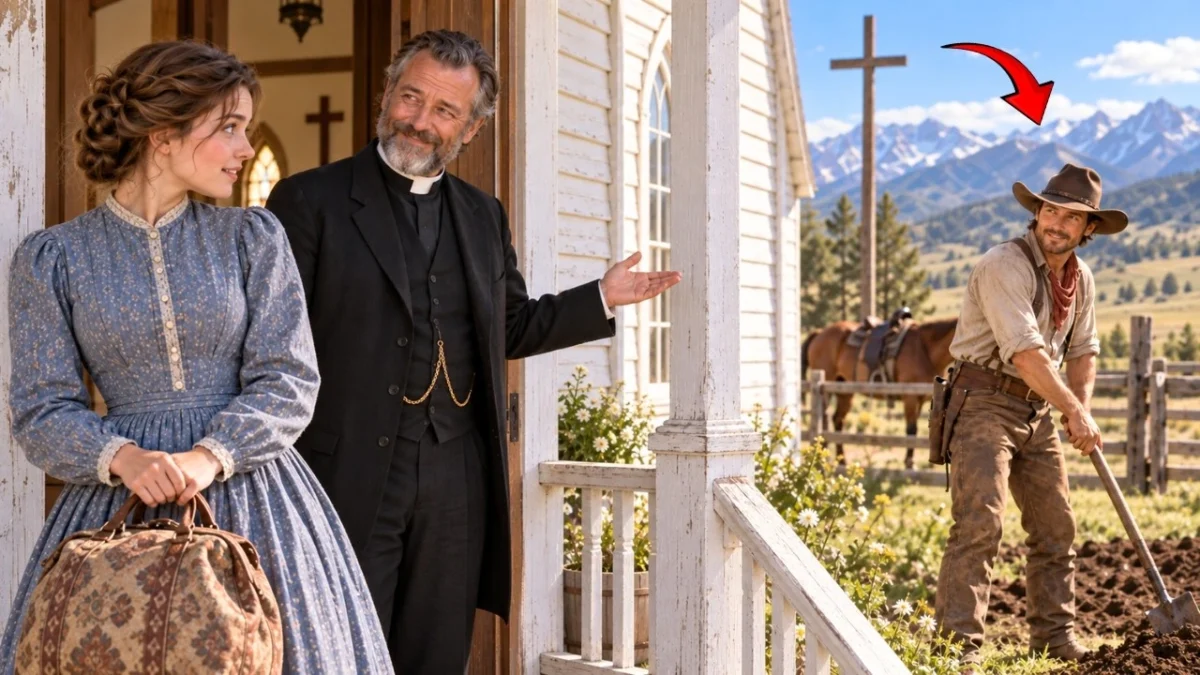
Amity Creek, Wyoming Territory, 1889.
Hannah Reed had been walking since before the moonset.
Somewhere around the third hour, walking had stopped being a thing she was doing and had become the only thing she was.
She did not remember deciding to keep going.
Her feet simply kept finding the next piece of road and the next, and she followed them the way a person follows a dog she trusts more than her own judgment.
She stopped once, an hour before dawn, at a bend where the road dipped down toward a dry creek bed.
She could not make herself take one more step without saying something to God first.
So she went down on her knees in the frost-stiff grass, her carpetbag still gripped in one hand because she could not make herself let go of it even to pray.
“I don’t know if You can hear a person this far from anywhere,” she said aloud to the darkness.
“But I am going to talk to You anyway because my father taught me to. And it is the only thing of his I have left that nobody can take from me.”
Her voice was steady in a way her hands were not.
“You know what he asked of me. You know what my father owed him. And You know I did not make that debt. I would rather walk into these mountains and never come out again than stand up in front of a preacher and promise myself to Elijah Crane for the rest of my life. To settle an account my father signed in a moment of desperation, God rest him, and never lived to regret.”
The wind moved through the dry grass and did not answer her, the way wind never does.
She had learned by then not to mistake silence for absence.
“I don’t know where I’m walking to,” she whispered.
“I only know I couldn’t stay where I was walking from. So I am asking You plainly, the way my father used to ask You things, to put something in front of me before my feet give out. I don’t need it to be grand. I would take almost anything. A roof. A kind word. Someone who won’t ask what I’m running from before they’ll give me a place to stand still in.”
She pressed her hand flat against the frozen ground.
“‘Whither thou goest, I will go,’ Ruth said to her mother-in-law. I always loved that verse without understanding it, because I had never yet been anywhere I didn’t want to go. I understand it now, Lord. I am going wherever You send me, because I have run out of places I chose for myself.”
She stayed there long enough for the cold to work all the way through her wool coat.
Then she got up, because grief and fear do not excuse a person from the business of putting one foot in front of the other.
To understand what had put Hannah Reed on that frozen road, one had to go back to the spring when her father, Amos Reed, had borrowed money.
Amos was a quiet, gentle man who had never in his life turned away a hungry traveler.
He had borrowed four hundred dollars from Elijah Crane to save the family’s small holding after two successive seasons of failed wheat, signing the note with the farm itself standing as security against it.
Elijah Crane held mortgages on half the county that way.
He was as patient as a spider, content to let a man work a debt for years so long as the land stood firmly behind it.
When Amos Reed died of a sudden brain fever before the note came due, the debt did not die with him.
It stayed fixed to the land, and the land was the only thing Hannah had left of her father’s memory.
Crane had ridden out to the funeral in a polished black coat.
He had expressed his deepest sympathy with every appearance of sincerity, then waited exactly eleven days before calling on the daughter left behind to answer for it.
Not because the law made the debt hers personally, but because the note gave him the right to take the farm out from under her the moment it went unpaid.
A twenty-three-year-old woman with no kin left to advise her and no way to raise four hundred dollars by harvest had no better shield against him than if the debt truly had been her own.
Crane had not simply come to collect what he was owed.
He had come offering what he called generosity.
“I am prepared to make a far more agreeable arrangement, Miss Reed,” Crane had said, leaning against her late father’s mantelpiece while his dark eyes surveyed the modest living room.
“I will tear up the note as your dowry. The farm will go on standing under my name instead of your father’s, and you will want for nothing.”
He had smiled the whole time he spoke—the smile of a man accustomed to people accepting whatever he offered because the alternative was starvation or ruin.
He was forty-six years old.
He had buried two wives already, both younger than Hannah was now, both dead within three years of their weddings of causes the county doctor had described each time as a “general decline.”
Hannah had looked him in the eye and said she needed time to consider it.
Crane had granted her one week.
On the sixth night, she had packed what she could carry into a single carpetbag and left through the kitchen door before the moon was fully down.
She walked north and then west toward a town she had heard her father mention once years before as a decent, God-fearing place with a preacher worth the name.
The sun was fully up by the time she finally crossed the town line into Amity Creek.
The little white church at the edge of town, with its modest bell tower and a front garden gone wild with autumn daisies, was the first building she saw that looked like it might belong to someone willing to open a door.
Reverend Josiah Abernathy had been the pastor of Amity Creek for eleven years.
In that time, he had buried more of his flock than he liked to count, married most of the rest, and learned through his own long grief over a wife who had passed in his third year in that pulpit that God’s providence rarely arrived looking the way a person expected it to.
He was out on the church steps that morning watering the daisy pots his late wife had planted, purely out of a habit he had never been able to give up.
He set down the watering can when he saw a young woman coming up the road on foot, alone, carrying a bag clearly too heavy for the distance she had traveled.
He came down the steps to meet her before she reached the fence line.
“Good morning,” he said in the unhurried, gentle tone he used on frightened animals and frightened people, which in his experience required very much the same handling.
“You’ve come a long way by the look of those shoes.”
“Two days,” Hannah said.
Her voice cracked on the second word, and she steadied it by sheer force of will.
“I’m sorry to arrive like this. I don’t know anyone in this town. But my father told me once that the church here was a place a person could ask for help without being asked too many questions first.”
“Your father told you right,” Abernathy said softly.
“I’m Reverend Josiah Abernathy. Come inside and sit down before you say another word. Whatever it is, it will keep for the length of a cup of coffee.”
He brought her into the parsonage kitchen.
Hannah glanced around instinctively for a pastor’s wife, but saw only a single used coffee mug and the quiet, unfussed way the preacher moved through the kitchen alone.
A framed photograph on the sideboard—a woman with a kind, plain face—told the rest of the story without either of them needing to speak it aloud.
Hannah sat by the stove and told him everything.
Something in the profound stillness of that kitchen made it feel safer to tell the truth all at once than to try to manage it in careful, guarded pieces.
She told him of the four-hundred-dollar debt, of Crane’s terrifying proposal, of the two wives who had died of a general decline, of the seven-day deadline, and of her late-night flight across fifty miles of wild range.
Abernathy listened without interrupting once, which Hannah soon learned was one of the rarest and most valuable things about him.
When she finished, he was quiet for a long moment, slowly turning his coffee cup on the scarred oak table.
“You did right to run,” he said finally, meeting her gaze squarely.
“I want you to hear that plainly before anything else. That note is fixed to the land, and the law may well let Crane take the farm out from under you if it goes unpaid. But no law in this territory or any other requires a woman to marry a man to keep hold of a piece of property. Whatever Elijah Crane has told you or told himself, you are not required to accept that offer. You are never required to.”
“I know that,” Hannah said, leaning her hands against her warm mug.
“But knowing it and being safe from it are two very different things. He’ll come looking. Men like Elijah Crane don’t let four hundred dollars walk away on its own two feet.”
“No,” Abernathy agreed quietly.
“I expect he won’t. You can stay here in the parsonage as long as you need to. My sister Constance keeps house for me—has done since my wife passed. She’ll be glad of the company, and glad of a second pair of hands if I know her. But I’ll tell you plainly, because I think you’re a woman who’d rather hear a hard thing said plainly than have it dressed up kindly and handed to you sideways: Amity Creek is a small town, and a small town talks.”
Hannah tightened her grip on her cup.
“An unmarried woman alone in a parsonage with no family and no explanation is going to draw exactly the kind of attention that makes a hard situation harder,” Abernathy continued gently.
“Whatever the truth of it is.”
Hannah’s chin came up instantly—the old instinct of a person who has learned to brace before being struck.
“Are you telling me I can’t stay?”
“I’m telling you the opposite,” Abernathy said.
Something in his face shifted—the beginning of an idea he was turning over even as he spoke it.
He looked past her, through the sunlit kitchen window, out toward the dry pasture that ran along the edge of the churchyard.
A man was working a shovel into the stubborn earth beside a half-built fence line, his shirt dark with sweat despite the chilly morning air.
He worked with the rhythmic, relentless focus of a man for whom labor was the only conversation he was willing to have that day.
“That’s Thomas Bridger out there,” Abernathy said softly, pointing toward the field.
“He owns the ranch two miles east. Three hundred acres of good grass and a herd he’s built up nearly single-handed since he was fifteen years old. Good man. The best man in this county, if you want my honest opinion—and you should, since you’re sitting in my kitchen asking for it.”
He watched Thomas drive the shovel into the dirt once more.
“He’s thirty-one years old,” the pastor said.
“And he has never once in the eleven years I’ve known him so much as walked a girl home from a social. Folks around here assume it’s shyness. It isn’t. It’s something much heavier than that. It isn’t my story to tell you, but I’ll say this much: he learned early that the people meant to stay in his life have a way of leaving. He decided a long while back that the safest thing was never to give anyone the chance to leave him again.”
Abernathy turned back to Hannah.
A slight smile crossed his face—not the smile of a man making a joke, though it took the shape of one.
“What if I found you a husband instead?” he asked.
Hannah set down her coffee cup with far more force than she had intended, the porcelain clattering against the saucer.
“Reverend Abernathy! I have just finished telling you that I walked fifty hard miles rather than marry a man for the sake of a debt. I don’t think I could make my feelings about such a proposal any plainer.”
“I’m not proposing you marry a stranger for money, Miss Reed,” Abernathy replied, entirely unruffled.
“I’m proposing something a good deal stranger than that, which is that you give yourself the chance to be known by a decent man before either of you decides anything at all. Thomas needs help on that ranch worse than he’ll ever admit to me. And you need a respectable place to be while Elijah Crane forgets which direction you walked in. I am not going to stand up in front of God and marry you to a man you met yesterday, whatever it might look like from the outside.”
He set his hands flat on the table and leaned in slightly.
“But I have buried enough people and married enough people in this town to have learned one thing for certain,” he said softly.
“The Lord has a peculiar habit of putting two people in the same corner of the same impossible situation and calling that His providence. I have rarely seen Him wrong about it yet.”
He nodded again toward the window where Thomas Bridger was driving a heavy wooden fence post into the frozen ground.
“Genesis says it is not good for man to be alone, Miss Reed,” Abernathy added gently.
“It doesn’t specify that the remedy has to arrive dressed as anything other than what it is: two lonely, frightened people and a little time to find out whether God meant something by putting them in the same county.”
Hannah looked out the window at the man working the fence line.
He had not once looked up toward the parsonage.
He was entirely unaware that his pastor was currently holding a conversation about his future.
She felt something stir in her chest that was not quite hope and not quite dread—something that was, if she were honest with herself, much closer to curiosity.
“I’m not agreeing to anything,” she said firmly.
“I haven’t asked you to,” Abernathy replied with a warm, reassuring smile.
“I’ve only asked you to let me introduce you to a good man, and see what the Lord does with the acquaintance. That’s a considerably smaller thing than a wedding. You are allowed to say no to every step of it, at every point along the way, for as long as you like.”
The story of Thomas Bridger’s solitary life was one written in quiet tragedy.
His father, Ezra Bridger, had been a drinking man.
It was a plain enough fact that half the county could have told you as much, though few knew the true weight of what it had cost his family.
Ezra had been sober enough most years to keep their modest ranch turning a small profit, and drunk enough most winters that the profit rarely survived the spring.
When Thomas was fourteen, his father rode into town for supplies and simply did not come home.
Not that week, not that season, not ever.
The only closure came months later in a brief, scrawled letter from a saloon keeper in Cheyenne, informing the family that Ezra Bridger had died from a fall down a flight of stairs he had no business attempting in his condition.
Thomas’s mother had held the ranch together for three more years on sheer stubbornness and grief.
She raised Thomas and his two younger sisters by teaching Thomas, far too young, how to be the man of the house in every practical sense.
She died the winter Thomas turned seventeen.
The country doctor cited a “weak heart,” but Thomas believed privately—and had never spoken aloud to a single living soul—that she had simply run out of reasons to keep going.
Her husband’s leaving had finished the slow destruction his drinking had started.
Thomas buried his mother, found safe homes for his young sisters with relatives two counties over, and stayed on the ranch alone.
It was the one thing left in his world that had never given him a reason to expect it would abandon him.
In the fourteen years since, he had expanded it into three hundred acres of prime grazing land with a cattle herd any rancher in the territory would envy.
He had built it entirely alone.
Somewhere amidst the wreckage of his seventeenth year, he had decided that the people a man lets close enough to matter are the very people whose leaving can break him completely.
So he quietly, permanently stopped letting anyone get that close.
He still attended church most Sundays, out of respect for Reverend Abernathy, but he always sat in the very back pew and slipped out before the final hymn ended.
He held a quiet belief in God, but viewed Him much like the mountain weather: a vast, unyielding reality of the world that was far too large to argue with, and largely unconcerned with his personal opinion of it.
On a cool Wednesday afternoon, Reverend Abernathy brought Thomas and Hannah together under the modest pretext of turning the parsonage garden before the autumn frost set in.
It was not entirely a pretext; the soil needed turning, and Hannah had offered to help, but needed a stronger pair of hands than Constance Abernathy’s arthritic joints could provide.
Thomas had come simply because his pastor asked him.
He stood at the wooden garden gate that afternoon, hat held respectfully in his large hands, looking at a young woman he had never seen before.
She was kneeling directly in the dark earth, her sleeves rolled past her elbows, a trowel gripped firmly in her hand.
“Reverend said you needed help with the turning,” Thomas said, his voice deep and slightly hesitant.
Hannah did not immediately look up from the row she was clearing.
“I could use it,” she said evenly.
“I’ll warn you now, though—I don’t know the first thing about mountain soil. My father’s land was flat bottomland, and I never had to think twice about rocks or heavy frost.”
Thomas unlatched the gate and stepped into the garden plot.
“It’s not so different,” he said quietly, setting his hat aside on a fence post.
“Just stays colder longer. You’ve got to watch the frost line closer than you would down on the flats.”
He knelt across the narrow dirt row from her without further comment, picked up a spading fork, and began turning the heavy soil.
For a long time, neither of them said another word.
The silence between them was neither tense nor awkward; it was comfortable, filled only with the rhythmic sound of iron striking earth and the caw of distant crows.
It was, Hannah realized later that evening, the first interaction she had experienced in six agonizing months that did not require her to explain herself, defend her choices, or manage another person’s expectations.
There was a relief in that silence so profound that she had to bite her lip to keep from weeping over a plain row of turned dirt.
They worked together during the afternoons that followed.
The garden plot was unexpectedly large, and the pastor’s household tasks seemed mysteriously bottomless.
There was always a section of perimeter fence that wanted mending, a cord of winter firewood that needed splitting, or a barn roof that required checking before the dark rain clouds rolled over the peaks.
Constance Abernathy assigned these chores with a perfectly straight face and a subtle twinkle in her pale eyes that fooled absolutely no one—least of all her brother.
Over those slow autumn afternoons, Hannah came to understand Thomas Bridger in the quiet way two guarded people come to know one another.
She learned that his long silences were not born of coldness or ignorance, but of a deep, abiding respect for words.
He asked a question only when he genuinely desired to hear the answer, never merely to fill empty air.
She noticed, too, how remarkably observant he was.
He saw that she favored her left hand for delicate tasks, that she instinctively flinched at sudden loud noises, and that she grew deeply quiet whenever someone mentioned family or fathers.
Yet he never once pressed her for an explanation.
On a quiet Sunday evening in late September, as they sat together on the parsonage porch after supper, Hannah decided to break the silence herself.
She had realized in the preceding weeks that she would much rather he hear the truth from her lips than from the local rumor mill, which had already begun to whisper about the preacher’s mysterious female guest.
“My father left a debt when he died,” Hannah said softly, her eyes fixed on the distant mountain ridge where the sun was beginning to dip.
“Four hundred dollars to a man named Elijah Crane.”
She told him everything then—about the mortgage, about Crane’s dark eyes and his sickening proposal to tear up the note in exchange for her hand, about the two young wives buried in the cold prairie soil, and about her desperate night escape.
Thomas listened without a single interruption.
His only movement was the tight clenching of his strong jaw when she mentioned the fate of Crane’s previous wives.
When she finished her story, he remained still for so long that Hannah began to fear she had ruined the fragile comfort between them.
“My father left when I was fourteen,” Thomas spoke at last.
His voice was lower than usual, carrying a weight that startled her.
It was not the response she had expected, but a second later, she understood its profound connection to her own pain.
“He didn’t die—not then,” Thomas continued, staring into the gathering shadows of the yard.
“He just rode into town one afternoon and kept riding. We didn’t so much as get a letter from him until word came three years later that he was dead in Cheyenne. Fallen down a flight of stairs he had no business climbing in the state he was in.”
He adjusted his wrists against his knees, his hands tightening.
“My mother held on for three hard years after that, and then she didn’t. I’ve always believed—though I’ve never said it aloud to another living soul—that grief killed her far slower and far surer than any fever could have. She never stopped waiting for a man who was never coming back.”
He turned his head slowly to look at her.
“I tell you that because I understand something about a person deciding, once and for all, that the safest thing in this world is not to need anybody who might leave. I’ve built my whole life on that decision, Miss Reed. I expect you understand the shape of it too, even if our reasons don’t match exactly.”
“They don’t match exactly,” Hannah agreed softly, her heart aching for the teenage boy who had been left to bury his mother alone.
“But I understand the shape of it very well.”
Thomas looked down at his rough hands, turning them over once in a familiar, unconscious gesture.
“I’m not offering you what the reverend seemed to think he was offering that first day,” Thomas said plainly.
“I don’t know the first thing about being a husband, and I’ve spent fourteen years making certain I never had to learn.”
He paused, taking a slow breath before continuing.
“But I’d like to keep turning your garden rows, if it’s all the same to you. For as long as you’re willing to let me. We can let the rest of it sort itself out slower than the reverend seems inclined to let it.”
Hannah felt a sudden, unexpected warmth spread through her chest.
She realized, with a faint touch of wonder, that she was smiling.
“I believe that is the longest sentence you’ve said to me since we met, Mr. Bridger.”
Thomas looked up, and the hard edges of his face softened into the ghost of a rare, genuine smile.
“I believe it might be,” he conceded quietly.
The peaceful monotony of Amity Creek was shattered in the third week of October.
A letter arrived, carried by a paid rider whom Elijah Crane had hired to track his runaway debtor across fifty miles of open range.
The letter was written with unsettling precision and addressed directly to Reverend Josiah Abernathy.
It stated that a Miss Hannah Reed, indebted to the sum of four hundred dollars plus substantial accumulated interest, was believed to be taking shelter under the pastor’s roof.
It announced that Mr. Crane would be arriving in person within the fortnight to collect what was owed to him—either “by marriage or by financial settlement, whichever the young lady preferred.”
The note added that Crane trusted the reverend would “counsel her toward the more sensible of the two options.”
Reverend Abernathy read the letter twice in silence at his kitchen table.
He then read it a third time aloud to Hannah, Constance, and Thomas, who had come over at the pastor’s urgent request.
Thomas sat through the reading without a word, his face carved of stone, his jaw set in a hard line that none of them had ever seen before.
“He can’t force her to marry him!” Constance exclaimed, her hands trembling as she set down her teacup.
“Surely the law won’t allow such a horrific thing!”
“The law will see a legitimate debt owed and a valid means of settling it offered,” Abernathy said grimly, laying the letter flat on the table.
“Elijah Crane has spent twenty years learning exactly how far the territorial law will bend in his favor before it breaks. He does not make mistakes on that account. He cannot physically force her hand, no. But he can make her life in this county—or any county he can reach—so utterly intolerable that marrying him starts to look like the lesser hardship. Men like Crane have built entire lives on that exact kind of patience.”
“Then we pay it,” Thomas said.
The kitchen went dead silent.
Hannah turned to him, her eyes wide with shock.
“Thomas, no! I won’t allow you to—”
“I didn’t ask your permission yet, Hannah,” Thomas interrupted.
His tone was not unkind, but carried a stark, absolute plainness that cut her off instantly.
He looked directly into her eyes.
“I’m not offering to pay your debt so you’ll marry me. I want to say that as clear as I know how to say anything in this life. I’ve got the money. Fourteen years of running a ranch carefully means I have savings in the bank, and I’ve never had much reason to spend it on myself.”
He leaned forward, placing his elbows on the table.
“If I pay Crane what your father owed him, it settles the account completely. You will owe him nothing further. And more importantly, you will owe me nothing further either. You’d be free to stay in this county or leave it tomorrow. You could keep working the reverend’s garden or never turn another row of dirt in your life. You could choose to marry me, or never speak to me again past a polite nod on the street. I’m not buying anything, Hannah. I’m only making sure nobody else gets to buy you.”
Hannah sat frozen, staring at him.
Her eyes glistened with unshed tears, her throat too tight to form a single word.
Reverend Abernathy watched the two of them across his kitchen table.
After a long moment, he broke the stillness, his voice soft and reflective, like a man quoting a truth he had carried in his heart for decades.
“There was an old prophet named Hosea,” Abernathy said quietly.
“The Lord asked him to do a very strange thing. His wife had left him and sold herself into a form of bitter bondage. And God told Hosea to go and buy her back—not to punish her, not to hold the purchase price over her head for the rest of her days, but simply to buy her out of what she had been sold into and love her anyway.”
The pastor looked between Hannah and Thomas.
“God wanted everyone watching to understand something true about how He loves His own people, even when we have sold ourselves into things we shouldn’t have. Hosea chapter three, if you ever want to read it for yourself. I’ve always thought it was one of the strangest, truest pictures of love in the whole of Scripture: a man who pays a vast price not to own a person, but to set her completely free, trusting the Lord with whatever she chooses to do with that freedom afterward.”
Hannah wiped her eyes with the back of her wrist, making no attempt to hide her tears.
“I don’t know how to accept a kindness that size,” she whispered, her voice trembling.
“Not without feeling like I owe my entire life in return.”
“You don’t owe anything for it,” Thomas said softly, reaching across the table to lay his large, calloused hand near hers, without touching.
“That’s rather the whole point of it being a kindness and not a bargain.”
Elijah Crane arrived in Amity Creek on the last Sunday in October.
He rode into town accompanied by two heavy-set hired men during the morning service.
Whether out of arrogant ignorance or deliberate cruelty, Crane walked directly into the church mid-sermon.
He removed his black hat with exaggerated courtesy, standing in the center aisle at the back of the sanctuary.
Reverend Abernathy stopped mid-sentence in his sermon.
He looked down from the pulpit at the intruder with the absolute calm of a man who has long expected an unwelcome guest and has already decided how to face him.
“Mr. Crane,” Abernathy said, his voice echoing clearly off the wooden rafters.
“You’ve interrupted the reading of the Word of God to collect a debt. I trust you’ll forgive the congregation if we find that a curious choice of timing.”
“My apologies, Reverend,” Crane said smoothly, taking a few steps down the aisle.
His voice carried a polished warmth that contained no genuine apology whatsoever.
“I understand a Miss Hannah Reed has been residing under your roof these past two months. I’ve come a long way to settle an outstanding financial account. I thought it best to settle it in the light of a Sunday morning, in front of decent witnesses, rather than have anyone in this county whisper later that I handled it in the dark.”
Hannah was sitting in the third pew.
Without thinking, her hand reached out sideways, finding Thomas’s hand.
His fingers closed tightly around hers, warm and unyielding.
Hannah stood up in the pew, facing the aisle.
“I am here, Mr. Crane,” she said, her voice ringing clear and steady through the quiet sanctuary.
“You needn’t address the reverend as though I were incapable of speaking for myself.”
Crane’s artificial smile remained intact, though the muscles around his eyes tightened imperceptibly.
“Miss Reed,” Crane said, adjusting his fine leather gloves.
“You’ve led me a fair chase. Fifty miles of rough country, plus the considerable expense of tracking you down, plus a fair rate of interest for the inconvenience of this whole affair. Yet I am still prepared to be generous. Marry me before the month is out, and I will tear up your father’s note with my own hands. His land will remain standing instead of going to the auction block.”
“The note is already paid,” a deep voice interrupted.
Thomas Bridger stood up beside Hannah.
The entire church held its breath.
Thomas stepped out of the pew and walked purposefully down the center aisle toward the pulpit where Reverend Abernathy stood.
He reached into his coat pocket, pulled out a folded piece of heavy paper, and laid it neatly on the pulpit rail.
“That is a legal receipt bearing the official seal of the Territorial Bank in Cheyenne,” Thomas said, turning to face Crane directly.
“The mortgage against the Reed homestead is marked paid in full, dated the very week your letter first reached Amity Creek. I wrote to Cheyenne the day your demand arrived, Mr. Crane, and settled the debt through the bank directly. I did so so there could be no question later of altered terms, missing pages, or unlawful interest.”
Thomas took a step closer to the banker, his tall frame towering over Crane.
“The farm is clear,” Thomas said, his voice dropping to a low, commanding tone.
“Miss Reed owes you nothing. Not money, not her father’s land, and certainly not her hand in marriage. I’ll ask you now to leave this church, leave this town, and leave this county. And I ask that you do it today.”
Crane’s face underwent a rapid series of shifts—shock, sharp calculation, and finally a cold, dark fury that he struggled to bank beneath his composure.
He looked at the official bank seal on the paper, then looked back at Thomas with a bitter sneer.
“And what is she to you, Mr. Bridger?” Crane hissed quietly, his mask slipping entirely.
“That you would throw away four hundred dollars of a hard-working bachelor’s life savings on a woman’s debt—a woman you’ve known for scarcely two months?”
Thomas stood his ground, his eyes fixed on Crane without a flicker of doubt.
“Nothing yet,” Thomas answered cleanly.
His voice did not shake, though the words cost him a visible effort.
“I haven’t asked her to be anything to me. And I won’t—not today, and not because of anything that has happened in this room.”
He gestured firmly toward the church doors.
“Your business here is finished, Mr. Crane. Ride back to where you came from.”
Crane glared at Thomas, then at Reverend Abernathy, and finally at Hannah, who stood straight and unflinching in the third pew.
Realizing he had been completely outmaneuvered in front of an entire town of witnesses, Crane snapped his hat back onto his head, turned on his heel, and strode briskly out of the church, his two hired men trailing behind him.
The heavy wooden doors thudded shut behind them.
A collective sigh rushed through the congregation.
Reverend Abernathy stepped down from the pulpit, looked at Thomas, and offered a quiet, approving nod.
“Amen,” the pastor said softly.
That afternoon, the sky cleared into a brilliant, crisp autumn blue.
Hannah walked out to the parsonage garden alone, wearing her heavy wool shawl against the chill wind.
She found Thomas standing by the back fence line, his hands resting on the top rail as he stared out over the vast, open prairie.
She walked up beside him and leaned against the fence, looking out at the same distant horizon.
“You told him I was nothing to you yet,” Hannah said gently after a long silence.
Thomas shifted, looking down at his boots before turning his head toward her.
“I said it because it was the truth,” he said quietly.
“I promised I wouldn’t use that debt to buy a claim on you, Hannah. I meant every word I said in that kitchen. You are a free woman. The farm back home is yours, clear and unencumbered. If you want to go back to it, or sell it and move somewhere else entirely, no one in this territory can stop you.”
Hannah turned her body to face him fully.
“And if I don’t want to go back?” she asked softly.
Thomas looked at her, his dark eyes wide with a quiet, fragile vulnerability he had guarded for fourteen long years.
“What do you want, Hannah?” he asked, his voice barely above a whisper.
Hannah reached out, placing her hand gently over his rough knuckles where they gripped the fence rail.
He did not pull away.
“I spent my whole life being told what I owed, or what was expected of me,” Hannah said, her eyes locked on his.
“When I ran away from home, I prayed for a place to stand still. I prayed for someone who wouldn’t ask what I was running from before giving me a shelter.”
She smiled, a warmth filling her chest that completely chased away the autumn cold.
“Reverend Abernathy told me that God has a way of putting two people in the same corner of an impossible situation. I don’t want to go back to an empty farm, Thomas. And I don’t want to walk any further.”
Thomas looked down at her hand covering his, then slowly turned his wrist so his fingers could entwine with hers.
The long, heavy silence that had guarded his heart for fourteen years finally lifted, replaced by a quiet, steady peace.
“Then stay,” Thomas said softly, his fingers tightening around hers.
“Let’s work the land together.”
Hannah nodded, resting her head gently against his shoulder as the autumn wind swept over the Wyoming hills.
“I’ll stay,” she whispered.
And for the first time in a very long time, neither of them felt the urge to run.








