She Bought a Forgotten 85-Acre Farm… What Happened 1 Year Later SHOCKED the Entire Town
The gravel crunching beneath the tires of Margaret Holt’s battered pickup truck sounded like dry bones grinding together.
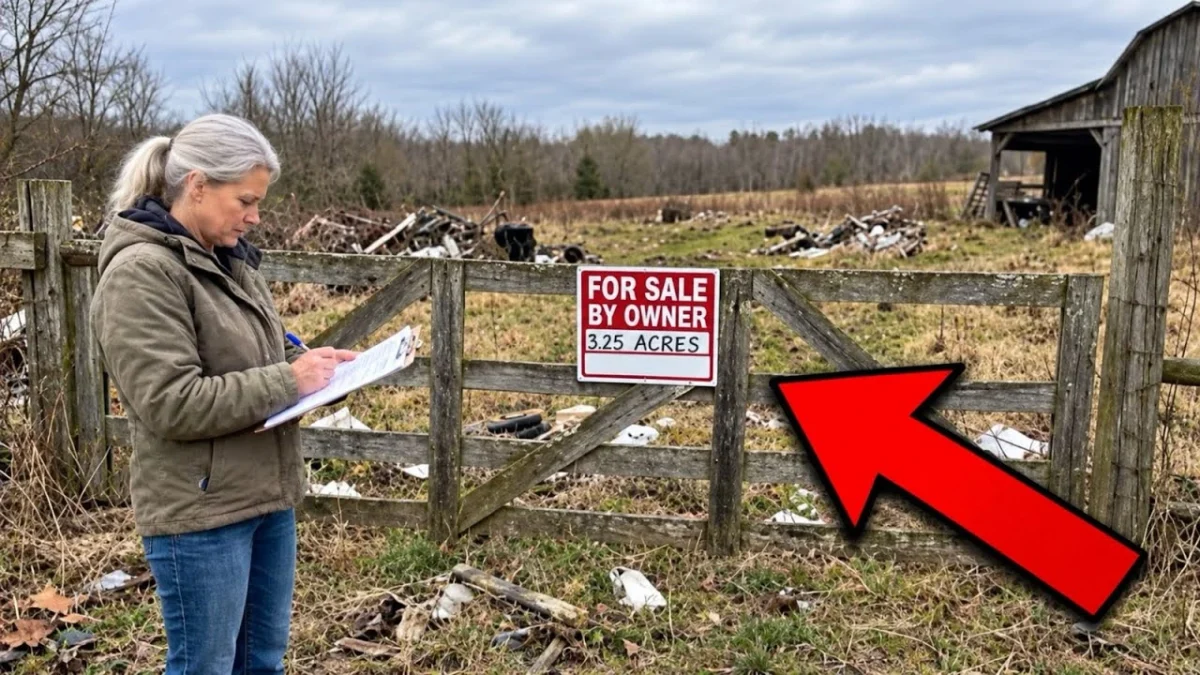
It was a chilly Tuesday afternoon in mid-March when she pulled up to the rusted front gate of the Voss place.
For eleven long years, the eighty-five-acre farm sitting on the desolate border of Cedar Hollow had remained completely abandoned.
The farmhouse roof swayed in the middle like the spine of a dying horse.
The big timber barn leaned heavily to the east, looking as though a strong gust of wind would finally collapse it into a pile of splinters.
Across the sprawling acreage, the fields were the dull, sickly color of an old dollar bill, choked with thick foxtail, thorny thistle, and an oppressive silence.
Margaret shifted the truck into park, killed the engine, and stepped out into the biting wind.
She was fifty-two years old, with silver streaks running through her dark hair and hands that bore the calluses of a lifetime of hard labor.
She had bought the entire property sight unseen through an online estate auction, relying only on four blurry photographs and a stubborn instinct she couldn’t quite explain.
Her friends in her hometown two hundred miles away had insisted she had lost her mind.
They reminded her that she had spent twenty-nine years working endlessly, raising two children alone after her husband’s early death, and managing a regional feed store.
When she finally sold the business and sat on a modest bank balance, everyone expected her to buy a quiet suburban cottage and retire comfortably.
Instead, she had spent her life savings on eighty-five acres of the most notoriously ruined dirt in the tri-county area.
Margaret reached into the bed of her truck and pulled out a heavy, steel soil probe.
The tool’s wooden handle was dark and worn smooth by decades of oil and sweat.
It had belonged to her grandfather, an immigrant who had left a small agricultural village in the Netherlands back in the 1950s to farm American soil.
She could still hear his thick accent echoing in her mind across the span of thirty years.
“The land does not forget who feeds it, Margaret,” he used to tell her while kneeling in the rich black earth of his garden.
“And it does not forget who starves it, either.”
Margaret walked past the decaying gate posts, her rubber boots sinking an inch into the stiff, cold mud.
She pushed the steel probe deep into the ground near the overgrown driveway and twisted the handle.
When she pulled it back up, the core sample inside the metal channel was pale, dense, and compressed like wet concrete.
There was no rich smell of humus, no crumbly structure, and not a single earthworm in sight.
She stared down at the pale clay, feeling a cold knot of anxiety tighten in her stomach.
“Well, Granddad,” Margaret whispered to the empty wind, wiping her damp forehead with the back of her sleeve.
“If you were here, you’d tell me I’ve got my work cut out for me.”
—
By Thursday morning, news of the purchase had swept through Cedar Hollow like wildfire.
In a town where a unfamiliar truck parked outside the feed mill for ten minutes was enough to fuel an hour of gossip, a middle-aged woman buying the ruined Voss farm was the biggest event of the spring.
Inside the crowded Cedar Hollow Diner, the smell of burnt coffee and sizzling bacon filled the warm air as local farmers gathered around the counter.
Hank Vance, a weathered man in his sixties who owned the hardware store down the street, poured a splash of cream into his mug and shook his head.
“She won’t last a single season,” Hank said, slamming his mug down onto the Formica counter.
“That ground has been dead longer than my marriage.”
A few older men sitting in the corner booth chuckled, nodding their agreement in unison.
“County ran a soil test on that place two years ago after the culvert washed out,” replied Jim Miller, a retired corn farmer who wore a faded grease-stained cap.
“Compacted clay, zero organic matter, and a pH so sour you couldn’t grow dandelions on it if you tried with a bucket of lime. The Voss family ran continuous corn on those hills for forty years without throwing down a single handful of manure or cover crop. It’s a dust bowl waiting to happen.”
“She’s an outsider,” Hank added, leaning back against the register.
“Probably thinks she can throw a few bags of synthetic fertilizer on it and turn it into a paradise. She’ll pack up and head back to the city before the August drought hits.”
Standing near the counter, waiting for her takeout order of black coffee and oatmeal, Margaret listened quietly to every word.
She didn’t turn around, nor did she raise her voice to defend herself.
She simply paid the waitress, picked up her cup, and walked out the glass front door into the crisp morning air.
She knew from experience that arguing with skeptical men was a waste of breath.
People always spoke the loudest about things they were afraid might actually succeed.
—
Instead of firing up a heavy tractor or ordering commercial chemicals, Margaret spent her first month doing almost nothing that looked like conventional farming.
Every morning at dawn, she laced up her boots and walked the boundaries of the eighty-five acres, studying the contours of the landscape under different weather conditions.
She noted the low spots where rainwater pooled and stagnated because the hardpan beneath prevented absorption.
She marked the collapsed fence lines where eastern red cedars had encroached upon the neglected pastures.
At the northern edge of the property, hidden behind a thicket of wild blackberries, she discovered an ancient, unpruned orchard consisting of twelve apple trees.
Their trunks were knobby and covered in gray lichen, and their canopies were choked with dead wood.
Yet, despite a decade of complete neglect, tiny pink and white blossoms were beginning to unfurl on the outer branches.
“Look at you,” Margaret said softly, gently touching a gnarled branch.
“Nobody cared for you for eleven years, but you’re still trying.”
She took soil samples from six different locations across the farm and sent them off to the state university extension office.
When the official laboratory report arrived in her mailbox two weeks later, the numbers were just as grim as the diner locals had promised.
Organic matter was sitting at a miserable 1.4 percent, compared to the healthy 5 or 6 percent typical of thriving native pasture.
The soil compaction extended nearly nine inches deep, creating an impenetrable barrier for plant roots and water infiltration.
That afternoon, a white pickup truck bearing the seal of the County Agricultural Extension Office pulled up the long driveway.
A young, sharp-eyed agronomist named David Reed stepped out, holding a clipboard and looking around at the choked fields with a sympathetic smile.
“Mrs. Holt?” David asked, extending his hand.
“I’m David Reed from the extension office. I reviewed your soil analysis on my drive over.”
“Call me Margaret,” she said, shaking his hand warmly.
“I take it the news isn’t great?”
David sighed, turning to look toward the swaybacked roof of the old barn.
“To be completely honest with you, Margaret, this is about as degraded as agricultural land gets in this county. If you want to raise anything commercial here, you’re looking at deep ripping the entire eighty-five acres with a heavy shank plow, applying massive doses of lime, and laying down heavy synthetic nitrogen treatments for at least three consecutive years. Even then, it’s a massive gamble.”
Margaret smiled gently, looking out over the brown hillside.
“I appreciate the honesty, David, but I’m not going to plow it, and I’m not buying synthetic fertilizers.”
David blinked, staring at her in sheer disbelief.
“Margaret, with all due respect, you can’t just plant seed in this hardpan. Nothing will germinate. The roots can’t penetrate the clay.”
“Then I’ll let something else break the clay for me,” Margaret replied calmly.
“Something with hooves and taproots.”
—
Three weeks later, a long cattle trailer backed down the driveway, kicking up clouds of dusty gravel.
The local diner crowd watched from the highway as the rear gate swung open, releasing eight elderly, thin dairy cows onto the overgrown pasture.
They were retired Holsteins and Jerseys, animals that local commercial dairies had culled because their milking years were long over.
Hank Vance pulled his truck over to the shoulder of the road, leaning out his open window to watch Margaret unload the herd.
“What are you doing with those old milkers, Margaret?” Hank called out, his tone half-amused and half-pitying.
“They won’t give you a gallon of milk between the lot of them!”
“I didn’t buy them for milk, Hank!” Margaret shouted back over the lowing of the cattle.
“I bought them for their four legs and their stomachs!”
Margaret immediately put her plan into action, utilizing high-density, short-duration mob grazing.
Using temporary electric polywire fencing, she confined all eight cows to a tiny quarter-acre paddock.
Instead of allowing the cattle to roam freely across eighty-five acres and graze the finest grass down to the bare dirt, she kept them crowded together for just twenty-four hours at a time.
The cows hungrily ate the top half of the tall weeds, but more importantly, their heavy hooves trampled the dead, dry vegetation into the surface of the soil.
They deposited rich dung and urine across every square foot before Margaret moved them to the next fresh paddock the following morning.
By late June, the summer heat began to bake Cedar Hollow, turning surrounding conventional cornfields pale and stressed.
But on Margaret’s farm, beneath the trampled layer of dead grass and manure, the ground remained cool and dark.
One hot afternoon in early July, Margaret knelt in a paddock that the cattle had trampled three weeks prior.
She pulled back the layer of decaying plant mulch and gasped softly.
Crawling through a moist cow patty were dozens of glossy, dark-shelled dung beetles, actively carving tunnels into the earth.
She reached down, her fingers picking up a handful of earth that felt noticeably cooler and softer than the surrounding hardpan.
Dung beetles were the unsung heroes of pasture restoration, burying organic waste deep underground where it could feed soil microbes rather than evaporating as ammonia gas into the dry air.
Their relentless tunneling created thousands of microscopic air shafts, aerating the compacted soil far more gently and effectively than any mechanical steel plow ever could.
“It’s working,” Margaret whispered to herself, feeling a rush of heat behind her eyes.
“The biology is waking up.”
—
In mid-July, Margaret took another radical step that raised eyebrows across the county.
She fenced off a six-acre section of land near the front road and planted a diverse cover crop mixture consisting of tillage radishes, crimson clover, and cereal rye.
As the weeks passed, the townspeople driving along the gravel road couldn’t help but slow down their vehicles to gape at the sight.
The tillage radishes produced massive taproots, thick as a man’s forearm, that drove straight down through two feet of dense, stubborn clay.
When the winter frosts eventually killed the radishes, those massive roots would rot in place, leaving deep, open subterranean channels that allowed autumn rain and future plant roots to penetrate deep into the water table.
Meanwhile, the crimson clover bloomed in vibrant shades of deep red.
The clover formed a symbiotic relationship with soil bacteria, pulling free nitrogen directly out of the atmosphere and fixing it into the root zone to nourish future crops.
By late September, Margaret used a heavy roller-crimper attached to her old tractor to flatten the tall cover crop, creating a thick, protective biological blanket over the six acres.
Even from the highway, the contrast was staggering.
While neighboring properties suffered from soil erosion and dust plumes, Margaret’s six-acre trial plot looked like a lush, dark carpet of organic matter.
One afternoon, David Reed drove his extension office truck back up her driveway, stepping out with a soil probe and an expression of pure curiosity.
“Mind if I take a quick core sample, Margaret?” David asked, pointing toward the crimson clover field.
“Be my guest, David,” Margaret said with a smile, leaning against the fence post.
David pushed his metal probe into the ground beneath the rolled cover crop.
To his utter astonishment, the probe slid smoothly into the earth with minimal resistance, sinking nearly ten inches deep.
He pulled the core sample out and held it up to the afternoon sun.
The top six inches were no longer pale, lifeless clay; they had transformed into a rich, dark brown crumbly soil that smelled earthy and fresh, like the floor of an ancient forest.
“I don’t believe it,” David muttered, crumbling a clod of dirt between his fingers.
“You’ve rebuilt nearly two inches of topsoil structure in less than six months without a single pound of commercial fertilizer.”
“Nature knows how to heal itself, David,” Margaret said softly.
“We just have to stop beating it into submission long enough for it to work.”
—
As autumn set in, Margaret turned her attention to the neglected structures on the property.
Her son, Daniel, a carpenter living two towns over, came home for a long weekend in October to help his mother stabilize the leaning barn before the winter snows arrived.
Armed with heavy pry bars, chains, and hydraulic jacks, Margaret and Daniel spent Saturday clearing out decades of accumulated debris from the rear section of the structure where the floorboards had rotted through.
“Mom, hand me that crowbar,” Daniel said, wiping sweat from his forehead as he pried up a section of soft, decayed pine flooring near the eastern wall.
With a loud, splintering groan, a heavy six-foot plank gave way, revealing a dark, square opening in the foundation below.
Daniel shone his flashlight down into the abyss.
“Hey, Mom,” Daniel called out, his voice echoing in the hollow space.
“There’s a hidden room down here. Looks like an old hand-dug root cellar.”
Margaret hurried over, taking the flashlight from her son and peering down into the stone-lined chamber.
The cellar was dry and cool, untouched by water or light for generations.
Daniel lowered himself through the opening, his boots landing on the dirt floor below, and held out his hand to help his mother down.
Sitting on a rough-hewn stone shelf against the back wall was a rusted tin box, wrapped tightly in thick oilcloth that had turned yellow and stiff with age.
Margaret reached out with trembling hands and lifted the box, carrying it up into the sunlight streaming through the open barn doors.
She carefully unwrapped the brittle oilcloth and pried open the rusted lid of the box.
Inside rested dozens of small, yellowed paper envelopes, neatly tied together with cotton twine.
Each envelope was hand-labeled in fading pencil script, bearing dates ranging from 1938 to 1948.
Margaret picked up one of the packets and read the handwritten words aloud:
*”Voss Family Heritage Flint Corn — Selection 1942. Deep drought resistant. Do not sell.”*
There were packets of bush beans, rare pole tomatoes, winter squash, and heirloom cereal grains that had completely vanished from commercial seed catalogs over half a century ago.
“My Lord,” Margaret whispered, clutching the packets to her chest.
“It’s a seed vault.”
She immediately contacted a regional non-profit seed preservation organization in state capital.
A team of agricultural historians arrived two days later to inspect the discovery.
They explained to Margaret that family seed lines like these, carefully selected over generations for specific local climate conditions, possessed invaluable genetic traits that modern commercial hybrids had lost.
They contained natural drought tolerance, pest resistance, and deep flavor profiles that industrial agriculture had sacrificed in favor of uniform size and long shipping durability.
The botanists placed samples of the sixty-year-old corn seeds into climate-controlled germination chambers.
A week later, the lead researcher called Margaret, his voice shaking with excitement over the phone line.
“Margaret, over thirty-five percent of those flint corn seeds sprouted,” he announced.
“For open-pollinated seeds stored in a barn cellar for over sixty years, that is an absolute miracle. You are holding a piece of agricultural history.”
The local county newspaper picked up the story, running a front-page feature article titled: *Woman Restoring Abandoned Farm Unearths Lost Heirloom Seed Vault.*
For the first time since she had arrived in Cedar Hollow, people stopped talking about Margaret Holt as a foolish outsider who was bound to fail.
—
When spring returned to Cedar Hollow the following May, Margaret was ready.
She prepared a quarter-acre plot using her regenerated, earthworm-rich soil and carefully planted three hundred seeds of the resurrected Voss family flint corn.
She also spent weeks carefully pruning the wild twelve-tree apple orchard, removing dead wood and opening up the tree canopies so sunlight could reach the inner branches.
By mid-summer, the results were nothing short of extraordinary.
While conventional corn fields across the county struggled through a hot, rainless July, Margaret’s heirloom flint corn grew tall, robust, and deep green, its massive root system reaching deep into the moisture-retaining soil she had spent a year building.
The ancient apple trees, pruned and nourished by the revived soil biology, produced hundreds of bushels of crisp, deep-red heritage apples that hadn’t been tasted in the county for over twelve years.
A regional heritage fruit society identified two of the twelve trees as rare “Black Oxford” and “Roxbury Russet” varieties—apples considered functionally extinct in commercial nurseries.
By October, exactly one year after Margaret had purchased the ruined property, the transformation of the Voss place was undeniable.
The fields that had once been the dull, dead color of an old dollar bill were vibrant, deep green pastures that held moisture even through the autumn heat.
The county extension office performed an official follow-up soil assessment as a courtesy.
The results showed that organic matter had jumped from 1.4 percent to an astonishing 3.8 percent in just twelve months.
Earthworm counts had risen from zero to over fourteen fat earthworms per square foot in the mob-grazed pastures, a number rivaling pristine native prairie soil.
Recognizing the monumental achievement, the Cedar Hollow Town Council voted unanimously to hold the county’s annual Fall Harvest Festival on Margaret’s farm that autumn.
On a crisp, sunny Saturday morning in mid-October, dozens of pickup trucks and family cars lined the long gravel driveway that had once been so quiet and deserted.
Children laughed as they ran through the rows of tall, golden flint corn, while families gathered around wooden picnic tables set up near the stabilized timber barn.
Margaret stood near the orchard, watching the townspeople enjoy the land she had poured her soul into.
Hank Vance walked up to her, holding a wooden basket filled with crisp Roxbury Russet apples.
The old hardware store owner looked down at his boots, shifting his weight uncomfortably before looking Margaret in the eye.
He reached into his pocket, pulled out a dried ear of the deep-red Voss flint corn, and rolled a smooth kernel between his calloused fingers.
“Margaret,” Hank said softly, his rough voice carrying a rare tone of genuine humility.
“I spent forty years thinking I knew everything there was to know about dirt in this county.”
He looked out over the thriving green pastures, sweeping his arm toward the bustling crowd of families.
“I was wrong about this place,” Hank continued quietly.
“And I was dead wrong about you. What you’ve done here in a single year… it’s nothing short of a miracle.”
Margaret smiled gently, placing a hand on the old farmer’s shoulder.
“It wasn’t a miracle, Hank,” Margaret replied softly, looking up at the clear blue sky.
“It was just patience, biology, and listening to what the ground was trying to tell us all along.”
Later that afternoon, a middle-aged woman approached Margaret holding a freshly baked apple pie made from the orchard’s harvested fruit.
She introduced herself as Clara Vance, a distant grand-niece of the original Voss family who had built the farm in the early 1900s.
Tears welled in Clara’s eyes as she looked at the restored barn and the thriving crops.
“My grandfather always talked about this land before he passed,” Clara said, her voice shaking with emotion.
“He broke his heart when the bank took it, and he always believed no one would ever care for it again. If he were here today to see this… he would be so proud.”
As the sun began to set behind the western hills, casting a warm, golden glow over the eighty-five acres, the crowd slowly dispersed, leaving Margaret standing alone near the edge of her pastures.
The Voss place was still a work in progress.
Restoring land that had been pushed so far into depletion would take another four or five years before it stabilized completely into a sustainable, profitable farm.
She knew she was only at the beginning of a long journey.
But as she looked down at the dark, rich soil beneath her rubber boots and listened to the gentle lowing of her cattle resting in the lush green grass, Margaret Holt knew she had found her home.
The conversation in the Cedar Hollow diner had officially changed.
No one was asking whether Margaret Holt would last the season anymore.
Instead, local farmers were pulling up to her fence line, asking for advice on how they might begin healing their own tired ground.
Because if Margaret’s first year had proven anything to the world, it was that no piece of land is ever truly dead.
It is only ever waiting for someone stubborn enough, patient enough, and loving enough to remember it was worth saving.








