She Crawled to His Porch Half-Frozen — The Rancher Carried Her Inside and Barred the Door
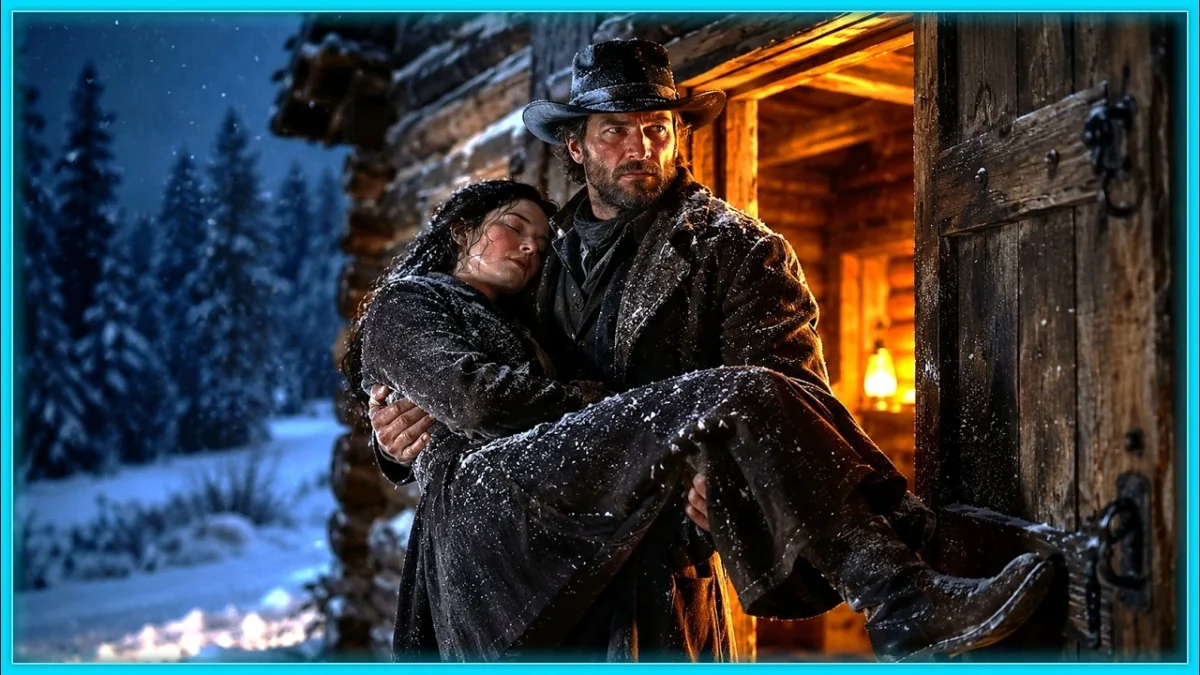
The world had been entirely erased by white.
There was no trail, no boundary line, and no distinction between the earth and the frozen sky above it.
To the north, the jagged peaks of the mountain range were swallowed completely by the blinding fury of the blizzard.
To the south, the lower valley tracks had long since vanished under drifting layers of wind-driven ice.
All that remained of the upper wilderness was the merciless, screaming gale and the relentless, biting cold.
The cold had been working on her for hours, clawing through her coat, freezing her fingers, and turning her breath into brittle shards of ice.
Merin Volg dragged one knee up onto the heavy wooden porch steps, then forced the other to follow.
She could not feel her feet, had not felt them since she crossed the frozen creek two miles back down the winding ridge.
Her coat, a garment of thick, good wool that had once kept her warm in a life that felt a lifetime ago, was soaked completely through at the shoulders before freezing solid in the wind.
Her hair had come loose from its braid hours ago, and now it lay plastered against her neck in dark, frozen ropes that felt like iron cables.
She did not even know whose cabin this was, nor did she care.
She had seen the chimney smoke from half a mile out—a thin, gray thread unraveling helplessly into the white sky—and she had steered toward it the way a drowning woman steers toward anything solid.
She reached the heavy wooden door, stumbling heavily against the rough frame.
She could not make a fist to knock, her fingers being swollen and stiff with frost, so she pressed her open palm flat against the timber and pushed twice, then a third time with all the weight she had left.
Then the door swung open, and the sudden wash of indoor light hit her eyes like a physical blow.
Travis Kel had his heavy rifle gripped in his hand before he was even fully awake.
He had heard something on the porch moments before—not the heavy, lumbering stumble of a man, not the sharp scratch of a wild animal, but something right in between.
That middle category was the one that made a man cautious, suspicious, and ready for trouble in these mountains in the dead of winter.
He yanked the door open wide with the steel barrel leveled and steady.
What he found on his threshold made him lower the weapon in a single, stunned breath.
It was a woman, barely standing, her body leaning heavily against the exterior wall.
Her eyes were wide open but completely unfocused, and her lips were the dark, bruised color of winter frost.
She was pressed against his door frame as though it were the only solid thing left in the entire world, and maybe, for her, right then, it truly was.
He caught her right before her legs gave out and she slid down into the snow.
She weighed almost nothing.
That was the very first thing that registered in his mind—not her face, not her tattered clothes, and not the bewildering question of how she had managed to get here twelve miles from the nearest town in a blizzard that had been building since sunrise.
Just the stark fact that she weighed almost nothing and that her skin, where his hand accidentally brushed the back of her neck, was as cold as a stone pulled from the bottom of a frozen creek.
Travis brought her inside instantly, kicked the heavy door shut with his boot heel, and threw the thick iron bar across it with one elbow, obeying an old, ingrained habit of survival.
He carried her directly to the narrow cot near the roaring iron stove and laid her down with practiced gentleness.
Then he crouched and built the fire up fast, his mind bypassing panic and going straight to the mechanical tasks that needed doing.
More dry oak wood into the belly of the stove, damper pulled wide open to draw the flame.
He pulled every single blanket he owned off the storage shelf—two thick wool blankets and one faded patchwork quilt his mother had sewn by hand years ago—and layered them heavily over her shivering frame.
Her eyes moved beneath her pale lids, not quite open, not quite closed, fluttering in a haze of exhaustion and hypothermia.
“You’re inside now,” he said, keeping his voice low, steady, and even, the exact tone he used when approaching a spooked, wild horse in the pasture. “You’re warm now. Just stay still and let the heat do its work.”
She muttered something unintelligible, her jaw trembling violently.
Travis leaned in close, bringing his ear near her lips to catch the faint sound.
“He’ll come,” she whispered, the words barely carrying over the crackle of the stove.
Travis sat back slowly on his heels.
He looked at her face for the first time with real, searching attention.
He noticed the dark, ugly shadow beneath her left eye that wasn’t quite a shadow, the instinctive way she held her arms crossed tightly over her middle even while unconscious, the defensive posture of a woman who had learned the hard way how to protect herself from the world.
He understood then, without needing a single explanation, what kind of cold she was actually running from.
“Let him,” Travis said quietly, his voice like flint striking steel. “There are bars on the door and a roof over your head.”
She did not answer him.
She had already drifted somewhere between shallow sleep and something much deeper, but the sharp, tense line between her brows had softened just slightly, and he took that small change for what it was worth.
He sat down in the wooden armchair by the stove and did not intend to sleep a wink.
He set a heavy iron pot of water on the hot surface to heat and rummaged through an old wooden chest by the wall until he found a soft flannel shirt.
With his pocketknife, he carefully tore long strips from its tail to use as clean bandages.
Her frozen boots came off stiffly, the leather swollen and misshapen with ice and moisture.
He worked slowly, carefully checking each of her toes for the white, waxy patches that signaled permanent tissue damage that wouldn’t repair.
Fortunately, her feet were red, swollen, and painfully cold, but nothing worse.
He wrapped them securely in the strips of soft flannel and then pulled on an extra pair of thick wool socks that he usually kept reserved for the deepest, most biting nights of winter, drawing them up high over her ankles before tucking the heavy blankets snugly back around her.
She stirred once at the movement, but she did not wake up, and he was profoundly glad of that.
A woman who was that thoroughly exhausted needed deep, uninterrupted rest far more than she needed to answer questions or listen to him talk.
He trimmed the oil lamp down low so it cast a warm, amber glow across the room, settled back into his chair, and listened to the howling storm press its icy weight against the heavy wooden shutters.
—
Maren woke to a muted gray light filtering through the cracks of the shutters and the comforting, familiar smell of pine smoke, roasting coffee, and dry wood.
For a disorienting moment, she did not know where she was, and her entire body went rigid with terror beneath the heavy blankets.
Then memory rushed back in a sharp wave—the endless white storm, the treacherous porch, the heavy door, and the quiet man who had pulled her from the snow.
She turned her head carefully on the pillow.
He was standing at the far side of the room near the stove, his back turned to her, broad-shouldered in a worn flannel shirt, moving with the unhurried, economical grace of a man who had long ago made his peace with complete solitude.
He had not heard her wake, or if he had, he was deliberately giving her the quiet grace of a moment to gather herself in peace.
She studied the interior of the cabin with sharp, evaluating eyes.
One sturdy door, heavily barred.
One window, securely shuttered against the fierce gale outside.
A clean hunting rifle resting on wooden pegs directly above the mantelpiece.
It was a neat, sparse dwelling, the home of a man who lived entirely by himself and had found a quiet dignity in the isolation.
She looked down and noticed her feet were carefully bandaged.
She hadn’t noticed it until she tried to flex her toes and felt the stiffness of the cloth wrappings holding the warmth in.
He had tended to her injuries while she slept without waking her up or making her feel small.
The realization should have frightened her, given everything she had fled from, but it didn’t.
Instead, it made something deep inside her chest ache in a way she hadn’t felt in longer than she cared to admit.
“Coffee’s ready,” he said without turning around from the stove. “Take your time, there’s no rush here.”
His name was Travis Kel, as she would soon learn when he brought her a steaming tin cup, but he didn’t offer any unsolicited stories about himself until she was fully ready, a discretion she appreciated more than words could express.
He brought the coffee over, sat down in the wooden chair across from the cot, and sipped his own brew while gazing quietly into the fire.
The silence between them was not the heavy, awkward kind that demanded desperate filling; it was comfortable, steady, and safe.
Eventually, she told him her name, her voice raspy and thin from the cold air she had breathed.
She told him where she had come from—a lonely homestead two days east near Barrow’s Crossing.
She told him about Silas Kray, sharing only small, guarded pieces of the truth, the way a person talks about something with dangerously sharp edges, careful not to cut themselves on the memory again.
Silas Kray had arrived in Barrow’s Crossing the previous spring with a charming smile and a smooth tongue.
He had seemed steady enough at first, making all the right social overtures and projecting an image of a respectable, reliable man.
By mid-summer, Maren had slowly begun to understand the terrible mistake she had made by trusting him.
By autumn, she had stopped making any mistakes at all because the physical and emotional cost of a single mistake had simply become too high to bear.
She did not say anything more than that, and she didn’t need to.
Travis listened the way a mountain listens—still, solid, and deep, absorbing every word without passing premature judgment or giving anything away unnecessarily.
When she finally finished speaking, he set his tin cup down on the floor beside his chair with a soft thud.
“How long has it been since you left that place?” he asked quietly.
“Three days,” she replied, staring into the dark grain of the wooden floor.
Something flickered behind his eyes, a brief shadow of realization.
It wasn’t pity—she knew she couldn’t have borne pity from a stranger—it was something much harder, quieter, and infinitely more practical.
“He’ll track you,” Travis said, stating it not as a threat or a guess, but as an absolute law of nature.
“He’s good at it,” she murmured, glancing nervously toward the barred door. “I walked right through the middle of the freezing creek for a mile to break my trail and confuse any dogs, but Silas is patient, and he doesn’t give up easily.”
Travis nodded slowly, his expression unchanging.
He stood up, walked over to the shuttered window, checked the latch without opening it to the cold, and then walked back to his seat.
“The weather report before the storm hit said this system is supposed to hold for two more days,” he said evenly, “maybe three if the wind shifts north.”
“I’m sorry to be such a terrible burden to you, Mr. Kel.”
He looked at her then, directly and unblinkingly, for the first time since she had woken up.
His eyes were the exact gray-green of the high mountain pines in November, and there was no trace of judgment in them, only a settled, immovable certainty.
“You’re not a burden,” Travis said firmly. “You’re a human being who needed a door, and I happened to have one that wasn’t locked. That’s all this is.”
She believed him.
That was the strangest, most foreign part of it all.
She believed him immediately, completely, and without an ounce of reservation, and she couldn’t for the life of her remember the last time she had believed anyone that quickly or that thoroughly.
—
The storm held its icy grip over the valley.
Three full days passed in the muffled, heavy hush of continuous snowfall.
Travis was a man of very few words and exceptionally careful actions, but his presence was a steady anchor in the room.
He brought her hot vegetable soup twice a day, kept the iron stove well-fed with seasoned oak, and checked the window latches each morning with his rifle resting easily and familiarly in his hand.
He did not pressure her to talk or demand answers she wasn’t ready to give.
When she was finally strong enough to get up and move around the cabin, he made space for her naturally without making a production out of it, pushing his armchair out a few more inches and shifting his belongings so she could reach the washbasin easily.
On the second day, she insisted on helping him with the morning chores, feeding the two sturdy horses he kept in the covered lean-to stable attached to the back of the cabin, and breaking the thick layer of ice off the wooden water trough.
She worked right alongside him in the biting, sub-zero air, and she found that the physical labor steadied her racing thoughts.
Her hands had finally stopped shaking.
Her feet, wrapped now in a pair of his thick wool socks that were far too large for her, had regained most of their feeling through the gentle warmth.
There was something deeply clarifying about doing hard, simple work in cold air; it gently returned a person to themselves, reminding them of their own agency.
She had forgotten that feeling during the long, suffocating months under Silas’s roof.
In fact, she had forgotten a great many things about who she used to be before Silas Kray had taken up every available inch of space in her life.
He caught her watching the silent, snow-covered tree line once from the open stable door while the horses chewed their hay.
“You see something out there?” Travis asked, pausing with a pitchfork in his hands.
“No,” she said softly, her breath pluming white in the freezing air. “I just keep looking.”
“That’s how it works after you run,” he said, his tone lacking any mockery. “I understand that completely. But you’re allowed to stop looking over your shoulder for at least a minute while you’re under this roof.”
She tried to follow his advice, though she quickly found it was much harder in practice than it sounded in theory.
That very afternoon, he showed her where he kept his extra boxes of ammunition, and he did it without any dramatic ceremony, simply pointing to a high wooden shelf above the door frame and telling her there were two more boxes behind the flour tins so she would know where to find them if she ever needed them.
She understood what he was communicating without him having to spell it out in plain terms.
He wasn’t just hiding her away from the world; he was actively arming her and trusting her with her own defense, and the difference between those two approaches was not small.
On the third evening, they sat together by the warm fire after finishing a supper of hearty venison stew and thick cornbread he’d baked from scratch—simple, plain, and profoundly good.
She hadn’t eaten food that honest and nourishing in a very long time.
After clearing the wooden bowls, Travis brought out a worn, softened deck of playing cards, and they played quiet, two-handed games that she half-remembered from her childhood days.
The fire popped softly in the hearth, the heavy storm pressed against the reinforced shutters outside, and for a little while, she felt something she had nearly forgotten was even possible in this life.
She felt safe.
His warm hand accidentally brushed and covered hers across the table at one point when she fumbled the dealing of the cards, and he quickly steadied the deck for her.
He pulled his hand back the instant the cards were settled in her grip—a small, respectful gesture, but it meant a great deal to someone who was used to hands that only touched to control or hurt.
“Thank you,” she said, looking down at the wooden table. “For all of it—the food, the shelter, the quiet.”
“You already said thank you yesterday.”
“I mean it again today.”
He smiled then, just slightly, the corners of his gray-green eyes crinkling against the firelight. “I know you do.”
—
She slept soundly that night without waking once from bad dreams, and in the morning when she woke to the same muted gray light, the same pine smoke, and the same steady man moving quietly around the stove, she lay still for a long moment and let herself fully feel it.
It wasn’t outright happiness, not yet, but it was the fragile, beautiful possibility of it.
It was the sudden recognition that the ground beneath her feet might actually hold firm instead of giving way.
Travis was standing at the window before dawn on the fourth day, peering intently into the gloom.
He’d heard something subtle over the dying wind—not the familiar voice of the storm, which he knew as well as his own name, but something with real, deliberate weight to it.
It was the sound of a horse moving slow and calculated, picking its way carefully through the deep drifts of the mountain pass.
He dressed quickly and quietly, pulling on his heavy coat and boots, and took the rifle down from its wooden pegs above the mantel.
He didn’t wake Maren just yet; instead, he crept to the window and gently eased the wooden shutter open by a fraction of an inch.
There was one lone rider coming steadily up the south trail—the main path that connected this remote, forgotten hollow to the main wagon road twelve miles down the mountain.
The man rode with his wide-brimmed hat pulled low against the blowing snow and his shoulders hunched against the gale, but there was nothing beaten or exhausted about the way he sat his saddle.
There was cold, calculated intention in every rigid line of his posture.
Travis turned and woke Maren with a firm, steady hand on her shoulder, his face calm and unshakeable.
“Stay back from the front door,” he whispered urgently. “Stay flat against the far wall by the pantry.”
She was fully awake in a fraction of a second, having been sleeping like a woman who never truly allowed herself to let her guard down.
She looked into his eyes and understood instantly.
“Is it him?” she asked, her voice barely a breath.
“One rider, coming up the south trail,” Travis replied, holding her gaze steadily. “You stay by that back wall. I mean it, Maren.”
She nodded once.
Her face had gone deathly pale, but her jaw was firmly set.
She reached down and grabbed the heavy iron fireplace poker from beside the hearth without being asked, holding it tightly at her side.
In the half-second before he turned his attention back to the door, Travis thought that Maren Volg was easily one of the strongest, bravest women he had ever encountered in his entire life.
—
The knock came hard and sharp—three heavy, rhythmic blows delivered with the heavy butt of a riding crop, the kind of sound specifically meant to intimidate anyone on the other side of the timber.
Travis stood squarely at the door with the iron bar still firmly across it and the hunting rifle held ready in his hands.
He did not open it immediately, choosing instead to let the heavy silence stretch out like an invisible wall.
“Open up in there,” a voice called out from the freezing porch.
The voice was flat, commanding, and utterly certain of itself—the voice of a man who was completely unaccustomed to being denied anything he wanted.
“State your business at this door,” Travis called back, his tone unwavering.
“I’m looking for a woman who goes by the name of Maren,” the man outside snapped. “She belongs to me, and it’s time she came back home.”
The word *belongs* landed inside the cabin like a heavy stone dropped into still, quiet water.
Travis felt the ripple of anger pass through him, but he kept his expression completely neutral, refusing to let the insult touch his face.
“No one in this house belongs to anyone,” Travis replied loudly, his voice echoing off the timber walls. “That is not how things work out here in the mountains.”
A cold pause followed outside on the porch.
Then the voice returned, dripping with condescension: “You don’t understand what you’re dealing with, friend. Open this door before I kick it off its hinges.”
“I am not your friend,” Travis said calmly.
His voice didn’t rise in volume, nor did it need to; there was a quiet, heavy quality to it that effortlessly filled the small room—flat, immovable, and dangerous.
“And I know precisely what I’m dealing with. I’m talking to a man who put his hands on a woman to control her, and then rode twelve miles through a raging blizzard because his pride couldn’t stand the fact that she had the courage to get away from him.”
Absolute silence hung from the porch for a long, agonizing moment.
Travis could hear the muffled sound of the stranger’s horse shifting restlessly in the deep snow outside.
“She’s a lying, ungrateful thief,” Silas Kray shouted back, his polished facade cracking just a fraction. “Whatever she told you inside that cabin—”
“She told me plenty,” Travis interrupted.
He moved swiftly to the side window, the one angled toward the southern approach, and eased the shutter open just enough to see.
He kept the rifle visible through the gap—not actively aimed or frantically threatening, just calmly present as a reminder of reality.
“I’m going to tell you exactly one time, Kray. You are going to turn that horse around right now. You’re going to ride back down that trail the way you came. And in the spring, when the mountain snow finally breaks and the roads clear, I’m going to ride down to the county seat myself and have a long conversation with the sheriff about what I know regarding your homestead. That is how this ends.”
Another silence followed, much longer and heavier this time, laden with suppressed fury.
“She’s not worth freezing to death over,” Kray muttered finally, his voice shifting—flatter, uglier, and completely stripped of its polite veneer. “Keep the ungrateful bitch if you want her so bad.”
“Wrong again,” Travis replied softly. “But we are completely done talking.”
He heard the creak of leather as the horse turned in the snow.
He kept his eye pressed to the narrow slit of the window until the lone rider had retreated down the south trail and been swallowed completely by the dense, white curtain of the tree line.
Even then, Travis waited another full ten minutes in complete silence before he lowered the rifle.
He was a patient man who had learned through bitter experience never to trust a quiet that arrived too quickly.
Then he turned his back to the window and stepped back into the main room.
Maren was still standing rigidly against the far wall exactly where he’d told her to stay.
The heavy iron poker was still clutched white-knuckled in her hand.
She had not made a single sound the entire time, standing there straight and still, her breathing controlled by sheer willpower alone.
He could plainly see what that kind of terrifying tension had cost her in the dark circles around her eyes.
Travis crossed the cabin floor and stopped a few feet in front of her.
He didn’t reach out to touch her or crowd her space; he just stood close enough so she could see his face clearly in the firelight.
“He’s gone,” Travis said quietly. “He turned the horse around.”
Maren let out a long, shuddering breath that seemed to come from somewhere deep inside her soul.
“He’ll be back when the thaw comes,” she whispered, her voice trembling. “Men like Silas don’t ever truly stop hunting what they think they own.”
“Then we’ll be ready for him when he tries,” Travis answered with absolute conviction. “And come spring, the sheriff will know his full name and what he’s done. A man who rides twelve miles in this kind of lethal weather just to terrorize a woman who made it clear she doesn’t want him—that’s a man who leaves tracks. He can’t hide what he is forever, Maren.”
She looked up at him for a long, searching moment.
The heavy iron poker slowly lowered from her grip and tapped softly against the floorboards.
“Do you really believe that?” she asked, searching his eyes for any sign of doubt.
“I do,” Travis said, holding her gaze without flinching. “And I need you to find a way to believe it, too.”
She gave a small, almost imperceptible nod—a modest physical motion, but it was entirely real.
Travis reached out then, very carefully, and took the heavy poker from her numb hand, leaning it gently against the rough wooden wall.
Instead of stepping away, he kept hold of her hand—just that, just her hand resting safely in his calloused palm.
Both of them stood together in the firelit cabin while the snow continued to press soft and heavy against every exterior wall.
“You’re safe here now,” he said softly. “Not just for today, and not just while the storm blows. We’re going to make damn sure of it.”
She didn’t answer him right away.
She looked down at their joined hands, then over at the heavily barred front door, and finally back up at his weathered face.
Something inside her mind shifted—not broken, not collapsed under the weight, but finally settled.
She looked like a woman who had been fiercely braced against a howling gale for so long that she had entirely forgotten what it felt like to stand upright without having to fight for every single breath.
She squeezed his hand back once—firmly, steadily, and with quiet resolve.
“All right,” she whispered, a ghost of a smile touching her lips. “I believe you.”
Outside the cabin, the snow continued to fall in thick, quiet sheets, burying the tracks on the south trail, softening the dark line of the trees, and blanketing the entire vast and silent mountain in a cloak of white peace.
Inside the warm room, the hearth fire held steady, the heavy iron bar remained firmly across the door, and a woman who had crawled to a stranger’s porch half-frozen stood in the warmth of his hand and let herself, for the first time in longer than she could measure, simply breathe.








