She Found Blueberries and Blackberries Everywhere… Then Built a Business
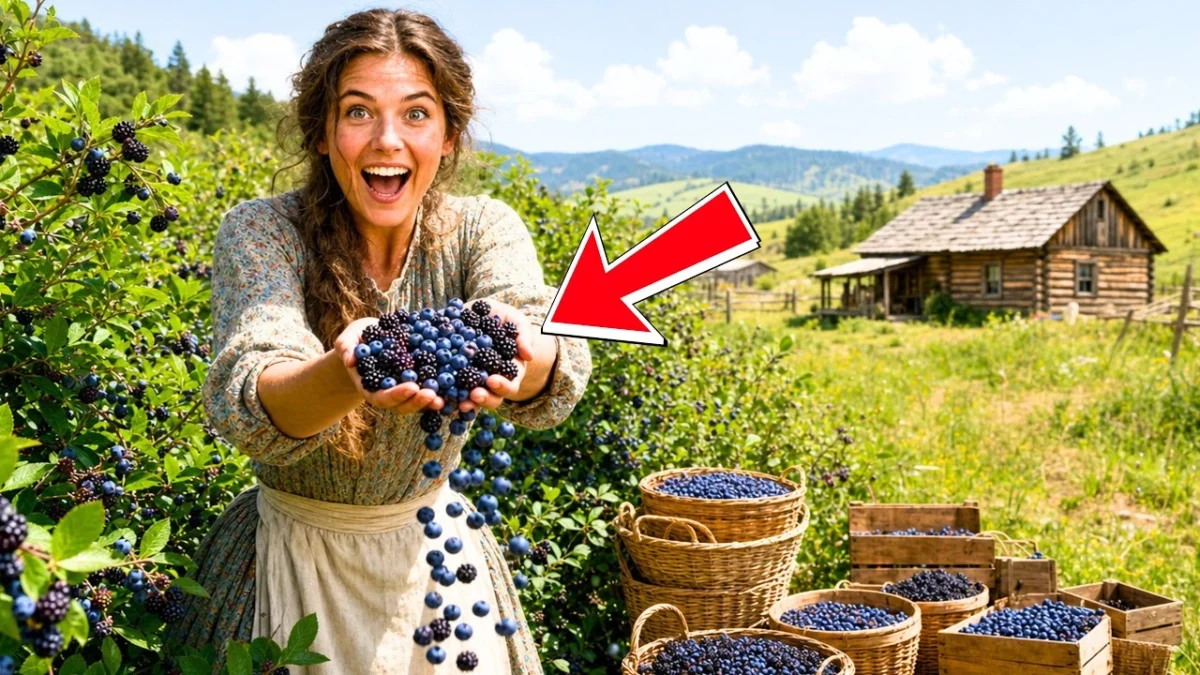
The afternoon sun pressed flat against the dry Wyoming plains, casting long, pale shadows across the dirt road that stretched into nothingness.
Ada stood motionless, watching the small wooden wagon shrink into the horizon.
She did not call out.
She did not reach after it.
She simply listened to the rhythmic, metallic creak of the iron-rimmed wheels fade into the dry air until there was nothing left but the wind rustling through the yellowed bunch grass and the steady sound of her own breathing.
In her right hand, she held a small canvas trunk latched with a twisted loop of rusty wire.
In her apron pocket rested eleven coins, counted twice already that morning, adding up to less than a dollar and a half.
Behind her stood the empty timber house the family had rented for the season, stripped entirely clean of every curtain, every iron pot, and every stick of furniture they had bothered to claim as their own.
They had not even waited for the late summer harvest.
“They’re gone, Ada,” she whispered to herself, her voice barely carrying over the wind.
“They’re gone, and you are still here.”
Ahead of her lay the main road into Berry Creek, a quarter-mile stretch of pale dust with no particular promise at the end of it.
She was twenty-two years old.
She had worked for that family since the cold damp of February, cooking over green wood, mending thick work trousers, and hauling heavy cedar buckets of water from the creek for wages that were always almost enough to live on.
She had told herself every night that she was saving something for the future.
She had told herself the arrangement was temporary, that she would find her footing as soon as the weather turned warm.
Now, the road was empty, and the work was finished.
She shifted the weight of the canvas trunk, took a deep breath of the pine-scented air, and began to walk.
Berry Creek was the kind of settlement that was either about to become something real or about to fade into the sagebrush.
It consisted of a single general store with a sagging porch, a two-story boarding house painted a dull brown, a livery stable smelling of damp straw, a church without a steeple, and a handful of raw timber buildings doing their absolute best to look permanent.
Ada knew a few faces there from her brief Saturday trips into town.
They were not friends, merely people who had nodded at her from across a dry-goods counter or stepped aside to let her pass on the narrow boardwalk.
She reached the edge of the main street and stopped beside the hitching post outside the livery, setting her trunk down on the dry earth.
She looked up at the sky.
It was late July.
The light held that particular quality she had come to recognize over the years—golden still, generous still, but leaning noticeably toward the south.
It lacked the reckless, endless brightness of June, when the days seemed as if they would never close.
This was a summer that knew its time was short.
In six weeks, perhaps eight if the mountain gods were kind, the first cold air would roll down off the ridges, settle into the hollows, and kill everything tender.
Six weeks.
She had eleven coins, two cotton dresses, a wool blanket, a small iron pocketknife, and no roof above her head.
She sat down on a weathered wooden bench outside the livery stable, resting her hands on her lap.
She forced herself to think carefully, the exact way her mother had taught her to think when the winters got lean—not about the fear that made her chest tight, but around it, looking for the physical edges of the problem.
“What do you actually have, Ada?” she asked herself softly.
She had her hands.
She had her health.
She had the remaining weeks of summer.
She turned her head and looked toward the jagged hills rising dark green and gold behind the settlement.
The high ridges were still bathed in brilliant afternoon light.
Ada picked up her canvas trunk, turned her back on the main street, and walked toward the mountain slope.
The path leading upward was not a true road.
It was merely a suggestion, a faint thinning of the mountain brush where boots had pressed the wild grass down years ago, and the land had never quite forgotten the burden.
She followed it because it was the only direction that moved away from the town’s quiet judgment.
She pulled her trunk by its worn rope handle, the leather strap beneath it smooth against her calloused palm.
She had fashioned two small, crude wheels from flat river stones wedged underneath the wooden frame, but they did little to lessen the drag against the steep incline.
Her shoulders began to burn after the first hundred yards.
The light slanted through the tall ponderosa pines in long, golden columns, and somewhere high above her, a mountain jay called out once before falling silent.
She stopped twice to breathe.
She did not rest—she merely breathed.
Resting meant setting the burden down completely, and she was not yet ready to set anything down.
Then the dense timber suddenly opened up.
Ada stepped through the final thicket of chokecherry bushes and stopped dead in her tracks, unable to make sense of what lay before her.
The mountain meadow spread out in a wide, shallow bowl, spanning three or four acres, cupped securely by steep pine ridges on three sides and open to the vast blue sky on the fourth.
The ground was not green.
The ground was an overwhelming tapestry of deep blue, velvet purple, bright red, and dark indigo, rolling in thick, heavy clusters across the entire floor of the valley.
It was broken only by tall mountain grass and the small white disks of wild clover.
There were wild blueberries clinging low to the damp soil, huckleberries growing slightly taller and darker, and massive blackberry brambles arching along the eastern ridge in dense, thorned canes heavy enough to bow down to the earth.
Ada let the rope handle slip from her fingers.
The canvas trunk dropped into the dirt with a soft thud.
She walked forward as if she were afraid the vision might shatter if she stepped too hard.
She crouched near a low bush, cupped a heavy branch in her hand, and stared at the fruit.
Dozens of berries hung from a single stem, each one fat, dark, and dusted with a delicate white bloom of freshness.
They grew so thickly that the green leaves beneath them were nearly hidden.
She picked a single blackberry, placed it in her mouth, and closed her eyes.
It was sweet—intensely, purely sweet—with just enough sharp tartness underneath to give the flavor weight.
She stood up slowly, turning in a full circle as the mountain breeze rustled her skirts.
“This is real,” she whispered to the empty air.
“Nobody is picking this. Nobody even knows it’s here.”
As her eyes traced the edge where the meadow met the dark treeline on the far side, she spotted a dark silhouette nestled under the pines.
It was a cabin.
It sat so quietly against the dark bark of the trees that she had missed it at first glance.
It was a small structure, perhaps built by a lone trapper or miner a decade prior.
The heavy wooden door hung half-open on a rusted, broken hinge, swaying an inch back and forth in the wind like a lung breathing.
The cedar-shingle roof sagged heavily on the western side where a main crossbeam had split under some forgotten winter snow, and the wooden shutter on the single front window was split completely down the middle.
Yet, the main walls were standing tall, constructed from thick, hand-hewn logs chinked with dry mud, solid and square at the base.
The door frame itself remained perfectly plumb.
Someone had built the foundation with deep care, and the heart of the building had endured.
Ada walked across the meadow, her boots crushing wild berries that released a rich, sweet perfume into the warm air.
She reached the doorway, placed her flat hand against the rough timber frame, and felt the sturdy, unyielding wood.
She stepped inside.
The wooden floorboards creaked beneath her boots, but they held her weight without yielding.
She looked up at the sagging roof structure, measuring the gap with a practiced eye.
Then she turned back toward the open doorway, looking out over the endless sea of purple and blue stretching all the way to the horizon.
“Six weeks,” she said aloud, her voice firm in the silent cabin.
“Six weeks until the frost.”
She set her basket on the rough floor, rolled her linen sleeves up past her elbows, and got to work.
The entire first day was spent on the roof.
Ada walked along the edge of the pine grove until she found a massive downed pine tree that had been dry-rotting in the shade.
She peeled off huge sheets of tough bark in long, fibrous slabs using her pocketknife.
Deeper in the woods, she discovered three long pine boards from a collapsed lean-to, the wood weathered gray by years of rain but still structural and sound.
She hauled the boards back in heavy armloads, her arms aching from the strain.
Using branches lashed together with tough mountain vines, she constructed a short, rigid ladder.
Working high above the floor with her fingers cramping and her lungs burning, she laid the thick bark over the broken roof gap in overlapping rows, recreating the shingle pattern she had watched a German carpenter build when she was a young girl.
She fitted the salvaged boards over the worst of the breach and weighted them securely at the edges with heavy granite stones carried up from the creek bed one by one.
By the time the sun dipped behind the mountain ridge, the roof was sealed.
It was crude, dark, and utterly unappealing from the outside, but it would keep out the rain, and that was the only truth that mattered.
On the second day, she turned her attention to the broken door.
The lower iron hinge had rusted completely through, snapping clean off at the frame.
Without extra metal or iron nails, she took her pocketknife and cut a thick, two-inch strip of leather from the bottom hem of her old work apron.
The heavy canvas apron was nearly threadbare, but the leather reinforcement along the lower edge was strong.
She looped the heavy leather through the door frame and tacked it down using carved wooden pegs driven deep into the existing nail holes with a heavy rock.
She hung the door, lifting the heavy pine slab onto its new leather hinge, and tested the movement a dozen times until the swing was smooth and quiet.
She carved a sliding wooden latch from a piece of seasoned hickory, shaping it meticulously with her knife until it dropped into the slot with a firm, satisfying click.
The single window was the simplest task.
She stuffed the crack in the split wooden shutter with thick wads of soft, green moss gathered from the damp bank of the nearby stream.
Behind the moss, she tacked a section of clean wool cloth taken from an old underskirt in her canvas trunk.
When Ada stepped back into the yard that evening to inspect her progress, the cabin still looked rough and abandoned to an untrained eye.
Yet, nothing rattled in the wind that was not supposed to move, and no rain could enter where she had sealed the wood.
It was a home.
She carried her canvas trunk inside and set it in the corner.
She hung her dark coat on a wooden peg beside the door.
She arranged her six empty woven baskets along the wall in a neat, orderly row, staring at them as the evening light softened.
Outside, the meadow held the last rays of the sun long after the forest below had plunged into shadow.
The low light struck the ripening fruit, making the entire hillside appear to glow with an inner warmth.
“The blackberries are ready,” she murmured, leaning against the door frame.
“They won’t wait for me to feel rested.”
The next morning, she was awake before the light had fully detached itself from the sky.
She moved through the tall grass, picking berries with both hands while the heavy morning dew still clung to the stems.
The fruit came away from the branches easily, cool and plump against her dark-stained fingers.
By the time the sun cleared the high pine ridge, she had filled three large baskets.
By mid-morning, she had filled two more.
She loaded the fruit carefully into her hand-pulled cart, placing soft grass between the layers to cushion the weight, and began her journey down the steep trail toward Berry Creek.
The cart rolled smoothly on the upper pine-needle path, but as she reached the lower road, the dry, angular ruts rattled the frame violently.
Ada used her free hand to steady the top baskets, but she could not prevent the fruit from shifting as the wooden wheels dropped into deep dust holes.
By the time she reached the outskirts of the town, the upper layer of blackberries had bruised against one another.
“It doesn’t matter,” she told herself, wiping sweat from her forehead.
“They are fresh. People will want them.”
Some did.
A woman standing outside the milliner’s shop inspected a basket, smiled at the fragrance, and bought it instantly without asking for a lower price.
“These are extraordinary, dear,” the woman said, pressing two copper coins into Ada’s palm.
“Did you find these up on the lower ridge?”
“A bit higher up, ma’am,” Ada replied politely, keeping the location vague.
“I’ll have more every few days.”
A man running the feed supply store purchased a second basket to take home to his family, paying her a fair wage in silence.
She sold a third basket to a young girl running errands for the boarding house, who took the fruit and hurried away before Ada could ask if the kitchen needed a steady supply.
For one bright, hopeful hour, it felt as though her life had finally begun to move in a clear direction.
Then the oppressive heat of the afternoon set in.
Ada sat beside her cart on the shaded side of the general store, waiting for customers, but the town had gone quiet in the midday sun.
The summer light moved relentlessly.
By two o’clock, the delicate skin of the wild blackberries began to break down under the heat.
By three o’clock, deep purple juice was seeping through the woven reed baskets, dripping slowly onto the wooden slats of her cart.
By the time she began the long climb back up the mountain, a full third of the fruit she had spent her morning gathering had collapsed into a bruised, weeping, unsellable mess.
The walk up the mountain felt twice as long as the journey down.
Ada stood in the center of her quiet cabin, staring down at the ruined fruit sitting in the corner.
The sweet, crisp scent of fresh berries had shifted into a heavy, sharp odor of impending fermentation.
“You picked them five hours ago,” she said to the walls, her voice shaking slightly with exhaustion.
“Five hours, and they are already dying.”
She sat on the edge of her narrow cot, staring at the ceiling beams as darkness fell over the meadow.
She did not sleep.
She thought about the rows of empty baskets along the wall.
She thought about the thousands of pounds of wild fruit ripening on the hillside under the summer sun.
She calculated the number of days remaining before the frost would sweep down from the north and blacken every cane in the valley.
Fresh fruit alone was a losing race against time and heat.
If she wanted to survive the coming winter, she needed the berries to last for months, not hours.
At the first gray streak of dawn, Ada was walking back down the mountain road toward the town center.
She walked directly into the general store.
The owner, a broad-shouldered man named Mr. Miller, was sweeping the wooden porch with a stiff broom.
He was a cautious, stern man who kept his ledger tightly bound and his trust even tighter, but Ada had paid him cash for two empty baskets earlier that week, and he knew her face.
“You’re down early, girl,” Mr. Miller said, leaning on his broom handle.
“Got more of those bruised berries?”
“No, Mr. Miller,” Ada said, her voice steady and clear.
“I need a cast-iron kettle. The largest one you have in stock.”
Mr. Miller raised an eyebrow, looking at her faded dress and dusty boots.
“That six-gallon iron pot on the back wall costs four dollars, miss. I don’t give credit to folks passing through.”
“I am not passing through,” Ada said, stepping closer to the counter.
“I live in the cabin above the creek meadow. I have three acres of wild berries that will be dead in a month if I don’t preserve them. I have no money today, but I will bring you preserved jam in glass jars. You can sell them off your shelves to the travelers and the freight wagons. You take your payment from the first three dozen jars.”
Mr. Miller looked at her for a long, silent moment, his gray eyes assessing her cracked lips, her stained fingers, and the absolute lack of hesitation in her posture.
He turned without another word, reached up to the high rear shelf, and pulled down a massive, black cast-iron kettle.
He set it on the wooden counter with a heavy, metallic thud that shook the front display.
“If I don’t see those jars by next Saturday, girl, I’m coming up that hill to take my pot back,” he said gruffly.
“And I’ll take whatever else you’ve got in that cabin to cover the rest.”
“You’ll have your jars, Mr. Miller,” Ada said.
She lifted the heavy kettle, looping the thick iron handle over both of her forearms.
The crushing weight pulled down on her shoulders the entire two miles up the mountain, the iron biting deep into her skin, but she did not set it down once until she reached her hearth.
Her first attempt at cooking was a total disaster.
She built the fire too high, stoked the pine wood too aggressively, and left the kettle unattended for ten minutes while she washed jars.
The entire batch of blackberries scorched to the iron bottom, filling the cabin with an acrid, black smoke that burned her eyes.
It took her over an hour of hard scrubbing with sand and cold creek water to clean the black crust from the metal.
The second attempt was even worse.
Terrified of burning the fruit again, she kept the wood fire too low.
The blackberries and wild sugar simmered weakly for hours, reducing down to a thin, watery, sour liquid that refused to set into jam no matter how furiously she stirred the pot.
She was forced to pour the entire batch out into the dirt behind the cabin.
Ada stood over the hearth, holding the heavy wooden spoon, her palms blistered from the heat and her body trembling with frustration.
“Think,” she told herself, rubbing her eyes with the back of her wrist.
“Think like your mother taught you. Watch the fire, not the clock.”
On the third attempt, she did not look away from the kettle for a single second.
She maintained a steady, even bed of glowing pine coals beneath the iron base, adjusting the heat by nudging small sticks in and out with a long pine branch.
She stirred the deep red mixture in slow, continuous, rhythmic circles.
She watched the color transform from a bright purple-red into a deep, luxurious, dark indigo.
She watched the surface physics shift from a thin, bubbling liquid to a rich, glossy sheen that clung heavily to the wooden spoon, falling back into the pot in thick, reluctant ribbons.
Holding her breath, she scooped a small spoonful of the hot preserve and dropped it onto the cold surface of the hearthstone.
She waited thirty seconds, then pressed her index finger against the edge of the dollop.
The jam wrinkled softly under her touch.
It held its shape perfectly.
Ada filled two small glass jars, wiped the rims clean with a wet cloth, poured melted beeswax over the top to seal out the air, and set them on the windowsill.
Three days later, she broke the seal on one of the test jars.
The jam inside was remarkably thick, dark, and gleaming like polished stone.
It smelled of warm August afternoons, pine needles, and pure mountain sunshine.
When she tasted it, the flavor exploded across her tongue—rich, deep, and perfectly balanced between natural sugar and wild tartness.
It had not spoiled in the slightest.
She held the glass jar up to the bright window light, watching the red rays pass through the dense preserves, and felt a sudden, electric clarity sweep through her mind.
“Two jars,” she said softly to the empty room.
“Three days of work, two burned batches, and two jars.”
Knowledge was valuable, but two jars would not buy food for the winter, and August was slipping away with terrifying speed.
She needed dozens of glass jars.
She needed hundreds of pounds of fresh fruit.
Most importantly, she needed a way to store gathered berries for several days without them rotting in the midsummer heat before she could process them in her single iron kettle.
The interior of the log cabin reached suffocating temperatures during the afternoon, making it impossible to store fresh fruit for more than twenty-four hours.
That very afternoon, while dragging a basket of softened berries toward the door to throw away, Ada noticed something strange near the dark back corner of the room.
One of the heavy floorboards sat slightly higher than the rest—less than a quarter of an inch—casting a long, thin shadow across the dust.
She had swept that floor a dozen times without paying attention.
Now, she stopped, dropped to her knees, and pressed her hand flat against the wood.
The board shifted slightly under her weight, rocking against the timber joists.
Ada inserted the flat blade of her pocketknife into the gap and pried upward with all her strength.
The thick oak board popped free, and a sudden draft of cold, damp air rushed up into her face.
It was not the stale, warm air of an enclosed space.
It was crisp, moving, and intensely cold.
Ada pulled up three more floorboards, revealing a hidden, stone-lined cellar beneath the cabin floor.
It was a compact room, roughly six feet long, four feet wide, and four feet deep, meticulously constructed out of fitted fieldstones without mortar.
Along the far wall, a tiny, natural spring of ice-cold mountain water trickled steadily through a gap in the rock, ran along a smooth, hand-carved stone channel, and disappeared into a dark drainage crack at the base.
The temperature inside the small chamber felt like November.
“A cold cellar,” Ada breathed, lowering herself down into the stone space.
She stood on the damp floor, surrounded by the cool air, and felt her heart beating fast.
Fresh berries placed in this chamber would stay firm and crisp for three or four days instead of twelve hours.
Sealed jars could be stored here indefinitely without any risk of the wax seals softening or the preserves spoiling in the summer heat.
The discovery fundamentally changed her reality.
She was no longer scrambling to react to every crisis hour by hour.
She had time—not infinite time, but structured, manageable time.
The following morning, Ada loaded eight finished jars into her hand cart—four wild blueberry, three blackberry, and one jar of concentrated huckleberry syrup.
She walked down the mountain road into Berry Creek, wearing her cleanest cotton dress and smoothing her hair back neatly.
She walked into the general store and placed the eight jars on the wooden counter in a neat row.
Mr. Miller picked up one of the blueberry jars, held it toward the sunlight streaming through the front window, and inspected the clear, hand-lettered paper label Ada had drawn by lamplight the night before.
“What are you asking for them?” Mr. Miller asked, his tone neutral.
“Twenty cents a jar on consignment,” Ada replied without hesitation.
“You sell them for twenty-five. If they don’t sell in a week, I will take them back and owe you for the kettle.”
Mr. Miller looked at the rich, dark color of the preserves, then looked at Ada’s calm, confident eyes.
“I’ll put them on the front display,” he said.
Three days later, while Ada was picking huckleberries near the upper ridge of her meadow, she heard the sound of heavy boots scrambling up the rocky mountain path.
It was the young boy who worked at the livery stable, breathless and red-faced from the steep climb.
“Miss Ada!” the boy shouted, leaning against a pine tree to catch his breath.
“Mr. Miller says you gotta come down right now! He needs more jars!”
Ada stopped picking, her hands hovering over a bush full of ripe fruit.
“All eight?” she asked.
“Every single one!” the boy cried.
“A freight driver bought three of ’em yesterday morning, and some folks traveling through in a covered wagon bought the rest before noon! Mr. Miller’s got two customers standing in the store right now asking when the next batch is coming!”
Ada stood motionless in the tall grass, holding her wooden basket, letting the news sink deep into her mind.
The empty space on Mr. Miller’s shelf was proof that her idea worked.
When she walked into the general store an hour later, Mr. Miller handed her a small leather pouch containing her share of the sales.
“They like the taste, Ada,” Mr. Miller said, dropping his formal distance for the first time.
“They’re calling you the ‘Berry Girl’ down at the boarding house. How many more can you make by Monday?”
“As many as I can pick and cook, Mr. Miller,” she said.
But as she stood in her meadow early the next morning, holding her lantern against the dark blue air before dawn, Ada realized the terrifying scale of the challenge before her.
The season was accelerating.
The morning air had taken on a sharp, cold edge that bit through her cotton dress.
The leaves on the aspen trees at the edge of the valley were turning a brilliant, fragile yellow.
The frost was coming, and she could smell it in the wind.
She began working eighteen hours a day.
She woke before the stars had faded, moving through the dark meadow with her lantern swinging in one hand and her baskets balanced on her hip.
She picked wild blackberries until her fingers were stained a dark, indelible purple that would not wash out.
She ran two heavy iron kettles over her hearth fire simultaneously—one for jam, one for rich syrup—stirring both with a long-handled wooden spoon until her shoulders throbbed with continuous pain.
She carried heavy loads of sealed jars down into the cold stone cellar, stocking the dark shelves in neat, disciplined rows.
Her back ached constantly from crouching, bending, and hauling water from the creek.
She did not stop.
Yet, on a Thursday afternoon near the end of August, the broad-shouldered housekeeper from the town’s primary boarding house rode her horse up the mountain trail and stopped outside the cabin.
The woman dismounted, looked at the neat stacks of firewood, the clean yard, and the rows of sweet-smelling preserves cooling on the outdoor table.
“I need a full wooden crate of blackberry jam and two large jugs of huckleberry syrup by Friday evening, girl,” the housekeeper said directly.
“The stagecoach line is making Berry Creek a regular stop starting next week, and I’ve got twelve hungry men to feed every morning.”
“I can have it ready,” Ada said immediately.
When the woman rode away, Ada sat down at her small wooden table, pulled out her paper notebook, and began doing the math.
The numbers did not work.
There were only so many hours in a day, and only one pair of hands to pick, haul, cook, jar, seal, and deliver.
If she spent all her time cooking to fill the boarding house order, hundreds of pounds of ripe blackberries on the upper slope would rot on the vine before she could harvest them.
If she spent all her time picking, she would have no time to run the kettles.
She closed her notebook, stood up, and looked out the window at the valley below.
In the lower valley lived a widow named Mrs. Clara Vance and her nineteen-year-old daughter, Sarah.
Ada had seen them in town, taking in heavy laundry and mending clothes to pay off their late husband’s debts.
They were quiet, hard-working women whose hands were rough from continuous labor.
Ada walked down the mountain that very evening, carrying a fresh jar of blueberry jam under her arm.
She knocked on the door of the widow’s small cottage.
When Mrs. Vance opened the door, Ada did not waste time with small talk.
“Mrs. Vance,” Ada said clearly.
“I have three acres of wild fruit on the mountain, a stone cellar full of jars, and more orders from the town than I can fill by myself. I need two people who know how to work hard and keep a fire steady. I will pay you a fair, guaranteed wage for every jar we pack and seal.”
Mrs. Vance looked at her daughter, Sarah, who was sitting by the window mending a wool coat.
Sarah looked at the dark, gleaming jar of jam in Ada’s hands, then looked back at her mother.
“When do we start?” Mrs. Vance asked.
“Tomorrow morning, an hour before dawn,” Ada said.
The transformation was immediate.
The next morning, two steady pairs of boots came up the mountain trail while the stars were still bright in the sky.
Without asking unnecessary questions, Mrs. Vance took over the management of the hearth, running the two iron kettles with masterly precision, knowing by smell alone the exact second the jam was ready to be pulled from the coals.
Sarah proved to be exceptionally fast at cleaning jars, pouring the sealing wax, and lettering the paper labels in clean, beautiful script.
With Mrs. Vance and Sarah handling the kitchen and processing, Ada was free to spend her entire morning in the high meadow, harvesting record amounts of fruit.
Their daily production tripled in forty-eight hours.
The stone cellar beneath the cabin floor began to fill to capacity with hundreds of dark, gleaming glass jars.
By the second week of September, the freight wagon drivers passing through Berry Creek were buying Ada’s preserves by the crate, carrying them to settlements fifty miles to the west.
People across the county were no longer referring to her as a poor girl living in the woods.
When they spoke of the “Berry Girl,” their voices held a distinct tone of respect and admiration.
On a crisp, dry Thursday morning in mid-September, with the high peaks covered in the season’s first light dust of white snow, Ada dressed in a clean wool dress, walked into the Berry Creek land office, and set her hat on the wooden counter.
The land clerk looked up from his heavy paper ledgers, surprised to see a young woman standing firmly before him.
“Can I help you, miss?” the clerk asked.
“Yes,” Ada said, her voice resonant and clear in the quiet office.
“I want to file an official lease inquiry and timber claim on the three-acre meadow parcel located in the hills above Berry Creek.”
The clerk blinked, looking at her calloused, berry-stained hands, then at the absolute determination in her eyes.
“That’s mountain land, miss,” he said.
“Nothing grows up there but wild brush.”
Ada smiled softly, reaching into her pocket and placing a heavy stack of coins and a dark, perfectly sealed jar of wild blackberry jam onto the wooden counter.
“Something grows there, sir,” Ada said calmly.
“And I own the business that turns it into gold.”








