She Found Four Cows and a Forgotten Butter Churn… Then Everything Changed
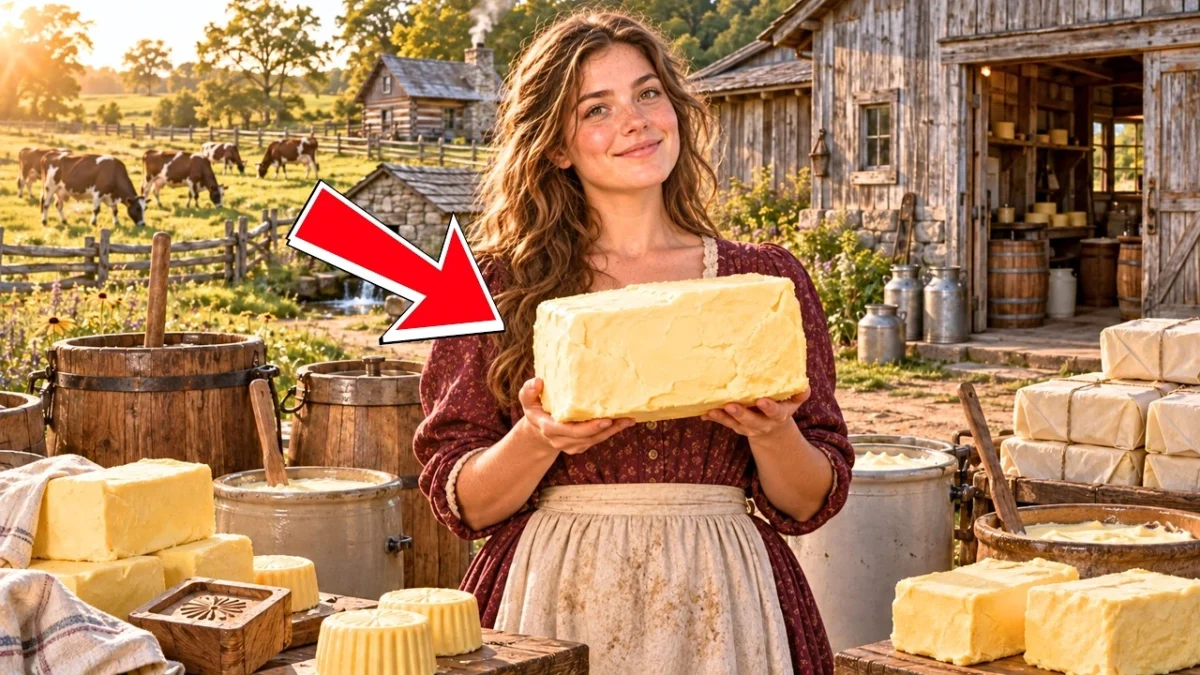
The wagon rolled away before the mist had fully lifted from the pasture.
She watched it go from the doorway.
A broad-shouldered draft horse pulled a flatbed stacked with wrapped blocks.
Each one was tucked in cheesecloth and packed in salted wooden tubs.
Each block was earning its way toward a hotel kitchen or a bakery counter two counties distant.
The heavy wheels left twin dark tracks in the dew-heavy grass.
She followed them with her eyes until the road bent and the wagon disappeared behind a stand of birch gone gold at the crown.
Behind her, inside the creamery, she could hear the sound of work already underway.
There was the rhythmic knock of a churn handle and the soft conversation of two women she paid in honest coin at the end of every week.
There was the faint musical drip of spring water running cold through the stone channel beneath the floor.
Outside, along the fence line, three more farm wagons were queued in the early morning light.
Their drivers sat patient on the bench boards while cream cans rattled softly as the horses shifted weight.
By mid-morning, the line would reach the main road.
It was autumn of 1891.
It had been two years since she had first stood in this same doorway.
Though stood was too generous a word for what she had done back then.
She had gripped the rotting door frame just to keep from swaying on her feet.
The building had smelled of abandonment, damp earth, and something faintly sweet beneath all of it.
It had smelled like a memory of work done long ago by hands she would never know.
There had been no wagon waiting then.
There had been no line of patient farmers.
There had been no hum of industry, no wrapped butter, and no coin in her pocket worth counting.
There had been almost nothing at all.
There was only a cold spring running quiet along the far edge of a neglected pasture.
Four cows had stood knee-deep in uncut grass, watching her with the patient, incurious eyes of animals that had simply waited for someone to return.
Old wooden churns had collected dust in the corner of a room that barely qualified as one.
The stone shelves were green with thick moss.
The roof had a gap wide enough to let in rain and starlight in equal measure.
And there was her.
She was twenty-three years old, with no land claim, no permanent address, and no family within a day’s hard ride.
The sum total of her savings had amounted to what most men spent on a single evening’s worth of supper and tobacco.
She had come to Wisconsin with plans that had since been sold out from under her, along with the dairy herd, the barn, and the good iron stove in the farmhouse kitchen where she had learned everything she knew about cream.
People in Clover Ridge would later have a great deal to say about her.
In those first weeks, however, what they mostly said was that she would not last.
They said it kindly, some of them, which almost made it worse.
The road out of Hadley’s farm was no different from any other stretch of Wisconsin dirt in April.
It was softened by snowmelt and rutted by heavy wagon wheels.
It smelled of iron, wet bark, and something green just beginning to push through the cold ground.
She stood in the middle of it with a canvas bag over one shoulder and a wool coat buttoned to her chin.
She had nowhere particular to be before nightfall.
That was the precise weight of it.
She had nowhere to be.
She had worked Hadley’s dairy for fourteen months.
She had risen before light, carried milk in the bitter cold, learned the smell of cream turning, and felt the butter coming together under her palms.
She had not been cheated by her employer.
The farm sale was simply a transaction between men who did not consult her.
The new owner had his own arrangements and required no extra hands.
“You have been a good worker, Clara,” Mr. Hadley had told her that morning as he held the kitchen door open.
“I wish things were different, but the papers are signed.”
“I understand, Mr. Hadley,” Clara had replied, adjusting her canvas bag.
“You owe me nothing. I’ll take my leave now.”
“Take care of yourself out there,” the old man said softly.
“Wisconsin winters are hard on a woman alone.”
“I can take care of myself,” she said.
She was given a fair morning to collect her things and a door held open as she left.
No wages were owed, and no wrong had been done to her.
The world had simply been rearranged while she was sleeping.
It was the way weather changes in Wisconsin, without announcement and without apology.
She had four dollars and sixty-two cents.
She counted it standing in the muddy road before she started walking.
Which was perhaps unnecessary, but it felt like the right kind of discipline.
The silver coins were cold between her fingers.
She put them back in her coat pocket and held them there as she walked.
She felt the small weight shift with her steps.
Clover Ridge was three miles east.
It offered a boarding house, a trading post, a mill, and the measured opinions of people who had known one another long enough to feel certain about things.
She had slept two nights at the boarding house before coming to Hadley’s the previous spring.
She remembered the landlady’s careful, assessing eyes.
“Looking for work, are you?” Mrs. Gable had asked her back then, wiping her hands on her apron.
“I am,” Clara had answered firmly.
“I know how to work a dairy.”
“We’ll see how long a young thing like you lasts out here,” Mrs. Gable had remarked with a skeptical smile.
Now, Clara walked toward that same town with no farm waiting for her.
She could ask for credit at the store.
She was not too proud for that.
Pride was a luxury she had quietly set down somewhere around the second winter of her life when she understood that it kept you warm approximately as well as a wet newspaper.
She could offer to help in the kitchen, to clean, or to mend clothes.
These were not shameful things.
However, the sky to the northwest was the color that meant rain before supper.
She had walked only a quarter mile, and she did not yet have a plan so much as she had a direction.
She kept walking.
The land on either side of the road was patchy with last season’s dead grass and the beginnings of new growth.
Wisconsin was coming back to itself the way it always did, indifferent to whatever trouble stood in the road.
A creek ran somewhere to her left, low and quick with snowmelt.
The sound of it followed her for a while.
She turned off the main road before she had consciously decided to do so.
The lane she turned onto was hardly a lane at all.
It was just two shallow ruts pressed into the earth by wheels that had not passed in a long while.
The grass between the ruts had grown tall and undisturbed.
She followed it because it ran downhill toward the sound of water.
She followed it because something in the angle of the afternoon light made the low ground ahead look greener than the fields behind her.
Those were reasons enough, as she had learned not to require better ones.
The elderberry bushes grew thick on both sides before she saw the building.
For a moment, she almost turned back, thinking she had wandered onto someone’s overgrown back pasture.
Then the elderberry parted where the ruts ended, and there it stood.
It was not large and not grand.
It was a low timber structure with a shallow roof, its boards gone silver-gray with weather.
A rusted iron fitting hung above the door where a sign had once been placed.
The wood had checked and split in places, but the walls were standing firm and the roof held its shape.
Beside the building, close enough that the sound of it reached her immediately, a cold spring ran out of a mossy shelf of rock.
It fell into a stone-lined channel, clear and fast.
It was the kind of cold water that did not belong to the season.
It was the kind that came from deep underground and did not care what month it was.
She stood still for a moment.
The air near the spring was noticeably cooler than the air behind her on the lane.
She could feel the chill against her face.
She pushed the door open with her shoulder and stepped inside.
The smell was old wood, cold stone, and something faintly sour that was not entirely unpleasant.
It was the ghost of cream, she realized.
Milk had been handled here long ago.
The stone shelves ran along the north wall at waist height, wide and thick, built specifically for weight.
Below them, the floor was packed earth, swept clean by nothing but time itself.
Three wooden churns stood in the corner, their staves dark with age and their lids fitted.
She crossed the room and lifted one lid.
It was dry inside and sound.
She pressed her thumb against the stave, finding it firm.
She checked the second churn, then the third.
A doorway at the back had a low frame, and she ducked through it.
She found a small room with a narrow window, shuttered but intact.
There was a wooden shelf with space enough for a rope bed, a trunk, and a single chair.
It was not large, and it was not comfortable.
It was, in every way that mattered, a room with a roof and four solid walls.
She stood in it for a long moment, listening to the silence.
Then she went back out to the main room and looked at the spring.
She looked at the stone channel.
She looked at the shelves built for keeping things cold.
She looked at the old churns.
She looked out at the pasture beyond the building where four dark and white cows stood watching her.
They watched with the mild, incurious patience of animals that had not been hurried in some time.
She was not yet sure what she was going to do.
However, she understood with a clarity that surprised her that she was not going to keep walking toward town.
She walked out to the fence line before she did anything else.
The pasture rail was down in three places.
It was not rotted through, just dropped from its fittings.
The posts tilted in their holes like men leaning tiredly against a wall.
She walked the perimeter slowly, pressing each post with both hands to test what held firm and what only looked like it held.
Most of them were sound beneath the soil.
The wood above ground had weathered gray, but the buried portions had kept their solid grip on the earth.
She made note of which posts needed resetting, which rails needed lifting back into their notches, and which sections needed new wooden pins to hold the joins.
Then she went toward the cows.
They did not startle or back away from her approach.
The largest one, a broad-shouldered animal with a dark patch across her left hip, lifted her head.
She regarded the woman with slow brown eyes, then went back to grazing.
The others did the same.
Clara moved among them carefully, running her hands along their flanks, checking their legs, their hooves, and the condition of their hides.
There was no visible injury and no signs of prolonged neglect.
Their ribs did not show through their skin, and their eyes were clear and bright.
Someone, at some point, had kept these animals well and then simply left them here.
The animals had continued being what they were.
She was not sure what surprised her more: that they had survived, or that they had survived so calmly.
She spent the rest of that day working on the fence.
It was slow work, and her hands were not soft, but fence mending required patience more than raw strength.
She lifted a rail, fitted it true, pinned it firm, and moved on to the next.
She borrowed two pine boards from a collapsed shed at the corner of the property.
She split them rough with the claw of an old hammer she found inside the creamery.
She used the pieces to replace two rails that had cracked completely through.
By late afternoon, the pasture perimeter was fully closed.
The animals barely noticed the change.
The roof was her next task.
She climbed onto it at first light the following morning, moving carefully across shingles that held in most places and sagged in a few.
The damage was concentrated over the small back room—her room, as she was beginning to think of it—and over the eastern corner of the main floor.
She found extra shingles stacked in the lean-to at the side of the building, dry and warped but entirely usable.
She layered them over the gaps, working from the bottom up the way she had watched men do before.
She weighted the edges with heavy stones until the pitch of the roof would carry rain away instead of drawing it in.
Then she milked the cows.
Her hands remembered how before her mind had entirely decided to do it.
The large cow stood steady as a tree stump.
The milk came full, rich, and warm into an old iron bucket she had found and cleaned.
The smell of it hit her somewhere underneath conscious thought.
The cows were in better shape than the building had been.
Slowly, the building was coming back to life as well.
The stone shelves came first.
She hauled water from the spring in the iron bucket.
She scrubbed the shelves on her knees with a rag torn from a flour sack from her canvas bag.
She worked the gray grime out of the stone’s pores until the deep cold of the rock came through to her palms.
The shelves ran along the north wall of the main room in two long tiers.
They were set deep into the masonry where the earth behind them kept the temperature low, even when the afternoon pressed warm against the south-facing windows.
She could feel the temperature difference clearly.
The difference between her side of the room and that northern wall was not imagined.
It was the best thing in the building, she decided.
It was perhaps the best thing on the entire property.
She scrubbed until the stone was pale and clean, and the water in her bucket had gone dark three times over.
Then she turned her attention to the churns.
There were three in the building: two stave churns with iron hoops, and one dash churn that stood taller than the others, though its handle was missing.
The stave churns were intact but swollen tight with disuse.
The wood had dried and drawn inward so the lids no longer seated properly.
She soaked them in cold spring water through the afternoon and into the next morning.
She let the wood swell back to itself, tapping the iron hoops down gently with the heel of her hand.
One churn sealed tightly, while one still wept water from a seam near the bottom.
She set the leaking churn aside and worked on the dash churn instead.
She fitted a new handle from a stripped branch she had cut and smoothed with a drawknife found hanging on the back of the lean-to door.
By the end of the third day, she had one good churn, two clean stoneware crocks, and a shelf ready to hold them.
She filled the crocks with fresh milk.
The next morning, she filled two more.
By the following evening, she understood her main problem clearly.
It was the kind of problem you understand with your body before your reasoning catches up.
The four cows gave more milk than the crocks could hold.
They gave more than the stone shelves could cool fast enough.
They gave more than any single person could drink before the warmth of the room began its quiet, irreversible work on what had been perfectly good milk the day before.
She stood in the doorway one evening, watching the golden light leave the pasture.
She felt the full weight of the situation.
Waste was worse than hunger, somehow.
Waste meant the opportunity she had been given was slipping through her fingers faster than she could close them.
She thought about the nearby town.
She thought about what four gallons of fresh milk was worth if she could get it there by morning.
She thought about what it would be worth in three days if left sitting.
Then she thought about Hadley’s farm, about the kitchen in the early morning hours, and about the unmistakable smell of rich cream rising.
Her eyes moved slowly toward the wooden churn.
She went to work at the churn before the sun was fully up the next morning.
The old wood was dry and the internal paddles were stiff from years of sitting idle.
She worked the seams with tallow she had rendered the evening before, pressing it into the cracks with her thumb until the joint softened.
She filled the barrel with the cream she had skimmed and held in the coolest corner of the stone shelf overnight.
It was not a huge amount—maybe a gallon and a half—and she began the labor.
The first strokes were hard on her arms.
Her muscles complained long before her will did, but she kept a steady rhythm, the way she had learned on the dairy farm.
She kept it steady, not fast.
Impatience always broke the butter improperly.
She had seen it happen to careless workers.
A woman rushing the churn because she wanted to be done quickly would end up working twice as long for half the expected yield.
So, Clara breathed steadily.
She counted her strokes in disciplined groups of twenty.
She rested her hands briefly and counted again.
The process took longer than she had anticipated.
The cream was slightly warmer than ideal because the morning had come in mild.
For a stretch of time that felt very long, she began to wonder if something was wrong with the paddle, the cream, or her memory of how this was supposed to go.
Then, the sound inside the churn changed.
The liquid slosh thickened.
The resistance against the handle shifted into something almost solid, something pushing back against her efforts, and she knew it was working.
She finished it out carefully.
She worked the thin buttermilk free and pressed the solid yellow mass against the side of the churn with the paddle.
She folded it and pressed it again until the remaining liquid ran nearly clear.
She salted the mass lightly from a small paper package she had brought from town.
Then, she pressed it firmly into the only mold she had found—a flat wooden rectangle left on the shelf, its inside carved with a simple leaf pattern she had not noticed until the butter came out.
It was not a large block of butter.
It was slightly soft at the center, and one corner had spread unevenly where the mold was not quite level on the table.
She held the finished block in both hands and looked at it for a long moment in the quiet room.
It was real.
She made four smaller rounds from the remaining yield, pressing them by hand and wrapping them carefully in the cleanest cloth she owned.
She loaded everything into a small wooden crate she had repaired the week before.
She hitched it under one arm and walked the two miles into Clover Ridge.
The stares from locals began before she even reached the main street.
A man standing outside the feed store said something low to the man beside him, and both of them laughed quietly.
A woman near the dry goods window turned and stared at Clara without pretending otherwise.
Someone called out a remark from across the dirt road.
Clara did not catch the exact words, but she caught the mocking tone clearly.
She walked straight to the boarding house and set the wooden crate on the keeper’s counter without ceremony.
The keeper, Mr. Gable, looked down at the fresh butter, then up at her face, then back down at the golden blocks.
“Where did you get this, girl?” he asked, sniffing the air.
“I made it,” Clara said directly.
“It’s fresh, salted, and clean.”
“Made it where?” he pressed, squinting at her.
“At the old creamery by the cold spring,” she replied.
“It’s good butter, Mr. Gable. Taste it if you like.”
He took a small wooden splint, scraped a bit from the edge of a round, and put it in his mouth.
His eyes widened slightly.
“How much do you want for the lot?” he asked.
She named her price, watching his face.
He bought every pound she had in the crate.
He paid her full asking price without haggling, counting the silver coins out flat on the wooden counter.
He slid them across to her.
“I’ll take the same amount again next week if you can manage it,” Mr. Gable said, clearing his throat.
“My guests appreciate good butter, and this is better than what the mill hands’ wives bring in.”
“I can manage it,” Clara said.
She walked home in the long afternoon light with the empty crate tucked securely under her arm and the cold coins resting in her apron pocket.
She did not look at anyone who looked at her along the street.
She was already thinking about cream volumes.
She was thinking about skimming schedules.
She was calculating how many pounds of butter the four cows could reliably yield if she kept their pasture watered and their daily grain steady.
She was already thinking like a woman who ran a business, because now, quietly and without any grand ceremony, she did.
The standing order from the boarding house changed things in ways that were not immediately visible to the town, but were immediately felt by Clara.
Before, she had been churning against total uncertainty.
Each batch had been a gamble, and each morning had brought the question of whether the hard work would amount to anything at all.
Now, there was a specific number to hit.
There was a weight to aim for, and a solid reason to be at the churn long before the sun came up.
She began rising well before dawn every day.
The yellow light of her lantern threw amber shadows across the stone cooling shelves while the world outside remained dark and still.
She worked in that quiet space with a kind of intense focus that felt almost like peace.
The cream sat overnight in the cellar space, pressed close against the stones where the chill from the underground spring came through the earth in a slow, steady breath.
By morning, the cream was thick, cool, and ready in a way that cream left in a warmer room simply never was.
She had learned this fundamental truth on the Hadley dairy farm: cold cream churned much faster, broke cleaner, and held its shape far longer once pressed into the wooden mold.
The spring gave her that vital cold for nothing every day, regardless of what the sky outside was doing.
And in June, what the sky was doing was getting extremely hot.
The summer heat came early that year, settling hard over the valley and refusing to lift.
Neighboring farms struggled terribly with their dairy.
Cream soured in the pans before it could even be skimmed or used.
Families who usually made their own household butter gave up by mid-morning and salted whatever spoiled batches they could salvage just to keep them from rotting completely.
Inside the old creamery, however, the thick stone walls held the spring’s chill.
The spring ran as cold as ever, and Clara’s wooden churns kept turning smoothly.
Then, a young boy appeared at her creamery door one morning with a folded note tucked under his arm.
He was perhaps twelve years old, barefoot, and he stared at the churning equipment with open curiosity while she wiped her hands to read.
“Who sent you, son?” Clara asked, taking the paper.
“Mr. Miller down at the east end bakery,” the boy said, shifting his feet on the dirt floor.
“He said to give it right to the butter lady.”
Clara unfolded the note and read the neat handwriting.
The bakery on the east end of Clover Ridge wanted a regular weekly supply of her butter.
They wanted the same weight as the boarding house order, and even more if she could possibly manage to produce it.
They had a large wedding cake order coming in August and urgently needed high-quality butter they could count on not to sour in the heat.
She read the note twice through to be certain.
She set it carefully on the shelf above the churns and looked at the boy.
“Tell Mr. Miller I can manage it,” Clara said firmly.
“First delivery will be Friday morning.”
“Yes, ma’am!” the boy said with a nod, turning and running back down the dirt road.
July arrived like a furnace door being swung wide open.
The air above the dirt road shimmered with heat by eight o’clock in the morning.
By noon, the entire valley felt sealed under the sun, the sky turned a hard, pale white, and the grass in the fields went completely dry at the edges.
Word moved through Clover Ridge the way bad news always moves: fast and low, passed from neighbor to neighbor along the fence line.
Cream was spoiling across the township before farm families could do anything useful with it.
One large farm lost an entire morning’s skimming before the woman of the house could even get the wooden lid onto the storage crock.
Another family lost two full days’ worth of production to a cellar that simply could not hold out against that relentless kind of heat.
People everywhere were heavily salting butter they did not trust and praying it would keep until market day.
Yet inside Clara’s creamery, nothing changed at all.
The underground spring ran at the exact same cold temperature it had maintained in March.
The stone floor held its deep chill the way ancient stone always does—slow to warm up, and slower still to give up its coldness.
She kept the wooden shutters angled precisely to catch the northern air while blocking out the direct rays of the sun.
This was a practical trick she had worked out in June when the first real heat had arrived.
The cream sat cool, thick, and sweet in the crocks lined up on the low stone shelves.
The churns turned steadily, and the butter came out pale gold, firm, and clean-smelling.
It was the exact same high quality it had been every week since she had begun.
The first local ranch family arrived at her door on a sweltering Wednesday, unannounced.
Their heavy farm wagon raised a thin cloud of dust as it came down the neglected lane.
The farmer’s wife climbed down from the seat before the wagon wheels had even fully stopped rolling.
“Are you the woman making butter here?” the visitor asked, stepping into the shade of the doorway.
“I am,” Clara said, stepping forward.
“I’m Clara.”
“I’m Mrs. Higgins from the west ridge,” the woman said, pulling a folded handkerchief from her apron.
“I heard a rumor in town that the butter made here is still coming out sweet despite this terrible sun. I came to see if that was true, or just talk.”
“It’s true,” Clara replied simply.
“The spring keeps the room cold.”
“I have cash here,” Mrs. Higgins said, showing a tightly folded wad of bills.
“I need three pounds if you have it to sell. My own pans soured before breakfast.”
“I have three pounds,” Clara said.
She wrapped the golden blocks in clean cloth and handed them over in exchange for the money.
Two more local families came before Saturday arrived.
A freighter passing through on the regional stagecoach route stopped his team when his driver mentioned the creamery.
He bought four pounds wrapped tightly in cloth, tucking them carefully into his insulated cooler box as if they were precious cargo.
A wealthy cattle rancher’s wife traveled from a distance of six miles away.
She stood in the creamery doorway looking at the crocks, the clean stone shelves, and the cold spring water running swiftly through the stone channel beneath the floor.
The woman said nothing at all for a long moment, simply taking in the scene.
“This is remarkable,” the rancher’s wife finally said, looking at Clara with newfound respect.
“I want ten pounds if you have ten pounds to spare.”
“I have it,” Clara answered, setting to work preparing the order.
By the end of that first blistering week of July, the quiet laughter and mocking remarks in Clover Ridge had gone quieter still.
The mockery was not entirely gone, but it had changed into something else.
Curiosity had begun to move through the very same mouths that had carried the doubt, and curiosity is always much harder to dismiss than mere skepticism.
One afternoon, a man came to the creamery alone.
He was a farmer from the north end of the valley, older, slow-moving, and clearly the kind of man who listened carefully before he spoke, and often chose not to speak at all.
He stood outside the creamery building for a long time without knocking.
He simply watched the spring channel work.
He watched the cold water move continuously from the rock shelf down into the stone building.
He watched where the water entered the masonry, where it exited into the lower pasture, and how Clara had fitted the flat river rocks to hold the heavy stoneware crocks steady in the current.
He did not ask Clara a single question while she worked near the window.
He just watched the mechanics of the setup, nodded to himself, and then walked back to his horse and left.
He came back four days later, driving his own heavy wagon.
Clara heard the wagon coming before she saw it.
She recognized the slow creak of a wooden axle that needed grease and the particular slow rhythm of a horse team that was older and unhurried.
She came to the open doorway, wiped her damp hands on her apron, and watched him pull up on the track beside the spring.
He had two large metal milk cans sitting in the back of the wagon bed.
Both were covered tightly with damp cloth to keep the flies away in the summer heat.
The old farmer climbed down without rushing and stood beside his wagon wheel.
Even then, he did not say much right away.
“Heat came on faster than I expected this year,” he said quietly, looking at the sky.
“It did,” Clara agreed, watching him.
“I’ve got more cream in these cans than my wife can churn or use,” he continued, gesturing toward the wagon.
“And it’s more than I can sell in town before the sun turns it sour.”
“That’s happening all over the valley,” Clara noted.
“I don’t want to throw it out,” the farmer said simply, looking her in the eye.
“It’s good cream, but it won’t last until tomorrow in my cellar.”
Clara looked at the large metal cans.
She looked at the cold spring channel and the crocks already resting safely in the running water.
She thought about the remaining space on her stone shelves, the capacity of her wooden churns, and the number of daylight hours left in the afternoon.
She had churned enough by now to know her own physical capacity down to the minute.
She had spent enough exhausting mornings with aching arms to understand exactly what she was agreeing to if she said yes to his implied request.
“How much cream do you have there, Mr. Vance?” she asked, recognizing him from town.
“Eight gallons,” he replied.
“I can take it,” Clara said directly.
“I will buy the cream from you at a set price per gallon. Lower than town retail so my labor is paid, but fair enough that you don’t lose your work.”
She named a specific price.
It was an honest figure—low enough that he would profit from coming back, yet high enough to reward his trouble.
She had fully expected him to argue or try to bargain her down as men often did.
He did not argue at all.
Mr. Vance simply nodded his head once.
It was the way practical men nod when a proposition makes complete sense to them and they see no valid reason to make things complicated.
“That’s a fair deal, Miss Clara,” he said.
“Let’s get them inside.”
She helped him carry the heavy milk cans into the cool interior of the creamery.
That afternoon, Clara churned longer and harder than she ever had in her life.
The wooden paddles turned continuously inside the dark barrel.
The cream thickened, separated, and the golden butter mass began to gather in the liquid.
It happened the way it always did—inevitable and deeply satisfying, like a natural outcome the world wanted to produce if you simply provided the right conditions.
She worked by the cool light coming through the small shuttered window and by the steady sound of the spring flowing outside.
When she finally pressed the very last of the massive batch into her wooden molds, her shoulders and arms ached with a deep tiredness that told her she had accomplished something substantial.
The total batch was the largest she had ever produced since arriving at the abandoned property.
She stood alone in the dim room, looking at the results of her labor.
There were the crocks, the wrapped yellow blocks, and the cool stone shelves holding far more butter than her own four cows could have produced in a full week.
At that moment, something fundamental shifted in her understanding of what she was building here.
Up until today, she had been thinking about her four pasture cows as the natural limit of what this place could accomplish.
She understood now that those four cows were merely the beginning.
The entire valley was full of rich cream going warm and sour in the summer heat.
It was full of hardworking farmers who had more milk than their households could process before it ruined.
Her four cows were not the boundary of this operation.
The entire valley was the limit.
She went into town the very next morning before the harsh July heat had burned the morning dew off the roadside grass.
She went not to sell her goods, but to listen to the people.
She stood near the feed merchant’s wooden counter and let the local talk move around her the way creek water moves around a stone in the current.
What she heard everywhere was talk of loss and waste.
“Poured off two full gallons of cream this morning,” one farmer from the north end was complaining to the clerk.
“No way to keep it cool enough in our cellar. Just wasted work.”
“Mine turned in the night before my wife could get to the churn,” another man chimed in, shaking his head.
“August is going to be worse.”
August was doing what August in Wisconsin always did: taking what the fertile land had generously given and quietly ruining it through relentless heat.
Clara waited quietly near the door until she had heard enough of their complaints.
Then she stepped forward into the group, made her offer in plain, clear words, and asked for nothing in return except the raw cream itself and a fair business arrangement.
She named the exact price per gallon she had offered Mr. Vance—an honest price that paid them more than they would ever earn from watching their cream spoil, while leaving her a respectable margin for the butter it became.
The first skeptical farmer arrived at her spring door the following morning with a covered tin pail balanced carefully in his wagon.
The second farmer came the day after that.
His wife rode beside him on the bench seat with an expression that was partly curious and partly skeptical, studying the restored creamery building as if she were not quite sure whether to be impressed or concerned by what the young woman was doing.
By the end of that week, there were four different farmers bringing their excess cream to the spring-side door every morning before breakfast.
Clara worked now from long before first light until the evening dark was fully back over the valley.
She learned to move through the creamery entirely by feel during those early morning hours.
She knew the touch of the cool stone beneath her hands, the solid weight of the wooden churns, and the precise sound the paddle made when the cream was finally ready to turn into butter.
She kept the spring channel running cold and clear through the stone shelves where the crocks rested.
She kept every mold meticulously clean and measured the salt with exact precision.
The butter had to be identical in quality and taste every single time, never varying because of her own tiredness or mood.
To handle the growing volume, she commissioned six large wooden tubs from the local carpenter at the edge of town.
He was a quiet, skilled man who asked no unnecessary questions, charged her a fair price, and had the tubs ready for her inside of two weeks.
They were solid, impressive pieces of coopering work—banded tightly with iron and built sturdy enough to travel long distances without falling apart.
She packed the salted butter dense and firm into the tubs, making sure there were no air pockets left inside that could cause spoilage.
The wooden lids fitted snug against the rims.
She neatly painted the exact weights on each lid using black paint and a small brush.
The first finished tubs went out by local delivery wagon, and then by the regional stagecoach line.
The Clover Ridge boarding house keeper had already told two other tavern owners in neighboring settlements about the quality of her product.
Her reputation was spreading beyond the valley.
Which brings the story back to that misty autumn morning in 1891.
The wagon carrying her butter blocks was disappearing down the road behind the gold-crowned birch trees.
Inside the bustling creamery, two hired local women were working the churn handles in a steady, practiced unison.
Outside along the fence line, more farmers were waiting patiently in their wagons to unload their cream cans.
Clara stood in the doorway, feeling the cool morning air against her face.
She looked out over the repaired fences, the healthy cows grazing in the pasture, and the cold, clear spring that had made it all possible.
She reached into her apron pocket and felt the solid stack of coins resting there—honest money earned through hard, intelligent work.
Two years ago, she had stood in this exact spot with four dollars and sixty-two cents, a torn coat, and nowhere to go.
She had possessed nothing but a pair of experienced hands, a knowledge of cream, and the refusal to keep walking when she found something worth building.
Now, as the morning sun finally broke through the autumn mist and lit up the valley, Clara smiled quietly to herself and turned back inside to oversee the day’s work.








