She Hired Him to Teach Her to Sell the Ranch — He Taught Her Why to Keep It
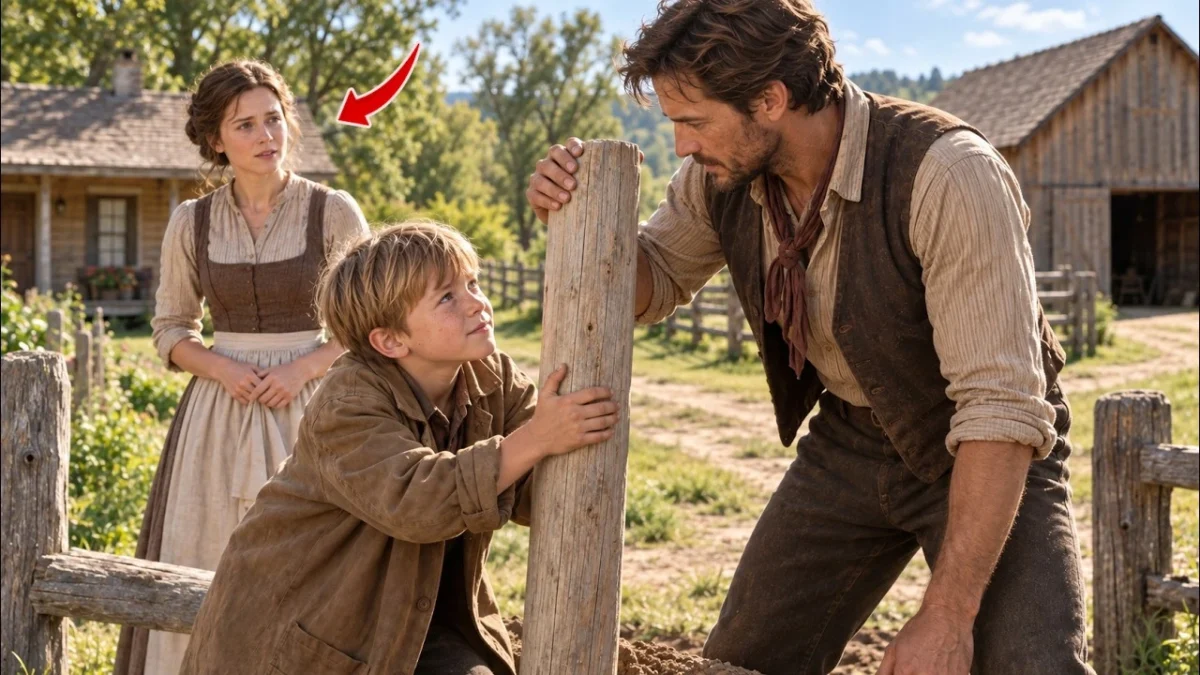
The buyer was due at ten o’clock, and at half past eight Cora Whitcomb stood at her kitchen window, watching her nine-year-old son attempt to drive a wooden fence post into the dry earth by himself.
The heavy post reached higher than the top of Toby’s head.
He had scraped out the old hole using a iron shovel forged for a full-grown man, and he was swallowed up in his late father’s canvas coat, its thick sleeves rolled back four full times at the wrists.
The morning sun had already burned off the early mist, making it far too warm for a coat, yet the boy refused to take it off.
Cora stepped onto the wooden porch, her apron dusted with white flour.
“Toby.
Mr. Dunning will be here soon.
Come inside and wash your hands.”
“I’m nearly done, Ma.”
“If the fence is fixed, he’ll see we don’t need to sell this place.”
The boy said the words directly to the post, not turning to look at her.
He threw his small weight against the timber to force it upright.
The post leaned stubborn and crooked in the dirt.
Cora stood on the porch with no answer she could offer him in the span of an hour.
She was still standing there when a lone rider turned off the main road and entered the yard.
He was a lean man past forty, riding a well-used bay horse with a canvas bedroll strapped securely behind his saddle.
He drew his horse to a halt by the sagging fence, looked closely at the boy, then at the crooked post, and swung down from the leather.
“That’s a two-man post, son,” he said, his voice low and dry as dry leaves.
“Want a second man?”
Toby wiped his forehead with a sleeve and eyed the stranger with deep suspicion.
“I can do it.”
“Didn’t say you couldn’t.
I’ll hold it straight.
You shovel the dirt in and tamp it down.”
The man set his broad shoulder against the post, squaring it up against the line, and did nothing else.
Toby picked up his shovel, filled the hole layer by layer, and stomped the loose earth tight with his boots just as the man instructed him with brief nods.
When the hole was filled to the brim, the stranger stepped back and pushed hard on the post with one calloused hand.
The timber did not budge.
“That’ll stand,” the man remarked quietly.
“First post I ever set in my life fell over before supper time.”
By then, Cora had walked across the dusty yard toward them.
The stranger immediately pulled off his wide-brimmed hat.
“Grant Hollis, ma’am.
The blacksmith in town mentioned a widow out this way might be looking for a hand to gather cattle.
I’ve worked stock for twenty-five years.”
“Cora Whitcomb.
I might need help.
I can’t talk right now, Mr. Hollis.”
She nodded toward the dust rising down the road.
“Water your horse at the trough.
Stay if you like.”
Mr. Dunning arrived in a polished buggy, his team of horses sleek and well-fed.
He owned the vast acres that bordered her far pasture, and he was a man who wasted few words on pleasantries.
“It’s the far pasture I’m after, Mrs. Whitcomb,” Dunning said, resting his arms on the wheel.
“It lies right against my grass, and I mean to run more cattle come fall.
The house and this near pasture are no use to me.”
“I’m selling all of it or none of it, Mr. Dunning,” Cora said, setting her jaw firmly.
“I can’t keep half a ranch going any better than I can keep a whole one.”
Dunning named a figure for the entire property.
It was insultingly low.
“Your far fence line is down in three separate places that I know of,” Dunning countered without blinking.
“Nobody has gathered or counted your stock since your husband passed away last winter, and I can’t pay good coin for cattle no one can prove exist.
I have to settle my purchasing plans for the herd by the middle of July.
If things look different before then, send word to town, and I’ll ride out to look again.”
He tipped his hat politely and turned his buggy back toward the main road.
It was a fair, practical answer, which only made it harder for Cora to hold onto her anger.
Grant Hollis was still standing over by the wooden water trough, and he had plainly heard every single word spoken.
Cora walked straight over to him, her skirts rustling against the dry grass.
“How long,” she asked, “would it take to get this place to where a buyer can see what it’s really worth?”
Grant looked past her, taking in the sagging barn door, the overgrown weeds along the near fence, and the hills beyond.
“Gather the herd and count every head.
Mend the far fence where the timber’s rotted out.
Rehang that corral gate so it doesn’t drag in the dirt.
Clear out your spring so the near pasture waters right.
Trim down what you’re spending every week on feed.
Six weeks.
I wouldn’t spend a dime building anything new.”
“Then I’ll hire you for six weeks, on one condition,” Cora said, looking him dead in the eye.
“You don’t just do the work yourself.
You teach me how to do it as you go.
When Mr. Dunning comes back in July, I want to know exactly what I’m selling.”
“That’s going to slow things down.”
“It’s my money I’m spending.”
Something very close to a faint smile crossed the man’s weathered face.
“Yes, ma’am, it sure is.
You should know I’m already promised to a big outfit up on the Powder River come the middle of July.
Six weeks is all the time I’ve got to offer.”
“Six weeks is all I need.”
They settled his wages in three short sentences, and Grant moved his bedroll into the small spare room off the side of the barn.
Toby carried the man’s heavy canvas roll across the yard without being asked by anyone.
A grin split the boy’s dust-streaked face, his father’s oversized coat flapping wildly against his knees as he ran.
To the boy, a new hand meant work was starting, and work meant they were staying on the ranch.
Neither grown-up thought to tell him otherwise, because neither one realized what the child had convinced himself to believe.
Grant spent the first week almost entirely on horseback, and Cora rode right alongside him.
They followed the far fence line from one end of the property to the other under the hot summer sun.
Where the wire had fallen, he dismounted and showed her how to tell a post that had rotted through at the base from one that had simply been pushed over by heavy steers.
Cora pulled a small black ledger from her pocket and wrote down every damaged spot, noting the exact count of new posts and coils of wire they would need to buy.
At the natural spring in the near pasture, Grant got down off his bay horse, cleared away a thick handful of dark silt with the toe of his boot, and watched the clear water begin to flow freely again.
“This is good, sweet water,” he said, taking off his hat to wipe his brow.
“Your near grass could carry a small bunch of cows and your team of horses without much trouble at all.
That far pasture is a long, hard ride every time you want to check on your stock, and it takes a full mile of expensive fence line just to hold it.”
“Mr. Dunning wants that pasture.”
“I know he does.
I’m just telling you what my eyes see.”
Cora made no answer to that.
She had spent a full, brutal year holding this entire place together with both of her bare hands.
What she truly wanted, deep down, was to finally put the burden down for good.
On the fourth morning, she walked out to the corral and found the heavy main gate already hung on new iron hinges, swinging square and true above the ground.
She stood looking at it with her hands resting firmly on her hips.
“I explicitly asked to learn how to do that, Mr. Hollis.”
“It’s done now,” Grant replied, wiping grease from his hands with a rag.
“And it’s a solid gate.”
“Mr. Hollis, I am paying you good money to teach me how to hang a corral gate, not to admire one that you hung by yourself while I was inside cooking breakfast.”
He rubbed the back of his sunburned neck, looking somewhat uncomfortable.
“You’d have taken half the morning to get it level.”
“Then it would have taken me half the morning.”
He looked down at the gate, then up at her determined face.
“All right.
The far gate in the lower paddock still needs doing.
You’ll do that one tomorrow.
I’ll just hand you the heavy tools and keep my mouth shut, mostly.”
She worked on the far gate the next morning under the blazing sun.
It took her nearly four hours of hard labor.
When she stepped back, the gate hung a tiny hair crooked against the post.
Without saying a word, she unbolted the hinge, reset the wood, and tightened it until it swung perfectly level.
Grant stood by the fence watching her, saying nothing at all, which coming from him was a great deal of praise.
That evening, after Toby had gone to bed, she opened her leather account book on the kitchen table and turned it toward him.
“This is what I’ve been paying the dry goods store for feed every month,” she said, pointing at the neat lines of figures.
“It’s the exact same order my husband set up when we had twice as many cattle on the range.”
Grant leaned over the candle and examined the numbers carefully.
“You can cut that figure right in half.
More than half, once the summer grass comes in full.”
“That’s precisely what I calculated.”
“You keep a far better book than I ever managed to keep,” he noted softly.
Toby wanted to learn how to throw a rope.
He wanted it far more than he wanted to eat his morning breakfast.
On the second week, Grant walked into the dusty corral early in the morning and found the boy swinging a awkward loop at an old fence post.
Meanwhile, the main horse trough stood half empty nearby.
“Whose job is it to fill that water trough every morning?” Grant asked, leaning against the fence.
“Mine,” Toby muttered, lowering the rope.
“I’ll pump the water right after I practice.”
“Horses don’t drink after.
They drink now.”
Grant held out his broad hand for the coil of rope, and Toby handed it over with a furious glare that could have curdled fresh milk.
“Roping can wait.
You fill that trough to the brim every single morning for a week without me asking you once, and then I’ll show you how to build a proper loop that doesn’t fall on your own head.”
“It didn’t fall on my head.”
“I was watching you from the barn door, son.
It came mighty close.”
Toby marched over to the hand pump and filled the trough until the water spilled over the wooden edges.
He filled it every morning after that without complaint, standing stiffly by the pump until Grant looked over from his chores, and Grant always made sure to look.
On Saturday afternoon, a heavy wooden wagon rolled into the yard from the neighboring ranch.
Mrs. Ostrander, their nearest neighbor, had been checking in on Cora ever since the funeral, and she often took Toby home to her place for afternoons so Cora could work without worrying.
Over a cup of hot black coffee on the porch, Mrs. Ostrander mentioned to Grant that Toby’s father had placed the boy on his very first pony when he was only three years old, right in that very yard.
Toby, sitting on the porch steps, heard the comment and went entirely silent.
Later that evening, Cora saw the boy standing alone in the dark aisle of the barn next to the old sorrel gelding his father had always ridden.
He was whispering something soft into the horse’s ear that she could not hear from the doorway.
The next night, Cora and Grant sat together on the porch steps with the ledger open between them.
“If the cattle count is finished by the end of the fourth week, I can send word to Mr. Dunning,” she said, dipping her pen in the inkwell.
“He’ll want to inspect the far fence line himself before he’ll discuss a final purchase price.”
Toby was sitting two steps below them in the shadow, working at a stubborn knot in a piece of scrap rope.
He did not need to hear the rest of their conversation.
He understood the whole meaning of it instantly.
He dropped the rope onto the dirt and walked into the house without saying a single word.
In the morning, he filled the water trough before the sun was fully up and did not even wait for Grant to look out from the barn.
The real trouble came out three days later along the boundary line.
Cora was pulling wire tight with a pair of iron stretchers while Grant stapled it to the posts along the near fence.
Toby, whose only job was to walk alongside them and hand them staples from a small tin bucket, suddenly dropped the bucket into the tall grass.
The staples scattered everywhere.
“Why are we wasting our time fixing this?” Toby yelled, his voice cracking.
“It’s just going to be Mr. Dunning’s fence anyway!”
“Pick those staples up right now, Toby,” Cora said sharply.
“You’re fixing up everything on this ranch just so you can give it all away to a stranger!”
Cora was exhausted, her dress soaked with sweat, and her hands were crisscrossed with small, bleeding cuts from the sharp barbed wire.
“Toby, I do not have the patience or the strength for this performance today.
Pick up those staples right now or go straight back to the house.”
The boy turned on his heel and marched toward the house without picking up a single staple.
By the time supper was served, Cora knew in her heart that she had handled the situation badly.
What she did not realize was how deep the boy’s hurt went, and Toby did not offer to tell her.
He told Grant instead the very next morning, though he did not mean to do it.
He walked into the cool darkness of the barn while Grant was sitting on a crate, rubbing oil into a leather bridle.
The boy stood in the doorway for a long time, casting a long shadow across the dirt floor.
“How long does it take a man to learn everything you know?” Toby asked quietly.
Grant did not stop his rhythmic rubbing on the leather.
“Twenty-five years, so far.
And I’m nowhere near done learning.”
“I mean just the important parts.
Enough stuff to run a cattle ranch.”
“Are you in some kind of a hurry, son?”
“There’s only four weeks left before July.”
Grant’s calloused hands went still on the leather bridle.
He looked up at the boy then, taking in the rigid set of his small jaw and the fierce determination in his eyes.
In that single moment, Grant understood everything that was driving the child, and for a long moment, he had no idea what to say to him.
He set the bridle down on the wooden crate.
“You figure if you can learn to do all the work by then, your mother won’t have to sell this place to Dunning.”
Toby raised his chin defiantly.
“My Pa ran this ranch.
Somebody has to do it now.”
Grant remained silent for so long that the boy began to shift his weight uncomfortably from foot to foot.
“Let me tell you something I’ve noticed since I rode in here,” Grant said finally, his voice deep and gentle.
“Every single morning when I walk up to that house, there’s fresh bread on the table.
Do you know who makes that bread?
Your mother does, at four o’clock in the morning, long before you open your eyes.
Who sits up late at night working on that account book after you’re fast asleep?
Who hauled heavy buckets of water from the creek all winter long when the hand pump froze solid?
She is running this ranch right now, Toby.
What she cannot do is run it entirely alone, and neither could your father, and neither could I.”
“Then I can help her,” Toby insisted, his eyes glistening.
“You are helping her right now.
That water trough gets filled every morning, and I don’t ever have to spend a minute thinking about it.
That is real help.
A nine-year-old boy trying to handle a runaway herd on the far pasture in a sudden thunderstorm is not help.
That is just one more thing for your mother to be terrified about.”
Toby said nothing to that, and Grant let the silence rest between them.
Later that afternoon, Grant found Cora standing near the cleared spring, watching the water ripple over the clean gravel.
He walked up and told her what had happened in the barn without hiding anything.
“The boy thinks he has to step up and be his father,” Grant said quietly.
“He thinks if he works hard enough and proves he’s useful, you’ll decide to stay here.
I told him what I could.
The rest of it has to come from you.”
Cora sat down heavily on a flat rock, covering her face with her hands for a long moment.
Then she wiped her eyes, stood up, and went to find her son.
She found him in the back stall of the barn, brushing the sorrel gelding’s neck.
She did not offer a grand speech.
Instead, she dragged an old wooden bucket over and sat down on it, making sure her head was lower than his.
“I was short with you out at the fence yesterday, Toby.
I am very sorry for speaking to you that way.”
The boy shrugged his shoulders shoulders, keeping his back mostly turned to her.
“It is my job to look after this family and figure out our future,” she said softly.
“Your only job right now is to be nine years old.
You do not have to be your father, and you do not have to earn your keep on this land.
Whatever decision I make about this ranch, I will make it so that the two of us are safe and all right.
Not because you did or didn’t manage to do enough work around here.”
“I don’t want us to move away into town,” Toby whispered, his hands stopping on the horse’s flank.
“I know you don’t, sweetheart.”
“I’m not going to pretend it’s fine.”
“You don’t have to pretend it’s fine.”
The boy leaned his forehead against the horse’s warm side, and after a long moment, he shifted over and leaned against his mother’s shoulder instead.
That was as far as the conversation went that afternoon, but it was far from nothing.
That evening at the kitchen table, Cora thanked Grant while they ate their meal together.
They ate at the same table, all three of them, and after supper Toby went upstairs to his small bed.
Cora and Grant remained sitting in the soft glow of the oil lamp.
“I wasn’t sure if I said the right things to him in the barn,” Grant admitted, staring down at his hands.
“The last person I tried to teach anything to was a green kid up in Wyoming who wanted to shoe a horse.
He managed to nail my hat to the barn door.
To this day, I still don’t know how he did it.”
Cora burst out laughing, the sudden sound surprising even herself.
She realized she had not laughed out loud at that table in more than a year.
Two days later, Grant missed the midday meal entirely.
He was out in the main corral repairing the heavy timber fence, and by the time the sun turned, it was past two in the afternoon.
Cora put together a plate of cold roast and thick bread and carried it out to him.
She originally intended to hand the plate over and walk straight back to her housework.
Instead, she climbed up and sat on the top wooden rail of the fence.
“You forgot to eat your dinner, Mr. Hollis.”
“I forget a lot of basic things when I get wrapped up in my work,” Grant said, taking the plate with a grateful nod.
“It’s a bad failing of mine.”
“Eat your food.
I’ll do the talking.”
Grant ate his meal while Cora talked about small, ordinary things that didn’t particularly matter—the weather, the garden, the neighbor’s news.
Then Grant set the empty plate down on a post and asked her a question no one had bothered to ask her since her husband’s death.
“When all this work is finished, and you’re settled in town living near your sister, what is it that you actually want?
Not what Toby needs.
What do you want for yourself?”
Cora looked out across the valley, thinking carefully about her answer.
“A morning where I wake up and nothing on the property is broken,” she said gently.
“A small shop with a brass bell hanging over the front door.
Enough free time to sit on the porch with my son and not have to spend every minute counting pennies.”
“That sounds like a very good answer to me.”
“You didn’t laugh at my dream.”
“Why on earth would I laugh at that?”
The afternoon sun shifted across the yard, casting long shadows.
The plate was completely empty, yet neither of them found a good reason to get up, and neither of them looked for one.
In the middle of the third week, Cora took eleven head of cattle into town to sell.
They were the specific animals Grant had picked out from the herd—the older cows and two heavy steers that would bring good money now while saving on feed costs later.
Grant drove the cattle on horseback, while Cora followed behind in the wooden supply wagon to bring back winter provisions.
Toby rode ahead in Mrs. Ostrander’s carriage, planning to spend the afternoon playing with her nephews in town.
The primary cattle buyer at the town stockyards inspected the stock thoroughly and offered a price.
Cora calmly asked for a higher figure, offering clear reasons based on the health and weight of the stock.
The buyer grumbled, raised his offer a fraction, and declared he would go no higher.
Cora accepted the offer and took the draft.
It was not a spectacular sale, but it was a completely fair one, and more importantly, it was entirely her own doing.
Grant leaned against the wooden gate of the pen, keeping his mouth shut until the cash was safely tucked into her purse.
“You didn’t need me here at all,” he remarked as they walked down the dusty street.
“I needed you standing right there beside me.”
“Well, that’s one thing I can certainly do.”
They ate their dinner at the small town hotel because there was nowhere else to go, sitting at a quiet corner table by the window.
Cora had not eaten a meal cooked by someone else’s hands in longer than she could remember.
Grant leaned back in his chair and asked her more about her idea for the town shop.
“Dry goods,” she explained, her eyes brightening.
“Spools of colored thread, mother-of-pearl buttons, bolts of fine cloth sold by the yard.
My sister’s town has a store, but the man who runs it doesn’t know a bolt of fine calico from a dirty saddle blanket.”
“And you’d have a brass bell over the door?”
“I certainly would.
And bright blue paint on the wooden sign outside.
And a comfortable wooden chair right by the stove for the old men to sit and talk.”
Grant listened attentively to every single detail she described.
He asked her what name she would paint on the sign, and when she told him, he did not tease her or brush it off, though she had half expected him to do so.
After finishing their meal, they walked together down to the far end of the street where the wooden boardwalk ended at the open prairie.
It was a soft, warm evening.
Cora turned to him and asked a question that had been weighing on her mind for weeks—why a man with his skill had never settled down on a place of his own.
Grant stared out at the horizon and answered in the flat, quiet tone of a man recounting a story he had told himself a thousand times in the dark.
“I had a small ranch of my own once, up in Colorado,” he said softly.
“Nothing grand.
We hit two terrible drought years in a row, and I was too stubborn to let the place go.
I borrowed money from my older brother to keep it afloat.
When that ran out, I borrowed more from his wife’s family.
Then the severe winter hit, and I lost the ranch anyway.
And they lost every single cent they had invested in me.”
He paused, watching the dust kick up around his boots.
“I’ve spent the last nine years working for wages on other men’s ranches, sending almost every dollar I made back to Colorado to pay them back.
It’s finally paid off now.
Has been for a while.”
“Then why are you still paying the penalty?” Cora asked gently.
Grant did not have an answer for that.
“I’m not going to sit here and tell you that it was all right,” Cora continued, stepping in front of him.
“It was a terrible thing that happened a long time ago.
But you worked hard and you made it right.
And yet you still won’t allow yourself to have a door of your own to walk through at the end of the day.”
“I don’t trust myself with one anymore.”
“That is not the same thing as not wanting one.”
They stopped walking at the edge of the road.
Cora reached out and took his hand.
Grant did not pull away; instead, he turned his hand over so that his long fingers were wrapped securely around hers.
He looked down into her face for a long moment while the town street lay quiet and empty behind them.
When he finally leaned down to kiss her, Cora had already leaned up to meet him halfway.
It was not a long or frantic kiss, but it was long enough to change everything between them.
They walked all the way back to the wagon yard without releasing each other’s hand.
Only when Mrs. Ostrander’s carriage turned the corner with Toby sitting up front did their hands part.
The boy climbed down and scrambled into the back of his mother’s wagon.
Grant tied his bay horse to the rear tailgate and took his seat on the wooden bench right beside Cora.
Mrs. Ostrander tipped her hand and drove ahead in her own vehicle.
On the dark road home, with Toby fast asleep against the sacks of grain in the back, Cora asked the question that had been hovering in the air.
“That job up on the Powder River in July.
Is that still your plan?”
Grant held the reins loosely, staring out between the horse’s ears for a long time before replying.
“Yes.
It is.”
“All right.”
“It’s a lot harder to say that word than it was three weeks ago.”
“I know it is,” she said quietly.
“I can hear it in your voice.”
She felt no anger toward him.
He had been entirely honest with her from the very first day he walked into her yard, and it would have been unfair to hold his honesty against him now.
But as she drove home under the emerging night stars, feeling the steady warmth of his shoulder pressed against hers, she knew she had traveled much further down this emotional road than he had.
She realized she would simply have to live with that truth, no matter how things turned out.
The last remaining section of their cattle was scattered across the far pasture, and the stock had to be gathered before Mr. Dunning returned.
They planned the final drive for the fourth week.
Toby was sent over to stay the night at the Ostranders’ house, allowing them to start at dawn.
Cora and Grant rode out at first light, packing two canteens each, cold beef and bread in their saddlebags, a heavy coil of rope, with the sorrel and the bay moving steadily beneath them.
The cattle were located exactly where Grant predicted—grazing along the creek beds in the low brush.
By noon, they had gathered twenty-two head of cattle into a tight, manageable herd and began moving them toward the home pens.
The primary difficulty lay in navigating the narrow cut through the hills.
The shortest route home ran up a steep, rocky trail with a solid cliff face on one side and a sharp drop of several feet on the other.
The cattle were skittish and hated the narrow passage.
They moved up the incline in a single line, but near the crest, an stubborn old cow turned sideways and stopped dead, causing the animals behind her to pile up dangerously.
Grant reined the bay horse out toward the outer edge of the narrow path to force the cow back into line.
It was a routine maneuver he had executed a thousand times on the trail.
Suddenly, the bay’s hind hoof struck a patch of loose, sliding shale.
The rock gave way completely under the horse’s weight.
The bay went down sideways onto the hard rock, trapping Grant’s left leg beneath its body.
The horse scrambled back up almost instantly, trembling and snorting, undamaged beyond a few superficial scrapes on its flank.
Grant, however, could not get up.
He remained sitting in the sharp rocks, his hands tightly gripping his left knee, his face drained of all color until it matched the shade of pale paper.
Cora swung off her horse before her mind had even fully processed what had happened.
“Don’t you try to move it!” she ordered, kneeling beside him in the dirt.
“It’s not broken,” Grant gritted out through clenched teeth.
“I’d know if the bone was broken.”
“You don’t know a thing yet.
Hold still.”
She carefully ran her fingers along his leg, feeling the joint the way she had felt injured horse legs a hundred times before.
Nothing felt broken or out of alignment, but the knee was already swelling rapidly beneath his trousers.
When he attempted to put weight on it to stand, the sheer pain forced him back down onto the shale.
“Give me ten minutes,” Grant gasped, wiping sweat from his eyes.
“We’re only an hour from the main gate.
The cattle are right here.
If we leave them now, they’ll scatter all the way back to the creek, and you’ll have to pay hands to do this whole drive over again.”
“Then I will hire hands and pay them!”
“Cora—”
“Grant Hollis, look at me right now,” she said, her voice shaking with intense authority.
“I am not leaving you lying helpless on this hill just to save myself a single day’s wages.
We are going home right now.”
Grant looked up at her for a long moment, staring into her fierce eyes as if she were speaking a strange language he had once known long ago but forgotten.
Then he slowly nodded his head.
Getting him back up onto his horse required the combined strength of both of them and the steady bay.
Cora positioned the horse on the downhill side and helped Grant mount from a high boulder.
He rode with his injured leg hanging straight and his jaw clamped tight against the pain.
Cora took the reins of both horses in her hand and led them down the steep, treacherous slope on foot, refusing to trust the loose shale under saddle.
The cattle stood at the crest of the hill, watching them leave, before slowly drifting back down toward the creek bottom, exactly as Grant had predicted.
Cora never once turned around to look at the stock.
It was long past dark when they finally turned into the ranch yard.
She helped him into his small room off the barn, wrapped his knee tightly with clean rags, and placed a bucket of ice-cold spring water right beside his bed.
Grant was fully awake, his face gray with exhaustion, and utterly furious at his own uselessness.
“I’ve managed to cost you a full day’s work and a whole herd of cattle,” he muttered bitterly.
“You haven’t cost me a single thing yet.
Now close your eyes and go to sleep.”
He clearly hated needing her assistance, but he had no choice, and he accepted it.
Cora sat in the open doorway of the barn for a long time after he fell asleep, watching the stars above the pasture.
She realized then that whatever ultimately happened between the two of them, she had known on that rocky hill exactly what she was willing to throw away just to bring him back safely.
First thing in the morning, Cora rode over to the Ostrander ranch.
By noon, she had hired two local ranch hands from a neighboring place, offering them a fair day’s wage each, paid directly out of the money she had earned from the previous cattle sale.
It hurt her heart to count out those precious silver coins.
Yet she counted them out without hesitation.
Grant, propped up in the barn doorway with his swollen leg resting on an oak crate, provided clear instructions to the hands on where the cattle would have gathered, which creek crossings were safe, and how much time the longer route would take.
Cora listened to his advice, but she made the final operational decisions herself.
They would avoid the cut entirely, drive the herd the long way around the base of the hill, and bring them in along the flat creek road.
It was slower, but there was no dangerous shale.
Toby had his own specific duties assigned to him that day, and they were real, operational tasks.
He filled all the canteens, checked the leather cinches on the saddles, and had the sorrel gelding brushed and saddled before the hired hands even arrived in the yard.
He made sure the horse trough was full to the brim and opened the main corral gate—the heavy gate his mother had rehung with her own hands.
When the herd finally came bawling into the yard at sundown, dusty and tired, all twenty-two head accounted for, it was Toby who swung the heavy gate shut behind them and dropped the iron locking bar into place.
Cora dismounted from her horse, walked over, and rested her hand proudly on her son’s shoulder.
“That was exceptional work today, Toby.
All of it.”
“I know,” the boy said, standing tall.
Then, because he was still only nine years old, he looked up and asked, “Can I please learn how to throw a rope now?”
Grant, watching the scene from his crate by the barn door, called out, “Tomorrow morning, son,” and meant every word of it.
That night, Cora sat alone at the kitchen table with the account ledger, carefully reviewing the figures.
The entire herd was gathered in the pens.
The official count was complete.
The far fence still required a few final repairs, and Grant was still unable to ride a horse.
Furthermore, her cash reserve was significantly smaller than it had been two days prior due to the hired hands.
She had proven to herself that she possessed the skill to run this ranch.
She had also learned the harsh, realistic cost of doing so alone.
By the fifth week, Grant could walk out to the corral using a thick wooden stick for support.
He stood by the fence line, offering advice while she worked, pointing out minor adjustments, though there were far fewer mistakes for him to correct now.
He still could not swing his leg over a saddle.
They finished repairing the far fence line together, working as a team.
Cora drove the iron staples into the posts, while Grant sat on the bench of the supply wagon, telling her when to pull the wire tighter with the stretchers.
At one point, he looked at her work and remarked, “That’s a tight fence line.
Better than I would have done it myself.”
Cora did not entirely believe him, but she treasured the compliment all the same.
The serious conversation they had both been avoiding for weeks finally took place on a quiet Sunday evening on the front porch.
Toby was fast asleep upstairs, and the evening sky had turned a deep, cool blue.
“I’ve been sitting here thinking about what you said to me in town,” Grant began, his hands nervously turning the wooden stick he held.
“About wanting a door of your own.”
“And what did you think?” Cora asked softly.
“I want that door.
And I want you.
I’ve known that for certain ever since that accident on the hill.
Maybe even before then.”
He stopped, staring down at the wooden floorboards.
“And it frightens me to death.
Not the hard physical work.
I’m afraid of you and that boy leaning on me, and me turning out to be the exact same failure who loses a ranch with his family’s money tied up in it.”
“I know you are afraid, Grant.
What I don’t know is whether you actually want to stay here with us.”
“That is the whole trouble,” Grant said, looking up at her.
“I’ve been sitting here making plans to leave as if the decision belonged entirely to me.
Just like the way I hung that corral gate without asking you.
Just like the way I borrowed money from my family years ago.
I make up my mind alone, and everybody else just has to deal with the consequences afterward.”
“Yes,” Cora said bluntly.
“That is exactly what you do.”
“And I don’t know how to stop doing it.”
“Nobody is asking you to stand here and promise me that everything will go perfectly,” Cora said, her voice ringing with quiet strength.
“I’ve been married before, Grant.
I know very well that life does not always go smoothly.
What I need is a partner who will sit at this kitchen table with me when things go wrong and talk it through like adults.
Not a man who promises he can control the weather.”
Grant made no answer to that statement, and Cora did not push him for one.
The choice was entirely his to make.
One thing was clear in her mind: she would not keep this ranch merely as a bait to hold onto him.
Mr. Dunning returned at the end of the sixth week, driving the exact same polished buggy up the driveway.
He walked the grounds with an evaluator’s eye.
The fence line stood straight and solid.
The entire herd was penned, counted, and recorded in neat columns in the ledger, which Dunning examined page by page.
When he finished, he named a new purchase price for the entire property.
It was a fair, respectable offer, and he did not hesitate to say so.
“That is a significantly better figure than the one I offered you back in May, Mrs. Whitcomb,” Dunning said, setting the ledger down.
“You have earned every bit of the difference.”
Cora allowed herself a moment to feel the deep satisfaction of her accomplishment.
That money represented her dream shop in town.
It represented the brass bell over the door, the bright blue painted sign, and her sister living just a few streets away.
It represented a quiet morning where nothing on the property was broken.
Just then, Toby came around the corner of the house.
He held his father’s old pocketknife—the one with the chipped horn handle—in his small hand, extending it toward his mother.
“If we move into town… can I still keep this?” he asked quietly.
“Of course you can keep it, Toby.”
“I still don’t want us to leave,” he added softly.
“I know, son.”
The boy put the knife back into his pocket and walked off to check on the horses.
He was not entirely fine with the situation, but he had stopped begging her to change her mind.
Cora realized she was no longer making decisions for a desperate child who needed her to save every wooden fence post.
She was free to decide her own future.
She walked back to the outdoor table where Mr. Dunning was waiting for her answer.
“Back in May, you stated that you primarily wanted the far pasture,” she said, looking him in the eye.
“I did.
I still want it.”
“Then I will sell you the far pasture, along with the cattle that currently range on it.
I am keeping twelve head of stock, my team of horses, the house, and the entire near pasture.
The natural spring stays with my property.
So does the access road.”
Dunning raised his eyebrows in surprise.
“You realize that means a good deal less money in your pocket, Mrs. Whitcomb.”
“I know down to the penny how much less it is.
I’ve done the calculations.”
She had worked through the numbers three separate times.
Twelve cows and four horses on the rich near grass, with their monthly feed bill reduced to a manageable sum.
She could afford two hired hands for a week in the spring and a week in the fall, paid out of her current cattle sales.
It left a slim, but real, financial margin for years when things went wrong.
The plan would work even if Grant Hollis packed his bedroll and rode north on Monday morning.
She had made sure of that fact before speaking a single word to Dunning.
“Done,” Mr. Dunning said immediately, extending his hand to seal the deal, as the far pasture was the primary land he had wanted all along.
Grant found Cora down by the spring later that evening.
He walked down the dirt path without using his wooden stick, moving slowly and carefully, and lowered himself onto the large flat rock beside her.
“I sent a letter to the Powder River outfit early this morning,” he said, staring at the clear water.
“Before Mr. Dunning arrived.
Before I knew what you were going to decide about the land.
I wrote to tell them I wouldn’t be taking the job.”
Cora turned her head to look at him.
“I didn’t do it just to secure work here,” Grant continued, his voice thick with emotion.
“I would have walked down this path and told you this even if you had sold every single acre and were leaving for town tomorrow morning.
I would have asked to go with you to town just to sweep out the floor of your dry goods shop.
I want to be here.
With you.
And with Toby.
Not as a hired hand.
As the man who sits at your table.”
“And what happens the next time something goes wrong on this place?” Cora asked gently.
“When the beef prices collapse, or the stock gets sick, or a bad winter destroys our fences?”
“Then I will come straight into the house and tell you,” Grant answered, looking directly into her eyes.
“That very night, not a month later after hiding it.
I won’t borrow money behind your back.
I won’t take a riding job up north and pretend I’m being practical.
I will sit down at the table with you and we will figure out what to do together.
And if our plan fails, we will be wrong together.
I can’t promise you wealth.
I can’t guarantee I’ll never make a mistake.
I am not naturally good at this kind of partnership.
But I am better at it than I used to be.”
“Is that the whole of your offer?”
“That is the absolute whole of it.”
“Good,” Cora said, a soft smile breaking across her face.
“Because I love you, Grant Hollis, and I have been waiting a very long time for you to stop making up your mind all by yourself.”
She leaned in and kissed him then, properly and deeply, resting her hand against the warm side of his face with nothing held back.
Grant wrapped his arms around her and held her tight, the way a man holds onto something he has fully decided never to let go of again.
They settled his future status on the ranch in a few simple sentences over the following days, taking far less time than it had taken to select the cattle for sale.
Toby discovered the truth at breakfast the next morning.
Grant walked into the kitchen and kissed Cora on the cheek by the hot stove before taking his seat, doing it as naturally as if he had performed the gesture for years.
Toby stopped eating and looked back and forth between the two of them over his plate.
“Does this mean I finally get to learn how to rope proper?” the boy asked.
“You’re already learning how to rope, son,” Grant replied with a slight grin.
“Just checking,” Toby said, thoroughly satisfied, as he reached for another slice of fresh bread.
By the time September arrived, Mr. Dunning’s cattle were grazing on the far pasture, and Cora had stopped looking over that way when she rode out to check the range.
Managing twelve cows on the near grass was steady work, but it was work that had a clear beginning and end each day.
The spring ran clear and strong.
The near fence line was short enough that she could walk the entire perimeter on foot in an hour.
On difficult days, she could still end up bone-tired by nightfall, but it was a tired that came from building her own life, at her own manageable scale, and that turned out to be a completely different kind of tired.
She continued to keep the account ledger.
Grant would stand behind her chair, looking over her shoulder and pointing out specific entries, and sometimes she would adjust the figures based on his advice, and sometimes she chose not to.
When the cattle buyer rode out from town in late August to discuss the fall calves, it was Cora who sat across the kitchen table negotiating the terms, while Grant calmly poured the coffee for them both.
He felt no hit to his pride, and he openly said so to anyone who asked.
They stood up together before a traveling circuit preacher in the front room on a warm Tuesday afternoon in August.
Mrs. Ostrander stood as their official witness, while Toby proudly held the brass wedding ring in his hand.
After the short ceremony concluded, everyone put on their work clothes and went right back out to the fields to bring in the late hay crop.
It was more than enough for both of them.
Cora had not desired a grand event, and Grant would not have known what to do with one if she had.
Toby kept his father’s chipped pocketknife in his trousers.
He used it daily to cut baling twine and repair leather halters around the barn.
Occasionally, he would mention to Grant, without any hesitation, that his father used to perform a certain chore in a different way.
Grant would always stop what he was doing, look at the boy, and say, “Show me how he did it.”
Toby would demonstrate the method, and more often than not, Grant adopted the technique himself afterward.
The boy could build a roping loop now that didn’t collapse on his head, though Grant still jokingly claimed it was only almost a proper loop.
On the final Saturday of the month, the three of them prepared to ride into town together.
There was nothing urgent to sell, and nothing pressing to buy that could not have waited another week.
Toby had asked if they could go, and Cora had looked at the hay still lying in the south field, thought about the leather harness that needed a rivet, and decided to say yes anyway.
She stood on the wooden porch in the clear morning air, her dark shawl draped over her arm, looking out across the quiet yard.
She noticed a wooden board hanging loose on the side of the corral fence; she could see it clearly from where she stood.
Tomorrow, she thought to herself with a gentle smile, and she didn’t bother walking over to inspect it.
Toby was already sitting up on the high wagon seat, his legs swinging back and forth with energy.
He had watered and brushed the horses, and the main water trough was filled to the brim without anyone having to remind him to do it.
Grant came walking around the side of the barn, holding his hat in his hand, moving smoothly and comfortably on his healed knee.
He stopped at the bottom of the porch steps and looked up at her.
“Are you ready to go, Mrs. Hollis?”
Cora walked down the wooden steps.
Grant took her hand, helped her up onto the bench, and then climbed up to take the seat beside her.
She shifted over on the wooden bench, leaning her shoulder firmly against his warm, solid shoulder, and left it there.
“I am ready,” she said softly.
Grant gathered the reins in his hands, clicked his tongue to the team, and drove the wagon out toward the open road.








