She Offered Her Body For Shelter—But The Rancher Gave Her His Name, His Bed, And Forever
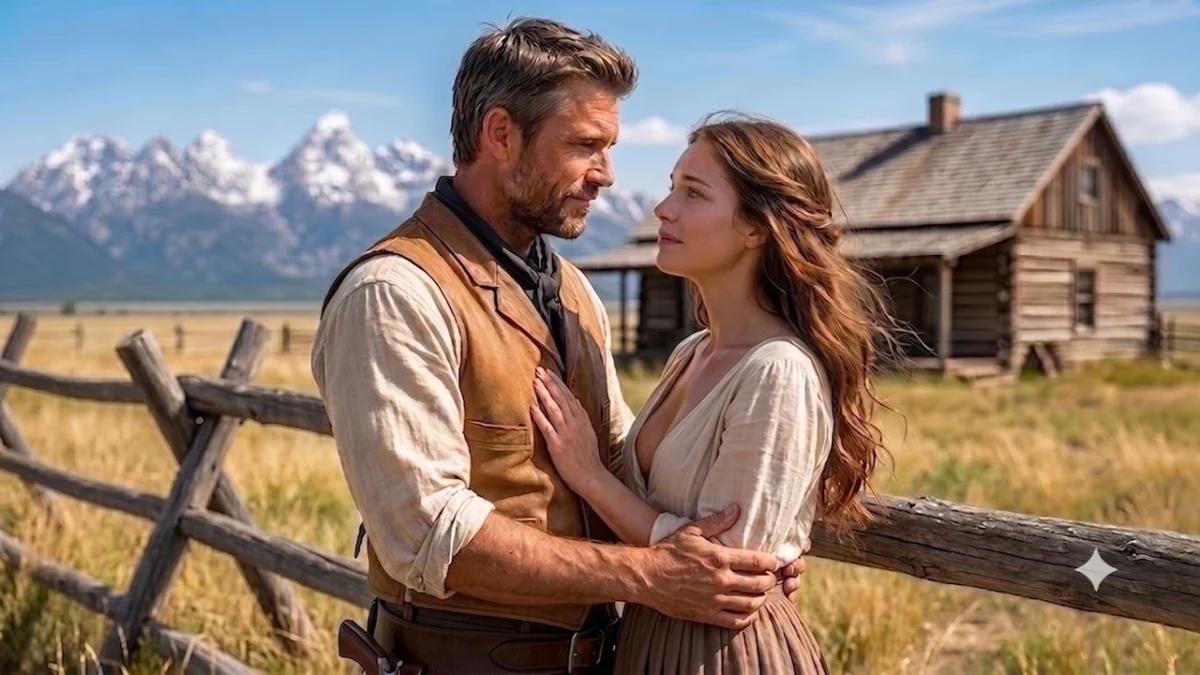
The knock came just as the howling wind tried to tear the front door from its iron hinges.
Clayton Reed reached for the loaded rifle leaning beside the fireplace hearth long before his hand touched the heavy wooden latch.
No decent traveler crossed the freezing Wyoming prairie after sunset in the middle of a bitter January storm.
Anyone caught outside in weather like this was either terribly desperate or dangerously foolish.
When he finally pulled the door open, bracing his shoulder against the icy blast, he found neither an outlaw nor a drifter.
A young woman collapsed across the timber threshold, falling forward into the drafty entryway.
Heavy drifts of snow clung to her dark hair and the threadbare wool of her traveling cloak.
Dark, dried blood stained the worn leather heels of her boots where the thin material had gave way.
Her lips had turned a terrifying shade of faint blue from the brutal cold, yet one trembling, frozen hand still clutched a tiny cloth bundle against her ribs as though it contained the very last piece of her life.
Clayton leaned out, peering past her into the swirling white abyss of the storm.
Nothing moved across the yard except the blinding clouds of windblown snow.
He lowered the barrel of the rifle, setting it against the wall as he knelt beside her.
“Come inside,” he said, his voice deep and raspy from disuse.
The woman tried to speak, her cracked lips moving feebly, but no sound came out against the roar of the gale.
Her knees buckled completely when she tried to push herself up.
Clayton reached down, catching her firmly by the shoulders, and guided her toward the radiant heat of the stone fireplace.
Warm, dry air filled the main room of the cabin, smelling richly of burning pitch pine, dried leather, and fresh black coffee.
The ranch house was plainly built, designed strictly for hard work and survival rather than aesthetic comfort, yet it stood solid and unyielding against the blizzard that swallowed everything outside.
Without asking a single question, Clayton wrapped a thick, hand-woven wool blanket around her shivering shoulders.
He poured a tin cup full of steaming coffee from the pot resting on the iron stove and pressed it gently into her mittened hands.
“Drink slowly,” he instructed quietly, taking a step back to give her space.
She accepted the hot cup with shaking fingers, bringing it to her mouth while steam drifted up between them.
After several careful, hesitant sips, a faint trace of natural color slowly returned to her pale cheeks.
“My name is Sarah,” she whispered, her voice barely audible over the crackling logs. “Nothing more.”
She offered no family name, no history, and no explanation for how she came to be walking alone in a Wyoming blizzard.
Clayton noticed the sharp pause and the tight, guarded look in her eyes, but he simply nodded and let it pass.
“I’m Clayton Reed,” he said.
A heavy silence settled between them, broken only by the steady pop and crackle of the burning logs in the grate.
Sarah leaned back against the high wooden bench, her dark eyes slowly surveying the dim, single-room cabin.
She saw one stout oak table, two hand-carved chairs, a heavy stock saddle hanging from a peg beside the front door, and a single bed tucked neatly into the far corner behind a faded canvas curtain.
Nothing about the orderly, utilitarian space suggested that another person had lived here with him for years.
“You live alone?” she asked, her voice growing slightly stronger as the heat seeped into her bones.
“I do,” Clayton replied simply.
He took the iron poker from the hearth and stirred another heavy log into the heart of the fire, sending a shower of bright orange sparks up the chimney.
“The storm will keep you trapped here tonight,” he added, looking toward the window where ice was already thick on the glass. “There’s no traveling in that.”
A visible wave of relief washed across her face, so intense and immediate that she quickly lowered her head to hide it.
“Thank you,” she whispered.
Outside, the wind screamed harder, rattling the heavy timber rafters above their heads.
Clayton watched her carefully from his spot by the mantle, taking in the small details he had missed in the dark doorway.
Her dark dress had once belonged to someone respectable; the fabric was fine wool, worn thin at the elbows but exceptionally well sewn with neat, tight stitches.
Her small hands carried the faint, delicate needle marks of a seamstress rather than the calloused, rough scars born of heavy ranch work.
She was clearly not a woman who belonged on the open frontier, nor was she who she appeared to be at first glance.
Yet as he looked at her pale, drawn face, she looked far more exhausted by life than dishonest.
He walked over to the stove, took down two tin bowls, and ladled a generous portion of hot beans and salt pork into each one.
He set a bowl and a spoon on the table near her bench.
Sarah hesitated, staring at the steaming food as if it were a hallucination.
“When did you last have a warm supper?” Clayton asked gently.
She lowered her eyes, a faint flush of embarrassment rising on her neck.
“I cannot remember,” she admitted softly.
He pushed the bowl a fraction of an inch closer to her hands.
“Then start now.”
She picked up the spoon and began to eat, moving with quiet, instinctual manners despite her obvious, desperate hunger.
That small detail alone told Clayton everything he needed to know.
People pretending to be refined ladies rarely remembered small courtesies, like waiting for their host or eating quietly, when they were starving.
Sarah still remembered, even after whatever terrible ordeal had driven her out into the winter wilderness.
When supper was finished, Clayton gathered a second pile of fresh wool blankets and a canvas pallet from a storage chest.
He arranged them neatly on the wide wooden floorboards right beside the hearth.
“You’ll sleep here by the fire,” he said, smoothing down the top blanket. “It stays warm through the night.”
Sarah looked up from her tin cup, her brow furrowing slightly.
“And where will you sleep?” she asked.
“I have my bed,” Clayton replied, gesturing toward the curtained corner.
“I cannot take your main room and force you to sleep in the cold corner,” she protested softly. “I am a guest—an uninvited one.”
“You aren’t forcing anything,” his firm answer effectively ended the discussion before it could begin.
Hours passed slowly as the deep night set in.
The relentless blizzard battered the thick pine cabin without a shred of mercy, shaking the heavy window frames.
Sarah lay awake on the pallet, her eyes wide and dark, staring blankly into the dying orange embers of the fireplace.
Clayton sat at the small table nearby, working quietly under the dim light of an oil lamp as he repaired a broken leather horse harness with an awl and heavy waxed thread.
Finally, the quiet became too heavy, and Sarah spoke into the dimness.
“Do you ever get lonely out here?” she asked softly.
Clayton’s hands stopped moving over the leather strap, the awl hovering just above the harness.
“Sometimes,” he admitted, his tone flat and even.
“Why stay?” she pressed gently, turning her head toward him. “It is so vast, and so far from everything.”
He looked away from his work, his gaze drifting toward the frosted pane of the small side window.
“My wife is buried behind the hill,” he said, offering the truth without any trace of self-pity. “This was our land.”
Nothing else followed his declaration, and the weight of his brief words hung in the warm air.
Sarah lowered her eyes, her heart aching for the quiet sorrow she saw etched into his weathered face.
“I’m sorry,” she whispered.
“So am I,” Clayton replied quietly.
Another silence settled between them, but it felt entirely different this time—gentler, softer, and built on a strange, shared understanding of loss.
Near midnight, the fire burned down to a mound of glowing coals, casting long, dancing shadows across the log walls.
Sarah’s breathing became uneven and shallow, not from the peaceful drift of sleep, but from the terrifying memories she could not seem to outrun no matter how far she traveled.
Without turning around from his workbench, Clayton spoke into the darkness.
“No one will harm you while you are in this house, Sarah.”
Her fingers tightened convulsively around the edge of the wool blanket.
“You don’t even know who I am,” she said, her voice trembling slightly. “You don’t know what troubles I might bring to your door.”
“I know enough,” Clayton answered, setting his tools down with a soft metallic clatter. “I know you were freezing, and now you are warm.”
“You shouldn’t trust strangers so easily,” she insisted, sitting up on the pallet.
Driven by a sudden surge of restless anxiety, she stood up and walked over to the frosted glass of the front window.
Outside, the blinding snow had completely erased every wooden fence line, every dirt trail, and every familiar landmark across the valley.
“It always seems to follow me,” she murmured, staring out into the white abyss. “The cold, the trouble, the noise.”
Clayton stayed where he was, waiting patiently for her to speak if she chose to.
Sarah drew one slow, shaky breath, pressing her palm against the icy glass.
“I trusted the wrong man back in Ohio,” she said, her voice dropping so low it was almost swallowed by the howling wind outside. “He was a wealthy man’s son. He promised marriage, he promised a future, and I was foolish enough to believe every word he spoke.”
Clayton said nothing, giving her the full space of the room to continue.
“When I told him I was expecting his child, everything changed in a single day,” she swallowed hard, her throat tight with old tears. “He denied me completely. He claimed he had never made such promises, and that I was merely seeking his family’s money.”
She stared out into the pitch-black night, her reflection faint against the frosted glass.
“The whole town believed him,” her shoulders went rigid and still. “His father had influence, and I had nothing. Every place I ran to after that believed the exact same story the moment his family sent word ahead. They called me disgraced. They never once asked me if it was true.”
Clayton slowly rose from his heavy chair.
He walked over to the hearth, passing close enough to her only to pick up another split log and place it carefully onto the dying fire.
“You don’t owe me the rest of the story, Sarah,” he said, looking at her directly.
She turned to him in genuine surprise, her eyes wide in the amber firelight.
“You aren’t going to ask me if I am telling the truth? You aren’t going to demand to know where the child is?”
“If you choose to tell me those things someday, I will listen,” Clayton replied steadily. “Tonight, you are safe, and that is all that matters.”
The room became quiet again, settled under a blanket of newfound peace.
Outside, the terrible storm only grew stronger, sealing them away from the rest of the world.
Morning never truly came the next day, at least not the bright, clear kind either of them might have expected.
The relentless blizzard completely buried the small ranch house beneath towering, fresh snowdrifts before dawn.
It sealed every dirt road, buried every timber fence, and effectively crushed any lingering hope of Sarah leaving the valley anytime soon.
As Sarah stood at the window later that afternoon, watching the entire white world disappear beyond the thick glass, she realized something extraordinary.
For the first time in endless, terrifying months, nobody could reach her.
The harsh wilderness had given her a fortress, but she did not yet realize that the greatest challenge waiting inside the small cabin was not the freezing storm outside.
It was the quiet, undeniable bond growing between her and the solitary rancher who had taken her in without question.
The relentless winter storm finally loosened its icy grip on the eighth morning.
Brilliant, blinding sunlight spilled across the fresh drifts like polished silver, revealing timber fences completely buried beneath white mounds and cattle huddled closely together against the biting wind.
Sarah stood on the small front porch beside Clayton, taking a deep, crisp breath of the sharp mountain air.
“This is where I should thank you for saving my life,” she said quietly, looking out over the pristine landscape. “And this is where I should take my bundle and leave.”
Clayton did not answer her right away.
Instead, he picked up a heavy iron shovel resting against the porch wall and began clearing a path through the deep snow toward the barn.
Sarah watched his rhythmic, powerful movements for a moment before marching back into the house, grabbing a second shovel from the lean-to, and stepping out onto the snow beside him.
“I said I would earn my keep while I was here,” she said firmly, digging her spade into the drift.
Clayton glanced at her sideways, a rare, subtle spark of amusement in his eyes.
“Then keep up,” he said.
By midday, working side by side in the freezing air, they had opened a narrow, workable trail through the snow to the livestock building.
The cattle began to bawl loudly the very moment Clayton threw the heavy barn doors open.
Inside, warm, musk-scented breath drifted through the dim rafters while restless hooves thudded against the frozen wooden floorboards.
Sarah moved instinctively without waiting for Clayton to give her instructions.
She grabbed a pitchfork, spreading fresh, clean hay into the wooden mangers, checking the ice-topped water barrels, and gently rubbing the thick frost from a frightened newborn calf’s dark face.
Clayton stood by the door, noticing every smooth, practiced movement she made.
“You’ve worked around livestock before,” he observed quietly.
“My uncle raised shorthorn cattle back in Indiana,” Sarah replied, not looking up as she smoothed down the calf’s fur. “I spent most of my childhood in his barns.”
“You never mentioned that before,” Clayton noted.
“You never asked,” she countered, tossing a small smile over her shoulder.
The faint corner of Clayton’s mouth lifted slightly in response.
For the very first time since her desperate arrival on his threshold, Sarah felt a genuine smile touch her own lips.
The days turned into two solid weeks, and the isolated ranch settled into a comfortable, steady rhythm.
There were morning chores in the icy barn, simple but heartening meals cooked over the iron stove, and long, quiet evenings spent sitting together beside the fireplace.
Neither of them spoke more than was strictly necessary, yet the silence between them no longer felt heavy or empty.
It had transformed into something comfortable, something deeply shared.
One afternoon, while sweeping the dust from the pine floorboards, Sarah’s broom struck a heavy object hidden far beneath Clayton’s bed.
She knelt down, pulling out an old wooden trunk bound with tarnished brass straps.
She paused, her fingers resting on the cold metal latch.
“I shouldn’t be prying,” she murmured aloud, backing away.
Clayton looked over from the kitchen table where he was cleaning his hunting rifle.
“Open it,” he said softly. “It’s alright.”
Sarah hesitated, then carefully lifted the heavy lid.
Inside rested several neatly folded cotton and wool dresses, carefully wrapped in tissue with dried lavender sprigs tucked between the folds.
There was a faded straw bonnet with a blue ribbon, and a delicate pair of white leather gloves that looked barely worn.
Every single item had been preserved with immense, heartbreak-laden care.
“Mary’s,” Clayton said, his voice staying completely calm and flat, though his eyes darkened slightly.
“She must have been very lovely,” Sarah said gently, touching the edge of a yellow dress.
“She loved bright spring colors,” Clayton agreed, setting his cleaning rag down. “She hated the gray of winter.”
Sarah gently closed the heavy lid, latching it tight, and pushed the trunk back beneath the bed.
“I’ll leave them untouched,” she whispered. “I’m sorry for pulling it out.”
Clayton shook his head slowly.
“She would rather someone wore them than let them sit in the dark turning to dust,” he said quietly.
Sarah looked away, her chest tightening with a strange, complex emotion.
“I could never replace her, Clayton,” she said honestly.
“I’m not asking you to replace anyone, Sarah,” he replied.
That evening, Sarah prepared supper using the very last of the store-bought onions, some dried herbs, and a chunk of salted beef she had simmered for hours.
Clayton took one bite of the stew before pausing, looking up across the small wooden table at her.
“This tastes better than anything that has been cooked in this house in three years,” he said bluntly.
Sarah laughed softly, a bright, clear sound that seemed to light up the dark corners of the cabin.
“You’ve been surviving, Clayton,” she said, leaning her chin on her hand. “That’s very different from actually living.”
The simple truth of her words lingered in the warm air long after the meal was finished and the dishes were washed.
Two mornings later, while walking out to fetch water from the well, Clayton paused in the snow, his eyes dropping to the ground near the edge of the barn.
There were fresh, deep tracks in the crust—horse tracks made by heavy iron shoes.
“Three riders,” Clayton said, kneeling in the snow to inspect the indentations. “They came in close during the night.”
Sarah’s heartbeat quickened instantly, her old panic rising like a cold hand around her throat.
“I thought the deep snow kept everyone away from this side of the valley,” she said, clutching her shawl tight.
“Not anymore,” Clayton said, his face hardening as he stood up.
He followed the trail of the tracks with his sharp eyes until they disappeared over the high white ridge toward town.
“Stay near the house today, Sarah,” he instructed firmly.
“Do you expect trouble?” she asked, her voice trembling.
“I expect people,” Clayton answered darkly. “And out here, people usually bring trouble.”
His prediction proved correct later that very afternoon.
Three mounted men rode brazenly into the ranch yard, not bothering to call out from the gate or ask for permission to enter the property.
The oldest rider, a heavy-set man with a thick gray beard, tipped his stained felt hat only halfway as he pulled his horse to a stop.
“Reed,” he called out loudly.
Clayton stepped out onto the front porch, resting his hand casually on the timber railing, keeping his rifle within arm’s reach inside the door.
“What brings you onto my land, Miller?” Clayton asked, his voice steady and cold.
The old man’s sharp eyes shifted past Clayton, locking onto Sarah, who stood just inside the open doorway.
“We heard down at the mercantile that you took in a woman during the storm,” Miller said, his tone dripping with skepticism.
“I hired some help for the winter,” Clayton answered without missing a beat.
The younger rider sitting beside Miller let out a crude, loud laugh.
“Pretty help,” he sneered, looking Sarah up and down.
Sarah recognized that look immediately; she had seen it in every town she had passed through since leaving Ohio.
It was not genuine curiosity; it was cruel, self-righteous judgment.
The oldest rider folded his hands over his saddle horn, leaning forward.
“Folks in town are saying she’s the exact same woman who caused a mess of trouble back east in the mining camps,” Miller said, his voice hard. “Saying she was turned out for good reason.”
Clayton’s stern expression never changed by a fraction.
“Folks in town talk entirely too much about things they don’t understand,” he replied smoothly.
The younger rider smirked again, spitting a stream of tobacco juice onto the clean white snow.
“Maybe you just don’t know what kind of woman you’re feeding at your table, Clayton.”
“I know exactly what kind of woman she is,” Clayton declared, stepping to the edge of the porch.
Sarah stared at his back in complete surprise, her breath catching in her throat.
Clayton continued, his deep voice carrying clearly across the cold, silent yard without him having to raise it.
“She is a woman who has worked beside me from sunup to sundown every single day. She is a woman who saved two of my newborn calves from freezing to death yesterday afternoon. And she is a woman who hasn’t told me a single lie since she stepped through my door.”
The lead rider spat into the snow, his face souring into a bitter scowl.
“You’ll regret standing up for trash like that, Reed. The whole county will know.”
Clayton stepped down off the wooden porch, taking two slow, deliberate steps toward the horses.
“This is my land,” he said, his voice laced with iron. “This is my decision. And that is my gate. Get off my property.”
The three visitors stared at him for another tense moment, realizing that Clayton was not going to back down or offer them any further explanation.
Reluctantly, the leader tugged hard on his reins, turning his horse around.
“Let’s go,” he muttered to the others.
As the riders disappeared over the snowy ridge in the distance, Sarah finally released the ragged breath she had been holding for minutes.
She stepped out onto the cold porch, looking down at her boots.
“I’m so sorry, Clayton,” she whispered.
Clayton walked back to the porch, leaning down to fasten the iron latch on the small yard gate.
“For what?” he asked.
“They came here because of me,” she said, tears prickling at the corners of her eyes. “They brought their filth to your door.”
“They came because they are small-minded men who enjoy finding someone they think is weaker than them,” Clayton corrected her firmly.
“They won’t stop with just visiting,” Sarah insisted, her voice thick with worry. “They will talk in town. They will ruin whatever good name you have left here.”
“Neither will I stop,” Clayton replied, looking her dead in the eye.
That night, neither of them slept more than a few restless hours.
The icy wind had completely faded outside, but a different kind of heavy storm seemed to be gathering just beyond the dark hills.
Near midnight, Sarah sat up on her pallet by the hearth and quietly began folding her thick wool blanket.
“I’m leaving before sunrise,” she announced softly into the quiet room.
Clayton, who was sitting up in his chair by the dying fire, looked over at her immediately.
“No, you aren’t,” he said.
“They will destroy your reputation, Clayton,” she argued, her voice cracking. “They will tell everyone that you are keeping a fallen woman in your house.”
“I’ve lived alone on this ridge for three years, Sarah,” he said calmly. “I care very little about what the town thinks of my house.”
“You don’t understand!” she said, standing up and facing him with desperate intensity. “If I stay here any longer without a clear reason, people will assume the absolute worst. They will say I traded my body to you just for shelter and food!”
Clayton slowly rose from his heavy chair, his boots scraping loudly against the pine floorboards.
He walked over to her until he was standing directly in front of her, looking down into her tear-filled eyes.
“Have I ever once asked that of you, Sarah?” he asked softly.
“No!” she answered immediately. “Never. You have treated me with nothing but honor and kindness. But they will still believe it, Clayton! A woman’s reputation, once broken, can never be mended in the eyes of people like that!”
A heavy, suffocating silence stretched between them as the fire crackled faintly in the grate.
Finally, Clayton took a slow, deep breath and spoke.
“There is one way to stop their mouths permanently,” he said.
Sarah waited, her heart hammering against her ribs like a trapped bird.
Clayton’s hands tightened into loose fists at his sides, his jaw setting firmly.
“I need someone here,” he began, his tone practical yet intensely earnest. “This ranch is too much work for one solitary man, especially when the hard spring work starts. And you need a place where nobody can judge your past or question your presence.”
Sarah searched his weathered face, her brow furrowing in confusion.
“What are you saying, Clayton?”
His next words came slowly, carefully chosen and deeply considered.
“We could get married,” he said simply.
Sarah’s breath caught sharply in her throat, her mind stalling.
“Clayton…”
“Listen to me before you answer,” he interrupted gently, holding up a hand. “Not because I expect you to be a real wife in that way. Not because I think you owe me anything for taking you in out of the snow. You would have your own space, your own dignity, and your own room until the day you chose otherwise.”
He stepped a fraction closer, his eyes locking onto hers with unwavering intensity.
“My name would protect you from every bitter tongue in this territory. The law would respect you. And this ranch would belong to both of us, fair and square.”
Sarah stared up at him, tears finally spilling over her dark lashes and tracing hot paths down her cold cheeks.
“You would actually marry a woman that everyone back east calls ruined?” she whispered, her voice trembling violently.
“I would marry the woman standing right in front of me,” Clayton answered without a single second of hesitation. “The woman who works beside me, who cares for this home, and who brought life back into this dead cabin.”
“You barely know me, Clayton,” she sobbed softly. “You’ve only known me for a few weeks.”
“I know enough to trust you with my life and my home,” he said softly. “And that is more than I have trusted anyone with in a very long time.”
Outside in the yard, a distant horse suddenly whinnied loudly in the dark, cold night.
Neither of them paid any attention to the sound, completely consumed by the heavy moment between them.
They did not realize that someone had already returned to the ranch under the cover of darkness.
And this time, the visitors had not come simply to talk or spread gossip.
The loud, violent knock came just before sunrise the following morning.
It was not a polite request for entry; three hard, heavy blows shook the thick oak door frame so violently that dust fell from the rafters.
Clayton was awake instantly, standing up from his chair and quietly reaching for his loaded rifle leaning in the corner.
Sarah stepped out from behind her curtain, standing beside him near the door without needing to be asked.
Another pounding blow followed, accompanied by a harsh, raised voice from the porch.
“Open up this door, Reed!”
Clayton unlocked the latch and opened the door just wide enough to step outside onto the porch, pulling the door shut firmly behind his back.
Four armed riders waited in the yard beneath the pale, cold morning sky, their horses stamping their hooves in the deep snow.
The man riding at the front—a tall, mean-looking fellow named Henderson—smiled without an ounce of warmth in his eyes.
“Heard down at the saloon that you’re fixing to make an honest woman out of that tramp, Clayton,” Henderson sneered loudly.
Clayton rested one hand on the stock of his rifle, his face completely unreadable.
“Whatever I choose to do on my own land is my business, Henderson,” he said calmly.
“It becomes the whole town’s business when decent people have to live next to filth,” the rider countered, resting his hand near his own holstered revolver.
Before Clayton could respond, the front door clicked open behind him, and Sarah stepped out onto the icy porch, her chin held high despite her pale face.
“I will leave,” she said clearly, looking directly at the armed men. “You don’t need to threaten him. I will pack my bundle and go right now.”
Clayton turned his head sharply, his eyes flashing with rare, intense anger.
“No,” he commanded her firmly. “You stay right where you are.”
The lead rider let out a harsh, barking laugh, looking back at his companions.
“See that, boys? Even the woman knows she doesn’t belong here!”
Clayton stepped off the wooden porch, his heavy boots sinking into the snow, his rifle held loosely across his chest.
“I told you men once before to get off my land,” Clayton’s voice dropped to a low, dangerous register that made the horses shift nervously. “I won’t tell you a third time.”
The four men hesitated, looking at one another in unexpected uncertainty.
They had ridden out expecting shouting, cowardice, or pleading from a lonely farmer.
They had not expected the absolute, quiet certainty of a man who was fully prepared to defend his home to the death.
The oldest rider among them finally grunted in frustration, tugging hard on his leather reins to turn his horse toward the gate.
“You’ll regret choosing a disgraced woman over your neighbors, Reed,” he spat bitter words over his shoulder.
Clayton never looked away from the leader’s eyes.
“I already made my choice,” Clayton said steadily. “Now leave.”
The four riders turned their horses and galloped out of the yard, disappearing across the vast, frozen prairie toward the distant town.
Sarah stood on the porch, watching them until they became tiny, dark specks against the white hills.
“They will spread even more terrible lies now,” she whispered, her hands shaking at her sides. “They will make sure no one in this county ever speaks to you again.”
Clayton walked back up the wooden steps, turning to face her on the porch.
“They already have,” he said simply. “It changes nothing.”
He looked into her eyes, his expression softening completely.
“You can still change your mind, Sarah. If you want to leave, I will hitch the wagon and drive you to the stagecoach station in town myself. I won’t force you into a life of fighting my battles.”
Sarah looked at his broad shoulders, his calm, steadfast eyes, and the quiet dignity he carried like armor.
“My answer hasn’t changed,” she said softly, stepping closer to him. “If you still want me, Clayton, I will stay.”
That very afternoon, they hitched the heavy wooden wagon and rode together to the small, solitary church sitting on the outskirts of Cotton Creek.
Snow still covered the surrounding fields, but the afternoon sunlight had finally begun softening the frozen earth along the trail.
Inside the quiet, cold chapel, only the elderly preacher and his kindly wife waited for them near the altar.
The old preacher looked from Clayton’s rough, scarred hands to Sarah’s pale, resolute face, sensing the quiet intensity between them.
“Are you both entirely certain of this step?” the preacher asked gently. “A marriage made in hard times must withstand great trials.”
Clayton answered first, his voice echoing clearly off the high wooden rafters.
“I am.”
Sarah swallowed the lump of emotion in her throat, looking up at Clayton before turning to the preacher.
“I am,” she said firmly.
The simple ceremony lasted only a few short minutes.
There were no crowded pews filled with cheering friends, no joyful music playing, and no elaborate celebration waiting for them.
When the time came, Clayton reached into his coat pocket and pulled out a simple, polished gold band that had once belonged to his late mother.
Gently taking Sarah’s small, cold hand in his own, he slipped the gold ring onto her finger.
“I give you my name,” Clayton said, his deep voice remaining absolute and steady. “I give you my home, my work, and my future, for as long as I live.”
Sarah looked deep into his dark eyes, tears filling her own, but her hands were entirely steady now.
“I give you everything I have left,” she whispered back. “My loyalty, my work, and my heart.”
The preacher smiled gently, extending a blessing over their bowed heads.
“You may walk out into the world together as husband and wife,” he declared.
When they stepped out of the heavy church doors into the bright afternoon sunlight, the biting winter wind felt entirely different than it had that morning.
It no longer felt lonely or threatening; it felt shared.
They climbed into the high wooden seat of the wagon and began the long journey back toward the ranch.
However, halfway home, as the trail narrowed through a rocky, snow-filled pass between two high ridges, they found trouble waiting for them once again.
The same four riders from that morning were lined up across the narrow dirt trail, blocking the only way through.
Their leader, Henderson, climbed down slowly from his saddle, holding a heavy lever-action rifle in his hands.
“You should have listened to us, Reed,” Henderson called out, a cruel smile spreading across his face. “We warned you about bringing trash into this valley.”
Clayton didn’t hesitate for a single second.
He handed the leather reins to Sarah, pulled his own rifle from the boot beside his seat, and climbed down from the high wagon into the snow.
“And I told you to stay off my trail,” Clayton said, his voice dropping into a cold, terrifying calm. “So you should have listened to me.”
The leader reached quickly for his sidearm, attempting to draw before Clayton could raise his rifle.
Everything happened at once in a chaotic, terrifying blur of sound and motion.
A deafening gun blast split the quiet valley air, echoing off the high stone walls.
The horses reared up in panic, whinnying wildly against their harnesses.
Sarah instinctively dropped down onto the floorboards behind the heavy wooden wagon wheel, her heart hammering against her ribs.
Clayton fired a single, lightning-fast shot from the hip.
The lead gunman spun backward violently, his rifle slipping from his fingers as he collapsed into the deep bank of snow with a heavy thud.
The remaining three riders froze in absolute shock, their hands hovering helplessly near their belts.
None of them had expected resistance so swift, so precise, or so lethal from a quiet rancher.
“Go home!” Clayton roared, racking another heavy shell into his rifle’s chamber with a loud, metallic clack. “Or the next shot won’t just hit a shoulder!”
The remaining three men looked at one another in sheer terror, seeing the deadly intent written across Clayton’s cold face.
Without speaking a single word, they scrambled down from their saddles, hoisted their bleeding, groaning companion onto his horse, and rode away at a frantic gallop back toward town.
Silence returned to the snowy mountain pass, thick and heavy.
Sarah scrambled out from behind the wooden wheel and rushed frantically toward Clayton, her face pale with horror.
“Clayton!” she cried out.
She gasped as she saw a dark red stain rapidly spreading across the coarse wool of his coat sleeve near the shoulder.
“You’ve been hit!”
Clayton glanced down at his arm casually, his expression unchanged.
“The bullet only grazed the meat of the arm,” he said smoothly. “It looks far worse than it actually is.”
Without a second thought, Sarah reached down, tore a wide strip of clean linen from the hem of her petticoat, and wrapped the wound tightly, tying a firm knot to stop the bleeding.
Clayton’s dark eyes stayed locked on her face the entire time she worked, watching the tender, fierce care in her quick hands.
“You always take care of everyone around you except yourself, Clayton Reed,” she murmured softly, adjusting the improvised bandage.
“That changes starting today,” she added, looking up into his eyes with absolute fierce devotion.
They finally reached the isolated ranch house just as the golden sun began to dip below the western mountains.
A thin trail of grey smoke curled peacefully from the stone chimney into the clear evening air.
The plain log house looked exactly as it had on the desperate night Sarah had first arrived freezing at the threshold.
Yet as they walked up the wooden steps together, both of them knew that everything inside those walls had changed forever.
Inside, Clayton picked up two tin plates from the shelf and carried them to the table, setting them down neatly.
Sarah paused in the doorway, a soft, genuine laugh bubbling up from her chest.
“I thought wives were supposed to serve supper in a house,” she teased gently.
“I thought husbands were allowed to learn new habits,” Clayton countered smoothly, a faint, genuine smile touching his lips.
They ate their evening meal together in the quiet room while the rich, golden light of sunset filled the space through the frost-free window.
No unnecessary words were needed between them; the comfortable understanding in the air was complete.
After supper was finished and the dishes were stacked beside the basin, Sarah walked over to the hearth.
She quietly picked up the thick wool blanket she had used for weeks on her floor pallet.
She folded it carefully into a neat square and set it inside the wooden storage chest.
Clayton watched her from across the room, his eyes dark and warm in the lamplight.
“You won’t be needing that blanket down there anymore,” he said softly.
Sarah looked up at him, a radiant, confident smile gracing her features.
“No,” she agreed gently. “I won’t.”
Clayton walked toward the small bedroom curtain, then paused, turning back to face her with complete seriousness.
“I meant every word of what I promised you this morning, Sarah,” he said, his voice thick with emotion. “Nothing will ever be forced in this house. Nothing expected that you do not freely give.”
Sarah understood the profound respect behind his words.
She stepped across the room, closing the distance between them, and gently placed her small hand inside his large, rough palm.
“I know,” she whispered, her dark eyes shining with pure devotion. “And I choose this. I choose you, Clayton.”
Together, hand in hand, they stepped behind the curtain into the quiet room.
Morning arrived bright, crisp, and spectacularly clear across the Wyoming prairie.
Fresh, brilliant sunlight poured through the clean windowpanes, illuminating every corner of the small cabin.
Sarah woke first, resting her head against Clayton’s solid chest, listening peacefully to the steady, rhythmic beat of his heart.
For several long, beautiful moments, she simply lay there, enjoying the absolute quiet.
There was no cruel shouting, no painful whispers, and no fear of what the coming day might bring.
There was only the distant calling of the cattle out in the snow-covered pasture and the pleasant sound of water beginning to boil over the iron stove in the next room.
She slipped on her warm dress, wrapped her heavy shawl around her shoulders, and stepped outside onto the front porch.
The vast Wyoming prairie stretched endlessly before her beneath a towering sky of brilliant, unclouded blue.
Clayton joined her a moment later, carrying two steaming tin cups of fresh coffee.
He handed one to her, his bare shoulder brushing against hers as he leaned against the porch railing.
“What are you looking at so intently?” he asked softly, taking a sip from his cup.
Sarah smiled, looking out toward the distant, sunlit hills where the snow was already beginning to melt in the morning heat.
“I’m looking at home,” she answered simply.
As they stood together in the crisp air, a solitary wooden wagon appeared far down the dirt trail, moving slowly toward the ranch gate.
As it drew closer, they saw an elderly, silver-haired widow driving the team.
In the back of her wagon sat two small, dormant apple saplings carefully wrapped in damp burlap.
The old woman pulled her team to a stop near the porch, offering them a shy, warm smile.
“I heard down at the mercantile yesterday that a new family had started out here on the ridge,” the widow said, her voice kind and gentle. “I thought to myself that every proper home deserves something living that keeps growing through the years.”
Sarah stepped down off the porch, accepting the two young saplings into her careful hands as if they were made of pure gold.
“Thank you,” Sarah whispered, her eyes shining with tears of genuine joy. “Thank you so much.”
Clayton fetched two iron shovels from the lean-to without a word.
Side by side in the crisp morning air, Clayton and Sarah dug two deep holes into the softening, rich earth near the side of the house.
Together, they carefully placed the roots into the dark soil and packed the earth firmly around the bases of the young trees.
When the last of the roots were safely buried beneath the fresh earth, Clayton straightened up, brushing the dark soil from his calloused hands.
“Years from now, when the summer heat comes,” Clayton said, looking down at her with quiet pride, “they’ll give us good shade.”
Sarah looked up from the tiny saplings to the strong, unwavering man standing beside her, her heart completely full.
“And they’ll always remind us of how our life together truly began,” she said softly.
The gentle winter wind moved softly across the vast, open prairie.
Beside the solid pine house, the two young trees bent together in the breeze, holding firm against the cold, refusing to break.








