She Received a Letter From Her Husband… 10 Years After His Death
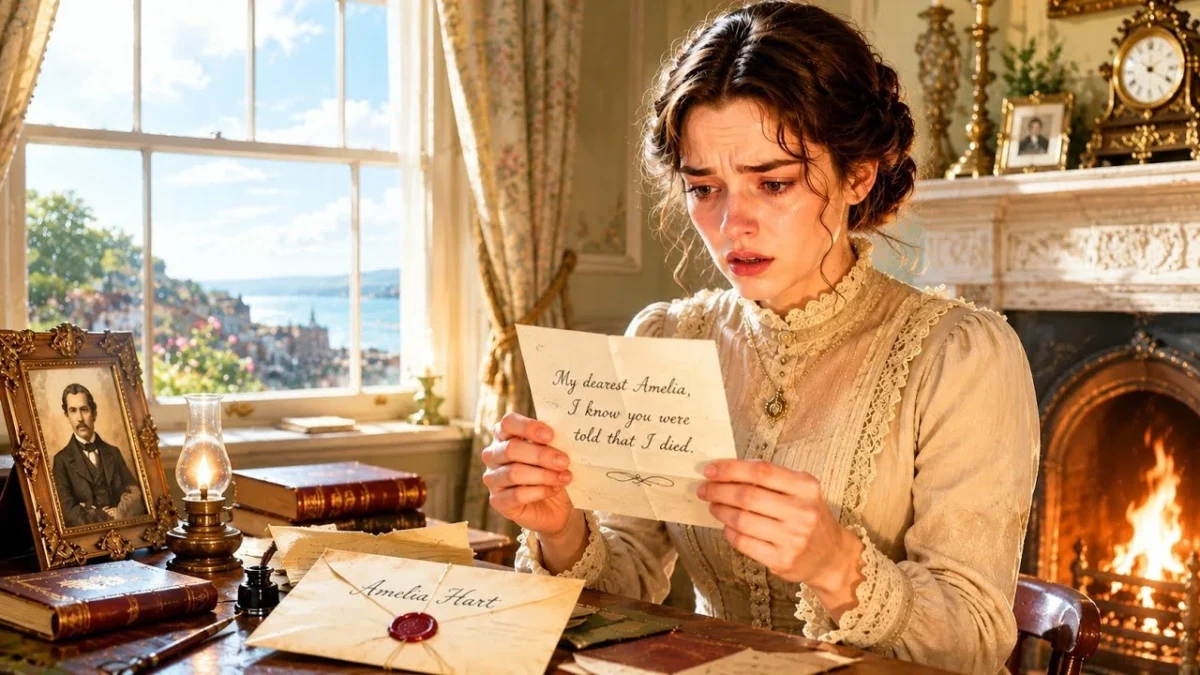
The winter air of 1898 bit sharply through the thin curtains of the cottage, yet inside the quiet parlor, time had remained entirely frozen for a decade.
Amelia Hart sat beside the dying embers of the hearth, her delicate fingers resting near a silver pocket watch that had not ticked since December of 1888.
She was twenty-four when the coastal authorities delivered the devastating news that her husband, Edward, had perished at sea during a horrific squall.
Although several bodies had been dragged from the violent surf, Edward’s body was never recovered, leaving Amelia bound to a shadow of grief.
She had never remarried, preferring the ghost of Edward’s memory over the living suitors who occasionally sought her favor.
His leather-bound books remained untouched on the mahogany shelves, aligned precisely as he had placed them.
His heavy wool coat hung behind the master bedroom door, still faint with the scent of pine and sea salt.
Amelia lived a solitary existence, her youth slowly slipping away into the quiet rhythm of widowed life in the coastal village.
Three slow, deliberate knocks resonated through the heavy oak front door, breaking the stillness of the freezing night.
Amelia startled, her heart leaping into her throat as she glanced at the grandfather clock ticking in the hallway.
It was nearly midnight, an hour when no respectable neighbor would ever dream of calling upon a lonely widow.
She pulled her knitted shawl tightly around her shoulders and walked down the cold corridor, her steps hesitant upon the floorboards.
“Who is there?” she called out, her voice trembling slightly against the drafty chill.
No answer came, only the whistling of the bitter north wind against the windowpanes.
Amelia reached for the brass latch, pulled the heavy door open, and braced herself against the gust of snow that rushed inside.
The doorstep was completely deserted, save for fresh footprints already being erased by the falling snow.
Looking down, she spotted a small paper envelope resting directly on the threshold.
She scooped it up quickly, closing the door against the tempest before turning the letter over in her trembling hands.
Written across the cream-colored parchment in bold, dark ink was her name: Amelia Hart.
Her breath caught in her chest, and the room seemed to spin around her as her eyes devoured the distinct, slanted penmanship.
It was a hand she had memorized through hundreds of love letters during their courtship, a hand she had mourned for ten long years.
It was Edward’s handwriting.
She staggered back to the parlor, her knees barely supporting her weight as she sank into the armchair near the hearth.
With shaking fingers, she broke the wax seal and unfolded the single sheet of paper contained within.
“My dearest Amelia,” the letter began, the ink fresh and unsmudged.
“I know you were told that I died.”
Amelia gasped, a sob lodging tightly in her throat as she stared at the words, reading them over and over until they blurred.
At the bottom of the page sat a date that sent a surge of pure electricity through her veins: December 12th, 1898.
It had been penned merely two days ago.
As she tilted the envelope, a small brass key slipped out, clattering loudly against the wooden floorboards.
Beneath the date on the parchment, a final warning was inscribed in hurried strokes: “Do not show this key to anyone.”
Amelia clutched the letter to her chest, her mind racing in a dizzying whirlwind of disbelief, hope, and terrifying uncertainty.
She sat awake through the entire night, staring into the flickering flames until the gray light of dawn crept through the windows.
As soon as the morning sun illuminated the frost-covered glass, Amelia mounted the creaky stairs into the dusty attic.
She searched through trunks of old linens and forgotten belongings until her hands found a small, iron-bound wooden box.
Edward had given her this tiny chest just days before embarking on his ill-fated voyage, instructing her to keep it safe.
She held her breath as she inserted the brass key into the rusted lock, turning it until a sharp click echoed through the rafters.
Inside lay a single photograph and a folded document.
Amelia lifted the photograph, her thumb brushing away a layer of fine dust that covered the glass frame.
The image depicted Edward standing beside three stern-looking men in heavy overcoats outside a busy railway station.
Flipping the frame over, she recognized Edward’s hasty script written in pencil across the yellowed cardboard backing.
“If I disappear, trust no one from Blackwater House.”
Amelia whispered the name aloud, the words feeling alien and dangerous on her tongue, for she had never heard of such a place.
She then unfolded the document lying at the bottom of the chest, realizing it was a confession written in Edward’s own words before he vanished.
The letter detailed a dangerous network of secret shipments, stolen funds, and corrupt high-society figures operating along the coast.
Someone was utilizing legitimate merchant vessels to transport illegal contraband across Europe under the cover of routine commerce.
Edward had stumbled upon the ledger while auditing freight records and had begun a covert investigation to identify the ringleaders.
The narrative ended with a chilling, desperate sentence that made Amelia’s heart stop entirely.
“If they believe I am dead, they will stop looking for me.”
Amelia sat on the dusty attic floor, the truth sweeping over her like an icy wave.
Edward had not merely drowned in a tragic natural disaster; he had deliberately staged his death or taken advantage of a wreck to escape execution.
Determined to find answers, she journeyed to the local town archives later that afternoon under the pretext of researching maritime history.
She pulled dusty volumes of old newspapers from late 1888, turning the fragile pages until she found the report on Edward’s ship.
A small sidebar column contained a brief statement from a local fisherman named Thomas.
Thomas had insisted to the local constable that he had given shelter to a surviving sailor matching Edward’s description three days after the wreck.
The police had dismissed his account as the ramblings of a drunkard, closing the case without further inquiry.
Amelia’s eyes scanned further down the page, only to find a follow-up article published two weeks later detailing the fisherman’s sudden disappearance.
She closed the newspaper ledger slowly, the leather binding creaking in the silent library.
Whoever was protecting the secret had ensured that no one who saw Edward alive would ever speak again.
When Amelia returned to her home at dusk, an unnatural coldness hung in the air of the parlor.
She froze on the threshold, sensing immediately that something was terribly wrong.
A floorboard creaked above her head, followed by the quiet sound of wood scraping against wood.
Someone was inside her house.
Fear seized her chest, but anger quickly superseded her terror as she crept up the staircase, holding a heavy brass candleholder.
She reached the doorway of the master bedroom and gasped.
Her desk drawers had been pulled open, their contents scattered wildly across the floorboards.
She rushed to the bedside table where she had hidden the attic photograph and Edward’s initial confession letter.
They were gone.
Amelia turned toward the vanity mirror, her heart pounding against her ribs like a trapped bird.
Written across the dusty glass in thick, oily charcoal were three stark words: “Stop searching, Amelia.”
She fell back against the doorway, realization dawning upon her with agonizing clarity.
The dark forces that had hunted Edward ten years ago were now watching her every move.
That night, as snow began to fall heavily once more, a soft rustle sounded at the base of the front door.
Amelia rushed down the hall and slid another envelope out from under the doorframe before the messenger could even step off the porch.
She opened it with trembling hands, reading the single line written inside: “If you want the truth about Edward, go to the house beside the black lake. Come alone.”
For ten years, she had mourned a ghost, but now the terrifying reality confronted her that the man she loved was breathing, hiding, and waiting.
Before sunrise, Amelia packed a small carpetbag, wrapped herself in a heavy woolen cloak, and left her home behind.
She traveled north along the forgotten coach road, where the trees grew thick and twisted, casting long shadows over the pristine snow.
After hours of walking through the biting wind, the dense woodland opened up to reveal a wide, flat expanse of black, frozen water.
Perched on the far edge of the lake sat a massive, decayed Victorian estate, its dark stone towers rising like jagged teeth against the gray sky.
It was Blackwater House.
Amelia approached the massive iron gates, which hung open on rusted hinges, groaning in the winter wind.
She walked up the overgrown stone driveway, her boots crunching softly on the ice.
The front door of the mansion stood slightly ajar, inviting her into the dark interior.
Amelia pushed the heavy panel open, stepping into a grand foyer swallowed by shadows and the heavy scent of rot and damp stone.
“Is anyone here?” she called out, her voice echoing hollowly through the empty halls.
Receiving no reply, she navigated the dark corridors, following a faint light that flickered at the end of a long hallway.
She reached the threshold of a cavernous study, where a bright fire roared within a massive marble fireplace.
The sight made her stop cold; someone was actively residing in this abandoned ruin.
On an ornate mahogany desk in the center of the room lay a freshly sealed letter addressed to her name.
Amelia stepped forward, her fingers trembling as she broke the seal and unfolded the paper.
“If you are reading this, you finally found me,” the letter read.
Tears filled her eyes as she recognized the penmanship, but before she could read further, a firm footstep sounded directly behind her.
Amelia whirled around, her heart slamming against her ribs.
A tall man stood framed in the archway of the study, illuminated by the warm light of the hearth.
His hair was heavily streaked with silver at the temples, and a deep, jagged scar ran from his left cheek down to his jawline.
Yet despite the marks of age and hardship, his striking gray eyes were unchanged.
“Edward,” Amelia whispered, the name tearing from her throat in a ragged sob.
The man stood entirely motionless for several agonizing seconds, his gaze locked onto hers with unbearable intensity.
“I’m sorry, Amelia,” he said, his voice deeper and rougher than she remembered.
Amelia took a slow, hesitant step toward him, tears spilling over her lashes and running down her cold cheeks.
“You’re alive,” she breathed, reaching out as if to touch a phantom. “You let me believe you were dead for ten years.”
Edward lowered his head, a look of profound anguish crossing his weathered features. “I had no choice.”
“You always had a choice!” Amelia cried out, her initial shock giving way to a sudden, furious grief. “I spent a decade mourning you! I built a prison out of our home while you walked the earth!”
Edward took a step closer, his eyes pleading for understanding. “If I had stayed, if I had let you come with me, they would have killed you, Amelia.”
He gestured to the burning hearth, inviting her to sit, though neither of them could rest.
“The shipwreck was not an accident,” Edward explained softly, his eyes fixed on the fire. “My vessel was sabotaged from the inside.”
“Sabotaged?” Amelia asked, her voice barely a whisper.
“I had uncovered a massive smuggling cartel operating right under the nose of the authorities,” Edward continued. “They were using commercial shipping lanes to traffic illegal goods, weapons, and stolen wealth across the continent.”
“Who was behind it?” she demanded.
“Charles Whitmore,” Edward replied, his jaw tightening. “One of the most powerful and untouchable men in the country.”
Amelia gasped, recognizing the prominent nobleman who frequently funded local charities and political campaigns.
“When Whitmore realized I had gathered ledgers proving his guilt, he ordered my ship destroyed,” Edward said. “I barely survived the wreck. A local fisherman pulled me from the icy water, but within days, Whitmore’s men were hunting us.”
“The fisherman disappeared,” Amelia noted, the newspaper article coming back to her.
“Because he helped me escape,” Edward said grimly. “I realized then that as long as Charles Whitmore believed I was alive, he would target anyone connected to me. He would have tortured you to find my ledgers.”
“So you let me suffer instead,” Amelia said quietly, the bitter pain evident in her voice.
“I chose your life over your happiness,” Edward said softly. “For ten years, I lived under assumed names, moving from town to town, slowly building an ironclad case against Whitmore’s entire network.”
He reached into his coat pocket and pulled out a thick leather portfolio, placing it on the desk between them.
“I finally have enough evidence to ruin him and put him behind bars forever,” Edward said. “But while gathering the final records, I discovered something terrible.”
“What?” Amelia asked, a feeling of dread rising in her chest.
“Someone very close to you was aiding Whitmore,” Edward said, pushing the folder toward her.
Amelia hesitantly opened the leather cover, her eyes scanning over financial receipts, shipping manifests, and letters bearing familiar signatures.
At the bottom of a transfer ledger was a signature that made her blood run ice-cold.
“My uncle Arthur?” she whispered, staring at Edward in absolute disbelief. “No… that’s impossible.”
“He was Whitmore’s chief distributor in the northern district,” Edward said gently. “He helped launder the proceeds through his import business.”
Amelia felt the room tilt beneath her feet as a sickening realization took hold.
Uncle Arthur had been the one to comfort her on the day the authorities declared Edward dead.
He had been the one who convinced her not to question the investigation, wrapping his arms around her while secretly protecting the men who had tried to murder her husband.
“He kept you close to ensure you never searched too deeply into my affairs,” Edward added.
Suddenly, the roaring of powerful automobile engines shattered the silence outside the mansion.
Edward rushed to the tall glass window, peering through the heavy curtains into the snowy dark.
Two black motorcars had pulled up to the front entrance, their bright headlamps cutting through the falling snow.
“They found us,” Edward whispered, his face turning pale. “Whitmore’s men tracked your movements.”
He grabbed Amelia’s hand, his touch warm and real against her freezing skin. “We have to leave now.”
“How did they know I was coming here?” Amelia asked, panic rising in her voice as heavy boots pounded against the front steps below.
“Because Whitmore’s agents were watching your house,” Edward said, pulling her toward a decorative bookcase at the back of the study.
He pressed a hidden catch within the woodwork, and a section of the wall swung open to reveal a narrow, pitch-black stone staircase descending into the earth.
“Down here, quickly,” Edward urged, pulling her into the damp passage just as the study door was kicked open above them with a deafening crash.
They scrambled down the icy stone steps in total darkness, guided only by Edward’s firm grip on her hand.
As they traversed the underground tunnel beneath the forest floor, Amelia’s mind spun with terrifying clarity.
“Edward,” she gasped, her breath coming in ragged bursts as they ran. “You didn’t just send that letter to reveal the truth, did you?”
“I sent it because Whitmore discovered I was still alive last week,” Edward admitted, his voice echoing in the stone passageway. “I knew his men would come for you to use as leverage against me. I had to bring you into the open where I could protect you.”
After what felt like hours of navigating the dark, damp subterranean passage, they emerged into a small wooden cottage concealed within a thick grove of pine trees near the edge of the lake.
Edward secured the heavy door with a wooden beam, blowing out the small lantern he had lit along the way.
“We will be safe here until nightfall,” he said, breathing heavily as he leaned against the wall.
Amelia stood in the center of the dimly lit room, staring at him as anger and grief warred within her chest.
“Why didn’t you write to me earlier?” she demanded, her voice shaking with emotion. “Even a anonymous note… anything to let me know you were alive!”
“Because any communication could have been intercepted,” Edward said, looking at her with deep sorrow. “I could not risk your life for my own comfort.”
“I did write,” Edward added quietly after a long pause.
Amelia froze, her breath catching. “What did you say?”
“I sent regular letters to your father,” Edward revealed softly. “For five years before he passed, your father knew I was alive.”
Amelia felt as though she had been struck in the chest. “My father knew?”
“He agreed that keeping the truth from you was the only way to ensure your safety,” Edward explained. “He knew that if you had known I was alive, you would have come looking for me, and Whitmore’s men would have cut you down.”
“Everyone lied to me,” Amelia whispered, tears spilling freely down her face. “My husband, my uncle, my father… my entire life was built on a lie.”
Edward walked over to a small table and retrieved a single yellowed sheet of paper, handing it to her.
“Your father wrote this to me before he died,” Edward said gently.
Amelia held the paper up to the pale moonlight filtering through the window, recognizing her father’s distinct, elegant handwriting.
At the bottom of a message acknowledging Edward’s survival was a final, desperate plea: “Protect my daughter at any cost.”
Amelia clutched the paper to her chest, her heart breaking under the weight of her father’s silent burden.
“He loved you immensely, Amelia,” Edward said softly. “He suffered carrying that secret, but he did it to keep you breathing.”
Before Amelia could answer, the sharp sound of horses trotting across the icy ground resonated outside the cottage.
Edward crept to the window, his expression darkening as he saw lantern lights moving through the dense trees.
“They have swept the forest,” Edward said grimly. “We must move again.”
“Where can we go?” Amelia asked, wiping her tears away as fear returned.
“There is an old escape tunnel beneath the cellar,” Edward said, pulling open a trapdoor in the floorboards. “It leads directly to the abandoned railway station.”
They dropped down into the narrow, earth-walled trench, crawling through the mud and ice until they emerged inside the ruined baggage room of the old train station.
It was the very same station featured in the photograph Amelia had found in the wooden chest.
Edward stopped near the derelict platform, his eyes scanning the decaying wooden walls.
“This is where I was seen ten years ago,” Edward murmured, stepping toward a broken wooden panel along the wall.
“Why did you come back here then?” Amelia asked, watching him carefully.
“Because I hid the final piece of the puzzle here before I went into hiding,” Edward replied, pulling a heavy metal box from behind the rotted floorboards.
He opened the chest, revealing original ship ledgers, signed orders bearing Whitmore’s seal, and sworn affidavits proving that the ship had been deliberately sabotaged.
“This is the proof that will hang Charles Whitmore,” Edward said, holding the records tightly.
Amelia looked at him, her heart aching as she saw the sheer exhaustion etched into his face. “You should have trusted me ten years ago, Edward. We could have faced this together.”
Edward offered a sad, painful smile. “I was terrified, Amelia.”
“Of what?” she asked softly.
“Of losing you,” he replied, his voice breaking. “I could endure ten years of isolation, cold, and running, but I could not endure the thought of seeing you buried.”
“You almost lost me anyway,” Amelia said, stepping closer to him.
Edward had no answer to her bitter truth; he merely looked at her with unconditional devotion.
Suddenly, heavy footsteps echoed across the wooden floorboards of the train station foyer.
“We have to go!” Edward whispered, seizing her hand as they sprinted toward the dark exit leading out to the tracks.
“Edward Hart!” a cold, authoritative voice boomed through the high-ceilinged station, commanding them to stop.
Edward froze instantly, stepping firmly in front of Amelia to shield her with his body.
A tall man in a tailored fur coat stepped out from the shadows of the waiting room, flanked by three armed men holding lanterns and pistols.
It was Charles Whitmore.
Whitmore smiled coldly, his eyes glittering with malice in the dim light. “You should have stayed dead, Edward.”
Edward stood his ground, his face set in stone. “For ten years, I lived in the shadows waiting for the day you would face justice, Whitmore.”
Whitmore laughed, a dark, mocking sound that echoed off the iron rafters. “Justice? I own the constabulary, the magistrates, and the shipping lines. You are a ghost, Edward, and ghosts are easily dispatched.”
Edward held up the iron box firmly. “I don’t need to fight you myself. The duplicate evidence is already on its way to the High Court in London.”
Whitmore’s smile vanished instantly, replaced by a dark, murderous glare.
He turned his gaze toward Amelia, his lips curling into a cruel sneer. “You should have listened to your uncle, Mrs. Hart. He was far wiser than you.”
Amelia stepped out from behind Edward, her eyes flashing with pure defiance. “My uncle is a traitor and a coward who helped you destroy innocent lives.”
“He protected you!” Whitmore snapped.
“No,” Amelia said, her voice ringing clearly through the station. “He protected himself, and he protected a murderer.”
Enraged, Whitmore reached inside his heavy wool coat to pull a nickel-plated revolver from his inner pocket.
Edward immediately shoved Amelia behind a wooden pillar, preparing to throw himself at the gunman.
Before Whitmore could raise his weapon, the loud crashing of heavy doors shattered the front of the station.
“Police! Drop your weapons!” a thunderous voice shouted from the main hall.
A dozen armed officers rushed onto the platform, their rifles raised and aimed directly at Whitmore and his henchmen.
Edward had alerted the regional inspector before sending the letter to Amelia, orchestrating a final trap to catch Whitmore in the act of hunting them down.
Whitmore looked around in desperate panic, realizing he was entirely surrounded, and lowered his weapon as the officers tackled his men to the floor.
“Charles Whitmore, you are under arrest for conspiracy, maritime sabotage, and murder,” the Lead Inspector declared, snapping heavy iron cuffs around the nobleman’s wrists.
As Whitmore was dragged away into the snowy night, shouting curses into the cold air, the long nightmare finally began to unravel.
In the weeks that followed, the scandal rocked the entire region to its core.
Whitmore’s shipping empire was seized by the government, exposing decades of illicit smuggling, bribery, and violence.
Several prominent businessmen and corrupt local officials were arrested and brought to trial.
Uncle Arthur fled the country before the constabulary could apprehend him, living out his remaining days as a disgraced fugitive in foreign lands.
The true story of Edward Hart’s heroic survival and ten-year crusade for justice became public knowledge, clearing his name entirely.
Yet, as the high-society trial faded from the front pages of the newspapers, one deep question remained between the husband and wife who had been reunited across a gulf of ten lost years.
On a quiet evening in late spring, Amelia and Edward walked along the rocky shoreline near their village.
The cold winter winds had passed, replaced by the gentle breeze of a setting sun reflecting over the blue ocean.
“You could have come home the moment Whitmore was under investigation,” Amelia said quietly, looking out at the rolling waves.
Edward stopped walking, turning to face her with a look of deep vulnerability. “I was terrified that you would hate me for what I put you through.”
Amelia stared at the vast water that had haunted her youth. “I hated the sea for ten years because I thought it took you from me.”
Edward reached out, his rough hand gently touching her cheek. “I never stopped loving you, Amelia. Not for a single day.”
Tears welled in Amelia’s eyes as she looked up into the face of the man she had loved since her youth. “Then you should have come home sooner.”
Edward offered a soft, bittersweet smile. “I know.”
For the first time in ten agonizing years, Amelia reached out and clasped his hand tightly, feeling the warmth of his pulse beneath her skin.
She realized then that her life was no longer frozen in the past; the shadow of grief had finally been lifted.
When spring fully bloomed, warmth returned to the old house that had stood silent for so long.
The dark window drapes were pulled back to let the bright sunlight flood the parlor.
Edward officially moved back into the home he had been forced to abandon a decade earlier.
His books remained on the mahogany shelves, but now they were opened and read in the evenings.
His wool coat hung behind the door, no longer a monument of mourning, but a practical garment worn for daily walks.
And his silver pocket watch sat beside the fireplace, wound tight and ticking steadily once more.
Amelia took the original letter that had started her terrifying journey and placed it carefully inside a small wooden keepsake box.
She no longer needed the parchment as proof that her husband was alive; he was standing right beside her, breathing and whole.
One evening, as they sat by the open window listening to the gentle evening birdsong, Edward looked over at her with a thoughtful expression.
“Do you ever regret waiting for me, Amelia?” he asked quietly.
Amelia turned her head and smiled softly. “Sometimes.”
Edward looked surprised, a moment of worry crossing his brow.
She couldn’t help but let out a soft laugh at his reaction. “I waited ten long years, Edward. You were extremely late.”
Edward smiled warmly, relief washing over his features. “I suppose I owe you a grand apology.”
“You owe me far more than an apology,” Amelia said, her eyes shining with affection.
“What do I owe you then?” he asked gently, leaning closer.
“A lifetime,” she replied softly.
Edward reached out and took both of her hands in his, bringing them to his lips. “Then I shall spend every remaining day of my life trying to repay you.”
Amelia looked out toward the horizon where the sun was dipping below the water.
For ten years, she had believed that the cold, merciless ocean had stolen her husband and shattered her future.
Now, sitting beside him in the warm evening light, she finally understood the absolute truth.
Edward had never abandoned her in his heart; he had spent ten brutal years fighting his way back to her side through the darkness.
The terrifying mystery that had begun with three knockings on a snow-covered door and a single mysterious letter had finally reached its conclusion.
Yet Amelia kept one single sentence from that first shocking message etched permanently into her heart.
“I know you were told that I died.”
Those nine words had shattered her quiet world of grief and rewritten her destiny forever.
They had brought back the man she thought was lost to the cold depths of the sea.
They had exposed a web of greed and crime that powerful men had buried under years of deception.
And most importantly, those words had given Amelia something she believed she would never possess again: a second chance at love.
Sometimes, the people we lose are truly gone forever, left behind in the quiet memories of the past.
But sometimes, life conceals a miracle behind years of silent endurance and unbearable waiting.
When that miracle finally arrives and knocks upon your door, you must find the courage to open it.
Amelia Hart had opened the door, and this time, Edward had come home to stay.








