She Returned Every Thoughtful Gift the Irish Duke Sent — Until He Finally Understood Why
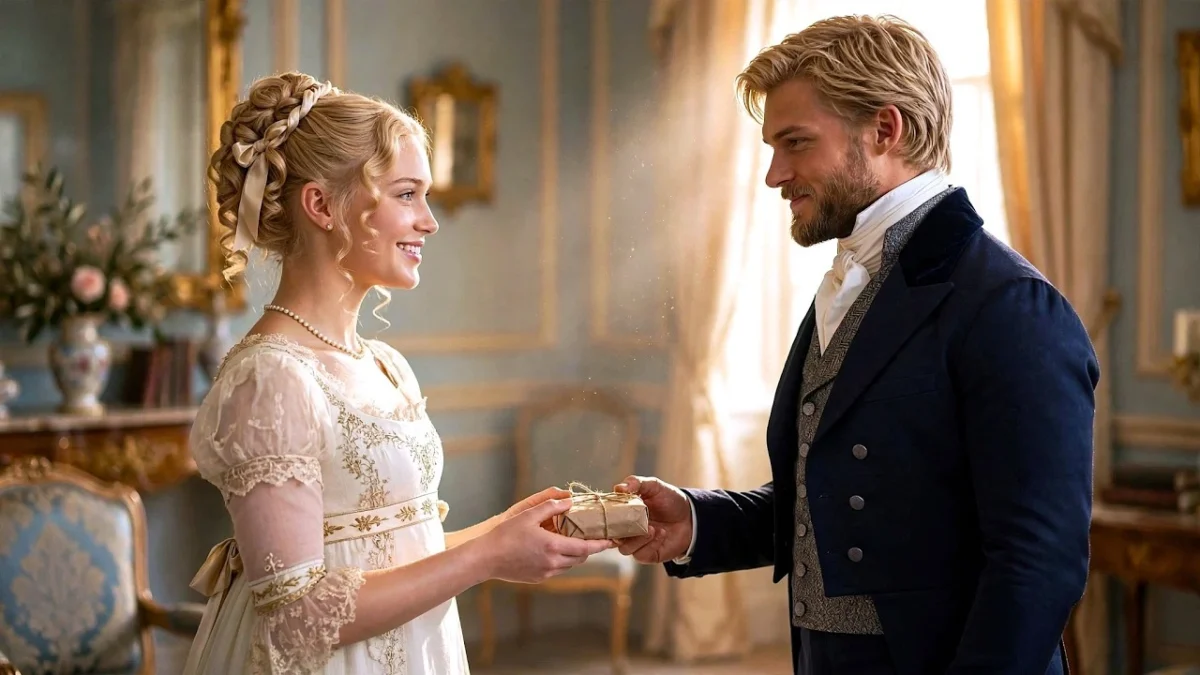
The heavy oak door of the study opened, the brass latch clicking softly in the quiet room.
A servant stepped inside, his footsteps muted by the thick Persian rug, and gently placed a small brown paper parcel on the edge of the desk.
Declan O’Brien, Duke of Glenmore, looked up from his correspondence and recognized the shape of the package immediately.
It was the exact dimensions of the volume he had sent away only yesterday morning.
He untied the string, the coarse paper rustling as it fell back to reveal the leatherbound book, untouched and unopened.
Beside it rested a small sheet of folded stationery with neat, elegant handwriting.
Miss Mave Sullivan thanked his grace sincerely for his consideration, but she stated that she could not possibly accept such a gift.
Declan leaned back in his deep leather chair, listening to the crackle of the fire in the hearth.
He was not angry, but rather genuinely confused.
The book was not an extravagant piece of jewelry or a grand romantic gesture.
It was merely a collection of essays that Mave had casually mentioned searching for during a dinner gathering the previous week.
Declan had located one in a Dublin bookshop and sent it simply because he remembered.
In Declan’s world, women rarely refused anything a Duke offered.
Mave Sullivan had just returned something she very clearly wanted, and looking at the polite note, Declan felt entirely curious.
Three days later, the opportunity to satisfy that curiosity presented itself at a respectable afternoon gathering at a neighboring country estate.
The drawing room hummed with the quiet clatter of teacups against saucers and the low murmur of polite conversation.
Mave sat near the tall windows, her pale golden blonde hair catching the muted Irish sunlight while her clear blue eyes carried a quiet, observant intelligence.
She possessed the education and manners to belong perfectly in this room, lacking only the fortune that usually accompanied them.
Declan crossed the room without making a spectacle of his approach and settled into an empty chair near hers.
“I hope,” Declan said softly, his deep voice meant only for her, “that you did not consider the book an impertinence.”
Mave did not flinch, though a faint flush of warmth touched her fair skin as she met his gaze directly.
“Not an impertinence, your grace,” Mave replied, her hands resting quietly in her lap.
“Excessive generosity, perhaps.”
Declan tilted his head, studying the delicate line of her jaw.
“Can returning a book one happens to find truly be considered excessive generosity?” he asked.
“That depends upon who offers it, your grace,” Mave said in a steady, controlled voice, “and who must accept it.”
Mave watched him carefully, bracing herself for his expression to cool or for him to walk away.
Instead, the corner of Declan’s mouth twitched in a shadow of a smile because he seemed to respect her honesty.
Mave felt a sudden flutter of appreciation that he sat there entirely calm, allowing her space to disagree without demanding an apology.
The following week, the social circle expanded to a walking party across the rolling green hills of a local estate.
Declan found himself walking a few paces behind Mave, who had paused near a low stone wall where her sketchbook lay open beside a small tin of watercolors.
He stood in silence, watching her work and noticing that she was being painfully careful with a particular shade of blue, rationing the pigment as if it were gold.
She mentioned to a companion that replacing the finer pigments required an expense she could not currently justify.
Declan said nothing and simply listened to her words.
A few days later, a small wooden box arrived at the modest home Mave shared with her widowed aunt, Mrs. Bridget Sullivan.
Inside rested a complete set of the finest watercolors available, delivered openly without any improper letter attached.
Mave stood in her aunt’s parlor, looking down at the rich, vivid colors with fingers aching to use them.
She stared at the box for a long time, listening to the ticking of the mantle clock as her heart beat a little too fast.
“You have been staring at those paints for twenty minutes, Mave,” Mrs. Bridget Sullivan observed softly from her armchair.
“They are exquisite, Aunt Bridget,” Mave whispered, closing her eyes briefly.
“They are everything I could ever need for my work.”
“Then why do you look at them as if they are a threat?” Bridget asked, pausing her sewing.
“Because they come from a man who holds power over everything he touches,” Mave replied, her fingers tracing the smooth wood of the box.
“If I accept this, what am I giving him in return?”
With a quiet exhale, Mave closed the wooden lid, wrapped the box in paper, tied it securely, and sent it back.
When the parcel was placed on Declan’s desk that evening, his reaction was entirely different than the first time.
The returned watercolors concerned him deeply, making him realize that receiving anything from him genuinely troubled her.
He wondered if she believed he was asking for something from her in return, realizing she was rejecting what she believed accepting them might mean.
Declan decided that if the objects made her uncomfortable, he would stop sending them, though he would not stop seeking her out.
The following week, during a musical evening at a neighbor’s estate, Declan approached Mave while she stood near the edge of the room listening to the string quartet.
“I have begun to suspect, Miss Sullivan,” Declan said in a mild tone, “that my attempts to be helpful are causing you distress.”
Mave looked away from the musicians and appreciated that he had not ignored the awkwardness between them.
“I admit, your grace, that certain forms of generosity can create obligations,” Mave said gently.
Declan watched her carefully, his expression unreadable.
“And you believe I would collect one?” he asked quietly.
“I do not know your grace well enough to know what you might expect,” Mave answered with quiet, devastating honesty.
The words wounded him slightly, as he was unaccustomed to being viewed as a potential threat.
Yet her answer made him realize that she genuinely did not understand his intentions because he had never spoken them.
Before he could respond, their conversation was interrupted by the arrival of other guests, forcing Declan to step back while his mind remained entirely on Mave.
Later that same evening, Mave sought a moment of quiet in an adjoining sitting room near a tall vase of hothouse lilies.
From the other side of a partially open door, she heard the rustle of silk skirts and the low voices of two older women.
“His grace seems remarkably attentive to Miss Sullivan,” one voice observed with sharp social assessment.
“Indeed,” the other replied dryly, “but attentions are not necessarily intentions.”
The overheard words gave voice to Mave’s deepest fear, reminding her that society saw the Duke’s focus without assuming it would lead to marriage.
She possessed no fortune or grand connections, knowing a duke could enjoy the company of a woman without ever offering his name.
If she accepted too much from him now, she wondered where she would be when his interest inevitably passed.
The next day, Declan’s new approach began with no more parcels delivered to the Sullivan residence.
Instead, Declan gave her his presence, making a point to speak with her at gatherings and walking beside her during group outings.
He asked about the subjects of her drawings rather than offering to buy her supplies, genuinely listening when she disagreed with him.
Without the pressure of gifts between them, Mave felt herself begin to relax and discover the man beneath the title.
She found that he possessed a quiet, dry humor, entirely distinct from the arrogant posturing of other wealthy men.
During a brisk walk across his sprawling estate, Mave pointed out a small thorny shrub growing near the path, offering its Latin name and then its common one.
“I admit, Miss Sullivan,” Declan said, pausing beside the plant, “I have no idea what that is called.”
Mave smiled, her eyes bright with gentle teasing.
“You do not know the flora on your own lands, your grace?” she asked.
“I possess several thousand acres, Miss Sullivan,” Declan replied, clasping his hands behind his back as the wind caught his coat.
“I have never claimed to have been personally introduced to every shrub.”
Mave laughed, a clear sound that hung in the crisp air, and Declan watched her as the humor in his eyes softened into something deeper.
They continued walking in a silence that felt comfortable and intimate, both realizing how much they valued these moments together.
A fortnight later, during a quiet afternoon visit to the Sullivan home, Mave pulled an old worn leather drawing case from her bag.
The leather was scuffed, the stitching fraying at the edges, and the brass clasp was broken, hanging loosely from its hinge.
“That appears to have seen better days, Miss Sullivan,” Declan remarked from his seat near Mrs. Sullivan.
“It belonged to my mother, your grace,” Mave said, touching the worn leather with gentle reverence.
“It is old and damaged, but I would never replace it.”
Declan looked at her hands and then at the case, understanding immediately that its value was rooted entirely in memory.
He did not offer to buy her a new one and said nothing more about it at the time.
Five days later, a servant delivered a parcel wrapped in plain brown paper to the Sullivan door.
Mave carried it to her bedroom, sitting on the edge of her bed as she carefully untied the string to reveal her mother’s drawing case.
Declan had not bought her a replacement; he had taken the case she already loved and had it repaired.
The leather had been cleaned and oiled, the stitching reinforced, and the broken brass clasp replaced with a simple, sturdy mechanism that snapped shut with a satisfying click.
Mave sat in the quiet room, deeply moved by a gesture that proved Declan listened, remembered, and understood what mattered to her.
Then a cold wave of panic washed over her as she realized this was an emotional bond tightening around her while he had still never spoken of a future.
He was wrapping her in a net of profound generosity without stating his intentions, making accepting this gift far more dangerous than the others.
With trembling hands, she placed the case back into the paper, wrote a note thanking him for his kindness, and stated unequivocally that she could not accept it, adding a direct request that he send her no more gifts.
When Declan received the repaired case, he stood by the fire holding the parcel and staring into the flames with a heavy heart.
This returned gift hurt because he had done what he thought was right to show he understood her heart.
Concluding that the intimacy of the gesture had frightened her and that she wanted distance, Declan decided that respect required obedience.
He assumed she wanted him to step back entirely, mistaking her boundary for a total rejection of his presence.
At the next assembly, Mave saw Declan enter the room and felt her breath catch in anticipation.
He walked directly toward her and her aunt, offering a polite, impeccable bow.
“Good evening, Mrs. Sullivan,” Declan said warmly, before turning to Mave.
“Miss Sullivan, I trust you are both enjoying the evening.”
“We are, your grace. Thank you,” Mave replied, bracing herself for their usual private exchange.
Instead, Declan offered a brief, conventional remark about the quality of the musicians, lingered for the exact duration courtesy required, and stepped away toward the card room.
Mave watched him walk away, telling herself that the sudden emptiness in her chest was merely relief that he was respecting her boundary.
Yet at subsequent gatherings, he behaved in the exact same manner, speaking briefly before moving on without ever seeking her out.
He was never cold or punitive, nor did he make a spectacle of ignoring her; he was simply absent, treating her like any other respectable acquaintance.
As days turned into weeks, Mave realized that what she missed had nothing to do with beautiful objects, but rather his thoughtful questions, his quiet intelligence, and his steady presence.
Her defenses had worked so well that she had pushed him away completely, leaving her feeling isolated.
The true cost of her success became clear during a crowded evening reception when Mave overheard two women talking behind a heavy velvet curtain.
“Have you noticed?” one voice murmured.
“The Duke of Glenmore no longer spends nearly as much time at Miss Sullivan’s side.”
“Indeed,” the second replied.
“It seems his grace’s interest has passed. A pity for her, but these sudden fascinations rarely endure.”
The words devastated Mave, making her realize that society viewed his withdrawal as lost interest.
Standing alone in the shadowed alcove, she questioned why her heart felt broken if she had only been protecting herself.
That evening, Mrs. Bridget Sullivan watched her niece stare silently into the hearth for nearly an hour before speaking.
“You are deeply unhappy, Mave,” Bridget said quietly.
“I am perfectly well, aunt,” Mave replied, trying to maintain her composure.
“I merely did what was necessary. I was prudent.”
“Prudence is a valuable trait,” Bridget agreed softly, looking up from her needlework.
“But I must ask you a question. When you returned that case to him, did you want him to stop sending you gifts, or did you want him to give you a reason why you could accept them?”
The question pierced straight through Mave’s defenses, leaving her unable to speak.
“Think of what the man actually did, Mave,” Bridget continued gently.
“He never sent you anything secretly to compromise your reputation. He never demanded private access to you or used his wealth to pressure you. And when you explicitly asked him to stop, he stopped.”
“He stepped back,” Mave whispered, her eyes filling with tears.
“Because you pushed him away,” Bridget corrected softly.
“Prudence and fear are not the same thing, Mave. One protects you from danger; the other isolates you from life.”
Mave stared at the flickering embers as the truth of her aunt’s words settled heavily in her chest.
She realized that while she had been terrified of losing her independence, Declan had shown her respect at every turn.
Furthermore, she realized Declan had assumed her rejection of the objects was a rejection of the man himself.
They had spent months interpreting silences and reading meaning into returned parcels while avoiding the vulnerability of direct conversation.
Mave resolved that if she wanted to know what his attentions meant, she had to stop hiding behind assumptions and cross the distance between them.
Three days later, at a large country house party, Mave deliberately sought Declan out near the library doors.
They moved into the quiet perimeter of the library, remaining visible to the main hall while securing a few yards of privacy.
“I fear I have judged you unfairly, your grace,” Mave said, looking up at him as her hands rested against her skirt, “and I wish to apologize.”
Declan looked surprised, his posture instantly straightening.
“You owe me no apology, Miss Sullivan,” Declan said firmly.
“You never owed me acceptance of anything I sent.”
“That, your grace,” Mave said softly, “was precisely the difficulty.”
Declan’s brow furrowed in confusion.
“I do not understand,” he admitted.
Mave took a steadying breath and decided to explain everything without polite artifice.
“A book or a set of paints from an ordinary acquaintance would have been one thing,” Mave explained, “but a succession of personal, observant gifts from a duke was entirely another. Every gesture told me that your attention was deepening, but you never told me where that attention was leading. I have no fortune, and I could not assume marriage merely because you were generous. If I continued accepting those meaningful things while knowing nothing of your intentions, I feared that gratitude itself would make me feel less free to choose.”
Declan listened in absolute silence as her words reoriented his entire understanding of the past months.
He had believed each thoughtful object proved his devotion, yet he now saw that without context, the gifts felt like an overwhelming pressure.
“I thought I was making myself clearer,” Declan said quietly, the weight of the realization settling into his voice.
“You were making yourself dearer, your grace,” Mave replied in a whisper.
“That was not the same thing.”
The words struck Declan with staggering force, causing him to stare at her with deep emotion.
“I would rather you returned a thousand gifts,” Declan said, his voice thick with sincerity, “than accepted a single one because you believed you had no choice.”
Mave looked into his eyes and realized he had never intended to buy her regard, but had simply been trying to reach her.
“Then why did you disappear?” Mave asked gently.
“Because you asked me to stop,” Declan answered honestly.
“I believed I was respecting your request.”
“I asked you not to send me things,” Mave clarified softy.
“I did not ask you to stop speaking to me.”
Declan closed his eyes briefly, realizing he had hidden behind respect to protect himself from the vulnerability of asking for her heart directly.
Later that evening, during the carriage ride back to his estate, Declan confronted his own cowardice, admitting that communicating through gestures had allowed him to avoid the risk of explicit rejection.
He knew he could no longer rely on gifts or subtle clues; he needed to speak plainly and place his intentions before her.
Several days later, the crunch of carriage wheels on gravel announced the arrival of the Duke of Glenmore at the Sullivan residence.
From the window of the parlor, Mave watched Declan step down onto the drive and noticed immediately that he carried no parcels or boxes.
For the first time since they had met, Declan came to her entirely empty-handed.
He entered the house and spent ten respectful minutes in the sitting room with Mrs. Sullivan, making his intentions clear before asking to speak with Mave alone in the parlor.
When Mrs. Sullivan stepped out, leaving the door slightly ajar, Declan turned to face Mave.
“Miss Sullivan,” Declan began, his voice steady and earnest, “I have come today without books, paints, or leather cases. I have brought nothing to offer you except my plain, unvarnished words.”
Mave stood near the fireplace, her heart beating fast, though her gaze remained steady on his.
“I am listening, your grace,” she said softly.
“For months, I believed I was being thoughtful by sending you small tokens,” Declan said, taking a step closer.
“I told myself I was sparing you pressure, but the truth is I was sparing myself the terror of asking you a question directly. I love you, Mave. I have loved you since the moment I realized you valued your truth more than my title.”
Mave caught her breath, the sincerity in his voice washing away the lingering remnants of her fear.
“Declan,” she whispered, using his name for the first time.
“I do not ask you to step into my world to lose your independence,” Declan continued, his blue eyes searching hers.
“I ask you to join your life with mine as my equal, my wife, and the Duchess of Glenmore. Will you accept my hand, Mave, with no obligation other than the truth of what you feel?”
A tear slipped down Mave’s cheek, but a genuine, radiant smile broke across her face.
“I returned your gifts because I was afraid of losing myself,” Mave said, stepping forward until the small distance between them vanished.
“But I have no fear of giving you my heart. Yes, Declan, I will marry you.”
Declan took her hands in his, holding them gently as relief and joy swept through him.
There were no parcels between them, no hidden meanings left to decipher, only the clear, unburdened truth of two people who had finally learned to speak without fear.








