She Returned Home Penniless—Unaware Her Dead Mother Had Prepared Everything
By the time the heavy stagecoach pulled away from the Renford crossroads, the dull November afternoon had already begun to surrender to a murky twilight.
Eliza Hart stood alone by the side of the rutted road, her calloused hand gripping the worn leather handle of a single carpet bag.
She watched the swinging red lanterns of the coach diminish into the distance until the damp hedges swallowed them whole.
For a few moments, the rhythmic grinding of heavy wooden wheels over wet gravel echoed through the valley.
Then, the sound dissolved into the whistling wind, leaving behind only the rustle of thorn bushes and the distant, solemn chime of the parish clock.
Eliza reached up with stiff, chilled fingers to adjust her frayed woolen shawl.
Inside her small leather purse rested exactly five pennies—the entirety of her physical wealth after two years away.
Tucked into the bag was a hard heel of bread wrapped in greasy paper, and stitched securely into the inner hem of her dress was a silver locket, her mother’s last gift.
She had been eighteen years old when she was forced to walk out of Renford.
She was twenty now.
Yet, looking at the cracked skin across her knuckles and feeling the hollow ache beneath her cheekbones, she knew those two years had aged her far beyond her time.
Half a mile ahead, the slate roofs of the village nestled against the dark horizon.
The church tower rose above the bare oak trees exactly as it had done throughout her childhood.
Plumes of gray wood smoke lifted lazily from brick chimneys.
Somewhere in the distance, a farm dog barked a sharp greeting.
The familiar scent of damp earth, decaying leaves, and oak smoke drifted on the evening air, hitting her with such overwhelming nostalgia that her breath caught in her throat.
For a terrifying second, she felt an instinctual urge to turn on her heel and flee back into the mist.
During those two brutal years of exile, she had rehearsed this return a thousand times in her mind.
She had envisioned it while trimming cheap velvet bonnets in a drafty Leeds workshop until her eyes burned from poor candlelight.
She had imagined it while scrubbing greasy pans at a cold farm near Ripon, and while shivering in a charity hospital ward surrounded by the coughing of dying women.
In every daydream, her goal had been simple and modest.
She would walk straight to the vicarage.
She would ask the kindly old pastor for a single night of shelter.
She would beg him for a written reference stating that she was a respectable, honest girl capable of hard labor.
And in the morning, she would leave Renford forever.
There was nothing left here to reclaim.
Her father had made that painfully clear on a freezing night two winters ago.
She could still vividly remember the front parlor of the Hart home, choked with the smell of pipe tobacco and dry heat.
She remembered her father’s red, furious face as he shouted about her refusal to marry Daniel Crow, a wealthy but cruel local landowner.
She remembered her stepmother sitting by the window, dabbing delicately at dry eyes with a lace handkerchief while fanning the flames of her husband’s rage.
“Stubbornness is not the same as principle, Eliza!” her father had roared, his voice trembling with anger.
Then he had opened the heavy front door and gestured into the freezing night.
“If you will not obey the head of this house, you are no daughter of mine.”
Eliza had walked through that door with a single shilling, her cloak, and the clothes on her back.
The sharp metallic click of the latch closing behind her had echoed in her nightmares ever since.
Now, stepping onto the muddy village lane, Eliza kept her head bowed and her eyes fixed firmly on the ground.
Mrs. Pike, the village milliner, was the first person to spot her.
The woman was busy arranging a display basket in her shop doorway, but she froze the moment her eyes landed on Eliza’s face.
Mrs. Pike gasped softly, stared for a long, uncomfortable moment, and then abruptly bent over her work, smoothing ribbon as if her life depended on it.
Further down the street, two young apprentices outside the blacksmith’s forge stopped hammering, their voices dropping into hushed, pointed whispers.
Eliza felt the heavy weight of their judgment, but she pressed onward until she reached the narrow lane leading to the vicarage.
She halted beside the mossy stone wall of the churchyard.
Across the lawn, warm yellow lamplight glowed invitingly through the vicarage windows.
Her hand tightened around her carpet bag until her knuckles turned white.
An overwhelming wave of shame rooted her to the spot.
She could not bring herself to walk up those steps and knock on the vicar’s door like a destitute beggar.
Instead, she turned back toward the main road and directed her steps toward the Crown and Hare inn.
She reasoned that her five pennies might be enough to buy a mug of weak, hot tea and an hour of warmth near the taproom fire.
She slipped into the shadowy cobblestone yard of the inn, keeping close to the stable walls.
Suddenly, an old man emerged from the dark interior of the stable barn carrying a lighted tin lantern.
He stopped so sharply upon seeing her that the yellow lantern light swung wildly across the wet cobbles.
“Miss Eliza?” the old man breathed out.
Eliza stopped in her tracks, startled to hear her name spoken aloud after so long.
She stepped closer to inspect his face.
“Mr. Harker?” she whispered.
Abel Harker had been the head stableman at the Crown and Hare for as long as anyone could remember.
When Eliza was a young girl, he had frequently let her feed sweet apples to a gentle gray mare that her father had disliked for being stubborn.
He looked noticeably older now; his shoulders were rounder, and his thick whiskers had turned entirely white.
Though his hand trembled slightly as he held up the lantern, his dark eyes remained remarkably sharp and kind.
Before she could speak, Mr. Harker stepped forward and firmly took the heavy carpet bag from her hand.
“I was beginning to worry the late coach wouldn’t bring you today,” he said softly, his voice gravelly with age.
Eliza stared at him in utter bewilderment.
“You were waiting for me?” she asked, her eyebrows pulling together.
“How could you possibly know I was coming back today? I sent no letters.”
“I didn’t know if it would be today, Miss Eliza,” Mr. Harker replied simply.
“I was only told to watch the incoming coaches.”
A cold gust of wind swept through the inn yard, carrying the smell of wet hay and wood smoke.
“Told by whom?” Eliza pressed, wrapping her shawl tighter around her shivering shoulders.
“And for how long have you been watching these coaches?”
Mr. Harker lifted the lantern higher to illuminate her face.
“For nine years, Miss Eliza,” he answered quietly.
Eliza nearly laughed at the absurdity of the statement, but her exhaustion was too absolute to manage it.
“Nine years?” she echoed in disbelief.
“That makes no sense.”
Without offering an immediate explanation, Mr. Harker turned and began walking toward a dark, overgrown lane running behind the inn yard.
“Come along now, child,” he said, gesturing for her to follow.
“The house is ready for you.”
Eliza hurried after him, her boots squelching in the mud.
“What house, Mr. Harker? I have no house.”
The old man glanced back over his bent shoulder, looking at her as if she were asking about the color of the sky.
“Your house, of course,” he stated plainly.
Having nowhere else to go and no strength left to argue, Eliza followed the bobbing yellow light of his lantern.
They left the last clustered cottages of the village behind and traveled down a narrow, neglected lane bordered by towering hawthorn hedges.
Dusk rapidly deepened into true night around them.
At a sharp bend in the lane, they arrived at two weathered stone pillars, one of which leaned precariously toward the roadside ditch.
Between the pillars hung a pair of heavy iron gates streaked with thick rust.
Beyond the gates, a gravel driveway wound beneath ancient, towering lime trees toward a modest two-story stone house.
Its wooden window shutters were tightly closed against the weather.
Dark green ivy clung heavily to one side of the stone gable, and a wild holly bush scraped softly against the front porch as the wind blew.
Eliza stopped dead in her tracks at the iron gates.
“I have lived in Renford my whole life, yet I have never been down this lane,” she said, looking up at the silhouette of the dwelling.
“No,” Mr. Harker agreed, setting his lantern down to lift the gate latch.
“Your mother made sure of that.”
“My mother?” Eliza gasped, her heart jumping into her throat.
“Mr. Harker, please stop speaking in riddles. You said this house belongs to me.”
“It does,” he replied firmly.
“That is impossible,” Eliza insisted, pulling her cold hands against her chest.
“My mother died seven years ago, and my father owned everything we had. He gave me nothing.”
Mr. Harker pushed open the heavy iron gate, which groaned loudly as it dragged through the wet gravel.
“Things may become clearer to you once we are indoors,” he said calmly.
He walked up the gravel path, and Eliza followed, her eyes scanning the dark, mysterious structure.
When they reached the front door, Mr. Harker produced a large iron key from his coat pocket and inserted it into the lock.
The brass mechanism turned smoothly and silently beneath his hand without the slightest resistance.
That small detail disturbed Eliza far more than the weeds and the rust outside.
A house left abandoned for years ought to resist being opened; its hinges should squeak, and its locks should jam with dust.
This house opened effortlessly, as though it had been expecting her.
As they stepped across the threshold, Eliza was greeted by an air that smelled faintly of polished wood, dried lavender, stone, and cold coal smoke.
There were no heavy cobwebs or thick layers of suffocating dust.
The floorboards of the entrance hall were clean enough to catch the yellow reflection of the lantern flame.
On the wall above a narrow oak table hung an oval mirror framed in black wood.
Eliza caught sight of her reflection as she passed—a pale girl in a wet, faded bonnet, with sunken cheeks and eyes hollowed by weariness.
Behind her reflection in the glass, she noticed the open door of the front parlor.
Inside the parlor fireplace, coal had been carefully arranged over dry kindling, and a twist of paper was tucked neatly beneath the iron grate.
It was a fire waiting only for a single match.
Mr. Harker walked into the parlor, set her carpet bag beside a wooden settle, and fetched a neatly folded wool blanket from a wooden chest in the corner.
“You can pump fresh water at the well in the back yard,” he said, his tone entirely matter-of-fact.
“I will bring fresh eggs, bread, and milk in the morning.”
Eliza stood near the parlor doorway, staring at the fireplace.
“Who laid that fire, Mr. Harker?” she asked softly.
The old man turned and looked at the grate, then met her searching gaze.
“I did,” he replied.
“When?”
“Most recently? Last Thursday,” he said quietly.
“Last Thursday?” Eliza repeated, her voice cracking with emotion.
“You have been coming here every week to lay fires in an empty house?”
“I have,” Mr. Harker confirmed, walking back toward the front door.
“Sleep now, Miss Eliza. You are worn out from your journey.”
He handed her the brass key, stepped out onto the porch, and closed the heavy door behind him.
Eliza stood in the silent hallway, listening to the key turn in her hand.
She walked back into the cold parlor and looked at the prepared fireplace.
Striking a match felt too much like surrendering to a fairy tale, or believing in a kindness she did not deserve.
Fearing that it was all some elaborate illusion that would vanish by morning, she chose not to light the fire.
Instead, she sat on the wooden settle, ate half of her stale heel of bread in the dark, wrapped herself tightly in the wool blanket, and slept with her boots on.
Gray morning light filtered through the wooden shutter slats, casting pale stripes across the parlor floor.
Eliza woke up cold and stiff, but the reality of the room remained solid around her.
She went to the back yard, pumped icy water into a stone basin, and washed her face until her cheeks burned and her teeth ached.
Invigorated by the cold, she returned inside to inspect the kitchen.
The kitchen was modest but meticulously organized.
It featured a scrubbed pine table, a heavy black iron range, and a high window overlooking a small garden plot overrun with weeds.
On a high wooden shelf stood a row of earthenware jars.
Each jar bore a label written in a delicate, elegant cursive hand: *Tea*, *Flour*, *Salt*, *Oats*, and *Sugar*.
Eliza stood on tiptoe and opened the tea jar.
Inside lay fresh, aromatic dark tea leaves.
It was not a full batch, but there was more than enough to prove that someone had replenished it long after an abandoned house should have gone dry.
She crouched down by the heavy iron range and opened its small furnace door.
Inside, another fire had been expertly laid—paper, dry pine kindling, and black coal, ready to be ignited.
She closed the iron door gently, feeling a lump form in her throat.
An hour later, Eliza walked back into Renford village to buy food, but the villagers were far less welcoming than the house.
When she stepped into the baker’s shop, the small brass bell above the door chimed loudly.
Mrs. Creswell looked up from behind the wooden counter, instantly recognized Eliza, and immediately dropped her gaze, wiping imaginary dust from her apron.
“One penny loaf, please, Mrs. Creswell,” Eliza said evenly, placing her coin on the counter.
The baker’s wife wrapped the small loaf in coarse paper in absolute silence, sliding it across the wood without making eye contact.
As Eliza walked back down the high street, three women standing by the village water pump stopped their chatter.
Their heavy silence followed Eliza step for step until she was five paces past them.
Then, a sharp, cruel laugh echoed behind her back.
Eliza tightened her jaw and kept walking, refusing to let them see her flinch.
“Miss Hart!” a loud, booming voice called out from the doorway of the Crown and Hare.
Eliza paused and turned.
Mr. Vane, the prosperous innkeeper, stood on his stone step, resting his thumb in the pocket of his embroidered waistcoat, where a heavy gold watch chain gleamed in the sunlight.
He was a prominent man in the village, and he had been sitting in her father’s parlor on the night Eliza was cast out.
She remembered how he had nodded in agreement when her father had disowned her, remarking that an obedient daughter was the foundation of society.
Mr. Vane offered her a broad, patronizing smile, clearly intended for the benefit of the watching villagers.
“So, the prodigal daughter has finally returned to Renford,” he said loudly.
“Good morning, Mr. Vane,” Eliza replied quietly.
“They tell me old Abel Harker has marched you off to that derelict house beyond the church road,” Mr. Vane continued, taking a step closer.
“That place has been standing empty and decaying longer than most marriages last. I suppose one ruin has finally found another.”
Eliza felt a familiar flash of hot, defiant anger rise in her chest—the same fierce pride that had compelled her to defy her father at eighteen.
She opened her mouth to snap back, but then she pictured the clean hall, the filled tea jar, and the carefully laid fires waiting for her.
She forced the anger down and let her breathing steady.
“Good morning, Mr. Vane,” she repeated smoothly, offering him a polite nod.
His broad smile faltered, his eyes narrowing in annoyance.
“You would do well to keep moving, girl,” he said, his tone dropping its false warmth.
“There is nothing for you here in this village.”
Eliza looked him straight in the eye, her posture straightening.
“I am not entirely certain that is true,” she said softly.
She turned on her heel and walked away, leaving the innkeeper staring after her in cold astonishment.
As she reached the low stone wall near the churchyard, an elderly woman wrapped in a thick black shawl stepped into her path and gently touched Eliza’s sleeve.
“My name is Mrs. Fenwick,” the old woman said, her voice soft and thin like dried parchment.
Eliza recognized the surname as belonging to a family living near the edge of the parish, though she had never spoken to the woman before.
“Good day, Mrs. Fenwick,” Eliza offered respectfully.
Mrs. Fenwick turned her pale blue eyes toward the quiet lane leading to the stone house.
“Your mother was a remarkable woman, child,” Mrs. Fenwick said gently.
“She was a woman who always prepared for the bitter cold of winter long before the warmth of summer had finished.”
Eliza went completely still, her breath catching.
“You knew my mother?”
“I knew her well enough to respect her wisdom,” the old woman replied.
“And what of that house?” Eliza asked desperately.
“Why does everyone speak of it as if it were a ghost?”
Mrs. Fenwick looked deeply into Eliza’s eyes.
“It is not a ghost, my dear. It is a door your mother intended for you to have when you needed it most.”
She released Eliza’s sleeve and patted her hand gently.
“Do not leave that door closed merely because someone else once shut a different door in your face.”
Before Eliza could ask anything more, Mrs. Fenwick turned and walked away through the gray morning drizzle.
By the time Eliza arrived back at the house, a steady rain had set in, darkening the shoulders of her woolen shawl.
She placed her fresh loaf of bread on the kitchen table and stood in the center of the hall, listening intently.
The structure did not feel dead or hollow, the way truly abandoned buildings feel.
Rainwater flowed smoothly through clean, clear copper gutters outside.
A gentle breeze sighed softly through the well-maintained fireplace chimney.
Upstairs, a floorboard settled with a small, dry click.
Every corner of the house bore the unmistakable marks of constant, quiet care.
Holding a tallow candle, Eliza walked to the staircase.
She ran her palm along the wooden banister; it came away completely free of dust.
She climbed to the upper floor and opened the second door on the left.
Inside, a neat wooden bed stood beneath a sloping ceiling.
It had been carefully made with fresh linen sheets and a heavy gray wool coverlet.
A clean earthenware basin waited on the washstand alongside an empty pitcher.
In the fireplace grate, another neat stack of paper, wood, and coal waited for a flame.
Eliza walked over to the wooden mantelpiece above the hearth.
Standing in the center of the mantel was a small, crudely carved wooden horse.
One of its carved ears was chipped at the tip, and the dark brown paint along its back had been rubbed almost bare by years of handling.
Eliza stopped breathing, her hand flying to her mouth.
She had owned this exact wooden horse when she was seven years old.
She had lost it during the summer haymaking in a vast field near the Barrowfield Road, and she had cried for days until her mother had pulled her close and whispered a promise.
*”Lost things sometimes find their own way home, Eliza,”* her mother had told her.
Eliza crossed the room with trembling steps and reached out to touch the toy.
Upon closer inspection, she saw that its split wooden tail had been carefully repaired using a small strip of dark leather and tiny brass tacks.
Her mother had always repaired broken household objects in precisely that manner.
Eliza did not pick up the horse.
She turned, walked slowly down the stairs, and sat at the scrubbed pine table in the kitchen, staring at the front door until Abel Harker arrived.
The old stableman entered carrying a wooden crate filled with provisions—eggs, fresh milk, thick bacon, two candles, a bar of yellow soap, a stiff scrubbing brush, and a worn housemaid’s wooden box with a leather carrying handle.
Eliza noticed that the leather handle had been reinforced with dark thread, sewn in double cross-stitches.
“My mother stitched that handle,” Eliza said quietly, her eyes fixed on the thread.
“She used this box every Saturday morning to clean our front porch.”
Mr. Harker set the crate on the table and removed his cap.
“I kept it dry for you,” he said simply.
“Why?” Eliza asked, her voice shaking with building emotion.
“Because she asked me to.”
“Nine years ago?”
“Nine years ago,” he repeated.
“What exactly did she ask you to do, Mr. Harker?”
The old man held his cap with both hands.
“She asked me to keep the roof sound, sweep the chimneys twice a year, lay the fires, and watch the incoming stagecoaches.”
“For a child?” Eliza pressed, tears welling in her eyes.
“For you, Miss Eliza,” he said softly.
Eliza’s voice hardened as she struggled to maintain her composure.
“And after she died seven years ago? Why did you continue? She was gone. My father was still alive.”
“Especially after she died,” Mr. Harker replied, his expression grave and unyielding.
He offered no further explanation.
Instead, he picked up the stiff scrubbing brush and pushed it gently across the wooden table toward her.
“You will feel better if your hands have honest work to do, child,” he said softly.
He was right.
For the rest of the afternoon, Eliza threw herself into cleaning the house with frantic energy.
She scrubbed the floorboards of the entrance hall, even though they were already spotless.
She washed the stone tiles of the front porch.
She wiped down the dark oval mirror until the glass gleamed.
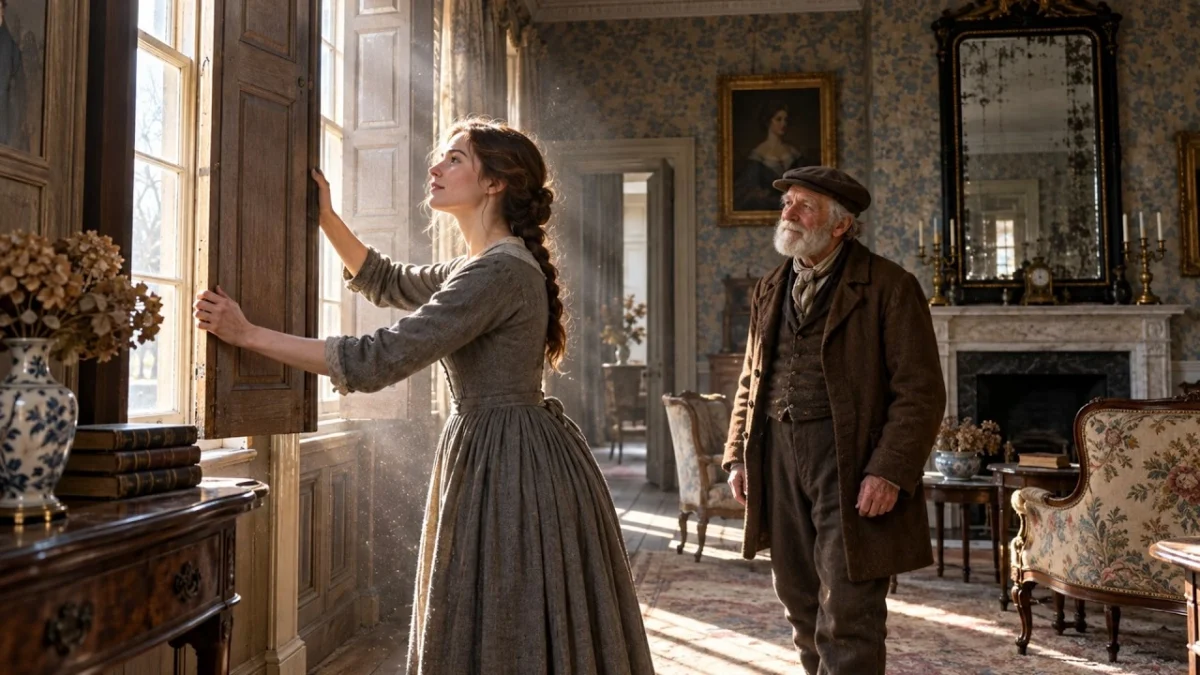
One by one, she unlatched the heavy wooden window shutters throughout the house, letting bright, cold daylight flood into rooms that had been waiting in the shadows for years.
In a small back room on the ground floor, she discovered a mahogany writing desk lined with green felt.
A steel-nibbed pen lay on a brass tray beside a dried quill.
Inside the desk drawers were three thick notebooks bound in black leather.
Eliza pulled out the first notebook and opened it.
It was a meticulous ledger of household accounts: *Coal, three shillings; Chimney sweep, one shilling; Repairs to the east guttering, four shillings; Soap, tea, oats, lamp oil…*
Entry after entry, recorded month after month, year after year.
Eliza turned back to the very first page of the ledger.
The date recorded at the top was nine years prior.
Beneath the date, written in her mother’s familiar, flowing handwriting, were six words:
*For Eliza, when she comes home.*
Eliza sank slowly into the wooden chair beside the desk.
The candle flame on the table flickered, though there was no draft in the sealed room.
She flipped through the pages.
The accounting entries continued in her mother’s elegant hand until the winter of her death seven years ago.
After that date, the entries persisted, but the handwriting shifted dramatically into larger, clumsier, rigid letters.
It was Mr. Harker’s hand.
Yet, the work had never stopped.
The coal had still been bought.
The chimneys had still been swept.
The gutters had been cleared of autumn leaves, and the fires had been laid week after week.
Eliza reached for the second black notebook.
Glued inside the front cover was an official legal document—a property deed.
Eliza read the legal jargon once, then read it again to ensure her mind was not playing tricks on her.
Her mother had purchased this stone house nine years ago using a modest private inheritance left to her by an unmarried sister.
She had placed the property into a legal trust, explicitly designating Eliza as the sole beneficiary.
The deed stipulated that full ownership of the house would transfer to Eliza either upon her return to Renford or upon her twenty-fifth birthday.
Pinned to the back of the deed was a yellowed letter.
Eliza recognized her mother’s handwriting before she even unpinned the page.
*My dearest Eliza,*
*If this letter has finally reached your hands, then you have returned to Renford and I am no longer there to receive you.*
*I purchased this house because I knew you and your father loved each other in a way that made neither of you gentle when frightened or angry.*
*You are both built of the same stubborn stone. I prayed that I was wrong about what might come of your tempers, but a mother is allowed to hope for the best and prepare for the worst at the same time.*
*I could not promise to prevent every quarrel between you. I could not guarantee that pride would not drive you from your home. So, I made certain that there would always be one door in this world that belonged entirely to you.*
*Mr. Harker knows what must be done. He has been paid to keep the roof sound, the chimneys swept, and the fires laid.*
*You will likely think this wasteful. I know how practical you are, my clever girl. But warm your cold hands at the hearth before you decide what to do next.*
*The little wooden horse on the mantel is yours. I found it in the hayfield the year after you lost it.*
*Your loving mother.*
Eliza read the letter through once.
She read it a second time, her eyes tracing every curve of her mother’s ink.
Halfway through the third reading, she stopped.
She placed both of her hands flat over the open notebook, bowed her head, and closed her eyes.
There was no dramatic outburst of grief; she did not sob or cry out.
She simply sat in the silent room as the candle burned down, feeling the heavy, immense weight of nine years of practical, unseen love gently restructuring everything she thought she knew about her past.
When Mr. Harker returned at dusk carrying a bundle of dry firewood, he found her still sitting at the desk.
Eliza looked up at him through the dim light.
“You kept every single promise you made to her,” she said softly.
The old man remained standing in the doorway, clutching his wool cap.
“Your mother once sat at my wife’s bedside for three sleepless nights when the red fever took her,” Mr. Harker said, his voice rough with emotion.
“There are some debts a man is glad to spend the rest of his life paying back.”
That night, a fierce winter storm swept down from the surrounding moors.
Heavy rain lashed against the closed window shutters, and the wind howled through the high branches of the lime trees, rattling the ivy against the eastern wall.
Upstairs, a loose window sash knocked softly in the draft at the top of the landing.
Eliza lay awake in the narrow bed beneath the gray wool coverlet, listening to the tempest outside.
She had still not lit the fire in her bedroom hearth.
The house belonged to her by law, and her mother’s letter was real.
Yet, striking a match to set the paper and coal alight felt like crossing a terrifying final boundary.
It meant moving from being a desperate wanderer seeking temporary shelter to fully accepting that she was worthy of being loved and protected.
Near midnight, above the roar of the wind, a sharp knock sounded at the front door.
Eliza sat up in bed, her heart hammering against her ribs.
The sound came again—weaker this time, frantic and desperate.
Eliza threw on her cloak over her nightdress, grabbed a candle, and hurried barefoot down the stairs.
She slid back the iron bolt and pulled the heavy front door open.
Standing on the dark porch was a young woman clutching a small child in her arms.
Both were soaked to the skin, shivering uncontrollably in the freezing rain.
The child, a boy no more than three years old, was trembling violently, his face pale and his lips turned a frightening shade of blue.
The young woman’s chin quivered as she looked at Eliza with wide, terrified eyes.
“I… I saw a light in your window,” the woman gasped out, her voice cracking with terror and cold.
“I am so sorry to disturb you. My husband… he was drunk again. He threw us out into the storm.”
She tightened her arms around the shivering boy.
“I thought I could walk to my sister’s cottage in the next village, but the boy… Jamie cannot walk any further. He’s freezing.”
Eliza looked down at the child’s blue lips and trembling frame.
In an instant, all of her own hesitation, fear, and pride evaporated.
The choice was no longer complicated.
“Come inside immediately,” Eliza commanded, stepping aside and pulling them into the hall.
She ushered them straight into the front parlor, knelt before the fireplace, and struck a match.
She touched the flame to the twist of paper beneath the grate.
The paper caught instantly, spreading to the dry pine kindling, and within moments, the black coal ignited with a roaring, comforting red glow.
The fire flared up as easily and smoothly as if it had been built that very morning.
And for the first time since stepping off the coach in Renford, Eliza felt a deep, overwhelming quiet settle into her soul.
She moved swiftly to the kitchen, igniting the range fire with equal ease.
She set a pot of milk to warm over the iron stove, sliced thick pieces of bread, and retrieved clean, dry woolen stockings from the linen chest upstairs.
She wrapped the shivering boy in the lavender-scented wool blanket from the settle.
As the child began to warm up, the young woman wept softly with relief.
She explained that her name was Ruth Mercer, and her son was named Jamie.
“We will leave at first light, I promise,” Ruth said, staring down into her warm cup of milk.
“I do not wish to be a burden to you.”
“No,” Eliza replied firmly, stirring the warm milk on the stove.
“You will leave only when you have somewhere safe and warm to go.”
Ruth looked up, her eyes brimming with tears, but she said nothing.
For a long time, the only sounds in the cozy kitchen were the tapping of rain against the windowpane and the cheerful whistling of the iron kettle on the stove.
After Jamie had been fed and tucked safely into the warm bed upstairs, Eliza returned to the parlor.
She sat in the armchair before the roaring hearth, cradling the small wooden horse in her lap.
Now, looking into the flames, she finally understood why her mother had gone to such extraordinary lengths to keep a house ready for nine years.
It was not so that Eliza could return and triumphantly prove to the village that she had survived without anyone’s help.
It was so that surviving would not be the only thing Eliza had left in her heart.
Her mother had created a sanctuary where bitterness could melt away.
When morning came, bright plumes of white smoke rose steadily from two of the house’s stone chimneys.
Abel Harker saw the smoke from the iron gates as he walked up the lane.
He opened the kitchen door, stopped, and saw Ruth and Jamie sitting peacefully at the table eating warm porridge.
He glanced toward the glowing iron range, then looked at Eliza.
A slow, genuine smile spread across his weathered face, crinkling the corners of his eyes.
“At last,” the old man murmured softly.
That afternoon, a horse-drawn gig arrived from the neighboring town of Barrowfield, carrying a local solicitor named Mr. Sewell.
The lawyer carried a heavy leather briefcase and spoke in the slow, measured tones of a man accustomed to handling wills, estate debts, and bitter family disputes.
He sat in the parlor and formally confirmed everything recorded in the black accounts book.
The house belonged to Eliza entirely, free of any mortgages or liens.
Furthermore, the legal trust set up by her mother still contained a balance of slightly more than eleven pounds—the leftover funds after years of paying for building repairs and Mr. Harker’s modest stipend.
It was not vast wealth, but to Eliza, who had spent two years desperately counting pennies to buy stale bread, it represented incredible freedom.
Mr. Sewell laid the official deed on the table before her.
“Your late mother was an exceptionally far-sighted woman, Miss Hart,” he said respectfully.
Eliza looked toward the warm, crackling fire in the grate.
“Yes,” she said softly, her heart swelling.
“She was.”
An hour after the solicitor departed, another visitor walked up the gravel driveway.
It was Mr. Vane, the innkeeper.
This time, however, he was not smiling arrogantly, and he carried his black top hat humbly in his hands.
He remained standing on the wooden porch, looking distinctly uncomfortable.
“Miss Hart,” he began, clearing his throat nervously.
“I… I spoke rashly and unkindly to you yesterday.”
Eliza stood in the doorway, holding her shawl, and waited silently for him to continue.
“I did not realize that this property belonged to you outright,” Mr. Vane added, shifting his weight from foot to foot.
Eliza understood his motive instantly.
It was not a genuine apology born of remorse for his past cruelty; it was the regret of a selfish man who realized he had insulted someone who turned out to be a property owner of means.
Nevertheless, Eliza felt no desire to harbor malice or engage in petty arguments.
“Thank you for coming to say so, Mr. Vane,” she replied calmly and politely.
The innkeeper glanced past her shoulder, taking in the spotless entrance hall, the warm glow of the parlor fire, and the sight of little Jamie’s wool stockings drying neatly near the kitchen stove.
Finding nothing more to say, he bowed stiffly and took his leave.
Over the coming weeks, the village of Renford gradually altered its attitude toward Eliza, as small villages always do when forced to revise a narrative they had previously enjoyed.
Mrs. Creswell, the baker’s wife, began slipping an extra fresh loaf into Mr. Harker’s wicker basket whenever he bought bread.
The gossip by the churchyard water pump quietly ceased.
When spring arrived, the local blacksmith’s husband came up the lane and spent two days repainting Eliza’s rusted iron gates a brilliant, glossy black.
When he finished, he tried to charge her only half of his normal fee.
Eliza politely refused his charity and insisted on paying him three-quarters of the full price.
Ruth Mercer and her young son stayed at the house for three days, then a week, and eventually the arrangement became permanent.
A letter had been dispatched to Ruth’s cousin in Halifax, who had offered her a room, but by that time, young Jamie had already befriended the churchyard cat and knew every nook of the garden.
Ruth had become indispensable, helping Eliza with the endless washing, baking, and garden cultivation.
Neither woman ever used the word *charity*.
There was simply too much practical work to be done to waste time on grand words.
Together, they cleared thick patches of nettles and briars from the backyard plot.
They planted neat rows of onions, carrots, and broad beans.
They threw open the upstairs windows to air out every room, and they sat by the sunny kitchen window in the evenings, mending linen curtains while Mr. Harker dozed peacefully on the wooden bench with his cap resting on his knee.
By Christmas of that year, Eliza had taken full control of the household accounting ledger.
She sat at the mahogany writing desk, holding the steel-nibbed pen and writing carefully across the fresh paper:
*Coal for two grates, four shillings; Lamp oil, sixpence; New leather boots for Jamie, three shillings; One extra wool blanket…*
Mr. Harker stood beside the desk, watching the motion of her pen.
“Your penmanship strongly resembles your mother’s, Miss Eliza,” he remarked softly.
Eliza paused and looked closely at the ink on the page.
The individual letters were not an exact match, but the strength and clarity of the writing clearly belonged to the same family.
By the following June, the tall lime trees lining the driveway were thick with vibrant green leaves, and the air smelled wonderfully of warm foliage and fresh rain.
One pleasant evening, Eliza stood in the open front doorway, enjoying the cool breeze.
Little Jamie leaned affectionately against her skirt, watching a butterfly fluttering near the flowerbeds.
Ruth stood just behind her in the hall, holding a woven basket filled with freshly folded, lavender-scented linen.
The churchyard gray cat sat lazily on the porch stone, older, fatter, and more contented than any stray cat had a right to be.
Near the water pump, Mr. Harker sat on his wooden bench, quietly watching swallows dart across the sunset sky.
A horse-drawn cart passed along the low road beyond the hedges, and the local driver raised his whip in a warm, respectful greeting.
Eliza smiled and waved back.
She looked down the driveway at the iron gates, now painted gleaming black against the green hedges, and then looked back at the house surrounding her.
It was not a grand or luxurious mansion.
The slate roof would still require repair before the next heavy autumn rains.
One of the upstairs window sashes still rattled when a strong wind blew from the east.
The floral wallpaper in the parlor had faded noticeably around the spot where a framed picture had hung years ago.
But there was plenty of fresh bread in the kitchen cupboard.
There was cold milk resting in a stoneware crock in the pantry.
There were clean, soft sheets on every bed upstairs.
And in every fireplace grate throughout the house, dry wood and black coal were carefully stacked, ready to be lit for the next cold evening.
Ruth stepped up to stand beside her in the doorway.
Eliza reached out and rested her palm gently against the solid wooden doorframe.
“For two long, miserable years,” Eliza said softly, her voice filled with quiet wonder, “I truly believed that coming home meant going back to the house I was thrown out of.”
Ruth remained silent, knowing that true friendship often means knowing when silence is the kindest gift.
Eliza watched the golden evening light move slowly across the gravel drive.
“This is not going back at all,” Eliza added softly.
“No,” Ruth agreed gently.
“It is moving forward.”
Inside the kitchen, the heavy copper kettle on the range began to whistle softly.
Jamie giggled and ran toward the kitchen to investigate the sound.
Mr. Harker rose carefully from his bench, brushing dust from his trousers, and followed the boy inside.
Eliza remained at the open doorway for another lingering moment.
She realized then that her mother had not been able to save her from every hardship in life.
Her mother had not saved her from hunger, exhaustion, humiliation, or the bitter trial of walking the long road of exile.
She had not been able to prevent the fierce, prideful quarrel that had shattered their family two years ago.
Instead, her mother had done something far quieter, far simpler, and infinitely more profound.
She had left a key in trustworthy hands.
She had kept a sturdy roof from leaking.
She had paid an old man to sweep chimneys and lay fires for a daughter who might never have returned.
And when Eliza finally did come home, broken, penniless, and cold, there had been enough warmth waiting inside those stone walls that Eliza did not merely survive—she had enough warmth left over to give away to others.
Eliza turned and pulled the heavy wooden door shut against the gathering evening chill, sliding the brass latch smoothly into place.
She walked into the bright, warm kitchen where Ruth was slicing fresh bread.
Jamie was cheekily trying to steal the first crust, and Mr. Harker was sitting in the corner, smiling and pretending not to notice the boy’s theft.
The fire in the kitchen range burned steadily, casting a warm, golden light across the scrubbed wooden table.
Eliza walked over to the hearth, picked up a brass poker, and carefully added one more dark piece of coal to the flames.
Tomorrow morning, she thought to herself, she would lay the fire in the front parlor again.
After that, she would lay the fires in the upstairs bedrooms.
And before the next winter storm descended from the moors, she would make certain there was always an extra woolen blanket resting by the front door, a fresh loaf of bread in the cupboard, and a stack of dry wood waiting for anyone who arrived at her threshold soaked through, freezing, and too ashamed to knock.
The house had waited nine long years for her return.
Eliza Hart intended to keep it ready for whoever came next.








