She Said “We’re Closed” — His Answer Froze Her… Emotional Western Story
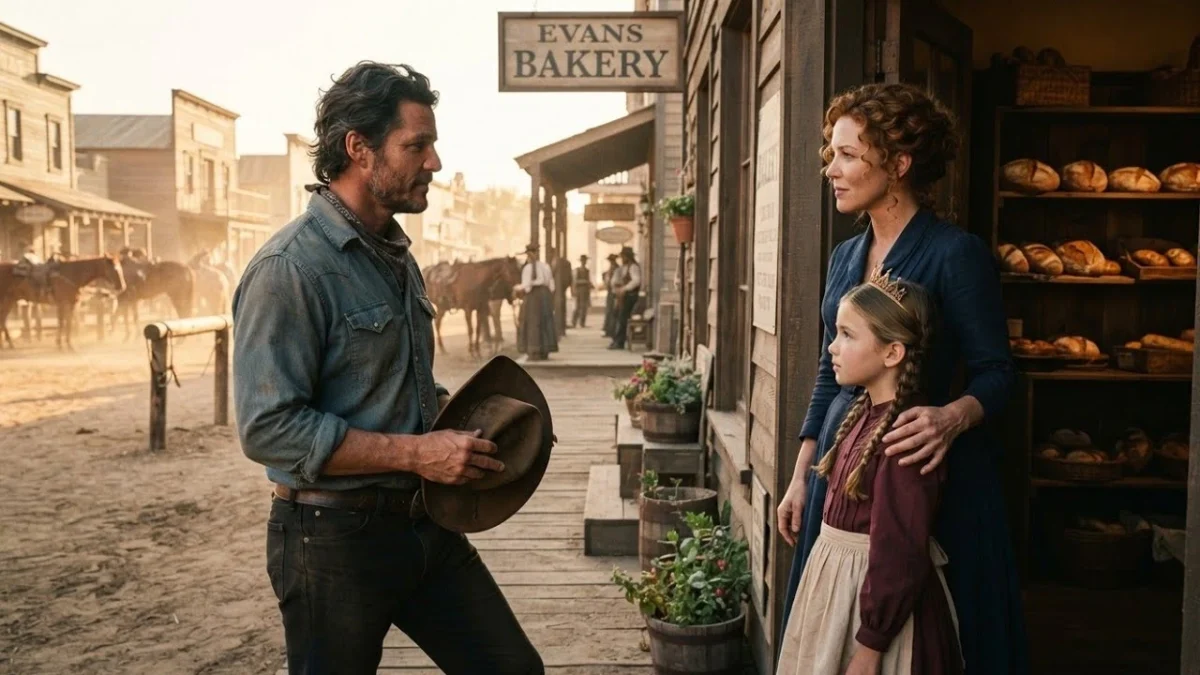
The dust of Cedar Bend settled slow that morning, drifting across the dirt road like ash from a dying fire.
The wind had finally given the small frontier town a brief rest, but the stillness offered no real comfort to Eleanor Vance.
Before the first golden light of dawn cleared the jagged ridge behind her shop, Eleanor was already elbow-deep in flour.
In the two hard years since her husband Thomas had been killed in a sudden accident, she had learned that grief kept better hours than most men.
It rose with her long before the rooster crowed and sat heavily on her shoulders until the last loaf came sputtering out of the brick oven.
The only way she had ever found to quiet the ache in her chest was to keep her hands moving.
Flour dusted the rough oak counter.
Flour dusted her dark canvas apron.
Flour drifted gently in the morning sunbeams, suspended in the cool air like tiny flakes of winter snow.
Eleanor worked the dough with a steady, practiced rhythm, pressing her knuckles into the heavy mass with the same silent resolve she used every single day to survive.
Her eight-year-old daughter, Rosalie, sat nearby on a tall wooden stool by the front window.
Rosalie was sharper-eyed than most grown men in town, and she was currently braiding a scrap of faded red ribbon into her thick brown hair while watching the empty street outside.
“Somebody’s coming,” Rosalie said.
She spoke plain and unbothered, her small voice cutting through the soft thud of the kneading board.
Eleanor did not look up from her work.
“Somebody’s always coming, sweetheart,” Eleanor replied softly, pushing her hair back with the clean crook of her elbow.
“It’s a town. People pass through.”
“Somebody new,” Rosalie clarified, leaning closer to the glass.
Something in the girl’s quiet tone made Eleanor stop her rhythmic pressing and glance toward the window.
The man coming up the main street of Cedar Bend did not walk like the typical drifters who passed through the territory.
Most travelers arrived slumped in their saddles, looking for quick work, cheap whiskey, or trouble.
This man walked on foot, leading a tired bay horse by the reins.
He moved with an easy, deliberate stride, like someone who had already decided precisely where he was going and felt no need to explain himself to anyone along the way.
He was tall and broad through the shoulders, dressed in a worn trail coat stiffened by weeks of dust.
Dark hair curled slightly too long beneath his broad-brimmed hat, and a few days of dark stubble covered a jaw that looked as though it had been set hard against adversity more than once.
When he reached the porch of the bakery, he tied his horse to the hitching post with unhurried care.
He patted the bay’s neck gently, an act of patience that spoke of a man who knew that rushing an animal only cost you time later.
Eleanor wiped her flour-dusted hands thoroughly on her apron and walked quickly to the front door before he could knock.
Knocking on a closed shop door made her nervous these days.
Ever since Silas Dunore had begun pressing her to sell her property a month ago, every sudden noise felt like a threat.
She unlocked the latch, opened the door just a few inches, and kept her voice firm and even.
“We’re not open yet, mister. The bread isn’t ready.”
The stranger paused on the wooden porch steps and slowly pulled off his hat.
The gesture was so old-fashioned and naturally courteous that it immediately caught Eleanor off guard.
He looked at her with an expression she could not quite read.
It was not a smile, nor was it pity, but something steady and heavy in between that made her chest tighten involuntarily.
“I’m not here for the bread, ma’am,” he said, his voice deep and raspy from the dusty road.
“My name’s Jesse Callaway. I knew your husband.”
The words landed in the small entryway like a heavy plate dropping onto stone, shattering the quiet morning into scattered pieces.
Eleanor felt the breath catch in her throat.
She had not heard anyone speak Thomas’s name directly to her face in months.
Most folks in Cedar Bend had learned to walk carefully around his memory, the way you walk around a hole in the floorboards so nobody falls through.
“You knew Thomas?” she asked, her voice dropping as she tested the syllables against the silence.
“Served with him in the cavalry unit before Cedar Bend,” Jesse said softly, turning his hat over in his calloused hands.
It was a small, nervous habit that seemed at odds with his towering frame and composed bearing.
“Before you met him, I expect. I’ve been meaning to come by for a long time now. Took me longer to get here than it should have.”
Rosalie had slipped down from her stool and crept up beside her mother, peering around Eleanor’s skirt with the bright, unfiltered curiosity only children manage without seeming rude.
“Did you really know my papa?” the girl asked.
Jesse crouched down on the porch floorboards, bringing his shoulders level with the child’s height.
The physical gentleness of his movement was immediate, and it instantly eased a fraction of the defensive tension in Eleanor’s neck.
“I did,” Jesse said, looking Rosalie square in the eye.
“He talked about you all the time in camp. Said you were going to grow up smarter than every boy in the whole territory.”
“I already am,” Rosalie declared matter-of-factly.
For the first time in longer than she could recall, Eleanor found herself laughing out loud.
It was a short, surprised sound that felt foreign in her own throat, like a language she had forgotten how to speak over the long winters of mourning.
Moved more by the manners her mother had ingrained in her than by any certainty that it was wise to trust a stranger, Eleanor pushed the door fully open.
“Come inside out of the dust, Mr. Callaway. You look like you’ve ridden a long way.”
“Thank you, ma’am,” Jesse said, stepping over the threshold and placing his hat on the wall peg near the entry.
She pointed him toward a small wooden table near the heat of the brick ovens and set down a tin mug of hot coffee.
Jesse did not push to talk right away, content to sip his drink and listen as Rosalie chattered away about the bakery’s half-blind mouser cat, the drafty schoolhouse, and the ribbon she hoped to wear for the autumn social.
From her workbench across the room, Eleanor watched him out of the corner of her eye while shaping her dough.
She tried to figure out what could drive a man to ride across three territories just to visit a small bakery in a town most mapmakers forgot to name.
It was Rosalie who finally voiced the question Eleanor had been turning over in her mind for an hour.
“Are you going to stay here in Cedar Bend?” Rosalie asked, resting her chin on her hands.
Jesse paused with the coffee cup halfway to his lips and looked over at Eleanor, as if silently asking permission before answering the child.
“I hadn’t fully decided,” Jesse admitted quietly.
“Depends some on whether I’m needed or wanted.”
“You’re wanted,” Rosalie declared with absolute confidence.
Eleanor did not correct her daughter, though she could not bring herself to agree out loud either.
Over the days that followed, Jesse integrated himself into the town’s rhythm without causing a scene.
Cedar Bend was a working town that always needed capable hands, and a man who could break a stubborn colt, repair a collapsed boundary fence, and haul heavy flour barrels without complaint quickly earned his keep.
He rented a small, tidy room above the town mercantile and made a quiet habit of passing by the bakery most mornings.
Sometimes he stopped for a quick cup of black coffee, and other times he walked Rosalie down the dirt road to the schoolhouse when Eleanor was buried in large commercial bread orders for the local mining camp.
Eleanor told herself it meant nothing more than a soldier fulfilling a sense of lingering obligation toward an old comrade’s widow.
For nearly two weeks, she almost convinced herself that was all there was to it.
However, Cedar Bend was a small settlement with sharp eyes and loose tongues.
It was not long before unwelcome news reached Eleanor secondhand at the mercantile counter from Mrs. Pruitt, who leaned over her dry goods ledger with an anxious scowl.
Silas Dunore had taken a sharp, suspicious interest in the bakery’s new handyman.
Silas Dunore was the wealthiest man in the basin; he owned the town bank, the land office, and nearly all the fertile pasture north of the river.
For the better part of a year, Dunore had been trying to buy Eleanor out of the commercial plot her bakery sat on.
At first, he had offered modest sums wrapped in polite, smooth talk.
Later, his tone had turned cold.
The regional railroad company was pushing a new spur line directly through the valley, and Dunore stood to make a massive fortune if he could secure title to all the parcels along the survey route before the final land maps were filed at the county seat.
Eleanor’s bakery sat square in the middle of the proposed right-of-way.
She had flatly refused his offers three separate times.
The property was all Thomas had left her, built with his own hands, and it was the only thing keeping food on the table for her daughter.
The first two times she turned Dunore down, the banker had simply tipped his fine derby hat and walked away, weaponizing patience.
The third time, however, Eleanor’s heavy flour shipment had mysteriously vanished off the freight wagon between the river depot and her shop.
A week after that incident, she had walked out her back door in the gray light of dawn to find a dead crow nailed brutally to her gatepost.
She had not told Rosalie about the bird, nor why she had suddenly started checking the window locks three times every night.
She had reported it only to Sheriff Amos Boon, a slow, heavy-set man who promised to look into the matter but had proceeded to do absolutely nothing.
On a quiet Thursday evening after Rosalie had gone to sleep upstairs, Eleanor finally told Jesse the truth.
They sat at the small bakery table while the residual heat of the oven warmed the darkening room.
The story came out of her in an unfiltered rush, like water breaking through a weak timber dam.
Jesse sat completely still, listening without interrupting her once.
The only sign of his rising anger was the slow tightening of his jaw and the hard, metallic edge that entered his dark eyes at the mention of the nailed crow.
When she finally finished, he stared down at his large hands for a long, silent moment before he spoke.
“Thomas asked me for a favor the week before our regiment was mustered out,” Jesse said, his voice dropping an octave.
“He told me that if anything ever happened to him out here on the frontier, he wanted somebody he trusted to come by and check on you and the girl. He wanted to make sure you weren’t left standing alone against men like Dunore.”
Jesse looked up, meeting her gaze directly.
“I should have come the moment I heard he had passed. I told myself I needed time to clear my own affairs, but the truth is I was a coward about it. I didn’t know how to walk through that door and face the woman whose husband died while I got to keep living.”
Eleanor felt something cold and tight crack open in her chest.
Old grief and new understanding tangled together inside her so tightly that she could not have separated them if she tried.
“So that’s why you came,” she whispered softly.
“That’s why I came the first time I set foot in Cedar Bend,” Jesse corrected her gently.
“It isn’t why I’ve stayed.”
Neither of them spoke another word about the matter that night, but something fundamental had shifted between them in the shadows of the kitchen.
It was as though a heavy oak door that had been locked shut for two years had been left standing slightly ajar.
Over the days that followed, Eleanor found herself far less guarded in his presence.
She caught herself watching him as he chopped firewood in the yard or repaired the flour bins, admiring the uncomplaining strength in his back.
And if she noticed that Rosalie had started drawing Jesse into her slate-board sketches of their little family—standing right beside her mother with his broad hat in hand—Eleanor chose for the time being not to examine the implication too closely.
Silas Dunore, meanwhile, did not take Eleanor’s continued presence gracefully.
Within two weeks of Jesse’s arrival, Eleanor received an official legal notice stating that her monthly ground lease on the town lot had been increased by triple its original rate.
It was a predatory technicality buried deep in the small print of the paperwork she had signed years ago when Thomas first leased the plot.
Without a word of complaint, Jesse took a day off from his repair work, saddled his bay horse, and rode twenty miles out to the county seat.
He brought the lease document to a legal clerk who owed him a debt from his army service.
When Jesse returned to Cedar Bend late the following evening, he walked straight into Eleanor’s kitchen and laid the documents out under the lamplight.
“The rate increase is legal on its face,” Jesse explained, pointing to the clerk’s red ink notes margin.
“But the way Dunore served it violates territorial law. He didn’t give the mandatory thirty days’ written notice before applying the penalty. That gives you clear legal grounds to challenge the order in court, provided you’re willing to make an open enemy of the wealthiest man in the county.”
Eleanor looked down at the paper, then up into Jesse’s tired face.
“I’ve already made an enemy of him,” Eleanor said quietly.
“The dead bird on my gate made that clear enough.”
“Then let’s make it official,” Jesse replied.
Something in the steady set of his shoulders told her that he had already calculated the risks and made his peace with whatever consequences might fall upon him.
The ultimate confrontation, when it finally arrived, came on a dark, breathless night that neither of them had chosen.
It was well past midnight, and Cedar Bend was completely dark.
The bakery was shut tight, its windows shuttered against the autumn chill.
Rosalie was fast asleep in the small bedroom directly above the kitchen, where Eleanor had taken to keeping her close ever since the lease dispute began.
Eleanor awoke suddenly to the acrid, sharp smell of coal oil drifting up through the floorboards, accompanied by the low, muffled murmur of male voices outside her lower rear window.
Heart hammering against her ribs, she crept to the glass and pushed the heavy shutter open a fraction of an inch.
In the pitch-black alley below, she saw two dark figures crouched near the base of her wooden back wall.
One of the men was holding a tin lantern low to the ground, while the other sloshed liquid from a heavy glass jug against the dry timber foundations.
Panic surged through her veins, but she did not scream.
Instead, she turned and began pounding furiously on the interior wall that shared a chimney stack with the boarding house next door.
At her quiet insistence days prior, Jesse had taken to sleeping in the corner room adjacent to hers whenever the tension in town felt close to boiling over.
Within less than a minute, a heavy boot struck the back entry, and Jesse materialized at her hallway door.
He was already fully dressed in his trousers and trail boots, holding a heavy Colt revolver in his right hand—a weapon she had never seen him carry openly in town.
“Stay up here with Rosalie,” he commanded, his voice dark and deadly calm.
“Lock this door behind me.”
Before she could argue or grab his sleeve, he turned and vanished down the dark stairs like a shadow.
What actually occurred in the narrow, muddy alley behind the bakery that night became, in the town’s retelling over the following weeks, considerably more dramatic than the brief, brutal reality Eleanor witnessed from her window.
She watched from above as Jesse emerged silently from the gloom of the side passage.
The two men caught the movement, startled like cornered rats, and scattered in opposite directions.
The man holding the oil jug panicked, dropping the glass bottle onto the damp earth, where the trailing match flame guttered out harmlessly in the dirt.
No gunshots were fired in the darkness.
No blood was spilled upon the soil.
Jesse moved with terrifying speed, closing the distance before the slower of the two arsonists could clear the high split-rail fence at the alley’s end.
Jesse grabbed the man by the greasy collar of his coat, slammed him hard against the rough cedar rails, and disarmed him before the culprit could draw his knife.
Without waiting for the man to recover his breath, Jesse dragged the struggling, cursing hired hand straight down the center of the main street to Sheriff Amos Boon’s front door, kicking the heavy oak portal until the lawman came out in his nightshirt.
Thrust into a cold cell with the immediate prospect of hanging for attempted arson, the captured gunman broke down completely before dawn.
He confessed everything to save his own neck, explicitly naming Silas Dunore as the man who had paid him fifty dollars in cash to burn the bakery to the ground while the town slept.
The plan had been simple and cruel: destroy the building, make the fire look like a stray oven spark, and force the ruined widow off the land before the railroad land commissioners arrived.
Sheriff Boon, whatever his past laziness and political cowardice had been, could not ignore an open confession made in front of three prominent town witnesses.
By the following afternoon, Silas Dunore found himself standing on his own bank porch, forced to answer direct questions from a circuit judge who, fortunately for the town, already harbored deep suspicions regarding the banker’s fraudulent land grabs.
It was not a clean, sweeping victory like those printed in cheap dime novels.
Dunore was wealthy enough to retain high-priced lawyers from the territorial capital, ensuring that the primary criminal charges never quite stuck to him personally.
However, the public scandal of the attempted arson ruined his local influence entirely.
The railroad authority, eager to avoid high-profile legal entanglements and bad press, quietly canceled their negotiations with Dunore and rerouted the spur line two miles east through open government land.
Cedar Bend, for its part, seemed to decide almost overnight that Eleanor Vance and her small bakery were well worth protecting.
The weeks that followed brought a flood of customers through her front door—far more than she had seen in the two painful years since Thomas had died.
Some came out of genuine goodwill to offer support, while others came out of sheer curiosity to see the resilient widow and the tall veteran who had caught Dunore’s men red-handed.
Eleanor found that she did not care much about their motives, so long as the flour kept moving across the counter and the big brick oven stayed hot.
Jesse stayed on in Cedar Bend through the remainder of that crisp, golden autumn.
If anyone in town still wondered what held a drifting veteran to a small-town bakery, they stopped asking out loud once they observed the subtle ways he moved around her.
They saw the quiet look he gave Eleanor across the counter in the early hours, and they saw how Rosalie had stopped addressing him formally, calling him simply “Jesse” with the effortless familiarity of a child who had long since stopped regarding him as a guest.
He replaced the rotting wood on the back gate where the dead crow had been nailed.
He spent three afternoons building Rosalie a small, sturdy set of pine book shelves for her bedroom, delivering them wordlessly while Eleanor was occupied in the kitchen with a stubborn batch of starter dough that refused to rise.
Throughout all those weeks, Jesse never once asked Eleanor for anything beyond her simple company.
Which was perhaps the exact reason why, when he finally did ask her a real question, she found that her heart had already prepared the answer.
It happened on a cold, bitter evening in late October.
The bakery was closed for the night, though the comforting warmth of the day’s final bake still lingered in the exposed brick of the chimney stack.
Jesse had walked over from his room, using the familiar excuse of bringing Rosalie back from an evening study session at a classmate’s house.
Rosalie, however, had marched straight upstairs to bed the moment they crossed the threshold, flashing her mother a knowing, conspiratorial smile that proved she understood the grown-ups’ pretense far better than either of them realized.
Eleanor was standing by the main counter, wiping down the polished wood with a damp rag, flour dust still clinging to the folds of her linen apron.
Jesse cleared his throat quietly from the doorway behind her.
“I told you once, on my very first morning here, that I wasn’t here for the bread,” he said softly.
Eleanor turned slowly to face him, a small, genuine smile forming on her lips despite her lingering shyness.
“I remember,” she replied.
“I’ve been thinking I ought to clarify what I am here for,” Jesse said, taking off his broad hat and holding it in front of him.
“Seeing as how a whole season has passed now, and I’ve let you wonder longer than is fair.”
He turned the brim over in his large, scarred hands—the exact same nervous habit he had shown on the day he arrived—though his dark eyes were steady and completely clear.
“I came to Cedar Bend to keep a solemn promise to an old friend,” Jesse said, his voice quiet in the warm kitchen.
“I’m asking to stay for reasons that have got considerably less to do with him, and a whole lot more to do with you. And with that smart girl upstairs who’s already decided I belong to this family, whether either of us has fully caught up to her thinking yet.”
“Rosalie is rarely wrong about people,” Eleanor said, her voice trembling slightly in a way she had not anticipated.
“Then maybe you’ll trust her judgment, even if you don’t fully trust your own heart just yet,” Jesse said.
He took a slow step closer, stopping near the edge of the counter where the lamplight illuminated the unguarded sincerity on his face.
“I’m not asking you for anything you’re not ready to give, Eleanor. I’ve got patience enough to wait as long as you need. But I’d be a liar if I said I hadn’t started thinking of this shop, this kitchen, and this family as the only place on earth I ever want to stay for good. If you’ll have me as a part of it.”
Eleanor set her cleaning rag down on the counter.
She looked at her flour-dusted hands, then up at the man who had defended her home, protected her child, and quietly stood by her without asking for a single thing in return.
She found that her answer required no deliberation at all, as though she had been composing it in the quietest corners of her soul for months.
“The bread’s not ready,” she said softly, echoing the exact words she had used to turn him away on that first dusty morning.
Only this time, her voice carried no weariness, no fear, and no lingering grief.
“But I think you already know you’re not here for the bread.”
“No, ma’am,” Jesse said, closing the remaining distance between them entirely and taking her hands in his.
“I never was.”
By the following spring, a newly crafted wooden sign hung proudly above the bakery’s front entrance, hand-painted by Rosalie herself with far more enthusiasm than technical precision.
VANCE & CALLAWAY BAKERY, the letters proclaimed in bold red stroke—slightly uneven, but unmistakably proud.
The wedding ceremony had been small and intimate, held right inside the warm bakery amidst the sweet smell of rising yeast and baking crusts.
Half of Cedar Bend had crowded into the room to witness the vows, with Sheriff Amos Boon standing near the oven as an unlikely but thoroughly sincere official witness.
Silas Dunore did not attend the festivities, though he unexpectedly sent a wooden crate of fine imported whiskey as a formal peace offering.
Jesse accepted the delivery with a dry laugh and a private resolve to keep a watchful eye on the banker’s affairs regardless.
Rosalie, for her part, declared herself thoroughly vindicated in her original judgment of the tall stranger who had once crouched down on the porch to look her in the eye.
She took great pride in introducing Jesse to every traveler who passed through the shop, speaking as though the entire marriage had been her personal master plan from the very beginning—an assessment that, in truth, was not far from the reality.
Flour still dusted the oak counters each morning, and Eleanor still rose before the dawn light hit the ridge behind the house.
However, she no longer worked to escape her thoughts.
The heavy, suffocating grief that had once kept her company through those quiet morning hours had finally settled into something soft and peaceful—a quiet memory rather than a sharp ache.
And when Jesse joined her in the kitchen each morning, leaving his hat hanging forgotten on the wooden peg by the door, neither of them needed to say aloud what they both understood so plainly.
Some men come to a frontier town looking for bread to fill an empty belly, and some come looking for a home they thought they had lost forever.
And Cedar Bend, against every hard year that had come before, had finally given the Vance-Callaway family precisely what each of them had been quietly hoping for all along.








