She Sold Her Mother’s Brooch for the Drifter’s Medicine — He Woke Up the Territory’s Governor
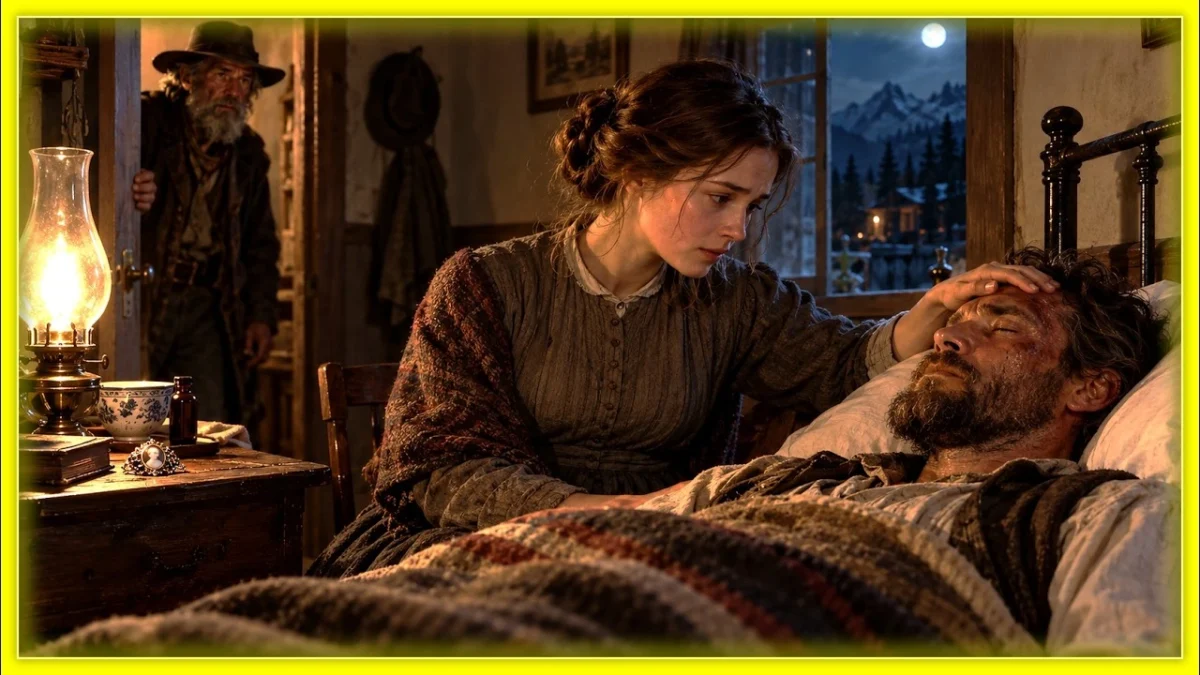
The spring runoff in the foothills outside Boise had turned the quiet creek into a churning, muddy torrent.
Cold meltwater rushed down from the snow-covered peaks, pulling dead branches, gravel, and heavy river silt along with it.
Ann Talbot stood on the rain-soaked grass near the back porch of her boarding house, holding a chipped porcelain washbasin under her arm.
Her eyes caught a dark, unnatural shape tangled in the submerged branches near the bend of the creek.
The man in the water was not moving, and the powerful current was working him loose an inch at a time toward the deeper channel.
Ann dropped the washbasin without a second thought, the delicate porcelain shattering against a flat stone in the grass.
She ran down the muddy bank in her thin house shoes, her heavy wool skirts fisted in one hand, screaming for help before she even reached the water’s edge.
“Silas! Silas, get down here! There is a man in the creek!”
Silas, an aging prospector who rented the small room above the woodshed, came hobbling around the corner of the house at a speed that was remarkably fast for his bent knees and aching joints.
Together, they waded into the freezing knee-deep water, fighting the current to grab hold of the heavy, waterlogged wool of the stranger’s coat.
They dragged him out of the rushing creek and hauled him onto the slick mud of the bank.
Ann knelt beside him immediately, pushing his wet, dark hair away from his forehead.
She saw the dark stain spreading through his linen shirt at the right shoulder, already turning brown at the frayed edges where the river water had diluted the blood.
Fever heat emanated from his soaked skin like the radiant warmth of a iron stove.
“He is shot,” Silas muttered, wiping river mud from his eyes with the back of his hand.
“Then we get him inside before we stand here talking about it,” Ann replied crisply.
Ann took his heavy, leather boots while Silas hooked his arms under the stranger’s shoulders.
Together, they carried the unconscious man up the slippery slope toward the two-story wooden boarding house.
It was a quiet, drafting building that Ann could no longer afford to call a functioning business.
They brought him into the corner room downstairs, the one she kept empty simply because no paying traveler had set foot in it for over three months.
She laid him on the good feather mattress instead of the rough corn-husk one, deciding that a dying man deserved comfort even if he never paid a single cent for it.
The stranger did not open his eyes once during the move.
His breath came in shallow, ragged hitches, his lips dry and cracked with fever.
Ann fetched her heavy sewing shears from her basket and cut the wet shirt away from his shoulder.
She cleaned the ragged wound with boiled water and packed it tightly with clean linen scraps, applying pressure the way her late mother had taught her years ago back in Illinois.
She sat beside his bed with a wooden basin of cold creek water, endlessly wringing out clean cloths and resting them on his burning brow until the black sky outside the window slowly turned to pale gray.
Silas stood in the doorway early the next morning, leaning against the frame while chewing his tobacco.
“You do not know him, Ann,” Silas said softly. “He could be anybody. Could be serious trouble.”
“He is a man bleeding in my spare room, Silas,” Ann said, wringing out the cloth over the basin. “He is trouble either way now.”
She looked at the old prospector’s tired face. “Fetch Dr. Reeves. Tell him I will find a way to pay his fee.”
Silas spat into a brass spittoon near the door. “With what?”
Ann did not answer him because she did not yet know the answer herself.
She looked down at the stranger’s pale face, watching his chest rise and fall so faintly under her hand that the only thought she had room for was a silent, desperate prayer.
Don’t stop breathing, she thought. Don’t you dare stop.
For nine endless days, the fever held the stranger in its grip, breaking slightly in the cool mornings only to return violently by nightfall.
For nine days, Dr. Reeves rode his tired bay horse up the long hill with his black leather bag, his grim expression, and his running ledger that grew longer with every visit.
On the ninth morning, the doctor washed his hands in Ann’s tin washbasin, drying them thoroughly on a clean towel.
“The wound itself is clean now,” Dr. Reeves told her, looking toward the bed. “The lead passed through without shattering the bone. But it is the fever that will take him if it takes him at all. He needs the tincture I brought yesterday, and he needs more of it if he is going to pull through. It is not cheap medicine, Mrs. Talbot.”
“Miss Talbot,” she corrected him automatically, as she always did.
Usually she minded the mistake, but today she had no patience left for minor corrections.
“How much more?” she asked directly.
Dr. Reeves named a price, and the exact number sat in the quiet room like a heavy, unwelcome third person.
Ann stood motionless by the window after the doctor left.
She had exactly eleven dollars in the rusted tin behind the flour bin in the kitchen.
She had whatever small rent Silas could manage when his luck held, which was rarely often.
She had nothing else in the entire world worth selling except for the small gold brooch pinned to her collar—garnet stone surrounded by tiny seed pearls, inherited from her mother.
It was the one precious object that had traveled west with her, the same pin her mother had worn across the plains years before in a different wagon on a different dusty road, before a similar fever had taken her mother’s life.
Ann stood in front of the small, cracked mirror in her hallway for a very long time before her fingers reached up to unclasps the brass catch.
“You are a foolish woman,” she told her reflection in a low whisper. “Spending your mother’s brooch on a drifter who might die anyway, a man who does not even have a name.”
Her reflection offered no argument.
She wrapped the brooch carefully in a white cotton handkerchief and walked down the dusty road to Mr. Ferris’s general shop before she could allow her own practical mind to talk her out of kindness.
She returned home an hour later carrying two dark glass bottles of medicine, four dollars and thirty cents in silver coins, and no brooch at her throat.
There was a sudden coldness against her collarbone where the metal had rested, a light vacancy she told herself was only the missing physical weight of the pin.
She walked upstairs and administered the stranger his first spoonful of the thick medicine that very evening.
By midnight, his skin had grown remarkably cool to the touch.
When the morning sun broke over the eastern hills, his eyes were wide open, clear, and staring up at the whitewashed ceiling.
“Where,” he whispered, his voice sounding like a rusted iron hinge that desperately needed oil, “am I?”
Ann turned from the bedside table so quickly that she nearly dropped the metal tray holding his bowl of broth.
She had imagined this exact moment nine different ways over the past nine days, but none of her imaginations had prepared her for how deep blue his eyes were.
They fixed upon her face with the sharp, calculating intensity of a man taking an immediate inventory of the room, the exits, and everyone inside it.
“My boarding house outside Boise,” she said, setting the tray down carefully on the nightstand. “You were shot and left to drown in my creek. I am Ann Talbot.”
The man remained entirely still, something moving swiftly behind his blue eyes—caution, calculation, or perhaps deep suspicion.
“Mark,” he said finally, his cracked lips moving slowly. “Mark Hale.”
“Mr. Hale,” she replied, pouring fresh water from a pitcher into a tin cup. “You have been bedridden for nine days. Dr. Reeves says you will survive, provided you do not do anything foolish like try to sit up too fast.”
Mark Hale immediately attempted to push himself upright on his elbows, winced sharply as the pull hit his bandaged shoulder, and fell back onto the mattress with a soft huff of breath that sounded almost like a laugh at his own stubbornness.
“Nine days,” he muttered, looking toward the window.
“Nine days and a great deal of Dr. Reeves’ expensive medicine,” Ann said, handing him the cup. “Which does not come free, which meant I had to sell my mother’s brooch to pay for it. I am not telling you this so you will thank me or feel indebted, Mr. Hale. I am telling you only so you understand why I have absolutely no patience left for you thrashing about and undoing the doctor’s work.”
She had not intended to say any of that.
The words had spilled out of her like floodwater over a broken dam, and the moment she finished speaking, she pressed her lips tightly together, her face burning with sudden embarrassment.
Mark Hale looked up at her, his posture going very still.
The calculating look in his blue eyes vanished completely, replaced by a quiet, serious intensity.
“You sold your mother’s brooch,” he said very slowly, “for me?”
“For the medicine,” she corrected, stepping back and clasping her hands together. “You were entirely incidental to the transaction.”
Her cheeks remained warm, and she busied herself folding a clean towel so she would not have to look at whatever expression was forming on his face.
He said nothing more about the brooch that morning, though she could feel him thinking about it constantly—the way a person feels the heat of a woodstove burning behind their back even when facing away from it.
As she turned to leave the room with the empty tray, he spoke softly from the bed.
“Thank you, Miss Talbot.”
He spoke in a tone so quiet and surprisingly formal that it sounded strangely out of place coming from a man who had been pulled half-drowned out of a muddy creek.
Mark mended far faster than Dr. Reeves had any right to expect.
Within two weeks, he was up and moving around the kitchen, visibly awkward at first, but steadily making himself useful around the house.
He learned where Ann kept the flour, how she stacked the firewood, and how she liked the cast-iron stove banked at night to keep the embers glowing until morning.
“You will ruin those hands,” Ann told him one evening, watching him dry a porcelain plate with a linen dish towel as though he had never held one in his entire life—which she suspected was very close to the truth.
“I have few enough useful skills left to me at the moment,” Mark replied smoothly without looking up. “I will not surrender this one.”
He dried the edge of the plate with exaggerated, meticulous care, and Ann let out a short, genuine laugh before she could stop herself.
It was a real laugh, the first one that had escaped her lips in longer than she cared to remember.
In the evenings, sitting across from her at the long kitchen table with the oil lamp burning low between them, Mark began asking questions about the surrounding territory.
He asked about the government agency up past the northern ridge, about the regional agent named Bledsoe, and about the persistent rumors of shorted winter rations and stolen tribal annuities.
He asked detailed questions about the territorial marshal’s jurisdiction, his deputies, and the physical limits of his authority.
Ann answered him plainly and directly, having never seen the practical use in sugarcoating bad news.
Besides, there was something about the careful, weighing manner in which he absorbed every word that made her want to offer him the plain truth without softening a single edge.
“You ask a great many detailed questions for a drifter,” she remarked one night, resting her cup on the table.
Mark leaned back in his chair, a faint smile touching the corner of his mouth. “I have been many things in my life, Miss Talbot. Curious is simply the one that has kept me alive the longest.”
He spoke lightly, but his blue eyes remained serious and guarded.
Ann let the matter drop, knowing that almost everyone who moved west carried a heavy story they were not yet ready to open for public viewing.
In the end, it was not his endless questions that gave him away, but a book.
Late one evening, Ann walked into the dimly lit kitchen and found Mark sitting near the lamp with Silas’ old Latin primer—a dense, leather-bound volume that no one in the house had ever been able to make sense of.
He was tracing the faded lines of print with his thumb, whispering the translation under his breath with a smooth, effortless fluency that belonged only to an educated man.
“You read Latin,” Ann said, stopping short in the open doorway.
Mark closed the leather cover a fraction too quickly, resting his palm flat over the title. “A little.”
“That is not a little,” Ann said, walking over to the table and pulling out a chair. “That is the reading of a man who has had formal schooling most drifters never even lay eyes on.”
She sat down across from him, resting her chin in her hand, studying his features the way she might study a complex wooden puzzle box with no visible seams.
“Who are you really, Mark Hale?”
Mark looked at her for a moment, then offered a warm, easy smile. “A man who is exceptionally grateful for hot soup and a warm bed, Miss Talbot.”
He shifted the conversation so smoothly and effortlessly to the topic of tomorrow’s weather that Ann did not even realize the subject had been changed until twenty minutes later.
It was only an hour later, lying alone in her cold bedroom upstairs, that she realized he had never actually answered her question.
The men came through the valley on a gray, overcast Tuesday afternoon.
There were three of them, hard-eyed, armed, and riding slow, unhurried horses down the main road.
They stopped at Mr. Ferris’ shop, asking around about a wounded drifter who might have washed up somewhere along the creek bank two weeks prior.
Ann was outside hanging wet sheets on the clothesline when she heard the heavy murmur of their voices down near the shop.
Her hands went icy cold, colder than the basin water had ever made them.
She dropped her wooden clothespins into her apron pocket and walked quickly into the house, heading straight for the kitchen.
“Bledsoe’s men are down at Ferris’ shop,” she said without wasting a single breath. “They are asking after a shot drifter along the creek. That is you they are hunting.”
Mark went entirely still, setting down the iron kettle he was holding. “How many?”
“Three,” Ann replied, her voice steady despite her racing heart. “Get in the cellar. Now.”
Mark did not argue or ask a single question, which revealed more to her than any spoken answer ever could have.
A man who trusted her judgment so implicitly without demanding explanation was a man who had already made up his mind about her character, and there was no time to ponder what that meant.
He moved quickly, stepping down into the shallow root cellar beneath the kitchen floorboards.
Ann shut the heavy wooden trapdoor, dragged the braided rag rug back over the seam, and stood straight.
The loud, heavy knock echoed off her front door less than thirty seconds later.
Ann wiped her hands on her apron, smoothed her skirts, and walked down the hallway to pull the heavy oak door open.
“Afternoon, ma’am,” the lead rider said.
He was a tall, rough-faced man with a jaw like a closed fist, wearing a low-slung revolver at his hip.
“We are looking for a man who might have come through this way, shot up pretty bad, maybe nine or ten days ago.”
Ann kept the wet dishcloth tightly in her hands, wringing it rhythmically, and allowed her voice to take on a sharp, annoyed tone—the exact voice of a tired landlady whose busy workday had been rudely interrupted.
“I run a boarding house, mister, not a county hospital,” she said, leaning against the doorframe. “I have had exactly two boarders this past month, both of them paid their rent in advance, and neither one had a bullet hole in him that I noticed. And I notice everything because I wash the laundry.”
The lead rider’s cold eyes drifted past her shoulder, scanning the empty front hallway in a slow, lazy sweep. “Mind if we step inside and take a look around?”
“I mind considerably,” Ann snapped, “but I do not suppose my opinion stops armed men from stepping onto my porch.”
She stepped back from the entrance, letting the three men walk into her hallway.
Her heart was beating against her ribs like a trapped bird, but she walked calmly into the kitchen and stood squarely over the rag rug covering the trapdoor.
She picked up a dry stoneware plate and began drying it again, keeping her posture casual until the men finished peering into the empty guest rooms.
Finding nothing, the leader tipped his hat curtly. “Obliged, ma’am.”
They turned and walked out, their heavy boots thudding across the porch before riding away.
Ann remained standing over the trapdoor for a full minute after the sound of the retreating hoofbeats had entirely faded down the gravel lane.
Only then did she drop her dishcloth, kick back the rag rug, and pull open the cellar door.
Mark climbed up into the warm lamplight, looking at her with an expression she had never seen on his face before—as though he were seeing her clearly for the very first time.
“You lied to armed men,” he said quietly, his voice lacking its usual guarded edge.
“I have had plenty of practice lying to men who owe me back rent,” she said, her hands finally beginning to shake now that it was safe to do so.
She looked at him directly. “Who are you really, Mark? Why are Bledsoe’s men hunting you like a wild animal?”
Mark opened his mouth as if to speak, but no words came out.
His jaw worked tightly, the truth clearly jammed behind years of practiced silence, and he remained quiet for the rest of the evening.
Two days later, the territorial marshal rode up to the boarding house.
He arrived on a dust-caked horse, looking worn and grim, his tin star gleaming dully against his leather vest.
Ann met him on the front porch, her flour-covered arms wrapped in her apron.
“I am looking for the governor,” the marshal announced abruptly as he dismounted.
Ann blinked, startled. “You are looking for the what?”
The marshal did not answer her question; he pushed past her into the front parlor where Mark was sitting near the cold fireplace.
The moment the lawman saw Mark, he stopped dead in his tracks, removed his wide-brimmed hat, and stood with the rigid, respectful posture of a man standing in a cathedral.
“Governor Hale, sir,” the marshal breathed, relief washing over his tired face. “Thank God. We feared the worst when Bledsoe’s men ambushed your carriage near the ridge.”
“Governor?” Ann whispered, the dishcloth slipping completely from her numb fingers.
She looked down at the cloth on the floor as if it might offer a rational explanation for what she had just heard, but it offered none.
Mark rose from his wooden armchair slowly.
For the first time since she had hauled him out of the muddy creek, he did not look like a drifter or an injured boarder.
He stood with immaculate, commanding authority—his shoulders back, his posture perfectly straight, his voice dropping into a deep, authoritative register she had never heard from him before.
“I am sorry, Ann,” Mark said, turning his gaze entirely toward her, ignoring the marshal completely.
It was the very first time he had ever spoken her given name.
“I gave you a false name because Bledsoe’s corrupt men would have finished what the ambush started if they had known who they had only wounded,” he explained, stepping toward her. “It was a deception meant to protect my life from assassins, Ann. It was never a lie meant to hurt you.”
Ann stood frozen by the door.
She thought of nine grueling days of tending his fever.
She thought of her mother’s pawned brooch.
She thought of a man standing in her kitchen, drying porcelain dishes badly, reading Latin primers by lamplight, and asking thoughtful questions about the local territory.
She stood there, entirely unable to decide whether she should be furious or overwhelmed by an entirely different emotion—one that had no clear name yet, sitting directly in the space where her anger ought to have been.
“You might have told me,” she said, her voice dropping to a quiet, steady whisper, “once you were well enough to sit up and lie about everything else.”
“I know,” Mark said, his deep blue eyes holding hers with absolute sincerity. “I am telling you the truth now.”
There was no time for further explanation.
The marshal quickly explained that Bledsoe, having somehow been warned that the governor was still alive, had fled the agency hours earlier.
He had taken two young clerks as hostages and stolen a wagon loaded with government annuity funds, heading straight for the county border.
The marshal needed Governor Hale’s immediate written authority to raise a large posse and pursue the fugitives before they crossed into unregulated territory.
Ann moved automatically to the kitchen counter, her hands shaking slightly as she packed food for his journey.
She wrapped freshly baked bread and dried beef in a clean linen cloth, working silently.
When she handed him the bundle at the front door, she looked up into his face.
“You do not owe me anything, Governor Hale,” she said clearly, making sure her voice did not falter. “I am not fishing for promises or political favors. I did not nurse a governor back to health. I nursed an injured man I found bleeding in my creek. Whatever grand position you held before you woke up in my guest room does not change what you owed me then—which was nothing more than any Christian owes another.”
Mark took the parcel from her hands.
Instead of pulling away, his long fingers wrapped firmly around hers, holding her calloused hands—hands roughened by heavy laundry, woodscrubbing, and nine days of relentless fever-tending.
“I do not forget what I owe, Ann,” he said softly, looking directly into her eyes. “Whatever else I am, I do not forget.”
A moment later, he mounted Silas’ borrowed horse and galloped down the dirt road in a cloud of thick gray dust, following the marshal toward the mountains.
Ann stood on her porch with her arms empty, watching the dust settle over the road.
She sternly forbade herself from holding onto hope.
Hope was an expensive, dangerous luxury in the West, and she had already spent her mother’s brooch this year on believing in a total stranger.
Three long weeks passed the way weeks always do when a person is trying very hard not to count the days.
Copies of the regional newspapers slowly made their way to the outskirts of Boise, their front pages filled with bold headlines about Governor Mark Hale and the collapse of the Bledsoe corruption ring.
The papers reported that the hostages had been rescued without harm, the corrupt agent was in heavy irons awaiting trial, and the entire territory was praising the governor’s courage and swift justice.
Ann read every single newspaper column that Silas brought home from town.
She told herself she was only reading them out of general interest, as anyone would, refusing to examine too closely why her eyes lingered over the exact same paragraphs two or three times before she laid the paper down.
Then, on a cold, overcast morning, a young delivery boy rode up to the boarding house gate carrying a small, tied package.
There was no accompanying letter inside the wrapping, only her name written on the heavy brown paper in a precise, elegant handwriting she recognized instantly from the margins of Silas’ Latin primer.
Ann unwrapped the parcel at the kitchen table while Silas watched silently over his mug of black coffee.
Nested safely in layers of soft white tissue paper was her mother’s brooch.
The garnet stone burned deep red in the morning light, surrounded by the delicate, undamaged seed pearls—bought back whole and restored to her.
Ann picked up the gold pin and held it in her palm for a long, quiet moment.
Beneath the overwhelming sense of financial relief, she felt a tiny, sharp stone of hurt settling in her chest—a quiet ache she was deeply ashamed of but could not seem to dissolve.
He had returned the physical item itself, but not a single written word accompanied it.
No personal note.
No formal expression of thanks.
No indication whatsoever that the man who had dried her kitchen dishes remembered anything about the woman who had nursed him back to life.
“That was right kindly of him,” Silas offered softly, taking a sip of his coffee.
“It was very kindly,” Ann agreed, her voice tight.
She pinned the brooch back onto her cotton collar with fingers that were not quite steady.
She told herself sternly that a territorial governor had an entire state to manage, dozens of political crises to solve, and important lives far more grand than hers to oversee.
Expecting anything more than a full financial repayment was a fool’s arithmetic, a foolish mistake she had promised herself she would never make again.
She went back to her daily work.
She washed the heavy bedding, scrubbed the wooden floors, and tended the kitchen garden.
She did not, as she told herself repeatedly every single morning, watch the road.
Three weeks later, an elegant dark carriage pulled up to the front gate of the boarding house.
It traveled without an armed escort, without a uniformed driver in livery, and without any official crest painted on the wooden door.
It looked like nothing more than a simple hired carriage from the Boise livery stable.
The man who stepped down from the interior wore a plain brown wool coat and no hat at all.
When he turned toward the house, the bright afternoon sunlight caught his face, and Ann recognized him before he had taken three steps toward the porch.
Ann stood on her porch, her heart beating so hard against her ribs that it felt almost painful.
“Governor Hale,” she said carefully, pronouncing the official title the way a person might handle a piece of red-hot iron.
“Miss Talbot,” he replied, stopping at the bottom of her stone porch steps.
He kept his hands loose at his sides, looking up at her with the focused intensity of a man who had traveled a very long way to see one specific sight.
“I have come about renting a room,” he said softly.
“A room?” Ann folded her arms across her chest, leaning against the porch railing. “You have an official mansion in the capital, or so the newspapers inform me.”
“I have an office in the capital,” Mark corrected gently, taking one step up the stairs. “It is not at all the same thing. I am asking for your standard rate, Miss Talbot, for a permanent resident. I find that I think of this kitchen far more than I think of anything in Boise proper.”
Ann felt a sudden, powerful rush of emotion—she wanted desperately to laugh, to cry, or perhaps to do both at the exact same time.
Instead, the words that came out of her mouth were flat, certain, and precisely what she had promised herself she would say if foolish hope ever showed its face at her door again.
“I do not take governors,” she said.
Something flickered across Mark’s face—not anger, and not quite hurt, but something very close to it—before it settled into an expression of absolute, unshakeable resolve.
“Then I will resign,” he said quietly.
He did not resign, of course.
The territory would never have permitted its most effective leader to step down, and Ann, once her heart had settled back down from her throat, would not have permitted it either.
A good governor was far too precious a thing to throw away on a rural boarding house when he could do so much lasting good remaining in office.
What Mark did instead was commute between the capital and the quiet foothills every single chance his official schedule allowed.
At first, he arrived once a month, then twice, and by the time the autumn leaves turned brilliant gold across the hills, he arrived so frequently that Silas stopped commenting on his presence entirely, simply setting an extra place at the dinner table without being asked.
The garnet brooch remained pinned securely to Ann’s collar every day.
The Latin primer stayed on the kitchen table, and on quiet evenings, Mark would sit across from her and read the ancient text aloud badly on purpose, just to hear her laugh.
And whenever the territorial mail rider came galloping up the road twice a week carrying official letters addressed in a governor’s precise, elegant handwriting to a modest boarding house that had never received anything grander than a doctor’s bill, Ann Talbot would take the thick envelope from the rider’s hands.
She would press it once gently against her collar, right beside her mother’s brooch, before she ever broke the wax seal.








