She Was Six Weeks With Child When She Heard Her Husband Say Five Words Through the Door
Part 1
Amelia had been married to Arthur, the Duke of Kelsworth, for two long years.
And for the whole of that time, she had believed herself to be entirely happy.
Which she would later come to realize was not in fact quite the same thing as being truly loved.
Theirs had been, by the strict standards of the London ton, an unusually warm match.
It was arranged as most such aristocratic marriages were by ambitious fathers and cautious solicitors over a matter of adjoining land and lucrative titles.
Yet over two years, it had grown into something neither family had quite planned for.
Kelsworth was not a demonstrative man in public company.
He could sit through an entire five-course dinner party saying almost nothing at all.
His dark, intense eyes moved over the crowded table with the same watchful reserve he brought to everything in his life.
Strangers invariably came away from meeting him with the settled impression of a cold, arrogant man.
But behind the closed oak doors of their private rooms, he was a different creature entirely.
He was quick to laugh at a subtle joke she made.
He was quicker still to reach for her fingers across a small table the very moment the last footman withdrew.
Amelia had spent two years believing that this private, gentle Kelsworth was the true man.
She believed his public reserve was merely a heavy coat he wore out of doors, the way another man might wear a greatcoat against bitter weather he did not care to feel.
In the early weeks of spring, Amelia discovered she was six weeks with child.
It was a tender secret she had shared with no one except her personal maid and her own glowing reflection in the looking glass.
She had decided to save the joyous news for his upcoming birthday, three weeks away.
She spent her quiet afternoons imagining the particular look of overwhelming relief that would come over his stern face when she finally told him.
Because Kelsworth, for all his quiet reserve in company, had a way of going entirely undone in private when it came to her.
She had been picturing that undone expression for a fortnight with something close to greedy impatience.
She rehearsed the exact words in the dark before she went to sleep each night.
On the fateful Tuesday in question, however, she found she could no longer hold the secret inside.
She walked down the grand carpeted staircase toward his private library, the news sitting warm and unbearable in her chest.
She intended to tell him three weeks early simply because her heart could not carry the weight of such joy alone for another hour.
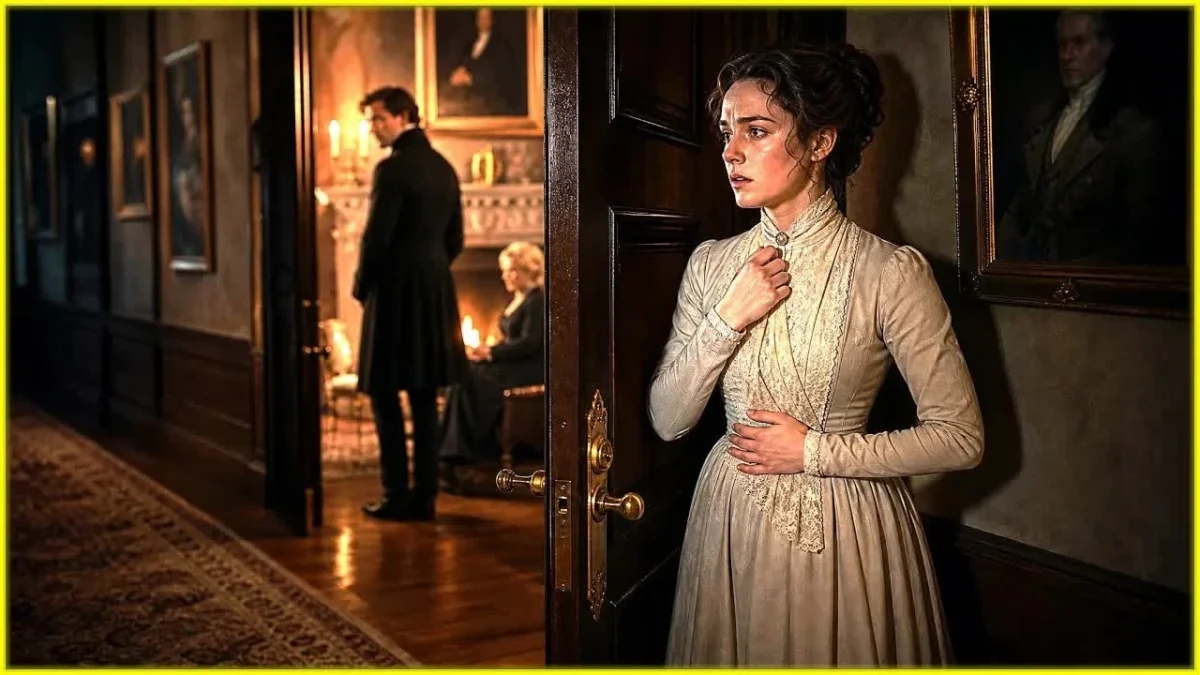
As she approached the library, she noticed the heavy mahogany door stood slightly ajar.
She heard the Dowager Duchess’s voice first—low, sharp, and persistently pressing him as she had done for two agonizing years.
“You must consider the estate, Arthur,” the Dowager said with cold insistence.
“The succession requires an heir, and society is beginning to whisper.”
“Was this marriage, in the end, truly the wisest course for a man of your exalted position?”
Amelia paused outside, her boots making no sound on the thick oriental runner.
Then she heard her husband answer in a tone she recognized, yet simultaneously did not recognize at all.
He spoke five sharp words that stopped her dead on the threshold, her hand still lifted to push open the heavy door.
“I never wanted her, Mother.”
Amelia did not push the door open.
She did not step inside to confront them.
She stood frozen in the drafty stone passage with one hand pressed flat against her lower stomach, directly over the unborn child neither of them yet knew existed.
She did not make a single sound.
After a long, suffocating moment, she slowly turned on her heel.
She walked back up the grand staircase the exact way she had come.
She told him nothing.
She packed nothing more than could fit inside one small traveling trunk.
Before the Friday post had even gone out from the local village, the Duchess of Kelsworth was gone from Kelsworth House, traveling fast on the rough road toward her aunt’s quiet cottage in Shropshire.
What Amelia did not stay to hear, standing frozen in that hallway as her entire understanding of her marriage collapsed, was that her husband’s statement had not ended where she stopped listening.
There had been eleven more words spoken immediately after those five.
Eleven words that turned the entire meaning of his sentence upside down.
Eleven words that the Dowager Duchess herself would later admit, with considerable shame, she had never expected her stoic son to utter.
The Dowager had barely let him finish those extra words before pressing her own advantage regardless.
But Amelia had not stayed for those eleven words.
She had heard five, and five had been more than enough to shatter everything she believed in.
In the harrowing days that followed, Kelsworth had no idea why his wife had vanished.
He knew only that her bed chambers stood silent and empty.
Her jewel case remained untouched upon her vanity.
She refused to answer a single letter he dispatched to Shropshire.
He wrote a dozen messages, each one more frantic and desperate than the last.
Every letter was returned unopened, or simply swallowed by the absolute silence that had opened between his grand London estate and the modest house in Church Stretton.
By the third week of her absence, her aunt’s footman—a broad, unsmiling man named Griggs—had standing orders to turn the Duke away from the front gates physically if necessary.
It nearly came to a violent physical brawl twice before the Duke finally stopped attempting the journey himself.
Instead, Arthur began the agonizingly slow work of trying to comprehend what he could have possibly done to drive his wife away in the span of a single Tuesday afternoon without a word of warning.
Six agonizing months passed in this agonizing manner.
Six months in which the Duke of Kelsworth aged far more than six years ought to age a man.
His dark hair grew gray at the temples, and his cold reserve hardened into absolute, painful isolation.
Part 2
During those grueling six months, Arthur dismissed his mother from two family dinners in a row without offering the slightest explanation.
It was an act of cold rebellion so wildly out of character that the servants whispered about it for a fortnight.
“Where is Her Grace, Arthur?” the Dowager had demanded sharply on the second occasion, setting her crystal goblet down with a sharp click.
“You have allowed this absurd scandal to drag on far too long.”
Arthur had simply looked at his mother across the long, empty dining table, his voice flat and terrifyingly quiet.
“Leave my house, Mother.”
“Arthur! I am your mother!”
“And she is my wife,” Arthur replied, his dark eyes hollow with unexpressed grief.
“And until she returns to this table, you shall not sit at it.”
He hired a private investigator from London to trace her every move, only to dismiss the man in a fit of rage when the investigator reported what Arthur already knew and refused to violate a noble lady’s privacy further.
Arthur wrote directly to Amelia’s stern aunt, receiving back a single icy line written in sharp black ink:
My niece is in good health, Your Grace, and wishes for no communication from a man who measures love in land titles.
Arthur took to riding out alone across the muddy moorlands in weather no sensible gentleman would brave.
His old steward, who had served three generations of Kelsworth dukes, later confessed it was the only time in thirty years he had seen a member of that proud family look utterly lost inside his own home.
Arthur finally discovered her true location in early October.
She was living in a small rented house in Church Stretton, where red autumn ivy clung to the stone walls and thin grey smoke drifted from its single working chimney.
He had finally bribed the truth out of a Shropshire innkeeper who owed his estate steward a massive personal favor.
When Arthur arrived at the narrow front door, Griggs the footman had been temporarily called away to the stables to tend to a sick carriage horse.
Arthur knocked sharply on the wood.
The door swung open, and the woman standing before him took his breath away entirely.
Amelia stood in the narrow hallway, enormous with child, and absolutely, magnificently furious.
Arthur stared at her rounded belly, his face turning deathly pale as his hands began to tremble violently.
“Amelia…” he gasped, leaning against the doorframe for support.
“You are… you are with child?”
Amelia gripped the edge of the open door, her eyes blazing with cold, unyielding fire.
“What are you doing here, Arthur?” she demanded, her voice cutting through the damp autumn air like a whip.
“How dare you come to this house!”
“How dare I?” Arthur repeated, stepping uninvited into the small, narrow parlor.
“You disappeared from my life for six months without a single word of explanation!”
“I searched every corner of this kingdom for you!”
“I thought you were dead, Amelia!”
The confrontation that erupted in that modest parlor was the ugliest, most raw argument either of them had ever experienced.
It was far worse than any quiet disagreement of their two years of marriage.
Both of them were shouting things neither had known they were capable of saying to another human being.
“You left me!” Arthur roared, his composure completely shattering into raw desperation.
“You abandoned your home, your husband, and your duty!”
“I left a man who never wanted me!” Amelia screamed back, her voice cracking as tears of anger spilled down her pale cheeks.
“I stood outside your library six months ago, Arthur!”
“I came down those stairs eager to tell you that I was carrying your child!”
“And what did I hear through the door?”
Arthur froze, his breathing ragged as he stared at her.
“What are you talking about?” he whispered.
Amelia stepped toward him, bracing one hand against the small of her aching back.
“I heard your mother ask if our marriage was a mistake,” Amelia spat, her voice trembling with two years of suppressed humiliation.
“And I heard you give her your answer!”
“You told her, ‘I never wanted her, Mother!'”
“Five words, Arthur! Five words were all it took to destroy every gentle thing I believed about us!”
The narrow parlor fell into a sudden, suffocating silence, save for the crackle of the small hearth fire.
Arthur stood utterly motionless, as if he had been struck by lightning.
The color drained completely from his face as he stared at his wife.
“You… you heard that?” he asked, his voice barely a breath.
“I heard enough,” Amelia said, turning her back on him.
“I heard the truth you were too cowardly to say to my face.”
“Amelia, listen to me,” Arthur said, his voice shaking with a desperate, terrifying intensity as he took a step toward her.
“You did not hear the end of that sentence.”
Amelia let out a harsh, bitter laugh.
“I did not need to hear any more!”
“You must hear it!” Arthur shouted, grabbing her gently by her shoulders and forcing her to face him.
“You heard five words, Amelia, but there were eleven more words after them!”
Part 3
Amelia tried to pull away from his grip, but Arthur held her firmly, his dark eyes burning with an intense, desperate sincerity she had never seen in him before.
“Release me, Arthur!” she demanded.
“Not until you hear the rest of what I said to my mother in that room!” Arthur countered, his voice raw.
“You heard me say, ‘I never wanted her, Mother.'”
“What I said right after that was: ‘…until the moment I saw her, and now I want no one else.'”
Amelia stopped struggling, her mouth parting in shock as she stared at him.
Arthur swallowed hard, a single tear slipping down his stern, weathered cheek.
“My mother was pressing me, as she always did, about arranged marriages and political alliances,” Arthur explained, his chest heaving.
“She called our union a mere business transaction between two wealthy families.”
“I told her that I never wanted a wife at all—not any wife, not the idea of marriage—until the evening I met you at that dull assembly in Bath.”
“I told her I found myself unable to stop watching the doorway waiting for you to return from the refreshment room.”
“I was arguing with her, Amelia! I was defending our marriage!”
“I was telling her that marrying you was the only truly magnificent thing I had ever done in my entire miserable life!”
“You caught five words of a sentence meant to crush my mother’s arrogance,” Arthur whispered, his hands trembling on her shoulders.
“And you missed the eleven words that contained my whole heart.”
Amelia stood frozen in the narrow parlor, her heart hammering wildly against her ribs.
The revelation hit her like a physical blow, turning her entire six months of bitter grief upside down.
Yet, despite the overwhelming truth in his eyes, the deep pain of the past two years did not magically vanish.
Amelia slowly pushed his hands off her shoulders and braced herself against the back of an armchair.
“It does not fix everything, Arthur,” she said plainly, her voice remarkably steady despite the tears on her face.
Arthur looked at her, his expression pained.
“Amelia…”
“A man whose own mother had to be argued with in private did not defend his wife in public,” Amelia said, looking directly into his eyes.
“Not once in two whole years of dinner parties did you ever tell that woman to stop her cruel remarks at my own table.”
“You let your mother needle me, criticize my background, and question my worth within earshot of the servants.”
“You called your silence ‘patience’ and ‘respect,’ but what it actually taught me was to expect cold contempt from you.”
“I believed those five words because your public silence made them believable!”
Arthur lowered his head, completely undone by the absolute justice of her accusation.
“You are right,” he whispered hoarsely.
“I was a coward, Amelia. I thought keeping the peace was noble. I did not realize I was sacrificing your dignity to spare my mother’s feelings.”
He did not return to London that night.
Over the strong objections of his mother, his solicitors, and initially Amelia herself, Arthur rented a modest set of rooms above the apothecary in Church Stretton.
Every single day, regardless of the howling wind or driving autumn rain, the Duke of Kelsworth walked to the small stone cottage.
He did not attempt grand, eloquent speeches.
He had learned the brutal cost of eloquence delivered to the wrong person in the wrong room.
He simply sat quietly in the parlor when she allowed him in, asking gently after her health and the baby’s progress.
On one freezing November afternoon, when Amelia confessed to a sudden, unbearable craving for a specific type of ginger biscuit found only in a neighboring village four miles away, Arthur did not send a servant.
The Duke walked four miles through a pouring rainstorm and four miles back, returning soaked to the skin, holding a small paper bag of dry biscuits with a quiet, triumphant smile.
In late December, as a hard frost blanketed the Shropshire hills, Amelia went into labor.
The labor was long, difficult, and stretched deep into the freezing night.
Arthur remained in the house for every single minute of it.
He paced the narrow, drafty hallway outside her bedroom—a passage far tighter than the grand corridors of Kelsworth House.
When his mother sent an urgent messenger ordering him to return to London immediately and declaring it “entirely improper for a Duke to attend a messy childbirth in a rented cottage,” Arthur threw the letter into the hearth fire without reading the second page.
Mrs. Ottery, a brisk local midwife who had delivered half the parish and was entirely unimpressed by dukes, poked her head out of the bedroom door at three in the morning.
She found the Duke of Kelsworth standing in his shirt-sleeves, his fine coat abandoned and his silk cravat long gone.
“If you’re going to wear a groove in my floorboards, Your Grace,” Mrs. Ottery barked, “you might as well make yourself useful and keep this fire built up!”
The Duke of Kelsworth spent the next three hours hauling logs and feeding the iron grate with his own bare, soot-stained hands.
He listened to his wife’s sharp cries echoing through the thin plaster walls, every fiber of his being straining toward a closed door he had been forbidden to open.
When the sharp, furious, unmistakable cry of a newborn babe finally echoed through the cottage, Arthur did not wait for permission.
He pushed open the door, ignoring Mrs. Ottery’s loud protests, and stepped into the warm, dim room.
Amelia lay exhausted against the damp pillows, pale and beautiful, holding a tiny, dark-haired infant against her chest.
Arthur crossed the small room in three long strides.
Without a single thought for the state of his fine trousers or his noble dignity, the Duke of Kelsworth dropped heavily to his knees on the cold floorboards beside the bed.
He rested his forehead gently against his wife’s shoulder, weeping silently.
Amelia reached out a trembling hand and buried her fingers in his damp hair, pulling him closer.
Neither of them said anything for a long time, because for once in their lives, there was nothing left that needed saying.
They named their daughter Grace.
They chose the name despite a furious written letter from the Dowager Duchess claiming it was “a common servant’s name, entirely unbecoming of a future lady.”
Arthur answered his mother’s letter with a single, icy line:
My daughter’s name is not yours to approve, Mother.
A few weeks later, as spring began to warm the Shropshire hills, Amelia sat propped up in bed watching her husband read another angry missive from London.
Arthur set the letter aside without the slightest hint of annoyance.
“Do you intend to spend the rest of your life quietly disappointing the Dowager Duchess in short, extremely well-mannered sentences?” Amelia asked, a soft smile playing on her lips.
Arthur looked over at his wife and daughter, his eyes warm and completely untroubled.
“I rather think I do,” he replied gently.
“And I find I mind it a great deal less than I once did.”
“Why is that?” Amelia murmured.
Arthur walked over to the bed, sitting beside her and gently taking her hand in his.
“Because I have finally worked out which of the two women in my life I cannot survive disappointing.”
The moment Amelia and the child were strong enough to travel, Arthur made good on his word.
He did not write an apology to his mother.
Instead, he delivered a formal legal notice written in his own hand, declaring that Amelia’s name would henceforth stand alongside his own on every document, every ledger, and every public record of the Kelsworth estate.
He moved his mother entirely out of the London townhouse, establishing her in a comfortable, elegant estate two counties away.
And for the rest of their long, joyful marriage, Arthur never again allowed a single critical word about his wife to go unanswered by his own fierce voice.
Years later, when young Grace was old enough to ask why her grandmother lived so far away and visited so rarely, the Duke of Kelsworth sat his daughter on his knee.
“Grown people sometimes have to make a choice, my dear,” he told her softly.
“They must choose, very plainly, who they mean to defend in this life.”
“I was very slow to make that choice,” he added, looking across the room at Amelia, who was smiling at him with a second child sleeping softly against her shoulder.
“And I have spent every day since making sure I never forget it.”








