She Whispered, “May I Warm Up by Your Fire?”… His Words Changed Her Life Forever | Wild West Stories
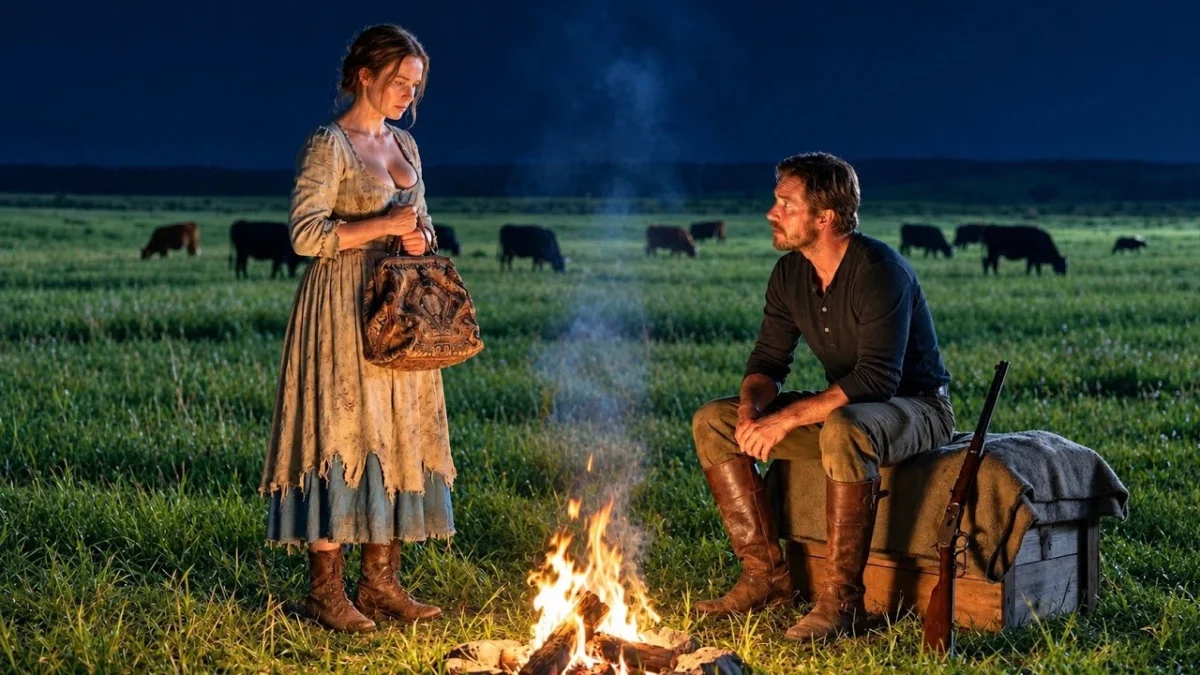
The first thing Caleb Mercer noticed was that the woman never stepped fully into the circle of firelight.
She stopped at its very edge, rooted to the spot like a phantom born of the twilight.
One mud-crusted boot was planted firmly in the dry prairie dust, while both of her pale knuckles wrapped white-hot around the handle of a worn, faded carpet bag.
The crackling mesquite embers painted the frayed hem of her skirts in flickering shades of gold, yet she remained anchored in the shadows as if awaiting a harsh judgment.
Caleb’s fingers tightened instinctively around the cold steel and oiled walnut of the repeater rifle resting across his knees.
Out on the lonely Wyoming trail, unexpected strangers appearing after sunset usually brought nothing but blood and trouble.
Yet as the fire crackled, Caleb studied the intruder with a veteran’s keen eye and realized she carried no visible holster, no horse, and no demands.
Only an overwhelming, bone-deep exhaustion was pressed into the sharp lines around her mouth and eyes.
She cleared her throat, the sound dry and small against the vast, empty plain.
“May I warm up by your fire?” her voice barely rose above the low moan of the prairie wind.
“If only until morning.”
The crackling mesquite answered first, sparking upward into the darkening twilight sky.
Caleb did not lower the rifle immediately, but his thumb eased off the hammer with a soft, metallic click.
He took in her appearance with slow, deliberate thoroughness.
Trail dust coated her boots, and the sleeves of her faded blue cotton dress had been mended more than once with mismatched thread.
Escaping strands of rich chestnut hair fluttered loose from slipping pins around a pale, fragile face.
Despite the obvious trembling in her slender fingers, she stood remarkably straight, refusing to bend under the cold wind.
“Coffee’s hot,” Caleb said, his deep voice carrying low across the grass.
“You can sit.”
The woman released a long, shaky breath that seemed to deflate her entire frame.
“Thank you.”
She finally stepped across the threshold of shadow and into the full, warm circle of yellow light.
Caleb leaned forward, setting his rifle across a nearby supply crate, and picked up a spare tin cup from the embers.
He poured the thick, black brew to the brim and set the steaming cup down on the edge of a flat rock near her side of the fire rather than handing it to her directly.
In his years on the frontier, Caleb had learned that giving space mattered, especially to wild creatures and people who looked ready to bolt at the slightest sudden movement.
She lowered herself onto a fallen log, wrapping both hands tightly around the tin cup as if drawing her very soul back into her body through its heat.
Steam drifted upward, catching the golden glow of the flames between them.
For several long minutes, neither of them spoke a word.
A hundred yards out in the darkness, the eighty head of cattle he was driving north shifted restlessly in their bedground.
Leather saddles creaked softly on their wooden stands, and the evening breeze whispered through the tall, dry grass.
Finally, Caleb took a slow sip from his own cup and glanced across the coals.
“You got a name?”
She stared deep into the swirling black liquid in her cup before speaking.
“Clara Bennett.”
Caleb nodded once, accepting the words without pretense.
“Caleb Mercer.”
Silence returned to the campsite, heavy and thick.
It was a comfortable silence for Caleb, who had spent three long years living inside his own head, but it clearly unnerved the woman.
A dry mesquite log popped violently, showering tiny orange sparks into the grass.
Clara startled, her shoulders leaping toward her ears before she caught herself and gave her head a small, deliberate shake.
“You don’t ask many questions, Mr. Mercer,” she said softly, looking up to meet his gaze for the first time.
“I ask useful ones,” Caleb replied.
The ghost of a smile twitched at the very corner of her mouth.
“You don’t even know if I’m dangerous.”
Caleb turned his head slightly, peering into the gloom toward the quiet herd.
“If you meant harm, Miss Bennett, you would have walked closer before asking permission.”
Clara lowered her eyes back to the embers, where the flames reflected like tiny, burning embers in her dark irises.
“I suppose that’s fair.”
Morning arrived cold, sharp, and gray across the boundless Wyoming horizon.
Caleb stirred from his bedroll at first light, his hand automatically reaching for the stock of his rifle before his eyes even opened.
The sharp, rich aroma of fresh coffee was already heavy in the freezing air.
He blinked away sleep and sat up to find Clara kneeling gracefully beside the pit, expertly managing the heat of his battered coffee pot using a pair of green stick tongs.
“You didn’t have to do that,” Caleb said, his voice husky from sleep as he pulled on his worn leather boots.
“You shared your fire,” she answered, using a thick cloth to pour a dark stream into his tin cup before holding it out to him.
“And you look like a man who needs to drink coffee before he speaks to the world.”
Caleb accepted the cup, their fingers careful not to touch.
The first scalding sip stopped him in his tracks.
It was thick, dark, and strong, boiled precisely to the bitter edge he preferred.
He leaned against his saddle and looked at her over the rim of the tin.
“You from around these parts?”
“No,” she said, wrapping her skirt neatly around her knees as she sat back on her heels.
“I was coming from Nebraska.”
She paused, her fingers twisting together tightly in her lap as the morning light exposed the harsh details of her reality.
“I was supposed to be married.”
The words came out flat and quiet, stripped of any lingering romanticism.
“My father owed a great deal of money to a land speculator in town.”
A gust of freezing morning wind shifted the smoke between them, carrying the scent of pine and ash.
“The groom’s family realized my father couldn’t pay his debts,” Clara continued, her voice remaining steadily distant.
“They decided they wanted more land than our farm could ever provide, and when they didn’t get it, the wedding ended before it ever began.”
Caleb waited in silence, offering no empty words of sympathy.
“My father passed away from the fever a week later,” Clara whispered, staring into the rising ash.
“The bank took the farm, and the boarding house in town sent me away when my last dollar ran out.”
She swallowed hard, her throat working against the cold air.
“So I walked.”
Off in the gray mist, an old cow lowed for her calf.
Caleb watched the mist roll across the sagebrush for a long, silent moment, weighing the reality of the wilderness against the delicate woman standing in front of him.
“I’m driving eighty head of cattle north to the railhead,” Caleb finally said, setting his empty cup on the grass.
She blinked, confused by the sudden change in topic.
“What?”
“I need another hand.”
Clara’s expression instantly guarded itself, her chin lifting with a sharp, prickling pride.
“I don’t accept charity, Mr. Mercer.”
“Good,” Caleb said, standing up to his full, broad-shouldered height.
“Because I don’t offer it.”
Clara stood up as well, her eyes narrowing as she assessed him.
“What would the work pay?”
“A dollar a day,” Caleb said, walking toward his grazing horse.
“Meals included.”
“And if I fail?”
“Then you go your own way at the next settlement,” Caleb said plainly.
Clara stared at him, her chest rising and falling as she processed the offer.
The weak morning sun caught the thin, pale line on her left ring finger where a band had clearly rested not too long ago.
“You don’t know anything about me, Caleb Mercer.”
Caleb caught his gelding by the halter and swung a heavy leather saddle onto the horse’s back with a smooth, practiced motion.
“I know you asked for a seat at the fire instead of taking what wasn’t yours.”
He tightened the cinch strap with a firm tug and looked over the horse’s spine at her.
“And I know that hard work tells the absolute truth about a person far faster than conversation ever will.”
The tight, strained corners of Clara’s eyes softened slightly.
“Fair enough.”
Caleb reached over to the spare horse tied to the supply wagon and unhooked a set of leather reins, tossing them toward her.
“Can you ride?”
A small, genuine spark flared beneath her exhausted, dirt-streaked face.
“I grew up on a draft farm, Mr. Mercer.”
“Then mount up,” Caleb said, swinging effortlessly into his own saddle.
“We lose daylight fast out here.”
The borrowed bay mare shifted nervously beneath Clara as she swung up into the saddle, but Clara adjusted her skirts with practiced ease and gathered the leather reins into her hands.
Her spine straightened instinctively, and the uncertain, trembling woman who had stood at the edge of the firelight the night before seemed to fade away.
In her place, another version of Clara Bennett emerged—watchful, steady, and capable.
Caleb trotted his horse over and pointed a gloved finger toward the left flank of the moving herd.
“That old red cow on the edge likes to drift off into the draws,” he instructed.
“Keep your eyes on her.”
“I see her,” Clara replied, turning her mare toward the herd.
“Cattle can sense if you’re nervous,” Caleb warned as he turned his horse.
“Then I had better stop feeling nervous, shouldn’t I?” she called back.
The quick, sharp answer caught Caleb by surprise, bringing a rare, faint twinge to his jaw as he turned away.
For the first time since she had walked out of the dark, Clara almost smiled.
The cattle herd moved north under a rising sun that burned away the morning fog and lit the high Wyoming sky in brilliant shades of blue.
Dust rose in thick clouds beneath drumming hooves as the animals settled into their steady, rhythmic trek across the hard earth.
Clara guided her mare into position on the drag, watching the cattle with focused intensity.
When the old red cow made a sudden break toward a dry wash on the left, Clara didn’t panic or yell.
She simply nudged the mare forward with her heels, cutting off the animal’s path with clean, decisive precision before turning it back toward the herd.
Caleb watched the maneuver from the crest of a nearby rise, noting the complete absence of hesitation in her movements.
By noon, the high sun was beating down mercilessly, and dark lines of sweat stained the faded collar of Clara’s blue dress.
Her soft hands had reddened and swelled against the coarse leather of the reins, but she never asked to slow down, nor did she utter a single word of complaint.
When they finally halted the herd near a shallow creek lined with cottonwood trees to let the stock rest in the shade, Caleb rode up and handed her a tin canteen.
She accepted it gratefully, taking long, measured swallows before wiping the sweat and dust from her forehead with the back of her sleeve.
“You’ve handled livestock before,” Caleb remarked, leaning his forearms over his saddle horn.
“Not eighty head of semi-wild cattle,” Clara admitted, her voice hoarse from the dust.
“But hard work doesn’t change its nature just because the scales get bigger.”
A soft prairie breeze lifted the loose, sweat-dampened strands of chestnut hair around her cheeks as she looked out across the endless, rolling expanse of green and brown earth stretching to the horizon.
“I spent the last three weeks believing my life was entirely over,” she whispered quietly, almost to herself.
“I thought when the farm was gone, there was nothing left.”
Caleb followed her gaze out toward the vast, empty distance where the sky met the mountains.
“Looks to me like it kept right on going,” he said softly.
Clara’s fingers tightened around the metal canteen in her lap.
She looked toward the distant northern horizon, taking in the sheer immensity of the open world before her.
“Maybe,” she whispered, her voice carrying a fragile new strength.
“Maybe it did.”
By the third morning on the trail, the brutal reality of the wilderness had fully caught up with Clara’s physical frame.
The delicate skin on her palms had split wide open under the friction of the reins, raw and bleeding against the dirt.
Every sudden shift of the saddle sent sharp, fiery aches shooting through the muscles of her lower back and legs.
Yet when Caleb rose long before dawn and reached for the coffee pot in the dark, he found Clara already crouched over the fire pit, carefully feeding dry twig kindling into a growing flame.
“You should be resting your hands,” Caleb said, his brow furrowing as he noticed the bloody rags she had wrapped around her knuckles.
“You hired a trail hand, Mr. Mercer,” Clara replied smoothly without looking up from her fire.
“Not a guest who needs taking care of.”
Caleb held back whatever sharp retort rose in his throat, hiding his expression behind the brim of his hat as he accepted the freshly boiled coffee.
The cattle moved through treacherous, narrow country that afternoon—a sprawling landscape of steep clay banks, hidden badger holes, and dry creek beds lined with thick cottonwood brush where a single panicked steer could start a disastrous stampede.
Caleb rode point, leading the way, while Clara maintained her steady position on the flank.
Without a word being explicitly spoken, a fluid, natural rhythm had begun to establish itself between them.
When Caleb raised a hand, Clara instantly adjusted her pace.
When he paused to scout a ravine, she widened her arc to keep the cattle bunched tight.
Words became entirely unnecessary; their movements became a quiet, shared language written in dust and action.
The real trouble started just as the sun began to dip below the western ridges, painting the clouds in fiery streaks of crimson and orange.
A sharp, distressed bawling rose from the very rear of the herd—a high, panicked sound that was entirely different from the low grunts of the trail.
Caleb instantly spun his horse around, kicking the animal into a sharp canter back through the dust.
Clara was already spurring her mare right behind him.
Near a clump of wild sage, a young black heifer stood separated from the rest of the herd.
The heifer was pacing in frantic, tight circles, her sides heaving heavily as she let out broken, mournful calls.
On the hard ground at her hooves lay a newborn calf.
The tiny, slick body was barely moving, its dark coat still coated in birth fluids, and its ribcage fluttered with faint, agonizingly shallow breaths.
Caleb swung down from his saddle, dropping to one knee beside the tiny creature.
He pressed two thick, calloused fingers firmly against the side of the calf’s neck, feeling for a pulse, then stood up immediately and wiped his hand on his trousers.
“We keep moving,” Caleb said, his voice flat and practical.
Clara stared at him from her saddle, her eyes wide with disbelief.
“What?”
“The calf won’t last an hour out here,” Caleb said, reaching for his horse’s reins.
“We lose calves on the trail sometimes, Clara. It’s part of the business.”
The heifer let out another heart-wrenching, broken cry, stepping forward to nudge the motionless form with her wet nose.
The newborn calf twitched weakly, one thin, spindly leg kicking out once against the dirt.
“No,” Clara said firmly.
Caleb turned, his eyes narrowing slightly as he looked up at her.
“We’ve got four miles to make before we hit the water hole, Clara. We don’t have time for this.”
“I said no,” Clara repeated, the absolute authority in her voice catching them both off guard.
Before Caleb could speak another word, Clara slid out of her saddle.
Her overworked legs buckled slightly as her boots hit the ground, but she forced herself upright and strode purposefully toward the newborn.
She crouched down in the dirt, her bleeding hands gently lifting the fragile, wet head.
The calf was heavier than it looked, its small body shuddering with a weak, fluttering heartbeat beneath her touch.
“I’m carrying it,” she announced, looking up at Caleb with fierce determination.
“You’ll collapse before you make half a mile,” Caleb warned her, his face dark with concern.
“Then I’ll collapse when we reach the water,” she retorted, untying the thick woolen shawl from around her waist.
She wrapped the heavy fabric tightly around the newborn’s slick body, securing the makeshift sling around her own shoulders and chest.
The calf’s tiny heart beat frantically against her palms—fast, uncertain, but indisputably alive.
Caleb stood entirely still, watching her strain under the awkward weight as she hoisted the creature into her arms.
“You understand what you’re choosing to carry?” Caleb asked quiet.
Clara adjusted her grip, her boots sinking deep into the trail dust as she took the full burden onto her back.
“I wasn’t given many chances to save anything in my life, Caleb Mercer,” she said, her voice shaking with exertion as she took her first step forward.
“I am not going to waste this one.”
The first hundred yards stole every drop of air from her lungs.
By the half-mile mark, her shoulders felt as though they were being torn from their sockets by white-hot hooks.
Sweat poured down her face, washing clean tracks through the dust on her cheeks as her legs shook violently with every single step.
The tiny calf shifted weakly against her chest, its warm, wet nose pressing against the underside of her chin.
Caleb walked his horse beside her in complete, heavy silence.
He did not offer to take the calf from her arms, nor did he tell her to stop and give up.
He simply slowed his pace, matching her agonizingly slow steps yard by yard through the gathering gloom.
Behind them, the anxious heifer followed closely, never straying more than a few feet from her newborn’s scent.
Each step became a distinct, agonizing decision for Clara.
*Keep moving. Keep breathing. Keep carrying.*
At the one-mile mark, her knees buckled completely, and she stumbled forward into the dirt.
Before her face could hit the ground, a massive, calloused hand caught her by the elbow, holding her upright with iron strength until she found her footing again.
It was Caleb.
He held her steady for only a second, ensuring she was stable, before stepping back to give her space once more.
“Camp is just over that ridge,” Caleb said, pointing toward a line of dark timber ahead.
“You can make it, Clara.”
There was no empty praise in his voice, no soft pity—only an unshakeable, rock-solid certainty that she was capable of doing it.
Clara tightened her bleeding hands around the shawl, dug her boots into the earth, and kept walking.
When they finally broke through the trees and reached the water hole, the last red embers of sunset were fading into deep purple.
Clara sank slowly to her knees beneath a wide mesquite tree, carefully unwrapping the shawl and setting the newborn down on a soft bed of grass.
The mother heifer rushed forward immediately, lowing softly as she began frantically licking her calf’s coat, pushing and nudging the small body with her nose.
The calf lifted its head, its long, spindly legs folding awkwardly beneath it as it tried to stand.
It collapsed back into the grass twice, trembling with exhaustion, before gathering its strength for a third attempt.
The thin legs wobbled, locked, and held.
The newborn stood upright on its own four feet, shaking the trail dust from its coat before eagerly finding its mother’s milk.
Clara sat heavily in the dirt, leaning her back against the rough bark of the tree.
Fresh blood leaked from the raw splits in her palms, and her arms hung entirely useless at her sides, paralyzed by fatigue.
Caleb walked over from the supply wagon, carrying a thick strip of dried beef and a fresh cup of water.
He crossed the camp and set the larger portion of food directly into her lap before stepping away to tend to his horse.
“You gave me more than your share,” Clara called out weakly after him.
Caleb paused near his saddle, looking back over his shoulder through the twilight.
“You worked harder,” he said simply, turning back to his work.
Darkness settled slowly over the Wyoming plain, bringing a cold, clear night filled with a million brilliant stars.
Coyotes called out to one another in long, haunting wails from the far ridges, but the campsite remained peaceful.
Clara sat by the dying fire, carefully cleaning her torn hands with water.
A shadow fell across her lap, and she looked up to see Caleb standing above her, holding a small round tin in his hand.
“What is that?” she asked.
“Pine-pitch salve,” Caleb said, kneeling beside her.
“Use it on your hands.”
She hesitated, looking at his own calloused, worn knuckles.
“Don’t you need it?”
“I’ve got another tin in the saddlebag,” he said, pressing the small container into her palm.
For a brief second, their fingers brushed together—his rough, weather-beaten skin meeting the raw, sensitive edges of hers.
The contact was startlingly warm, sending a sharp jolt through the quiet air between them.
Both of them drew their hands back quickly, looking away into the darkness, neither acknowledging the brief spark that had passed between them.
Off in the shadows, the calf slept soundly against its mother’s flank, its small chest rising and falling in deep, peaceful breaths.
The flames flickered softly, casting long shadows across their tired faces.
For a long time, the only sound was the crackle of burning wood.
“My wife died three winters ago,” Caleb said suddenly, his voice low and heavy in the night air.
Clara froze, her breath catching in her throat as she looked across the coals at him.
Caleb did not look at her; his eyes were fixed on the glowing embers at the base of the fire.
“The fever took her in January,” he continued slowly.
“The baby didn’t survive the birth either.”
The heavy silence of the open prairie closed in around them, thick with ancient grief.
“I buried them both beneath a large cottonwood tree on the south ridge of my ranch,” Caleb said, his broad jaw tightening once, then again, as he fought back years of buried pain.
“I pretty much stopped talking to people after that.”
Clara looked at the man sitting across from her—at the steady, strong hands wrapped tightly around a tin cup, and at the broad shoulders that had been silently carrying a weight far heavier than any trail load.
She searched her mind for soft, comforting words to offer him, but realized that empty words would only cheapen the moment.
Instead, she reached out with her raw, bandaged hand and quietly slid the heavy iron coffee pot closer to his side of the hearth.
It was a tiny, almost invisible gesture of understanding, but Caleb noticed it immediately.
He looked at the pot, then up at her, his dark eyes softening in the firelight.
He reached out, lifted the pot, and poured another dark stream into her cup before topping off his own.
Steam drifted up between them into the cold night air, carrying the scent of roasted beans and pine smoke.
Neither of them looked away this time.
And there, beneath the endless, star-crowded sky of the Wyoming wilderness, two broken people who had spent years learning how to survive in absolute isolation discovered the quiet, profound weight of simply staying together.
Neither of them understood what that choice would ultimately cost them in the days ahead.
Neither of them knew if it was enough to heal the deep wounds they carried.
But for the first time in a very long while, neither Caleb Mercer nor Clara Bennett reached for the safety of distance.
The storm arrived two days later without a single drop of rain.
Clara woke long before dawn to a strange, heavy pressure in the atmosphere that made the hair on her arms stand on end.
Out in the dark meadow, the eighty head of cattle were already standing upright, their heads lifted toward the northern horizon in absolute silence.
There was no grazing, no shifting—only a terrifying, unnatural stillness.
Suddenly, a massive bolt of spider-web lightning split the black sky, illuminating the entire prairie in a blinding flash of violet light.
No thunder followed, making the silence even more ominous.
Caleb sat bolt upright from his bedroll, his boots already in his hands.
“Get your horse, Clara,” he ordered, the sharp, military urgency in his voice instantly banishing the last remnants of her sleep.
“Now!”
Clara pulled on her boots and scrambled toward the tether line.
The bay mare was dancing frantically against her rope, her eyes rolling back in terror as dust rolled up beneath her hooves.
Another flash of dry lightning tore through the darkness, much closer this time.
Then came the smell—sharp, metallic, and heavy with the scent of ozone and scorched earth.
Without warning, a massive static discharge popped in the air, and the entire herd panicked simultaneously.
Eighty cattle bolted as one, the ground thunderously shaking beneath hundreds of pounding hooves as they charged blindly into the night.
Caleb swung into his saddle before his horse had even stopped turning.
“Keep them together if you can!” he yelled over the deafening roar of hooves.
Then he galloped straight into the blinding storm of dust and movement.
Clara kicked her mare into a hard sprint, plunging blindly into the chaotic vortex.
Dust swallowed the world whole.
Sharp horns flashed inches from her legs in the dark, and terrifying bellows tore through the night air.
She chased dark, looming shadows through successive bursts of blinding white light, her heart hammering against her ribs like a trapped bird.
A group of three cows veered sharply to the left, heading toward a deep canyon rim.
Clara pushed her mare hard, leaning over the horse’s neck as she shouted into the wind.
“Cut back! Get back!”
Another group split off to the right, and she turned without hesitation to head them off.
Fear gripped her chest in a cold vise, making her breath come in ragged gasps, but her hands held the reins with iron determination.
The mare stumbled hard over a hidden depression in the ground, nearly throwing Clara over her head, but the horse recovered its footing and kept sprinting.
Flash after flash of lightning lit the open prairie as bright as midday, only to plunge them back into pitch darkness a second later.
Hours blurred together into an endless, agonizing blur of sweat, dust, and danger.
Trail dirt coated Clara’s teeth and filled her eyes with burning grit.
The muscles in her thighs burned like liquid fire, and her hands cramped into rigid claws around the leather reins, but she refused to pull back.
Because somewhere out there in the swirling storm, Caleb was still riding, and she refused to let him face the darkness alone.
When dawn finally broke, it brought a flat, gray light that revealed the full extent of the disaster.
The storm had passed, leaving a quiet, ruined landscape littered with scattered groups of cattle stretched across miles of open plain.
Caleb appeared through the morning haze, his gelding coated in white, lathered foam and breathing heavily.
They spent the next four hours working in silent, methodical unison, gathering the scattered animals from the gullies and washes.
When the final tally was completed, Caleb stood before the herd, his face dark as he counted the heads one last time.
“Seventy-three,” he said, his voice flat.
Clara swallowed hard, her throat raw from dust.
“Seven gone.”
The weight of those missing seven animals hung heavily in the freezing morning air.
“Seven lost,” Caleb repeated, staring at the ground as he slid down from his saddle.
For the first time since Clara had met him, the broad shoulders of Caleb Mercer sagged under an unbearable defeat.
“That money was supposed to buy winter feed,” he said, his voice sounding hollow and distant.
“It was supposed to pay for roof repairs on the barn… and seed for the spring crop.”
Clara climbed down from her mare, her knees trembling so badly she nearly fell into the sagebrush.
Instead of collapsing, she forced her aching body across the short distance separating them.
“We saved seventy-three, Caleb,” she said softly.
Caleb looked away toward the empty horizon.
“We still lost seven.”
“I know,” Clara said, stepping closer and resting a comforting hand against the warm leather of his saddle.
“I know we lost them. But seventy-three cattle are standing here right now because we stayed and fought for them in the dark.”
The morning wind lifted loose, dusty strands of chestnut hair around her pale face as she looked up at him.
“We rode through the absolute worst of it, Caleb. And we didn’t quit.”
Caleb finally turned his head to look at her, his dark eyes filled with complex, unspoken questions he had held back for days.
“You could have left, Clara.”
Clara blinked, caught off guard.
“Left? What are you talking about?”
“During the storm,” Caleb said, his jaw tightening.
“You had your wages coming to you. You knew the way back south to the main road. You could have turned your horse and gone.”
Clara stared at him, genuine shock and hurt registering across her features.
“You really think I would have left you out here alone?”
“I think people usually leave when things get hard, Clara,” Caleb said quietly, his voice carrying the bitter weight of his past.
A heavy silence settled between them—not an empty silence, but a deeply wounded one that exposed the raw vulnerabilities they both carried.
Clara took another step forward, closing the remaining distance between them until she was looking directly into his eyes.
“I stayed,” she said, her voice quiet but ringing with absolute truth.
“And you’re still sitting here asking me why.”
Caleb’s jaw worked silently as he stared at her.
“Why?” he repeated softly.
Clara looked out over the herd of seventy-three cattle resting in the morning sun, then turned her gaze back to the tired, honest face of the man standing before her.
“Because this stopped being just your herd three days ago, Caleb Mercer,” she said, taking a slow, steady breath.
“It became ours.”
The morning breeze carried her words away across the grass, leaving a profound stillness in its wake.
Neither of them spoke another word about the storm.
Three days later, a low haze of dark coal smoke appeared on the northern horizon, marking the location of the rail station town.
Wooden buildings rose from the flat plains, and the sharp scent of coal ash replaced the clean smell of sagebrush as they drove the herd into the crowded stockyards.
Men moved everywhere, shouting over the lowing of livestock, counting heads, and scratching numbers into heavy leather ledgers.
Buyers argued prices with loud, aggressive voices, but Caleb stood his ground, arguing back with steady, measured authority until every steer was sold.
When the business was finally concluded and the cattle were loaded into the wooden cattle cars, Caleb walked back across the dusty yard toward where Clara was waiting by the wagon.
He carried a small stack of folded paper bills in his hand.
“Thirty-eight dollars,” Caleb said, holding the money out to her.
Clara stared at the green bills in disbelief—it was more money than she had ever held in her hands at one time in her entire life.
“I can’t take all of this,” she whispered.
“You earned every single cent of it, Clara,” Caleb insisted, pressing the bills firmly into her bandaged palm.
She accepted the money carefully, feeling its strange, life-changing weight against her skin.
“What happens now?” Caleb asked, his voice suddenly sounding tight.
Clara looked up, her heart missing a beat.
“What do you mean?”
“You’ve got choices now,” Caleb said, looking down at his boots as he rubbed the back of his neck nervously.
“You can take a train east, find a new town, and make a completely fresh start for yourself.”
His throat moved as he swallowed hard, fighting through his own deep-seated reservations before continuing.
“Or… my ranch sits two days back to the south.”
He paused, finally lifting his eyes to meet hers with complete, unshielded honesty.
“It’s a small place. There’s a small, separate caretaker’s cabin near the creek that’s dry and sturdy. But there’s far more work there than one person can handle alone.”
Clara waited silently, her breath held in her chest as she listened to him speak.
“I can’t offer you a luxurious life, Clara,” Caleb said softly.
“You’d have long, quiet winters with a lot of silence, and you’d be far away from town and polite society.”
The surrounding noise of the busy railroad station seemed to completely fade away around them, replaced by the heavy significance of the moment.
Steam hissed softly from a nearby locomotive as people hurried past them on the wooden boardwalks.
Caleb shifted his weight uneasily, his hat held tightly in his hands.
“If… if you wanted the job, that is.”
Clara didn’t hesitate for even a fraction of a second.
“Yes.”
Caleb blinked in surprise, his mouth staying slightly open.
“What?”
“I’ll take the job, Caleb,” she repeated clearly.
“You haven’t even seen the place yet, Clara.”
“I don’t need to see it.”
The tight, severe corners of Caleb’s mouth finally softened into a genuine, beautiful warmth that transformed his entire rugged face.
“Are you sure?”
Clara looked at the man who had offered her honest work instead of patronizing pity when she was at her absolute lowest.
She looked at the man who spoke few words but noticed every single detail of her comfort; the man who had quietly placed healing salve beside her bleeding hands; the man who remembered exactly how she took her coffee; and the man who carried profound, unspeakable grief without ever making it someone else’s burden to bear.
“I am completely sure, Caleb,” she said softly.
Caleb drew a long, deep breath of the dusty prairie air, nodding his head once in solemn agreement.
“All right then,” he said, his voice almost getting swallowed by the whistle of a departing train.
“Then let’s go home.”
Clara felt a sudden, fierce burning behind her eyes as those three simple words settled deep into her spirit.
*Home.*
It wasn’t charity, and it wasn’t a binding obligation born of debt or desperation.
It was a place she had earned through hard physical labor, through surviving terrifying midnight storms, and through deliberately choosing to remain when walking away would have been the easiest thing in the world to do.
They turned their horses south as the late afternoon sun painted the sky in breathtaking strokes of purple, gold, and burning orange.
Two figures riding side by side across the vast, open expanse of the Wyoming territory.
The trail behind them had been long, brutal, and filled with deep sorrow.
The trail ahead remained entirely uncertain, filled with hard winters and unwritten days.
As the quiet darkness of evening settled gently over the endless plains once more, Clara turned her head to look at Caleb riding beside her.
He was staring straight ahead toward the distant southern horizon—toward fences that were waiting to be mended, toward the upcoming winter, and toward the quiet promise of a brand-new future.
Neither of them reached out to touch the other’s hand.
Not yet.
But their horses walked side by side in perfect, unbroken rhythm beneath the brilliant light of the first evening stars.
And for the very first time in many long, lonely years, neither of them was riding toward solitude anymore.








