Strange Sprouts Covered a Woman’s 35-Acre Farm—No One Knew What They Were Until She Dug One Up.
The morning lawyer arrived at the Carter farm carried the cold, calculated precision of a man who dealt strictly in numbers and inevitabilities.
He sat across from Naomi Carter at the worn wooden table in the center of the kitchen.
The same table where her late father, Samuel, had spent forty years struggling over ledger books.
The same chair where Naomi had sat just months ago, staring at insolvency.
The lawyer unzipped a sleek leather briefcase, extracted a single crisp folder, and slid it across the table.
“You have 72 hours to surrender the seed stock,” he said, his voice flat and void of emotion.
“Every plant, every cutting, every jar in that storage unit.”
Naomi did not touch the folder.
She looked directly into the lawyer’s eyes, her hands resting quietly on the scarred oak.
“That stock came from a storm,” Naomi replied softly.
“Nothing in your contract covers an act of nature.”
The lawyer adjusted his cufflink, unbothered.
“Your debt is still part of this,” he countered calmly.
“The bank has its own deadlines. If this isn’t resolved immediately, the farm’s entire financial structure could be affected.”
Naomi leaned back, her composure holding firm despite the tightness in her chest.
“Then I’ll need that demand in writing.”
“You’ll get it with the court order,” the lawyer said, standing up and buttoning his suit jacket.
He left without looking back.
That was the tell, the kind of absolute, silent exit a man makes when he firmly believes the outcome has already been decided by forces far greater than the person left behind.
He had spent exactly twelve minutes in that room.
Twelve minutes to attempt to dismantle nearly two years of grueling labor, three generations of land, and a debt that had been hanging over Naomi Carter since the day she signed her name to the inheritance paperwork.
He had the contract.
He had the full backing of Northstar Crop Sciences, a conglomerate boasting nine figures in annual revenue.
And he had the one thing Naomi appeared not to have—time.
What he didn’t have was any reason to wonder why she had closed that folder so quietly instead of arguing back.
—
The farm had been in the Carter family for three generations, but it had never felt heavier than the sweltering morning Naomi signed her name next to her father’s on the legal papers.
Samuel Carter had worked those 140 acres alone for decades.
He was a man built of grit and quiet routine, rising long before dawn, running the tractor through summer heat that could buckle asphalt, keeping the fences tight, and keeping the books just barely in the black.
When his health began failing two years ago, Naomi drove back from her apartment in Atlanta without waiting to be asked.
At the time, she told herself the return was temporary, just a brief leave of absence from her corporate marketing job to help her father transition into care.
That brief pause had turned into two full years.
In those two years, the city faded from her skin.
She learned to read soil moisture by pressing her palm flat against the earth and counting seconds.
She learned which corner of the South Field drained too slowly after a spring rain, and which stretch of barbed wire the cattle tested every single morning.
Samuel had taught her from his bed in the final months, whispering instructions while she took meticulous notes in the margins of his old accounting ledgers because there was no other paper in the house.
By the time he passed away, she knew the physical land well enough to run it.
What she hadn’t known—what Samuel had kept hidden behind stoic smiles and quiet evenings—was the sheer magnitude of the debt.
Nearly $380,000 in outstanding loans, deferred equipment payments, and agricultural liens had accumulated over a decade of bad weather and falling crop prices.
It was the kind of number that doesn’t feel real until a bank officer reads it line by line across a glass desk and slides a rigid repayment schedule toward you without making eye contact.
At the Carter family reunion that first summer after Samuel’s death, her cousin Derek had pulled her aside near the shaded back porch.
Derek was a practical man, the kind who delivered discouraging news with genuine, heartfelt concern, which made him infinitely harder to argue against.
“The smart move is to sell, Naomi,” Derek had said, leaning against the wooden railing with a plastic cup of iced tea in his hand.
“You’ve been living in Atlanta for almost a decade. Nobody expects you to throw your youth and savings into a failing operation. There’s no shame in walking away.”
Naomi listened quietly to the hum of the cicadas in the pecan trees before responding.
“I’m staying, Derek,” she said firmly.
Derek had nodded slowly, giving her the patronizing smile of someone who expects a short-lived defiance.
“Alright,” Derek replied.
“We’ll talk again in six months when the bank comes calling.”
What he said and what he meant were two entirely different things, and Naomi understood both.
He didn’t think she belonged on the land anymore.
She wasn’t entirely sure he was wrong, but she needed to prove it to herself first.
—
The catalyst arrived at the end of March.
A violent tornado swept through the Georgia county on a Thursday night, moving with enough fury to strip the corrugated metal roofing off the main equipment barn and drop three ancient oaks across the eastern fence line.
The farmhouse miraculously held its ground.
Naomi spent the following fortnight pulling debris from the fields—twisted sheet metal, shattered timber, and thick plastic sheeting blown in from unknown locations miles away.
The cleanup was exhausting in that specific, unrelenting way unique to manual farm labor, where the task before you is always slightly larger than the daylight remaining.
She didn’t even notice the first sprouts until the cleanup was nearly complete.
They appeared as tiny, red-purple shoots near the western edge of the property, low to the ground and easily dismissed against the churned, muddy soil.
She assumed they were an invasive weed strain brought in by the storm’s churning winds and kept working.
A week later, there were hundreds of them.
A week after that, thousands.
They emerged in dense clusters and isolated patches—in the middle of the old corn rows, along the drainage ditches, and pressed tightly against the wooden bases of fence posts.
It was as if the tornado had deliberately seeded the entire western half of her farm without logic or pattern.
Within three weeks, the strange growth covered close to 35 acres.
Naomi brought local farmers out to inspect the field, but no one in town recognized the plant.
Vernon Croft, a neighboring farmer who had worked the county’s soil for over forty years, walked the perimeter of one patch, kicked at a shoot with his boot, and shook his head in frustration.
“Never seen a leaf like that in Georgia,” Vernon said, wiping sweat from his brow.
“Looks stubborn. If it takes over your soil, you won’t be planting corn this decade.”
Desperate to protect what little usable land she had left, Naomi called the local agricultural extension agent.
The agent took one look at the vast purple-tinged field and immediately suggested chemical containment.
“Full coverage, high-strength herbicide,” the agent declared, calculating figures on a tablet.
“It’ll run you about $11,000 to spray all 35 acres properly.”
Naomi agreed to the treatment despite the daunting cost because she had no better option, and the terrifying uncertainty of the unknown felt far more dangerous than the financial sting.
She scheduled the commercial spray crew for Tuesday morning.
On Monday night, unable to sleep, Naomi pulled up high-resolution drone footage she had recorded earlier that afternoon to map out the application zones.
She intended to highlight the densest areas to make the herbicide application more efficient.
As she zoomed in on the digital map, a distinct pattern emerged on the screen that made her freeze.
The highest concentration of sprouts was tightly packed along the far northwest corner of her property line.
From that specific point, the density of the plants dropped steadily toward the southeast—not in random, chaotic splotches, but in a long, elegant diagonal gradient.
It was the exact path the tornado had traveled across the county.
Naomi opened her storm damage assessment maps from the weeks prior and overlaid them.
The lines matched perfectly.
The sprouts were not an invasive weed spreading outward from the soil.
They were a aerial deposit, dropped precisely along the atmospheric path of the storm.
At 6:30 the next morning, half an hour before the spray crew was set to arrive, Naomi called the agent and canceled the treatment.
She walked out to the northwest corner of the field carrying a heavy spade.
She selected the largest sprout she could find, a plant with a thick purple base and broad, velvety leaves spreading wide against the dirt.
She drove the spade into the earth, digging down twelve inches before hitting a dense, stubborn resistance.
Widening the hole, she dug deeper, carefully levering the earth upward.
What she pulled from the cool soil was a large, heavy cluster of seventeen interconnected tubers.
They were dark purple-black on the outside, ranging in size from a small walnut to nearly the size of a fist.
Naomi pulled a pocketknife from her jeans and sliced one tuber in half.
The flesh inside was dense, cream-white, with a vivid, distinct purple ring running just beneath the skin.
It smelled earthy, sweet, and entirely unfamiliar.
It didn’t match a single crop guide or regional botanical manual in Samuel’s extensive library.
She carefully placed three tubers into a sealed bag and shipped them via overnight express to the agricultural research department at the state university.
Three days later, her phone rang.
The call came from Dr. Evelyn Brooks, a senior plant geneticist at the university.
Evelyn didn’t offer a polite greeting when Naomi answered.
“Miss Carter, do not spray anything on that field,” Dr. Brooks said, her voice sharp with urgency.
“I am looking at the preliminary protein and cellular markers now. Stop digging, stop clearing, and do not touch those plants until I can get out to your property in person.”
“What am I looking at, Dr. Brooks?” Naomi asked, leaning against her kitchen counter.
“I will explain when I see it on-site,” Evelyn replied.
“Just understand one thing right now: whatever is growing on your 35 acres, it is absolutely not a weed.”
—
Dr. Brooks arrived two days later, bringing a portable field laboratory, soil sensors, and high-powered cameras.
She spent four hours moving through the sprout clusters, taking core samples and analyzing root structures.
By noon, she sat on the tailgate of Naomi’s pickup truck, wiping her glasses.
“What you have here,” Evelyn explained, pointing to a freshly dug sample, “is an extraordinarily pure, highly evolved strain of a leguminous groundnut.”
“A groundnut?” Naomi asked.
“Scientifically, *Apios americana*, but not any wild or commercial strain recorded in modern agricultural databases,” Evelyn clarified.
“For now, I’m calling it the Black River groundnut. It’s a nitrogen-fixing powerhouse. Look at these root nodules. This plant enriches the soil as it grows, penetrates deep into hardpan dirt to draw up water, tolerates severe drought, and requires zero synthetic fertilizers.”
Evelyn held up a sliced tuber.
“Furthermore, the protein density in these tubers is nearly triple that of a standard potato and significantly higher than commercial soybeans. It is, by all practical measures, an absolute dream crop for sustainable farming.”
Naomi looked out over the chaotic, wild 35 acres.
“If it’s a dream crop, why isn’t everyone growing it?”
“Because of the way it arrived,” Evelyn said quietly.
“You have 35 acres of total chaos. It was scattered by a tornado. There are no straight rows, no predictable spacing, no way to run harvesting machinery through it without destroying half the yield. You cannot harvest chaos at scale, Naomi. To make this commercial, you have to tame it.”
The following week, Naomi used the last of her credit reserves to hire four local farmworkers.
Using her drone mapping data, she identified the healthiest, most vigorous plants across the 35 acres.
They began a slow, painstaking reclamation process.
Weaker sprouts were cleared out, while the strongest tubers were carefully dug up, classified, and replanted into meticulously straight, raised beds.
She installed a low-cost drip irrigation line running directly from her farm’s main water reservoir.
She didn’t disturb all 35 acres.
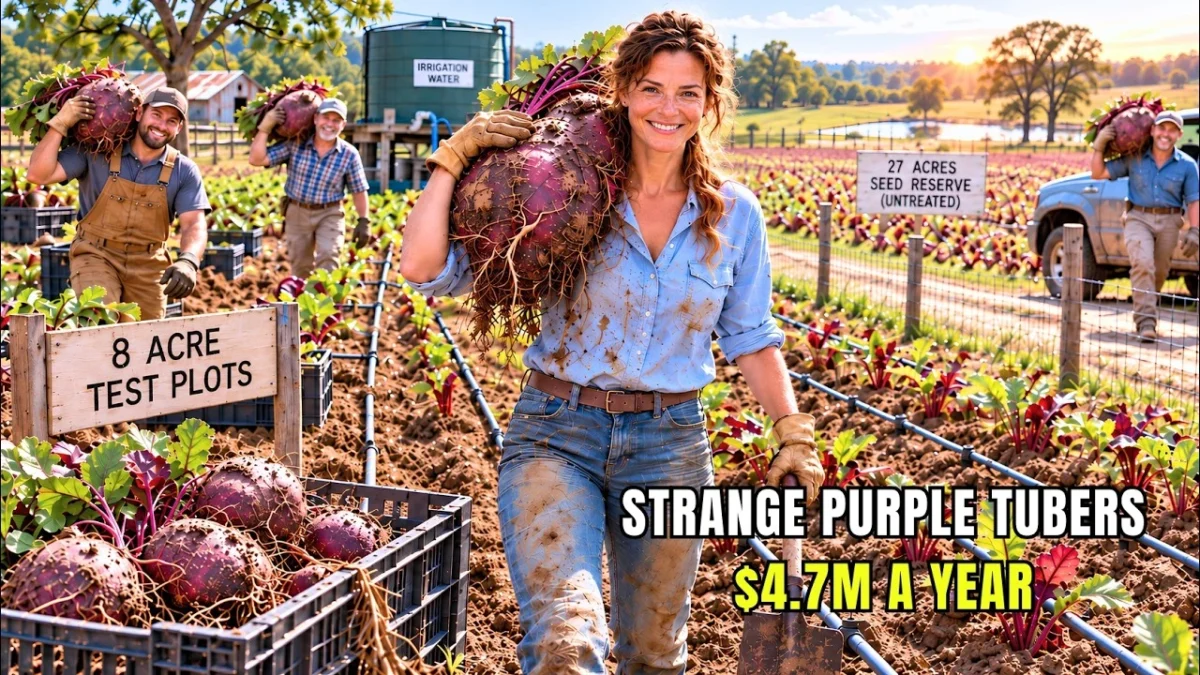
She harvested only what was necessary to build eight perfectly structured test plots, leaving the remaining 27 acres untouched as a massive, living seed reserve.
The work was grueling and sun-baked, occupying every waking hour of her spring.
One afternoon, Vernon Croft pulled his truck up to the fence line, watching Naomi manually haul drip tubing through the heat.
“You’re working yourself to the bone, Naomi,” Vernon shouted over the idle of his engine.
“Looks to me like you’re just farming a tornado’s garbage.”
Naomi wiped the sweat from her eyes, adjusted her grip on the tubing, and kept walking down the row.
“The row is straight, Vernon,” she called back calmly.
“That’s enough for today.”
Four months after the first transplant went into the structured test beds, Naomi conducted a trial harvest on a single acre of the cultivated plot.
She worked quietly alongside two laborers on a cool Wednesday morning before the summer heat set in, using a heavy-duty scale mounted to her truck tailgate.
When the final crate was weighed, Naomi calculated the yield.
The single acre had produced 11,800 pounds of pristine tubers.
Naomi read the digit three times to ensure she hadn’t misplaced a decimal point.
She set the clipboard down on the tailgate and stared out over the field in complete silence.
She had hoped for a modest, encouraging result.
She had not anticipated an agricultural miracle.
Subsequent laboratory testing confirmed the preliminary findings.
The Black River groundnut possessed a rich, nutty flavor that held up under baking, boiling, and milling into high-protein flour.
A high-end farm-to-table restaurant in Savannah bought the first small commercial batch of 500 pounds.
Within six days, the head chef called Naomi back, desperate to buy every single pound she could dig out of the ground.
Two weeks later, executives from Apex Foods, a national food technology corporation specializing in plant-based proteins, reached out after reviewing Dr. Brooks’ published preliminary research.
Their representative flew out to Georgia and met Naomi at her kitchen table.
He laid out a formal contract offering an upfront purchase price of $420,000 for her first full year’s yield.
Sitting in her father’s old chair, Naomi read the final figure on the contract.
It was slightly larger than her total outstanding debt with the bank.
Not by a massive margin, but enough to clear the liens, pay off the machinery, and breathe freely for the first time in her adult life.
—
By mid-summer, news of Naomi’s unexpected fortune moved through the family circuit.
At the annual Carter family reunion, the atmosphere around Naomi had noticeably shifted.
Derek approached her near the food tables, carrying a plate of barbecue and wearing a tight, cautious smile.
“So,” Derek began, attempting a casual tone.
“I hear you’ve been having some luck with those storm weeds.”
Naomi didn’t offer a verbal summary.
Instead, she walked to her truck, retrieved a heavy canvas bag, and returned to the table where Derek and several relatives were seated.
She reached into the bag and set a series of items on the picnic table: a cluster of fresh, dark-purple tubers, a bound copy of Dr. Brooks’ official university analysis, the signed $420,000 Apex Foods contract, and a glossy photograph taken from her drone showing eight acres of immaculate, lush green rows running perfectly toward the horizon.
Derek looked down at the documents, his eyes locking onto the $420,000 figure.
He remained quiet for a long moment before looking up at her.
“You actually turned that storm mess into a viable business?” he asked softly.
“I didn’t turn it into anything, Derek,” Naomi replied in a calm, measured voice.
“I simply chose not to destroy it before I bothered to understand what it was.”
The table fell silent.
For a brief afternoon, Naomi allowed herself to believe that her struggle was over, that she had won.
She was wrong.
It was Dr. Evelyn Brooks who accidentally unlocked the next chapter of the mystery.
A week after the reunion, Evelyn returned to the farm to inspect the 27-acre wild seed reserve.
As they walked through the dense growth, Evelyn stopped, staring thoughtfully at the ground.
“Tornadoes can carry light debris for miles, Naomi,” Evelyn said, vocalizing a thought she had been tracking for days.
“But thousands of pounds of heavy, genetically distinct tubers don’t appear out of thin air. For a storm to deposit this volume of seed along a precise vector, there had to be an enormous source point. Something massive, concentrated, and growing for decades directly in the tornado’s path.”
That night, Naomi pulled up regional topographical maps.
She drew a straight diagonal line extending 11 miles northwest along the tornado’s recorded track.
The line crossed several rural properties before intersecting a remote, overgrown farmstead that Naomi had driven past occasionally since childhood.
The property had belonged to a woman named Mabel Reed.
Mabel had been a recluse in county lore, a woman remembered vaguely as an eccentric who saved heirloom seeds and rejected modern industrial farming techniques.
She had passed away eight years prior, leaving no living heirs.
The land had been tied up in probate court ever since, lying completely abandoned.
The tornado’s core had passed directly over the center of Mabel’s property.
The next morning, Naomi drove out to the Reed farm.
Navigating through waist-high briars behind the collapsed ruins of a weathered barn, she found the shattered remains of a heavy timber seed storage shed.
Wooden crates had been splintered open by the storm, canvas bags had rotted, and millions of empty seed husks lay buried under fallen beams.
Wedged beneath a stone foundation block, Naomi spotted a strip of waxed card.
She pulled it free and wiped away the dirt.
Written in faded blue ink was a clear label: *Black River Reserve Stock – Generation 31*.
Naomi held the tag in her hand as the full reality settled over her.
The tornado had struck Mabel’s unprotected storage shed, lifted the dormant seed reserve high into the storm’s vortex, and deposited it eleven miles downwind onto the Carter family’s western field.
Where Naomi had been just hours away from drenching it in lethal herbicide.
Naomi explored the abandoned Reed farmhouse.
Inside the water-damaged kitchen, stored inside heavy wooden cabinets, she found dozens of canvas-bound journals.
They were Mabel Reed’s farming logs, spanning thirty-two consecutive years.
What those journals detailed was not simple, passive seed saving.
Mabel had been running a masterclass in selective plant breeding for over three decades.
Every dry summer, she harvested seeds exclusively from plants that survived without watering.
Every autumn, she selected tubers demonstrating high protein markers, deep root structures, and natural resistance to pests.
She cross-referenced every crop generation against county climate data, recording the failure of every weak lineage she abandoned.
Over thirty-two years of quiet, solitary dedication, Mabel Reed had engineered a super-crop capable of thriving in a changing climate.
—
When Dr. Brooks analyzed Mabel’s detailed journals alongside the genetics of Naomi’s crop, the scientific community took notice.
The findings were published in a prominent agricultural journal, highlighting the Black River groundnut’s ability to maintain high yields with 60% less water than standard commercial root crops.
In an era of increasing global droughts, that single genetic trait was worth a fortune.
The corporate interest was immediate.
Ten days after the article published, Naomi received an uninvited visit from representatives of Northstar Crop Sciences, a multinational agricultural technology giant.
Their chief acquisitions officer sat in her living room and offered her $3.8 million for complete, exclusive patent control of the seed stock.
Naomi politely declined.
Forty-eight hours later, Northstar returned with a revised offer: $7.5 million.
Naomi declined a second time, stating she intended to keep the seeds accessible to local farmers.
The third communication from Northstar arrived not through an executive, but through a team of corporate attorneys.
Northstar’s legal team had scoured historical records and unearthed a generic research agreement from 1996.
In that document, Mabel Reed had provided basic plant samples to a tiny local genetics firm in exchange for soil testing services.
Over twenty-five years, that tiny firm had been acquired and merged multiple times, eventually landing under the vast corporate umbrella of Northstar Crop Sciences.
Northstar argued that the 1996 agreement constituted a full transfer of intellectual property rights for all future variations of the strain.
They filed an emergency injunction in federal court, freezing Naomi’s ability to sell seed stock, distribute cuttings, or fulfill her commercial contract with Apex Foods.
Within forty-eight hours of the court filing, Apex Foods called to inform Naomi that they were suspending their $420,000 contract until full legal clarity was established.
By that point, Naomi had already reinvested her savings into cold storage facilities, harvesting equipment, and processing infrastructure.
The bank did not care about pending corporate litigation.
The bank had a schedule, and the interest was compounding.
That was the moment the corporate lawyer had walked into her kitchen, sat at her father’s table, and delivered the 72-hour ultimatum to surrender every seed jar or face immediate personal bankruptcy and land foreclosure.
—
That evening, after the corporate lawyer had departed, Derek called Naomi.
His voice lacked its usual smugness; he sounded genuinely terrified for her.
“Naomi, listen to me,” Derek urged over the phone.
“You’re trying to fight a company with nine figures in annual revenue. Your farm is underwater, the bank is hovering, and you can’t out-spend their legal team. At some point, this stops being about holding your ground and starts being about basic survival.”
“They’re trying to steal thirty-two years of a woman’s life work, Derek,” Naomi said quietly.
“It isn’t theirs.”
“It doesn’t matter whose it was if you lose the land in the process!” Derek argued passionately.
“Take whatever settlement they offer and walk away whole!”
Two days later, Northstar presented a final, formal settlement agreement: $12 million for a total, quiet transfer of all rights, paired with the immediate dismissal of all bank liens and legal actions.
Her family begged her to sign it.
Even sitting alone in the quiet farmhouse late at night, Naomi felt the overwhelming temptation.
One signature on the bottom line would clear every debt Samuel had accumulated, secure her personal financial freedom forever, and end the suffocating stress.
She grabbed her pen, holding it over the signature line.
She almost signed.
Unable to stay inside the house, Naomi drove out to Mabel Reed’s abandoned property in the middle of the night.
She walked into the rotting farmhouse, taking a flashlight down into the damp basement.
Searching beneath a collapsed wooden shelf, she discovered a heavy steel document box fitted with a waterproof rubber seal.
She pried the rusted latches open.
Inside lay records Mabel had kept separate from her daily journals: formal university correspondence, certified mailing receipts, and official registry receipts dating back to 1994.
Among the papers was a certified record from the State University Agricultural Gene Bank, dated May 14, 1994—two full years before the 1996 research agreement Northstar was using as the entire legal pillar of their lawsuit.
The 1994 document proved that Mabel Reed had formally deposited 64 samples of the Black River groundnut into the public domain as part of a state-funded regional preservation initiative.
Naomi carefully reviewed the original 1996 contract text in light of this discovery.
Because the genetic strain had already been registered in the public domain in 1994, the 1996 contract only granted the small firm temporary authorization to study those specific samples—it never transferred, nor could it legally transfer, exclusive ownership of the underlying public lineage.
Northstar’s legal team had based their entire multi-million-dollar lawsuit on the assumption that the 1996 agreement was the earliest existing legal record.
It wasn’t.
At the bottom of the steel box, Naomi found a personal letter written by Mabel on yellow notebook paper, unsealed, addressed to no one in particular.
Near the end of the letter, Mabel’s clear handwriting stood out:
*”People tend to call something valuable only after they have found a way to extract a profit from it. But the price something commands in a market has never been what created its true worth. The worth was always already there, in the dirt, in the seed, and in the patience of the hand that planted it.”*
Naomi read those lines twice in the dim beam of her flashlight.
She thought about the $12 million settlement offer.
She thought about how close she had come to surrendering, measuring the true value of Mabel’s life work—and her own—by the size of a corporate payout.
She folded the letter, placed it carefully in her coat pocket, and called her attorney at dawn.
“We aren’t settling,” Naomi instructed her legal team.
“File the 1994 public domain registration records immediately.”
—
The legal defense anchored by the 1994 university submission destroyed Northstar’s position.
Faced with definitive proof that the genetic material was firmly established in the public domain prior to their contract, Northstar’s attorneys quietly withdrew their injunction within three weeks.
The federal court formally dismissed the claim with prejudice.
With the legal freeze lifted, Apex Foods reinstated their contract, and bank operations resumed smoothly.
Instead of signing an exclusive deal with a single corporate entity, Naomi worked alongside Dr. Evelyn Brooks to establish the Black River Growers Cooperative.
The cooperative was structured to allow small, family-owned farms to access the high-yield seed stock under affordable, fair-use conservation agreements.
The goal was explicitly designed to prevent any single corporate entity from ever monopolizing the crop again.
The initiative spread rapidly across the region.
By the end of the third year, over 21,000 acres across three states were under active cultivation with Black River groundnut lines.
The Carter farm itself expanded from its original 140 acres to over 900 acres.
Naomi integrated her father’s traditional cattle operation with the groundnut plots through an innovative rotational system, using the crop’s natural nitrogen-fixing properties to eliminate synthetic fertilizer costs entirely.
By the fourth year, the farm’s annual revenue reached $4.7 million.
The crushing $380,000 debt that had once felt like an inescapable death sentence was completely paid off.
During the summer reunion following the debt clearance, Derek walked the expansive northwest field with Naomi late in the evening.
He had been notably quieter around her since the court victory, treating her not as a younger cousin who needed unasked advice, but as a deeply respected peer.
They stopped near the edge of the field where the tornado had first dropped the wild seeds four years prior.
Derek looked out over the endless, lush green rows stretching cleanly to the distant tree line.
“I owe you an apology, Naomi,” Derek said quietly, keeping his eyes on the horizon.
“Not just about how I handled the bank situation, but from the very beginning when I told you to sell.”
Naomi looked at him, waiting.
“I told myself I was trying to protect you from failing,” Derek continued, his voice tight with genuine emotion.
“But looking back… I think I was just trying to protect myself from having to watch you succeed at something I was too afraid to try.”
Naomi watched the evening sun dip below the trees, casting long golden shadows across the soil.
“I almost quit a dozen times, Derek,” she admitted gently.
“I know,” Derek replied.
“Which makes what you built here all the more impressive.”
They stood together in the quiet twilight, the air filled with the steady hum of a thriving, living farm.
After Derek walked back toward the farmhouse, Naomi stayed behind, walking the edge of the northwest field alone.
She paused at the exact spot where she had driven her spade into the earth four years ago, uncovering those first dark, purple-black tubers in the wake of the storm.
She thought of Mabel Reed—thirty-two years of silent, uncredited labor that no market had valued until a storm scattered it across eleven miles of Georgia sky.
The worth had been there all along.
It was in the soil, in the seeds, and in the quiet persistence of those who refused to surrender what was real.
Naomi smiled faintly, pressed her boots into the rich, dark soil, and turned toward home.








