Struggling Mechanic Fixes Woman’s Tractor — Unaware She’s the Richest Farmer in America
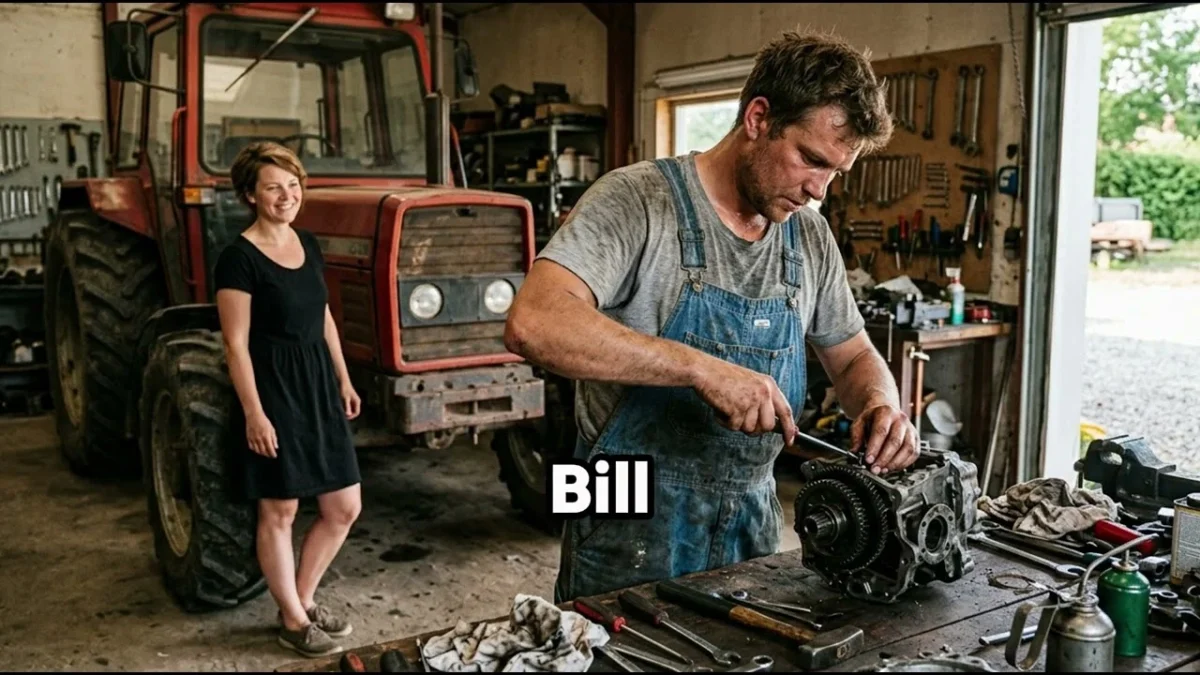
Jack Turner was a hardworking mechanic living in a small rural town surrounded by endless fields, rolling pastures, and vast expanses of farmland.
His repair shop, Turner’s Auto & Agricultural Repair, sat right beside an old stretch of highway that stretched across the county like a dusty ribbon.
Although Jack possessed remarkable skill and could fix virtually any machine—from rusted classic sedans to modern diesel combines—customers had become increasingly scarce in recent years.
Rising operational costs, skyrocketing supply prices, and a stack of unpaid utility bills weighed heavily on his mind every single day.
Every morning long before the sun cleared the horizon, Jack unlocked the heavy wooden doors of his garage and stepped into the cool, silent shop to prepare for another uncertain day.
He meticulously wiped down his hand tools, organized spare gaskets and oil filters, and quietly hoped that paying customers would arrive before his bank account hit zero.
Despite his unwavering dedication and mechanical genius, business remained agonizingly slow.
Some days passed with only a single small repair job—a flat tire patch or an oil change—leaving him deeply worried about his future and his basic livelihood.
The shop itself was modest, weathered, and worn down by decades of relentless service to the community.
Rusted metal shelves lined the interior timber walls, holding vintage manuals and spare parts, while aging hydraulic lifts showed obvious signs of decades of heavy use.
Jack dreamed of upgrading his equipment, buying modern diagnostic computers, and hiring an apprentice, but he barely earned enough money to keep the overhead electric lights on.
Still, no matter how desperate his financial situation grew, Jack refused to cut corners or cheat the folks who walked through his doors.
He took immense pride in providing honest work, transparent advice, and fair prices to every soul in the county.
One particularly sweltering Tuesday afternoon, while Jack was bent over the open hood of a farm truck replacing a snapped fan belt, he heard the low, sputtering thrum of an approaching engine.
He stepped out onto the gravel driveway, wiping grease from his forehead with the back of his arm, and noticed an old, battered John Deere tractor being slowly driven into the yard.
Dust coated its green paint, grease smeared the side panels, and thick, dried mud clung heavy to the massive rear tires.
Behind the steering wheel sat a young woman wearing simple denim overalls, a dust-streaked flannel shirt, and sturdy, dirt-caked work boots.
Her brown hair was tied back in a messy ponytail beneath a sun-bleached canvas hat.
She cut the sputtering engine, hopped down off the iron step with practiced agility, and dusted off her pants with a weary sigh.
“Afternoon, mister,” she said, stepping toward the shade of the open garage bay.
“Are you the head mechanic here?”
“I am,” Jack replied, offering a polite, welcoming smile.
“Jack Turner. What can I do for you today, ma’am?”
“My name is Emily,” the woman introduced herself, extending a slender hand that bore fresh oil stains across the knuckles.
“My tractor decided to give up the ghost about two miles down the farm road while I was trying to prepare a field for planting. I managed to limp it here, but she’s running on prayer and bad luck right now.”
She seemed genuinely frustrated by the breakdown, yet her demeanor remained strikingly polite and soft-spoken.
Jack listened carefully as she described the strange knocking sound and the thick cloud of black smoke that had belched from the exhaust pipe just before the engine lost power.
“Well, Emily, you brought it to the right place,” Jack assured her gently.
“Let’s pop the engine cover and see what’s going on under the hood.”
“I’d appreciate that more than you know,” Emily said, wiping sweat from her brow with her sleeve and stepping back to give him room.
“Planting season is right around the corner, and I can’t afford to lose a single day if I’m going to get seeds in the ground.”
Jack pulled up a rolling tool cart, fetched his heavy wrench set, and unlatched the tractor’s side panels.
As soon as the iron casing opened, he gasped softly at the heat and the distinct smell of scorched diesel fuel and melted rubber.
He began his inspection, probing deep into the heart of the machine with a drop-light in hand.
After twenty minutes of careful examination, Jack leaned back and wiped his hands on a shop rag, his expression serious.
“Found the culprit?” Emily asked, leaning against the workbench and peering over his shoulder.
“I did,” Jack said, pointing his flashlight into the dark recesses of the engine bay.
“It’s a cascade failure, Emily. Your fuel lift pump seized up, which starved the injection system and caused severe pressure buildup. That melted a couple of rubber hoses, clogged the main line with debris, and damaged the governor assembly. It’s a mess, to be frank.”
Emily’s shoulders slumped slightly, her eyes darkening with worry.
“Is it fixable, Jack? Or am I looking at buying a whole new machine?”
“Oh, it’s definitely fixable,” Jack said quickly, wanting to ease her mind.
“I won’t let a good tractor end up in the scrap heap. But it’s going to take several hours of heavy labor. I’ll need to pull the pump, flush the entire fuel manifold, replace the blown lines, and recalibrate the timing gears by hand.”
“How long will that take you?” she asked softly.
“If I drop everything else and work straight through the evening, I can have it purring like a kitten by sundown,” Jack answered firmly.
“Then please do it,” Emily said, relief washing over her feature.
“I’ll wait right here in the shade if you don’t mind.”
“Make yourself at home,” Jack smiled, gesturing to an old folding chair in the corner near a small water cooler.
“Help yourself to cold water.”
As the afternoon sun beat down mercilessly on the corrugated metal roof of the garage, Jack got to work with single-minded focus.
Sweat rolled down his face, dripping off his jaw as he wrestled with stubborn, heat-fused bolts and unseated the heavy iron pump.
Every now and then, as he cleaned clogged fuel lines with pressurized air and scrubbed carbon deposits from the intake valves, he struck up casual conversation with Emily.
She sat comfortably on the squeaky folding chair, sipping cold water and watching his meticulous hands work with obvious interest.
“Do you work a farm nearby?” Jack asked, leaning over the engine block to align a new rubber seal.
“I do,” Emily replied casually.
“I spend most of my time managing crops, checking soil chemistry, and looking after farmland. It’s hard work, but there’s nothing quite like watching something grow from nothing.”
“Ain’t that the truth,” Jack agreed, tightening a bolt with a steady torque.
“My grandfather had thirty acres down by the creek. I spent my childhood summers grease-stained and sun-baked, helping him keep his old equipment running. That’s where I learned to love mechanics.”
“It takes a special kind of patience to understand machines,” Emily observed, her dark eyes studying his steady rhythm.
“Most folks just turn the key and expect magic. They don’t respect the work that goes into keeping the wheels turning.”
“Machines are honest,” Jack said with a quiet laugh, adjusting the timing belt tensioner.
“If you treat them right, give them good oil, and don’t rush the repairs, they’ll work hard for you. Humans could learn a thing or two from an old engine.”
Throughout their conversation, Emily never once mentioned money, success, or the size of her acreage.
She spoke with the quiet humility of an ordinary, everyday farmer who spent her days wrestling with unpredictable weather and muddy fields.
Jack watched her simple work boots and faded clothes and felt a deep kinship with her.
He assumed she was just another struggling local grower trying to survive another tough year in a cutthroat agricultural economy.
Because he understood how devastating an expensive repair bill could be to a small farm operation, Jack refused to rush or skip a single step.
He painstakingly cleaned every single valve, polished the governor seat, and replaced worn washers out of his own private stock of spare parts without making a note on the work order.
Hours rolled past, and the golden hues of sunset began to spill into the open garage bay, painting the greasy concrete floor in shades of amber and orange.
Finally, after nearly five hours of intense, continuous labor, Jack reattached the last fuel line, tightened the primary housing, and topped off the fluid reservoirs.
He wiped his hands clean on a rag, stepped up to the tractor’s iron platform, and turned the key in the ignition.
The starter motor whined briefly, and then the heavy diesel engine roared to life with a powerful, rhythmic, perfectly balanced thrum.
The black smoke was completely gone, replaced by a clean, clear exhaust note that vibrated through the floorboards.
Emily stood up from her chair, her face lighting up with absolute joy and visible relief.
“Listen to that!” she exclaimed, walking over to the machine and placing a hand on the vibrating green hood.
“It sounds better than the day I bought it! You’re a magician, Jack Turner.”
“No magic,” Jack chuckled, hopping down off the step.
“Just clean lines, proper timing, and a little elbow grease. She’s ready to go back to work.”
Jack walked over to his small timber desk in the corner of the office to calculate the final invoice.
He grabbed a pencil and pulled out a fresh billing slip, adding up his cost for the replacement pump, the high-pressure hoses, and the fluid top-offs.
When he reached the line for labor, his hand hesitated above the paper.
Standard shop rate for five hours of complex diesel repair would easily exceed three hundred dollars in labor alone—a sum he desperately needed to pay his own overdue electricity bill sitting right beside the register.
He looked over at Emily, who was standing by the tractor, thoughtfully checking her worn leather wallet with an anxious expression.
Jack remembered how terrifying it felt to look at a bank statement and wonder if you could afford to keep your doors open.
He took a deep breath, made his decision, and wrote down a labor charge that amounted to barely twenty dollars—just enough to cover the electricity he had used running his air compressor.
He walked back out into the shop and handed her the slip.
“Here you go, Emily,” he said softly.
“All squared away.”
Emily took the paper and scanned the numbers, her eyebrows suddenly knitting together in confusion.
“Jack… wait a minute,” she said, looking up at him with wide eyes.
“You spent almost five hours breaking down this entire engine and rebuilding it. The parts alone cost more than what you’re charging me here. Where is your labor fee?”
“It’s on there,” Jack said with a gentle, reassuring wave of his hand.
“I added a few bucks for the shop lights.”
“This isn’t right,” Emily insisted, stepping closer.
“Your time is valuable, Jack. You worked yourself to the bone in this heat. You deserve to be paid fairly for your expertise.”
“Emily, I know how hard it is to make a living off the land,” Jack said, his voice honest and unwavering.
“Planting season is starting. You need that money for seed, fertilizer, and diesel. If I charge you three hundred dollars today, it might be the difference between you making a profit or going under this fall. I can manage. You take that tractor and go plant your crops.”
Emily stared at him in profound silence for a long moment, her eyes searching his face for any sign of pretense or hidden motives.
She saw only genuine kindness, quiet integrity, and the humble heart of a man who truly cared about his neighbors.
A soft, enigmatic smile touched her lips, and her eyes glistened with a sudden, deep emotion.
“You are a rare man, Jack Turner,” she said softly, reaching out to shake his grease-stained hand once more.
“I won’t forget this. I promise you, I won’t forget what you did for me today.”
“Just drive safe,” Jack smiled, helping her climb back up to the high driver’s seat.
Emily engaged the clutch, put the tractor into gear, and drove out of the yard, waving goodbye as the machine rumbled smoothly down the dusty highway into the twilight.
Jack stood in the quiet driveway for a long time, watching the red taillights vanish into the dusk.
He then turned back into his dark, quiet shop, counted the small stack of bills she had left on the desk, and sighed.
He had barely broken even on the job, but as he locked the garage doors for the night, his heart felt lighter than it had in months.
A full week passed after Emily’s unexpected visit, and Jack returned to his exhausting, stressful routine.
Business remained agonizingly slow.
The generous discount he had given the young farmer had left him with virtually no profit, and his mailbox continued to fill with urgent payment notices from the utility company and his tool supplier.
Although he occasionally thought about the polite woman in the overalls and wondered if her planting season was going well, he fully expected never to see or hear from her again.
On a rainy Monday morning, while Jack was sitting at his desk staring blankly at an unpaid invoice, a sleek silver mail courier truck pulled into the gravel driveway.
The driver walked into the shop carrying a thick, wax-sealed envelope made of heavy, cream-colored linen paper.
“Jack Turner?” the courier asked.
“That’s me,” Jack replied, rising from his chair.
“Sign here, please. Express delivery.”
Jack signed the digital pad, took the heavy envelope, and pulled open the wax seal.
Inside was a beautiful, gold-embossed invitation card along with a pre-paid valet parking pass and an official entry badge.
The card read:
*You are cordially invited to attend the 42nd Annual National Agricultural Leadership & Innovation Conference at the Grand Plaza Convention Center in Capital City.*
*Personal Keynote Guest of the Chairwoman.*
Confused, Jack turned the card over, wondering if it was some kind of elaborate marketing trick or a mistake by the post office.
However, typed on a small slip of enclosed parchment were two handwritten lines:
*Please come, Jack. I saved a seat for you near the front. — Emily.*
Jack blinked in disbelief.
He looked at his grease-stained coveralls, then at the elegant invitation in his hands.
He had no idea why an ordinary farm girl would be attending a massive national conference in the state capital, let alone sending him a VIP badge.
Driven by sheer curiosity and having no pending customer appointments booked for the day, Jack made a bold decision.
He closed the shop, hung a “Closed for the Day” sign on the front door, changed into his only clean Sunday suit, and drove his old pickup truck two hours down the interstate to Capital City.
The Grand Plaza Convention Center was an intimidating, massive glass structure that stretched across an entire city block.
The parking lot was packed with luxury SUVs, state political cars, commercial transport trucks, and news broadcasting vans.
Jack felt completely out of place the moment he stepped out of his battered truck in his modest, slightly outdated suit.
Inside the grand foyer, thousands of well-dressed attendees—corporate executives, agricultural scientists, wealthy landowners, international investors, and political representatives—milled about sipping espresso and discussing grain futures.
Jack flashed his guest badge to a security guard, who immediately bowed his head respectfully and ushered Jack through a set of heavy velvet curtains into the main auditorium.
The hall was colossal, equipped with soaring stadium seating, professional television cameras, and a massive stage lit by bright theatrical spotlights.
Jack quietly slid into an empty seat near the back of the VIP section, attempting to make himself as small as possible among the dignitaries.
At precisely ten o’clock, the house lights dimmed, and a deep, resonant voice echoed through the auditorium’s surround-sound speakers.
“Ladies and gentlemen, welcome to the Keynote Address of the National Agricultural Summit. Please welcome the founder of Vanguard Ag-Corp, owner of over two million acres of sustainable farmland, and Chairwoman of the American Agricultural Council… Ms. Emily Vanguard!”
The entire auditorium erupted into thunderous, standing applause.
Jack nearly fell out of his chair as the speaker walked confidently onto the brightly illuminated stage.
He rubbed his eyes, staring in absolute, jaw-dropping shock.
The woman standing on stage was indeed Emily—but she looked completely transformed.
Gone were the faded overalls, the dirt-caked work boots, and the grease-stained flannel shirt.
She wore an exquisitely tailored dark blue business suit, her hair styled in an elegant chignon, and her stance radiating authority, intelligence, and grace.
As the applause continued for nearly two full minutes, the man sitting next to Jack turned and whispered in awe, “Incredible woman, isn’t she? The richest farmer in America, yet she built the entire empire from scratch.”
Jack sat frozen in his seat, his mind spinning into utter chaos.
*The richest farmer in America?* he thought, his heart hammering wildly against his ribs.
He suddenly remembered her dusty boots, her simple manners, the way she had sat on his squeaky folding chair drinking water from a plastic cup, and how she had acted so worried about the cost of a tractor repair.
Not once had she mentioned her vast wealth, her corporate empire, or her legendary status in the industry.
Emily stepped up to the podium, smiled warmly at the crowd, and raised her hands to signal for quiet.
“Thank you, everyone,” Emily began, her voice crisp, clear, and commanding over the microphone.
“It is an honor to stand before the men and women who feed this nation every single day.”
She spent the first fifteen minutes of her address discussing modern soil conservation, autonomous machinery tech, and corporate responsibility.
The audience listened in rapt silence, hanging on every word of her sharp, brilliant analysis.
Then, Emily paused, stepped out from behind the mahogany podium, and walked to the front edge of the stage, her expression softening.
“Today, I want to talk to you about something far more important than profit margins, yield metrics, or corporate expansion,” Emily said softly into her lapel mic.
“I want to talk about character. I want to talk about integrity.”
She looked out over the sea of faces in the auditorium.
“As many of you know, I regularly conduct unannounced visits to our field operations across the country. I don’t wear a designer suit, I don’t bring an entourage of executives, and I don’t drive a luxury car. I wear work clothes, drive an old service tractor, and go out into the rural towns where the real work happens.”
A gentle chuckle rippled through the crowd of executives.
“Two weeks ago,” Emily continued, “I was testing an experimental field unit in a small county two hours from here when the fuel injection system collapsed. I was stranded on the side of the road, covered in dirt and grease. I towed that machine into a small, weathered repair shop sitting beside an old highway.”
Jack felt his breath catch in his throat, his hands gripping the armrests of his seat so hard his knuckles turned white.
“The owner of that shop didn’t know who I was,” Emily said, her eyes sweeping across the auditorium.
“He didn’t see a billionaire corporate chairwoman. He saw an ordinary, exhausted farm girl who was terrified of losing her crop season. He worked for five straight hours in a suffocating, ninety-degree garage, hand-cleaning every valve and gear to make sure that machine ran perfectly.”
The room was deathly quiet now, every eye fixed on the speaker.
“And when it came time to write the bill,” Emily’s voice grew thick with emotion, “this man—who was clearly struggling to keep his own business afloat, whose own overhead bills were stacking up on his desk—charged me barely twenty dollars for labor. When I pressed him on why he was cutting his price so drastically, do you know what he told me?”
She paused, looking directly toward the back section where Jack sat.
“He told me, *’I know how hard it is to make a living off the land. You need that money for seed and fertilizer. I can manage.’* He sacrificed his own well-being to protect a stranger.”
Murmurs of admiration and soft gasps spread throughout the massive hall.
“In a world where so many people treat others based on what they wear, what they drive, or how much money they have in the bank,” Emily said firmly, “that mechanic showed me what true American leadership looks like. He showed me honesty, selfless generosity, and undeniable skill.”
Emily raised her hand and pointed toward the back of the auditorium.
“That man is sitting in this room today. Ladies and gentlemen, please join me in honoring Mr. Jack Turner!”
A powerful spotlight suddenly swung across the ceiling, cutting through the dim hall and landing square on Jack.
The entire audience of thousands turned in their seats, erupting into a roaring, standing ovation.
People around Jack cheered, clapping wildly and slapping him on the back.
Nervous, overwhelmed, and blushing furiously, Jack slowly stood up from his seat, his heart pounding like a bass drum.
On stage, Emily motioned for him to come forward.
“Come on up here, Jack,” she called out through the microphone with a warm, encouragement-filled smile.
Feeling as though he were walking in a dream, Jack navigated the long aisle, stepped up the carpeted stairs, and walked onto the brightly lit stage.
Emily stepped forward, extended her hand, and gave him a firm, deeply respectful handshake before pulling him into a warm, genuine side-hug.
The crowd cheered even louder, camera flashes strobing across the auditorium.
When the applause finally settled, Emily stood beside Jack and addressed the audience and the dozens of news cameras lined up in the center aisle.
“As Chairwoman of Vanguard Ag-Corp,” Emily announced, her voice echoing with absolute authority, “I am proud to officially declare that as of today, Turner’s Repair Services has been awarded the exclusive, multi-year master maintenance contract for our entire Midwest and Eastern agricultural fleets!”
Gasps of surprise echoed through the executive seating.
“This contract,” Emily elaborated, looking over at Jack with a brilliant smile, “covers the ongoing service, overhaul, and maintenance of over four thousand tractors, harvesters, transport trucks, and heavy field implements spread across twelve states.”
Jack stared at her in total, stunned silence, his jaw dropping as the sheer magnitude of her words washed over him.
A contract of that scale was worth tens of millions of dollars—it was the kind of deal that built legacies and transformed small operations into regional powerhouses.
“Furthermore,” Emily added, turning to the media, “Vanguard Ag-Corp will be fully funding the construction of a state-of-the-art repair and training facility right in Jack’s home town, where he will serve as Chief Fleet Director, hiring and training the next generation of certified agricultural mechanics.”
The auditorium erupted once more into applause, with industry leaders nodding in hearty approval of the announcement.
Emily handed the microphone to Jack.
“Care to say a few words, Chief Director?” she whispered with a playful wink.
Jack took the microphone with trembling hands, looked out at the thousands of expectant faces, then turned to look at Emily.
He swallowed hard, cleared his throat, and stepped up to the podium.
“I… I don’t really know what to say,” Jack admitted honestly, his humble voice carrying clearly through the speakers.
“When Emily brought that old John Deere into my shop last week, I didn’t see an empire or a corporate title. I just saw a fellow worker who needed a hand to keep moving forward. Where I come from, when someone needs help, you fix what’s broken and you do it right. That’s just how we were raised.”
He looked at Emily, his eyes shining with deep gratitude.
“Thank you, Emily. Not just for this opportunity… but for showing me that doing the right thing still matters in this world.”
The crowd rose to its feet for a third time, offering a final, deafening ovation that shook the rafters of the convention center.
Over the months that followed, Jack’s life transformed at a dizzying, breathtaking speed.
Architects and construction crews descended upon his small rural town, breaking ground on a massive, modern 50,000-square-foot service facility outfitted with solar power, advanced computer diagnostics, and state-of-the-art hydraulic lifts.
The old, weathered shop beside the highway was preserved, restored, and converted into a permanent museum honoring classic farm machinery and honest craftsmanship.
Jack hired dozens of local mechanics, paying them generous wages and providing complete health benefits to every worker.
Young men and women from surrounding counties lined up to apply for apprenticeships under his renowned leadership.
Despite his incredible overnight success, newfound wealth, and elevated status, Jack Turner never changed who he was at his core.
He still walked into the shop every morning at dawn, still wore his canvas work shirts, and still picked up a wrench to work on engines alongside his crew whenever a complex problem arose.
And every few weeks, a sleek silver helicopter or a simple green service truck would pull into the yard, and Emily Vanguard would step out, leaving her executive titles at the gate.
She would sit on a stool in the corner of the busy shop, drink cold water from a plastic cup, and laugh with Jack as they talked about crops, machinery, and the quiet beauty of the land.
Jack never forgot the day an old, muddy tractor rumbled into his gravel driveway, nor the valuable lesson it taught the world: that a simple, selfless act of quiet kindness can open the door to extraordinary, life-changing blessings.








