Ten Years Ago She Lent a Stranger Her Father’s Watch — Now the Duke Has Come Back to Return It
Ten years ago, on the wettest night of that miserable spring, Laura Morlay pressed her dead father’s silver pocket watch into the hand of a soaked young officer so that he would not miss the Portsmouth coach. She never learned his name. She had only known that he looked like a man standing on the edge of the grave, and that her father had spent his whole life keeping people from falling in.
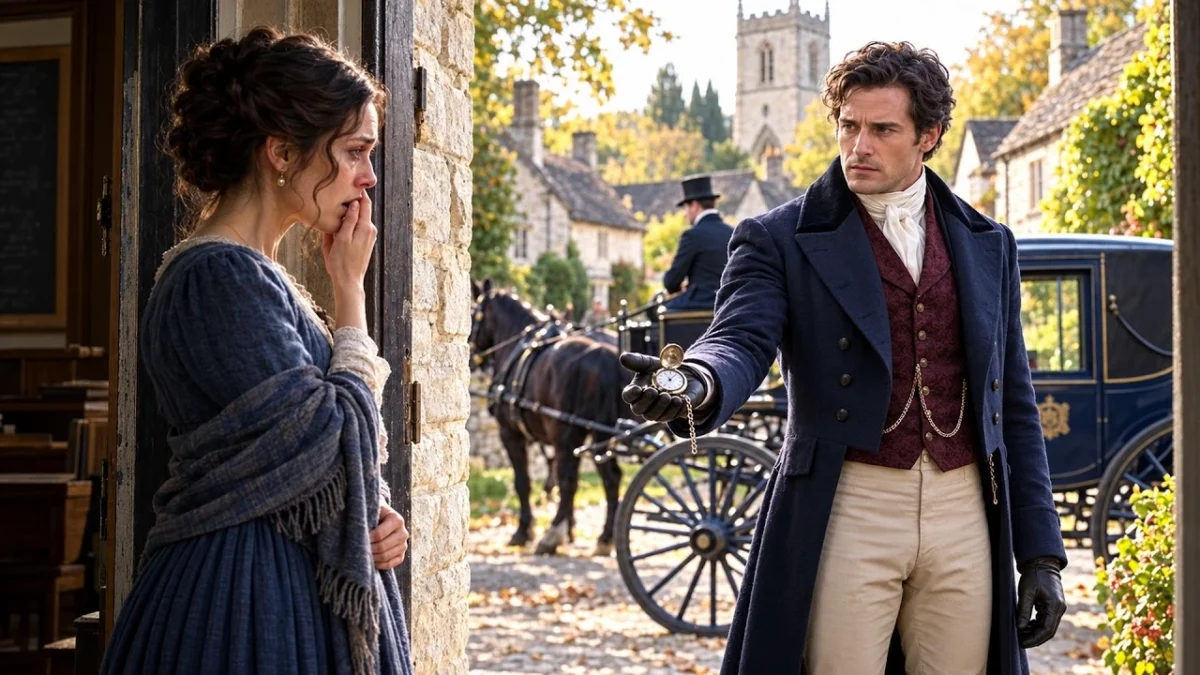
This autumn afternoon, the Duke of Lowther stood at the door of her little stone schoolroom. He held the same silver watch out to her, still ticking, and said, “I have wound it every morning since.”
Laura did not reach for it. She stood in the doorway of the small village school, wrapped in a faded blue gown and a worn wool shawl, a chalky slate rag clutched in her hand. She stared at the silver case resting on his open palm. There was a deep dent in the lid now, broad enough to catch the pale autumn light—a mark that had not been there on the night she pushed the watch through a rolling coach window.
Down in the muddy lane, a lavish carriage emblazoned with a gilded crest waited under the damp trees. Two local farm boys stood upright in their horse cart, their mouths agape, staring at the humble schoolmistress and the towering, immaculate gentleman on her doorstep. By supper time, the whole village would be buzzing with the news.
He had written a grand, carefully phrased speech at an inn the night before, reading it over twice by the dim light of a tallow candle. But standing before her now, he did not use a single word of it. He merely held the watch out a little further, his hand remarkably steady, and waited.
Laura looked up from the silver case to his face. She noted the sharp line of his jaw, the faint silver threading his dark hair, and the quiet, bone-deep exhaustion in his eyes. Her hand rose to her mouth and stayed there. Her eyes filled with sudden, overwhelming tears, but she refused to blink them away.
“I have kept it going,” he said, breaking the silence because she had not moved and because he could think of nothing else in the world to say. “I thought you should know that first.”
“It gains,” said Laura. Her voice was very low, barely carrying over the wind in the lane. “In the cold, it gains nearly two minutes by morning.”
“I know,” said the Duke. “I set it back at breakfast every day.”
And because his hands needed something to do, he performed the familiar ritual he had carried out in military tents, on rolling ships, and in the long, freezing corridors of Lowther Castle. He unhooked the tiny silver key from his chain, fitted it into the back of the case, and turned it slowly.
She stood in her doorway and listened to the soft, rhythmic ratchet of the mechanism. Click after click. It was the exact sound her father had made by the fireside every night of her girlhood.
“You were very wet,” she said at last.
“I was.”
“And very rude.”
“You ate my supper.”
“I had not eaten in two days,” said the Duke softly. “I have been ashamed of that stolen supper ever since.”
Laura let out a small, broken sound—half a laugh, half a sob. She wiped her eyes with the back of the hand that still held the slate rag, leaving a faint streak of white chalk across her cheek.
“You had better come in,” said Laura. “You are letting the cold air in, and I have only just got the stove to draw.”
The schoolroom smelled of chalk dust, damp wool, and the bitter smoke of the small iron stove. Lessons were over for the day. The wooden benches were pushed straight against the walls, the slates were stacked neatly on the sill, and a paper map of England hung on the plaster wall with one corner curling off its nail.
She did not curtsy to him. He noticed that at once, the way a man notices that a heavy door he has been leaning on has suddenly ceased to exist.
“Who are you?” she asked, turning to face him. “I think I am owed that much now.”
He paused, holding his hat in both hands. “My name is Jason Monroe. I am the Duke of Lowther.”
“Lowther?” She looked at the fine cloth of his coat, then out the window at the carriage in the lane, and finally at the coachman in his tall hat pretending very hard not to watch them. “The Duke?”
“Since the spring,” he replied. “My elder brother died in March.”
“Then you have had a very hard year,” said Laura gently. “And I would guess nobody has allowed you to say so.”
Jason opened his mouth to tell her that it had been an ordinary year as years went, that his brother had been ill for a long while, and that everyone had been exceptionally kind. But nothing came out. He stood in the middle of a humble village schoolroom with his hat in his hand, and found that his throat had closed up completely.
“Sit down,” she said softly. “You look as if you have not sat down since March, either.”
The only seat nearby was a small pupil’s bench. He sat down on it, his long legs folding awkwardly so that his knees came up nearly to his chest. She did not laugh at him, though he saw the faint twitch at the corner of her lips that proved she wanted to. She took the chair behind her own desk and folded her hands neatly on the blotter.
She was thirty-one now. He had worked the mathematics out in the carriage, and many times before that.
He held the watch out to her once more, but she did not reach to take it.
“It is yours,” she said. “You have kept it alive for ten years. That makes it more yours than mine now. Truthfully, it was never mine for even an hour. I was only minding it for my father. But how did you find me? You never knew my name. I made sure of that. I did not want you to feel you owed a stranger anything.”
“You told me,” said the Duke. “You only took ten years to do it.”
When he shut his eyes, he could still see that inn yard in Petersfield as clearly as if it were yesterday. He had been twenty-six, a lieutenant of foot and a second son, which was to say a young man with a good coat, no money, and no prospects but a war. It was the spring the Emperor returned from Elba, and every officer in England on leave was being recalled to his regiment. His ship was scheduled to sail from Portsmouth on the morning tide.
His horse had gone hopelessly lame at Liphook, and he had walked the remaining miles to Petersfield through rain so heavy that it ran down inside his collar and out at his boots. When he arrived, the inn was overflowing. The taproom was hot, loud, and smelled of wet dogs and tallow candles. The clock over the hearth had stopped at a quarter past something, and nobody could say which hour it truly was.
The Portsmouth coach was scheduled to leave the yard at ten. He had sat down by the fire to wait, and he did not remember falling asleep from absolute exhaustion.
He did, however, remember her.
She had been sitting on the wooden settle across from him, dressed in simple black mourning clothes with a small leather trunk at her feet. She was very young and looked terribly tired. The landlady had just set a small plate of bread and cold beef beside her. He had looked at the plate—he could not help himself, his stomach aching with hunger—and she had looked at his face. Without a word, she had pushed the plate across the wooden table to him.
He had eaten every single crumb. He had not even thanked her properly before falling asleep again, the last crust still clutched in his hand.
The next thing he knew, someone was shaking his shoulder hard.
“Sir! Sir, your coach!”
She was bending over him, holding a silver pocket watch open in her small palm. It read one minute before ten. Out in the yard, he could hear the horses stomping, the ostler shouting, and the guard blowing his horn.
He had run. He had left his hat behind on the bench. He threw himself into the moving coach just as it began to roll out of the yard, soaked to the skin, and leaned far out of the window into the pouring rain.
“Has anyone the right time?” he had shouted at the ostler like a desperate fool, because his own watch had been lost in a river in Spain, and he needed to locate his ship on a pitch-black quay before the tide turned.
The ostler had only shrugged. And then, suddenly, she was there.
She was running alongside the heavy iron wheels in the swinging lantern light, her black skirts gathered up out of the deep mud with one hand. With the other hand, she reached up and pushed the silver watch through the window, closing his fingers firmly over it with her own. Her hand had been ice-cold, wet, and remarkably small.
“Keep it!” she had called out. “Do not miss your ship!”
“Your name?” he had shouted back. “Tell me your name!”
But the coach swung sharply out of the yard and into the dark night. The noise of the wheels was too loud, and the last image he had of her was her pale face in the lantern light, turned up toward the rain.
He did not miss his ship.
Two months later, he stood on a muddy ridge in Belgium near a village called Waterloo, enduring rain that had fallen all night on men without tents. He had slept, if it could be called sleep, sitting in the thick mud with his back propped against a wagon wheel.
At first light, he pulled the watch out of his wet breast pocket. With fingers too numb to feel the metal key, he wound it and held it to his ear. It was going. He did not know why that tiny ticking sound mattered so much in the middle of a war, but it did. The soldiers sitting near him watched him, and a few of them even smiled.
He wound it again the next morning, and the one after that in a chaotic hospital in Brussels with a blood-soaked bandage wrapped around his head. Between those two mornings lay the battle.
He never spoke of the battle afterward. Not to his brother, not to his friends, not to anyone. He remembered only shattered pieces of it: the smoke that lay so thick in the tall rye that a man could not see his own regiment’s colors; the noise, which was not like sound at all, but like catastrophic weather; and the precise moment in the afternoon when his horse was shot beneath him and the earth came up to smash against his face.
When he woke, he was lying on his side in the trampled rye. His first clear thought had not been of his leg or his head, but of the watch. He dragged it out with trembling fingers. The outer silver case was badly dented where it had struck a stone—a deep crescent impression like a thumbprint in soft wax.
He held it to his ear with a shaking hand. It was still ticking.
He lay there in the smoke and the rain and began to laugh. He laughed until he shook, unable to stop, while a regiment sergeant who crawled over to check for corpses thought the young lieutenant had gone completely mad. But he had not gone mad. He had simply decided, with absolute clarity, that if a stranger’s watch could keep going through all of that, so could he. And that one day, when the war was finally over, he would find her and place it back into her hand.
It had taken him ten long years.
He had gone back to Petersfield the following spring, but the landlady had sold the inn and moved to Kent. Nobody remembered a young woman in black on a wet night years ago. There had been a massive war, a hundred wet nights, and ten thousand travelers.
There were two initials faintly engraved on the back of the case: a J and an M. He spent a fortnight visiting every parson along the Portsmouth Road, asking about a family with those initials, but it yielded nothing. So he did the only thing left to him: he kept it wound.
He wound it while stationed in India, and during the long, monotonous voyage back home. He wound it in his elder brother’s sickroom last winter, sitting up through the dark, freezing nights while his brother coughed away his life. And he wound it on the morning of the funeral in March, standing at the window in a stiff black coat that did not feel like his own.
That was the morning he became the Duke of Lowther.
It was also the morning his mother, the Dowager Duchess, took his hands in the cold stone hall and reminded him of what his brother had left behind. His brother had been betrothed for nine years to Lady Sophia, the Earl’s daughter from the neighboring valley. The match had been arranged by their fathers when Sophia was very young, and it had been postponed repeatedly—first by family mourning, and then by his brother’s agonizing illness. Lady Sophia had waited through all of it with a serene, silent patience that the entire county praised.
Now his brother was dead, and Sophia was still waiting. His mother had said very quietly that Sophia had been promised to their house, and that the house now belonged to him.
He had said yes. He could not think of any valid reason to say anything else on that dreadful morning. The formal betrothal would be announced to both families at a grand dinner at Lowther Castle before October was out, and the wedding would follow at Christmas.
Then, in mid-September, the watch began to lose time. In ten years, it had never lost a single minute.
Panicked, he took it to an expert watchmaker in London—an old man in a shop filled with a hundred ticking clocks. The watchmaker opened the inner casing under a bright lamp and uttered a small grunt of surprise. Tucked carefully beneath the tiny brass gears was a small round piece of paper, folded extremely tight and yellowed with age.
The old man handed it across the counter with his metal tweezers. The handwriting on it was a girl’s hand—round, careful, and precise:
Cleaned and set right by Laura Morlay, aged 15, for papa. Who said I could not? Alresford.
The Duke had read it standing up, and then he had been forced to sit down before his legs gave way.
He was in the town of Alresford by the very next afternoon. The local rector remembered Dr. Morlay remarkably well—a generous country surgeon who had never sent a poor patient a bill in his entire life. He had died of a sudden fever in the spring of the year of Waterloo. His daughter had gone to live with an aunt, and when that aunt passed away, she had taken up the post of schoolmistress in a village two counties over. She had been there ever since.
The Duke had exactly eleven days remaining before his grand announcement dinner at Lowther Castle. He did not stop to question why he immediately spent two of those days traveling the rough roads to reach her door.
Jason took the tiny, yellowed circle of paper out of his pocketbook now and laid it gently on her desk blotter, right between her folded hands.
Laura looked down at her fifteen-year-old handwriting without saying a word. Then she laughed, a soft, breathy sound, and pressed her hand over her eyes. When she lowered her hand, her cheeks were slick with tears.
“I had completely forgotten,” she whispered. “Papa told me I would ruin it forever. He had left it on his desk with the case open. So I took it entirely to pieces on the kitchen table while he was out on his rounds. I cleaned every tiny wheel with a crow feather and a single drop of oil, and I put it back together. And to his utter shock, it went. He did not believe I had done it until I showed him that slip of paper hidden inside.”
She reached out and touched the brittle paper edge with a fingertip.
“He carried it every single day after that,” she added softly. “He always said it kept better time simply because it had been mended by someone who loved him.”
“When did he die?” asked the Duke gently.
“Eight days before I met you at the inn,” said Laura. “I was on my way to my aunt’s house with everything I owned in the world packed into a single trunk. That watch was the only item of his I had kept out to carry in my own hand.”
“Then why?” he asked, his voice thick. He found he could not finish the question.
Laura was quiet for a long while. The only sound in the room was the crackle of the wood fire ticking inside the iron stove.
“Because you looked at that stopped clock on the wall,” said Laura, looking directly into his eyes. “You looked at it the exact way my father used to look at a dying man’s pulse when he was afraid for him. You were going somewhere terrible, somewhere people die. Papa spent his entire life trying to keep people from dying. It felt like the one thing of his that truly ought to go with you.”
The Duke did not trust his voice to answer. He held out the silver watch again on his bare palm, and this time, Laura reached for it.
Her fingers closed over his—cold, slightly rough from chalk and the iron pump handle, exactly the way they had closed over his hand through the carriage window ten years before. Neither of them let go. He could feel her pulse drumming against his knuckles, quick and light.
Then she slowly drew back, holding the watch in her hands. She turned it over and traced the deep crescent dent in the silver lid with her thumb.
“Waterloo,” he said simply. “I fell on it.”
She lifted the watch to her ear and closed her eyes, listening to the steady beat.
“Will you be staying the night at The Bell?” she asked, not opening her eyes.
“If they have a room for me, yes.”
“Then come tomorrow when lessons are over,” said Laura, looking up. “I will give you tea. It is only fair. I still owe you a proper supper. You did not have to steal that beef.”
He stayed at The Bell that night, but he did not sleep. He sat by the narrow window of a low room directly above the noisy taproom, watching the faint glow of a lamp in a cottage window at the far end of the village green until it finally went out.
He told himself repeatedly that he was a man of thirty-six, a Duke betrothed to a highborn lady, and a hopeless fool.
Yet he was standing on the schoolhouse step by a quarter to four the next afternoon.
Laura kept him waiting on the stone step until the church clock finished striking the hour. When she finally opened the door, her mouth was straining very hard not to smile.
“You are early, Your Grace.”
“I have been early for ten years,” he replied. “I am out of practice at anything else.”
She had a brown earthenware teapot warming on the iron stove, a small plate of bread and butter, and two cups that did not match. She poured tea for him and set the plate squarely in front of his seat.
“Eat it all,” she instructed. “I shall not demand this one back.”
They talked for hours. He could not recall ever simply talking to another human being like this—without the suffocating awareness of a room full of courtiers and servants listening to what the Duke of Lowther might say.
She told him about her aunt, who had been sharp-tongued but fiercely kind, leaving her forty pounds and an extraordinarily ill-mannered parrot. She told him about the village, and about the proud local farmers who could not read and came to her back door in the dark evenings so she could teach them in secret.
In return, he told her about the scorching heat of India, about the brutal battles, and about his late brother—who had been a far better Duke than he would ever be, and who had taught him how to swim in the castle lake by simply throwing him into the deep water.
“Do you like it?” she asked softly, leaning her chin on her hand. “Being the Duke?”
“No,” he said honestly.
“Then why do it?”
“Because my brother did it so exceptionally well,” he said. “And somebody must take up the burden.”
Laura looked at him over the rim of her teacup for a long, quiet moment. “That is the loneliest answer I have ever heard in my life,” she said. “And I teach spelling to stubborn farmers.”
Jason let out a sudden laugh—a genuine, deep sound that surprised him so much he stopped mid-breath. Laura laughed at the stunned expression on his face, and after that, the air between them grew warm and easy.
It was raining heavily when he walked her home to her cottage. The downpour had come on all at once, as it so often does in October, heavy and loud against the autumn leaves.
Without a word, Jason unbuttoned his heavy wool greatcoat and draped it around her shoulders. When she began to protest, he pulled one side of the vast coat up over both their heads, holding it like a tent. They walked the length of the village green pressed close together, laughing like children, her hand resting firmly on his arm while the rain drummed violently on the heavy wool above them.
At her garden gate, she turned to give the coat back, bringing them very close. He could see individual raindrops caught in her dark hair, the faint trace of chalk still lingering on her cheek, and her warm breath coming out in white clouds in the autumn chill.
For a long moment, neither of them moved or spoke.
“You are wet again,” she said softly, her eyes locked onto his.
“It seems to happen to me,” he whispered, “whenever I am near you.”
The following evening, she admitted him into her small parlor—a warm, cozy room situated above the village bakery, equipped with a crackling fire, a brass lamp, a shelf of well-worn books, and a basket of mending.
She had laid a clean white cloth over the wooden table and neatly arranged her father’s old tools upon it: a pair of fine brass tweezers, a clean feather, and a tiny glass bottle of oil.
“You mentioned it was losing time again,” she said, pulling out a chair. “Let me look at it.”
He sat beside her while she carefully opened the silver casing. She leaned in close to the lamp, and he held the brass lamp steady for her, his eyes fixed entirely on her hands. They were remarkably quick and sure.
She lifted out one microscopic gear after another, laying them on the cloth in a neat row. She blew softly on them, touched them with the tip of the feather, and reassembled the movement with breathtaking skill. Sitting so close to her, Jason completely forgot to breathe.
“There,” she said, sitting back with a satisfied smile. “It was only dust. A little dust accumulated from ten years of riding in a man’s pocket.”
She fitted the final wheel into place, snapped the silver case shut, and wound it tightly. She held it up between their faces so they could both hear the mechanism. It ticked strong, steady, and even in the warm lamplight.
Laura turned her head toward him. He was already staring at her.
Their faces were mere inches apart—close enough that he could feel the faint warmth of her skin and the rhythm of her breath. Her eyes flicked down to his lips and then back up to his eyes. Jason began to lean forward, driven by a desperate, aching longing—and then he abruptly stopped.
It was the hardest thing he had ever done in his life—harder than holding the ridge at Waterloo, harder than standing beside his brother’s deathbed.
He sat back in his chair and placed both hands flat on the wooden table.
“I must tell you something,” he said, his voice raw, “before I allow myself to do what I so desperately want to do. I am promised to another. There is a lady—the Earl’s daughter, Lady Sophia. She was my brother’s betrothed for nine years. When he died, my family effectively passed her to me. The match is to be announced at Lowther Castle before the month ends. I should have told you the moment I stepped onto your schoolhouse step. I did not because I am a coward, and because I selfishly wanted one day with you first.”
Laura did not move. The silver watch ticked rhythmically on the white cloth between them.
“Thank you for telling me,” she said at last, her voice barely audible. “I think you had better go now.”
He did not argue. He stood up, took his hat, and left.
The Dowager Duchess of Lowther arrived at the village schoolroom early the following morning.
She came in her private carriage, dressed in heavy, expensive black silk in continued mourning for her elder son. She stepped down into the muddy lane without assistance and walked up the stone path with her back rigid. She was sixty years old, but the grief of the past year made her look decades older.
Laura met her at the door, curtsied deeply, and invited her inside, offering the guest the only proper chair in the room.
“You know who I am,” said the Duchess, her sharp eyes scanning the humble space.
“Yes, Your Grace.”
“My son left home a week ago without offering me a word of explanation,” the Duchess stated plainly. “It was not difficult to discover where he had gone. His valet let slip that he had been inquiring in Alresford after a schoolmistress.”
The Duchess looked around at the wooden benches, the slates, the curling map, and finally turned her gaze upon Laura.
“I have not come here to be cruel to you, Miss Morlay. I can see clearly that you are not a fortune hunter. Frankly, I rather wish you were. It would make this entire situation far simpler.”
“Then why have you come, ma’am?” Laura asked quietly.
“To tell you what this will cost him,” said the Duchess, her voice dropping. “Lady Sophia waited nine years for my elder son. She sat faithfully by his bedside. She walked behind his coffin in the rain. If my younger son breaks this betrothal now, the Earl will never forgive our family. Every noble house in three counties will know the scandal. And Sophia will be publicly humiliated as the woman abandoned by two brothers—one of them in his grave. My son will carry that guilt for the rest of his life. He is not a man who puts burdens down easily. You must have noticed that about him.”
Laura looked down at her hands. She thought of the deep crescent dent in the silver watch case, of the ten years he had carried it, and of the tiny key he turned every morning.
“I have noticed,” Laura said gently.
“I am not asking you for anything,” said the Duchess, her voice trembling for the first time. “I buried one son in March. I only want to keep the other one whole.”
When the Duchess departed, Laura sat at her desk for a long time with her hands pressed flat against the blotter. She did not cry. She had done all her crying eight days after her father died in a cold coaching inn at Petersfield. She had learned back then that sometimes, your duty in life is simply to give people what they need to get where they are going—and then to let them go.
When the Duke walked up the lane at four o’clock, Laura was waiting for him on the stone step.
As he reached her, she sank into a curtsy so deep, so formal, and so perfect that her blue skirts pooled gracefully on the cold stones. She remained bowed with her eyes lowered until he spoke her name.
“Your Grace,” said Laura, rising smoothly to her feet. “Your mother called upon me this morning.”
Jason felt it happen immediately. He felt the old, cold armor settle over him piece by piece, exactly as it had in the grand hall at Lowther Castle on the morning of his brother’s funeral. His expression went completely still, and his hands went behind his back.
“Laura—”
“Miss Morlay, Your Grace,” she corrected gently. “It is better this way.”
She pulled the silver pocket watch from her pocket. She took his hand, turned it palm up, laid the watch upon it, and closed his fingers over the metal with her own—exactly as she had done through the window of a moving coach ten years ago.
“You will need the hour,” she said, looking straight into his eyes. “You have an announcement dinner to give at Lowther Castle, and a wedding to attend at Christmas. Do not miss them.”
“It is yours,” he said, his voice tight with pain. “I came all this way to give it back to you.”
“And you have,” said Laura with a sad, beautiful smile. “Now I am lending it to you again. That is all I ever truly did with it.”
She stepped back into the schoolroom and closed the heavy oak door. A moment later, Jason heard the iron bolt slide firmly into place.
He stood alone in the muddy lane with the watch clutched tightly in his fist until his coachman walked up the hill to ask if His Grace was feeling unwell.
Jason got into the carriage and ordered the man to drive to Lowther Castle. He did not allow himself to look back at the small stone schoolhouse, because he knew with terrifying certainty that if he did, he would never be able to leave.
Lowther Castle was ablaze with hundreds of wax candles on the night of the grand dinner.
Every high window of the magnificent estate glowed brilliantly down the valley. The long carriage drive was packed with fine conveyances, and the rich scents of roasting meats and expensive hothouse lilies filled the great hall.
The Duke had dressed early. He stood alone by the far window of the long picture gallery, holding the silver watch. He realized that for the first time in ten years, he had not wanted to wind it that morning. He had wound it anyway.
“You look remarkably like a man waiting to be hanged,” a cool voice said behind him.
Lady Sophia was twenty-nine years old—tall, fair, and exquisitely composed. She was dressed in elegant gray silk, remaining in half-mourning for his late brother. She came to stand beside him at the window, looking out at the arriving carriages.
“I loved him, you know,” she said quietly.
“My brother?”
“I would have married him in a sickroom if he had asked me,” she said. “He never did. He kept saying ‘next year.'”
She was silent for a moment, watching the lantern light flicker on the drive below.
“I do not love you, Jason,” she continued smoothly. “And I do not think you love me. I have been told what my role is, and I have agreed to perform it. But I will ask one thing of you tonight, and then we need never speak of it again.”
Jason turned to look at her. “What is it?”
“Whatever you decide to do tonight,” Sophia said, turning her clear blue eyes to his, “do it to my face. Not in a private letter. Not through your mother. I have had quite enough of being handed politely from one room to the next.”
He stared at her. He had known her his entire life, yet he had never once realized how extraordinarily brave she was.
“To your face,” he repeated solemnly. “I give you my absolute word.”
The dinner was agonizingly long. Forty noble guests sat around the immense mahogany table, enduring six formal courses while Sophia’s father, the Earl, sat at the Dowager Duchess’s right hand and talked endlessly about estate drainage.
The Duke heard not a single word of it. He sat with his right hand resting over his waistcoat pocket, feeling the silver watch ticking steadily against his ribs like a second heart.
When the final covers were removed, the Earl rose to his feet, lifting his crystal glass. The long table fell silent.
“My dear friends,” the Earl announced loudly, “it is my greatest happiness tonight to officially inform you that my daughter, Lady Sophia, and the Duke of Lowther have agreed to join our two great houses in marriage.”
The Duke stood up.
He did it before his mind had even consciously made the decision. His heavy chair scraped back against the polished floorboards with a sound as sharp and violent as a gunshot. Every head at the table turned instantly toward him.
He stood upright before all forty guests in the golden candlelight. At the far end of the table, his mother’s face turned as pale and still as marble. Beside him, Sophia sat perfectly calm.
“Forgive me, sir,” Jason said, addressing the Earl. “I cannot let you finish.”
An absolute, suffocating silence fell over the room. Nobody moved. A footman standing by the sideboard froze in place with a heavy wine decanter suspended in both hands.
“I will not marry Lady Sophia,” the Duke declared, his voice ringing clear and firm through the great hall. “The fault is entirely mine, and I want every person present in this room to know that. Lady Sophia has done nothing in nine years but act with more grace, patience, and dignity than my family ever deserved. I will not insult her by asking her to bind her life to a man whose heart belongs entirely to someone else. It would be the cruelest thing I could do to her, and I have done quite enough harm already by agreeing to this arrangement in March.”
He turned slowly to Sophia, bowed deeply to her, and said, “To your face, as I promised.”
Sophia looked up at him, her eyes locking onto his. Then, very slightly, she inclined her head in a gesture of profound gratitude. He realized then that she was not sorry at all.
The Earl slammed his crystal glass down onto the table so hard that the delicate glass stem snapped cleanly in two.
“You will live to regret this outrage, Lowther!” the Earl thundered, his face turning purple with rage. “Every noble house in this county will hear of your dishonor by Sunday, and I shall personally ensure they hear every detail from me!”
The Earl offered his arm to his daughter. Sophia took it without a word, and together they walked the entire length of the grand dining room toward the double doors, passing forty stunned guests, without looking back a single time.
The Dowager Duchess had not moved. She remained seated at the foot of the table in her black silk, her gloved hands resting motionless in her lap. When she finally rose to her feet, every remaining guest stood up with her.
“I shall move to the Dower House first thing in the morning,” the Dowager Duchess announced to the silent room, her voice devoid of all emotion. “I do not believe I can remain in this house tonight.”
That was the price, and Jason paid it standing tall. He had lost his mother’s goodwill, the Earl’s thirty-year friendship, his respectable reputation in every drawing room from Yorkshire to London, and the final wish of the brother he had loved so dearly.
He had known the exact cost before he stood up. What he had not known was that paying it would feel so tremendously like being free.
He did not wait for his valet or his carriage. He went directly to the stables in his velvet evening coat, saddled his gray horse himself, and rode out of the castle yard just before midnight.
It began to rain heavily before he had traveled five miles.
It rained relentlessly all through the night—the same cold, biting autumn rain he had known ten years before, streaming inside his collar and pouring out at his boots.
And as he galloped along the dark, deserted road, the Duke of Lowther threw his head back and laughed aloud into the wind. Because it seemed to him that no matter where he started from in this life, every single road that led to her was soaked with rain.
He rode straight through the blackness, through the icy downpour, and into the pale gray dawn. He reached the foot of her narrow village lane just as the parish church clock struck six in the morning.
A thin plume of gray smoke was already rising from the chimney of the little stone schoolhouse. She was awake. She had not slept either.
Laura opened the heavy oak door before his boots even hit the stone step.
She was wearing her faded blue gown with the wool shawl wrapped tightly around her shoulders. Her dark hair was not yet pinned up, cascading loosely over her back, and she still held the iron fireplace poker in her right hand.
She stood in the doorway and stared at him.
He was soaked through to the skin, hatless, caked in mud to the thigh, and wearing a ruined velvet evening coat that had cost more than her entire schoolhouse.
“You are wet,” said Laura softly.
“I am,” he replied, catching his breath.
“And I suppose you intend to be exceedingly rude now and eat my breakfast?”
“If you will let me,” he said, stepping closer. “But I have something to say to you first, and I have no prepared speech for it. I wrote a very good speech once, but I never managed to use it.”
Laura stepped aside, opening the door wide.
He came inside, dripping rainwater onto her clean wooden floor, and stood near the empty pupil benches with his heart pounding in his throat.
“I stood up at my own table last night,” Jason said, looking straight into her eyes. “I refused Lady Sophia in front of forty people and both our families. She bore it with far more grace than I ever deserved. The Earl has promised to utterly destroy my reputation. My mother has moved to the dower house and refuses to speak to me, and I suspect she may not speak to me for a very long time.”
He took a deep, steadying breath and reached into his coat pocket.
“I have lost my standing, my comfort, and the approval of society,” he said softly, holding out the dented silver watch on his trembling palm. “I have come back with nothing left to my name but an old title, a battered watch, and a heart that has ticked only for you for ten long years. Laura… will you keep me going?”
Laura dropped the iron poker. It clattered loudly against the floorboards, but neither of them cared.
She crossed the small room in three quick strides and threw her arms around his wet neck, pulling him down to her. Jason wrapped his arms tightly around her waist, lifting her off her feet, and buried his face in the soft crook of her neck, inhaling the sweet, familiar scent of chalk and rain.
“I thought you would never ask,” she whispered into his ear, her tears running warm against his cold cheek. “I have been keeping the time for you all along.”








