The Apache Girl Begged the Rancher to Let Her Stay — What Happened Next Changed Everything
Part 1
The scorched red dirt of the Arizona high desert shimmered under a brutal afternoon sun.
Elias Ward yanked the leather reins of his stallion, bringing the beast to a sudden halt as dust billowed around its hooves.
A few yards ahead lay a body, motionless and half-buried in the parched earth.
At first, Elias thought it was merely a illusion born of the blistering heat, but as he leaned forward in his saddle, his jaw tightened.
It was a woman.
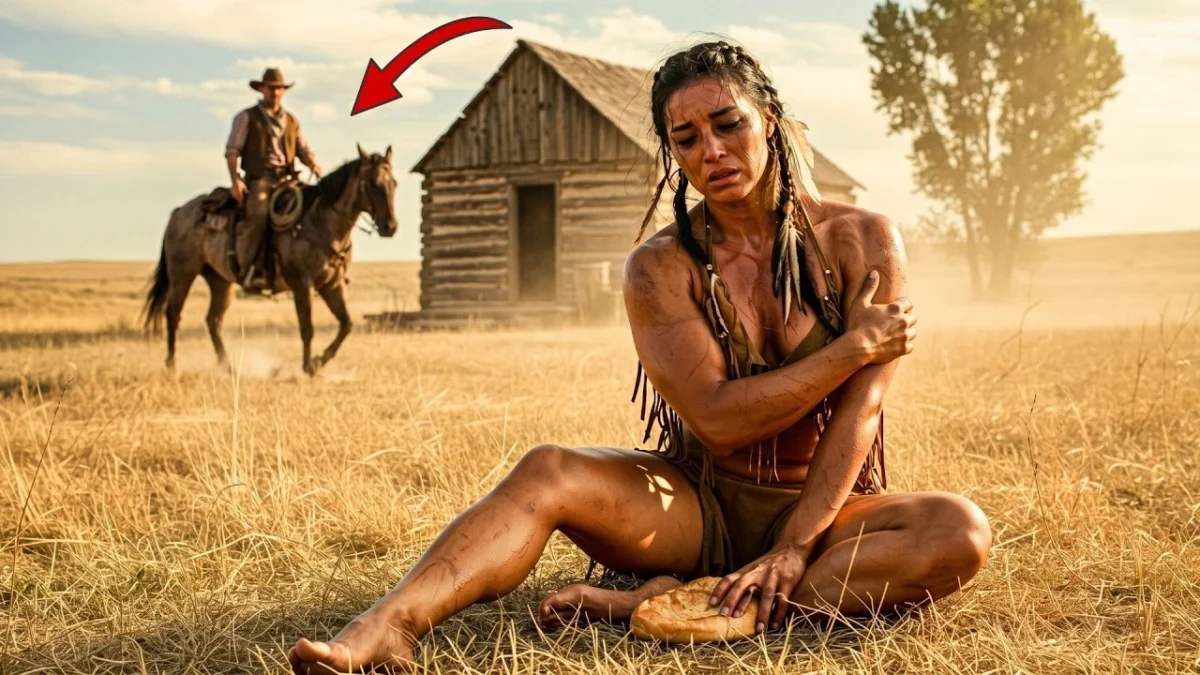
She was tall and built like a warrior, her powerful frame covered in thick gray dust and patches of dried blood.
Worse yet, purple welts from a heavy whip crisscrossed her shoulders and back, and her wrists were bound tightly with a strip of raw leather.
Her chest rose and fell in shallow, agonizing motions that threatened to vanish at any moment.
Elias leapt down from his saddle and dropped to his knees beside her, his leather boots sinking into the hot sand.
Heat radiated off the ground in suffocating waves, but a far colder thought flashed through his mind as he looked at her facial features.
She was Apache.
The tribal elders had warned him more than once not to meddle in their internal affairs or cross their border lines.
He reached out a calloused hand and pressed two fingers against her neck.
Her pulse was so faint it felt like the flutter of a dying bird’s wing.
If he left her here, the relentless desert sun would claim her life before the sun dipped below the horizon.
“Damn it,” Elias muttered, gritting his teeth as he drew a sharp hunting knife from his belt.
With a swift stroke, he sliced through the leather binding around her wrists, freeing her skin from the tight restraint.
He slipped his hands beneath her waist and shoulders, hoisting her up with a heavy grunt.
She was surprisingly heavy, her muscular frame carrying the dense weight of pure strength.
He powered through the strain, heaving her across the back of his saddle before swinging himself up behind her.
He kicked the reins hard, sending the stallion into a fast gallop as red dust swirled wildly in their wake.
The sharp scent of copper blood, sweat, and hot sand mixed in the dry air.
Elias did not look back toward the canyon trails.
He knew that if anyone from the tribe was watching from the ridge, they would know whose side he had chosen, and there would be no turning back from this single act of mercy.
The stallion thundered through the rickety wooden gate of his homestead, sliding to a stop right in front of the small log cabin.
Elias swung down, carefully gathering the unconscious woman into his arms, and rushed her inside.
He gently lowered her onto an old wool blanket spread beside the cold stone fireplace, then hurried to kindle a fire.
Flickering yellow light soon danced across his sun-darkened, sweat-soaked face as the dry pine caught fire.
He dragged a heavy wooden bucket over and scooped out what little clear water remained in his storage tank.
During the dry season, every single drop of water was worth its weight in gold on this barren ranch.
Yet Elias did not hesitate as he soaked a clean cloth and began wiping the thick dust and crusty blood from her forehead and cheeks.
The pulse at her wrist remained faint, but her breathing gradually deepened as the warmth of the cabin filled her lungs.
Elias took a step back and wiped his brow, staring down at the stranger resting on his floor.
He had never been a man to get tangled up in other people’s problems.
A few years back, a sudden outbreak of fever had swept through the territory and taken his wife and two young sons in the span of a single week.
Since that tragic spring, Elias had lived like a ghost on his own land, tending to the parched soil and his small herd of cattle in total isolation.
He stayed far away from town and even farther from the dangerous conflicts that brewed between the settlers and the native tribes.
But what he had done today shattered that fragile solitude completely.
The woman lying before him was unlike any Apache woman he had ever encountered in the trading posts.
Her body was broad and muscular, her arms showing the defined shape of hard physical labor and fighting capability.
The severe whip marks carved into her skin told a story of a cruel punishment, likely inflicted for breaking a severe tribal law.
Elias sat on a low stool, resting his elbows on his knees as he watched her chest move.
He knew one thing for certain: if her people tracked her to his homestead, they would brand him a traitor and an enemy of the tribe.
Outside, the desert night fell fast, dropping the temperature sharply as the sun vanished.
Prairie winds began to howl through the valley, driving fine sand through the small cracks in the cabin walls.
Elias threw two more heavy oak logs into the hearth, letting the fire roar higher to push back the chill.
He filled a small wooden bowl with the last of his warm broth and leaned down beside her.
Her eyes fluttered open slightly, dark and disoriented, filled with the haze of extreme exhaustion.
“Drink this,” Elias said in a low, gentle tone, lifting her head slightly.
She parted her lips with difficulty, swallowing the warm liquid slowly before her eyes rolled back and she slipped back into deep unconsciousness.
Elias let out a long, ragged breath and pulled his Winchester rifle close, leaning it against the edge of his chair.
He leaned his head back against the rough log wall, keeping his grey eyes fixed entirely on the front door.
He knew what kind of men would whip a woman and leave her to bake in the red sand, and he knew they might come riding through the night to finish what they started.
If they came knocking on his door tonight, Elias Ward intended to be the one standing in their way.
Part 2
The fire in the hearth had faded to a low, quiet bed of glowing red embers by the time the midnight hour arrived.
Elias dozed fitfully in his chair, his fingers resting lightly over the cold steel of his rifle.
A faint, sharp rustle of fabric snapped him awake in an instant.
The woman had pushed herself upright, her dark eyes wide and wild with instinctual panic as she looked around the room.
In one fluid, explosive movement, her large hand reached out and snatched a small paring knife left on the table beside the stove.
Steel flashed brightly in the dim red embers as she held the blade toward his chest, her muscles tense and her chest heaving.
Elias did not jump, nor did he reach for the rifle in his lap.
He slowly raised both hands in the air, his gray eyes steady and his voice deep and gravelly.
“If you are going to stab me, make sure you do it clean,” Elias said quietly.
“But if you want to stay alive, put the knife down before you tear those wounds open again.”
The woman was panting heavily, cold sweat beading across her forehead as she held her ground.
Her sharp eyes darted rapidly around the cabin, noting the thick walls, the humble furniture, and the open space.
It was a shelter, not a trap or a cage.
Then her gaze shifted back to the man standing before her—tall, lean, unshaven, with steady eyes that carried no cruelty.
She hesitated, her breathing beginning to slow down.
“I cut your bonds,” Elias continued, keeping his voice smooth and calm.
“If you want to walk out that door, I won’t stop you.”
“But out there, there is nothing waiting for you right now except cold wind, hot sand, and vultures.”
The heavy knife trembled in her hand as she processed his words.
After a long, tense pause, she let out a shaky exhale and allowed the blade to slip from her fingers, clattering onto the floorboards.
Her powerful body collapsed back onto the wool blanket like a felled tree, drained of all remaining energy.
Elias stepped forward, picked up the knife, and set it back on the counter.
He filled a small cup with fresh water and offered it to her.
“Drink,” he said simple. “You need it more than I do.”
She accepted the cup with shaking hands, taking slow, deliberate sips while her dark eyes followed his every move.
She was studying him, trying to discern whether this white rancher was planning to hold her captive or turn her in.
Without saying another word, Elias gathered his heavy canvas coat and walked out onto the wooden porch.
He pulled the cabin door almost shut, leaving a small crack open, and sat down on the top step with his rifle rested across his thighs.
Through the crack in the door, the woman tilted her head, watching his silhouette against the moonlight.
He remained as motionless as a stone carving, the only movement coming from the faint wisps of smoke curling from his cigarette.
That entire night, she did not sleep for more than a few minutes at a time.
Every time a nightmare startled her awake, she looked toward the doorway and saw Elias sitting there, never coming inside to bother her, but never abandoning his post either.
A strange, unfamiliar feeling began to stir deep in her chest—a sense of absolute safety she thought had died long ago.
By the time the eastern sky began to turn pale gray, Elias turned his head toward the door and spoke into the morning quiet.
“My name is Elias,” he said softly.
“If you want to stay here until you get your strength back, you can.”
“If you want to leave, I will give you a canteen and a horse, and I will not stop you.”
“The choice is entirely yours.”
The woman stared at his profile through the crack, then slowly turned her face toward the fireplace.
“Ta-Keena,” she murmured, her voice rough and deep.
She said nothing more, but her large hand reached out and tightened firmly around the blanket draped over her shoulders.
That single gesture was her answer.
By noon, the sun was casting bright light down on the weathered shingle roof of the ranch house.
Ta-Keena proved to be astonishingly resilient, standing upright on her own two feet despite the severe whip marks on her back.
She stepped out onto the porch, her shoulder wrapped in a clean cloth, her dark eyes sharp and focused.
Elias was nearby in the yard, hammering a splintered section of the cattle fence, not bothering to look up as she approached.
“You’re standing,” he remarked in an even tone.
“If you’re hungry, there’s dry meat in the kitchen, and a well behind the cattle pen if you want water.”
Ta-Keena offered no verbal reply, but a moment later, she picked up a heavy wooden bucket and walked straight to the water pump.
Her thick, muscular arms flexed under her sun-darkened skin as she effortlessly hoisted the heavy bucket full of water.
Elias glanced over, genuinely caught off guard by her physical power.
A woman who had been near death less than twenty-four hours ago was already hauling water without a single complaint.
Throughout that afternoon, Ta-Keena spoke almost nothing, but she followed Elias around the homestead like a silent shadow.
She watched closely as he patched broken fence rails and mixed clay to seal the outer walls of the barn.
When Elias finally paused to wipe his brow and catch his breath, Ta-Keena stepped forward without a word.
She took the heavy iron hammer from his hand and finished driving the thick wooden posts into the hard soil herself, her strikes far more powerful than his own.
Elias stood still for a moment, surprised, before giving her a quiet, respectful nod.
That evening, without being asked, Ta-Keena lit the small iron stove in the kitchen.
She prepared a simple rabbit stew using the dried meat and wild herbs she found near the creek, setting a steaming bowl down in front of Elias.
He looked down at the food, then up at her intense face.
“Thank you,” he said softly.
A short, almost imperceptible nod was all she returned before sitting down to eat her own share.
In the days that followed, the silent, ghost-like atmosphere of the ranch faded away.
The steady sounds of hammers, shovels, and chopping wood filled the open air from dawn until dusk.
Elias dug a deeper water trench near the creek bed to save the dying crops.
Ta-Keena carried massive stone boulders single-handedly to build a windbreak wall along the western side of the cabin.
Her strength was so extraordinary that she rebuilt an entire collapsed section of the heavy timber corral in a single afternoon.
One evening, as the purple shadows lengthened across the valley, the two of them sat together on the front steps of the porch.
Elias lit a cigarette, watching the smoke rise, while Ta-Keena sat beside him, using a small knife to whittle a piece of pine wood.
For the first time since she had arrived, she broke the long silence between them.
“Why did you save me?” she asked, her dark eyes fixed on the distant hills.
“You knew my people would be angry.”
Elias stared out at the cracked, dry fields he had spent years trying to keep alive.
“Because I couldn’t sit by and watch a human being left to die in the sand,” he answered honestly.
“I’ve seen too much death in my life, Ta-Keena.”
“I didn’t want to see any more if I could stop it.”
Ta-Keena fell silent, digesting his words as she smoothed the wooden stick in her hands.
A moment later, she gave a slow, deliberate nod.
It was a simple answer, but something deep inside her seemed to uncoil and loosen its tension.
That night, as the prairie wind rustled through the roof shingles, Ta-Keena did not toss and turn with nightmares.
For the first time in many months, she slept deeply and peacefully inside the warm cabin.
And outside on the porch, Elias walked his steady perimeter checks, feeling a long-lost sense of purpose returning to his chest.
Part 3
Late the following afternoon, the sky turned a harsh, unnatural golden hue as dust gathered in the upper atmosphere.
Elias was tightening the leather girth on his saddle when the distant, unmistakable sound of rhythmic hooves echoed across the canyon.
His head snapped up immediately.
On the northern horizon, a dark plume of red dust was rising fast, heading straight toward his gate.
“Uninvited guests,” Elias muttered under his breath, stepping over to the porch to grab his Winchester rifle.
Ta-Keena heard the commotion and stepped out of the cabin, her posture rigid.
The moment her eyes landed on the approaching riders, she froze, her jaw clenching.
Three Apache warriors on magnificent warhorses trotted through the open gate, coming to a halt in the middle of the yard.
Their faces were painted with dark war markings, and their eyes were as cold as winter ice.
The lead warrior nudged his horse a step forward, glaring down at Elias with a deep, flat voice.
“Our woman is here,” the warrior demanded, pointing a steel-tipped lance at the door. “Hand her over now.”
Ta-Keena took a small step back, her hand instinctively dropping to the handle of the knife at her belt.
Elias did not flinch; he stepped forward, placing his tall frame directly between the riders and the woman behind him.
He brought the rifle up to his chest, his finger resting lightly on the trigger guard.
“She was near death when I found her,” Elias said calmly, his voice steady.
“She has the right to stay here until her body is healed.”
The second warrior snarled, his horse shifting uncomfortably under his sudden rage.
“She has been cast out by the tribe for her defiance!” the warrior shouted.
“She has no right to live, and no right to take shelter on this land!”
“If you shelter a disgraced exile, white man, you become an enemy of our people!”
Elias did not lower his rifle an inch, his gray eyes locking onto the lead warrior with cold determination.
“If you want to take her by force, you’ll have to put a bullet through me first,” Elias declared.
The silence that followed was as taut as a fully drawn bowstring.
The hot wind kicked up swirls of red sand around the horses’ legs, but no one moved.
Behind Elias, Ta-Keena stared at his broad back, amazed by the unyielding resolve of a man who owed her nothing.
Finally, the lead warrior slowly lowered his spear, his dark eyes burning with pure fury.
“We will return,” he warned, pulling his horse around.
“Next time, rancher, we will not come as three.”
They yanked their reins hard and galloped out of the yard, leaving behind a heavy, suffocating cloud of dust.
Ta-Keena gripped her knife so tightly her knuckles turned pale, her breath coming in fast gasps.
Elias turned back toward her, the fire of battle still lingering in his gray eyes.
“They will be back with a full war party,” Elias said quietly.
“If you still want to stand your ground here, we have work to do.”
Ta-Keena looked at him, and her eyes lit up with a powerful, dangerous resolve.
“I am done running,” she said fiercely.
That night, Elias lit two oil lanterns and dragged out every single crate of ammunition and sandbag he had stored in the barn.
Ta-Keena stood right beside him, her sleeves rolled up, helping him nail thick wooden planks over the windows and build dirt barricades across the porch.
She was no longer a helpless refugee waiting for fate to claim her; she was a partner preparing for battle.
Three days later, just as the sun began to sink toward the horizon, the dreaded red dust rose once more along the northern ridge.
Elias stood on the reinforced porch, his Winchester resting in his hands.
Ta-Keena stood shoulder to shoulder with him, her hair tied back tightly, holding a long hunting spear in her right hand and a heavy blade in her left.
The thunder of hooves grew deafening as nearly twenty Apache riders swept into the yard, surrounding the homestead in a tight, inescapable circle.
The air thick with the smell of lathered horses, leather, and impending violence.
An old man stepped forward from the line of riders, his silver hair braided neatly and a thick buckskin cloak draped over his broad shoulders.
He was the tribal elder, his weathered face looking as ancient and unyielding as the granite cliffs above them.
He looked at Elias, then shifted his gaze to Ta-Keena standing tall beside the rancher.
“She was cast out by the law of our ancestors,” the elder said, his voice carrying surprising power.
“She belongs to the dust of the desert. Why do you protect her, white man?”
Elias raised his voice so every warrior in the circle could hear him clearly.
“Because she is a living human being, and she chose to live!” Elias called back.
“She has the right to stand where she pleases!”
A low murmur rippled through the gathered warriors, several of them tightening their grips on their weapons.
A younger warrior rode forward, his face twisted in anger.
“She brought shame upon her house!” he yelled. “She refused her duties and struck a warrior! She cannot be allowed to survive!”
Ta-Keena stepped to the edge of the porch, her thunderous voice cutting through the noise.
“I brought no shame to anyone!” she roared, her chest expanding.
“I was beaten and condemned because I refused to be treated as property!”
“I will not apologize for fighting for my own life!”
A sudden, profound heavy silence fell over the entire war party.
The warriors looked at one another, surprised by the raw power and dignity in her voice.
The silver-haired elder held up a hand, silencing his men, and stared deeply into Ta-Keena’s eyes.
“If you choose to live under the roof of this white rancher, you sever every remaining tie to your people,” the elder stated gravely.
“You will have no tribe, no family, and no protection.”
Ta-Keena did not hesitate for a single second; she thrust the butt of her spear into the wooden porch floor.
“I choose life,” she said with absolute clarity. “And I choose to stand right here.”
The elder remained quiet for a long, agonizing moment before slowly nodding his head.
“So be it,” he declared.
“From this day forward, your name is erased from our ledgers.”
“You are no longer a daughter of the Apache.”
“We will not hunt you, but if you cross our path again, you will be treated as a stranger.”
He turned his piercing gaze toward Elias, pointing a thin finger at the rancher.
“You took her in, Elias Ward,” the elder warned.
“Her life and her blood are now bound to your hands.”
“If trouble comes from this choice, you will bear the consequences alone.”
“I accept those terms,” Elias responded without hesitation.
The elder raised his hand high, and with a single command, the entire war party turned their mounts and galloped away into the fading light, leaving the homestead in sudden, peaceful quiet.
As the sound of hoofbeats died down, Ta-Keena let out a long, trembling breath, her shoulders relaxing for the first time in years.
Elias turned to look at her, a soft, genuine smile appearing on his weathered face.
“You just chose a hard life out here, Ta-Keena,” he said gently.
Ta-Keena looked back at him, her dark eyes shining with newfound freedom and quiet joy.
“No, Elias,” she replied softly. “I chose my own life.”
That very evening, as if the heavens were celebrating her newfound freedom, dark rain clouds rolled over the mountain peaks.
After months of devastating drought, heavy drops of rain began to fall onto the dusty roof of the cabin.
The rich, sweet smell of wet earth filled the air as the desert finally let out a long, cooling sigh.
Ta-Keena stepped out into the yard, tilting her head back to let the cool rain wash away the dust and blood stains from her skin.
Elias walked out and stood beside her in the downpour, watching the dry fields turn rich and soft under the falling water.
“This ranch isn’t going to be so quiet anymore,” Elias said with a chuckle, looking at the massive timber fence she had helped him build.
“It was too quiet anyway,” Ta-Keena said, a beautiful, genuine smile lighting up her face for the very first time.
Side by side, the rancher and the warrior stood together in the cleansing rain, ready to face whatever the future might bring to their shared home.








