The Bank Eroded the Old Farmer’s Land to Drive Him Out — Instead, It Made Him Richer
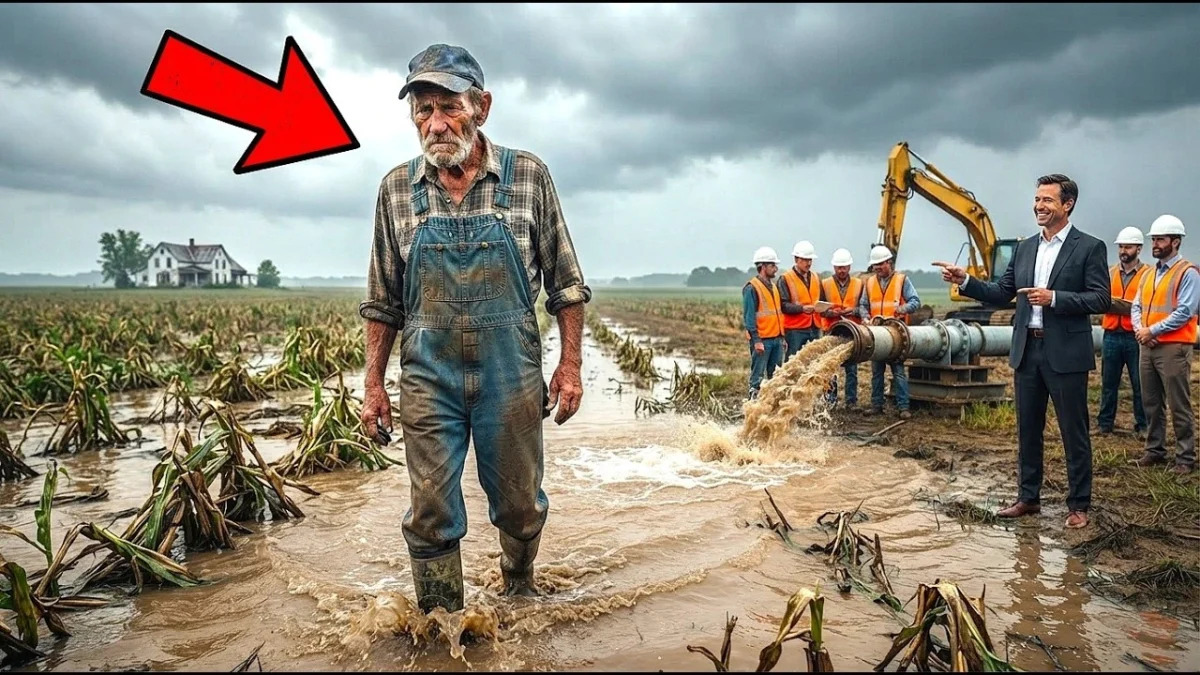
The morning sun had barely crested the eastern horizon when seventy-four-year-old Walter Combmes stepped onto his front porch, nursing a chipped ceramic mug of black coffee.
He expected to look out over the familiar, flat green rise of his lower forty acres—ground he had planted with corn less than three weeks prior.
Instead, he froze on the second step, his eyes narrowing as he stared at a raw, brown gash cutting violently across his bottomland.
It was a deep, jagged gully, far worse than anything a single spring shower should have carved into soil that had held firm for sixty years.
Walter set his mug down on the wooden railing and walked down the steps, his worn leather boots crunching against the gravel.
He crossed the yard and stood at the rim of the newly formed ravine, watching muddy water chew away at the dark, fertile topsoil.
“This doesn’t make a lick of sense,” Walter muttered to himself, shaking his head.
He looked up at the sky, then down at the ground around his boots, which was barely damp.
The storm the previous evening had been a light, passing drizzle—certainly not enough to dump the volume of water required to tear open a six-foot-deep trench overnight.
He walked along the fence line, following the path of the rushing water upstream through a dense stand of sycamores that marked his boundary line.
As he cleared the tree line, he spotted the source of the sudden deluge.
On the adjacent property—a recently cleared tract controlled by a commercial development group—a heavy concrete drainage culvert had been installed straight into the embankment.
It funneled a torrent of high-velocity runoff directly toward Walter’s lowest, most vulnerable acreage.
“Well, now,” Walter said softly, resting both hands on the wooden fence rail as he glared at the freshly poured concrete.
“That didn’t get there by accident.”
Four days later, a pristine, dust-free pickup truck pulled down Walter’s gravel driveway and came to a stop near the barn.
Roy Senate, the regional vice president of Meridian Agricultural Bank, stepped out of the cab, wearing polished leather boots that looked entirely out of place in the rural mud.
Roy walked over to where Walter was repairing a wooden fence gate, offering a tight, practiced smile that didn’t reach his eyes.
“Morning, Walter,” Roy said, leaning against the fence post.
“I was driving by and thought I’d take a look at the lower field. I heard you took some heavy damage from the recent weather.”
Walter didn’t stop hammering the staple into the cedar post.
“It wasn’t the weather, Roy,” Walter replied without looking up.
“That water came from the culvert those developers put in upstream.”
Roy adjusted his golden cuff links and looked out over the ruined cornfield with a cool, calculating gaze.
“Be that as it may, Walter, the bank has to look at the hard numbers,” Roy said, his voice smooth and detached.
“That lower forty has always been prone to standing water, but now it’s completely unproductive. It’s becoming a serious drag on the collateral value of your operating loan.”
Walter finally lowered his hammer and turned to face the banker.
“I’ve farmed this ground for sixty years, Roy. My father farmed it before me, and his father before him. We’ve been through droughts, floods, and the farm crisis of the eighties. We always pay our debts.”
“Times change, Walter,” Roy said softly, stepping closer.
“If the lower acreage stays this unproductive through another season, the bank will have no choice but to begin foreclosure proceedings on the entire four hundred and eighty acres. But it doesn’t have to come to that.”
“Is that so?” Walter asked, his jaw tightening.
“The bank is willing to buy the damaged lower forty acres outright at a fair market valuation,” Roy offered, spreading his hands.
“We can wipe out your current operating debt and restructure the remaining note around your upper fields. You get to keep the farmhouse and the productive ground, and you don’t have to keep fighting the water.”
Walter stared at the banker for a long, silent moment before spitting into the dirt.
“I’m not selling off pieces of my grandfather’s farm to fix a problem somebody else created.”
Roy sighed, shaking his head as he turned back toward his truck.
“Think about it, Walter,” Roy called over his shoulder.
“You don’t have to keep fighting the water forever. Ground has a way of making decisions for folks who won’t make them for themselves.”
Walter watched the truck drive away, a cold knot tightening in his stomach as he realized the bank’s offer was less about helping him and more about taking his land.
Later that morning, a dusty sedan pulled up to the farmhouse, and Walter’s twenty-eight-year-old granddaughter, Dana, stepped out.
Dana had recently moved back to the county after a painful divorce and a soul-crushing corporate marketing job in Little Rock, seeking the quiet solace of her grandfather’s farm.
She found Walter sitting at the kitchen table, staring blankly at a stack of overdue bank notices.
“Grandpa?” Dana asked, setting her purse on the counter.
“I saw Roy Senate’s truck leaving when I was coming up the county road. What did he want?”
“He came to deliver an ultimatum,” Walter said quietly, resting his weathered hands on the table.
“He says if we can’t make that lower forty produce this year, they’re going to foreclose on the whole place. He offered to buy the ruined acreage to ‘help’ us out.”
Dana frowned, picking up one of the notices.
“He wants that specific land? Why would the bank want forty acres of flooded mud?”
“Because they think I’m old, tired, and out of options,” Walter replied grimly.
“And right now, they’re not entirely wrong. The planting window for a replant is closed. That crop is gone.”
Determined to understand what was happening, Dana walked down to the gully later that afternoon, carrying a camera and a small canvas bag.
She slid down the raw bank of the ravine, stepping carefully over the uprooted corn stalks.
As she examined the deepest section of the cut, where the rushing water had sheared away five feet of earth, something unusual caught her eye.
Beneath the dark, organic topsoil lay a thick, brilliant streak of pale, reddish-white clay that looked entirely different from the surrounding dirt.
It was dense, smooth, and greasy to the touch, almost like polished wax.
Dana knelt in the dirt, taking out her phone to capture close-up photographs of the exposed layer from multiple angles.
She extracted a small trowel from her bag and dug loose a sample, placing it inside a ziplock bag.
That evening, as Walter ate a quiet dinner of roast beef and potatoes, Dana placed the sample bag and a handful of printed photos onto the kitchen table.
“Grandpa, look at this,” Dana said, pointing to the distinct reddish-white band in the photo.
“Where the gully cut deepest, there’s a massive layer of this pale clay. It doesn’t look like ordinary subsoil.”
Walter glanced at the bag and let out a tired sigh.
“Clay doesn’t pay the bank, Dana. Corn does, and I don’t have a harvest coming off those bottomlands this year.”
“I know,” Dana said gently.
“But look at how thick that band is. It runs the entire length of the wash. What if there’s more to that ground than just soil?”
“I’m a farmer, Dana,” Walter said, turning back to his plate.
“For fifty years, a good acre of land has been measured by how many bushels of corn or soybeans it yields. A field you can’t plant is just a liability.”
Undeterred by her grandfather’s skepticism, Dana made a call the following morning to the State Geological Survey office.
She described the location, the sudden erosion, and the physical characteristics of the exposed clay layer to a junior staff geologist.
The response she received was polite but unpromising.
“Miss Combmes, clay deposits are common throughout the region,” the geologist explained over the phone.
“Unless the material has specific industrial properties, high purity, and significant volume, it holds very little commercial value. Verifying that would require core samples, laboratory testing, and formal geological surveys—all of which cost money.”
Dana hung up the phone, feeling the weight of a dead end.
She sat on the porch steps, staring at the sample bag in her hands.
Her grandfather’s debt was real, the bank’s deadline was approaching, and her curiosity was currently just an unproven theory.
Two days later, Dana visited the county extension office to ask about local drainage regulations.
While there, an old family friend and extension agent listened to her story and gave her a handwritten note with a phone number.
“If you want a real answer about that dirt, call Renee Castillo,” the agent told her.
“She’s an independent consulting geologist who used to work for the state. She doesn’t waste time, and she knows the mineral composition of this valley better than anyone.”
Dana called the number immediately, and Dr. Renee Castillo arrived at the farm two days later.
Renee was a sharp, practical woman in her late forties, wearing work boots, a high-visibility vest, and carrying a field kit.
She spent over two hours walking the full length of the gully, stopping frequently to inspect the exposed clay, measure the depth of the cut, and take small core borings with a hand auger.
Walter stood by the fence line, watching her with a mixture of curiosity and fatigue.
When Renee finally climbed up the bank, she wiped her muddy hands on a towel and walked over to Walter and Dana.
“Mr. Combmes, you have a very interesting situation here,” Renee said, pulling off her gloves.
“Is it just ordinary red clay?” Walter asked plainspokenly.
“Far from it,” Renee replied, her eyes bright with professional interest.
“Preliminary field observation suggests this is a high-purity kaolinite-type clay deposit with extremely low iron content. That’s remarkably rare for this specific Delta basin.”
“What does that mean in plain English?” Dana asked.
“It means,” Renee explained, “that this isn’t brick clay. High-purity kaolin is used in specialty technical ceramics, refractory linings, high-grade porcelain, and industrial glazes. If the deposit is as pure and extensive as this cut suggests, it’s worth significantly more per ton than any crop of corn you could ever grow on top of it.”
Walter stared at her in disbelief, crossing his arms over his chest.
“Ma’am, with all due respect, I’ve spent my whole life measuring the worth of land by what comes off it at harvest. You’re telling me my worst forty acres is worth a fortune because of what’s buried underneath it?”
“I’m telling you that you might be farming on top of a major mineral asset,” Renee said firmly.
“But we need full laboratory testing and a systematic survey to prove the depth, volume, and chemical purity before anyone writes a check.”
The following week, Renee returned to the farmhouse with a thick folder containing the initial laboratory results from the samples she had sent off.
She sat down at the wooden kitchen table with Walter and Dana, spreading out a series of charts and chemical analysis sheets.
“The lab results confirm my initial assessment,” Renee stated, pointing to a column of figures.
“The kaolinite purity levels are exceptional—over ninety-two percent. The deposit appears to be between twelve and fifteen feet thick along the primary ridge of the bottomland.”
“How much is something like that worth?” Dana asked, leaning forward.
“A specialty ceramics manufacturer two counties over pays premium prices for kaolin of this grade,” Renee said.
“Depending on the total tonnage we confirm through deep core drilling, a long-term extraction lease could generate substantial annual royalty payments for decades.”
Walter leaned back in his wooden chair, looking out the window toward his damaged field.
“It sounds fine, Dr. Castillo, but a lease doesn’t pay the bank next month,” Walter said quietly.
“Meridian Bank gave me a hard deadline to bring my operating loan current, or they’re starting foreclosure.”
“Then we need to buy you time, and we need to figure out why that gully opened up so suddenly,” Dana said, turning to her grandfather.
“Grandpa, water doesn’t just reroute itself with that kind of force. Someone changed the flow upstream.”
The very next morning, another registered letter arrived from Meridian Agricultural Bank.
The letter was signed by Roy Senate, stating in polite, bureaucratic language that due to the severe degradation of the collateral property and the lack of crop production, the bank was accelerating the loan timeline.
Walter had precisely thirty days to satisfy the outstanding balance or surrender the deed to the lower forty acres to avoid full legal foreclosure on the entire farm.
Roy called Walter an hour after the letter was delivered.
“Walter, I assume you received our notice,” Roy said smoothly over the telephone line.
“I did,” Walter replied, his voice flat.
“It’s a tough situation, Walter, but the bank has fiduciary duties,” Roy said, feigning sympathy.
“A farm that loses its productive core becomes an unacceptable risk. My offer to buy the lower forty outright is still on the table. It’s the cleanest way out for you.”
“Why are you so eager to take that specific land off my hands, Roy?” Walter asked sharply.
“Was it just coincidence that the erosion started right after that development group put in their new culvert upstream?”
There was a brief pause on the line before Roy spoke again, his voice cooler this time.
“Water damage is unpredictable, Walter. Nobody can control the weather or natural drainage shifts. I suggest you focus on your financial reality rather than groundless theories.”
After hanging up the phone, Walter and Dana drove into town to meet with Franklin Boyd, a veteran local attorney who had represented area farmers for over forty years.
Franklin sat behind a heavy oak desk stacked with legal files, listening quietly as Walter explained the situation and Dana presented her photos and Renee’s preliminary mineral report.
When Walter finished, Franklin took off his reading glasses and rubbed his eyes.
“Walter, I know Roy Senate, and I know how Meridian Bank operates,” Franklin said slowly.
“If we want to stop a foreclosure or hold them accountable for land damage, suspicion isn’t going to cut it in front of a judge. The bank will simply claim the gully was caused by natural erosion and bad farm management.”
“So what do we need?” Dana asked.
“We need proof,” Franklin replied.
“We need a complete engineering analysis showing that the upstream drainage modifications directly caused the catastrophic erosion on your land. And we need to prove the developer and the bank knew what would happen.”
To build that proof, Franklin hired Marcus Adulgo, an experienced civil engineer specializing in agricultural water rights and hydraulic disputes.
Marcus arrived at the farm the following week carrying a tablet, topographical maps pulled from the county archives, and historical satellite imagery.
Instead of jumping to conclusions, Marcus spent days gathering data.
He requested old county drainage permits, historical rainfall records, maintenance logs, and construction plans for the commercial development next door.
Sitting at Walter’s kitchen table, Marcus spread out a series of large, overlaid aerial maps.
“I’ve seen this playbook before, Mr. Combmes,” Marcus said, tracing a red line along the property boundary.
“A commercial developer wants to clear land, but they need to dispose of massive amounts of stormwater runoff without spending money on proper retention ponds.”
“So they dump it on me,” Walter said.
“Exactly,” Marcus confirmed.
“They engineered a concrete outlet that redirected a major drainage corridor straight onto your lowest ground. Before their construction, runoff dispersed evenly across a broad meadow. The new outlet concentrated that water into a high-pressure jet.”
Dana pulled out her field notebook and handed it to the engineer.
“I’ve been tracking the width and depth of the gully every three days since April,” Dana said.
“I have dates, measurements, and weather logs.”
Marcus flipped through Dana’s meticulous records, his eyebrows rising in genuine surprise.
“Miss Combmes, this is outstanding,” Marcus said, nodding approvingly.
“You’ve documented a clear, chronological acceleration of erosion that directly matches the construction phases upstream. Most people don’t start gathering evidence until after their land is already gone.”
“I just wanted to help my grandfather save his farm,” Dana said quietly.
For three weeks, Marcus worked tirelessly, correlating local rainfall data with the timing of the gully’s expansion.
His final report was definitive: the rainfall on the night of April 13th was entirely routine and could not have caused the gully under natural conditions.
The catastrophic soil loss was the direct mathematical result of the newly installed upstream culvert, which increased water flow velocity onto Walter’s land by over four hundred percent.
Furthermore, Marcus uncovered a critical connection in county property records: the commercial development group that built the culvert was a subsidiary entity heavily financed by Meridian Agricultural Bank itself.
While Marcus finalized his engineering report, Dr. Renee Castillo completed her extensive geological survey.
She brought a deep-drilling rig to the farm, sinking several test cores across the entire lower forty acres.
The results were even better than expected.
The high-purity kaolin deposit wasn’t just a narrow strip; it extended beneath almost thirty-five acres of Walter’s bottomland, reaching depths of up to eighteen feet.
It was a massive, highly valuable commercial deposit worth millions of dollars in raw mineral value.
Equipped with Marcus’s hydraulic study and Renee’s mineral valuation, Franklin Boyd filed a formal motion in county court to halt the foreclosure proceedings and requested an emergency discovery order against Meridian Agricultural Bank.
The bank’s legal team fought the motion, but the judge, presented with overwhelming scientific evidence from an engineer and a licensed geologist, ordered the bank to hand over all internal communications regarding the loan, the property valuation, and the adjacent development project.
Two weeks later, Franklin’s paralegal found the smoking gun hidden deep within hundreds of pages of subpoenaed internal emails.
Franklin called Walter and Dana into his office, a grim, triumphant smile on his face as he laid three printed emails onto his desk.
“Read these,” Franklin said quietly.
Dana picked up the first email, sent from Roy Senate to the lead developer of the upstream project eight months prior.
The text was plain, calculating, and devastating:
‘The Combmes property represents the ideal drainage outlet for our phase two expansion. Walter Combmes is heavily leveraged on his operating note. Increased water flow onto his lower acreage will destroy his crop yield, accelerating a distress sale or foreclosure scenario that allows us to acquire the acreage at a nominal cost.’
A second email from a bank loan officer read:
‘Combmes refused our initial purchase offer. We will hold off on loan restructuring until the spring runoff impacts the lower forty. The resulting field damage will force his hand.’
“They didn’t just accidentally erode his land,” Dana said, her voice shaking with outrage.
“They deliberately engineered the flooding to bankrupt my grandfather and steal his farm!”
“It’s a clear case of bad-faith lending, intentional property damage, and tortious interference,” Franklin said firmly.
“They knew the land had potential value, though even they didn’t realize how rich that clay deposit actually was. They just wanted the land for development leverage.”
Armed with the internal emails, the engineering report, and the mineral survey, Franklin scheduled a mandatory settlement conference with Meridian Bank’s senior executives and their lead legal counsel.
The meeting took place in a stark, glass-walled conference room at the bank’s regional headquarters in town.
Roy Senate sat at the head of the table, looking pale and thoroughly shaken, flanked by three high-priced corporate attorneys.
Walter sat across from them, wearing his best Sunday suit, flanked by Dana and Franklin Boyd.
Franklin didn’t waste time on pleasantries.
He opened a leather binder and placed copies of the internal emails, Marcus’s drainage study, and Renee’s geological report directly in front of the bank’s lead attorney.
“Gentlemen,” Franklin said, his voice ringing with quiet authority.
“We are prepared to file a federal lawsuit tomorrow morning alleging civil conspiracy, intentional destruction of real property, fraudulent foreclosure practices, and lender liability.”
The bank’s lead attorney skimmed the emails, his face turning an ash-gray color as he realized the catastrophic legal liability his client was facing.
He leaned over and whispered frantically to Roy Senate, whose eyes remained glued to the carpet.
“What are your terms, Mr. Boyd?” the bank’s attorney asked, clearing his throat nervously.
Franklin looked at Walter, who nodded slowly.
“First,” Franklin declared, “Meridian Bank will completely forgive and discharge Walter Combmes’s entire outstanding operating loan and mortgage, releasing all liens on his four hundred and eighty acres with prejudice.”
“Second,” Franklin continued, “the bank will pay three hundred thousand dollars in cash damages for crop loss, land restoration, and legal fees resulting from the illegal diversion of stormwater.”
“And third,” Walter added, speaking up for the first time in his deep, gravelly voice, “you will re-engineer that culvert upstream within thirty days so not another drop of unauthorized water crosses my fence line.”
The bank’s attorney looked at Roy Senate, then back at Franklin.
“If we agree to these terms, Mr. Combmes will execute a full release of liability and sign a strict non-disclosure agreement regarding the internal communications?”
“We agree,” Franklin said.
Roy Senate opened his mouth as if to speak, but his attorney put a hand on his arm, cutting him off instantly.
“We have a deal,” the bank’s attorney said quietly.
Four months after the settlement was finalized, the foreclosure notice was formally cancelled, and Walter’s farm was entirely debt-free for the first time in thirty years.
With the help of Dr. Renee Castillo, Dana negotiated a highly lucrative mineral extraction lease with a regional technical ceramics manufacturer.
The contract was structured as a royalty agreement rather than a sale, meaning Walter retained full ownership of the land while receiving monthly royalty checks based on the tonnage of kaolin clay extracted.
The extraction operation was confined to a strictly permitted fifteen-acre footprint on the lower forty, leaving the remaining four hundred and sixty5 acres undisturbed.
The steady royalty income allowed Walter to replace his aging farm equipment, repair the farmhouse roof, and put a substantial sum into a trust fund for Dana’s future.
He continued farming his upper fields, planting corn and soybeans every spring, taking comfort in the simple, honest work he had loved his entire life.
Dana permanently moved into the farmhouse, taking over the operational management of the ranch and the mineral lease.
She established a local environmental consulting firm, helping other area farmers protect their land and water rights from aggressive commercial developers.
On a warm autumn afternoon, Walter and Dana stood together at the edge of the lower field, looking out over the property.
The old gully had been properly graded and stabilized, with green grass growing along its banks, while a quiet, efficient extraction crew worked in the distance.
Walter reached over and rested a heavy, calloused hand on his granddaughter’s shoulder.
“You know, Dana,” Walter said softly, a warm smile breaking across his weathered face.
“When I stood out here back in April and saw that raw gash in the dirt, I thought it was the end of everything my father and grandfather built.”
Dana smiled, placing her hand over his.
“And now?” she asked.
Walter looked out over the thriving farm, the clear blue sky, and the land that was finally, truly safe.
“Now I see that the bank tried to bury us,” Walter said softly.
“They just didn’t realize we were standing on top of gold.”








