The Bank Flooded His Farm to Force a Sale – Then He Blocked Their $61 Million Project
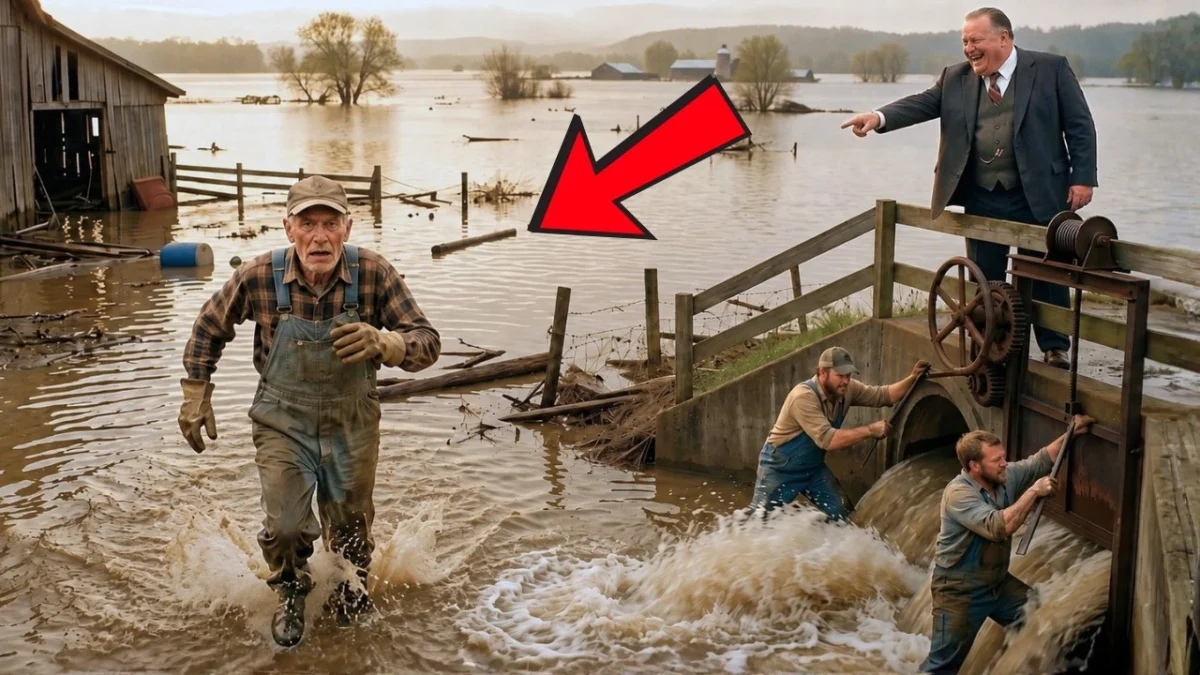
At five o’clock on a freezing autumn morning, seventy-two-year-old Thomas Vance pushed open the heavy wooden doors of his main barn.
The cold water was already swirling up to his knees, turning more than sixty acres of prime agricultural land into a vast, muddy lake.
Rows of healthy young winter wheat had completely vanished beneath the murky brown water.
On the elevated access road across the boundary fence, a corporate bank manager named Marcus Sterling stood beside a sleek black sedan, looking down at the submerged farm.
Marcus adjusted his expensive wool coat and spoke down to the old farmer with a cold, predatory smile, suggesting that if Thomas could no longer maintain his farming operations, the bank was prepared to purchase the entire property that very day.
However, there was something deeply suspicious about the sudden deluge that had swallowed the fields overnight.
The previous evening had only brought a light, moderate rainstorm to the valley—nowhere near enough precipitation to submerge dozens of acres of high ground.
Thomas’s family had farmed this land for over eighty years, surviving much harsher historical storms, and the excess water had always naturally drained toward the east.
Three weeks earlier, a heavy construction team contracted by Vanguard Regional Bank had constructed a massive new access road nearly six feet high along the northern boundary of the farm.
The elevated road was part of an aggressive sixty-one-million-dollar logistics project involving commercial distribution warehouses, truck parking lots, and a private transit corridor leading directly to the interstate highway.
The bank had already quietly acquired more than four hundred surrounding acres, but Thomas’s one-hundred-and-twenty-eight-acre farm stood directly in the center of the shortest route they desperately needed.
If the bank could seize control of his land, hundreds of commercial semi-trucks could drive straight through his property every day instead of taking a costly, circuitous route around the valley.
That strategic location made Thomas’s ancestral farm the final, stubborn obstacle standing in the way of their multi-million-dollar corporate expansion.
Thomas had already flatly rejected four separate buyout offers from Vanguard Bank because this land represented far more than a financial asset to him.
His late father had cleared the brush and tilled the soil with his own hands, and inside the old wooden farmhouse, Thomas had kept his late wife’s bedroom untouched exactly as she had left it before her passing.
The bank executives were well aware that Thomas still carried an outstanding mortgage balance of thirty-nine thousand eight hundred dollars on the property, and they viewed that debt as his ultimate vulnerability.
They calculated that a single lost harvest would render the elderly farmer completely incapable of making his quarterly mortgage payments.
If he defaulted on his debt, they could easily foreclose on the property and force him off the land regardless of his willingness to sell.
Over the next three days, the stagnant floodwaters on Thomas’s farm did not recede an inch.
In fact, as small streams continued to feed into the basin, the water level rose even higher across his fields.
The drowned winter wheat began to rot beneath the surface, several sections of wooden boundary fencing collapsed under the water pressure, and Thomas was forced to haul his small herd of cattle onto the high dirt mound near the main house.
As his financial losses mounted by the hour, Vanguard Bank sent him a formal certified letter stating that his property was suffering severe devaluation due to an unmanageable natural flood risk.
That cold legal letter made Thomas even more deeply suspicious of the bank’s true motives.
Before the new elevated access road had been constructed along his northern fence line, his fields had never held standing water like this in his entire lifetime.
The bank’s letter conveniently included a revised purchase offer for his farm, but the offered price was nearly thirty percent lower than the baseline value the bank had proposed before the logistics project had begun.
Later that afternoon, Marcus Sterling drove back out to the edge of the flooded property, stepping out of his vehicle to confront the old farmer directly.
“Mr. Vance, you have to be practical about this situation,” Marcus said smoothly, leaning against his car door.
“If your wheat crop is entirely destroyed, you won’t have the cash flow to meet your upcoming mortgage payment of thirty-nine thousand eight hundred dollars.”
“My father built this farm to handle rain, Sterling,” Thomas replied calmly, his voice steady despite his muddy clothes.
“This isn’t a natural flood, and you know it.”
“The weather doesn’t care about family history, Thomas,” Marcus countered with a cold, smug grin.
“If you default on your mortgage loan, the bank will acquire this land through legal foreclosure anyway.
Why not accept our cash offer today and walk away with something in your pocket before the property value drops even further?”
Thomas signed nothing and refused to utter another word to the manager.
He simply stood at the edge of the rising water, staring intently toward the base of the newly constructed six-foot road embankment.
He knew in his heart that the valley had experienced far heavier downpours in decades past without turning his pasture into a stagnant lake.
In all previous years, rainwater had always moved smoothly through the low terrain and drained into the deep creek to the east within hours after a storm ended.
This time, millions of gallons of water had piled up directly against the bank’s new dirt road and remained completely trapped on his fields.
Thomas realized that the core problem was not the volume of rain that had fallen from the sky.
The true problem was that Vanguard Bank had built a massive earthen wall directly over the exact spot where the valley’s water had always escaped.
An eighty-one-year-old neighboring farmer named Arthur Oakley drove over to the farm that evening to inspect the damage himself.
Arthur stood on the porch with Thomas, looking out over the submerged acres as the sun set over the valley.
“Thomas, I’ve been watching this valley since I was seven years old,” Arthur said, shaking his head slowly as he pointed across the water.
“Before the bank raised that ground for their truck parking lot, all the runoff from the western hills flowed right through a natural low channel over there.”
“I remember that channel, Arthur,” Thomas said, leaning against the wooden railing.
“My father used to tell me never to build permanent structures in that low strip because the earth needed to breathe when the spring rains came.”
“When we were boys, there was a massive stone box culvert sitting deep under the old dirt track,” Arthur recalled vividly.
“It carried every drop of valley runoff straight under the road and emptied directly into the east creek.
If those contractors dumped thousands of tons of fill dirt right over that old stone culvert without clearing it, your low fields have nowhere to drain.”
The two elderly farmers walked back into the farm shed and opened a heavy wooden trunk filled with archived property deeds and land records from their fathers’ era.
After spending hours sorting through stacks of yellowed parchment and hand-drawn survey documents, they uncovered a original county drainage map dating back to 1941.
The historic map clearly illustrated a designated drainage corridor nearly forty feet wide starting in the low western fields, crossing the precise parcel of land now owned by the bank, and discharging straight into the eastern creek.
The path mapped out in 1941 matched the exact direction of the natural water flow that both old men remembered from their youth.
More importantly, the historic document explicitly marked the presence of a large stone box culvert positioned directly beneath the old roadbed.
A clear handwritten surveyor’s note at the bottom of the map specified that the stone structure had to remain permanently open to allow natural valley runoff to drain freely.
Early the following morning, Thomas and Arthur walked along the perimeter fence to inspect the precise geographic coordinates marked on the 1941 map.
However, the exact location where the ancient culvert entrance had once operated was completely buried beneath the bank’s new development.
Thousands of tons of packed clay, heavy gravel, and fresh asphalt had been piled over the site, raising the road surface almost six feet above the original ground level.
At that moment, Thomas realized that the definitive proof of the bank’s destruction was buried directly beneath the foundation of their multi-million-dollar project.
Carrying the fragile 1941 drainage map in a protective folder, Thomas walked into the monthly county zoning meeting just as Vanguard Bank’s legal team was requesting a final permit to expand their commercial truck parking facility.
When the board president opened the floor for public comments, the old farmer walked up to the podium, unrolled the yellowed map on the display table, and pointed directly to the forty-foot drainage corridor running straight through the bank’s property.
Marcus Sterling, sitting at the executive table with his corporate attorneys, glanced at the ancient map and let out a condescending laugh.
“Mr. Chairman, with all due respect, this is absurd,” Marcus declared loudly to the county board.
“The applicant is presenting an obscure document that is more than eighty years old to blame our modern development for a simple natural weather event.
The recent rainstorm was an unusual act of nature, and Mr. Vance is merely looking for a scapegoat because his aging farm infrastructure failed to handle the runoff.”
Thomas did not get angry, nor did he argue with the bank manager.
Instead, he turned away from Marcus and looked directly at the lead civil engineer hired by the bank to design the warehouse project.
“Sir, I have one simple question for you,” Thomas said in a quiet, firm voice that filled the quiet courtroom.
“Along the half-mile stretch of elevated road running beside my northern fence line, how many drainage culverts did your team install to carry water from west to east?”
The lead engineer looked uncomfortable, adjusting his glasses as he opened his thick blueprint folder in front of the county board.
After flipping through the technical cross-section pages for several tense minutes, the engineer swallowed hard and cleared his throat.
“According to the certified site plan, that specific half-mile section contains two ten-inch PVC drainage pipes,” the engineer admitted quietly.
“And were those two small pipes designed to carry the natural watershed runoff from the entire western valley, or were they only designed for the rain falling directly onto your new asphalt road?” Thomas pressed directly.
The engineer hesitated, looking over at Marcus before answering truthfully.
“They… they were only calculated to handle surface runoff from the paved roadway itself.”
That startling admission was more than enough for the county board officials, who immediately issued an emergency order dispatching an independent engineering inspection team to assess the flooded farm site.
The following morning, county engineers arrived at the property with precision surveying equipment to measure ground elevation, water depth, and flow rates on both sides of the new bank road.
The technical results were completely indisputable.
On Thomas’s side of the embankment, standing water was measured at nearly three feet deep, while the ground on the eastern side of the road was completely dry.
While neighboring pastures across the road were virtually clear, dozens of acres of Thomas’s agricultural land remained submerged under millions of gallons of trapped water.
The independent engineers concluded that the bank’s six-foot-high clay road was acting as an artificial dam, impounding the valley’s natural drainage directly onto Thomas’s farm.
When the inspection team surveyed the exact physical elevation of the bank’s two new ten-inch drainage pipes, they uncovered an even more egregious design flaw.
The bottom edges of the new PVC pipes had been installed nearly four feet higher than the natural floor of the historic drainage channel.
That meant the floodwaters on Thomas’s land had to rise four extra feet above normal levels before a single drop of water could even reach the bank’s new drainage system.
In decades past, natural runoff had simply followed the low contours of the earth, passed smoothly through the old stone box culvert, and emptied into the creek within hours of a storm ending.
Now, the bank’s careless engineering had transformed the old man’s family farm into an artificial retention basin for the entire district.
Even with the mounting technical evidence against them, Vanguard Bank refused to accept legal responsibility or halt their construction timeline.
Marcus Sterling appeared on a local news segment, claiming that the farm’s flooding was purely the result of unusually saturated soil conditions combined with an unprecedented micro-burst storm.
He aggressively argued that the county could not legally force a developer to tear up millions of dollars worth of vital infrastructure based on an unproven theory derived from an ancient paper map.
Thomas then stepped forward and offered the county board a remarkably simple, fair proposition.
“If the bank is so confident that their new road didn’t block the historic drainage path,” Thomas stated calmly, “let them dig a simple five-foot test trench at the exact spot marked on the 1941 map.
If we dig down and find nothing beneath their fill dirt, I will drop my complaint entirely and pay for the excavation out of my own pocket.”
The county commissioners agreed immediately and issued a binding order requiring the bank’s contractor to open a test section of the road under the direct supervision of county civil engineers.
An industrial track excavator was brought out to the precise fence-line location Thomas had marked with a wooden stake.
The heavy steel bucket slowly bit into the top layers of fresh asphalt, crushed gravel, and packed red clay.
At a depth of approximately six feet, the excavator’s steel teeth struck a solid mass with a loud, metallic impact that echoed across the quiet field.
The operator stopped the machine, and manual laborers hopped down into the trench with shovels to carefully clear away the compacted dirt.
The massive, hand-cut stone capstones of an old box culvert began to emerge intact beneath the roadbed.
The historic 1941 structure was still sitting in its original position, remarkably structurally sound despite decades of heavy weather.
However, the most damning discovery was made at the western mouth of the stone culvert.
The intake opening facing Thomas’s farm had been completely smothered and sealed under thousands of tons of newly dumped dirt and rock during the bank’s initial grading work.
Inside the buried stone channel, millions of gallons of trapped water from the farm were backed up under immense hydrostatic pressure, searching desperately for an outlet.
The contractor’s shovel had barely scraped away a small portion of the dirt seal when a powerful, roaring jet of water burst through the cleared gap.
The pent-up floodwater rushed through the ancient stone culvert and surged toward the eastern creek, exactly along the historical path illustrated on the 1941 map.
No one standing at the construction site could dismiss the significance of the discovery any longer.
Over the next four hours, under county supervision, workers widened the excavation gap, allowing a massive, steady river of trapped water to flow continuously beneath the road.
Everyone present watched in real-time as the water level across Thomas’s pasture slowly began to recede.
By the following morning, Thomas measured the water level at his barn door and discovered it had dropped by nearly fourteen inches overnight.
The tops of drowned wooden fence posts that had been completely submerged for days began to reemerge from the murky water.
Trees, field boundaries, and stone markers gradually came back into view as the water continued its steady march through the stone channel toward the creek.
Within three days, without using a single mechanical water pump, over ninety percent of the floodwaters had completely drained from Thomas’s fields.
The acres that had looked like an endless lake were visible once again, though covered in thick mud and ruined wheat crops.
The immediate disappearance of the water following the excavation made it legally impossible for the bank to argue that weather alone had caused the disaster.
The bank’s new road had undeniably dammed the natural watershed, and reopening the buried culvert had instantly relieved the flood that had paralyzed the farm.
However, Vanguard Bank’s legal and financial nightmare was only beginning.
During the post-drainage inspection, structural engineers discovered that the millions of gallons of water trapped against the road for days had soaked deep into the sub-soil beneath the western side of the bank’s new truck parking lot.
The saturated earth had lost its structural integrity, causing large sections of the newly paved asphalt surface to sink unevenly.
Deep, jagged cracks opened up across the concrete floor of the newly constructed warehouse, proving that the underlying soil foundation had become dangerously waterlogged and unstable.
The flood that the bank had orchestrated to destroy the old farmer’s livelihood was now directly destroying their own sixty-one-million-dollar commercial asset.
When county building inspectors discovered that the multi-million-dollar truck facility was actively sinking into the mud, they immediately issued a complete stop-work order on the entire western half of the development.
The county revoked the bank’s temporary occupancy permit and ordered them to completely redesign their regional drainage plan before any further construction could take place.
Structural engineers issued a stern warning that if the historic drainage corridor was not permanently restored to its full natural capacity, heavy seasonal rains would continue to wash out the warehouse foundations.
This time, the financial risk was no longer limited to a single farmer’s wheat crop; tens of millions of dollars in corporate infrastructure were on the verge of complete collapse.
While civil engineers worked around the clock to re-evaluate the site, Thomas’s attorney filed a formal discovery motion to review Vanguard Bank’s internal construction permit documentation.
Buried deep within hundreds of pages of environmental impact filings, his lawyer uncovered a confidential hydrological report written six months before ground had ever broken on the new road.
In that report, an independent consulting engineer had explicitly warned the bank’s executive board that the ancient stone culvert sat directly on the primary drainage path for the western valley.
The consultant had warned in plain text that if the culvert was buried or replaced with inadequate piping, the agricultural properties on the western side of the road would suffer catastrophic, uncontrollable flooding during normal rain events.
This document proved beyond a shadow of a doubt that the bank had not been surprised by the sudden flood.
They had been fully warned of the precise consequences before a single ton of dirt was ever dumped onto the site.
Then, Thomas’s legal team discovered an even more explosive piece of evidence within the bank’s internal email archives.
An email chain between Marcus Sterling and the regional vice president revealed exactly why the bank had ignored the engineer’s warning.
Installing a modern, high-capacity concrete bridge culvert to preserve the natural water flow would have added nearly two million dollars to their construction budget and delayed their project timeline by three months.
In one devastating email, Marcus Sterling had written directly to his superiors: *”If the western fields experience severe seasonal flooding as a result of the simplified road design, it will severely compromise the farmer’s crop yields and make acquiring the Vance parcel far easier and significantly cheaper within the year.”*
Those words transformed a civil negligence lawsuit into a massive corporate conspiracy case.
Vanguard Bank had knowingly created an environmental hazard to intentionally drive a vulnerable mortgage client into financial ruin and force a predatory land sale.
Armed with these internal documents, Thomas filed a massive federal lawsuit against Vanguard Regional Bank for intentional property destruction, civil fraud, and predatory lending practices.
He demanded full financial restitution for his destroyed wheat harvest, his damaged boundary fences, the cost of emergency livestock care, and the extensive soil restoration required to make his fields farmable again.
The federal judge presiding over the case was appalled by the bank’s internal communications and immediately frozen all foreclosure proceedings related to Thomas’s mortgage.
The letters Marcus Sterling had sent to Thomas, offering to buy the farm at a discounted rate while describing the flooding as a “natural risk,” were entered into the court record as primary evidence of extortion.
Faced with overwhelming evidence, devastating publicity, and the threat of severe punitive damages from a jury, Vanguard Bank surrendered completely before the trial even commenced.
The court ordered the bank to pay Thomas full financial compensation for all lost crops, damaged equipment, lost livestock productivity, and soil rehabilitation.
Furthermore, as part of the binding legal settlement, the judge ordered Thomas’s thirty-nine-thousand-eight-hundred-dollar mortgage to be completely wiped out and paid off in full by the bank, leaving his one-hundred-and-twenty-eight-acre farm entirely debt-free.
On top of the cash settlement, the court mandated that the bank construct a massive, state-of-the-art concrete culvert system beneath their access road at their own sole expense, permanently guaranteeing that the historical drainage corridor would never be obstructed again.
The legal ruling established that no commercial enterprise could ever block a natural watershed to pressure a property owner off their land.
Thomas had saved his family’s farm, while the bank was forced to spend millions repairing the very property they had tried to steal.
However, when the bank’s structural engineers began drafting the blueprints for the mandatory new drainage system, they ran into yet another major engineering hurdle.
The safest, most reliable engineering plan required the main volume of valley floodwater to pass through an eighteen-acre low-lying strip located entirely inside Thomas’s property boundaries.
The natural topography had carried water through that specific eighteen-acre marsh for centuries, and trying to divert the massive flow away from his property would require building a two-mile concrete bypass channel costing over twelve million dollars.
Without access to those eighteen acres on Thomas’s farm to serve as a natural surge basin during heavy rainstorms, the bank could not meet the county’s strict flood mitigation standards, and their warehouse project would remain permanently shut down.
In a dramatic twist of fate, Marcus Sterling himself was forced to drive back out to the old wooden farmhouse where he had once stood in his expensive coat and mocked the old farmer.
This time, Marcus walked up the porch steps with his head held low, holding a formal contract offer from the bank’s executive board.
The bank was now offering an astronomical sum of money just to purchase those specific eighteen acres of low ground.
Thomas sat on his porch rocking chair, looking at the disgraced manager with a quiet, knowing smile.
“I told you four times before, Sterling,” Thomas said softly, taking a sip of his black coffee.
“This land is not for sale at any price.”
Marcus swallowed his pride, his voice trembling slightly as he pleaded with the farmer.
“Mr. Vance, please understand… if we cannot secure drainage access across those eighteen acres, the county will permanently revoke our commercial operating license.
The bank will lose over sixty million dollars. What do you want from us?”
Thomas set his coffee cup down and looked out over his newly dried, debt-free fields.
“I won’t sell you an inch of my father’s land,” Thomas stated firmly.
“However, I will grant your bank a restricted, non-transferable drainage easement over those eighteen acres under terms that I dictate.”
“What are your terms?” Marcus asked eagerly, pulling out a pen.
“First, the water must follow its natural historical course without artificial diversion,” Thomas instructed calmly.
“Second, your bank will pay a substantial annual usage fee directly to my family’s trust for as long as your warehouse facility operates.
Third, your engineers will maintain and inspect the culverts twice a year at your sole expense.
And finally, no concrete, asphalt, building, or permanent structure will ever be placed on those eighteen acres—it remains natural green space forever.”
With no other viable options left to save their sixty-one-million-dollar investment, the bank’s board signed Thomas’s easement agreement without altering a single word.
The massive upfront payment from the drainage agreement provided Thomas with more than enough capital to rebuild his barns, install brand-new fencing across his entire property, and purchase modern farming equipment without ever borrowing another dollar from a financial institution.
The damaged wheat fields were carefully tilled, re-nourished, and brought back to rich productivity over the following spring.
The eighteen low-lying acres were designated as a permanent wetland conservation area, serving as a vital surge basin that absorbed excess valley rainwater during heavy storms and released it slowly into the eastern creek.
The remaining hundred-plus acres of high ground continued to be actively farmed by Thomas and his children, securing his family’s legacy for generations to come.
The land that the bank had tried to use as a financial weapon to break an old man had ultimately become the very asset that guaranteed his family’s eternal financial independence.
The sixty-one-million-dollar logistics warehouse project was eventually completed and opened for business, but it looked radically different from the bank’s original ambitious design.
The commercial truck access road had to be completely demolished, regraded, and rebuilt from the ground up.
Multiple massive concrete bridge culverts were installed beneath the road surface, and the entire facility’s drainage system was structurally engineered to accommodate the natural flow of the old farmer’s land.
Every single rainy season, millions of gallons of storm runoff now move smoothly through the protected corridor on Thomas’s farm before flowing safely beneath the bank’s road into the creek.
That means the structural safety of the bank’s entire commercial complex, its access roads, and its massive distribution centers now relies entirely on the natural drainage corridor maintained by the very farmer they once tried to destroy.
Shortly after the project was finalized, Marcus Sterling was quietly removed from his position as branch manager and demoted by the bank’s corporate board for his catastrophic handling of the property acquisition.
The story of Thomas Vance quickly spread throughout the entire agricultural region, becoming a legendary lesson in country halls and legal classrooms alike.
It served as a powerful reminder that corporate wealth, legal arrogance, and multi-million-dollar master plans can still crumble when developers refuse to respect the history of the earth and the resilience of the people who work it.
The bank executives had looked at a flooded field and believed they were looking at the tragic end of a seventy-two-year-old farmer’s career.
They believed his age, his debt, and his quiet demeanor made him an easy target for corporate displacement.
But Thomas did not fight them with aggressive wealth or political influence.
He simply possessed an intimate knowledge of his ancestral land, remembered where the water had always flowed, and had the patience to dig up the truth that everyone else had forgotten beneath six feet of dirt.
In the end, the very floodwaters the bank had hoped would force his surrender became the exact tool that washed away his debt, broke their corporate scheme, and protected his family’s farm forever.








