The Bank Laughed at His $3 Locker – Then He Pulled Out a 1960 Contract
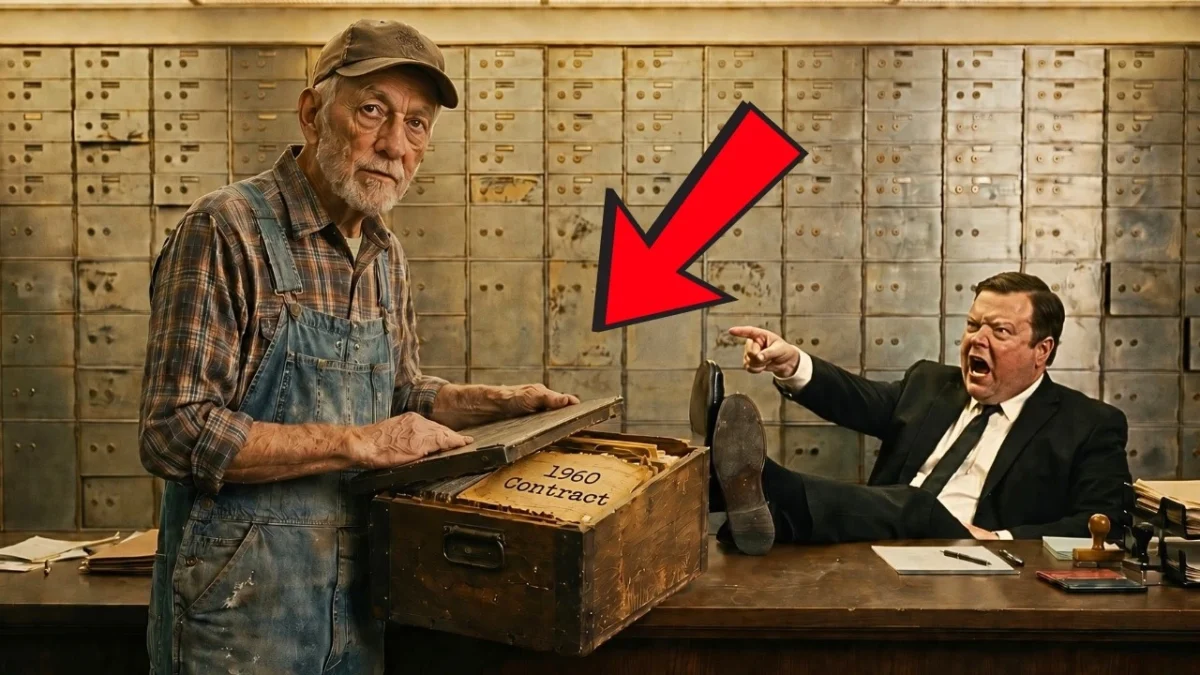
One morning in late autumn, the seventy-one-year-old farmer stepped out onto his porch, pulling his worn canvas jacket tightly around his chest against the crisp country breeze.
He climbed into his beat-up blue pickup truck, the engine turning over with a familiar heavy rattle before idling steadily.
Just as he had done on this exact date every single year for nearly half a century, Arthur Vance put the truck into gear and drove the twenty miles from his quiet homestead into the heart of town.
His farm stretched across one hundred and fifty-four acres of rolling hills in rural Tennessee, land that his father, James Vance, had passed down to him in the early 1970s.
Arthur was a humble, hardworking man who fixed his own fences, plowed his fields with a tractor that had seen decades of soil, and lived entirely by his word.
He was not wealthy in terms of liquid cash, but everyone in the county knew that if Arthur Vance made a promise or signed an agreement, it was as unshakeable as the bedrock beneath his pasture.
He pulled up in front of the local bank, a brick building that had stood on the corner of Main Street since his childhood.
Stepping inside the warm lobby, he took off his hat and approached the counter, reaching into his pocket to draw out three crisp, folded one-dollar bills.
“Good morning, Sarah,” Arthur said softly, placing the exact sum onto the polished wooden counter.
“I’m here to pay the annual fee for safe deposit box number 118, as usual.”
The young teller smiled warmly, reaching out to process the routine payment that had been logged in the bank’s ledgers since long before she was born.
“Good morning, Mr. Vance,” she replied.
“Always right on time.”
However, before her fingers could touch the paper money, a sharp, cold voice interrupted from the doorway of the manager’s office.
“Don’t touch that money, Sarah.”
A tall man in a tailored grey suit stepped forward, holding a thick black leather binder under his arm.
He was Richard Sterling, the newly appointed regional director brought in after a corporate conglomerate had acquired the small local bank earlier that spring.
Sterling extended two fingers and cold-heartedly pushed the three dollars back toward Arthur across the counter.
“Mr. Vance, isn’t it?” Sterling said, his voice entirely devoid of warmth.
“Starting today, this financial institution will no longer accept a three-dollar payment for box 118.”
“Nor will we accept it for any other safe deposit locker under those ancient, non-profitable rates.”
Arthur paused, looking down at his rejected three dollars before lifting his calm blue eyes to meet Sterling’s stern gaze.
“My family has kept box 118 for forty-nine years, sir,” Arthur stated quietly.
“We pay three dollars every year on this exact date.”
“The agreement signed by my father guarantees that fixed rate for as long as the vault stands and the fee is paid on time.”
“I have never missed a single payment, not during the bad droughts, not during the economic downturns.”
Sterling let out a light, dismissive chuckle, leaning his palms on the edge of the counter.
“That was then, Mr. Vance.”
“The modern banking world doesn’t operate on small-town nostalgia or handshake agreements from half a century ago.”
“We are currently auditing and shutting down more than two thousand safe deposit boxes tied to outdated contracts that charge ridiculous fees like three to seven dollars a year.”
“Those lockers occupy valuable physical real estate inside our high-security vault.”
“Standard boxes of that volume now rent for roughly fifty dollars annually.”
“We are bleeding potential revenue by keeping thousands of old boxes active at these absurd heritage prices.”
Arthur did not raise his voice; he simply adjusted his posture and looked directly into the executive’s eyes.
“A contract isn’t an option you throw away when you decide you want to make a higher profit, Mr. Sterling.”
“The bank gave its word to my father.”
“I gave my word to keep up my end of it.”
“I have fulfilled my obligation completely.”
Sterling narrowed his eyes, pulling out a pre-printed form from his binder and slapping it onto the counter next to Arthur’s money.
“We are giving every affected customer two clear options, Arthur.”
“Option one: you sign this waiver today, accept an eighty-dollar cash compensation check, empty box 118 immediately, and surrender the key.”
“Option two: you decline the eighty dollars, and you are granted a strict two-month transition period to find alternative storage for your personal items.”
“At the end of those sixty days, the locker must be surrendered so we can re-lease it at the standard fifty-dollar market rate.”
Arthur didn’t even look down at the sheet of paper.
“I do not want your eighty dollars,” Arthur said firmly.
“And I do not need two extra months to carry my family’s papers home.”
“What I want is to pay my three dollars, just as I have done every year for forty-nine years.”
“I expect this bank to uphold the contract it created.”
Sterling’s expression hardened, his patience clearly running out in the presence of an old farmer who refused to yield to corporate authority.
“Most of our other customers have already taken the eighty dollars or quietly signed the two-month extension without causing a scene,” Sterling snapped.
“You are not an exception to our corporate restructuring.”
“If you refuse to accept either standard option, I am legally obligated to issue you this formal notice.”
Sterling pulled a brightly colored pink document from his folder and wrote box number 118 across the top in dark ink before thrusting it toward Arthur.
“Because you refuse to sign our new agreement or accept our buyout terms, you now have exactly seven calendar days to clear out box 118.”
“If you fail to remove your items within seven days, the bank will drill the lock, seize the box, and take full possession of the contents.”
“Read the final bold line on that page, Mr. Vance.”
Arthur picked up the pink notice and adjusted his reading glasses.
His eyes scanned down the page until he reached the bottom paragraph.
It explicitly stated that any unclaimed or uncollected documents left inside surrendered lockers after the deadline would be logged as abandoned property and systematically destroyed.
Several other bank patrons in the lobby stopped whispering and turned their heads, sensing the rising tension at the counter.
Yet, Arthur remained entirely composed.
He didn’t slam his fist on the wood, nor did he yell at the arrogant man standing before him.
He slowly folded the pink notice into a neat rectangle, slipped it into the front pocket of his work shirt, and looked squarely at the bank manager.
“Mr. Sterling,” Arthur said, his voice dropping into a deep, grave cadence.
“If I were running an institution like this, I would take the time to find out exactly what is sitting inside box 118 before making a final decision to destroy it.”
Sterling laughed out loud, throwing his head back with a sarcastic smirk.
“Oh, please, Arthur.”
“Don’t try to make a few dusty yellowed papers sound like a grand treasure just so you can keep hoarding vault space for three bucks a year.”
“Seven days.”
“Not a single hour more.”
Without another word, Arthur picked up his three dollar bills, put his hat back on, and walked out of the bank into the bright autumn sunshine.
He climbed back into his pickup truck and sat behind the steering wheel for a long moment, staring thoughtfully at the bank’s modern glass double doors.
He didn’t drive around town or stop by the general store to complain to his neighbors.
Instead, he drove straight back to his farm, the tires crunching softly on the gravel driveway as he pulled up beside his farmhouse.
That evening, as the sun dipped behind the timber line, Arthur walked into his bedroom and opened the bottom drawer of an ancient oak dresser.
Beneath a stack of old quilts, he pulled out a small steel lockbox.
Using a tiny key on his keychain, he opened it and retrieved two items: a heavy brass key stamped with the number 118, and a short, handwritten letter dated June 14th, 1960.
The letter was written in the thick, sweeping cursive of his late father, James Vance.
Arthur held the paper under his desk lamp and read the lines he had memorized decades ago.
“Arthur, my son,” the letter began.
“If the day ever comes when the bank tries to force you out of box 118 or threatens to breach our agreement, do not panic.”
“Do not raise your voice, and do not let them see your hand.”
“Before you move a single paper out of that vault, go down to the county clerk’s office and find out what they are planning to do with the undeveloped land directly north of our property line.”
Arthur folded the letter and carefully placed it beside the brass key.
The next morning, long before the bank opened its doors, Arthur was sitting outside the county courthouse.
When the doors unlocked at eight o’clock sharp, he walked straight into the land records department.
“Good morning, Mr. Vance,” the clerk behind the desk said politely.
“What can I look up for you today?”
“I need to see all recent land transactions, zoning modifications, and development permits filed for the parcels adjacent to my northern boundary over the last twelve months,” Arthur requested.
The clerk nodded and began pulling up digital files and retrieving large physical plat maps from the archives.
As Arthur sat at a long oak table reviewing deed after deed, a distinct pattern rapidly began to take shape.
Over the previous eight months, a subsidiary investment corporation—wholly owned by the very same banking entity that had just bought out his local branch—had been quietly purchasing property.
They had acquired or placed heavy option deposits on more than three hundred acres of rough farmland directly behind Arthur’s property.
Arthur requested the accompanying commercial planning applications.
To his astonishment, the filings revealed a massive corporate project: a forty-two-million-dollar regional office park and industrial logistics warehouse facility.
The documents boasted that the site was ideal due to its close proximity to the state highway.
However, as Arthur leaned over the large topographical blueprints, his sharp eyes noticed a critical detail that the out-of-town corporate developers seemed to have glossed over.
The entire three-hundred-acre parcel behind his farm was virtually landlocked by steep rocky ridges on three sides.
The only viable, level ground suitable for heavy commercial traffic, construction vehicles, and main utility lines directly connecting to the state highway ran straight through the northern edge of Arthur’s one hundred and fifty-four-acre farm.
In fact, right there in the bank’s official land survey and appraisal documents submitted to the planning board, the developers had explicitly designated an old, paved access path across Arthur’s northern pasture as the primary entrance corridor for the entire forty-two-million-dollar development.
The bank’s internal appraisal division had factored this exact, guaranteed access route into their valuation, artificially inflating the worth of the raw northern land by millions of dollars.
A quiet, knowing smile spread across Arthur’s weathered face as the final piece of his father’s foresight clicked into place.
Arthur asked the clerk for the historical deed archives dating back to 1960.
He searched through the leather-bound record books until he found the original right-of-way easement recorded between James Vance and the bank sixty-six years prior.
In 1960, the original local bank had foreclosed on a small farm behind the Vance property and needed a temporary road to haul timber and access the site.
James Vance had agreed to grant the bank an easement across his northern parcel, but he was a cautious man who hired a shrewd local attorney to draft the agreement.
Deep within the faded ink of the 1960 land easement contract, Arthur found the special covenant his father had insisted upon inserting.
The clause was unmistakable.
It stated that if the bank, or any successor institution that ever absorbed or purchased the bank, utilized the granted northern access route to purchase, revalue, appraise, or commercially develop any property behind the Vance farm, the Vance family was legally entitled to receive exactly seven percent of the total appraised value of any real estate that directly benefited from that access.
Furthermore, the covenant explicitly noted that the right ran with the land indefinitely and had no expiration date, remaining fully enforceable for as long as the bank maintained its right to cross the property.
To ensure the bank could never claim the easement had been abandoned or modified, James Vance had placed the original executed copy of the 1960 agreement, complete with the official county notary seals and original boundary maps, inside safe deposit box 118.
He had instructed Arthur to maintain the locker continuously, paying the three-dollar annual fee without fail, to keep the contractual chain of custody legally active within the bank’s own vault until the day the bank attempted to exploit the land behind their farm.
On the sixth day of the bank’s seven-day ultimatum, Arthur drove back into town.
He walked calmly into the lobby carrying only his original brass key and the pink notice Sterling had handed him.
He approached the counter and requested the presence of the bank manager and two official employee witnesses to oversee the opening of box 118.
Richard Sterling emerged from his office, a smug grin plastered across his face.
“Ah, Mr. Vance,” Sterling said mockingly.
“I see you finally came to your senses before the deadline expired.”
“Ready to clear out your old trinkets so we can re-lease the space?”
“I am ready to open my box, Mr. Sterling,” Arthur replied plainly.
Accompanied by Sarah and another senior teller, Sterling led Arthur down into the cool, fluorescent-lit vault.
Arthur inserted his key alongside the bank’s master key, turned the lock, and pulled out the long metal container.
He carried it to a small viewing table and lifted the lid.
Inside the box, there was no stack of cash, no velvet pouches of gold coins, and no expensive stock certificates.
There was only a faded black-and-white photograph of James Vance, an old brass seal, a hand-drawn land map, and the original, yellowed 1960 easement contract.
Sterling leaned over Arthur’s shoulder, glancing down at the yellowed paper with an exaggerated sigh of disappointment.
“Is this it?” Sterling scoffed.
“You made a dramatic scene over a sixty-six-year-old piece of paper signed when farmland around here wasn’t worth the dirt on your boots?”
“How embarrassing.”
Arthur did not lose his temper, nor did he mention the seven percent clause or the commercial development.
He carefully gathered the documents, placed them into a manila folder, and looked at Sarah.
“Sarah, please log in the vault record book that box 118 was opened today, and stamp a formal written receipt confirming that these specific original 1960 documents were retrieved directly from this locker in the presence of the branch manager.”
Sarah looked at Sterling, who waved his hand dismissively.
“Fine, fine, stamp his paper so he can be on his way,” Sterling ordered.
“Box 118 is now officially surrendered and closed.”
Once the receipt was stamped, Arthur turned back to Sterling with a calm, steady gaze.
“Now, Mr. Sterling, as a property owner whose land abuts your corporate development site, I am requesting formal copies of your bank’s recent commercial appraisals and access site plans for the northern project.”
Sterling blinked, momentarily caught off guard by Arthur’s sudden use of precise legal terminology, but he quickly recovered his arrogance.
“Those are public planning documents filed with the county anyway, Arthur,” Sterling said, gesturing to a clerk to print the files.
“Take whatever you like.”
“It won’t change the fact that your three-dollar locker is gone.”
That evening, Arthur called his son, Thomas Vance, a practicing real estate attorney in Nashville.
Thomas drove down to the farm immediately.
For hours, the father and son sat at the kitchen table beneath the warm light of a single hanging bulb, spreading out the 1960 contract, the county land deeds, the bank’s certified appraisal reports, and the newly printed site maps.
Thomas ran the numbers on a calculator three times, his hands trembling slightly as he verified the figures.
“Dad, this is incredible,” Thomas breathed, looking up at his father in absolute awe.
“The bank’s own appraisal department valued the parcels that directly depend on your northern road for commercial access at five point eight million dollars.”
“Under paragraph four of Grandfather’s 1960 covenant, you are entitled to exactly seven percent of that appraised value.”
“Seven percent of five point eight million dollars is four hundred and six thousand dollars!”
Thomas looked at Arthur, a mixture of shock and admiration in his eyes.
“Did Sterling have any idea what was sitting inside that box when he threatened to throw it in an incinerator?”
Arthur shook his head slowly.
“He saw three dollars, Thomas.”
“He couldn’t see the value of a promise.”
Three days later, Arthur walked back into the bank lobby, dressed in his finest Sunday suit.
He didn’t bring three dollars this time.
Instead, he carried a thick, formal legal packet prepared by his son’s law firm.
He walked directly past the teller counter and knocked on the door of the manager’s office.
“Come in,” Sterling called out irritably.
Arthur stepped inside, closed the door, and placed the thick envelope directly onto Sterling’s desk.
“What is this, Arthur?” Sterling asked, pushing his glasses up his nose.
“A formal demand for payment, Mr. Sterling,” Arthur stated calmly.
“Inside that envelope, you will find a copy of the 1960 right-of-way covenant retrieved from box 118, a certified county title search confirming the easement’s continuous validity, and your own bank’s commercial appraisal report for the northern development.”
“Page four outlines the four hundred and six thousand dollars currently owed to my family under the terms of the covenant your institution inherited.”
Sterling’s face flushed red as he pulled the documents out and began reading the highlighted legal clauses.
His eyes darted back and forth across the page, his arrogant composure visibly collapsing with every line he read.
He re-read the page a second time, his hands beginning to sweat against the crisp white paper.
“This… this is absurd!” Sterling stuttered, his voice rising sharply.
“This contract is ancient!”
“Our legal department will review this claim, but I can tell you right now, we won’t pay a single cent of this extortion!”
“You have thirty days to settle the payment claim in full, Mr. Sterling,” Arthur replied calmly.
“If the balance is not remitted to my legal counsel within thirty days, we will see you in court.”
Thirty days passed without a payment.
True to form, the bank’s corporate legal team sent a cold, formal rejection letter, asserting that the 1960 contract was far too old to be enforceable, that no prior claims had been made under its terms for decades, and that it could not possibly apply to a modern, multi-million-dollar commercial enterprise.
They believed the old farmer would simply crumble when faced with the prospect of an expensive legal battle against a powerful banking corporation.
They were dead wrong.
Two weeks later, Richard Sterling, accompanied by three senior corporate defense attorneys, found himself sitting inside a packed courtroom at the county courthouse.
Sitting across from them at the plaintiff’s table was Arthur Vance, flanked by his son Thomas.
Presiding over the case was Judge Eleanor Vance—no relation to the family—a sharp, formidable magistrate known for her strict adherence to property law.
The bank’s lead defense attorney stood up, straightening his suit jacket as he presented his opening argument to the bench.
“Your Honor,” the attorney began confidently.
“The plaintiff is attempting to weaponize an obscure, sixty-six-year-old document to extract over four hundred thousand dollars from my client’s modern development project.”
“This 1960 easement was created in a completely different era when land values were negligible.”
“Furthermore, because the Vance family never exercised or claimed compensation under this specific clause for nearly half a century, we argue that the covenant has legally lapsed due to abandonment and laches.”
“It would be unconscionable to enforce such an ancient burden on a contemporary commercial transaction.”
When the defense sat down, Thomas Vance stood up quietly.
He did not deliver a long, dramatic speech.
He simply walked up to the bench and submitted three items into evidence.
“Your Honor,” Thomas said clearly.
“Exhibit A is the original, continuous chain of title for the easement, proving that the right-of-way was never abandoned.”
“Exhibit B is the certified receipt from the bank, proving my father kept safe deposit box 118 active without missing a single annual payment for forty-nine consecutive years specifically to maintain the legal record of this covenant inside the defendant’s own vault.”
“And Exhibit C is the bank’s own internal commercial appraisal, which explicitly uses my father’s northern land access to justify a five point eight million dollar valuation on their land locked parcels.”
Judge Eleanor Vance carefully examined each document, reading through the clear, explicit language of the 1960 agreement.
She turned her gaze down toward the bank’s defense team.
“Counsel,” Judge Vance asked, her voice echoing coldly through the courtroom.
“Does the five point eight million dollar commercial valuation in your client’s official planning filing rely upon access across Mr. Vance’s property?”
The defense attorney squirmed in his seat, glancing nervously at Sterling before clearing his throat.
“Well, Your Honor, while the access route is a factor, the broader zoning and market dynamics—”
“Answer the question directly, Counselor,” Judge Vance interrupted sharply.
“Does the valuation rely on that access?”
“Yes, Your Honor,” the attorney admitted quietly.
Judge Vance then picked up the bright pink seven-day eviction notice that Sterling had issued to Arthur weeks earlier, placing it directly beside the 1960 contract.
She looked sternly at Richard Sterling, who lowered his head in embarrassment.
“Mr. Sterling,” Judge Vance said, her eyes flashing with anger.
“Do you realize that in your relentless, short-sighted quest to squeeze fifty dollars out of an old vault locker, your profit-driven program almost led this bank to destroy the very legal document proving a four-hundred-and-six-thousand-dollar obligation owed by your own institution?”
“The sheer arrogance and negligence displayed here is staggering.”
Judge Vance adjusted her glasses and began reading her formal ruling into the record.
“The court finds that the 1960 covenant is fully valid, legally binding, and currently enforceable.”
“The covenant ran continuously with the land, and the plaintiff maintained perfect contractual performance by renewing box 118 every single year.”
“The defendant bank triggered the seven percent clause entirely through its own actions when it acquired the northern parcels, incorporated the Vance land into its master development plans, and used that access to inflate its commercial appraisal.”
“I hereby order the defendant bank to pay Arthur Vance the full requested sum of four hundred and six thousand dollars, along with all associated court costs and attorney fees.”
“Furthermore,” Judge Vance continued, slamming her gavel down with a loud crack.
“This court issues an immediate injunction halting the bank’s nationwide program to unilaterally seize and destroy the contents of over two thousand heritage safe deposit boxes.”
“The bank is ordered to conduct a full, independent legal audit of every legacy contract before taking any further action against its long-time account holders.”
The courtroom erupted into quiet murmurs as the bank’s legal team sat in stunned silence.
The court-ordered audit that followed sent shockwaves through the bank’s executive board.
As thousands of long-forgotten lockers were carefully opened and reviewed under judicial supervision, hundreds of families discovered ancient land deeds, water rights agreements, mineral reservations, and historical easements that previous generations had stored away for safekeeping.
The corporate fallout was swift and severe.
An internal investigation into Richard Sterling’s reckless, profit-seeking scheme led to his immediate termination from the financial institution, his corporate career irreparably damaged by the scandal.
A few days after the court victory, Arthur Vance stood on the quiet, windy hill overlooking his northern pasture.
The evening sun cast long, golden shadows across the rolling grass that his family had tended for generations.
In his hand, he held the original 1960 contract, its yellowed edges fluttering gently in the breeze.
Arthur walked slowly up the small knoll behind his farmhouse to the quiet family cemetery where his parents lay at rest.
He knelt beside his father’s headstone, gently placing his hand on the cold, carved granite.
“We kept the box active, Dad,” Arthur whispered softly, a tear tracing a path down his weathered cheek.
“We paid the three dollars every single year.”
Arthur laid a copy of the court judgment against the headstone, placing a small river stone on top to hold it against the wind.
His father could never have predicted the exact year or the exact manner in which the bank would come for their land.
Yet, James Vance had understood a fundamental, timeless truth about human nature.
He knew that while honsety and patience often go unnoticed for decades, greed eventually creates its own trap.
And when that day finally arrived, three simple dollars and a kept promise were all it took to make justice prevail.








