The Bank Sold Him 43 Starving Bison for $1,200 – Months Later, Breeders Begged for Their Calves
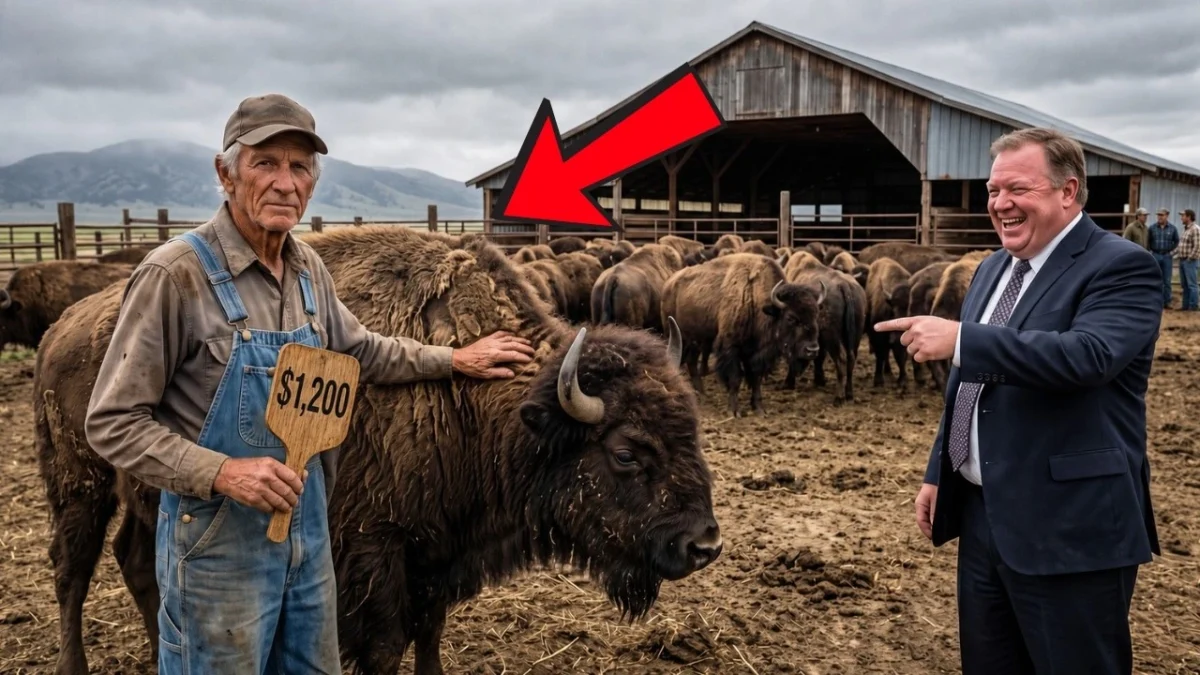
It was the coldest autumn in forty years when the auction block was set up behind the abandoned Miller ranch.
The wind howled off the northern plains, whipping dust and dried grass against the corrugated iron walls of the barn.
Standing in the center of the ring were forty-three bison.
They were bone-thin, their ribs protruding like rows of fence posts beneath matted, dirt-encrusted coats.
Their sunken eyes stared blankly ahead, hollowed by months of neglect after the bank had foreclosed on the original owner.
At the front of the crowd stood Richard Vance, the president of First National Bank.
He was a heavy-set man, wrapped in a plush wool coat that stretched tight across his stomach, his face flushed from the cold and his own self-importance.
He held a clipboard and tapped his expensive leather boots against the frozen ground.
“Look at them,” Vance called out to the gathered crowd of local ranchers and speculators, his voice dripping with loud amusement.
“The bank just wants this land cleared for the new commercial corridor project.
We aren’t in the business of feeding dying livestock.
Starting bid for the whole lot… let’s say five hundred dollars.”
Silence fell over the crowd.
A few men chuckled nervously; others simply shook their heads.
“They won’t make it to December, Richard,” one rancher shouted back.
“You’re selling hide and bones.
It’ll cost more to haul their carcasses away than they’re worth.”
“Six hundred,” a voice called out from the back of the crowd.
Vance squinted, pulling his collar up against the wind.
An old man stepped forward, leaning lightly on a worn wooden walking stick.
It was Thomas Miller.
He wore a faded denim jacket, patched at the elbows, and a battered felt hat that had seen fifty harvests.
His hands were rough and calloused, scarred by decades of hard labor on his small, modest farm just adjacent to the seized property.
Vance let out a booming laugh that echoed through the muddy yard.
“Thomas?
You can barely pay your own land taxes, and you want to buy forty-three dead animals?”
Thomas did not smile.
He kept his gaze fixed on the animals in the pen.
While others saw only starvation, Thomas saw the way the bison held their heads.
He noticed the steady, rhythmic breathing of the lead cow, the alert twitch of her ears whenever the gates slammed, and the clear, unclouded gaze in her dark eyes.
Fifty-two years of working the soil had taught him the difference between a creature dying of disease and one simply deprived of nourishment.
“Seven hundred,” another voice bid sarcastically from the crowd, just to stir the pot.
“Eight hundred,” Thomas said calmly.
Vance sneered, stepping closer to the edge of the ring.
“Thomas, be reasonable.
If you waste your money on this trash, you won’t have a cent left for your mortgage come spring.
The bank won’t extend your line of credit again.”
“Nine hundred,” someone yelled.
“Twelve hundred dollars,” Thomas said, his voice quiet but resolute, cutting through the murmurs of the crowd.
The auctioneer looked around, holding his gavel high.
“Twelve hundred once… twice… sold to Thomas Miller for twelve hundred dollars!”
Vance shook his head, looking down at Thomas with a mix of disdain and pity.
“You just threw your life savings into a ditch, old man.
Mark my words, they’ll all be rotting under the snow before the first major blizzard, and I’ll be taking your keys by April.”
Thomas walked past the banker without saying a word, pulling a worn leather pouch from his coat pocket to settle the bill with the clerk.
As the crowd dispersed, Thomas approached Dr. Samuel Evans, the town’s veteran veterinarian, who was standing near the loading chutes.
“Sam,” Thomas said, resting his hand on the wooden gate.
“Take a look at them for me.
Tell me if I’ve completely lost my mind.”
Dr. Evans stepped up to the rails, adjusting his wire-rimmed glasses as he inspected the herd.
He watched the animals for several long minutes before turning back to Thomas.
“They’re on the absolute brink, Thomas.
Severe dehydration, extreme malnutrition, and their digestive systems are completely shut down from eating weeds and dirt.
If you overload them with rich feed right now, their stomachs will rupture and they’ll die in hours.”
“Can they be saved?” Thomas asked directly.
Dr. Evans sighed, rubbing the back of his neck.
“It’s a tightrope walk.
Slow rehydration, low-protein hay, constant monitoring, and a lot of luck.
It’s going to cost you everything you have left, Thomas.”
“Then let’s get to work,” Thomas said.
He called his long-time neighbor, Joe, who owned a heavy-duty livestock trailer.
Together, they spent the next six hours carefully loading the weak animals, transport by transport, back to Thomas’s farm.
The work was painstaking; some of the bison were so weak they had to be supported with canvas straps just to walk up the ramp.
By the time the last trailer was unloaded, darkness had completely fallen over the valley.
Thomas immediately went to work in his barn.
He divided his pasture into smaller paddocks using temporary wire fencing.
He placed the strongest animals in the outer pasture and kept the weakest twelve near the main barn, where he could monitor them around the clock.
Every morning before dawn, he hauled buckets of fresh, tepid water to the troughs, adding small amounts of electrolytes prescribed by Dr. Evans.
He rationed his low-protein grass hay, scattering it in small, frequent intervals so the animals’ digestive tracts could slowly readapt.
His savings bled out rapidly.
Feed bills, veterinary medications, fencing supplies, and fuel drained his remaining bank account week after week.
Then, in early November, the weather turned violently.
A massive Arctic front swept across the region, dropping temperatures far below zero and burying the pastures under two feet of dense snow.
The wind howled through the cracks of the old barn, freezing the water pipes and damaging the boundary fences.
One night, as the blizzard raged outside, Thomas walked out to the lower shelter with a lantern.
Lying in a deep snowdrift was an old female bison, the weakest cow from the auction.
Her coat was thin, her ribs visible even under the snow, and her breathing was dangerously slow.
Her head rested motionless on the frozen ground.
Thomas dropped to his knees beside her, brushing the snow off her face.
“Come on, girl,” he whispered, his breath clouding in the freezing air.
“Don’t give up now.
You didn’t come this far to die in the dark.”
He ran back to the house, grabbed several heavy wool blankets, and hauled two buckets of warm water back to the shed.
He wrapped the cow, rubbed her frozen flanks to stimulate circulation, and poured warm water into a shallow pan, holding it right under her nose.
Dr. Evans arrived an hour later, his truck barely making it through the snowdrifts.
He knelt in the straw beside Thomas, checking the animal’s weak pulse.
“Her core temperature is dangerously low, Thomas,” Dr. Evans said softly, shaking his head.
“Her body is shutting down.
I can give her an injection of stimulants, but honestly… I don’t think she’ll see the sunrise.”
“Do what you can, Sam,” Thomas said, settling down onto an upturned bucket.
“I’m staying right here with her.”
“Thomas, you’ll freeze out here yourself,” Dr. Evans warned.
“I’ve got my coat and my lantern,” Thomas replied firmly.
“She needs to know she isn’t alone.”
Dr. Evans administered the injection, offered a sympathetic pat on Thomas’s shoulder, and headed back out into the storm.
For hours, Thomas sat in the freezing draft, checking the cow every twenty minutes, gently speaking to her, rubbing her neck, and keeping fresh water nearby.
Around four in the morning, the blizzard finally began to subside, leaving a heavy, suffocating silence in its wake.
The cow’s chest heaved suddenly.
She let out a low, raspy breath.
Slowly, painfully, she tucked her front legs beneath her chest and pushed upward.
She wobbled violently, her joints popping in the cold, and crashed back into the straw.
“Easy, easy,” Thomas murmured, reaching out to steady her shoulder.
“Take your time.”
The cow rested for a moment, her nostrils flaring.
Then, with a sudden surge of raw determination, she lunged forward, straightened her hind legs, and stood upright.
She swayed slightly, but her head remained high.
She leaned down and drank deeply from the bucket of warm water.
Thomas let out a long breath he hadn’t realized he was holding, tears freezing on his weathered cheeks.
“You’re a fighter,” he said softly, running his hand along her rough neck.
“Your name is Hope.”
In the weeks that followed, Hope became the anchor of the herd.
Though she remained lean, her energy returned with unbelievable vigor.
When the snow crushed the natural grass, Hope used her massive head and powerful hooves to plow through the hard crust of ice, uncovering the dormant grass beneath.
The rest of the herd watched her and quickly followed her lead, forging paths through the deep drifts that allowed them to graze even in the worst weather conditions.
Thomas observed this behavior with growing fascination.
Commercial bison usually stood near the feeders waiting for hay, but these animals displayed wild, ancient instincts for survival.
They moved as a synchronized unit, protecting the weaker calves and finding shelter in natural ravines away from the biting wind.
However, just as the herd began to stabilize, trouble arrived from town.
Richard Vance sat in his air-conditioned office at First National Bank, looking over the land deeds of the valley.
The bank had acquired three thousand acres from the bankrupt estate next to Thomas’s farm, but the development consortium required a minimum of four thousand continuous acres to build their planned commercial hub and freight terminal.
Thomas’s eight hundred acres sat directly in the middle of the proposed map.
Vance picked up his telephone and dialed the regional agricultural supply cooperative.
“Mark,” Vance said into the receiver, leaning back in his leather chair.
“This is Richard Vance.
I want the bank’s investment group to buy up every available bale of alfalfa and grass hay within a fifty-mile radius today.
Pay top dollar.
Clear out the barns.”
“Every bale, Richard?” the manager asked, surprised.
“That’s going to drive local prices through the roof.”
“Just do it,” Vance ordered with a cold smile.
“I have a specific market correction in mind.”
Within forty-eight hours, local hay prices tripled.
When Thomas drove his old pickup to the supply depot to buy his weekly feed, the yard was empty.
“Sorry, Thomas,” the manager said, looking down at his desk in embarrassment.
“A corporate buyer cleaned us out.
What little is left coming from out-of-state is going for thirty dollars a bale.”
Thomas stared at him in disbelief.
“Thirty dollars? That’s four times the normal rate.
I can’t afford that.”
“I know, Thomas.
Word is… the bank was behind the purchase.”
Thomas returned to his farm with an empty truck bed.
His remaining hay stack was down to three days of feed.
To make matters worse, a formal notice arrived in his mailbox that afternoon: his quarterly mortgage payment was due in ten days, and the bank had denied his request for a routine seasonal extension.
Sitting at his kitchen table under the yellow glow of a single lightbulb, Thomas spread out his financial ledgers.
The numbers were brutal.
If he spent his remaining cash on overpriced hay, he would default on the mortgage.
If he paid the mortgage, the herd would starve within a week.
The next afternoon, a sleek black sedan pulled up the gravel driveway.
Richard Vance stepped out, impeccably dressed, carrying a leather briefcase.
He walked over to where Thomas was mending a gate strap.
“Beautiful day, isn’t it, Thomas?” Vance said smoothly, looking around at the snowy pastures.
“I hear feed is getting hard to come by.”
Thomas did not drop his pliers.
“What do you want, Richard?”
Vance opened his briefcase and pulled out a stapled document.
“I’m here to offer you a lifeline.
The bank understands you’re in an impossible situation.
We are willing to assume your mortgage, pay off all your outstanding agricultural debts, and buy this farm outright.
We’ll even take those bison off your hands so you don’t have to watch them starve.”
Thomas took off his work gloves slowly.
“And what are you offering for the land?”
“Two hundred thousand,” Vance said with a patronizing smile.
“It’s more than fair given your current financial distress.”
“This land is worth at least six hundred thousand on the open market,” Thomas said coldly.
“And with your new development project next door, it’s worth double that to you.”
Vance’s smile faded, his eyes narrowing.
“Without hay, your bison die next week.
Without money, I foreclose on this property next month.
Sign the papers, Thomas.
Take the money, rent a nice apartment in town, and enjoy your retirement.
Stop playing the hero.”
Thomas took the document from Vance’s hand, looked at it for a second, and then neatly tore it in half.
He tossed the pieces onto the hood of Vance’s sedan.
“Get off my property, Richard.”
Vance’s face turned bright red.
“You stubborn old fool!
You’ll lose everything!
I’ll make sure you don’t get a single dollar when the sheriff puts this place on the auction block!”
He slammed his car door and sped off, throwing gravel across the drive.
With his back against the wall, Thomas implemented a radical grazing plan.
Instead of relying on hay, he opened up long-abandoned sections of his property—forested hillsides and brush-covered ravines that he had left untouched for decades.
He divided the entire farm into sixteen micro-pastures, using lightweight wire to move the herd every forty-eight hours.
“Rotational grazing,” he explained to Dr. Evans, who stopped by a few days later to check on the situation.
“If I keep them moving, they eat the top half of the native winter forage without killing the root.
It gives the previous section time to rest under the snow.
They’re finding native big bluestem and wild rye that’s been buried for years.”
Dr. Evans watched as the bison effortlessly stripped dead wood and forged through frozen brush, thriving on forage that domestic cattle would have ignored.
“They aren’t just surviving, Thomas,” Dr. Evans said in awe.
“They’re actually putting on weight.
Look at their coats.”
Week by week, Thomas squeezed through the winter.
He cut his hay consumption by eighty percent through meticulous management.
When spring finally arrived, breaking the ice and melting the snowpacks, the results defied every expectation in the valley.
Out of the forty-three starving animals bought for scrap value, forty-two had survived the winter.
Only one aged bull had passed away peacefully of old age in late January.
The rest of the herd was transformed.
Their skeletal frames were now covered in thick, powerful muscle.
Their coats were deep chocolate brown, glossy and full.
Dr. Evans conducted a full herd health examination in early May.
As he ran the animals through the chute to check their vital signs and bloodwork, his eyes went wide.
“Thomas,” Dr. Evans called out, leaning over the chute with a ultrasound scanner.
“Come look at this monitor.”
Thomas stepped up, peering at the black-and-white screen.
“What am I looking at, Sam?”
“That’s a fetus,” Dr. Evans said, his voice trembling slightly with excitement.
“A healthy, strong fetus.
Thomas… I’ve scanned twenty cows so far.
Nineteen of them are pregnant.”
Thomas rested his hand against the side of the wooden chute.
“Nineteen?”
“They were bred right before the bank seized the original ranch,” Dr. Evans explained.
“Because they were starving, their bodies suppressed the visible signs of pregnancy.
Now that you’ve restored their nutrition, the calves are developing rapidly.
You aren’t just holding forty-two bison, Thomas.
You’re about to have a herd of over sixty.”
A few days later, Thomas was helping Dr. Evans shed the remaining winter coats off the core animals to treat them for spring parasites.
As Thomas worked a currycomb over Hope’s left flank, removing a massive clump of matted winter fur, he noticed a dark patch of hair beneath.
He brushed harder, clearing away the dust.
Scared into the hide was a distinct, raised mark.
It was a stylized crown with three sharp points.
Thomas stopped, rubbing his thumb over the old mark.
“Sam, come take a look at this.
Is this a ranch brand?”
Dr. Evans walked over, wiped his glasses, and bent down to inspect the mark closely.
He gasped, reaching out to trace the three points of the crown.
“My God… Thomas, do you know what this is?”
“No idea.
Looks like a crown.”
“It’s the Red Crown mark,” Dr. Evans said, his voice dropping to a low whisper.
“Thirty years ago, the National Bison Genetics Conservation Project established the Red Crown bloodline.
It was a secret, highly controlled breeding program designed to preserve pure American plains bison genetics without any interbreeding with domestic cattle.
Red Crown animals were legendary—they could process low-quality forage, withstand extreme Arctic temperatures, and had incredible disease resistance.”
“I thought that project was dissolved,” Thomas said.
“It was,” Dr. Evans replied.
“When funding dried up, the original herd was auctioned off to private ranches across North America.
Most of the bloodlines were lost or diluted through crossbreeding.
If these animals carry the Red Crown brand… you aren’t holding ordinary livestock.
You are holding pure, un-hybridized genetic royalty.”
Thomas checked the rest of the herd over the next two days.
Fourteen of the older cows and two of the bulls carried the faint, faded three-pointed crown mark.
“We need to prove it,” Dr. Evans urged.
“A brand is evidence, but high-end conservation buyers and purebred registries require full DNA sequencing.
If we send tail hair samples to the Texas Livestock Genetics Laboratory, we can get a definitive genetic profile.”
Thomas looked down at his bank book.
The genetic panel for forty-two animals, plus expediting fees and official certification paperwork, would cost nearly three thousand dollars.
He had less than two hundred dollars left in his account.
That evening, Thomas walked out to his old equipment shed.
Parked in the back corner, covered under a canvas tarp, was a 1972 Chevrolet pickup truck.
It had belonged to his wife, Sarah, who had passed away six years prior.
It was her prized possession—a beautifully preserved classic with original red paint and chrome bumpers.
He had refused to sell it despite dozens of lucrative offers over the years.
Thomas pulled off the tarp.
He ran his hand along the smooth hood, looking at his reflection in the polished red paint.
“Sarah,” he whispered into the quiet shed.
“I need your help one last time.”
The next morning, Thomas drove the red pickup into the neighboring county and sold it to a classic car collector for three thousand five hundred dollars.
He took the cash straight to the post office, paying for the overnight shipping of the DNA kits to the university laboratory.
Word of the truck sale spread through town instantly.
At the local diner, Richard Vance sat with several town council members, laughing over coffee.
“The old man has finally lost his mind completely!” Vance announced loudly.
“He sold his late wife’s truck—the only thing of value he had left—just to pay for some bogus DNA test on a bunch of scabby bison!
He’s chasing ghosts.
In two weeks, the test results will come back negative, he’ll be dead broke, and I’ll acquire his farm for pennies on the dollar.”
Thomas heard the rumors, but he said nothing.
Every morning, he rose at four, fed his herd, checked the water troughs, and waited.
Before the laboratory results could arrive, the valley was hit by an unseasonal late-spring drought.
For six weeks, not a single drop of rain fell.
The temperature soared into the nineties.
The lush green pastures turned dry and brittle, and the water table dropped precipitously.
On a boiling Tuesday afternoon, Thomas pulled the lever on his main well pump.
The motor whined loudly, sputtered, and emitted a thick cloud of black smoke.
No water came out of the pipe.
The primary well pump had completely seized.
Thomas ran to the pasture.
The bison were gathered around the dry troughs, panting in the heat.
The pregnant cows were visibly distressed.
He checked his bank account—zero dollars.
The money from the truck sale had all gone to the laboratory.
Refusing to panic, Thomas pulled out his old mechanical toolbox.
He spent eighteen brutal hours under the blazingly hot sun, disassembling the ancient pump motor piece by piece.
He salvaged parts from an old tractor engine sitting behind his barn, hand-filing a custom copper bushing to replace the melted bearing.
He rewired the capacitor using spare electrical lines, his hands bleeding and covered in black grease.
At three o’clock the next morning, he flipped the manual switch.
The modified motor groaned, vibrated violently, and then began to hum smoothly.
A thick, steady stream of cold water burst from the pipe, filling the troughs.
Thomas collapsed against the wooden fence, drenched in sweat and dirt, watching as the herd rushed forward to drink.
Later that same morning, Vance’s sedan kicked up dust as it sped up the driveway.
Vance stepped out, holding a formal Notice of Foreclosure Intent.
“Your well is dead, Thomas,” Vance said, throwing the paper onto the porch table.
“The drought is going to bake what little grass you have left.
The bank is filing foreclosure paperwork based on your impending insolvency.
Sign the voluntary transfer now, and I’ll give you five thousand dollars moving cash.
Otherwise, you get thrown off by the sheriff with nothing.”
Thomas picked up the notice, looked Vance directly in the eye, and crumpled the paper into a tight ball.
“The well is running, Richard.
The bison are drinking.
And you are standing on private property.
Get off my land.”
Vance glared at him, his face twisting in rage.
“You’re going to rot out here, old man!
You hear me?
Rot!”
Three days later, the calving began.
Despite the brutal heat and the dry pastures, the bison cows showed extraordinary resilience.
Hope was the first to give birth, delivering a robust, dark-red calf in the shade of a large oak tree.
Within twenty minutes of birth, the calf was standing on its feet, nursing eagerly.
Over the next two weeks, nineteen calves were born.
Eighteen survived without a single human intervention.
The mothers produced abundant milk despite the dry forage conditions, aggressively protecting their young from coyotes and displaying perfect maternal instincts.
Dr. Evans examined the newborn calves, shaking his head in sheer disbelief.
“It’s miraculous, Thomas.
Commercial bison calves in this drought have a thirty percent mortality rate right now.
Yours have a ninety-four percent survival rate.
They have the true Red Crown vigor.”
Six weeks after the hair samples were sent, an official thick courier envelope arrived at Thomas’s front door.
Thomas sat at his kitchen table, his hands trembling slightly as he opened the seal.
Dr. Evans sat across from him, sipping a cup of black coffee.
Thomas pulled out the multi-page genetic analysis report from the Texas Livestock Genetics Laboratory.
He scanned down the cover letter to the summary paragraph written by the head geneticist, Dr. Aris Thorne.
Dr. Evans leaned forward.
“What does it say, Thomas?”
Thomas read the text aloud, his voice steadying with every word:
“‘…Results confirm that of the 42 adult subjects tested, 32 possess intact genetic markers corresponding directly to the original 1984 Red Crown Conservation Lineage, exhibiting less than 0.05% domestic cattle genomic introgressions.
Furthermore, the 18 surviving offspring display an unprecedented 99.2% genetic purity index.
This herd represents the largest single intact, self-sustaining breeding nucleus of pure Red Crown Plains Bison remaining in North America.
Estimated conservation value of the herd: extraordinary.'”
Dr. Evans let out a loud shout, slamming his fist onto the table in joy.
“I knew it!
You did it, Thomas!
You were right from the very first minute!”
Attached to the report was an official valuation assessment from the National Purebred Bison Association.
A certified Red Crown breeding cow was valued at forty thousand dollars.
A purebred calf was worth fifteen thousand.
The total estimated value of Thomas’s $1,200 auction purchase was now over ONE MILLION DOLLARS.
News of the laboratory report hit the agricultural registry networks like a tidal wave.
Within twenty-four hours, Thomas’s landline phone began ringing non-stop.
Prominent conservation ranches from Montana, state wildlife foundations, and elite private breeders from across the country were calling, desperate to secure breeding contracts for the Red Crown calves.
On Friday morning, as Thomas was talking on the phone with a representative from the American Bison Society, three vehicles pulled up his driveway.
The lead vehicle was Richard Vance’s bank car, followed by two police cruisers and a sleek silver SUV carrying a high-priced corporate attorney from the city.
Vance stepped out of his car, carrying a thick leather binder, accompanied by the town Sheriff and his lawyer.
“Thomas Miller!” Vance shouted, walking up to the barn where Thomas was standing with Dr. Evans.
“Stand down.
This property and all assets upon it are being secured by First National Bank.”
Thomas walked out into the sunlight, leaning calmly on his walking stick.
“What are you talking about, Richard?”
The corporate attorney stepped forward, adjusting his tie.
“Mr. Miller, I represent First National Bank.
We have filed an emergency injunction and writ of replevin.
Our records indicate that the bison herd purchased by you at auction was subject to a prior perfected security interest under a umbrella commercial loan agreement executed by the former ranch owner.
Because the bank held a prior blanket lien, the liquidation auction was legally invalid.
The bison—and all their offspring—remain the exclusive property of First National Bank.”
Dr. Evans stepped forward angrily.
“You predatory bastards!
You auctioned them off as trash when you thought they were dying, and now that Thomas saved them and proved their genetic value, you want to steal them back?!”
“Business is business, Doctor,” Vance sneered, a triumphant grin spreading across his face.
“Sheriff, please execute the seizure writ and impound the animals.”
The Sheriff looked uncomfortable, turning to Thomas.
“Thomas… do you have your original paperwork from the auction?”
“I do,” Thomas said quietly.
He reached into his denim jacket pocket and pulled out a clean, plastic-slipped folder.
“My lawyer told me you might try something like this, Richard.”
Thomas handed the folder to the Sheriff.
“Look at page three, Sheriff.
That’s the bill of sale signed by the court-appointed bankruptcy trustee and the bank’s own liquidator.”
The attorney scoffed.
“A standard trustee bill of sale does not override a perfected blanket lien—”
“Read the asset schedule number, Sheriff,” Thomas interrupted, pointing his calloused finger at the page.
“And then look at the lien document Vance just handed you.”
rights reserved. The Sheriff compared the two documents, his brow furrowing.
“Richard,” the Sheriff said, turning to Vance.
“The asset number on your lien document is #B-409, covering ‘Commercial Cattle and Livestock Equipment.’
The bill of sale for Thomas’s auction purchase lists Asset Schedule #B-412, specifically marked ‘Abandoned Non-Standard Wildlife – Unencumbered Scrap Disposition.'”
“What?!” Vance yelled, snatching the papers from the Sheriff’s hands.
“That’s a clerical error!
It’s the same herd!”
“It’s not a clerical error,” Thomas said, his voice cut like steel.
“Your bank intentionally classified them as ‘Unencumbered Scrap’ on the legal bankruptcy filings so you wouldn’t have to pay the state-mandated livestock maintenance fees while the land was pending development.
You officially declared to the federal court that these animals had zero financial value and carried no liens, just so you could wash your hands of them.”
The corporate attorney quickly read the trustee bill of sale, his face draining of color.
He pulled Vance aside, speaking in a harsh, hurried whisper.
“Richard, drop this immediately.
If this trustee filing is challenged, the court will audit the bank’s entire bankruptcy asset classification.
You signed a sworn affidavit stating these animals were unencumbered scrap.
If you claim otherwise now, you are admitting to federal bankruptcy fraud.”
Vance stood frozen, his mouth open, his eyes darting frantically between his lawyer and the legal documents.
“Furthermore,” Thomas continued, stepping closer to Vance.
“I have a signed statement here from your former loan officer, Mark Stevens.
He confirmed in writing that you personally saw the Red Crown brands on the cows before the auction, refused to pay five hundred dollars for genetic testing, and deliberately rushed the sale so you could force me into foreclosure later and take my land.”
Vance’s face turned ghostly pale.
He looked at the Sheriff, who was now staring at him with deep disgust.
“We… we are done here,” the attorney declared quickly, grabbing Vance by the arm and shoving him toward the car.
“We are withdrawing the injunction.”
“Wait, Richard!” Thomas called out.
Vance paused at his car door, trembling with rage and embarrassment.
Thomas pulled a certified cashier’s check out of his pocket.
“This is forty-two thousand dollars, drawn from the deposit made this morning by the Montana Bison Sanctuary for the purchase of two purebred calves.
It pays off my mortgage, my land taxes, and all interest owed to First National Bank in full.”
Thomas tossed the check onto the hood of Vance’s car.
“I want my land deed stamped ‘PAID IN FULL’ by five o’clock today.
If it isn’t on my table by then, my lawyer files the fraud lawsuit with the federal banking commissioner.”
Vance didn’t say a word.
He got into his sedan, slammed the door, and drove away so fast the tires screeched against the asphalt.
By the end of the month, Thomas had transformed his operation.
With the proceeds from the selective sale of six young bulls under high-value conservation contracts, he paid off every debt he had ever owed.
He drilled a massive, deep-aquifer well equipped with solar-powered pumps, replaced every mile of old fencing with high-tensile bison netting, and constructed a state-of-the-art handling facility designed specifically for low-stress animal management.
He officially renamed his property the Red Crown Prairie Ranch.
One warm evening in late summer, Thomas walked up to the high ridge overlooking his broad, green pastures.
The drought had finally broken, and gentle rain had restored the native grasses to a deep, vibrant emerald.
Dr. Evans walked up the hill, standing beside his old friend.
Below them, the herd of sixty strong, healthy bison moved peacefully across the valley.
In the front of the herd walked Hope, her chocolate-brown coat shining in the golden light of the setting sun, her strong calf trotting happily by her side.
“You proved everyone wrong, Thomas,” Dr. Evans said softly, looking out over the valley.
“The bank, the town, the whole state.
They all thought you were crazy.”
Thomas leaned lightly on his wooden walking stick, a quiet, contented smile touching his lips.
“They only looked at what the animals were,” Thomas said, watching Hope lead the herd toward the clear water of the new creek.
“They didn’t have the patience to see what they could become.”








