The Duke Found the Widow He’d Secretly Loved — Selling her jewelry to pay her debts—and decided…
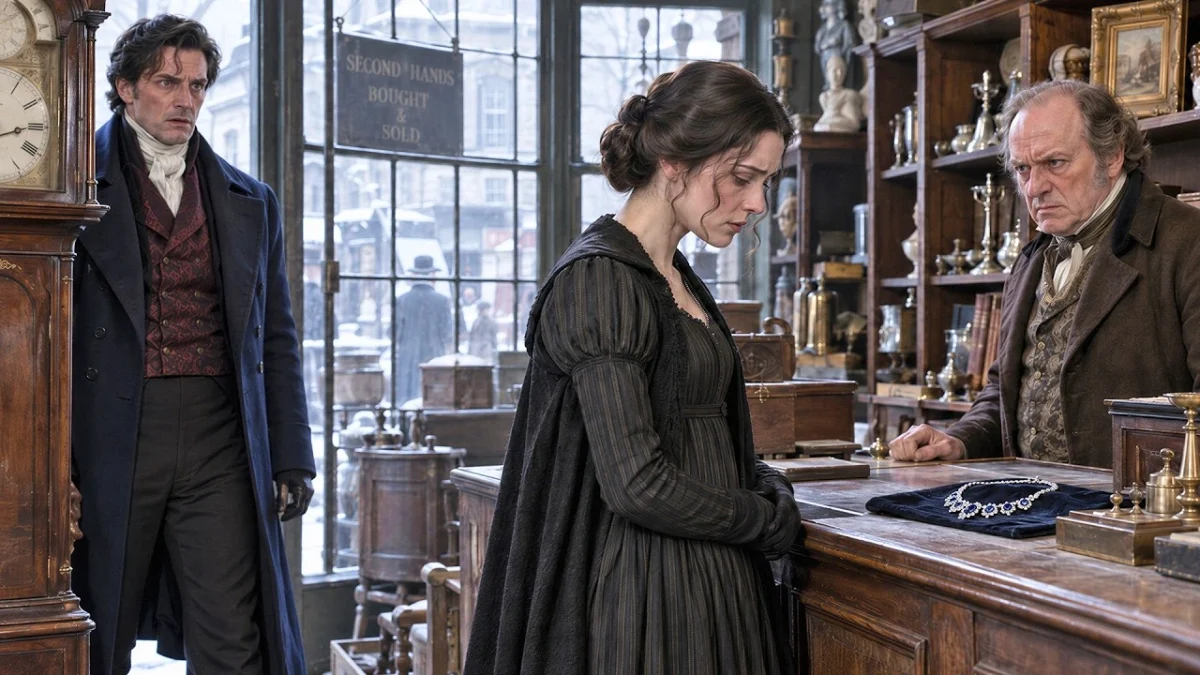
Pawn shops in Cheapside smelled of desperation, wet wool, and stale gin.
It was not a place built for a duke, but Romano Pendleton, the Duke of Wikliffe, stood just inside the threshold of Finch’s Antiquities and Loans regardless.
He let his eyes adjust to the murky gloom of the narrow room.
He had not come to this miserable, soot-stained corner of London for charity.
He had come to retrieve a sapphire-encrusted signet ring that his foolish younger cousin had gambled away to a card sharp three nights prior.
The shop was a graveyard of broken lives and surrendered dignity.
Tarnished pocket watches, silver candlesticks with melted tallow, cracked porcelain, and frayed lace lined the cluttered wooden shelves.
Each item represented a sudden eviction, a desperate medical bill, or a final descent into absolute ruin.
Romano loathed places like this because they stripped away the polite fictions of High Society, leaving only the raw, ugly mechanics of survival.
He adjusted his heavy wool greatcoat and took a step toward the counter, preparing to demand the ring, when a quiet voice stopped him dead in his tracks.
“Twenty pounds, Mr. Finch. The stones alone are worth fifty.”
It was a soft voice, huskier and far more weary than it had been ten years ago, but its melodic cadence was unmistakable.
Romano froze.
His chest tightened instantly, a phantom grip squeezing the air directly from his lungs.
Instinctively, he stepped backward into the shadow of a tall grandfather clock that smelled heavily of lemon oil and damp decay.
He peered toward the back of the shop.
She stood at the counter, her back partially turned to him.
It was Beatrice.
She was dressed in full mourning black, but the fabric was completely exhausted.
The hem of her skirt was stiff with dried street mud, and her pelisse, which might have been fashionable three winters ago, hung far too loosely on her delicate frame.
She looked terrifyingly small against the oppressive shadows of the shop.
Romano’s gaze dropped to the scarred counter.
Between Beatrice’s gloved hands—where the left index finger had been neatly and repeatedly darned—sat a familiar sapphire and diamond necklace.
Romano recognized it instantly.
He had been standing in the far corner of her father’s drawing room on her nineteenth birthday when that exact necklace had been clasped around her neck.
He had watched her laugh, her hazel eyes sparkling as the blue stones caught the candlelight, just moments before Thomas Cole had stepped forward to ask her for the first dance.
Romano had spent that entire evening nursing a warm glass of punch, swallowing the confession of love he had spent months practicing in private.
Six months after that ball, she was Mrs. Thomas Cole.
And now, Thomas Cole was dead.
A tragic carriage accident, the society papers had claimed—a sudden end to a dashing, spirited life.
The reality, it seemed, was considerably less romantic and far more cruel.
Mr. Finch, a squat man whose face resembled a bruised thumb, picked up the necklace with a grimy hand and a dismissive grunt.
He did not bother using a jeweler’s loupe.
He did not need to.
He knew the smell of utter desperation the second it walked through his door.
“Ten pounds,” Finch said, tossing the piece carelessly back onto the wood. “Take it or leave it, Mrs. Cole. I’m running a business here, not a parish charity.”
Beatrice’s shoulders flinched.
It was a microscopic movement, but Romano saw it.
He saw the subtle way her chin trembled before she clamped her jaw shut, fighting with every ounce of her remaining strength to maintain her composure.
She reached out, her gloved fingers hovering trembling over the sapphires.
“Please, Mr. Finch,” she whispered, her voice cracking slightly. “I have creditors knocking at my door. My landlord… I need fifteen pounds. Just fifteen.”
“Ten,” Finch repeated, resting his fleshy hands on the counter. “And that’s me being generous to a widow. Do you want the coin or not?”
Beatrice stared at the sparkling blue stones.
Slowly, the fight drained out of her, leaving behind only a hollow, brittle exhaustion.
She closed her eyes and bowed her head.
“Very well,” she said softly.
Finch grunted again and reached beneath the counter to pull out his iron cashbox.
Romano did not calculate the consequences.
For a man who had built a fierce reputation in Parliament and High Society on cold, calculating stoicism, his movement was entirely instinctual.
He stepped out from behind the grandfather clock, his heavy greatcoat sweeping against a pile of rusted fire irons, and walked directly to the counter.
“Put the cashbox away, Finch,” Romano commanded, his voice echoing through the cramped shop like a crack of thunder.
Beatrice gasped, spinning around.
Her eyes—the exact same sharp, expressive hazel that had haunted his dreams for a decade—went wide with sheer shock.
The small amount of color in her pale cheeks drained away completely.
“Your… Your Grace,” she breathed.
Romano did not look at her.
He could not bring himself to look at the severe hollows of her cheeks or the dark, bruised circles beneath her eyes, knowing that if he did, he would tear Finch apart with his bare hands.
He kept his cold gray eyes locked onto the pawnbroker.
“Your Grace,” Finch stammered, his fingers instantly freezing on the brass lid of the box.
Finch recognized him immediately.
Most of London’s underbelly knew the Duke of Wikliffe; he owned a vast portion of real estate in the East End and possessed a terrifying reputation for evicting criminal tenants with ruthless efficiency.
Romano reached down and picked up the sapphire necklace from the counter.
The metal felt icy cold against his palm.
“This is not for sale,” Romano stated quietly.
“Romano…” Beatrice whispered.
Her voice contained an agonizing blend of deep humiliation and stubborn pride.
She reached out, her fingers brushing his sleeve as she tried to take the necklace back.
“Please,” she begged quietly. “This is none of your concern. Give it back to me.”
He finally turned his gaze toward her.
The raw proximity hit him like a physical blow.
She smelled of freezing rain, cheap lye soap, and wet wool—a heartbreaking departure from the delicate rosewater she used to wear.
Yet, underneath the poverty, the grief, and the crushing weight of her immediate reality, she was still Beatrice.
She was still the only woman who had ever possessed the power to make him feel utterly inadequate.
“It is my concern now, Beatrice,” Romano said, his voice flat and controlled, betraying none of the absolute chaos roaring in his chest.
He turned back to Finch.
“You have a ring,” Romano said, his voice dropping an octave. “A gold signet bearing a badger crest. It was brought in three days ago by a young gentleman with far more gambling debts than sense.”
Finch swallowed hard, bowing his head frantically.
“I… Yes, Your Grace. I have it in the back drawer. I’ll fetch it immediately.”
As the pawnbroker scrambled into the back room, Beatrice stepped closer to Romano, her frame stiff with indignation.
“You have no right,” she hissed under her breath, keeping her voice low so as not to be overheard. “You have absolutely no right to interfere. I need that money! You do not understand the situation I am in!”
“I understand that Finch was about to rob you of something priceless for a pittance,” Romano replied, staring straight ahead at the dusty clutter on the shelves.
“And now my landlord will throw me into the freezing street tomorrow morning!” she retorted, her voice laced with a bitter sarcasm born of sheer terror. “Are you going to save me from that as well, Your Grace? Or do you simply enjoy witnessing my degradation?”
Romano carefully slipped the sapphire necklace into the deep inner pocket of his greatcoat.
He turned to face her fully, his gray eyes completely devoid of pity.
He knew her pride; pity was the last thing she would tolerate.
“Yes,” Romano said simply. “I am.”
By the time they exited the shop, the damp London fog had transformed into a biting, wind-driven sleet.
Romano’s unmarked black carriage was waiting at the corner of the alley, the two bay horses stamping their hooves impatiently against the slippery cobblestones.
He did not offer her his arm, knowing instinctively that her pride would force her to refuse it.
Instead, he held the heavy door open and waited.
Beatrice hesitated on the curb.
She looked at the polished wooden door of the carriage, then looked down at her own ruined, waterlogged boots.
The stark disparity between them was heartbreaking.
She looked like a stray, shivering bird being coaxed into an opulent golden cage.
“I can walk,” she said, wrapping her thin shawl tighter around her shoulders. “My lodgings are not far from here.”
“Get into the carriage, Beatrice,” Romano said.
It was the first time he had spoken her given name aloud in over ten years.
The word hung in the freezing air between them, heavy with a decade of unexpressed yearning and painful history.
Beatrice looked up into his unyielding face, her jaw tight, before finally stepping up into the vehicle.
Romano followed immediately, closing the heavy door behind them and shutting out the grim, noisy reality of Cheapside.
He rapped his knuckles twice against the roof, and the carriage lurched forward into the sleet.
The interior was a warm, quiet cocoon of rich leather and velvet.
Yet, the silence between them was far from peaceful; it was a loud, demanding presence that filled every inch of the cabin.
Romano sat directly opposite her, his long legs folded so that his knees nearly brushed hers in the confined space.
He watched as she stared fixatedly out the rain-streaked window, her posture rigidly upright as though she were attempting to physically shrink away from him.
“Where are you currently residing?” he asked quietly.
“Spitalfields,” she answered, still looking at the dark glass.
Romano’s jaw clenched tightly.
Spitalfields was a notorious district of impoverished weavers, cutthroats, and the destitute.
“Thomas left you with nothing,” Romano stated, it being more of a painful realization than a question.
Beatrice let out a short, breathy laugh that contained zero humor.
“Nothing would have been a luxury, Romano,” she said, finally turning to face him with a fierce, defensive fire in her hazel eyes. “Thomas left me with debts. Mountains of them. Tailors, wine merchants, horse breeders, gambling hells… It turns out my late husband was a man of vast and varied appetites, none of which he could actually afford.”
She gestured sharply toward him.
“Are you satisfied now, Your Grace? Is this what you came to see? The great, tragic fall of Beatrice Cole? The proud girl who turned you down now begging in pawn shops?”
“Don’t be absurd,” Romano said sternly.
“Then why are you here?” she demanded, tears of frustration glistening in her eyes. “Why did you stop me? That necklace was my rent for the month! It was coal for my fireplace! You may have preserved my delicate feelings in front of a pawnbroker, but pride does not buy bread!”
Romano reached into his coat pocket, retrieved the sapphire necklace, and laid it gently on the velvet seat beside her.
“I will purchase it from you,” he said.
“I do not want your charity!”
“It is not charity,” Romano replied smoothly, leaning back and crossing his arms to project a calm he was far from feeling. “It is a business transaction. Tell me, what is the total sum of his outstanding debts?”
Beatrice looked back toward the window, her breath fogging the glass.
“You do not want to know.”
“Try me, Beatrice.”
“Four thousand pounds,” she said softly, as though speaking the number aloud might summon the bailiffs directly to the carriage window.
Four thousand pounds.
To a man of Romano’s immense wealth, it was the cost of a minor estate repair.
To a penniless widow with no family or income, it was a guaranteed sentence to a debtor’s prison.
A wave of cold, violent anger toward the late Thomas Cole washed over Romano.
He had always known the man was a charming, shallow scoundrel, but to abandon his wife to the wolves in such a manner was unforgivable.
“The carriage will take us to your lodgings now,” Romano said, his voice terrifyingly calm. “You will pack your belongings.”
Beatrice blinked in utter confusion.
“Pack? Pack to go where?”
“To my townhouse in Grosvenor Square,” he replied. “You are finished living in Spitalfields.”
“Are you completely mad?” She sat forward, her hands clenched into tight fists against her skirts. “I cannot live with you! The scandal alone would destroy whatever is left of my name!”
“You are a widow in mourning, and I am a duke with twenty unoccupied guest rooms in Mayfair,” Romano said dismissively. “Let them gossip. Upper-class gossip is vastly preferable to freezing to death. You are coming with me.”
“I will not be your kept woman, Romano!”
The words were harsh, thrown like jagged stones across the small carriage.
Romano flinched internally, feeling the deep burn of the accusation, but his face remained an unreadable mask of stone.
“I have no intention of making you my mistress, Beatrice,” he said evenly. “I am offering you a secure roof and a temporary solution until we can properly untangle this disastrous mess.”
The carriage ground to a sudden halt.
Romano looked out the window and saw a leaning, soot-covered boarding house surrounded by piles of slush and garbage.
“Show me your room,” Romano said.
“No.”
Without another word, Romano opened the carriage door and stepped out into the freezing sleet.
He turned back and offered her his hand.
“Show me where you have been living, Beatrice, or I give you my word I will stand out here in the storm until you comply.”
She glared at him with a magnificent, furious intensity that sharply reminded him of the spirited girl she had once been.
However, sheer exhaustion quickly overtook her anger.
Ignoring his extended hand, she stepped down from the carriage herself and led him into the grim building.
They climbed three flights of narrow, creaking stairs that smelled heavily of boiled cabbage and damp rot.
The air grew progressively colder the higher they climbed.
At the end of a dark corridor, she unlocked a flimsy wooden door and pushed it open.
Romano stepped inside, and his heart shattered.
The room was no larger than his dressing closet at home.
It contained a narrow cot with a thin blanket, a single rickety wooden chair, and a washbasin featuring a severely cracked pitcher.
Worst of all was the small fireplace in the corner; the grate was completely empty, swept clean of even the dust of burnt coal.
The room was an absolute icebox.
Romano stood in the center of the miserable space, feeling an immense, ruinous rage expanding in his chest.
Beatrice stood by the door, her arms wrapped tightly around her shivering frame.
Stripped of the bustling noise of the street and exposed in the bare, physical evidence of her absolute ruin, her fiercely guarded defiance finally snapped.
She covered her face with her gloved hands, and a jagged, painful sob tore from her throat.
Romano crossed the small room in two long strides.
He did not pull her into his arms, knowing he possessed no right to hold her.
Instead, he unbuttoned his heavy wool greatcoat, removed it, and gently draped its thick warmth over her trembling shoulders.
“Pack your things, Beatrice,” he said softly.
Two hours later, Romano’s private study in Grosvenor Square provided a striking contrast to the slums of Spitalfields.
It was a sanctuary of dark mahogany, rich leather, and profound silence.
A massive fire roared in the marble hearth, casting a warm golden light across the rows of bound ledgers and legal volumes lining the walls.
Beatrice sat curled up in a high-backed leather armchair near the fire.
She looked entirely swallowed by Romano’s oversized coat, which she still stubbornly refused to take off.
A silver tray sat untouched on the side table, bearing a steaming pot of tea and a plate of delicate sandwiches.
Romano sat behind his massive desk, silently reviewing the haphazard stack of unpaid bills and promissory notes she had brought from her room.
The reality was far worse than she had thought.
With the exorbitant interest rates the predatory moneylenders were charging, her debts were closer to six thousand pounds.
He set the final paper down and rubbed his temples thoughtfully.
He could simply write a draft to his solicitor right now, pay every penny, and set her free.
But he knew her pride.
If he paid her debts outright as an act of charity, she would view it as an insurmountable obligation she could never repay.
She would spend the rest of her life feeling indebted to him, and eventually, she would grow to hate him for it.
He needed a logical mechanism—a formal agreement that would allow her to accept his full protection while keeping her dignity completely intact.
He looked across the room at her.
She was staring hollowly into the flames, the flickering light casting deep shadows over her prominent cheekbones.
Romano pulled a fresh sheet of heavy vellum toward himself and dipped his quill into the inkwell.
He was about to do something extraordinarily reckless, entirely logical, and profoundly selfish.
“The total sum is closer to six thousand pounds, Beatrice,” Romano said, breaking the long silence.
Beatrice closed her eyes tightly, her throat working as she swallowed hard.
“I see,” she whispered.
“They will begin seizing what few assets you have left by the end of the week,” Romano continued calmly. “After that, the bailiffs will issue a warrant for your arrest.”
“You do not need to explain the law to me, Your Grace,” she replied with a touch of her former sharp bite. “I am well aware of where my husband’s legacy is leading me.”
“You are not going to prison,” Romano said, standing up from his desk.
He walked around the heavy wood and leaned against the edge, looking down at her.
“I have a proposition for you.”
She looked up at him, her hazel eyes wary and suspicious.
“As you are likely aware,” Romano began, his voice adopting the dry, detached tone he typically reserved for parliamentary debates, “my uncle passed away six months ago. As a result, I am now in possession of this dukedom, as well as extensive unentailed estates in Yorkshire. I have also inherited his political obligations, his vast staff, and an endless horde of society matchmakers who view me as an unwed target.”
Beatrice frowned slightly, thoroughly confused by the sudden change in subject.
“Congratulations,” she said dryly.
“It is a complete nightmare,” Romano replied flatly. “My households are mismanaged, my social obligations are vast and tedious, and I am hounded constantly. I require someone capable to organize my residences, host necessary political dinners, and act as a shield against ambitious mothers.”
Beatrice’s eyes narrowed dangerously.
“Are you asking me to be your head housekeeper, Romano?”
“I am asking you to be my wife.”
A log shifted in the hearth, sending a brilliant shower of sparks up the chimney.
Beatrice sat utterly motionless, staring at him as if he had suddenly begun speaking a foreign tongue.
“Excuse me?” she breathed.
“A marriage of convenience,” Romano stated smoothly, carefully burying the frantic pounding of his heart beneath a thick layer of utter pragmatism. “A business contract. You will become the Duchess of Wikliffe. In exchange, I will assume your debts immediately, clear Thomas’s name from all legal ledgers, and provide you with a generous personal allowance and a permanent home. In return, you will manage my households, entertain my political associates, and ensure I am never subjected to unwanted matchmaking ever again.”
Beatrice stood up so quickly that the heavy coat slid from her shoulders, pooling on the carpet.
“You are mocking me!” she gasped.
“I have never been more serious in my entire life,” Romano answered calmly.
“This is utter madness!” she exclaimed, pacing back and forth before the fire. “You could have your pick of any young, wealthy heiress in the Kingdom! Why on earth would you chain yourself to a bankrupt, ruined widow?”
*Because I have loved you since I was twenty years old,* Romano thought fiercely. *Because I have measured every single woman I have ever met against the memory of you, and they have all fallen short. Because watching you suffer in poverty is tearing my soul apart.*
“Because I do not want an inexperienced debutante, and I have no desire for a romantic entanglement,” Romano lied smoothly, his voice chillingly steady. “I require a practical, intelligent partner whom I already know and respect. We understand one another, Beatrice. This is a logical, mutually beneficial solution to both of our problems.”
She stopped pacing and searched his gray eyes for any trace of sarcasm, cruel humor, or overwhelming pity.
She found nothing but a cool, unreadable wall of calm assurance.
“You would willingly pay six thousand pounds simply to avoid persistent matchmakers?” she asked skeptically.
“I would pay double that for peace and quiet,” Romano replied without missing a beat.
She turned away, walking toward the dark window.
He watched her mind working rapidly, weighing her overwhelming desperation against her fiercely guarded pride.
She had nothing left—no money, no family support, no societal standing—only the grim reality of a cold room in Spitalfields and the immediate threat of a debtor’s cell.
“Separate lives,” she stated firmly, her back still turned to him.
“Separate bedrooms,” Romano agreed instantly.
The words felt like a physical blade twisting in his chest, but he knew the condition was absolutely necessary to secure her agreement.
“You will enjoy complete autonomy over your household and your allowance,” he added. “I ask only for your public loyalty and your assistance with my official duties.”
She stood by the window for a long, agonizing minute, gazing out into the dark, sleet-covered square.
Finally, she turned around.
Her eyes were completely dry, and her chin was lifted in that proud, defiant manner he knew so well.
“Draw up the contract, Your Grace,” she said.
Romano quietly exhaled a breath he felt he had been holding for ten long years.
“I will have my solicitors prepare the settlements first thing in the morning.”
He had saved her.
She was safe now, and she would legally be his wife.
Yet, as he looked at the distant, guarded expression on her face, Romano recognized the terrifying truth of his victory.
He had purchased her debts, and he had secured her hand in marriage.
But winning the heart she had buried long ago—that was a debt he had no idea how to pay.
Grosvenor Square did not wake up in the morning; it merely transitioned from the quiet hum of privilege to the active administration of it.
Beatrice stood in the center of her luxurious new bedchamber, completely overwhelmed by the sheer volume of heat in the room.
The fire in the carved marble hearth was a roaring, magnificent beast.
Deep black coal was piled high, burning with a fierce, expensive crackle.
Just two days prior, Beatrice had spent an agonizing hour debating whether to burn a broken wooden chair leg to keep her fingers from growing entirely numb.
Now, she was actually sweating.
She stepped away from the hearth, feeling a wave of deep nausea that had nothing to do with the lavish breakfast sitting untouched on a silver tray near the window.
It was guilt—pure, heavy guilt.
She was safe and warm, while outside these heavy velvet curtains, the people of the Spitalfields slums were still shivering in the cold.
The bedchamber door opened with a soft, precise click.
Mrs. Gable, the housekeeper, stepped into the room.
She was a woman of formidable posture, dressed in black silk that rustled like dry leaves whenever she moved.
She did not look at Beatrice with pity, nor with the veiled contempt the servants of Thomas’s creditors had so frequently displayed.
She viewed Beatrice strictly as an operational directive from the Duke.
“The modiste is waiting in the yellow drawing room, Your Grace,” Mrs. Gable announced, her hands folded neatly over her apron.
Beatrice flinched slightly at the lofty title.
They had been married early yesterday morning by special license in a quiet, echoing church in Mayfair.
Romano had worn a severe black coat, while she had worn the exact same threadbare mourning dress she had almost pawned.
It had taken less than fifteen minutes to legally bind their lives together forever.
Immediately after the ceremony, Romano had departed for an urgent session in the House of Lords, leaving her alone in his massive house.
“I do not require a modiste, Mrs. Gable,” Beatrice said softly. “I have clothing.”
“You have rags, Beatrice.”
Romano’s deep voice echoed from the open doorway.
He stood leaning casually against the wooden frame, holding a stack of morning correspondence in his hand.
He wore a tailored navy morning coat that fit his broad shoulders to absolute perfection.
His gray eyes swept over her carefully before settling on the visibly frayed cuff of her black sleeve.
Mrs. Gable bowed her head slightly and vanished down the corridor with practiced efficiency.
“I am in mourning,” Beatrice insisted, lifting her chin. “I do not require lavish new gowns simply to sit in an empty house.”
“You are the Duchess of Wikliffe,” Romano stated, stepping fully into the room and closing the door behind him.
The sudden privacy instantly made the vast room feel dangerously intimate.
“You will not be sitting in an empty house,” Romano continued smoothly. “We are hosting the Spanish ambassador on Thursday evening, and a large delegation of Whig politicians on Saturday. You cannot possibly serve as hostess while wearing a gown that looks as though it has been dragged behind a coal cart.”
Beatrice bristled, the defensive mechanisms she had built over the last miserable year flaring to life.
“I apologize if my past poverty offends your delicate aesthetic sensibilities, Your Grace,” she said coldly. “Perhaps you should have hired a professional hostess rather than marrying a bankrupt widow.”
Romano did not take the bait.
He walked calmly to the window and looked at the untouched tray of food.
“You haven’t eaten.”
“I am not hungry.”
“You are starving, but you are far too stubborn to admit it,” Romano replied quietly.
He turned to face her, his features hardening into the cool, pragmatic mask he wore so effortlessly.
“Listen to me carefully, Beatrice. This is not charity. We established that this is a business arrangement. A soldier requires a musket; a clerk requires a pen. You, in your official capacity as the head of this household, require an appropriate wardrobe. It is a simple professional necessity. Do not turn this into an unnecessary battle of pride.”
He called it a uniform.
With brilliant tactical skill, he stripped the entire expenditure of any personal intimacy or emotional indulgence.
Beatrice stared at him, the sharp anger slowly draining from her shoulders.
He was right, of course.
If she appeared in his drawing room looking like a beggar, it would reflect poorly on his standing and invite endless mockery.
She owed him a flawless performance.
She owed him the six thousand pounds he had paid to clear her late husband’s name and buy her absolute freedom.
“Very well,” she agreed quietly. “A working uniform. Nothing superfluous.”
Romano gave a single, curt nod of approval.
“Madame Celeste is waiting downstairs. Select whatever you deem necessary and have the bills directed to my steward.”
He turned to leave, placing his large hand on the brass doorknob.
“Romano,” she called out softly.
He stopped in his tracks, though he did not turn back to look at her.
His knuckles turned white where he gripped the brass handle.
“Thank you,” she said, the words difficult to form, but sincere. “I… I haven’t been warm in a very long time.”
Romano stood completely frozen for a long, agonizing moment, his broad back rigid.
“The house is always kept warm,” he said softly, his tone completely lacking its usual aristocratic edge. “You will never be cold again, Beatrice.”
He stepped out into the hallway and closed the door, leaving her alone with the crackling fire and the overwhelming realization that her new husband was a man she did not understand at all.
High Society did not merely gossip; it hissed.
It was a collective, venomous sound that echoed off the gilded ceilings of Lord Harrington’s magnificent ballroom two weeks later.
Beatrice stood near a tall floral arrangement of white lilies, a crystal flute of untouched champagne held firmly in her gloved hand.
She was acutely aware of the dozens of sharp eyes burning into her back.
The sudden, unexpected marriage of the wealthy Duke of Wikliffe to the disgraced, destitute widow of Thomas Cole was the only topic of conversation worth discussing in Mayfair.
She was dressed in a striking gown of deep Wikliffe blue.
Madame Celeste had performed a minor miracle, crafting a gown of heavy silk that draped with breathtaking elegance.
It was technically half-mourning—a severe, beautiful cut that left her collarbones exposed while offering no unnecessary lace or flounces.
Around her neck sat the magnificent sapphire and diamond necklace.
Romano had left the velvet box on her dressing table earlier that evening, accompanied by a brief, formal note: *A Duchess must display the family jewels.*
“I heard the bailiffs were literally dragging her from the house by her hair when Wikliffe arrived to pay them off,” whispered Lady Cowper, standing just close enough to be overheard behind her painted silk fan.
“He always was terribly eccentric,” a gentleman replied in a low murmur. “A pity, really. He could have had any eligible young lady in London. Now he is burdened with Cole’s catastrophic debts. They say Thomas died fleeing a crooked card game, you know.”
Beatrice took a slow, measured breath, keeping her eyes fixed on the rim of her glass.
She refused to run.
If she fled the room, they won.
She had survived freezing nights and terrifying threats from moneylenders in the East End; she could certainly survive the petty cruelty of bored aristocrats.
Suddenly, a heavy, warm presence settled directly at her side.
She did not need to turn her head to know it was Romano.
He radiated an aura of absolute, unshakeable authority that instantly altered the atmosphere around them.
“You look as though you are currently planning a murder,” Romano said smoothly, keeping his eyes trained on the crowded dance floor.
“I am merely calculating the cost of a carriage ride back to Spitalfields,” Beatrice muttered under her breath. “I believe the street rats there possessed vastly superior manners.”
The corner of Romano’s mouth twitched slightly.
“The rats in Spitalfields are at least honest about their desire to consume you,” Romano noted quietly. “The ones in Mayfair prefer to do so while complimenting your gown.”
He subtly shifted his position, angling his broad shoulders to physically block her from the view of the worst gossips nearby.
It was an entirely protective gesture, executed with natural instinct.
Beatrice felt a strange, unsettling flutter in her chest.
Before she could process the feeling, Lady Cowper materialized directly before them, wearing a smile that resembled a polished blade.
“Your Grace,” the older woman purred, executing a shallow curtsy. “And the new Duchess… What a startling surprise your sudden announcement was to us all. Given the rather tragic circumstances of poor Mr. Cole’s passing, we all assumed you would remain in quiet, humble seclusion.”
Beatrice’s grip on her champagne flute tightened until her knuckles turned pale.
The cruel mention of Thomas, along with the clear implication that she ought to be hiding away in shame, cut deep.
Romano did not allow Beatrice to answer.
He took a decisive step forward, closing the distance and looking down at Lady Cowper with a gaze so utterly devoid of warmth it could have frozen boiling water.
“I am not a man who requests permission to claim what belongs to me, Lady Cowper,” Romano said, his deep voice carrying a sharp, resonant edge that silenced the nearby conversations. “Beatrice’s period of mourning is officially concluded. She is my wife, and I have exceedingly little patience for anyone foolish enough to question my judgment or my choices.”
The ambient chatter within a ten-foot radius ceased instantly.
Lady Cowper’s triumphant smile faltered completely, the color draining from her painted cheeks.
Romano was not merely a powerful duke; he held the mortgages on half the prominent estates in London, including the property Lady Cowper’s son currently occupied.
“Of… Of course, Your Grace,” she stammered nervously, taking an immediate step backward. “I only meant to offer my warmest congratulations to you both.”
“Your congratulations are noted and dismissed,” Romano replied coldly.
It was a social execution—absolute and ruthless.
Without another word, Romano turned his back on the woman entirely and offered his arm to Beatrice.
“I require a breath of fresh air,” he said calmly. “Walk with me.”
Beatrice placed her hand on his forearm.
Beneath the fine wool of his evening coat, his muscle was as hard as iron, radiating a steady, comforting heat.
He escorted her away from the crowded ballroom, leading her through a set of double doors and out onto a wide stone terrace overlooking the dark, manicured gardens.
The night air was freezing, biting through her silk dress in seconds, but she did not care.
She released his arm and walked to the carved stone balustrade, leaning against it and taking a long, deep breath of the cold air.
Romano stood beside her, pulling off his white gloves.
“You did not have to do that,” Beatrice said softly, her voice trembling slightly as the adrenaline of the encounter faded, leaving behind an overwhelming fatigue. “They will only gossip more now.”
“Let them,” Romano said, his hands gripping the stone railing tightly. “They are parasites who feed on perceived weakness. You will yield nothing to them, Beatrice. Do you hear me? Nothing.”
She looked up at him.
In the pale moonlight, the strong, sharp angles of his profile were clearly defined.
He looked absolutely furious—not at her, but *for* her.
“This is merely a business contract, Romano,” she reminded him gently, as much to steady her own heart as his. “You do not need to defend my honor as though this were a love match.”
Romano slowly turned his head to look at her, his gray eyes dark with an unreadable, turbulent emotion.
“Do you truly believe I would allow anyone to insult the Duchess of Wikliffe?” he asked quietly.
“I know you care deeply about your family name,” she replied, looking away toward the dark gardens below. “And I am grateful for your protection. Truly, I am. But we agreed to be practical. I know why you married me, Romano. You needed a capable hostess, and I needed to be saved from a debtor’s cell. There is no need to pretend otherwise when we are alone.”
Romano stared at her in silence, his chest rising and falling heavily.
The urge to shatter his carefully constructed wall of pragmatism—to grasp her by the shoulders and confess that he had loved her desperately for ten long years—was almost unbearable.
He wanted to tell her that every single debt he had paid, every gown he had purchased, and every sharp word he had spoken in her defense sprang from an intense, unyielding devotion that had never faltered.
But he saw the delicate, fragile state of her spirit.
She was a woman who had been betrayed, impoverished, and deeply wounded by a husband who had claimed to love her.
If he thrust his true feelings upon her now, she would feel trapped by a new kind of obligation.
She would feel forced to pretend to return an affection she did not feel out of sheer gratitude.
He could not do that to her.
“You are right,” Romano said quietly, forcing his voice into a steady, controlled tone that cost him every ounce of his willpower. “We must remain practical.”
Beatrice looked back at him, a subtle flick of disappointment passing through her hazel eyes so quickly he almost missed it.
“The wind is growing colder,” Romano said, offering his arm to her once more. “We should return inside before you catch a chill.”
Beatrice hesitated for a brief second before sliding her hand back onto his arm.
“Thank you, Romano,” she murmured as they turned toward the glowing warmth of the ballroom doors. “For everything.”
“You never need to thank me, Beatrice,” he replied softly.
As they stepped back into the brilliant light and hushed murmurs of High Society, side by side, Beatrice felt the solid warmth of his arm beneath her fingers.
She realized then that the cold, distant Duke she thought she had married was far more complex than she had ever imagined.
And for the first time in ten years, as she looked at the silent, protective man beside her, she wondered if the heart she believed she had buried forever might finally be beginning to thaw.








