The Duke Had Not Laughed in Twenty Years—Until His New Bride Challenged Him at Dinner Tonight!?
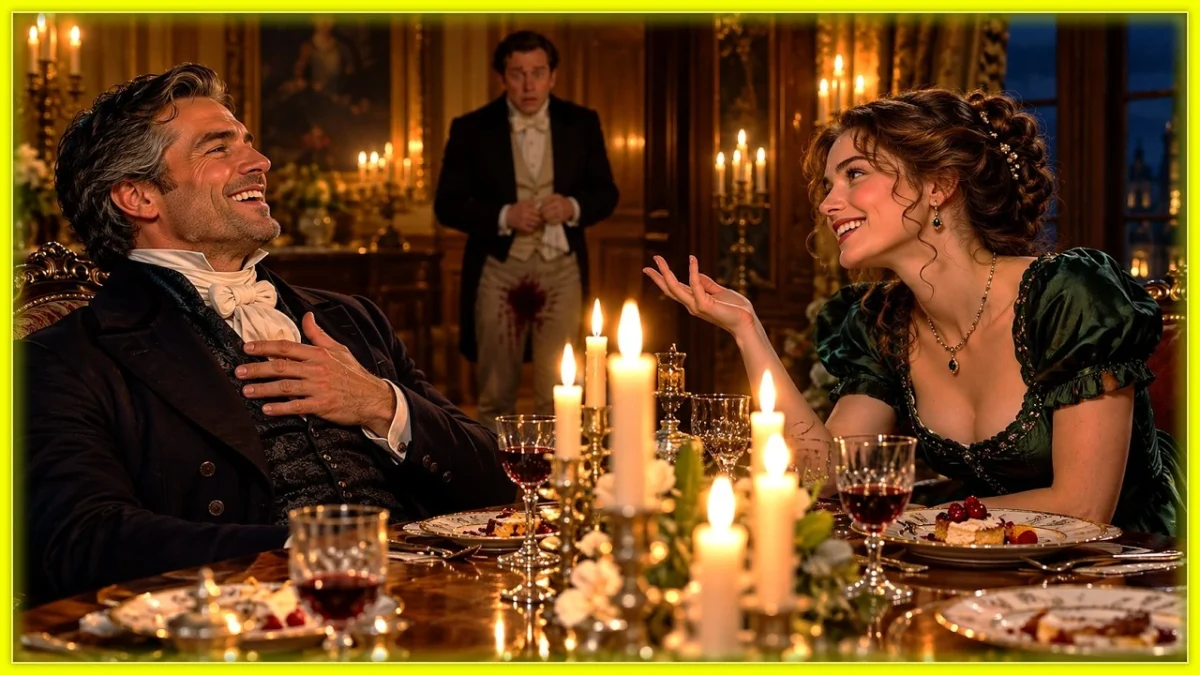
Nobody in Ashcombe Hall could remember the last time the Duke of Ravensmere had laughed.
The servants spoke of it the way people speak of a comet that appears once in a generation and is never seen again.
Twenty years, they said, though none of them had actually counted.
Not since his father died in the winter fever.
Not since the carriage accident that took his younger brother on a wet road outside Bath.
Not since anything at all of any consequence.
The Duke ran his household the way he ran his estate, with absolute order, with absolute silence, and with a face that gave nothing away to anyone.
He rose at the exact same hour every morning, without fail.
He rode the exact same path every afternoon, his posture rigid in the saddle.
He signed his letters with the same careful, unhurried hand, never rushed, never smudged.
The head maid said his private rooms were so unnaturally tidy that a person could not tell anyone actually lived in them at all.
The senior footman said his eyes looked like winter windows, clear but cold, letting in light without a single shred of warmth behind them.
Evelina Heart had heard every single one of these warnings before she finally agreed to marry him.
Her aunt had gripped her hands tightly the night before the wedding and said, “He is granite, my dear child. You will warm a stone much faster than you will ever warm that man.”
Her lady’s maid, a kind but perpetually nervous girl named Josephine, had whispered while lacing her tightly into her heavy wedding gown, “Do not expect kindness or warmth from him, my lady, only cold correctness. Some men give correctness instead of affection, and it is truly all they have left to offer the world.”
Evelina had listened to all of it with a calm expression and married him anyway.
It was not, if she were entirely honest with herself, purely a matter of love or foolish romance.
Her family’s finances had crumbled quietly over several years, the way a great house crumbles from the inside before anyone even notices the cracks creeping up the wallpaper.
The Duke’s formal offer of marriage had arrived at the exact desperate moment her father needed rescuing, and Evelina, ever practical, had accepted it with her eyes wide open to the reality of her bargain.
Yet it was not only cold practicality that had made her say yes to the title.
During their very short, proper courtship, she had accidentally caught him, just once, looking at an old portrait of his late brother with an expression so raw and unguarded that it had nearly broken her heart.
It had lasted only a second before he noticed her watching him and instantly rearranged his face back into its usual stone-cold calm, but she had seen it clearly.
She had seen a living man buried alive beneath twenty years of meticulous emotional control, and something stubborn and fiery in her had decided right then that she would not spend her whole marriage pretending she hadn’t noticed the man trapped underneath.
Their wedding had taken place three days earlier, a quiet, correct affair with exactly the right number of distinguished guests and exactly the right number of polite toasts.
Since then, their daily conversations had consisted of precisely the words required for basic politeness and nothing more.
“Good morning, my dear,” he would say.
“I trust you slept well through the night.”
“The weather looks fair and suitable today.”
Sentences built like little wooden fences, keeping everything real and human safely on the other side.
Tonight was their first formal dinner together as husband and wife.
The estate staff, eager to mark the occasion properly, had prepared the dining room with unusual ceremony.
Tall white candles flickered down the length of the long mahogany table, polished silver caught the warm light, five complex courses arrived in perfect order, and a husband ate each one as though he were completing a military inspection rather than enjoying a meal with his bride.
Evelina decided, somewhere between the lukewarm soup and her own patience running perilously thin, that she had had quite enough of this quiet torture.
“My lord,” she said softly, setting down her silver spoon with a clear, deliberate click against the porcelain.
The Duke did not look up immediately from his plate, maintaining his steady composure.
“Have you something to say, Evelina?” he asked, his voice low and level.
“I have developed a rather fascinating theory about you,” she replied, tilting her head slightly.
That earned her a brief glance, assessing and cautious, gone almost before she could be entirely sure she had seen it.
“I have been told otherwise by people who know me rather well,” he murmured, picking up his wine glass.
“By people who have never tried very hard to look past the surface,” Evelina countered smoothly.
“I intend to try very hard.”
“To do what, precisely, Duchess?” the title still sounded slightly strange in his mouth, as if he were trying it on for size and finding it did not quite fit either of them yet.
“To make you laugh,” she said with absolute seriousness.
“Before the fish course, ideally, though I am prepared to negotiate all the way through dessert if you make this terribly difficult for me.”
For the first time since she had met him, the Duke set down his own fork and actually studied her, the way a man studies a complex puzzle he has decided, against his better judgment, to attempt to solve.
There was something almost amused already hiding somewhere behind his cold gray eyes, though his mouth had not yet caught up to it.
“You genuinely believe you will succeed,” he said slowly, “where twenty years of solemn occasion has failed entirely.”
“I believe,” Evelina answered without blinking, “that twenty years of solemn occasion is precisely the core of the problem, because nobody has ever been foolish enough to actually try.”
“And you intend to be foolish?”
“Spectacularly foolish, if necessary.”
A footman nearby hurriedly refilled the Duke’s wine glass with the exaggerated carefulness of a man who sensed something profoundly unusual was happening at the table and wished, quite sincerely, no part of the blame for whatever disaster came next.
The Duke’s mouth remained flat and composed, but something behind his eyes had shifted, the way thick ice on a winter pond shifts in the first warm afternoon of spring, deciding, reluctantly, that perhaps it would crack after all.
“Very well,” he said at last, picking up his fork again.
“You have until the fish course.”
Evelina did not waste a single second of the precious opportunity he had just granted her.
She told him, with the utmost seriousness a person could manage while clearly enjoying herself immensely, about the truly disastrous afternoon her family’s eccentric pet peacock had somehow escaped its pen and wandered directly into the vicar’s private garden during his solitary rehearsal of Sunday’s sermon.
She described, in excruciatingly careful detail, how the bird had apparently chosen its moment with theatrical precision, letting out its enormous, blood-curdling shriek at the exact instant the vicar declared, in his most solemn pulpit voice, And lo, a great and terrifying voice was heard among the people.
The Duke’s left eyebrow rose slightly at the image.
That was all he allowed.
But it was demonstrably more facial movement than she had seen from him in three entire days of marriage.
Encouraged by this microscopic victory, Evelina continued seamlessly with her catalog of domestic disasters.
She told him about her younger sister, who had once, at a notoriously elite masquerade ball, completely mistaken an elaborately decorated ceramic bowl of cold raspberry pudding for a very unusual and fashionable hat, wearing it proudly for nearly an hour while greeting distinguished guests and graciously accepting compliments on her brilliant costume, before anyone finally found the courage to inform her of her sticky mistake.
She told him about her eccentric uncle’s long and thoroughly unsuccessful campaign to train the family’s oldest, most stubborn horse to bow like a gentleman, a project that had inevitably ended with the massive animal simply sitting down in the middle of a formal garden party and refusing, with great and insulting dignity, to ever get back up again.
She did not tell these stories as a hollow performance to win a wager.
She told them the way a person tells stories they genuinely love, with her expressive hands moving through the air and her eyes bright with the fond memory of it all.
And she did not once glance over to check whether he was laughing, because some deep instinct told her that glancing would shatter whatever fragile thing was beginning to mend between them.
The fish course came and went in a blur of fine dining, and the Duke did not laugh aloud, though the corner of his mouth had begun to twitch in a way that suggested a deeply losing battle was being fought somewhere beneath his rigid composure.
The fowl course came and went as well, accompanied by the clinking of silverware and the quiet whispers of the serving staff.
By now, his broad shoulders, which Evelina realized she had never once seen anything but perfectly straight and tense, had eased down from somewhere near his ears into something much closer to a natural human posture.
By the time the third course arrived, he was actually asking her questions, real questions, not the polite fence-building kind they had traded earlier, but curious, engaged inquiries about her life.
He wanted to know what had happened to the peacock afterward, whether her sister had kept the pudding hat as a twisted souvenir, and whether the horse had ever, eventually, learned to bow to its audience.
“He never did learn to bow,” Evelina admitted with a grin, “but he did eventually learn to violently shake his head, which my optimistic uncle decided to call agreement, while my pessimistic aunt decided to call absolute defiance, and the two of them argued fiercely about it for the rest of the summer.”
It was the dessert course that finally undid him completely.
Evelina, caught up in the momentum of a story about her uncle’s disastrous attempt to teach the very same stubborn horse to count using apples, gestured a little too enthusiastically with her free hand and accidentally knocked her own heavy wine glass directly into the lap of the very stern, very silent butler standing at strict attention behind her chair.
He was a man of such immense dignity, so permanently composed, that Evelina had genuinely assumed, until this exact second, that he simply did not experience human emotion the way ordinary people did.
The butler’s face went through several rapid, astonishing, and entirely new stages of controlled horror.
He looked down in disbelief at the rapidly growing dark red stain spreading across his pristine black breeches, then up at the duchess with wide eyes, and then back down again, clearly attempting to calculate the correct and proper response to a situation for which he had received absolutely no training in his decades of service.
The Duke of Ravensmere laughed.
It came out rough and startled at first, as though the sound had to force its way past twenty years of profound disuse before it could escape his throat properly, but once it started, it simply could not be stopped.
It was a real, genuine laugh, completely unguarded and helpless, the kind that made him press one large hand briefly over his eyes and shake his head, utterly unable to compose himself.
The butler, mortified beyond words, could do nothing but stand there dripping red wine while his employer laughed harder than anyone in that house had heard him laugh in living memory, harder, perhaps, than anyone in that house had ever heard him laugh at all.
Evelina laughed along with him, partly at the sheer absurdity of the butler’s expression and partly, if she were entirely honest with herself, at the sheer relief and joy of watching something finally break open in the man sitting across the table from her.
When the laughter finally subsided into occasional, breathless aftershocks, the Duke looked at his new wife with an expression she had not yet learned to name on his face.
It was entirely unguarded, slightly bewildered, and remarkably tender.
Something almost boyish was sitting strangely and beautifully on a face that had clearly forgotten over the decades how to hold such an expression at all.
“Twenty years,” he said softly, his voice still slightly uneven from the physical effort of it.
“I did warn you, my lord,” Evelina said, trying and failing entirely to look modest about the whole chaotic affair.
“I said I intended to be spectacularly foolish. You have ruined poor Grimshaw Shaw’s best breeches beyond any hope of recovery.”
“A small and acceptable sacrifice,” he said, catching his breath, “in the service of a very important historical moment for this house.”
He shook his head slowly, though the warm smile had not yet left his face, an expression that seemed to surprise even him each time he noticed it was still lingering there.
“I begin to think,” he said, looking at her with a new intensity, “that marrying you may have been the least dutiful and the most sensible decision I have made in a very long time.”
“High praise indeed, my lord.”
“Thomas,” he corrected her quietly, setting his linen napkin down beside his untouched plate.
“If you can make a duke laugh uncontrollably at his own dinner table on only the third night of his marriage, I believe you have well and truly earned the right to use my given name. And I believe I would very much like to hear you use it.”
Down the length of the long table, the butler, his breeches thoroughly ruined but his legendary dignity somehow still intact, permitted himself very privately and very briefly the smallest and most disloyal smile of his entire long career in domestic service.
Evelina looked at her husband, really looked at him, and saw for the first time not the cold granite everyone had warned her about, but a man who had simply been waiting quietly and for a very long time for someone patient enough and foolish enough to knock on a door he had long ago forgotten how to open himself.
“Thomas,” she said, testing the sound of it on her tongue, finding that she liked it immensely.
“I think I should like some more of that wine, if only to prevent any further catastrophic accidents at dinner tonight.”
“I think,” he said, standing up to walk around the table and refill her glass himself, rather than calling for the footman, “that this quiet house could use a great many more accidents if they end in laughter like that one did.”
Outside the tall, arched windows of the grand dining room, the evening had settled fully into night, and the candles burned low and warm along the polished table.
And for the first time in twenty long years, the sound of laughter did not feel like something Ashcombe Hall had forgotten how to hold.
It felt instead like something the house had simply been waiting for, patiently, the way old stone houses wait for the people who will finally fill their quiet, empty rooms with sound and life again.
The servants, gathered later that evening in the comfortable warmth of the basement kitchen, whispered about it excitedly long after the last of the silver dishes had been washed and cleared away.
The senior staff spoke of the Duke’s laugh the way people speak of a long, brutal winter finally breaking, sudden, startling, and entirely welcome.
Nobody could quite agree on what had exactly caused it, though Grimshaw the butler, still faintly damp about the knees, offered his own quiet, authoritative theory, suggesting that it had a great deal to do with the new Duchess and her remarkable, God-given talent for creating exactly the right kind of necessary trouble.
Whatever the primary cause, the entire household noticed a profound change in the days and weeks that followed.
The Duke still rose at his customary early hour and still rode his familiar horse along the same estate path each afternoon, but his official letters were signed a little less carefully now, and his eyes, the maids all agreed behind closed doors, no longer looked quite so much like cold winter windows.
Something considerably warmer had finally begun to show through the glass.
The Duke of Ravensmere had not laughed in twenty years.
He would, from that memorable dinner onward, find it a great deal harder to stop.
And Ashcombe Hall, room by quiet room, slowly began to fill with the sound of a deep, abiding happiness that nobody living within its walls had dared to hope for.








