The Duke Married Her for Money and Sailed for Vienna — He Came Home to 94 Letters She Never Sent
PART 1
He married her in a single week for her grandfather’s vast fortune, sailed for the diplomatic summit in Vienna on the very next tide, and wrote her four cold, formulaic lines every quarter for two straight years.
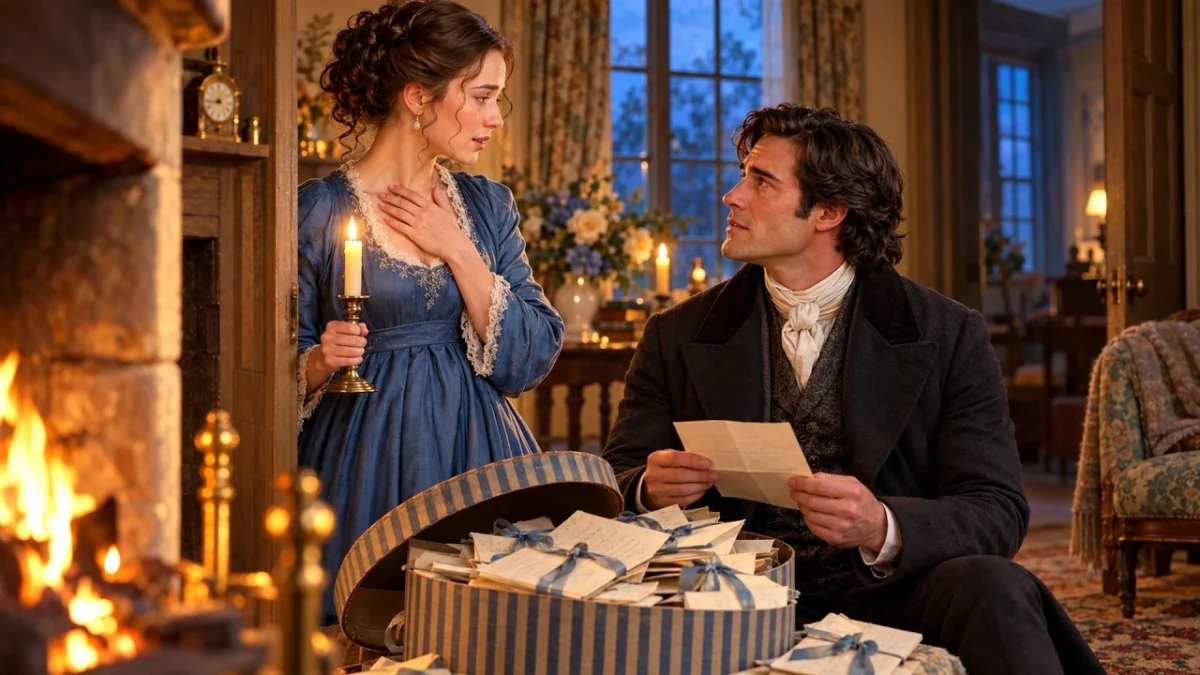
What Ambrose, the Duke of Rushford, did not know when he returned home unannounced and opened the hatbox in his wife’s sitting room was that she had written back ninety-four times and never posted a single letter.
Each sheet was addressed to him, and somewhere past the fortieth—without ever stating the shift explicitly—they had turned into love letters.
The fire was lit in July.
That was the first thing Ambrose noticed when he let himself into her private sitting room at dusk, still wrapped in his heavy traveling coat, with the cold summer rain dripping steadily from the brim of his hat.
The second thing he realized was that he had no idea where anything was kept in his own house.
He had come searching for the original estate ledger to check the agricultural yields.
He pulled open a drawer of her walnut writing desk, found only unused parchment, shut it, and bent down to inspect the space beneath.
There, resting deep in the shadow of the kneehole, sat a round hatbox striped in faded blue and cream, secured with a tarnished brass clasp.
He reached in and pulled it into the dim light.
He lifted the lid.
Inside lay dozens upon dozens of folded papers, neatly tied into small bundles with blue silk ribbon.
On the top sheet, written in a small, upright, clear script, were the words: My Lord Duke.
There was no wax seal to break.
Ambrose simply unfolded the page while standing and began to read.
My Lord Duke, she had written in neat, precise ink.
You will want to know how dinner went with your uncle after you left to catch the evening tide. It went on until the candles gutted in their sockets. He explained the intricate drainage system of the lower meadow to me using the salt cellar and a long row of boiled peas. During the fish course, I ate the lower meadow by accident. He has not forgiven me. I thought you would like to know that your new wife has made a start.
Ambrose sat down abruptly.
He had not intended to sit.
He dropped directly onto her carpet in his wet coat beside the open box, his boots drawing damp patches on the wool, and reached for the next letter.
Second Sunday, the next page began.
I did a foolish thing on Friday, and I shall confess it to you here, since you will never read this. I walked down to the harbor wall to watch your ship go out. I stood on the stone in my blue pelisse until the canvas sails were no bigger than my thumbnail. You did not look back. I did not expect you to. I only wanted to be there.
Something stirred faintly in his memory—a fleeting smudge of blue fabric against gray coastal stone—before sliding away into the fog of two years of foreign service.
Then he heard her step on the stair outside.
They were quick, light steps—the steps of a woman who fully believed the house was completely empty.
Ambrose folded the page precisely along its original creases, shut the lid, and pushed the striped hatbox back under the writing table with the toe of his riding boot.
He stood up just as he noticed his mistake.
The brass clasp, which had originally faced the back wall, now faced outward toward the center of the room.
The heavy oak door swung open.
His wife stood on the threshold holding a lit brass candlestick, her linen sleeves pushed up to her elbows and a graphite pencil stuck haphazardly through her pinned-up hair.
“Your Grace,” said Philippa.
She did not start.
She did not drop her candle or gasp.
“We had you in Vienna until Michaelmas.”
“I came early, as you see,” Ambrose replied, his voice raspy from the cold rain.
Her dark eyes went once around the room, taking in every corner the exact way a careful housekeeper counts silver spoons, before returning calmly to his face.
“You are wet through,” she noted.
“It is raining.”
“It has rained since May,” she said quietly.
“Nobody in the county has seen the sun this year.”
She set the candlestick on the marble mantelpiece, well away from her writing table.
Ambrose did not breathe until her hand left the brass base.
“Were you looking for something?” she asked.
“The estate ledger,” he said.
“Ah.”
A small, shallow line appeared between her brows.
“The steward has the secondary ledger,” she explained.
“The master ledger lives in the estate office down the hall, under the wall map of the home farm.”
She smoothed her apron with one hand.
“I will have Mrs. Abney bring you up some hot tea. Your old rooms are aired. They are aired every week.”
She did not ask him why he had come home early.
She did not ask how long he intended to stay.
She simply stood in her own sitting room—a composed, handsome woman of twenty-nine with a smudge of black ink on her inner wrist—and waited politely for her husband to leave.
Ambrose left.
At the threshold, he hesitated and looked back over his shoulder.
Philippa was already straightening the velvet cushions on the window seat, and her eyes never once strayed toward the writing desk or the floor beneath it.
An hour later, at dinner, she sat across from him at the long mahogany table and asked after the diplomatic mission in Austria as if he were a visiting guest of moderate acquaintance.
“Was the crossing kind to you, Your Grace?” she asked, cutting her roast meat.
“Tolerable,” Ambrose said.
“And the congress? Has it concluded?”
“It concluded.”
“And you were well there?”
“I was well.”
Philippa nodded once and raised her soup spoon.
Sitting to her left, his younger sister, Lady Maria—who was twenty-seven and had never in her entire life held her tongue for a whole course—looked from her brother to her sister-in-law and said absolutely nothing.
In the silence of the dining hall, the Duke heard his own voice echoing in his head.
Four lines.
He had just spoken to his wife’s face in the exact same cold, abbreviated manner he had written to her quarter after quarter.
And she had received his words now exactly as she must have received his rare letters over the past two years: with a polite nod, a raised spoon, and not the slightest change in her serene expression.
Ambrose cleared his throat, trying again over the mutton.
“The Emperor gave a grand ball before we departed,” he said.
“There were more wax candles in the hall than anyone could count.”
“How warm it must have been,” Philippa said pleasantly.
“It was very warm.”
“Then I am glad you were warm, Your Grace.”
She turned smoothly away from him to face his sister.
“Maria, regarding the miller’s roof—will you walk down to the lane with me tomorrow morning before the thresher arrives?”
“I will,” Maria said.
And that, apparently, was the end of the conversation.
After dinner, Maria caught Ambrose in the dimly lit corridor, holding a candle and wearing a stern look he remembered all too well from their childhood nursery.
“You wrote to her four times a year,” Maria said, stepping directly into his path.
“She let me read them, Ambrose.”
“They were official updates—”
“‘The weather was temperate and the congress proceeded,'” Maria quoted verbatim, her voice sharp with disdain.
“‘And you trusted she was well. And then your initial at the bottom. Not even your full name. A single capital ‘A’, as if you were writing to your tailor about a coat repair.'”
Ambrose shifted his weight.
“It was an exceptionally difficult diplomatic posting,” he argued defensibly.
“The Foreign Office courier bag went out every single week. I told her before I left that the pouch would carry anything she wished to send.”
“She told me she would not put her personal letters in a diplomatic bag alongside Prussian tariff disputes to be opened by a husband who wrote her four lines,” Maria retorted.
“So she wrote nothing at all to Vienna.”
Maria searched his face intently in the flickering candlelight.
“Doesn’t that tell you anything about her?”
It told him a great deal.
Most importantly, it told him that his sister had never heard of the striped hatbox under the table.
At one o’clock in the morning, the vast house was entirely quiet, and the heavy rain outside had not abated.
The Duke took a small silver candlestick down the dark gallery, walking in his thick woolen stocking feet like a thief in his own ancestral home.
He let himself silently into her sitting room.
He knelt on the cold floor, drew the round hatbox out, turned the brass clasp toward the back wall where it had originally belonged, and then, because he could not stop himself, lifted the striped lid once more.
He began reading the letters in strict chronological order.
That seemed the absolute minimum he owed her.
By the third Sunday after his departure, Philippa had taken the complete management of the estate into her own hands.
The steward told me on Thursday that a duchess need not trouble her head about drainage ditches, she had written in her bold, clear hand.
So I have troubled it anyway. I find I have quite a remarkably good head for drains. You would be thoroughly surprised by most things about me, I think, if you ever took the trouble to look.
The fifth letter, the sixth, the seventh—they detailed the repair of the miller’s thatch, her sharp disputes with the local vicar regarding the chapel organ, every one of which she had decisively won.
Her observations were so sharp and dryly humorous that twice Ambrose had to press his palm firmly over his mouth alone on the carpet to keep from laughing out loud and waking the sleeping household.
Then he reached the page written on the Sunday after his very first quarterly letter had arrived from Austria.
She had copied his four stiff lines out across the top of the parchment, one beneath another, and answered each line directly underneath in her own hand.
The weather in Vienna is temperate, he had written.
Beneath it, she wrote: Here it is pouring rain. The weather at Rushford is never temperate. It is either in a violent passion or fast asleep, much like your uncle.
The congress proceeds, his second line had read.
Beneath it: I am so glad. I had genuinely feared it might stop altogether without your guidance.
I trust you are well, his third line said.
Beneath it, the ink was noticeably darker where her pen had pressed into the fiber: I am quite well. Thank you. Nobody else asks. It is remarkably kind of you to be the one.
And beneath his final initial—A.—she had written only a single letter: P.
The Duke sat motionless on the floor with the page resting on his knee.
He remembered writing those four sentences at his desk in the British embassy in less time than it took to melt the sealing wax, sandwiched between an urgent dispatch on Saxon territory and a polite note to the Russian secretary.
He had not thought of her face for a single second while writing them.
Now, sitting in the dark of her room, he could not think of anything else.
He tied the blue ribbon around the stack precisely as she had bound it, slid the hatbox smoothly beneath the writing desk with its brass clasp turned away, and sat in the dark room for an hour with his cold hands wedged tightly between his knees.
PART 2
Philippa was always down for breakfast before the rest of the house.
She preferred the morning room at seven o’clock, when the brass urn was piping hot and the quiet manor felt entirely hers.
She liked it considerably less this morning because the Duke was already sitting at the table when she entered.
Ambrose stood up the moment she opened the door.
He had shaved, though his dark hair was still damp, and he looked, she thought, as though he had not slept a single minute.
“The continent must be extraordinarily tiring,” she remarked mildly, walking toward the sideboard.
She poured his tea without asking how he took it.
She had asked him that question exactly once—on the morning immediately following their wedding—and he had replied, “Milk and no sugar,” in a tone so impeccably polite it had effectively closed the door on personal conversation forever.
She placed the porcelain cup near his right elbow.
Their fingers did not touch.
“You will want to inspect the home farm today,” she said, taking her seat.
“I can provide you with the steward, or I can give you the right answers myself.”
“The right answers,” Ambrose said without hesitation.
“Then we shall review the books after church on Sunday,” she said.
“Before then, I have the thresher coming, Mrs. Abney’s running dispute with the fishmonger to resolve, and a meeting with the vicar.”
“Does the vicar still want to remove the chapel organ?” Ambrose asked.
Philippa’s hand froze over the butter dish.
He had asked the question lightly, buttering a slice of toast, but for several seconds the entire morning room seemed to hold its breath.
Nobody in the county had written to him in Vienna about the chapel organ.
She certainly had not written to him about it—or about anything else.
“Maria must have mentioned it to you,” she said slowly, watching his face.
“Maria must have told me,” Ambrose agreed, looking directly across the table at her.
He did not look away, and there was something sitting deep in his gray eyes that she had never observed there before—something raw and entirely unguarded.
It made her stomach turn over in a sudden, sharp way she did not care for.
She had stood on a freezing harbor wall once to watch a man sail away without looking back.
She had no intention of being a fool twice.
“Well,” Philippa said, recovering herself and picking up her tea.
“He may try to take it down, but he will not succeed.”
At eleven o’clock, her cousin Robert arrived at the house as he did most weeks, carrying a fresh sheet of printed music under his arm and splattered with mud to his knees.
Robert was thirty-two, broad-shouldered, extraordinarily kind, and permanently cheerful.
He was also the only person residing at Rushford who could make the Duchess laugh out loud.
Ambrose heard the sound from the main hall and stopped dead, his hand resting on the polished banister of the staircase.
The sound was coming directly from the music room over the keys of the pianoforte—a low, helpless, genuine laugh.
Then came Robert’s boisterous voice, followed by the two of them starting the duet over from the beginning, only to make the same mistake in the exact same bar and dissolve into laughter once more.
Ambrose had been legally married to this woman for two full years.
He had never once heard her make that sound.
He walked down the corridor and stood silently in the open doorway.
Philippa was seated at the treble end of the bench, her shoulders relaxed and a stray dark curl hanging loose against her neck.
She looked five years younger than the composed woman who had poured his tea at seven.
Then her eyes caught his figure in the doorway, and the joy vanished instantly.
She sat up straight.
Her hands went completely still on the ivory keys.
“Your Grace!” Robert said, springing up from the bench and extending a broad hand to shake Ambrose’s firmly.
“Welcome home! You’ll be off again directly, I suppose. Pip tells me you go on to the embassy in Paris next.”
Pip.
Ambrose had not known anyone called her that.
He had not known she played the pianoforte.
He had not known that his potential diplomatic posting to Paris was common knowledge in his own music room.
“Nothing is settled regarding Paris,” Ambrose said carefully.
“Well, when it is settled, you must let her come stay with us for the spring,” Robert said, missing the tension entirely.
“My mother would like it above all things. It is dreadfully dull for her here with nobody but Maria and the land ledgers.”
“It is not dull,” Philippa said firmly from the piano bench.
“I like the ledgers.”
And the Duke of Rushford—who at thirty-five could read an entire room of seasoned European ambassadors at a single glance—stood in his own doorway and realized he could not read his wife at all.
That night, he tried to refrain from returning to her sitting room.
He lasted until midnight.
The letters written during their second winter were noticeably shorter.
The witty observations still appeared, but they came lower down on the page, as though she had to work harder to warm up to the task.
On a Sunday in mid-December, she had written to him while confined to her bed.
I have a fever, her pencil script read.
Mrs. Abney says it is nothing serious and has sat up by my bed for three nights to prove it. The doctor says it is indeed something and has dosed me with a bitter liquid, which I suspect was given out of pure spite. I am writing in pencil because they have confiscated my inkstand. I am writing at all only because it is Sunday, and I refuse to let a temporary fever take away my Sunday ritual.
The very next entry was dated Christmas Day.
I set a place for you at the dinner table today, she wrote.
That was immensely stupid of me. Maria looked at the empty plate all through the roast goose and said nothing, which is easily the kindest thing she has ever done in her life. Your second quarterly note arrived on Christmas Eve. ‘The congress proceeds. I am much occupied. I trust you are well.’ I read those lines four times searching for a single warm word. I have decided the warm word is ‘trust’. You trust I am well. That is something. I shall keep it.
Ambrose laid the sheet back in the box and stared into the dying embers of the hearth.
He remembered writing that Christmas note.
He had written it standing up at his desk with his heavy wool coat already buttoned, because he was running late for a formal dinner at the French embassy and wanted to arrive before the soup course was served.
He could not remain in her sitting room another second.
He walked down through the dark, cold house to the basement kitchen, drawn by a thin sliver of yellow light showing under the thick oak door.
He found Mrs. Abney sitting at the long pine worktable in a white linen cap, her sleeves rolled to her elbows, working dough for the morning bread.
She was a stout, sensible woman past sixty who had known Ambrose since he wore nursery dresses, and she did not bother to curtsy when her master walked in.
“The Christmas before last,” Ambrose said, stopping by the table.
“The Duchess had a severe fever. Was it dangerous?”
Mrs. Abney’s working hands stopped instantly on the dough.
“Bad enough,” the housekeeper said quietly.
“The second night I thought we might lose her altogether, and I told her I was going to send an express rider to Vienna to fetch you home.”
She looked up, fixing him with an unblinking gaze.
“And she sat right up in that bed, Your Grace, as white as that whitewashed wall there, took hold of my wrist with what little strength she had, and said: ‘Mrs. Abney, you will not write to him. Not about this, and not about anything else.'”
The housekeeper wiped a dusting of flour from her forearm.
“So I didn’t write.”
Ambrose stood in the warm, yeast-scented kitchen and understood the exact, devastating measure of what he had built between them.
“Thank you, Mrs. Abney,” he said softly.
“Don’t thank me,” the old woman replied, turning back to her dough.
“Thank her.”
She had survived.
On Wednesday afternoons, the Duchess always practiced the organ in the stone chapel alone before the village choir arrived for evening rehearsal.
Ambrose knew this because Letter 52 had informed him of the detail.
It is the only place in the entire house, she had written, where I can make a great deal of noise and nobody asks me to stop.
He let himself into the chapel through the quiet vestry door and took a seat in the back pew under the shadow of the gallery.
Philippa was playing a slow, grave piece of music that filled the high vaulted space, making the ancient floorstones vibrate underfoot as the gray afternoon light filtered through the stained glass.
She played with her whole body, leaning forward into the heavy wooden pedals.
Ambrose sat perfectly still in his coat, suddenly not knowing what to do with his hands.
When the piece came to an end, the deep notes faded slowly, but she did not turn around on the bench.
“You need not stare, Your Grace,” she said to the pipes ahead of her.
“It is only practice.”
“I should like to stay,” Ambrose said.
A brief silence hung in the cold chapel.
Then she began another piece, much faster and more intricate than the first.
When she reached the bottom of the page, her hand reached up to turn the music sheet, only to find Ambrose already standing at her shoulder.
He had walked up the stone aisle without making a conscious decision to move.
He turned the page smoothly for her.
She played on without breaking rhythm.
He turned the next page when her eyes reached the final measure.
His sleeve was less than an inch from her shoulder.
He could smell the faint scent of lavender she used to scent her clothes, mixed with the sharp odor of hot candle wax burning beside the music stand.
When the final chord resolved, the sound hung in the chilly air for a long moment, and neither of them moved or spoke until it had died away completely.
“You turn pages very well,” Philippa said at last, staring straight at the wooden music rack.
“I have been practicing,” Ambrose said.
“On whom?”
“On nobody,” he replied.
“That is the trouble.”
She turned her head to look up at him.
Ambrose saw her make a deliberate choice not to ask what he meant by the statement.
She closed the leather music book, gathered her gloves, and walked past him down the center aisle.
At the chapel door, she stopped and spoke without turning around.
“Thank you.”
PART 3
That evening, Maria went upstairs early, claiming a sudden headache that no one in the house actually believed in, leaving Ambrose and Philippa alone in the small drawing room before the hearth.
Philippa sat near the lamp with her mending basket, her needle moving rhythmically through linen.
Ambrose sat opposite her with an unread book open in his lap.
The rain beat steadily against the tall glass windows.
After a long silence, Philippa spoke without raising her eyes from her work.
“You may ask it, you know.”
Ambrose lowered his book.
“Ask what?”
“You have been looking at me all week like a man trying to decipher a letter written in a language he learned poorly at school.”
Ambrose closed the volume in his lap with a quiet thud.
“Did you mind being married for money, Philippa?”
She threaded her needle with precise movements before answering.
“My grandfather made his fortune in Lancashire cotton,” she said calmly.
“He wanted a duchess in the family line. Your father wanted a new lead roof for the east wing. They settled the details over a glass of vintage brandy. I was the roof.”
She pulled the thread taut.
“No, Ambrose. I did not mind that. I understood the arrangement. I minded the letters.”
Ambrose looked into the fire, the flames reflecting in his gray eyes.
“I wrote you a real letter once,” he said, giving her the absolute truth.
“In my first spring in Vienna. It was five pages long. I sat up until dawn writing it.”
Philippa’s needle paused mid-stitch.
“What happened to it?”
“I burned it in the grate the next morning,” he said softly.
“It seemed an overwhelming amount of sentiment to impose upon a woman I had known for only seven days.”
He stared at the burning logs.
“I have been remarkably lonely, Philippa. I only discovered how lonely when I came back through that door.”
It was the first time since his return that he had spoken her Christian name aloud.
It fell into the silent room like a heavy stone dropped into a deep well.
Philippa carefully placed her sewing down on the table and stood up.
For a brief moment, Ambrose thought she was going to walk out of the room.
Instead, she stepped toward his armchair, bent over him, and with quick, practical fingers reached for his neckcloth, which had worked itself loose over the course of the evening.
She retied the linen knot with practiced skill.
Her hands were warm against his throat.
Her face was so close he could see the tiny specks of gold in her dark brown eyes, and he forgot entirely to breathe.
Then she seemed to register what she was doing.
Her fingers went rigid against his collar.
“There,” she said, stepping back instantly.
“Now you look like a duke again.”
She took her candle from the table and walked out to the stairs.
Ambrose sat alone in the quiet drawing room for a long time, his hand resting against the spot on his throat where her warm fingers had just been.
At four o’clock in the morning, unable to rest, he went back to the sitting room and opened the hatbox once more.
The letters written in their second year were distinctly braver in tone.
She had stopped making excuses for her feelings.
I should like, she had written one Sunday, to be looked at, not merely admired.
I should like someone to look up with genuine interest when I walk into a room.
And in another letter:
It is exactly one year today since we were married. I have spent precisely one week of that year in your presence. I know vastly more about the miller’s roof than I know about my own husband. That is the miller’s good fortune, I suppose, and not mine.
And then he found a page that made him laugh out loud before he buried his face in his hands.
Maria hears from a friend in London that you danced three times at the Embassy Ball with a Russian princess, Philippa had written.
I have decided not to mind. I have decided it so forcefully that I have just snapped my steel pen nib in half.
Ambrose remembered that ball vividly.
He had danced with the diplomat’s daughter purely as an excruciating political courtesy to the Tsar’s envoy, hating every single step across the floor.
It had never once entered his mind that anyone at Rushford would ever hear of it, let alone care.
The Duke sat back on his heels among the scattered papers, feeling a profound sense of shame.
These pages were not meant for him.
She had not given him these private thoughts; he had stolen them.
Every night he had crept into her room like a trespasser to read what she had never intended another human soul to see.
And every morning he had allowed her to pour his tea in cold silence as if he were completely ignorant of her inner life.
He vowed to tell her everything at breakfast before he lost his courage.
However, the Foreign Office arrived first.
The official dispatch came up with the morning post in a thick, parchment cover sealed with red wax.
Philippa always opened the estate mail, and she had already broken the seal before realizing it was not agricultural business.
She held the document across the table to him.
“I beg your pardon, Your Grace. I did not inspect the direction on the cover.”
The document was an official offer: the post of Minister at the embassy in Paris.
The Foreign Secretary and Ambrose’s uncle would be passing Rushford on Saturday on their way to the coast, and wished to dine at the manor and take Ambrose along with them to France.
Ambrose looked up from the page.
Philippa was buttering her toast with meticulous care.
“You will leave on Saturday, then,” she said smoothly.
“I shall instruct the servants to have your traveling trunks brushed. Paris will be very warm, I expect.”
The opportunity to confess had vanished.
He slipped the dispatch into his coat pocket, deciding he would read the final letter that night and confess the entire truth immediately after.
That evening, while Philippa was visiting the vicarage, he went up to her sitting room at dusk.
The fire was burning brightly against the evening chill.
He knelt on the floor, pulled out the hatbox, and removed the lid.
There was only a single sheet remaining at the bottom—unbound by any ribbon.
Letter 94.
He did not stand to read it.
Earlier that afternoon, he had walked down to the harbor wall himself and stood on the exact spot where she had stood two years prior.
He sat down on the carpet amidst the loose papers and unfolded the final page.
This is the last letter I shall write, the page read.
I have written to you every Sunday since you sailed, and I have never sent one. It is time to stop writing to a man who does not read my words. If you ever return home for good, I shall be entirely polite. You will never know that I walked to the harbor or that I have loved you since that day—which is foolish, because you did not look back. I have only one question, and I shall ask it here where it is safe: Did you even once look back at the shore?
Ambrose did not hear the door open.
He heard only a tiny, sharp intake of breath a second later, and raised his head.
Philippa was standing in the doorway in her blue wool gown, holding a candle.
She had stopped dead on the threshold.
The flame trembled in her hand, and her other hand had gone directly to her throat, pressing flat against her skin as if to physically hold her composure in place.
Her eyes took in everything: his damp coat, the open hatbox at his knees, the scattered letters covering her carpet, and the single sheet held in his trembling hands.
The fire crackled softly in the grate.
Neither of them moved.
“Philippa,” he said, his voice rough.
“How many?” she asked.
Her voice was barely a whisper.
He could have lied.
He had lied to foreign ministers and princes for years.
“All of them,” Ambrose said.
He watched the truth hit her.
“The harbor wall,” he said.
“The fever. The place set at Christmas. The Russian princess. The broken pen. And this last one.”
“Put it back,” Philippa said, her voice shaking slightly.
“Please put it back.”
“Philippa, let me—”
“Put it back!”
Ambrose folded the paper along its crease with unsteady hands, placed it atop the bundle, and replaced the lid on the box.
When he looked up, the doorway was empty.
Only the faint smell of snuffed candle wax remained in the dark gallery outside.
She did not come down for dinner that evening, sending word through Mrs. Abney that she was indisposed with a headache.
The next morning, she came down to the breakfast room precisely at seven o’clock, looking utterly flawless.
She wore a crisp gray dress, her dark hair pinned perfectly in place.
When Ambrose stood as she entered, she sank into a curtsy so immaculate it might have been measured with a ruler.
“Good morning, Your Grace,” she said, her voice as formal and cold as a closed drawing room.
She set his tea beside his elbow.
“Milk. No sugar.”
“Philippa—”
“I have written to my cousin Robert,” she interrupted smoothly, taking her seat.
“His mother invited me for the spring, and I find I would prefer to go now. He will send his carriage on Sunday morning after you and your uncle have departed for France. The steward will provide you with the master ledger. I have marked every relevant entry.”
“Philippa,” Ambrose said, leaning across the table.
“I read them because I could not stop. I should have told you the very first night I returned.”
“Yes,” she said pleasantly, her face completely unreadable.
“You should have.”
She turned immediately to Maria, who had just entered the room and stopped cold at the sight of their faces.
“Maria, did the miller receive his new thatch yesterday?”
She maintained that flawless, terrifying politeness all day—the exact manner of diplomacy Ambrose had seen used before a declaration of war.
He knew precisely what it cost her to maintain it, having used the same defense mechanism himself for years.
In the afternoon, a footman carried a heavy traveling trunk down from the attic.
Through the half-open door of her bedroom, Ambrose saw it resting near her bed, and beside it sat the striped hatbox, now bound tightly with plain heavy twine.
He went searching for her and found his sister in the hall instead.
“What did you do?” Maria demanded, catching his arm.
“I read her letters,” Ambrose confessed.
“She wrote to me every Sunday I was away and never sent them. She kept them in a hatbox, and I found them and read them all without telling her.”
Maria sat down abruptly on the bottom step of the staircase.
“Every Sunday? Ninety-four letters?”
She covered her face with her hands.
When she lowered them, there was no sympathy in her eyes.
“They were addressed to you,” Maria said sternly.
“Every single one had your title on it. Then they were yours to read, you absolute fool. And now that you have read them, you owe her an answer. Not four cold lines—a real answer.”
On Friday, Robert arrived at the manor to confirm the timing for the carriage on Sunday.
Ambrose met him on the stone terrace in the pouring rain.
They walked the length of the terrace and back twice in complete silence.
Finally, Robert stopped near the stone balustrade and turned to face him.
“She is the finest person I know, Rushford,” Robert said quietly.
“I would have married her myself years ago if my mother had possessed a roof to sell to her grandfather. If you are going to Paris, then go, and let her come stay with us.”
He looked directly into Ambrose’s eyes.
“She laughs at our house. She does not laugh here. Did you know that?”
“I know it,” Ambrose said.
“I heard her laugh on Tuesday in the music room with you. It was the first time I had heard the sound in two years.”
Robert, to his immense credit, did not look pleased by the admission.
He looked genuinely sad.
“I am not going to Paris,” Ambrose said.
Robert studied the Duke for a long, quiet moment.
Then he gave a single nod and extended his hand.
“Then you had better tell her so,” Robert said, “before ten o’clock on Sunday.”
On Saturday evening, Ambrose’s uncle and the Foreign Secretary arrived in a grand traveling coach loaded with luggage, thoroughly pleased with themselves and the political prospects in France.
They sat down to a grand dinner at seven.
Philippa sat at the foot of the long table in her gray silk dress, performing the role of the perfect aristocratic hostess.
She asked the Foreign Secretary about his gout with genuine concern.
She inquired about the drainage of his uncle’s lower meadow with such apparent fascination that the old man talked uninterrupted through the entire fish course, causing Maria to stare intently at her plate to hide her expression.
Philippa did not look at her husband once.
When the port was poured, his uncle raised his glass with a wide smile.
“To Paris!” the old man toasted.
“And to my nephew, who will certainly be made an ambassador before he turns forty, provided he minds his diplomatic manners!”
The Foreign Secretary lifted his glass in agreement.
Maria raised hers slowly.
At the foot of the table, Philippa reached calmly for her glass.
Ambrose did not touch his.
“Forgive me, sir,” Ambrose said, his voice cutting through the dining room.
“I am not going to Paris. I shall write an official letter to the Foreign Office tonight, but I preferred to state it to your faces first. I am grateful for the appointment, but I shall not take it.”
The lifted glasses froze in mid-air.
The Foreign Secretary set his glass down with extreme care.
“Rushford, understand me clearly,” the diplomat said, his voice dropping an octave.
“If you refuse Paris now, there will not be another posting offered. Not Vienna, nor a minor legation in the smallest court in Germany. You will never serve the Crown abroad again.”
“I understand that completely, sir,” Ambrose said.
“Then may I ask why?”
Ambrose looked straight down the long mahogany table, past the silver candelabras and his uncle’s astonished face, directly to the foot of the table where his wife sat motionless.
“My wife wrote to me every Sunday I was away,” Ambrose said clearly.
“I have not answered her letters yet. I find I cannot do it from Paris.”
Absolute silence fell over the room.
His uncle opened his mouth to speak, but shut it without making a sound.
Maria pressed her hand flat against the table linen to steady herself.
Philippa held his gaze across the long expanse of wood.
For several seconds, she did not avert her eyes.
Then she set her wineglass down completely untouched, folded her hands in her lap, and maintained an unreadable expression.
Only her knuckles, pressed white against her dress, betrayed any emotion.
“Well,” the Foreign Secretary said at last, breaking the tension.
“I hope she is worth the sacrifice, Rushford.”
“She is worth a great deal more than Paris, sir,” Ambrose replied quietly.
“It is only that I was too blind to realize it until now.”
Philippa stood up smoothly.
She curtsied gracefully to the Foreign Secretary, then to his uncle, and finally to her husband—the same flawless, distant curtsy she had given him that morning.
She walked out of the dining hall, and the heavy oak door clicked shut softly behind her.
That night, Ambrose sat at his library desk until the early hours of the morning trying to write his response.
He had spent a decade drafting complex treaties that altered international borders.
Yet now he sat with a clean sheet of parchment and a fresh quill until the candle burned down to a stub, and every sentence he attempted came out stiff, formal, and completely devoid of life.
At three o’clock, he tore up the last draft.
He had written to her in cold ink for two years and communicated nothing of value.
Whatever he had to say to her now would have to be said aloud to her face, and even if he stumbled over the words, they would at least be genuine.
He pulled Letter 94 from his coat pocket—where he had carried it every moment since finding it—and read her final question one last time by the dying light of the candle.
On Sunday morning, her heavy traveling trunk stood strapped and waiting in the main hall.
Philippa came down the staircase at seven dressed in a dove-gray traveling gown, holding her bonnet by its silk ribbons.
Her cousin’s carriage was scheduled to arrive at ten.
The Foreign Secretary and his uncle had departed at first light in a cloud of furious silence.
Ambrose was already waiting in the breakfast room.
He had not shaved.
He was still wearing his coat from the previous evening, and his neckcloth hung completely loose at his throat.
Philippa walked to the sideboard and poured his tea with an utterly steady hand.
She set the cup down at his elbow.
Ambrose did not look at the tea.
He looked directly into her eyes and took Letter 94 from his pocket, laying the folded sheet on the white tablecloth between them.
“You asked me a question at the end of this page,” Ambrose said, his voice quiet in the morning stillness.
“You asked if I ever once looked back at the harbor wall.”
Philippa’s hand tightened slightly on the handle of the teapot, but she did not speak.
“I did,” Ambrose said softly.
“I stood at the stern rail of the ship until the coastline was nothing more than a thin gray line against the sea. I saw a small smudge of blue standing on the stone wall.”
He took a step closer to her side of the table.
“I did not know it was you. I was too arrogant, too foolish, and too caught up in my own duties to realize what I was leaving behind. But I saw you, Philippa. I have carried that smudge of blue in my memory for two years without understanding what it meant.”
Philippa stared down at the folded paper resting on the table.
“You read my private thoughts,” she said, her voice barely audible.
“You took what was never meant for your eyes.”
“I did,” Ambrose admitted without defense.
“It was an unforgivable intrusion. But reading those letters saved my life, Philippa. It showed me the woman I had been married to for two years without ever truly knowing.”
He reached out slowly, his fingers hovering just inches from hers on the table, giving her the choice to pull away.
“I refused Paris because there is nowhere else on earth I want to be except here, trying to earn the right to sit at this table with you.”
Philippa looked up from the letter to his unshaven face, taking in his disheveled coat, his loose neckcloth, and the raw, desperate sincerity in his eyes.
The silence stretched long between them in the sunlit breakfast room.
Slowly, without saying a word, Philippa reached out her hand and closed her fingers gently around his.
“Your neckcloth is loose again, Your Grace,” she whispered, a faint, fragile smile touching the corner of her lips.
“Then tie it for me,” Ambrose said softly, leaning closer.
“And this time, don’t step back.”








