The Maid’s Little Girl Sang to the Comatose Duke—Then He Woke Up Asking for Her
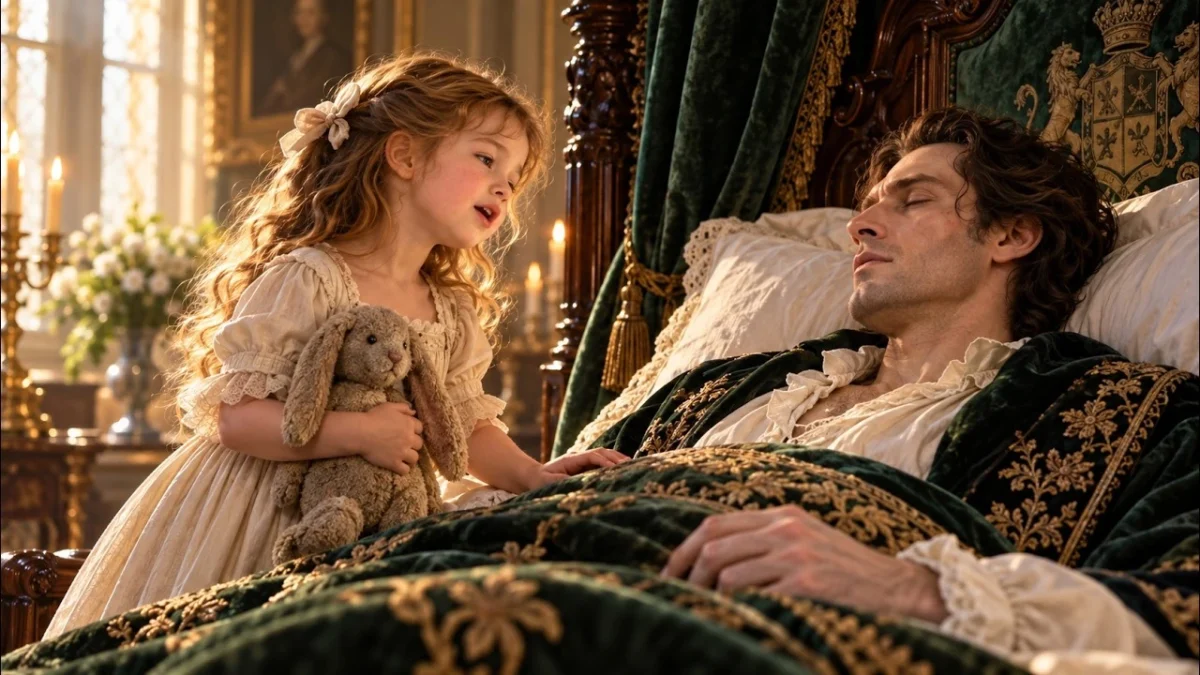
England, 1787.
Sir, are you frightened? Sleeping all alone?
Three-year-old Rose Hartley stood in the doorway of the grandest bedchamber she had ever seen, clutching a worn cloth rabbit beneath one arm.
No one had told her the pale man lying beneath the dark green canopy was Nathaniel Blackwood, the Duke of Blackwood, master of nearly 12,000 acres, patron of three villages, and a man whose signature could alter the fortunes of hundreds of families.
No one had told her that he had been unconscious for seven weeks, or that the physicians had begun speaking in quieter voices whenever they left his room.
Rose knew only that he looked lonely.
She dragged a small chair across the carpet, climbed onto it, and leaned toward him.
“Mama sings when I cannot sleep,” she whispered. “I can sing for you, too.”
Then, with the solemn confidence only a very young child could possess, Rose began a soft country lullaby her mother had sung to her since infancy, an old tune about lavender and love.
Her voice was imperfect.
She forgot a word and hummed through it.
She started one line twice, yet in the stillness of the room, every note seemed to settle over the bed like warm light.
Rose did not know that Nathaniel Blackwood could hear her.
He could not open his eyes.
He could not lift a finger.
He could not shape a word.
For seven weeks, his body had been a locked house, and his mind had wandered through darkness without doors.
But somewhere beyond that darkness, a small voice had reached him.
Nor did Rose know that by opening the forbidden door, she had stepped into an old conspiracy, one that someone inside Blackwood Hall had already killed to protect and would kill again before allowing the Duke to wake.
Mrs. Beatrice Wren had spent twenty-one years tending the sick in noble houses, charitable infirmaries, and country estates.
She knew the difference between peaceful sleep and the strange stillness of a body fighting to return to itself.
She also knew that children did not belong in a sickroom where a duke lay between life and death.
When she entered carrying a basin of fresh water and saw Rose perched beside the bed, every instinct told her to remove the child at once.
Then she glanced at Nathaniel’s pulse beneath her fingers.
It had quickened, not dangerously, not enough for anyone less experienced to notice.
But Beatrice had counted that pulse morning and night for forty-nine days.
She knew its stubborn rhythm better than she knew the ticking of the clock in the corridor.
Rose finished her song, bent down, and pressed a quick kiss to the Duke’s cold hand.
“There,” she whispered. “Now you are not by yourself.”
She climbed down and walked past Beatrice with the rabbit swinging by one ear.
Beatrice did not stop her.
Instead, she sat beside the bed and counted again.
Nathaniel’s pulse was still faster.
“Your Grace,” she murmured, though she did not expect an answer. “What exactly did you hear?”
Nathaniel had been thirty-eight when the accident happened.
He had inherited the dukedom at twenty-six after his father died suddenly of a fever that swept through the estate.
The young Duke had learned very quickly that grief was a luxury men in his position were expected to indulge in privately, if at all.
By sunset on the day of his father’s funeral, tenants were waiting to discuss leases.
Creditors were waiting to be paid.
A neighboring lord was disputing a boundary, and three elderly relatives had already begun advising Nathaniel on whom he ought to marry.
He had answered every letter.
He had settled every account.
He had married no one.
For twelve years he governed Blackwood with strict fairness and almost no visible tenderness.
He reduced rents after two bad harvests, repaired cottages without attaching his name to the work, and paid pensions to the widows of men injured on his land.
Yet inside the house, he remained distant.
Servants respected him.
Neighbors feared disappointing him.
Women found him compelling and impossible.
No one knew what he looked like when he was lonely.
Seven weeks before Rose arrived at Blackwood Hall, Nathaniel had traveled to London to meet his solicitor concerning a series of irregular debts being claimed against one of the western estates.
He returned after dark in his enclosed carriage.
The road was dry.
The horses were steady.
The driver later swore he had felt no warning before the left rear wheel tore free.
The carriage struck the ditch, rolled onto its side, and shattered against an oak.
Nathaniel was pulled from the wreck with blood in his hair and no response to voice or pain.
His coachman died before dawn.
A footman survived with a broken shoulder and remembered almost nothing.
The local magistrate called it a tragic accident.
Dr. Henry Pembroke, who came from London at the request of the family, was less certain about anything except the Duke’s condition.
“He breathes without assistance,” Pembroke had told them. “His heart is strong. The swelling from the injury has diminished, but whether he returns to consciousness tomorrow, in a month, or ever, I cannot tell you.”
Nathaniel’s private secretary, Mr. Jonathan Mercer, immediately brought him home to Blackwood Hall.
A quiet chamber on the second floor was turned into a sickroom.
Curtains were changed so light could be controlled.
Fires were kept low and steady.
A bed was placed where the physician could approach from either side.
Medicines were locked.
Visitors were restricted.
The household was told one rule above all others: no one entered the Duke’s room without permission.
The rule mattered for more than dignity.
Nathaniel had no wife and no child.
His nearest male relative, Lord Sebastian Wickliffe, was heir presumptive to the dukedom.
If Nathaniel died unmarried, Wickliffe would inherit the title and much of the entailed land.
Jonathan Mercer did not accuse Wickliffe of anything, but he doubled the night watch anyway.
Seven weeks after the carriage wreck, Eleanor Hartley arrived at Blackwood Hall with two small cases, a faded blue cloak, and a sleeping child in her arms.
Eleanor was twenty-nine and had been a widow for eighteen months.
Her husband, William, had been a carpenter in London.
He died when scaffolding collapsed at a townhouse near Bloomsbury, leaving her with a daughter, a few coins, and debts that seemed to multiply each time she paid one.
She washed linens for an inn before dawn, scrubbed floors in two houses, and mended shirts by candlelight after Rose fell asleep.
On the worst nights, she worked until her fingers cramped and woke two hours later to begin again.
The position at Blackwood Hall came through a woman who had once served there and knew Mrs. Margaret Bellamy, the housekeeper.
The wages were more than Eleanor could earn from three small employments combined.
There was one difficulty: the work began before sunrise and often continued until late evening.
Eleanor had no one with whom she could leave Rose.
She nearly refused the position.
Instead, she traveled to Blackwood Hall, stood before Mrs. Bellamy in a borrowed brown dress, and asked whether her daughter might live with her in the servants’ wing.
Mrs. Bellamy studied her for a long moment.
“This is not a nursery, Mrs. Hartley,” the housekeeper said sternly.
“I understand, ma’am,” Eleanor replied, holding her breath.
“His Grace is very ill,” Mrs. Bellamy continued. “The entire house is under immense strain.”
“I understand that as well,” Eleanor said quietly. “She is a quiet girl, ma’am. I promise she will not be a burden.”
“You will be entirely responsible for the child at all times,” Mrs. Bellamy stated, her tone unyielding. “If she disrupts the household, I will have no choice but to let you go.”
“Yes, ma’am. Thank you, ma’am.”
Mrs. Bellamy’s expression softened by one degree.
“Then bring her. See that you keep your word.”
On their first evening, Rose wandered upstairs while Eleanor was being shown the linen cupboards.
By breakfast the next morning, Mrs. Bellamy had summoned Eleanor to her office.
“Your daughter entered His Grace’s chamber yesterday evening,” Mrs. Bellamy said flatly.
All color left Eleanor’s face.
“I am so sorry, ma’am! I did not know she had left my side. I swear to you, it will never happen again!”
Mrs. Bellamy folded her hands over her apron.
“See that it does not. Not merely because I wish to reprimand you, Mrs. Hartley, but because this household is not presently an ordinary one. Restraint is required from everyone.”
Eleanor returned to the servants’ wing, knelt before Rose, and took her small hands.
“Rose, listen to me,” Eleanor said, her voice shaking. “You must never, ever go up those stairs again. Do you understand me? It is very dangerous, and we could be sent away.”
“I was only saying hello to the sleepy gentleman, Mama,” Rose murmured, looking at her shoes.
“I know, my sweet, but you must promise me. Promise Mama you will stay downstairs.”
“I promise, Mama.”
The promise lasted two days.
On the third afternoon, while Eleanor polished silver in the dining room, Rose waited until the back staircase was empty.
Then she tucked her rabbit beneath her arm and climbed.
Mrs. Wren had left the Duke’s door slightly ajar to let in the fresh air.
Rose pushed it open.
Nathaniel heard the faint scrape of the chair before he heard her voice.
“I brought Samuel’s best flower,” she announced proudly.
Samuel Finch, the cook, had given Rose permission to pick small blossoms growing near the kitchen wall, so long as she did not crush the herbs beside them.
That afternoon she had chosen one yellow rose whose petals were already browned at the edges.
She placed it carefully on the white sheet beside Nathaniel’s motionless hand.
“Mr. Finch says flowers make people hungry for summer,” she explained, leaning over the mattress.
Nathaniel could not understand why that sentence stayed with him.
Perhaps because no one had spoken to him as if he were simply a man in weeks.
Doctors spoke about him.
Servants whispered around him.
Jonathan Mercer sometimes sat at the foot of the bed and read estate reports aloud, hoping familiarity might draw him back.
But Rose spoke to him.
She asked whether he liked pumpkin soup.
She told him her rabbit’s name was Button, even though it had only one button eye left.
She confessed that she disliked raisins, but ate them when her mother looked tired because she did not want to cause trouble.
She told him Eleanor sometimes cried when she thought Rose was asleep.
“Mama says she is only tired,” Rose whispered one afternoon, her small hand brushing his sleeve. “But tired tears and sad tears look the same to me.”
Inside the darkness, Nathaniel felt something tighten painfully around his heart.
He began waiting for her.
That realization would have humiliated the man he had been before the accident.
Nathaniel Blackwood had never waited eagerly for anyone.
People waited for him outside studies, ballrooms, court offices, and carriage doors.
Yet now he measured time by the lightness of small footsteps in the corridor.
Mrs. Wren noticed the pattern almost immediately.
Each time Rose visited, Nathaniel’s pulse strengthened.
His eyelids sometimes moved beneath the pale skin.
Once while the child was humming her lullaby, Beatrice saw the fingers of his right hand curl by the smallest fraction.
She told Dr. Pembroke.
The physician frowned, then observed for himself.
For seven days, he recorded subtle improvements.
On the eighth day, he called a private meeting in the library.
Jonathan Mercer attended.
Mrs. Bellamy attended.
Captain Thomas Reed, a retired army officer who supervised the household watch and coordinated with the parish constables when trouble arose, stood near the heavy oak door.
So did Mr. Alistair Crowe, the senior steward of Blackwood Hall.
Crowe had served the Blackwood family for nearly thirty years.
He was fifty-four, silver-haired, controlled, and almost universally trusted.
He knew every tenant by name, remembered which servant had an ailing parent, and sent baskets from the kitchen to cottages where illness had struck.
He had taught Nathaniel how to read estate ledgers when the future Duke was fifteen.
After Nathaniel’s father died, Crowe had shown the young man where the oldest contracts were kept, which neighboring families could be trusted, and which smiles at a dinner table concealed lawsuits.
He had once been almost a second father to him.
Dr. Pembroke stood beside the grand fireplace, clearing his throat.
“The Duke is improving,” he said clearly. “I will not promise what no physician can promise, but his physical responses are stronger and remarkably more frequent. If this improvement continues, I believe he may wake within a fortnight.”
Jonathan Mercer closed his eyes briefly in sheer relief.
Mrs. Bellamy whispered, “Thank God.”
Captain Reed smiled for the first time in weeks. “That is outstanding news, Doctor.”
Alistair Crowe smiled, too.
It was exactly the right smile, warm and relieved.
“Tragically delayed, but excellent news indeed,” Crowe said softly.
Then he returned to his private office, locked the heavy oak door, and sat without moving for nearly ten minutes.
At last, he opened the bottom drawer of his desk and removed a small bundle of letters tied with a black silk ribbon.
The uppermost letter bore the crimson wax seal of Lord Sebastian Wickliffe.
Crowe read only one sentence before folding it again: *If Blackwood wakes, all arrangements fail.*
Three years earlier, Alistair Crowe had begun telling himself that Nathaniel owed him more than a salary.
He had trained the boy.
He had managed the estate when Nathaniel’s father died.
He had spent decades in rooms where lesser men inherited greater authority simply because of their blood.
That grievance had hardened into a private creed.
Crowe no longer saw himself as a servant who had been trusted.
He saw himself as the unseen architect of Blackwood, the man whose judgment had preserved the estate while another man inherited the title merely by being born.
In his own mind, every secret coin he diverted and every decision he made without permission became not theft, but payment long denied.
Yet each year Nathaniel grew more independent.
He consulted solicitors Crowe had not chosen.
He audited accounts Crowe considered his own domain.
He rejected a land sale Crowe had privately promised to another wealthy family.
Worst of all, Nathaniel had discovered irregular debts attached to the western farms and ordered Jonathan Mercer to investigate them thoroughly.
Those debts led quietly and inevitably toward Alistair Crowe.
By then, Crowe had already borrowed against money that was not his.
He had already sold small pieces of information to Wickliffe—lease schedules, travel plans, and the names of vulnerable tenants.
At first, he had called it harmless survival.
Then, Wickliffe offered him a grander future: if Nathaniel died childless, Wickliffe would become Duke of Blackwood, and Crowe would become indispensable, elevated to overseer of all the lord’s northern properties.
The carriage accident was supposed to end everything cleanly.
Crowe had provided the route from London and the expected hour of travel.
A man paid by Wickliffe had loosened the wheel assembly at an inn yard outside the city.
But Nathaniel had survived, and now he might wake.
That same afternoon, Rose climbed onto the chair beside Nathaniel with another yellow flower in her tiny hand.
“You must wake soon,” she told him, leaning close to his ear. “Mr. Finch says the last pumpkin will not keep forever, and he wants to make soup.”
Nathaniel tried with all his strength to move one finger.
For the first time in forty-nine days, he felt the cool linen beneath it.
The darkness surrounding his mind no longer seemed endless.
Two nights later, Rose woke after midnight and found Eleanor’s bed empty.
Her mother was helping in the kitchen after an unexpected late arrival of guests from a neighboring estate.
Rose slipped into the corridor looking for her, holding Button by his remaining ear.
At the top of the back staircase, she stopped.
The second-floor passage was dim, lit only by two wall lamps turned low.
A door opened near Nathaniel’s chamber.
Alistair Crowe stepped out into the hallway.
In his hand was a small black glass bottle.
He glanced down the corridor, then swiftly slipped it inside his coat pocket.
Rose stared at him with wide, innocent eyes.
Crowe turned and saw her standing by the banister.
For half a heartbeat, his face became utterly still, cold as stone.
Then, the familiar warmth returned to his eyes.
“Miss Rose,” he said softly, stepping closer. “You should be asleep in bed.”
Rose hugged Button tighter to her chest. “I was looking for Mama.”
“Your mother is downstairs,” Crowe said smoothly. “Go back to bed now. I was only checking on His Grace.”
Rose nodded obediently. “Goodnight, Mr. Crowe.”
She turned and went back down the hall, but as she snuggled under her blanket, she whispered into her rabbit’s worn ear, “Why did Mr. Crowe hide the little bottle?”
The next morning, she went back to Nathaniel’s room.
She sat on her chair and told him about her breakfast.
She told him that one of the kitchen cats had stolen a piece of ham off the table.
Then, as casually as if she were describing a cloud in the sky, she added, “Mr. Crowe came out of your room last night. He had a little black bottle, but he hid it inside his coat when he saw me.”
Inside Nathaniel’s mind, the world shattered and reformed.
He knew Crowe’s habits better than anyone.
He knew the steward had no valid reason to enter the sickroom after midnight.
He knew all medicine was kept in a locked wooden cabinet under Dr. Pembroke’s sole authority.
He tried frantically to open his eyes, but his eyelids were like lead.
He tried to move his hand, but his muscles refused.
He tried to force a sound from his dry throat, but nothing came.
Memory was returning with cruel, terrifying clarity: the disputed debts, Crowe’s subtle objections to the audit, a private conversation in which Crowe had asked too casually what hour Nathaniel meant to leave London, the carriage wheel breaking on a smooth, dry road, and now a hidden bottle in the dead of night.
Nathaniel screamed inside a body that would not answer him.
Rose finished her song, patted his cold hand affectionately, and left the room.
On the staircase, she passed Crowe coming up.
He touched her golden hair lightly. “Good morning, little dove.”
“Good morning, Mr. Crowe,” she smiled brightly, not yet knowing enough to be afraid.
Crowe entered Dr. Pembroke’s study an hour later.
The physician had requested the meeting to discuss estate funds for medical supplies.
“The Duke’s condition has advanced far more quickly than anticipated,” Pembroke said, looking up from his notes. “There is a strong possibility he may wake within days, perhaps even sooner.”
Crowe asked calm, precise questions. “Would His Grace remember people immediately, Doctor? Would confusion be expected? Could his memory return slowly over time?”
Pembroke answered as carefully as physicians do when they do not wish hope to become false prophecy. “It varies. Some remember everything up to the moment of trauma; others are hopelessly confused.”
“I see,” Crowe said gently. “We must pray for the best.”
He thanked the doctor and walked back to his private office.
He locked the door behind him.
He removed a crystal decanter from a shelf, poured two fingers of brandy, and drank the spirits down without tasting a thing.
He had reached the end of delay.
Nathaniel had to die before he could speak, and the child who had seen Crowe leaving the room with the bottle had to disappear from Blackwood Hall before anyone thought to ask what she knew.
Crowe did not initially intend to kill Eleanor or Rose.
Murdering a housemaid and a three-year-old child inside the hall would draw furious investigation.
A sudden disappearance could be far more easily explained.
He prepared a alternative solution.
A hired coachman named Peter Null received strict instructions to bring a closed carriage to the east service gate shortly before midnight.
At an abandoned hunting cottage twelve miles from the estate, Crowe placed two heavy purses of gold coins and a packet of forged letters of introduction, along with shipping papers naming Eleanor and Rose under a different surname.
A second coach would be waiting there before dawn to carry them to the port of Bristol.
From there, passage had been purchased on a merchant ship bound for Halifax in the Americas.
The choice for Eleanor would be simple: leave England forever and live, or remain and discover how dangerous Blackwood could become.
Crowe’s final, desperate task concerned Nathaniel.
Dr. Pembroke had prescribed only weak broth, water, and carefully measured drops of a mild sedative when the Duke showed signs of restless agitation.
Crowe had obtained a far stronger tincture of opium from a shady apothecary in town who asked no questions.
A full dose given at once to a weakened, unconscious man would stop his breathing quietly before morning.
At ten o’clock that evening, Crowe entered the sickroom through the dark side passage while Mrs. Wren was helping Dr. Pembroke in the adjoining chamber.
Taking the black glass vial hidden inside his coat, he carefully measured the concentrated tincture into a spare glass bottle and exchanged it for the medicine bottle Dr. Pembroke had prepared on the bedside tray.
The bottles and labels were nearly identical.
Crowe returned the black vial to his inner pocket and stepped out quietly into the dark.
He did not notice the single yellow rose petal lying on the floorboards beside Rose’s chair.
At ten minutes past ten, Mrs. Wren returned to the bedside.
Nathaniel was noticeably restless.
His breathing had turned rapid and shallow.
His brow tightened as if he were fighting a desperate battle in his sleep.
Beatrice checked the fire, checked the window latches, felt his elevated pulse, and checked the water basin beside the bed.
Then she reached for the medicine bottle Dr. Pembroke had left out for him.
She stopped mid-reach.
The bottle felt slightly heavier than it had an hour ago.
She raised it toward the oil lamp.
The liquid inside was distinctly darker than the amber mixture she was used to pouring.
Beatrice had spent twenty-one years around sickrooms.
She had seen mislabeled bottles kill patients far faster than disease ever could.
She pulled the cork stopper and smelled the contents.
Her face hardened immediately.
She replaced the stopper at once and called out, “Dr. Pembroke!”
The physician entered hastily from the next room. “What is it, Mrs. Wren?”
“I did not prepare this bottle,” she said grimly, handing it to him. “And neither did you. Smells of pure, unrefined laudanum.”
Pembroke examined it, his face draining of color.
Neither spoke for several agonizing seconds.
Then Pembroke stepped to the locked cabinet and turned his key.
The original, lighter bottle was completely gone.
“Do not give him anything,” Pembroke commanded sharply. “Not a single drop.”
He reached for the wall cord and pulled it hard.
A bell rang sharply through the quiet corridors of the estate.
Captain Reed arrived first, his boots thudding against the floor.
Jonathan Mercer followed seconds later in a dressing coat, a sword belted hastily over his nightshirt.
Within minutes, Blackwood Hall woke into utter confusion.
Doors slammed open, lanterns flared to life, footmen ran through the passages.
“Close the east gate immediately!” Captain Reed barked to his men. “Every servant is to remain in their quarters until they are counted and questioned!”
Alistair Crowe appeared in the corridor, looking remarkably composed, his face a mask of solemn concern.
“What in God’s name has happened, Captain?” Crowe asked, looking between the men.
“Someone has attempted to tamper with His Grace’s medicine,” Jonathan Mercer said coldly, staring directly at him.
Crowe’s expression registered deep shock at exactly the proper speed.
“My God! Who could commit such a monstrous act?”
Captain Reed turned to issue orders to his men.
Crowe smoothly used the distraction.
He backed away from the Duke’s chamber and slipped down the dark back staircase.
At ten minutes before eleven, Crowe knocked firmly on Eleanor’s bedroom door in the servants’ quarter.
She opened it in her nightdress, a woolen shawl wrapped tightly around her shoulders.
“Mr. Crowe? What is all the noise outside?”
“Mrs. Hartley, listen to me carefully,” Crowe said in a low, urgent whisper. “There has been a violent attempt against His Grace tonight. Captain Reed believes the servants’ wing is no longer secure.”
Eleanor gasped, clutching her shawl. “A violent attempt?”
“Mrs. Bellamy has ordered all women with children to be removed temporarily to a secure cottage beyond the estate boundary,” Crowe lied smoothly. “A private carriage is waiting at the gate right now.”
Eleanor’s maternal fear instantly overcame her caution. “Oh, mercy! Let me wake Rose!”
“Quickly,” Crowe urged. “Bring only what you need for the night.”
Eleanor hurried inside, pulling Rose from her deep sleep into her arms.
Rose surfaced against her mother’s shoulder, Button clutched tightly in her tiny fist.
“Are we going somewhere, Mama?” Rose asked blearily, rubbing her eyes.
“Only for a little while, my sweet,” Eleanor whispered hastily.
She wrapped Rose’s thick blue cloak around her, grabbed a small canvas bag, and followed Crowe down the rear service passage.
The estate grounds were in complete disorder.
Men moved through the dark carrying bright lanterns.
Horses were being saddled in the stable yard.
Somewhere upstairs, an alarm bell rang twice.
In the chaos, no one stopped them.
At the east service gate, Peter Null’s dark carriage waited in the shadows.
The driver did not turn around as Eleanor climbed inside with the child.
Crowe shut the wooden door firmly himself.
“You will be safe now,” he said through the window. “Drive on, Null.”
The carriage rolled away into the dark night.
Crowe watched from the gate until its red tail lamps vanished beyond the east wall.
Then he crossed the stable yard with steady steps, mounted a swift bay mare he had ordered saddled earlier, and took the narrow old bridle path cutting through the north wood.
The main carriage road wound around the marsh and through two separate villages, adding miles to the journey.
The rough bridle path cut nearly half that distance.
Peter Null had been instructed to drive at a slow pace and stop once to water the horses.
Crowe fully intended to be waiting inside the hunting cottage long before Eleanor ever understood she had been utterly deceived.
Upstairs in the grand bedchamber, Nathaniel Blackwood opened his eyes.
At first, the room was only blur, a haze of warm light and dark shadows.
Then, shapes separated clearly: the dark green canopy above, the glowing oil lamp, Dr. Pembroke leaning over him, and Mrs. Wren standing beside the bed with tears shining on her cheeks.
Nathaniel’s throat burned like hot coals when he tried to speak.
Only a dry rasp of air escaped his lips.
Pembroke touched his shoulder gently. “Your Grace! Praise God! Do not force yourself to speak!”
Nathaniel swallowed, fighting through the thick fog in his mind, and tried again.
One clear word emerged from his cracked lips: “Rose.”
Pembroke leaned closer, startled. “What did you say, Your Grace?”
“The… child,” Nathaniel’s voice was barely a whisper, but it carried absolute intent. “Where… is she?”
Mrs. Wren covered her mouth with both hands, sobbing softly. “He remembered! Oh, merciful Lord, he heard her!”
Jonathan Mercer stepped into the room that very moment, stopping dead in his tracks as Nathaniel turned his dark eyes toward him.
“Crowe…” Nathaniel whispered, struggling for breath.
Mercer froze. “Mr. Crowe?”
Nathaniel swallowed painfully, gathering every ounce of his returning strength. “Rose saw him… Black bottle… My room…”
The changed medicine bottle sat on a silver tray near the physician.
Jonathan Mercer’s face hardened into stone. “Captain Reed!” he called out sharply.
Mrs. Bellamy reached the servants’ wing moments later to check on the staff.
Eleanor’s room was completely empty.
The child was gone.
So was Alistair Crowe.
Mrs. Bellamy had ordered no evacuation whatsoever.
Captain Reed ran at full speed to the east gate.
The young gatekeeper looked terrified under the captain’s glare.
“Mr. Crowe said Mrs. Bellamy ordered the maid and child away for their safety!” the gatekeeper stammered. “He showed the Duke’s official seal!”
“What carriage were they in?!” Reed demanded, grabbing the man’s coat.
“A hired one, sir! Dark blue, two horses, Peter Null driving!”
Reed swore bitterly under his breath.
Jonathan Mercer returned to Nathaniel’s chamber, his face pale. “Your Grace… they have taken them.”
Nathaniel pushed himself upright against the pillows.
Dr. Pembroke immediately caught him by the shoulders. “No! Your Grace, lie down!”
Nathaniel stared at him with burning intensity. “Release me.”
“You have not stood on your feet in seven weeks!” Pembroke insisted forcefully. “If you attempt to leave that bed tonight, your heart may fail or you will collapse before you reach the staircase!”
Nathaniel swung his bare legs over the side of the high mattress.
His limbs shook violently, completely unaccustomed to weight.
Jonathan stepped forward, reaching out a steadying hand. “Your Grace, please! Let Captain Reed go with the men! We will bring them back safely!”
Nathaniel tried to stand.
His weak knees failed him instantly.
Captain Reed and a footman caught him under the arms before his body struck the floorboards.
For a breathless moment, everyone in the room expected a outburst of noble rage.
Instead, Nathaniel gripped Reed’s coat sleeve with surprising force.
“Find the child,” Nathaniel rasped, his voice raw with desperate authority. “Not Crowe first… Rose first.”
Reed nodded firmly. “Understood, Your Grace.”
Nathaniel pulled himself upright between the two men, his breath coming in ragged gasps. “I am coming with you.”
Dr. Pembroke stared at him in utter disbelief. “Your Grace, you cannot! It is madness!”
Nathaniel’s voice was raspy, but the true Duke of Blackwood had fully returned to it.
“I was trapped in terrifying darkness for seven long weeks. That three-year-old child came to my room every single day because she thought I was lonely. I will not remain resting in this bed while she is afraid somewhere in the dark because of me.”
No one dared to argue again.
They wrapped his shivering frame in a heavy wool coat and boots.
Reed and a strong footman supported his weight as they moved down the grand staircase to the waiting carriage.
Jonathan Mercer brought loaded pistols, brass lanterns, and six mounted guards.
The Duke’s stablemaster recognized Peter Null’s name and remembered a remote location Crowe had used for estate business years before: a neglected hunting cottage near the old Wickliffe land boundary.
Two carriages and six mounted men tore out of the gates of Blackwood Hall within ten minutes.
Miles away, inside the dark blue carriage, Eleanor had begun to realize with mounting terror that something was terribly wrong.
The rough lane they traveled did not lead toward any estate cottage she had ever heard mentioned.
“Driver!” she called out, knocking hard on the front partition glass. “Where are you taking us? This is not the village road!”
Peter Null did not answer.
He simply whipped the horses to go faster.
Rose slept peacefully against Eleanor’s side, holding her rabbit tight.
Eleanor pulled the window curtain back by one inch and looked out into the night.
The narrow lane outside was flanked by dense, overgrown hedges and pitch-black open fields.
No cottage lights or village fires shone anywhere ahead.
Her vague anxiety hardened into sheer certainty.
She reached down for the metal door handle and pushed.
It was firmly secured from the outside.
“Stop this carriage right now!” she screamed, pounding on the door. “Help!”
There was no answer, only the sound of heavy hooves pounding the dirt.
Rose stirred, rubbing her eyes. “Mama? Why are you shouting?”
Eleanor forced her trembling voice to sound calm as she hugged her daughter tight. “I am here, sweet girl. Everything is alright.”
The carriage turned sharply onto rough, unpaved ground and ground to a sudden halt.
A moment later, the door was unlatched from the outside.
Alistair Crowe stood in the doorway, holding a lantern.
“Step inside,” he ordered, gesturing toward a small, dilapidated stone cottage standing in the woods.
Eleanor did not move from her seat, clutching Rose firmly.
“Mrs. Bellamy did not send us, did she?” Eleanor asked, her voice shaking with quiet fury.
Crowe’s warm, gentle face completely lost its kindness, hardening into a cold mask. “No, she did not.”
Rose woke fully, looking frightened by the shift in his tone.
Eleanor tightened her protective grip around her child. “Why are you doing this to us?”
“Because your daughter saw something she should not have seen,” Crowe stated flatly. “Now, get out of the carriage.”
Eleanor went ice-cold with terror.
Crowe stepped aside, holding the cottage door open. “Inside, Mrs. Hartley. I have no personal wish to hurt either of you, but you will obey me.”
Inside the damp cottage, a single oil lamp burned on a rough wooden table.
Two heavy leather purses lay on the tabletop beside folded parchment papers.
Crowe closed and bolted the door behind them.
“There is more than enough gold there to sustain you both for several years if you are sensible,” Crowe said, pointing to the table. “At dawn, a separate coach will take you to the port of Bristol. Passage has been fully arranged across the Atlantic Ocean. You and the child will leave England under different names and never return.”
Eleanor stared at him in utter horror. “You expect me to kidnap my own daughter and disappear into the wilderness?”
“I expect you to survive,” Crowe replied coldly.
“And if I refuse your money?” Eleanor demanded, standing her ground. “If I scream until someone hears us?”
Crowe turned his dark eyes directly toward little Rose.
That silent look was answer enough.
Eleanor immediately stepped between Crowe and her daughter, shielding her completely. “You will not touch her! I will kill you before you lay a finger on my child!”
“I do not intend to harm her,” Crowe said softly, reaching inside his coat pocket for the forged documents he needed Eleanor to sign. “Do not force me to change my intentions, Mrs. Hartley.”
As he pulled the thick papers free from his inner pocket, something small and heavy slipped from the silk lining.
It struck the edge of the wooden table with a sharp crack and rolled across the bare floorboards with a hard glass click.
The small black bottle came to a rest directly beside Rose’s tiny leather shoe.
Rose peered around her mother’s skirt, looking down at the object.
Instant recognition crossed her innocent face before Eleanor could stop her.
“Mama!” Rose said loudly, pointing her small finger down at the floor. “That is the dark bottle Mr. Crowe hid when he came out of the sleepy gentleman’s room!”
An awful, heavy silence filled the small cottage.
Crowe slowly lowered his gaze down to the black glass bottle resting on the floor.
Then he slowly raised his eyes to meet Rose’s.
Eleanor understood in an instant.
Whatever small spark of mercy or hope had remained in Crowe’s expression completely vanished.
He knew the child could testify against him for attempted murder.
Outside in the lane, a horse stumbled on the rocks.
Crowe turned his head toward the window to listen.
Eleanor seized the split second.
She reached out, snatched the burning oil lamp from the table, and hurled it with all her strength toward the stone hearth.
The glass shattered, and the flame went out against the cold stone, plunging the room into total darkness.
Rose screamed in horror.
Eleanor grabbed her daughter into her arms and sprinted blind toward where she remembered the wooden door was located.
Crowe lunged in the dark, his hand catching the sleeve of her dress.
The coarse fabric tore loudly.
Before he could grab her shoulder, a heavy fist struck the wooden door violently from the outside.
“Open this door in the name of the Duke of Blackwood!” Captain Reed’s booming voice roared through the wood.
Crowe instantly released Eleanor’s arm.
For one frantic second, he turned toward the small rear window.
Before he could take a step, the heavy wooden door burst inward with a splintering crash.
Captain Reed charged into the cottage first, a drawn pistol in his hand and two armed guards right behind him.
Lantern light flooded the dark room.
Crowe raised his hands slowly into the air, staring in frozen shock as Jonathan Mercer stepped over the threshold, followed by the towering, pale figure of Nathaniel Blackwood.
Nathaniel was leaning heavily on a guard’s shoulder, his face ghastly pale, but his dark eyes burning with unmistakable authority.
“Seize him,” Mercer commanded.
The guards rushed forward, slamming Crowe against the wall and forcing his arms behind his back to bind him with thick rope.
Nathaniel ignored Crowe completely.
His trembling gaze moved across the room until it landed on Eleanor, who was kneeling on the floor, holding a sobbing Rose tightly against her chest.
Nathaniel slowly let go of the guard’s arm and forced his weak legs to take two agonizing steps forward on his own.
He sank carefully down onto one knee in front of the small girl.
“Sir?” Rose whispered through her tears, looking up from her mother’s shoulder. “Are you… are you awake now?”
Nathaniel reached out a shaking hand, gently brushing a tear from her small cheek with his thumb.
“I am awake, little dove,” Nathaniel said, his voice thick with raw emotion. “And you will never have to sing to a lonely man again.”








