The Most Powerful Man in London Destroyed Me — But He Couldn’t Destroy My Spirit
Part 1: The Curtsy of Fire
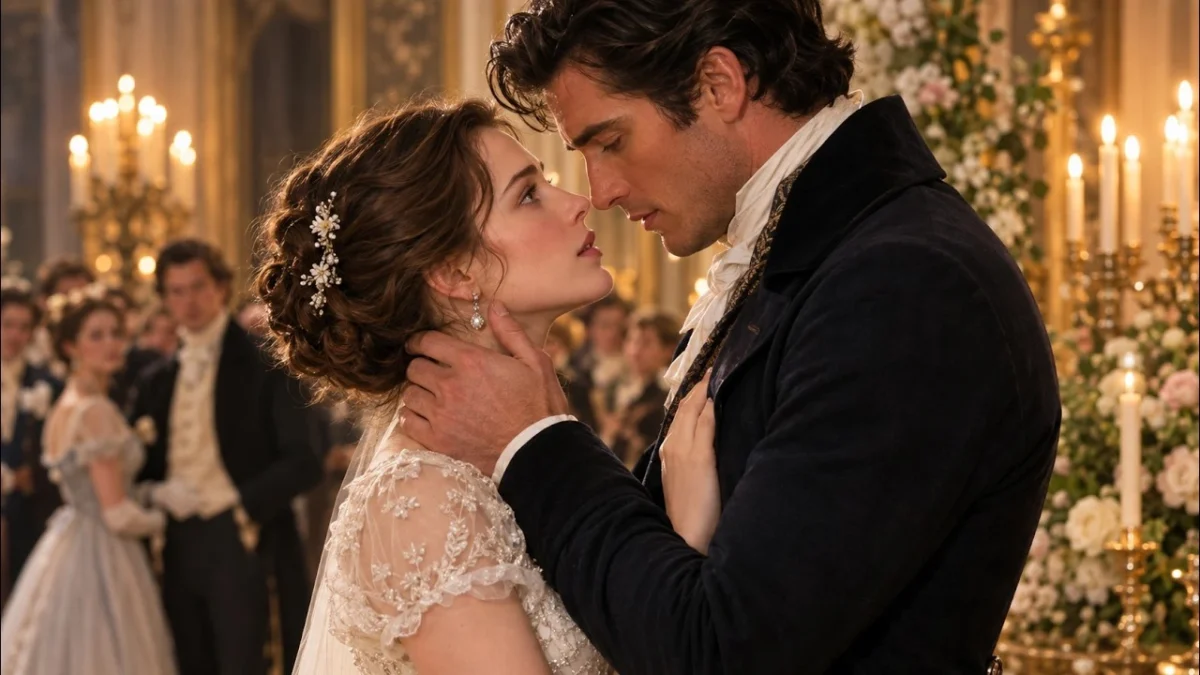
The Chadwick Ball was a crush of silk, crushed velvet, and a thousand gleaming wax candles.
It was, by every account, the season’s most anticipated affair.
Miss Clara Whitfield stood near the edge of the polished mahogany floor, holding a cup of lukewarm punch.
At twenty-three, she possessed a quiet, unshakeable dignity that set her entirely apart from the giggling, frantic debutantes filling the room.
She had arrived that evening with her heart holding a fragile, private hope.
For two full years, Adrian Blackwood, the formidable Duke of Ashford, had paid her marked and deliberate attention.
There had been delicate dances at Almack’s, unchaperoned strolls through Hyde Park, and lingering looks across crowded drawing rooms.
His glances had always seemed to promise something unspoken and profound.
The Ton, with its insatiable appetite for gossip, had already married them off in a hundred envious whispers.
Yet Clara was no simpleton.
She understood that a nobleman’s duty to his ancient lineage could easily outweigh his personal inclinations.
Still, Adrian’s private letters to her had been tender and brilliant.
His conversation had been earnest, and she had allowed herself to believe that a man of true sense might choose a partner of sense over the glittering, superficial heiresses of the marriage mart.
“You look remarkably reflective tonight, Clara,” whispered her aunt, Lady Ashby, fanning herself against the heat of the ballroom.
“I am merely taking in the scene, Aunt,” Clara replied softly, offering a modest smile.
“Well, do not look too distant,” Lady Ashby cautioned, adjusting her emerald turban.
“The Duke will certainly be here before the midnight supper, and everyone expects him to seek you out immediately.”
Clara’s heart gave a subtle, erratic flutter, though her face remained serene.
At that precise moment, a sudden hush rippled outward from the grand entryway.
The Duke of Ashford had arrived.
He was strikingly tall, his dark hair brushed immaculately back from a countenance that was handsome in a severe, unforgiving manner.
His sharp blue eyes swept the vast room with practiced indifference, stopping only when they locked onto Clara.
Clara’s breath caught in her throat.
She kept her posture straight and her expression perfectly composed.
He took three steps in her direction, but before he could reach her, he was intercepted by Lord Ashby.
Lord Ashby was flushed with fine port and boisterous good cheer.
“Ah, Ashford!” Lord Ashby boomed, his voice carrying far over the gentle string quartet.
“The entire room is taking wagers on when you will finally make your grand offer! Miss Whitfield has been most patient with you, sir!”
A heavy silence descended upon the nearby guests.
Dozens of heads turned, drawn irresistibly by the prospect of an immediate, public proposal.
Adrian’s jaw tightened into a rigid, icy line.
A cold, heavy knot formed at the base of Clara’s stomach as she watched his eyes darken.
“Lord Ashby,” Adrian spoke, his voice carrying a clipped, lethal edge that slice clean through the lingering murmurs.
“I fear you have been grossly misinformed, and you speak far out of turn.”
“Misinformed?” Lord Ashby stammered, his jovial smile faltering into confusion.
“I have absolutely no intention of offering for Miss Whitfield,” Adrian stated clearly.
The entire ballroom seemed to gasp at once.
A young lady nearby tittered nervously behind her silk fan.
Clara felt the color drain completely from her face, yet she refused to lower her gaze.
“I… I beg your pardon, Ashford?” Lord Ashby stammered, stepping back.
The Duke turned his entire body toward Clara, his gaze cutting across the open space.
His face was a chilling mask of aristocratic disdain.
“Miss Whitfield is a pleasant enough sort,” Adrian said, ensuring every soul in the room heard each syllable.
“However, she was never my choice. I am simply not in the market for a country miss with more sense than fortune, no matter how desperately attentive she has been toward me.”
The words struck like an iron gauntlet across her face.
The explicit implication—that she had been pursuing him, pleading for his favor—was a poison blade driven straight into her honor.
Lady Ashby gasped in horror beside her.
In the adjoining room, the musicians ceased playing altogether.
Every single pair of eyes in London society was pinned upon Clara.
She stood utterly alone in her deep blue gown.
Her skin was paper white, but her chin remained held high.
The Duke’s gaze was unwavering, staring her down as if daring her to weep, to protest, or to flee in humiliation.
He had calculated this moment to be as public and brutal as possible, severing their silent bond to prove his complete independence to a pushy society.
Clara’s heart hammered violently against her ribs.
Yet her upbringing, her pride, and her very soul rallied within her.
She would not grant him the satisfaction of a single tear.
She would not stoop to an angry retort that society would twist into proof of her desperation.
With a slow, breathtaking grace, Clara drew back her skirts.
She sank into a curtsy.
It was not the brief, light dip given to a fleeting dance partner.
It was the deep, sweeping, formal obeisance of a noblewoman acknowledging a lord of highest rank.
It was a ritual gesture that acknowledged his title while silently affirming her own unbroken dignity.
It was a final, undeniable farewell.
Rising fluidly, Clara did not offer him another word.
She gave no glance to the stunned onlookers.
She turned calmly on her heel and began her walk toward the exit.
Her spine was straight as steel.
Her steps were perfectly measured.
She did not run.
She did not falter.
She walked past whispering dowagers, past smirking young lords, and past the pitying stares of her former acquaintances.
The crowd parted for her as if she were a queen passing through a phantom hall.
Behind her, the silence in the ballroom stretched thick, suffocating, and heavy.
Adrian Blackwood stood motionless, the absolute victor of a war no one else knew he was fighting.
Yet, as the high oak doors closed quietly behind Clara, his triumph tasted like ash in his mouth.
He had done what he believed was necessary to protect his name and estate.
He had cut his ties and reclaimed his total freedom.
Yet a strange, hollow ache settled deep inside his ribs.
He had prepared himself for her screaming.
He had prepared himself for her tears.
He had not been prepared for that quiet, devastating curtsy, or the fading sound of her footsteps walking away from him forever.
Part 2: The Weight of Silence
The carriage ride back to Mayfair was a blur of dark cobblestones and yellow gaslights.
Lady Ashby wept and raved continuously in the corner of the velvet interior.
“The nerve of that despicable brute!” Lady Ashby cried, dabbing her reddened eyes with a lace handkerchief.
“A monster in tailored wool! I shall write to your father tonight, Clara! I shall tell him how we were insulted!”
Clara sat in the opposite corner with her hands resting motionless in her lap.
She stared out at the passing night, watching the streetlamps flicker in the rain.
“Do not write to Father, Aunt,” Clara said, her voice eerily quiet and flat.
“It will only distress him, and it will change nothing that occurred tonight.”
“Change nothing?” her aunt gasped.
“He publicly branded you a desperate fortune hunter!”
“He showed the Ton who he truly is,” Clara replied softly.
“And he showed me who I was mistaken about.”
When they reached the townhouse, Clara climbed the stairs to her bedchamber, refusing supper.
She sat before her vanity mirror, looking at her pale reflection.
The humiliation was a cold, surgical instrument that had sliced away her illusions.
Yet behind the wall of shock, no tears fell.
Two days later, Clara and her aunt departed London for Willowbrook, a quiet country estate in Hampshire.
The crisp rural air offered a physical retreat, but no true escape from the gossip.
The local Hampshire gentry received the London broadsheets promptly, and their visits to Willowbrook became suspiciously frequent.
“My dear Clara,” neighboring Mrs. Featherington pried during tea one afternoon.
“We were so grieved to read of the unpleasantness at the Chadwick Ball. Is it true the Duke was so dreadfully curt?”
Clara poured the tea with a steady hand, not spilling a single drop.
“The Duke of Ashford expressed his preferences quite clearly, Mrs. Featherington,” Clara said with a polite, mild smile.
“It is always best when gentlemen are clear about their intentions, is it not?”
Her absolute refusal to play the victim baffled the neighborhood gossips.
She did not hide in her room.
She walked the gardens, read extensively, and managed her aunt’s household accounts.
Meanwhile, in the bustling heart of London, Adrian Blackwood was discovering that victory brought no peace.
The sprawling rooms of his mansion felt oppressive, cold, and vast.
When he walked into his private club on St. James’s Street, conversation would visibly falter.
Gentlemen who usually sought his favor now offered awkward, guarded nods before drifting away.
One evening, Lord Finchley sat across from Adrian in the dimly lit library of White’s.
“You look ghastly, Ashford,” Finchley remarked, swirling his cognac.
“I am entirely fine,” Adrian snapped, staring coldly into the roaring fireplace.
“You did what was necessary,” Finchley offered, trying to cheer his friend.
“The girl was becoming far too expectant. A man of your lineage cannot be trapped by informal attentions.”
“I am aware,” Adrian growled.
“Then why the black mood?” Finchley pressed.
“You got what you wanted. You are unencumbered.”
Adrian did not answer.
He could not explain to Finchley that the image of Clara’s deep, dignified curtsy burned behind his eyelids every time he closed them.
He had expected recriminations that would justify his harshness.
Instead, her absolute composure had turned his actions into an act of unprovoked cruelty.
A week later, while walking near Bond Street, Adrian spotted Lady Jersey standing near an art gallery.
As he raised his hat to greet her, the powerful patroness of Almack’s looked directly into his eyes with cold, unblinking disdain.
She did not bow her head.
She did not acknowledge his presence.
She simply turned her back on him completely, delivering the cut direct in full view of twenty nobles.
Adrian felt a hot flush of anger and shame creep up his neck.
He had saved his title from what he viewed as an inconvenient entanglement, but he had lost his honor in the process.
Society had not congratulated him for his ruthlessness; they reviled him for his lack of breeding.
He found himself constantly wondering what Clara was doing in Hampshire.
Was she weeping in a dark parlor?
Was she cursing his name to the heavens?
He almost wished she were.
Anger was something he could understand and dismiss.
Her quiet, magnificent exit was something he could neither master nor forget.
Part 3: The Price of Redemption
By late September, the crisp autumn air signaled the start of the Little Season in London.
Clara returned to the city, driven not by a desire for society, but by devotion to her seventeen-year-old sister, Lucy.
Lucy had just entered society and was terrified of navigating the social waters alone.
“You do not have to do this for me, Clara,” Lucy whispered nervously as their carriage approached a musical soirée in Mayfair.
“I am whole, Lucy,” Clara said firmly, squeezing her sister’s hands.
“I did nothing wrong, and I will not spend my youth hiding in the shadows because a Duke lacked good manners.”
When Clara entered the drawing room that night, a brief hush fell over the guests.
Clara held her head high, dressed in an elegant gown of emerald silk.
She greeted acquaintances with genuine warmth, answered polite inquiries easefully, and laughed softly at pleasant jokes.
The gossips were stunned.
“She carries herself like a queen,” a dowager whispered behind her fan.
“She has a spine of tempered steel,” another agreed.
Her refusal to be ruined transformed her in the eyes of the Ton from a pitied victim into a figure of immense strength.
When news of her triumph reached Adrian, it struck him like a series of sharp blows.
She was not broken.
She was thriving.
Driven by a desperate need he could not name, Adrian began attending events he normally despised.
He stood in the shadows at exhibitions, charity bazaars, and concerts, watching her from afar.
Clara saw him immediately whenever he entered a room.
Her heart would give a sudden, traitorous thud, but her face never betrayed her.
If he walked in her direction, she calmly turned away to engage someone else in conversation.
If their eyes met across a room, she looked straight through him as if he were made of clear glass.
She did not insult him.
She did not scowl.
She simply rendered him invisible.
It was a punishment far worse than any harsh word.
Then, in early October, disaster struck the Whitfield family.
Lucy had foolishly written a romantic, naive letter to a handsome officer named Lieutenant Harcourt.
Harcourt, a ruthless fortune hunter buried in gambling debts, immediately leaked word of the letter to a scandal sheet to force a financial settlement from her family.
Lucy sat weeping hysterically in the drawing room.
“My life is over!” Lucy sobbed.
“No one will ever marry me!”
Clara read the scandal rag with icy fury.
She knew Harcourt’s commission could be bought out and his debts settled, forcing him to vanish to the colonies, but the sum required was astronomical—far beyond her father’s modest means.
“Lord Ashby has no such liquid cash,” Lady Ashby wailed, wringing her hands.
“There is only one man with the wealth and power to force Harcourt’s regiment to send him overseas immediately,” her aunt added hesitantly.
Clara felt a bitter, terrible weight settle upon her chest.
“Ashford,” Clara said quietly.
She would rather have walked through burning coals than ask Adrian Blackwood for a favor.
Yet, looking at her terrified, innocent younger sister, Clara knew that her pride was a luxury she could not afford.
An hour later, Clara stood in the grand, leather-scented study of Ashford House.
Adrian stood by the high window, turning slowly as the butler announced her.
Surprise flickered across his severe features.
“Miss Whitfield,” he said, his voice husky.
Clara did not curtsy.
She stood straight, her hands clasped tightly before her.
“I am not here for myself, Your Grace,” Clara said, her tone businesslike and clear.
“I am here regarding my sister.”
In calm, precise sentences, she explained Harcourt’s blackmail attempt and the exact sum required to buy the officer’s commission and secure his immediate transfer overseas.
She did not beg.
She stated the facts as if presenting an invoice.
Adrian listened in complete silence.
When she finished, he stepped toward his mahogany desk.
“Why come to me, Clara?” he asked softly.
“Because you possess the power to act before the morning broadsheets print the letter,” she replied coldly.
“I have no other resort.”
Adrian looked at her, seeing the pale exhaustion beneath her eyes and the fierce loyalty that had driven her into the house of her enemy.
The realization of his past stupidity crushed him.
“I will settle it today,” Adrian said quietly.
“Harcourt will be on a ship to the Americas by tomorrow morning. The letters will be returned to you by nightfall.”
Clara blinked, caught off guard.
“What are your conditions?” she demanded suspiciously.
“There are no conditions,” Adrian replied, stepping closer to her.
“None?” she repeated.
“I owe you a debt of honor that I can never truly repay,” Adrian said, his voice dropping into a rough whisper.
“I acted like an arrogant fool at the Chadwick Ball, Clara. I thought… I thought I was protecting my freedom.”
“You humiliated me to save your pride,” Clara said, her eyes flashing with sudden fire.
“I know,” Adrian confessed, his head bowing slightly.
“I was a coward. I feared the Ton’s expectations, and I destroyed the only woman who ever saw me clearly.”
“I will repay every sovereign you spend on Harcourt,” Clara declared firmly.
“It may take my entire life, but I will not remain in your debt.”
“As you wish,” he said softly.
Clara turned toward the door, her chest heaving with chaotic emotion.
Before she opened it, she paused.
“Thank you, Your Grace,” she whispered.
“You are welcome, Clara,” he murmured to the empty room as she vanished.
Within three days, Lieutenant Harcourt was stripped of his commission and placed on a vessel bound for Boston, his mouth sealed permanently by the Duke’s lawyers.
The scandal vanished before it could harm Lucy.
In the weeks that followed, Lord Finchley, overwhelmed by guilt over his friend’s deteriorating spirit, privately confessed the true reason behind Adrian’s behavior at the ball to a few key ladies of the Ton.
Adrian’s late father had bound him to a conditional arrangement with a wealthy foreign heiress, and Adrian had mistakenly believed that a public scandal of his own making would force the heiress’s family to break the arrangement.
The gossip spread rapidly.
The Duke was no longer viewed as a cold monster, but as an arrogant man who had executed a terrible, foolish plan and lost the woman he loved in the process.
Society expected a grand reconciliation.
They expected Clara to forgive him.
Yet Clara felt no triumph when she learned the truth.
Understanding his motives did not erase the wounds he had inflicted.
Instead, Clara began accepting the attentions of Mr. Charles Bennett, a kind, brilliant barrister who courted her with quiet respect and total honesty.
On a crisp late-October afternoon, Adrian saw Clara walking through Kensington Gardens.
She was accompanied by Mr. Bennett, who was holding her umbrella and making her laugh genuinely.
Adrian stepped out from the shadow of the grand oak trees, intercepting their path.
Mr. Bennett bowed politely, sensing the immense tension, and stepped back to grant them privacy.
“Clara,” Adrian said, his voice strained and desperate.
“Your Grace,” Clara replied, her tone polite but distant.
“I know you know the truth now,” Adrian said, taking a step closer, his eyes searching her face.
“Finchley told the Ton. You know why I did it. It was a terrible mistake, but my heart was never false to you.”
Clara looked at the powerful Duke standing before her.
His face was lined with genuine regret, his aristocratic composure entirely shattered.
“Your motives do not alter your actions, Adrian,” Clara said softly, using his Christian name for the final time.
“You chose to crush my dignity publicly to solve a problem of your own making. You assumed I was weak enough to be discarded and forgotten.”
“I was wrong!” Adrian pleaded, his hands reaching toward her before stopping short.
“I love you, Clara. I have loved you since the moment you curtsied to me and walked away.”
Clara looked at him with a profound, quiet sorrow.
“I believed I loved you once, too,” she admitted softly.
“But the man I loved would never have sought to save himself by destroying me.”
“Is there no path to forgiveness?” he asked, his voice breaking.
“I forgive you, Adrian,” Clara said, her voice steady and clear.
“I forgive you entirely. But forgiveness does not mean I will ever return to you.”
She turned away from him and took Mr. Bennett’s offered arm.
As they walked down the gold-leafed path, Clara did not look back.
Adrian Blackwood stood alone beneath the falling autumn leaves, left only with his title, his vast fortune, and the endless, silent echo of the woman who had conquered his world simply by walking away.








