The Old Horse Refused to Enter One Field—Until the Farmer Dug Beneath the Gate
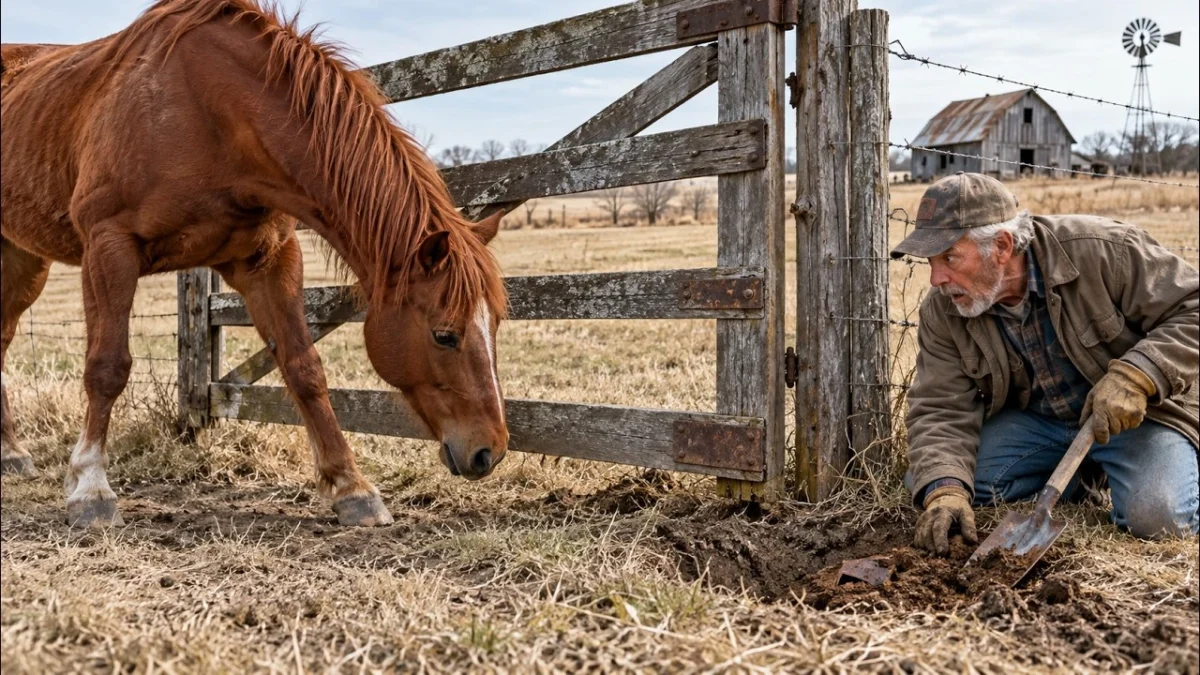
The Missouri sky had turned pale and hard with summer heat.
Dust clung to the wooden fence posts lining the lane like a fine gray flour.
The grass across the pastures had long since faded from a vibrant green to a brittle, scorched gold.
Even the early morning wind carried no real relief, bringing only the dry, metallic smell of baked earth and withered cornstalks.
Warren Bellamy stood beside the old well behind his house, resting one calloused hand on the weathered wooden cover.
He listened intently as the pump gave a dry, rattling cough before finally pulling up a thin, muddy stream of water into his zinc bucket.
At sixty-eight years old, Warren still possessed the broad, heavy shoulders of a man who had spent his entire life lifting eighty-pound feed sacks, repairing endless miles of barbed-wire fence, and wrestling with rusted farm machinery that seemed to actively resent being fixed.
Age had narrowed his frame slightly through the waist and stiffened his knees on cold mornings, but there was undeniable strength remaining in his thick forearms.
His face was long and deeply creased by decades of sun and wind, featuring a square, stubborn jaw covered in gray stubble that he rarely bothered to shave completely smooth.
His blue-gray eyes had grown quieter and more reserved ever since his father had passed away eight years prior.
Throughout his life, Warren had always been remarkably patient with animals and bluntly honest with human beings.
Years of watching neighboring farmers surrender to debt, watching young sons move away to distant cities, and watching promising spring seasons turn into disastrous autumn droughts had taught him never to trust easy promises or quick solutions.
The declining well worried him far more than he was willing to admit aloud.
He had checked the water level three separate times already that week, each time desperately hoping he had misread the measuring tape.
He had not misread it.
The water table was dropping lower every single day.
Warren lived entirely alone in the two-story white farmhouse that his grandfather had constructed back in 1912, though living sometimes felt like far too generous a word for his existence.
He ate his quiet meals at the same long oak kitchen table where three generations had sat before him.
He slept in the same small upstairs bedroom overlooking the north barn.
He still kept his father’s chipped blue coffee mug sitting on the small wooden shelf right beside the kitchen sink.
Most of his days were measured by necessary physical chores rather than the ticking of a wall clock.
He would feed the small herd of black cattle, check the perimeter fences, inspect the stock troughs, walk the dry south pasture, and repair whatever piece of equipment had broken down since yesterday.
The Bellamy farm had successfully outlasted three generations of his family, and Warren fully intended to make sure it survived him as well.
Marlo was one of the very few living creatures left on the property who was older than most of Warren’s own adult memories.
The twenty-nine-year-old gelding had once been a striking, deep chestnut brown, though old age had long since softened his dark coat and turned the coarse hair surrounding his muzzle almost silver.
His back sagged gently now in his golden years, and his gait had slowed into careful, deliberate steps that carefully avoided loose rocks.
His left ear carried a distinct small notch from a long-forgotten fencing accident during his youth.
His dark eyes maintained the patient, knowing expression of an animal that had witnessed enough foolish human behavior never to be surprised by anything people did.
Marlo had originally belonged to Warren’s father.
Even after the old man had grown too frail to ride regularly, the horse had followed him around the homestead like a second shadow.
These days, Warren simply let Marlo wander wherever the old horse pleased.
The horse regularly visited the cool alleyway of the main barn, the shaded edges of the south pasture, the quiet gravel lane beside the cornfield, and the deep shade beneath the mature cottonwood trees near the back porch.
However, Marlo would never, under any circumstances, set foot inside the east field.
Warren had first truly noticed the peculiarity two weeks ago when he attempted to lead Marlo through the old wooden gate that separated the main barn lane from fourteen acres of dry, unused pasture.
“Come on, old man,” Warren had said, giving the cotton lead rope a light, encouraging tug.
Marlo had abruptly stopped dead in his tracks.
Warren turned around and gave the rope another gentle pull.
The old horse leaned his weight backward slightly, planting all four hooves firmly into the dry dirt path.
Warren frowned and shifted the lead rope to his other hand.
“What is the matter with you today?” Warren asked, looking the animal over for any signs of injury. “You have walked twice as far as this just to steal a handful of sweet oats out of the shed.”
Marlo did not move a single inch.
He did not rear up, he did not snort violently, and he showed no fear in the whites of his dark eyes.
Instead, he slowly lowered his head until his nose was nearly touching the ground, staring directly at the patch of earth immediately beneath the wooden gate entrance.
Warren stepped through the open gateway himself, standing inside the east field and keeping the tension on the lead rope.
“Step on over, Marlo,” Warren coaxed. “There is nothing in this pasture that is going to hurt you.”
Nothing happened.
The horse remained entirely motionless, his eyes fixed on the dirt beneath the threshold.
After another quiet minute of waiting, Warren gave up, shook his head in mild exasperation, and led the horse back toward the barn.
Two days later, the exact same sequence of events occurred when Warren tried to move the horse into the east field to graze on what little scrub grass remained.
Then, on a hot Thursday afternoon, Dean Carver happened to drive his tractor up the lane and witness Warren’s fourth attempt to coax the animal through the entrance.
Dean owned the adjacent cattle operation to the east and had known Warren since they were both boys attending the local consolidated school.
At sixty-five, Dean was slightly shorter and noticeably heavier than Warren, featuring sun-darkened skin, thick white eyebrows, and a closely trimmed silver beard that made his round face look permanently amused by the world.
Dean was naturally friendly, fiercely dependable, and far too pleased with his own dry jokes.
After losing his beloved wife to illness five years earlier, humor had become Dean’s primary defense against letting quiet loneliness settle too deeply into his bones.
Dean shut off his tractor engine, climbed down from the cab, leaned his arms against Warren’s wooden fence, and grinned widely.
“Looks to me like that horse has finally figured out how retirement works long before you ever will, Warren,” Dean called out over the quiet hum of the cicadas.
Warren kept tugging gently at the cotton rope, his boots kicking up small puffs of dust. “He goes everywhere else on this property without a single complaint,” Warren replied, wiping his brow with the back of his forearm. “I cannot get him to take one single step past this post.”
Dean scratched at his silver beard thoughtfully. “Well, animals have a way of knowing things we do not,” Dean said, his smile softening slightly. “Maybe he knows something about that pasture that you do not.”
Warren glanced over at his neighbor with a skeptical look. “He is a horse, Dean. He does not know anything about property lines or pasture rotation.”
Dean laughed aloud, the sound echoing across the dry field. “Or maybe he is just twenty-nine years old and has finally gone completely senile,” Dean offered cheerfully. “My uncle had an old mule that refused to cross a painted white line on a paved road for five whole years.”
Warren looked back at Marlo.
The old gelding was entirely unbothered by Dean’s laughter, continuing to stare quietly at the exact same patch of ground beneath the gate.
“He is just being stubborn,” Warren muttered, though the explanation felt hollow even as he said it.
“Well, let him be stubborn then,” Dean said, patting the top fence rail before turning back toward his tractor. “There is not enough grass in that east field to feed a grasshopper anyway this summer.”
Yet the word stubborn bothered Warren long after Dean had restarted his tractor and driven back down the dusty road.
In all the decades Warren had worked alongside Marlo, the horse had never once exhibited blind, unreasoning stubbornness.
He had always been a calm, sensible animal that trusted human guidance completely.
Three days after Dean’s visit, a sleek silver pickup truck with clean fender wells turned slowly into Warren’s gravel driveway.
A neatly dressed man in a crisp button-down shirt and polished leather shoes stepped out of the vehicle.
He introduced himself as a senior representative of a regional land acquisition company based out of St. Louis.
The representative held a thin leather folder and spoke in smooth, carefully measured tones.
He explained that his employer was actively seeking to purchase a very specific section of Warren’s property.
Specifically, they wanted to buy only the fourteen acres that comprised the east field.
Warren almost laughed aloud in the man’s face.
“That pasture is half dead and full of scrub brush,” Warren said, leaning against the porch railing. “It is the worst fourteen acres on the entire Bellamy property. Why in the world would your company want that specific piece of ground?”
The representative smiled politely, not missing a beat. “Our client is currently assembling several contiguous parcels across the county for future agricultural development and long-term land investment,” the man explained smoothly. “We are prepared to offer you a very fair market price to finalize the transfer quickly.”
The man then named a specific financial figure.
Warren’s casual expression instantly changed.
The amount of money the representative had just uttered was absurdly high.
It was far more than any reasonable farmer would ever pay for fourteen drought-stricken acres of mediocre Missouri pasture land.
For one long, dangerous moment, Warren closed his eyes and imagined what that sum of money could instantly solve for him.
He could hire a commercial drilling rig to sink a deep, high-yield well near the house.
He could replace all the sagging barbed-wire fencing along the north perimeter.
He could pay for complete repairs to the main barn roof.
Perhaps there would even be enough money left over that he could finally stop lying awake at three o’clock in the morning, anxiously wondering how many bad dry seasons remained before the farm began taking more from his body than he could ever give back.
Then Warren turned his head and looked past the barn toward the dry, dusty expanse of the east field.
He thought of his grandfather clearing the timber by hand.
He thought of his father walking those same fence lines every spring.
“No,” Warren said firmly, looking the representative straight in the eye.
The representative’s smile faltered slightly, but he quickly recovered his composure. “Mr. Bellamy, I urge you to consider the reality of your current situation,” the man said, lowering his voice slightly. “The current drought conditions across this region are severe. That amount of capital could secure your entire operation for years to come. I can even raise our initial offer by another ten percent right now if you sign the preliminary intent paperwork.”
Warren shook his head without the slightest hesitation.
“My father never sold off a single acre of this farm,” Warren said, his voice flat and uncompromising. “And neither will I.”
“Is that your final word on the matter?” the representative asked.
“It is,” Warren replied. “Have a safe drive back to the city.”
The silver truck backed out of the driveway, leaving behind a thick trail of white dust that hung suspended in the stagnant summer air.
That night, Warren lay awake in his bed for hours, listening to the house settle in the heat.
The land company’s outrageously high offer made no practical sense whatsoever.
Why would anyone spend a small fortune on fourteen acres of scorched soil?
And Marlo’s sudden, bizarre behavior at the gate made no sense either.
Just before dawn broke over the horizon, a brief, violent summer thunderstorm rolled across the county.
The rain lasted barely twenty minutes, offering no real relief to the deep drought, but it was just enough water to darken the surface soil and leave small, dirty puddles beneath the wooden eaves of the barn.
Warren stepped outside shortly after sunrise, holding his morning coffee cup.
He immediately spotted Marlo standing entirely alone by the east gate.
As Warren watched from the porch, the old horse raised his left front hoof and struck the damp ground firmly once.
Then he paused, lowered his head, and struck the exact same spot again.
Warren stopped in his tracks, setting his coffee cup down on the wooden porch railing.
Marlo was aggressively pawing at the exact patch of dirt that he had been staring at for the past two weeks.
“All right, Marlo,” Warren whispered to himself, his curiosity finally overriding his skepticism. “Let us see what you are trying to say.”
Warren walked into the tool shed, grabbed a heavy steel spade shovel, and walked down the lane toward the east pasture.
The horse did not move away as Warren approached.
Marlo simply stepped back two paces, stood quietly beside the fence post, and watched the man with his dark, patient eyes.
The first foot of soil was soft and slick from the morning’s brief rainfall.
Below that shallow top layer, however, the earth quickly became dense, tightly packed, and heavy with stubborn clay.
Warren dug slowly and methodically, pausing twice to wipe the heavy sweat from his eyes and straighten his aching lower back.
When the hole reached a depth of less than two feet, the flat edge of the steel shovel struck something hard with a sharp, clear metallic clang.
Warren froze in place.
He carefully scraped away the loose dirt with the tip of the shovel blade.
Satisfied that he was not hitting a buried utility pipe, he dropped down onto both knees in the mud and began clearing the remaining dirt away using his bare hands.
Thick red rust appeared beneath the wet clay, followed by the exposed curve of heavy iron.
Warren brushed away one final thick layer of soil, uncovering a thick, rusted iron lifting ring secured to a heavy metal plate.
He sat back on his heels, breathing hard from the exertion, his hands caked in cold mud.
He had lived on this exact piece of land for sixty-eight years.
He knew every fence corner, every tree stump, and every shallow dip in the terrain.
Yet he had never known that this iron ring existed beneath the ground.
Warren stayed on his knees beside the east gate for a long time, staring down into the shallow hole at the rusted iron ring.
Marlo stood several feet away, perfectly still now, his silver muzzle lowered as if the old animal had successfully completed whatever long duty had been assigned to him.
Warren reached into the pit, wrapped both caked hands tightly around the cold iron ring, and pulled upward with all his strength.
Nothing moved.
The metal plate seemed entirely welded to the surrounding earth by decades of accumulated rust, packed clay, and spreading grass roots.
Warren retrieved a heavy steel pry bar and a pickaxe from the shed.
He spent the next hour carefully widening the trench around the buried structure.
Gradually, the distinct circular outline of a massive cast-iron access lid emerged from the dirt, nearly obscured by decades of decayed organic matter.
Warren drove the flat edge of the pry bar deep beneath the lip of the heavy iron lid and leaned his full body weight against the steel handle.
His shoulders burned with strain and his muscles shook before the ancient seal finally broke with a dull, wet groan.
A sudden draft of cold, damp air rose up from the darkness below, smelling powerfully of old stone, wet earth, and long-trapped moisture.
Beneath the cast-iron lid lay a narrow, neatly constructed brick masonry chamber.
It was roughly four feet deep—deep enough for Warren to reach into with his arm, but far too small for a grown man to physically enter.
Inside the dark space sat an intricate web of heavy, corroded brass valves, iron couplings, and thick cast-iron pipes.
Some of the smaller pipes disappeared through the brickwork toward the main barn lane.
Two larger, heavy-gauge iron pipes ran straight beneath the eastern fence line, pointing directly into the center of the east pasture.
Warren stared down at the machinery in absolute disbelief.
He knew the exact location of every single visible water line on the Bellamy property—or at least, he had honestly believed he did until this moment.
By mid-morning, realization dawning that he needed specialized help, Warren called Otis Granger.
Otis arrived within thirty minutes, driving an aging green pickup truck that carried a wooden toolbox looking nearly as old as its owner.
At seventy-eight years old, Otis was tall but noticeably stooped through the shoulders.
He possessed large-knuckled, grease-stained hands, a narrow, weathered face, and a thick white mustache that drooped heavily over the corners of his mouth.
His remaining hair was thin and silver, usually kept hidden beneath a faded canvas work cap.
Otis had spent more than fifty years drilling water wells and repairing mechanical pumps across three Missouri counties.
A tragic well collapse early in his career had nearly killed one of his closest friends, leaving Otis with a permanent, unbreakable habit of studying old underground structures very carefully before touching a single bolt.
He was patient, exceptionally methodical, and deeply disliked people who confused loud confidence with actual mechanical knowledge.
Otis crouched down beside the newly excavated opening, peering into the brick chamber with a bright brass flashlight.
“Well now,” Otis said softly, his voice low and raspy. “I have not seen one of these setups in a very long time. Do you know what you have got here, Warren?”
“I was hoping you could tell me,” Warren said, leaning on his shovel.
“This is part of an old gravity-fed water distribution system,” Otis explained, tapping the beam of light against a heavy brass valve. “Probably modified later on to handle a mechanical pressure pump. Your grandfather would have used something like this back in the twenties. Your father too, when he was just a young man. This was back before everybody started trusting cheap electric pumps to do all the work for them.”
Warren pointed toward the two large iron pipes leading east. “Where do those main lines go?”
Otis shook his head slowly. “That is what we are going to have to find out.”
Otis reached down into the chamber and inspected each metal connection, tapping the iron lightly with a small ball-peen hammer to test its structural integrity.
Then he stopped moving entirely, fixing his flashlight beam on the mouth of the largest eastbound pipe.
The end of the heavy iron pipe had been completely filled and packed tightly with a dense, gray material.
Otis reached down with a flathead screwdriver and scraped firmly at the gray obstruction.
Warren watched the old well-driller’s expression turn uncharacteristically grim.
“What is it, Otis?” Warren asked.
“This pipe did not fail or collapse from old age,” Otis said, chipping a tiny flake of the dry material away and holding it up to the light. “Somebody deliberately sealed it off with hydraulic cement.”
Warren frowned deeply. “Why would my father bury a water distribution valve and permanently seal off the main line?”
Otis looked up from the pit, his pale eyes steady behind his glasses. “I did not say your father was the one who sealed it, Warren.”
That quiet answer bothered Warren far more than the discovery of the pipe itself.
Early that afternoon, Warren drove thirty miles into town to visit his older sister, Ruth Bellamy.
Ruth was seventy-one years old and lived in a modest, immaculately kept brick house on a quiet street near the local high school.
She was a slender woman with straight silver hair neatly styled to her jawline, possessing pale blue eyes very much like Warren’s.
She had fine lines surrounding her mouth from decades of smiling at generations of schoolchildren.
Ruth had spent most of her adult life teaching elementary school, a career that had rendered her gentle in tone but nearly impossible to intimidate or deceive.
After their mother had passed away decades ago, Ruth had naturally become the family historian—the official keeper of birth certificates, old photographs, handwritten letters, land deeds, and every scrap of paper that Warren would otherwise have tossed into the woodstove.
When Warren sat down at her dining table and explained what he and Otis had uncovered beneath the east gate, Ruth stopped sorting her laundry entirely.
“The East Field?” Ruth asked, her voice dropping to a whisper.
“Right beneath the main gate entrance,” Warren confirmed. “Marlo showed me right where to dig.”
Ruth sat down slowly in the wooden chair opposite him, her hands resting flat on the table. “Dad used to say something very specific about that field, Warren. Do you remember?”
Warren waited, watching his sister’s face carefully.
Ruth looked toward the sunlight streaming through the window, searching through a memory that was more than sixty years old.
“‘Never sell the East Field,'” Ruth quoted softly. “Do you remember him saying that?”
Warren felt a cold chill run down his spine despite the stifling afternoon heat outside. “He told you that?”
“He told both of us that, more than once, when we were little children,” Ruth said. “I always thought it was just one of his stubborn farming rules. Like never turning cattle into clover when it is wet.”
Ruth stood up, walked into her spare bedroom, and returned carrying a heavy, dented cardboard document box labeled *Bellamy Farm – Historical Records* in faded black marker.
For nearly an hour, the two siblings sat side by side, sorting through yellowed tax receipts, old feed bills, tractor equipment manuals, and handwritten letters.
Near the bottom of the box, Ruth unfolded a brittle, fragile sheet of grid paper.
It was a hand-drawn map showing a rough outline of the Bellamy homestead as it existed in the late 1940s.
Warren leaned in close to examine the drawing.
A faint pencil line crossed directly through the middle of the east field, terminating at a small drawn square.
Beside that square, written in their father’s distinct, slanted handwriting, were three words and a date: *Stone Reservoir, 1948.*
Neither sibling spoke for a long moment.
Warren stared at the faded pencil line running from the gate into the distant pasture.
The buried iron valve beneath the gate was not the secret itself.
It was merely the valve that controlled it.
By seven o’clock the following morning, Warren and Otis had marked the probable direction of the buried pipe using long wooden stakes, following the faint, subtle depression in the ground that led from the east gate out into the dry pasture.
The physical work was painfully slow and exhausting.
In some places, the old iron pipe had corroded so badly over seventy years that it crumbled into rusty flakes beneath Otis’ screwdriver.
In other places, the thick roots of mature cottonwood trees had wrapped around the iron so tightly that the metal seemed completely fused into the soil.
Warren dug with the spade shovel until his arms shook with fatigue, while Otis moved carefully beside him, testing the ground with a steel probe before they opened another section of earth.
Meanwhile, the severe summer drought worsened with every passing day.
The remaining grass in the east pasture turned from a dull yellow to a dusty gray.
Warren’s small herd of cattle gathered around the wooden water troughs earlier and earlier each morning, waiting for water that no longer came easily from the failing house well.
Warren was finally forced to pay for a commercial water tanker to drive out from town and fill his stock tanks.
The invoice for the first delivery made him wince in pain.
The second invoice, arriving a week later, truly frightened him.
That evening, Warren sat at his kitchen table under the single overhead lightbulb, staring at the bleak numbers in his ledger book.
Feed prices were rising sharply due to the regional drought.
Fuel costs for his truck and tractor were up.
His main well was producing less water every twenty-four hours.
His modest bank savings were shrinking far faster than the water level in his well.
For the first time in his entire adult life, Warren allowed his mind to wander toward the unthinkable: selling off part of the land.
Not the whole farm—never the homestead itself—but perhaps those fourteen troublesome acres of the east field.
The brief thought made him feel profoundly disloyal to his father’s memory before he had even finished processing the calculation.
Two days later, the sleek silver pickup truck returned up the gravel driveway.
The same corporate representative stepped out into the dust.
He was still wearing crisp, immaculate clothes and leather shoes that looked far too clean for a working cattle farm.
This time, the man carried a leather folder containing a formal, updated purchase agreement.
He held it out to Warren on the front porch.
The revised purchase offer was substantially higher than the first one.
Warren read the final dollar figure twice to make sure he had not added an extra zero in his head.
“You raised the price by almost forty percent,” Warren noted quietly.
“Our client remains exceptionally interested in securing this specific acreage, Mr. Bellamy,” the representative said, offering a practiced, polished smile.
“For fourteen acres of dead grass?” Warren asked, looking at the man closely.
The representative smiled politely without offering any direct answer.
Warren slowly folded the paper in half and handed it back. “The answer is still no.”
The representative’s polite demeanor hardened slightly. “Mr. Bellamy, I must inform you that this offer will not remain open indefinitely. Land values in this county are volatile, and my client will eventually look elsewhere if you remain unreasonable.”
“Let them look elsewhere,” Warren said.
The man turned around, climbed back into his truck, and drove away.
Warren watched the dust cloud rise over the lane.
The inflated price bothered him far more than the representative’s subtle threats.
Someone wanted that specific fourteen-acre field desperately, and Warren was finally beginning to understand that they knew exactly what was buried beneath it.
Late the next afternoon, Dean Carver found Warren and Otis digging a deep trench in the middle of the east field.
Dean stood at the edge of the dirt pile with his hands resting on his hips, looking down at the two tired men.
“Are you two planning on digging all the way to China, or are you just looking for buried pirate treasure?” Dean called out, trying to sound cheerful.
Otis did not break his rhythm, continuing to scrape away dirt around an exposed pipe joint.
Warren wiped sweat from his eyes with a dirty bandana and pointed toward the exposed line. “We are tracing my father’s old water system, Dean.”
Dean looked toward the fence line, where Marlo was standing quietly in the shade of a wild plum bush near the east gate.
Dean let out a soft chuckle. “You mean to tell me you two old fools are still doing all this backbreaking labor just because a twenty-nine-year-old horse would not walk through a gate?”
Warren straightened his back, his jaw setting tight. “Not anymore, Dean.”
Dean’s casual smile faded slightly at Warren’s serious tone. “What is that supposed to mean?”
“It means a corporate land developer offered me enough money for this dead pasture to buy a brand-new farm in Iowa,” Warren said flatly. “And nobody spends that kind of money unless they know there is something under the dirt worth buying.”
Dean stopped laughing entirely.
That night, Warren sat on his dark front porch and watched Marlo standing near the east gate under the moonlight.
As he watched the dark silhouette of the horse, a memory returned to Warren without warning.
He had been eight or nine years old.
His father had been younger then than Warren was right now—broad-backed, powerful, and energetic, riding Marlo across the property long before the horse’s muzzle had ever turned silver.
On certain hot summer mornings, his father would saddle Marlo, ride out toward the far edge of the east pasture, and not return until noon.
Young Warren had never thought to ask where his father went or what he was doing out there.
Children rarely question the daily routines of the adults around them; they simply accept them as part of the landscape.
Now, sitting in the quiet dark, Warren realized how many answers had been right in front of his eyes all along.
The following morning at nine o’clock, Otis’ shovel struck a heavy stone structure buried four feet beneath the pasture surface.
It was a hand-cut limestone block, far too straight and square to be a natural rock formation.
As they cleared away more earth, another stone appeared directly beside it, and then another.
The blocks formed a smooth, deliberate curve beneath the dry topsoil.
Warren’s pulse quickened as he dropped his shovel and began clearing dirt with his hands.
Together, they expanded the excavation pit, carefully lifting away heavy sod until a narrow stone lintel appeared.
Directly beneath that stone lintel was the top step of a small, narrow stone staircase descending into the dark earth.
Otis stood up, wiping his muddy hands on his overalls, and looked at Warren. “Well, Warren. It looks like your father’s hand-drawn map was not exaggerating after all.”
The stone steps were cramped, steep, and wet with condensation.
Warren pulled a heavy flashlight from his belt, switched it on, and slowly descended the narrow stairs, with Otis following closely behind.
At the bottom of the steps, they stepped into a vaulted, stone-lined subterranean chamber constructed entirely of dry-laid limestone blocks.
The air inside was cool, damp, and smelled strongly of minerals.
The chamber walls were dark, streaked with decades of iron stains and mineral deposits.
It was remarkably large—nearly twelve feet long and eight feet wide—resembling a buried stone cellar, but it was almost entirely empty.
Only a tiny, shallow puddle of murky water covered the lowest section of the flagstone floor.
Warren shone his flashlight beam around the empty stone walls, his heart sinking rapidly into his chest.
“That is all there is?” Warren asked, his voice echoing hollowly off the damp stone.
For several long seconds, neither man spoke.
The heavy weight of disappointment struck Warren far harder than he had anticipated.
In his mind, he had imagined finding a vast subterranean reservoir overflowing with clean water—enough water to save his dying pastures, enough to justify days of agonizing physical labor, enough to explain why his father had kept the location secret for over half a century.
Instead, there was barely enough stagnant moisture on the stone floor to fill a bucket.
Warren sat down heavily on the bottom stone step, dropping his hands between his knees. “All this work for nothing,” he said quietly.
Otis did not answer immediately.
He was slowly walking the perimeter of the stone chamber, holding his flashlight mere inches from the limestone masonry.
Then Otis crouched down in the far corner and pointed his light at the wall. “Warren. Come take a look at this.”
Warren got up from the step and walked over to where the older man was kneeling.
A thin, dark line ran vertically between two massive limestone blocks.
Water was slowly gathering along that seam, forming tiny, clear beads that glistened in the flashlight beam.
As they watched, a single bead of water pooled, grew heavy, and trickled down the face of the stone.
Then another drop formed right behind it.
Otis touched the wet seam with two fingers and brought them to his tongue. “Sweet, cold water,” Otis murmured. “It is coming through from the outside, Warren.”
“It is just a slow leak from the surrounding ground,” Warren said, trying not to let his hopes rise again.
Otis shook his head firmly. “No. That is not a leak. That is a pressure seepage from an active spring source behind this wall.”
Otis followed the damp seam upward across the stone structure. “The primary natural water source is still very much alive out there, Warren.”
Warren stood up and looked around the chamber. “Then why isn’t this reservoir filling up like it was built to do?”
Otis turned his flashlight back toward the western wall where the main intake pipe entered the chamber. “Because whatever feeder system your father or grandfather built upstream from this wall was deliberately shut off or blocked.”
Warren stared at the slow trickle of water running down the stone seam.
The stone reservoir itself was dry, but the underlying natural spring beneath the east pasture had never died.
It had simply been cut off from the light.
Warren returned to his sister’s house early the next morning with dry clay still caked along the cuffs of his work jeans.
The sight of active water seeping through those stone walls had given him a profound sense of hope.
However, it had also sharpened the single question that had been haunting him since he first touched the buried iron ring.
If that abundant natural spring was still down there, why had his father gone to such extraordinary lengths to seal the system, bury the access valves, and hide its existence from his own children?
Ruth had already retrieved three more storage boxes from her closets by the time Warren walked through her back door.
They spent the entire morning sitting at her kitchen table, systematically sifting through decades of farm documents—old tax assessments, equipment receipts, handwritten letters, and legal notices.
Near the very bottom of a tin lockbox, Ruth discovered a tight bundle of papers wrapped in heavy oiled cloth to protect them from moisture.
Warren recognized his father’s precise, firm handwriting on the outer wrapping immediately.
The first document inside was an official letter from a regional water development syndicate, dated July 14, 1952.
The letter formally offered the Bellamy family a substantial sum of cash in exchange for exclusive, permanent commercial pumping rights to the natural underground aquifer located beneath the east field.
A second letter, dated six months later, raised the financial offer significantly.
A third letter, written in a far more aggressive legal tone, warned Warren’s father that several neighboring landowners were already preparing to sign commercial groundwater extraction contracts with the syndicate.
Warren felt his jaw tighten as he read the corporate letters. “They wanted to strip the entire water table.”
Ruth nodded quietly, handing him another sheet of paper from the bundle. “Read what Dad wrote on the back of the land map.”
On the reverse side of an old survey map, their father had written several lines in dark pencil.
The words were short, blunt, and direct: *If they pump the commercial wells too hard, Carver’s shallow well will go dry first. Then Miller’s well. Then ours. A man does not sell off the water that feeds his neighbors just to put money in a bank.*
Warren read those lines three times out loud in the quiet kitchen.
His father had not been hiding the natural spring out of greed, paranoia, or secrecy.
He had hidden it to protect the entire valley.
He knew that if a commercial entity gained legal access to that high-yield spring, they would pump millions of gallons out of the ground, dropping the water table and destroying every shallow family well for miles around.
More documents in the bundle revealed the rest of the story.
After repeatedly refusing the water company’s lucrative offers, Warren’s father had physically dismantled the surface pumps, sealed the main underground distribution line with concrete, buried the valve access chamber under two feet of dirt, and intentionally omitted the stone reservoir from all future property maps.
He had not destroyed the vital spring.
He had simply made it impossible for anyone to find—and impossible for a commercial enterprise to exploit.
Ruth leaned back in her kitchen chair, looking at her brother. “He knew someone would come back for that water eventually.”
Warren picked up an old newspaper clipping that had been tucked behind the corporate letters.
The clipping detailed how the original 1950s water syndicate had eventually been bought out, renamed, restructured, and ultimately absorbed into a massive regional land acquisition corporation based in St. Louis.
Warren felt a cold knot form in his stomach as he read the corporate entity’s current name.
It matched the exact name printed on the purchase agreement that the representative in the silver truck had handed him on his front porch three days ago.
The absurdly high purchase offer suddenly made complete sense.
The corporation did not want fourteen acres of pasture for farming.
They were coming back to finish what they had started in 1952.
By two o’clock that afternoon, Warren was back in the east field with Otis.
Otis read through Warren’s father’s handwritten notes carefully, nodding his head in deep understanding.
Then Otis led Warren into the excavation trench beyond the stone reservoir structure.
“We know the main intake line was intentionally sealed with concrete,” Otis said, shining his flashlight into an exposed stone junction box. “Now we know why your father did it.”
Otis crouched down in the dirt, examining the thick, hardened concrete plug surrounding the old cast-iron intake pipe. “This concrete seal is heavy, Warren. It was poured right into the stone junction box over seventy years ago.”
“Can we break it out?” Warren asked.
Otis looked up, his expression extremely grave. “We can. But if we use heavy sledgehammers or power tools incorrectly, the vibration could easily collapse the old limestone masonry behind it. If that stonework shifts, we could lose the natural spring channel permanently.”
“What happens if we leave it alone?” Warren asked.
“If you leave it alone, the spring stays trapped behind the stone wall, the pasture stays dead, and you keep paying for water trucks until your money runs out,” Otis stated plainly.
Warren stood silently in the dirt trench, looking across the dry, cracking earth of the east pasture.
The safe, easy choice was to pack the dirt back into the hole and leave his father’s secret buried forever.
However, his farm was dying, his savings were nearly gone, and now he finally understood his father’s true intent.
His father had not buried the spring to hide it forever.
He had buried it to protect it until a time when it was truly needed to sustain the land.
“We open it,” Warren said firmly.
Otis studied Warren’s face for several long seconds, then slowly nodded his head. “All right then. Let us get to work.”
They worked with agonizing slowness for nearly three hours, using small masonry chisels and hand hammers to carefully chip away the ancient concrete plug inch by inch.
Dean Carver arrived at the farm midway through the afternoon, carrying a pair of fencing pliers and expecting to make another casual joke about their endless digging.
However, after Warren handed him his father’s 1952 letters and let him read the handwritten notes, Dean did not say a single word.
He quietly picked up a hand trowel, climbed down into the trench, and began clearing loose concrete chips away alongside them.
At four o’clock in the afternoon, the final, stubborn core of concrete cracked loose beneath Otis’ chisel.
Otis carefully pulled the concrete plug out of the cast-iron pipe.
Everyone stepped back and waited in total silence.
For a minute, nothing happened.
Warren felt a familiar wave of heavy disappointment begin to settle in his chest.
Then, deep beneath their boots, a low, muffled vibration echoed through the heavy iron pipe.
Otis immediately raised one hand, signaling for absolute quiet. “Listen,” he whispered.
A deep, rushing sound moved through the subterranean stone structure.
Suddenly, a thick stream of cold, crystal-clear water erupted from the mouth of the iron pipe, splashing violently into the concrete channel and spilling directly into the underground stone reservoir chamber.
The flow rapidly strengthened.
Within five minutes, the thin trickle across the stone floor turned into a powerful, churning current of water.
Warren descended the stone steps and stood in the cool chamber, watching the water level rise steadily against the limestone walls, washing away decades of accumulated dust and silt.
Dean took off his canvas cap, staring down into the water in complete awe.
Otis wiped his mustache with the back of his hand and smiled broadly.
Near the wooden gate entrance, Marlo stood quietly in the warm afternoon sunlight, his head raised high, his ears pointing forward toward the sound of rushing water.
No one laughed at the old horse now.
By late August, the Bellamy farm looked vastly different from the desperate, parched property Warren had feared losing just a month earlier.
The east pasture had begun to recover at a remarkable speed.
A vibrant green color spread outward from the center of the field where the restored irrigation channels carried clean spring water directly to the soil roots.
The heavy wooden stock troughs near the main barn stayed completely full of cold, fresh water.
The cattle no longer gathered anxiously around the empty tanks before sunrise, waiting for a water truck that was no longer needed.
For the first time all summer, Warren could sit at his kitchen table without mentally calculating how many weeks of financial survival he had left in his bank account.
The restored spring system was producing far more water than Warren’s farm actually required.
Otis checked the pressure and flow rate several times over the following weeks, convinced at first that the yield would drop once the underground aquifer settled into continuous use.
It did not drop.
The subterranean spring remained exceptionally strong, clean, and steady.
That abundance should have felt like a complete, final victory.
Instead, Warren found himself constantly returning to his father’s handwritten words: *If they pump too hard, Carver’s shallow well will go dry first.*
Dean Carver’s house well almost did.
Warren learned about his neighbor’s crisis when he found Dean sitting silently on the dropped tailgate of his truck one Tuesday afternoon, staring across his parched fields with none of his usual humor or smile left in his face.
The older man looked noticeably smaller, his heavy shoulders rounded beneath a faded denim work shirt, his silver beard unkempt from several days of worry.
“Pumps are pulling pure red mud, Warren,” Dean said quietly, looking down at his boots.
Warren understood the full weight of those words instantly. “How long has it been doing that?”
“Three days now,” Dean replied, rubbing both hands tiredly over his face. “I can haul water in tanks from town for a week or two. After that, I have to start selling off the cattle herd.”
For Dean Carver, those cattle were far more than just commercial livestock on a ledger sheet.
He and his late wife had painstakingly built that purebred herd together over thirty years, carefully selecting bloodlines that she had chosen herself.
Selling off those animals would mean destroying the last living legacy of the life they had shared on that land.
Warren looked across the wooden fence line separating their properties.
Months earlier, Dean had stood at that very fence and laughed about an old horse refusing to walk through a gate.
Now, Dean looked crushed by the reality of the drought.
“I have got plenty of water, Dean,” Warren said quietly.
Dean looked up, frowning slightly. “Plenty of what?”
“Water,” Warren repeated. “More than this farm can ever use.”
Dean shook his head immediately, his pride asserting itself. “No, Warren. That is your water. Your father preserved it for your land. I am not taking your water.”
Warren almost smiled, remembering his own stubbornness. “You sound just like I did when that land company representative showed up in my driveway.”
“This is completely different,” Dean insisted.
“No, it isn’t,” Warren said firmly. “My father buried that system because he did not want a big corporation taking so much water that it ruined the neighboring farms. He preserved it so the whole valley could survive.”
Dean lowered his eyes, his voice thick with emotion. “And I was the fool making jokes about your horse.”
“You make jokes about everything, Dean,” Warren said gently. “That does not mean you do not deserve clean water for your cows.”
Over the next two days, Warren, Otis, and Dean worked together to lay a heavy polyethylene pipe extending from the stone reservoir chamber directly onto Dean’s property, connecting it securely to a large storage tank near his primary cattle pens.
They carefully regulated the valve pressure, ensuring that the water draw remained well within the natural flow limits that the restored spring could comfortably sustain.
When clean, cool water finally began filling Dean’s stock tanks, Dean stood beside Warren at the fence line without speaking a word for a long time.
After several minutes, Dean cleared his throat roughly. “Why are you doing this for me, Warren?”
Warren looked out across the greening pasture. “My father understood something that I am only now beginning to figure out, Dean. A resource like this water was never meant to make one man rich or powerful. It was meant to keep a community alive when hard times come.”
Dean nodded slowly, wiping a tear from his eye.
For once in his life, he did not make a single joke.
By the early days of September, the east field had been transformed.
It was not yet perfect, but healthy green grass had returned strongly enough to soften the hard, scorched contours of the terrain.
Thick clover grew densely around the wooden entrance gate where pale dust had once gathered in dry drifts.
On a crisp, cool morning, Warren brought Marlo down the main barn lane on a loose lead rope.
The old horse walked beside him at his usual unhurried, deliberate pace, his silver muzzle held low, his hooves making soft, rhythmic sounds against the packed earth.
When they reached the open east gate, Marlo stopped.
Warren felt a small flicker of the old tension return to his chest.
Months earlier, he would have impatiently tugged on the rope to force the horse forward.
This time, Warren did nothing.
He simply stood quietly beside the fence post and waited.
Marlo lowered his head and gently snorted, smelling the damp, rich earth where the iron access lid sat buried beneath the fresh green grass.
He stood there in the morning sun for several long, peaceful seconds, his left ear twitching slightly as the gentle breeze moved across the open pasture.
Then, without any hesitation or fear, the old gelding lifted his left front hoof and stepped cleanly across the threshold.
He placed his second hoof down inside the east field, then his third, and then his fourth.
Warren held his breath until all four hooves were planted firmly inside the east pasture.
Marlo continued walking forward into the green grass, grazing contentedly as if the invisible barrier that had held him back for years had never existed at all.
Warren remained standing by the wooden gate post, watching the old horse move through the sunlit pasture.
He knew, of course, that Marlo did not possess a human understanding of legal land deeds, corporate acquisitions, water rights, or the complex reasons why his father had buried the stone reservoir in 1952.
The horse had simply remembered something real.
Perhaps he had felt the faint, subtle vibration of flowing underground water deep beneath his hooves.
Perhaps he had smelled the cool, damp earth rising through the soil.
Or perhaps he simply remembered the thousands of peaceful mornings when Warren’s father had brought him to that exact gate and stood beside him in the quiet light.
Warren rested his hand on the weathered wooden post and looked out over the land that his family had worked for over a century.
People often liked to imagine that answers and miracles arrived suddenly, with great drama and loud noise so that no one could possibly miss them.
However, Warren realized that life worked far more quietly than that.
Sometimes the answers people desperately prayed for had been resting right beneath their feet all along.
And sometimes, an old horse was left behind to remind them where to look.








