The Schoolteacher Asked to Board at My Ranch for One Winter… She Never Left
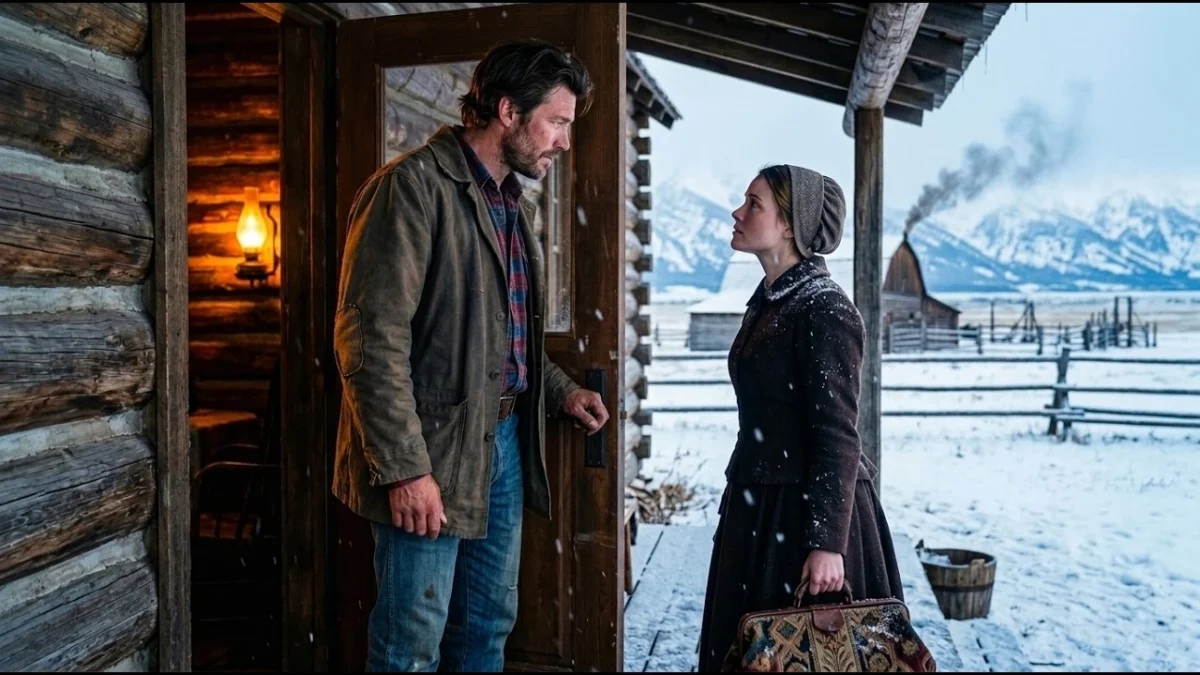
Wyoming Territory, 1884.
Tom Ellery had eleven cows, one bad knee, and a house that hadn’t felt a woman’s hand in it since his mother passed away six years back.
He didn’t think much about the second and third of those things until the schoolteacher showed up on his porch with a carpetbag and a letter from the town council.
“Mr. Ellery,” she said, looking straight up into his weathered face with a chin that didn’t know how to tremble, “I’m told you have a spare room.”
He did have a spare room, though he’d been using it exclusively to store stiff harness leather and a rusted, busted plow blade that he hadn’t gotten around to hauling to the dump.
“I do,” he said, which was true enough in the literal sense of having four walls and a roof over it.
Her name was Clara Whitfield, twenty-six years old, and she had come all the way out from Ohio on the promise of a teaching post in Larkspur, a settlement of two hundred souls and change.
The town had exactly one boarding house, and unfortunately for Clara, that boarding house had burned down clear to the foundations back in October during an unchecked kitchen fire.
So, the town council had gone around asking which bachelor or widower had a room to spare and enough stern decency to be trusted with a single woman under his roof for an entire Wyoming winter.
Tom’s name had come up because he kept mostly to himself, drank very little whiskey, and didn’t bother his neighbors.
“It’s forty cents a week I can pay you,” Clara said, her fingers tightening slightly on the handle of her worn leather bag as the cold wind whipped her skirts. “That’s all the council allows me for lodging.”
“Don’t need your forty cents,” Tom replied, shifting his weight off his bad knee.
“I insist on paying something, Mr. Ellery, as I won’t board for free under any man’s roof.”
He looked at her for a long, quiet moment while a bitter gust of wind cut across the yard, noting that her wool coat was far too thin for the plains and her cheeks were already bitten red by the frost.
“Forty cents, then,” he said, deciding he’d rather argue with a fence post. “But you clean that plow blade out of the room yourself, because I’m not touching it.”
She almost smiled, a brief twitch at the corner of her mouth that looked entirely foreign on her tired face.
“Agreed.”
That was the whole conversation, with no fanfare, no pretense, and no sign of what that winter would eventually grow into.
He reached down and carried her heavy bag inside anyway, his boots thudding heavily against the floorboards.
The room still smelled sharply of old grease and leather when he showed her in, despite his hasty efforts earlier that morning.
He had dragged the plow blade out to the shed, hauled the harness straps over to the barn, and swept the floorboards twice, though he would have rather taken a bullet to the heart than admit to a living soul that he’d swept the room twice for a stranger.
“It’s small,” he muttered, standing awkwardly in the doorway.
“It’s warm,” she answered, testing the air with an appreciative nod. “That’s more than I had at the last place I boarded.”
“Where was that?”
“A room above a dry-goods store in Cheyenne, my first month out here, where the stove downstairs went cold every single night by nine o’clock, and by morning I could see my breath same as if I’d slept out in the yard.”
He didn’t ask any more than that, and she didn’t offer any more than that, but it was the first thread of her history to come loose unasked, and he tucked it away quietly in his mind without making a single remark.
Three days passed before they spoke more than a clipped good morning and a nod over bowls of beef stew on the stove.
Tom kept to the barn from dawn until dusk, mending fences that didn’t strictly need mending and checking on cows that were already accounted for, while Clara kept to her room grading slates or walked the mile and a half into town for her schoolhouse through rain, snow, or whatever else the sky cared to throw down.
The fourth morning found her standing in the kitchen at half-past five, shivering slightly in her dressing gown as she tried and failed to get the stubborn iron stove lit.
“You have to open the flue first,” Tom said from the doorway, leaning his shoulder against the frame.
She jumped, startled, and dropped a box of matches onto the hearth. “I don’t know what a flue is, Mr. Ellery.”
“Little handle on the left side, down low.”
She crouched, found it, and shoved the metal tab open, after which the wood finally caught with a grateful roar of flame.
She stood back from it, satisfied, with her hands still black with soot, and said, “Thank you,” in a voice that didn’t sound like she was accustomed to saying thank you to men very often.
“You’re up early for a Saturday.”
“I’m grading through Christmas break because twelve students are enough to drive a person mad, and half of them can’t spell their own last names.”
“Whitfield’s an easy one to spell,” he said.
“I meant theirs, not mine.”
He almost laughed, didn’t quite make it, but the corners of his mouth twitched upward in a way they hadn’t in years.
That was their first real contact, if you wanted to call a stove flue and a failed joke contact at all, but it broke the ice of those opening days.
The kindnesses started small, the way they always do when two lonely people are thrown together by circumstance.
Tom noticed she walked to town even when the snow was piling up deep enough to drag at her skirts, so one Tuesday morning he hitched the wagon without being asked, stepped out onto the porch, and said, “Get in, I’m going that way anyhow.”
Larkspur was a full two miles out of his way to the feed store, and both of them knew it perfectly well.
She didn’t argue with him, just climbed up onto the wooden bench, tucked her heavy wool skirts carefully around her boots, and said, “You’re a remarkably poor liar, Mr. Ellery.”
“Never claimed to be a good one.”
That simple exchange quickly turned into a Tuesday and Thursday morning habit, requiring no words or scheduling to arrange.
She would step out onto the porch right at seven o’clock, and the wagon would already be waiting there with the horse stamping its hooves against the frost.
Some mornings she talked the whole two miles, telling him about a student who had finally figured out how to write his cursive letters or a library book she was rationing out chapter by chapter so it wouldn’t run out before January.
Other mornings she said nothing at all, staring out across the flat, white expanse of the Wyoming plains, and Tom learned to let those quiet mornings be, offering her the exact same peace he would have wanted for himself.
On one such quiet morning, she finally turned her head and asked him something back.
“Why do you farm out here all alone, Tom? Surely there’s kin somewhere who miss you.”
“Had a younger brother,” he said, his eyes fixed firmly on the horse’s ears. “Went east for work six years back, right around the time my mother passed away. Writes twice a year if the mail coach isn’t ambushed or bogged down.”
“That’s a lonesome arrangement for a man.”
“Suits me fine,” he muttered, though even as the words left his mouth, he wasn’t entirely sure they were true anymore, especially with her sitting right beside him on that bench, her breath fogging up in the bitter air.
Her turn to look after him came a week later when a sudden cold snap made his old knee flare up worse than usual.
He misjudged a step coming down off a corral fence rail and winced hard enough to drop his pliers, and she caught him dead-to-rights before he could straighten his face out.
“That knee needs wrapping,” she said, dropping her school bag by the porch steps.
“It’s fine.”
“It is not fine, Tom Ellery. Sit down on that bench right now.”
He sat down, not because she had ordered him around—Tom Ellery took direct orders from no living man—but because there was something in the flat, unyielding authority of her voice that made arguing feel like entirely too much trouble.
She fetched a pair of sharp scissors and a strip of clean white linen from her own trunk inside, using the good fabric meant for Sunday handkerchiefs rather than rough horse-doctoring rags.
“That’s your good linen,” he pointed out, watching her kneel before him in the dirt.
“It was my good linen,” she replied without looking up as she wound the cloth tightly around his joint. “Now it’s a bandage, which has a far more noble purpose.”
He didn’t know what to say to that, because nobody had tended to him with that kind of quiet care since his mother had passed away under this very roof.
“You’ll want to keep that dry,” she added, tying off the knot with practiced efficiency. “And stay off it for a day if you can possibly manage such a thing, which I strongly doubt.”
“Can’t manage it. Fence line on the east pasture needs mending before the heavy snows pack in.”
“Then at least let me hand you the tools so you aren’t bending twice as much as you need to.”
He argued against that for exactly as long as it took her to walk to the shed and fetch the heavy toolbox herself, which was to say, about five seconds.
She spent the better part of that Sunday afternoon standing in the freezing wind, handing him iron nails and holding fence rails steady while he worked around his stiff knee.
Though neither of them said much of anything all afternoon, the fence got mended twice as fast with two sets of hands as it would have with his one.
Something about that shared, unremarkable labor settled deep and easy between them, clearing out the dusty corners of a house that had been empty for too long.
Small domestic habits followed close behind, easy to miss if you weren’t paying close attention to the rhythm of the ranch.
Clara had noticed that Tom’s work shirts were badly fraying at the cuffs and collar, the kind of steady wear a lonely bachelor simply lives with because mending wasn’t a skill he was ever taught.
One evening after supper, she asked plain as day if she might borrow his sewing kit.
“Don’t have one,” he said, looking up from his pipe.
“Then I’ll use my own.”
She mended three of his heavy flannel shirts that very week without being asked once, folding them neatly and laying them across the foot of his bed each time she finished one.
There were no notes left behind, no commentary, and no grand speeches.
He noticed every single stitch, said nothing about it directly, but the very next morning he split an extra four logs of seasoned pine and stacked them neatly right by her bedroom door for her own small stove, giving her more than she’d asked for and more than the room strictly needed.
They were learning each other’s secret language, neither one of them fluent in speaking their feelings out loud, but both entirely fluent in showing them through work and warmth.
December rolled in hard and cold, howling across the plains and burying the fences in heavy drifts of white.
Clara had been keeping a strict running account of what she owed for her board, counting out forty cents every single Monday morning from her modest ten-dollar monthly salary and setting it in a little pile on the kitchen table.
But Tom had started noticing that she was skipping her own supper on the nights she stayed late marking papers, telling him she had eaten in town when he knew for a fact that the schoolhouse stove was broken and she’d been bent over her slate until dark.
He didn’t call her out on the lie, knowing her pride was as stubborn as his own.
Instead, he simply started leaving a covered iron plate of warm beef and potatoes sitting right on the back of the stove those nights, pretending it was just leftovers he didn’t want to see go to waste.
The third time it happened, she marched right out to the barn after him, her shawl pulled tight over her shoulders against the freezing draft.
“You don’t have to do that, Tom.”
“Do what?” he asked, not looking up from brushing down the bay mare.
“Leave plates of hot food out for me every time I stay late.”
“Don’t know what plate you’re talking about.”
“The horse probably didn’t fry those potatoes, Tom.”
“Smart horse,” he muttered, keeping his face turned toward the animal’s flank. “Good worker, too.”
She stood in the doorway with her arms tightly crossed, the cold air pouring in around her, and said, “Tom,” using his given name for the very first time with a weight that made his hands pause on the brush. “I know it was you.”
She didn’t push the argument any further than that, but she ate every single bite of those plates from then on and never brought up the subject of leftovers again.
A quiet understanding settled over the ranch, firm and unshakeable like the frozen foundations of the house itself.
There was a Sunday afternoon in mid-December when the county tax assessor came rattling up to the door in a buggy, collecting on overdue property taxes from a dry summer two years back that had cost Tom four head of cattle.
Clara wasn’t supposed to know anything about his financial troubles, as he had kept his ledgers locked away in the desk drawer.
But she had spotted the assessor’s buggy from the schoolhouse window, put two and two together with the local gossip, and that evening she came to him in the kitchen holding a small white envelope.
“What’s this?” Tom asked, wiping grease from his fingers onto a rag.
“It’s six dollars, Tom. It’s not nearly enough for the whole tax, but—”
“No,” he said, cutting her off before she could finish the sentence, his voice dropping an octave. “Put that back.”
“Tom, you’ve fed me for two months and never once let me pay past forty cents a week when we both know that’s not what boarding a person actually costs.”
“That’s entirely different.”
“It is not different at all,” she snapped, stepping closer with her chin jutting out. “It’s the exact same thing, just with the names switched around.”
He looked down at the envelope in her hand for a long moment, then up at her face, which wore that exact same fierce expression she’d had on his porch the very first day.
“Keep your six dollars,” he said, gentler now, letting his shoulders slump slightly. “I’ll manage the tax bill myself.”
“You’re a remarkably stubborn man, Tom Ellery.”
“Been told that by experts,” he muttered.
She put the envelope back into her coat pocket without another word, but the next morning, when he went to scoop coffee grounds from the tin, he found two crisp dollar bills folded neatly underneath it.
It was money he found and never mentioned to her, because he understood that some gifts are better received in silence than argued over.
Christmas Eve arrived with howling winds, and Clara managed to drag Tom into attending the small holiday gathering hosted at the schoolhouse.
He had only agreed to go because she needed a driver through the snowdrifts, but no sooner had they stepped inside than he found himself ambushed and hauled onto the wooden floor by Widow Hastings, who loudly declared that no healthy man had any business standing against the wall like a post on Christmas Eve.
Tom was a terrible dancer, truly and spectacularly terrible at it, stepping on his own heavy boots twice in the first thirty seconds of the fiddle tune.
Clara watched from the punch table, trying her absolute best not to laugh and failing miserably before finally walking over and tapping him on the shoulder.
“Let me show you before you break your own ankles, Mr. Ellery.”
“I’m managing just fine,” he lied, nearly tripping over a bench.
“You’re dancing with everyone else in the county quite abysmally. Might as well learn to do it right.”
She took his large, calloused hand in hers and placed her other hand at his waist, maintaining a proper, respectable distance, treating the whole thing like a school lesson on a slate board.
“One, two, three. One, two, three. You’re not fighting an unruly bull, Tom. You’re just walking in a circle. Not a good circle, mind you, but a better one.”
There was a brief moment right as the fiddle slowed down for the final turn of the song where neither of them said a single word, and the silence between them felt louder than any music.
The turning point of the winter didn’t come from Tom or Clara, however, but from Clara’s youngest student, a nine-year-old boy named Petey Marsh who had lost his father the previous spring.
Petey had taken to riding his pony out to the Ellery place on Saturdays because Tom let him help curry the horses, which the boy considered the finest enterprise available in the entire territory.
One bright, freezing Saturday morning, with a curry comb gripped tightly in his small hand, Petey looked up at Tom with the brutal, unvarnished honesty unique to nine-year-olds.
“You going to marry Miss Whitfield?”
Tom nearly dropped the metal comb right onto his own boot. “Where on earth did you get an idea like that, boy?”
“She looks at you the exact same way my ma looked at my pa before he died,” Petey said simply, brushing off a clump of mud from the horse’s hock, “and you look at her like you’re scared you’re going to break her if you look too long.”
Tom didn’t answer that, because he couldn’t find a single word in his vocabulary to counter a child who had seen straight through six years of careful loneliness in one breath.
“Get back to brushing that flank,” was all he managed to grunt out, but the words echoed in his head for the rest of the day and kept him staring up at the ceiling long after the house went dark.
The direct ask came from her, not him, which surprised him more than anything else that bitter winter.
It was early February, during the coldest week of the year, and they were sitting by the cast-iron stove after supper, the way they had most nights now, comfortable in the shared warmth of the room.
“Tom,” she said, her voice unusually quiet as she stared down at her teacup. “I need to give the town council my answer come spring.”
“Answer about what?”
“Whether I’ll be staying in Larkspur for another teaching term or packing my bags to move on to the next post that will have me.”
He felt something drop heavy and cold right in the center of his chest. “You thinking of moving on?”
“I’m thinking,” she said, measuring every word as if she were walking across thin ice, “that I don’t want to go anywhere at all, but I don’t rightly know if I have a proper reason to stay that won’t make me look like a fool.”
“What reason would you need?”
She looked straight up at him then, her eyes clear and steady, devoid of all bravado.
“I came out here to board for one single winter, Tom, not to fall in love with a ranch and a man who won’t speak his mind. But that’s what’s happened, and I don’t know what to do about it, and I’m too tired to pretend otherwise.”
The room grew so quiet they could hear the wind rattling the wooden shingles on the roof outside.
“I’m not a rich man,” Tom said finally, his voice rough as gravel. “Eleven cows, one bad knee, and a house that hasn’t had a woman’s touch in years. That’s all I’ve got to offer you.”
“I didn’t ask what property you owned, Tom.”
“What’d you ask for then?”
“I told you what I wanted. I’m asking if you want the exact same thing.”
He reached across the small space between their chairs, slow and deliberate, and took her hand—the same hand that had wrapped his knee, left two dollars under the sugar tin, and taught a stubborn rancher how to waltz.
“I do,” he said, the words finally tearing free after years of silence. “Been scared to say it out loud, but I ain’t scared anymore.”
Word travels fast in a town of two hundred people, and it wasn’t a week later that Clara’s aunt in Cheyenne got wind of the situation and arrived on the stagecoach to investigate personally.
Aunt Ruth was a formidable woman who had been widowed young by a banker and remarried well to a territorial judge, and she had certainly not traveled two days by stagecoach to watch her only niece throw her life away on a cattleman with a limp.
“There’s a Mr. Harding in Cheyenne,” Aunt Ruth announced over a pot of tea that Clara had not wanted to brew, “who runs the land office with a very steady income and owns a house with real glass windows, Clara, not oiled paper on the frames. He asked after you twice since you left.”
“I don’t know any Mr. Harding, Aunt Ruth.”
“You met him briefly at your cousin’s wedding, and he remembers you with great fondness.”
“I don’t remember him at all.”
“That isn’t the point, my dear. The point is security,” Aunt Ruth said, gesturing dismissively at the modest kitchen and the mended curtains. “This is a hard, cold life out here in the middle of nowhere with eleven cows standing between you and absolute ruin.”
Clara remained quiet for a long moment, listening to the sound of Tom chopping firewood out in the yard through the glass window, knowing he had the good sense to stay out of the kitchen while her family sorted itself out.
“Aunt Ruth,” Clara said softly, setting her cup down on the table. “Do you know what Tom Ellery did the very first week I moved in here?”
“I imagine he charged you rent.”
“He gave me a room, took forty cents a week he plainly didn’t need, and left me completely alone to do my work and find my feet. And then slowly, without ever asking for a single thing in return, he started leaving me hot supper on the nights I skipped it. He wrapped his own injured knee so I wouldn’t worry. He let a nine-year-old boy come curry his horses every Saturday because that boy lost his father and needed a place to put his grief. That isn’t a man offering ruin, Aunt Ruth. That’s a man offering everything he has without keeping score.”
Aunt Ruth sat back in her chair, staring at her niece with pursed lips. “You could have comfort and position with Mr. Harding, Clara.”
“I could have comfort with a stranger, or I could have a hard winter with a man who taught himself to dance just so I wouldn’t have to stand alone by a punch table. I know which one I’m choosing, and I’d choose it again every single time.”
Aunt Ruth stayed the better part of that week until the return stagecoach ran on Friday, using every meal to make her case in smaller, sharper ways, admiring China cups and questioning whether ranch wives could keep working.
Tom bore all of it with infinite patience, refilling the older woman’s coffee cup whenever it emptied and answering her pointed questions about the ranch without a trace of defensiveness.
Clara noticed that he never once tried to sell himself as a catch or argue his case against her aunt, simply letting his steady character speak through the quiet courtesies he couldn’t help but show.
By Thursday evening, Aunt Ruth’s objections had grown much quieter, though her personal opinion clearly remained unchanged.
“You could still write a letter to Mr. Harding just to see,” she tried one last time, her voice softening into something resembling maternal concern.
“I don’t need to see anything, Aunt. I’ve already looked at everything that matters.”
Aunt Ruth left on the Friday morning stage, sending a very fine set of porcelain China as a wedding gift two months later, which Clara took as the closest thing to a formal blessing she was ever going to get.
“I chose you,” Clara told Tom that evening once her aunt’s dust had settled down the road, “and I wanted you to know it was a real choice, not a fallback, and not because I had nowhere else to go.”
“Why’d you pick me then?” Tom asked, looking down at her with quiet wonder.
“Because of a stove flue on a freezing morning. Because of a plate left warm on the stove. Because you wrapped my aunt’s China teacup back in its box so gentle, like you understood what it cost her to send it. Small things, Tom. You never gave me one grand theatrical gesture in four months. You gave me a hundred small ones, and I’ll take that over fireworks every day of my life.”
He didn’t have a fine speech to match hers, because he had never been a man of many words.
“Eleven cows,” he said softly.
“And you?” she asked, smiling up at him.
“That’s plenty. That’s more than enough.”
They were married in April right inside the Larkspur schoolhouse, which was Clara’s own choice since it was the exact place where their story had quietly begun to turn.
Petey Marsh stood at the front holding the wedding ring on a small velvet pillow his mother had sewn, looking prouder than any nine-year-old had a right to be, while Widow Hastings cried through the entire ceremony on account of feeling responsible for forcing Tom onto that dance floor.
Clara wore a practical dress of deep blue wool that would easily see her through the following winter, and Tom wore his father’s old coat with the elbow mended neatly by Clara’s own hand two weeks prior.
The town council never did find where that extra boardinghouse money went, because Tom quietly paid back the exact equivalent of her room and board into the school fund the week of the wedding, calling it a debt settled fair even though nobody had asked him to.
Five years later, the Wyoming Territory had officially become a state, and the Ellery ranch had grown to thirty head of cattle, a proper glass window in the kitchen, and two healthy children running around the yard—a girl of three named for Clara’s mother, and a boy of one who Tom swore already possessed his own stubborn chin.
Clara still taught school three days a week instead of five, with the schoolhouse close enough to reach by a ten-minute wagon ride, while fourteen-year-old Petey Marsh still came out every Saturday to help with the heavier ranch work, earning a fair wage and being treated as family in every way that counted.
One golden evening that spring, Clara walked out past the vegetable garden to find Tom standing by the old fence line, mending a rail that had come loose during a spring storm—the exact same section of fence where he’d once hurt his knee.
She brought him a tin cup of coffee, brewed strong with no sugar just the way he had grown to like it over five years of sharing a roof.
“You remember that stove flue?” she asked, sitting down beside him on the weathered wooden rail.
“Which one?” he teased gently, taking the cup from her fingers. “The one you couldn’t figure out my first week here? I think about it pretty near every day.”
He looked at her with a warmth in his eyes that had nothing to do with the setting sun, steady and absolute.
“Best forty cents I ever earned in my life,” he said softly.
She laughed, a bright, easy sound that drifted across the open fields, and leaned her head comfortably against his broad shoulder while the children’s laughter echoed from the house behind them.
“Nobody in this family ever says the plain thing straight out,” Clara murmured, smiling into his flannel shirt. “We just show it slow and wait for the other person to pay attention.”
“You said it plain enough that night by the stove,” he reminded her, his arm wrapping securely around her waist.
“Only because I’d completely run out of other ways to show it to a stubborn man.”
He laughed low in his chest, pulling her a little closer as the evening breeze rustled the prairie grass, knowing without a shadow of a doubt that the silence between them wasn’t empty at all, but as full as a life could possibly get.








