The Terms of the Land
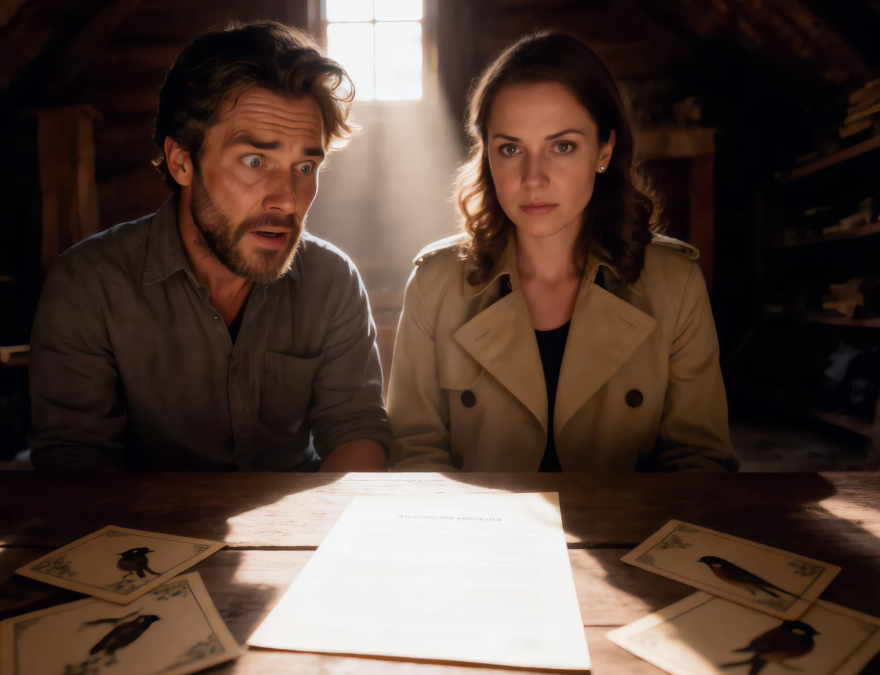
Maggie Reyes had been in Bexar Ridge, Texas, for exactly eleven minutes when a man pointed a shotgun at her rental car.
He did not aim it at her, exactly.
He held it loosely across his forearm, the way a man holds a thing he has no intention of using, and stood in the middle of the gravel road with a look that suggested she was the second-worst thing to happen to him that week.
She rolled down her window.
“Good morning,” she said. “I’m looking for the Calloway ranch.”
“You found it.”
“Great. I’m Maggie Reyes, from the Chicago Ledger. I emailed about an interview.”
“I saw the email.”
“And?”
“And I didn’t answer it,” said the man, “which is how most folks around here say no.”
He was somewhere in his early thirties, tall and sunburned, with dust on his boots and a gray hat pulled low over his eyes.
Behind him, a long wooden gate hung open onto rolling pastures, and beyond them stood a white farmhouse with a wraparound porch and a barn the color of dried blood.
It was a beautiful place, and she could tell instantly that it was in trouble.
“Mr. Calloway,” she said, “I’m not here to cause you problems.”
“Ma’am, women who drive up in rental cars with press badges are always here to cause problems.”
“I’m here because your county is about to seize four hundred acres of private land for a highway bypass, and nobody in the national press is covering it.”
His jaw tightened, but he did not lower the shotgun.
“You want a story.”
“I want the truth. If you want to tell it, I’ll write it fairly. If you don’t, I’ll turn around and drive back to the airport.”
He studied her for a long moment.
Then he sighed, broke the shotgun open, and slung it over his shoulder.
“Coffee’s on the porch,” said Wade Calloway. “Don’t touch the dog.”
The dog turned out to be a massive, drooling bloodhound named Biscuit, who leaned against Maggie’s legs the moment she sat down and sighed like a man who had waited all his life to meet her.
“He doesn’t do that,” Wade said, frowning.
“Maybe he likes city people.”
“He’s never liked city people.”
“Then he has excellent judgment.”
Wade almost smiled, then caught himself and poured the coffee instead.
It was strong enough to strip paint, and she drank every drop.
He told her the story in flat, careful sentences, as if he had rehearsed it in an empty room.
The Calloway ranch had been in his family for one hundred and forty years, and it was the last unbroken piece of land in the valley.
Three years ago his grandfather had died and left it to him, along with a mortgage nobody had known about and a stack of debts from a bad cattle year.
Then the state announced a bypass route that ran straight through his north pasture, and a developer in Austin, who happened to sit on the county planning board, had suddenly become very interested in the surrounding land.
“They can’t just take it,” Maggie said.
“Eminent domain says they can, if they call it public use.”
“But you’re a working ranch.”
“That’s the problem. Working ranch land is worth a lot less to a judge than a family farm.”
“What’s the difference?”
“A family.” Wade stared out at the pasture. “The county’s lawyer said it plain in the last hearing. Single owner, no dependents, no operating partnership. Just a man and some cows, and a piece of land he can’t afford to hold. He said the public good outweighs it.”
“That’s absurd.”
“That’s the law.”
Maggie sat quietly with her notebook open, and for the first time in a long career she felt the story turn into something heavier than a story.
“What would change their minds?” she asked.
“Nothing.” He shrugged. “Unless I had a family, I guess. A wife. Kids. Somebody depending on it.”
He said it bitterly, as a joke, and then neither of them said anything at all.
Maggie stayed three days.
She interviewed neighbors, pulled county records, and drove out to the bypass survey markers with a borrowed pair of boots two sizes too big.
She learned that the developer’s company had quietly bought forty acres adjacent to the proposed route two months before the announcement, and that the county commissioner’s brother-in-law was on the company’s board.
She wrote it all down, and by Friday night she had the makings of a very good story.
She also had a problem.
“They’ll bury it,” she told Wade on the porch, watching the sun sink behind the barn.
“Who will?”
“My editor. The developer’s lawyers. Everyone. The story is strong, but it’s about a corrupt land deal in a county nobody has heard of. It’ll run on page fourteen and vanish by Monday.”
“So what was the point?”
“The point is that I don’t think the story will save you.” She hesitated. “But a marriage might.”
Wade turned and stared at her.
“I’m sorry?”
“Hear me out.”
“I don’t believe I will.”
“Texas family law gives extra weight to land held by a married couple with a household in residence. I checked it this morning. If you had a legitimate spouse living on the property, a judge would have to treat this as a family homestead, and the county’s argument collapses.”
“Ms. Reyes.”
“Maggie.”
“Maggie.” His voice was dangerously quiet. “Are you suggesting that I marry you?”
“I’m suggesting that one of us needs a story and the other needs a wife, and neither of us is going to get what we want any other way.”
“That’s insane.”
“It’s a contract. Six months. We live here, we file the paperwork, and we fight the case in court. When it’s over, we get a quiet divorce and go our separate ways.”
“And what do you get out of it?”
“Access,” she said. “The exclusive, for as long as it lasts. Everything that happens on this ranch, from the inside. It’ll be the best story of my career.”
“So this is a job for you.”
“It’s a job,” Maggie agreed. “And it’s the right thing to do, and it’s the only idea I have.”
Wade looked out at the darkening pasture, at the barn and the fence line and the four hundred acres that his great-great-grandfather had cleared with his own hands.
Biscuit put his heavy head on Wade’s boot and whined.
“You’re not going to let this go, are you?” Wade said.
“Not a chance.”
“Terms?”
“Separate rooms. No physical contact beyond what the courthouse requires. You keep the ranch, I keep the story, and we tell no one the truth.”
“Not even my sister?”
“Not even your sister.”
“She’ll see through us in a minute.”
“Then we’ll have to be very convincing.”
He was silent for a long time.
“Six months,” he said finally.
“Six months.”
“And when it’s over, you leave and never write a word about me that isn’t true.”
“Everything I write will be true,” said Maggie. “That’s the whole point.”
They were married the following Tuesday at the Bexar County courthouse, in front of a bored clerk and a pair of witnesses borrowed from the vending machine hallway.
Maggie wore a green dress she had bought at a thrift store in town, and Wade wore his only suit, which was slightly too short at the wrists.
“You may kiss the bride,” the clerk said, without looking up from his paperwork.
They both froze.
“It’s fine,” Maggie whispered. “Quick and professional.”
“Right.”
“On three.”
“There’s no three.”
“Wade.”
He leaned down and kissed her, briefly and awkwardly, on the corner of her mouth.
It lasted less than a second, and she felt it for the rest of the afternoon.
The first week was a disaster.
Maggie could not work the ancient coffee maker, and Wade could not understand why anyone needed three different types of oat milk.
She kept waking at four in the morning to the sound of him leaving the house, and he kept finding her laptop cables draped across the kitchen table like a nest of snakes.
“You can’t leave those there,” he said one morning.
“Why not?”
“Because the dog will eat them.”
“Biscuit is not going to eat my charger.”
Biscuit, lying under the table, made a small guilty sound.
Maggie looked down, and then across the kitchen at Wade, and the two of them burst out laughing before either could stop it.
It was the first time she had heard him laugh, and it changed his whole face.
By the second week, she had learned to feed the chickens and to keep out of the way during calving season.
By the third, she was up at five with him, wearing his old flannel shirt and a pair of boots that finally fit, learning to fix fence wire under a rising sun.
“You’re not bad at this,” he admitted, watching her twist a strand into place.
“For a city girl.”
“For anybody.”
“That may be the nicest thing you’ve ever said to me.”
“Don’t let it go to your head.”
She grinned at him, and he looked away, and she noticed that the tips of his ears were pink.
The county hearing was set for the first week of December.
In the meantime, the developer’s lawyers sent letters, and then a private investigator, who spent an afternoon at the diner in town asking suspiciously detailed questions about the Calloways’ marriage.
“He thinks we’re faking,” Wade said that night.
“We are faking.”
“I know that. But he doesn’t have to.”
“Then we make it look better.” Maggie chewed her lip. “We should be seen together. Go to church, go to the feed store, hold hands at the town fair.”
“Hold hands.”
“It’s a very small sacrifice.”
“Is it?”
She looked at him, and he was not joking.
“Wade,” she said slowly, “are you afraid of holding my hand?”
“No.”
“You are.”
“I’m not afraid,” he said. “I’m just… trying to remember what’s pretend.”
The words sat between them, quiet and heavy, and neither of them knew what to do with them.
Then Biscuit knocked over a bucket in the hall, and the moment broke.
They went to the Bexar Ridge fall festival on a Saturday in October, and Maggie held Wade’s hand for nearly three hours.
His palm was rough and warm, and he held on carefully, as if she might break.
Half the town stopped to congratulate them, and his sister Josie, a sharp-eyed veterinarian with her brother’s stubborn chin, watched them from behind a lemonade stand with narrowed eyes.
“Well?” Maggie asked when Josie finally cornered them by the pie table.
“Well what?”
“Do you approve?”
“Of my brother marrying a Chicago reporter he met eight days before the wedding?” Josie folded her arms. “Not remotely.”
“Josie,” Wade warned.
“But,” she said, in a softer voice, “he looks happier than he has in three years. So I suppose I’ll let it slide.”
Maggie’s heart gave an odd, painful little twist.
“Thank you,” she said.
“Don’t thank me. Just don’t break him.”
She did not answer, because she did not know how to promise something she was afraid she could not keep.
On the last night of October, a storm rolled in from the west.
It was the kind of storm Maggie had never seen in Chicago, a wall of black cloud that swallowed the horizon and made the whole sky shudder.
The power went out at nine, and by ten the wind had torn a section of roof off the north barn.
“The heifers,” Wade said, already pulling on his coat.
“I’m coming.”
“It’s dangerous.”
“So is doing it alone.”
He looked at her, and she looked back, and he nodded once.
They spent three hours in the rain, moving frightened cattle into the east shed while lightning split the sky.
Maggie slipped in the mud twice, and the second time Wade caught her by the elbow and held on.
“I’ve got you,” he shouted over the wind.
“I know.”
“Stay close.”
“I’m staying.”
By the time the last heifer was safe, they were soaked to the bone, shaking with cold and adrenaline, standing in the doorway of the shed with the storm still howling behind them.
“That was insane,” Maggie gasped.
“That was Tuesday.”
“It’s Saturday.”
“It’s Texas,” he said, and she laughed until she had to lean against him.
His arm came around her, and neither of them moved.
The rain drummed on the tin roof, and the world narrowed to the sound of his breathing and the warmth of his chest through wet cotton.
“Maggie,” he said quietly.
“Yes?”
“I don’t think I’m pretending anymore.”
She lifted her head.
His eyes were dark and steady in the dim light, and there was nothing guarded in them at all.
“Neither am I,” she whispered.
He kissed her then, slowly and thoroughly, and it was nothing like the kiss at the courthouse.
When they finally broke apart, she was smiling against his mouth.
“That,” she said, “was not in the contract.”
“I’ll file an amendment.”
“You’d better.”
They walked back through the rain with his coat around both their shoulders, and Biscuit met them on the porch and howled his approval to the storm.
The hearing came on a cold, bright morning in December.
Maggie sat beside Wade in the second row of the county courtroom, dressed in the same green dress she had worn to the courthouse, her notes on her lap and her heart pounding like a drum.
The developer’s lawyer was smooth and polished, and he spent forty minutes explaining why a bypass was in the public interest.
Then the judge turned to Wade and asked him to stand.
“Mr. Calloway,” she said, “I understand you married recently.”
“Yes, Your Honor.”
“Convenient timing.”
“Yes, Your Honor,” said Wade. “It’s also the best decision I ever made.”
A murmur went through the room.
“Explain that,” said the judge.
Wade looked at Maggie, and for the first time she saw his hands trembling.
“When my grandfather died,” he said, “I thought I’d lose this ranch because I was alone. I didn’t think anyone would fight for it but me. Then a woman came to my gate, with a notebook and a rental car, and told me the truth even when it wasn’t kind. She learned to fix my fences and feed my chickens and stand out in a hailstorm to save my cows. She’s the reason I’m still standing here.” He swallowed. “I don’t care what the county calls it. She is my family, and I would not trade her for four thousand acres.”
The room was very quiet.
Maggie could not speak.
Beside her, Josie wiped her eyes with the back of her hand.
The judge looked at Wade for a long moment, and then she looked at the developer’s lawyer, and then she picked up her pen.
“I’ve reviewed the records,” she said, “including certain documents recently published by the Chicago Ledger regarding the timing of land purchases along the proposed route. I find serious questions about this petition. The motion to condemn is denied, pending a full ethics inquiry.”
The courtroom erupted.
Wade turned to Maggie, and she threw herself into his arms, laughing and crying at once.
“We won,” she said.
“You won.”
“We won,” she repeated firmly, and kissed him in front of the entire county.
That night, they sat on the porch with a bottle of cheap champagne and a very sleepy bloodhound between them.
The stars were out in their thousands, huge and cold over the pasture.
“Six months isn’t up until April,” Wade said.
“I know.”
“The case is over, though. You could file for divorce tomorrow and be back in Chicago by the weekend.”
“I could.”
“Is that what you want?”
Maggie set down her glass.
“My editor called this afternoon,” she said. “The Ledger wants to make me their national correspondent. Washington bureau. It’s the job I’ve wanted my whole life.”
Wade’s face did not change, but his hand tightened on the arm of the chair.
“That’s wonderful,” he said quietly. “You should take it.”
“I’ve already turned it down.”
“Maggie…”
“I told them I’d take a remote position instead. Long-form writing, covering rural America, from a ranch outside Bexar Ridge.” She smiled at him, a little shyly. “If the owner doesn’t mind having a full-time journalist underfoot.”
He stared at her, and then he started to laugh, low and helpless and utterly delighted.
“The owner,” he said, “would like to remind you that there’s a clause in the contract about separate rooms.”
“I thought you were amending that.”
“I might have done it already.”
“When?”
“About a month ago,” said Wade, pulling her into his arms. “I just never got around to telling you.”
Biscuit sighed heavily, rolled over, and went to sleep.
Out in the pasture, the wind moved through the long dry grass, and for the first time in a hundred and forty years, the Calloway ranch belonged not to one lonely man, but to two people who had promised to keep it, and who, somewhere along the way, had forgotten they were only pretending.








