They Dumped 12 Tons of Waste Feathers on Her Farm by Mistake — What She Did Next Changed Everything
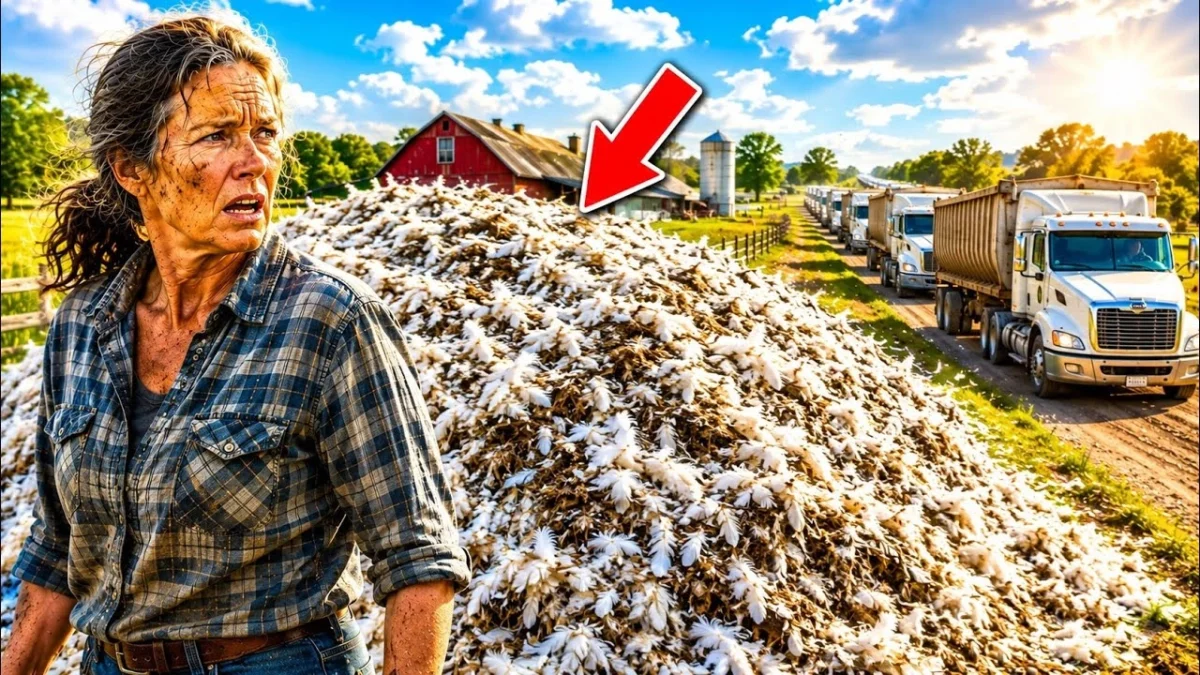
The first pale light of dawn barely cleared the tree line when the heavy, metallic rumble of an engine shook the quiet gravel road.
A local farmer in a rusted pickup truck slowed down near the wooden boundary fence, rolled down his window, and simply stared in sheer disbelief.
Where there used to be an open, autumn-dry hay field, there was now a massive, towering mountain of white and grey fluff, rising nearly eight feet high in places.
It stretched almost the entire length of a football field, steaming faintly in the crisp, cold morning air.
And standing right at the base of the colossal mound, her arms crossed tightly over her denim jacket, was a woman most people in the county knew only as the quiet recluse who kept to herself and grew heirloom vegetables nobody believed would sell.
She wasn’t running around in a frantic panic.
She wasn’t calling the county sheriff.
She wasn’t crying over her ruined pasture.
She was actually smiling, and nobody driving past that morning could begin to figure out why.
The county sat in the heart of working farmland, where the regional economy ran on a handful of tightly interwoven industries.
There were expansive row crops planted on the flat bottomland, a few struggling dairy operations clinging to the rocky hills, and one massive commercial poultry processing plant that had, over two decades, become the town’s primary employer and its most frustrating operational headache.
The processing plant handled tens of thousands of birds every single week, and with that immense volume came an overwhelming amount of organic waste that had to go somewhere.
Feathers, mostly—tons upon tons of them, day after day, week after week.
It was a stubborn, bulky byproduct that nobody wanted and almost nobody in the agricultural sector had figured out how to use effectively.
For years, specialized trucking companies were paid hefty contracts to haul the rejected feathers away to distant landfills or high-temperature incineration sites two counties over.
It was an extraordinarily expensive arrangement for the plant, it smelled awful along the entire transit route, and local farmers quietly hoped someone, someday, would find a practical solution.
The woman standing at the edge of the steaming white field was named Carol.
If you had met her before that unusual autumn morning, you would have had very little reason to remember her name.
She managed a modest forty-acre farm on the outer edge of town, a property she had inherited from her late father.
By her own frank admission, she was barely holding on financially.
The falling market prices for organic vegetables at the local farmers’ market didn’t cover the rising cost of tractor fuel and heirloom seed packets, let alone the constant repairs her aging equipment demanded.
Two consecutive seasons of poor soil yields had pushed her to the absolute brink of bankruptcy, forcing her to consider selling off the back half of her land just to keep the electricity running.
Carol wasn’t a university-trained scientist.
She wasn’t an agricultural chemist or an expert agronomist.
She had spent most of her youth simply watching her father work that same stubborn dirt, half-listening to his practical wisdom about soil care—things she never truly thought she would need to rely on to survive.
So, when a tired, sub-contracted haulage driver made a wrong turn before dawn, misread an outdated address on a decade-old waste permit, and dumped twelve tons of rejected processing feathers straight onto her fallow pasture, most people in the valley expected her to fly into a rage.
Instead, as she looked at the mountain of fluff, she remembered a specific conversation her father had held years ago, recalling advice she hadn’t thought about in over fifteen years.
That memory pointed directly to a retired farmer named Walt.
Walt was an old, long-time friend of her father’s who had worked the neighboring farm for almost five decades before his knees finally forced him into retirement.
He was the kind of weathered country man who didn’t talk much unless you asked him a direct, sensible question.
When Carol called him that morning, her voice a mix of lingering shock and sudden hope, Walt didn’t hesitate.
He pulled up in his ancient green truck within twenty minutes.
Walt stepped out of his vehicle, adjusted his canvas cap, and walked slowly along the perimeter of the giant pile.
He kicked at the edge of the feathers with the toe of his work boot, watching a small cloud of down float into the air.
“Walt, tell me I’m not crazy for not calling the police,” Carol said, stepping beside him.
“Well, Carol,” Walt said slowly, turning to look at her.
“Most folks around here would see a disaster, but feathers are almost pure keratin.”
“Keratin?” Carol asked, her brows furrowing.
“That’s right,” Walt nodded, pointing a calloused finger at the steaming pile.
“Keratin is packed to the brim with nitrogen—far more nitrogen by dry weight than the best livestock manure you can buy.
The problem with feathers has never been their nutrient content.
The problem is that nobody around here has the patience or the knowledge to break them down properly.”
Carol looked at the mountain of white, squinting against the morning sun.
“How long does it take for them to break down on their own?”
“Left alone in an open field like this, a feather can sit in the dirt for five years without rotting,” Walt explained.
“The exact same toughness that keeps a bird dry in a rainstorm keeps the feather resistant to natural decay.
But if you mix it the right way, with the right microbes, the right carbon ratio, and the proper amount of moisture and manure, that stubborn protein turns into one of the richest, most powerful natural fertilizers a small farm could ever ask for.”
Carol looked at him, her eyes brightening.
“Can we actually do that here, Walt?
With twelve tons of it?”
Walt turned, a faint grin appearing beneath his grey mustache.
“If you’re willing to work hard and get your hands dirty, Carol, I’ll show you how.”
Walt didn’t just give her a theoretical formula and leave her to figure it out alone.
Over the next two weeks, the retired farmer showed up at her gate early every single morning.
He taught her how to use her small tractor to turn the massive pile, creating long, structured composting windrows across her field.
He showed her how to layer the light feathers with wet, composted manure collected from her small herd of cattle.
“You can’t just throw them together, Carol,” Walt instructed one morning as they stood over a freshly layered section.
“You need structure.
Add dry straw and coarse wood shavings to create airflow, otherwise the whole thing will pack down tight like a wet mattress.”
“How do I know if it’s working?” Carol asked, holding a wooden pitchfork.
Walt reached into his jacket pocket and pulled out a long metal dial thermometer, plunging it deep into the heart of the pile.
“Watch this gauge,” Walt said.
“If the temperature rises to one hundred and forty degrees over the next few days, it means the heat-loving bacteria are eating that protein alive.
You have to judge the moisture by feel, too—it should feel like a wrung-out sponge, not a soaked rag.”
“I’m not fighting the feathers, am I?” Carol remarked, wiping sweat from her brow after an hour of pitchfork work.
“That’s right,” Walt chuckled softly, dusting off his sleeves.
“You’re not fighting the feathers at all.
You’re just giving them time, oxygen, and the right company.”
It was a phrase Carol would repeat to herself constantly over the challenging months ahead, especially when the delicate biological process hit severe complications.
And things did go wrong—badly wrong.
About three weeks into the project, a heavy autumn rainstorm soaked the field, followed by a sudden period of unseasonably warm weather.
The massive pile was turned a day too early and packed down far too tightly in its central section.
Deprived of vital oxygen, the inner core went completely anaerobic.
By the fourth afternoon, the warm, pleasant scent of damp soil was replaced by a thick, overpowering, sour ammonia stench.
The foul odor drifted on the afternoon breeze, carrying straight across the valley and settling over two neighboring properties.
Before long, the telephone in Carol’s kitchen began ringing off the hook.
“Carol, what in heaven’s name are you doing over there?” her nearest neighbor, Harold, shouted into the receiver.
“The air out on my front porch smells like a rotten poultry house!
It’s making my wife sick, and it’s ruining our evenings!”
“Harold, I am so sorry,” Carol pleaded, holding the phone tightly.
“We had a drainage issue with the compost pile after the rain.
I’m working on fixing it right now.”
“I don’t care about your compost project!” Harold snapped angrily.
“If that horrific smell isn’t gone by the end of the week, I’m filing a formal complaint with the county environmental health office!
That pile was dumped illegally, and it needs to be trucked off to a hazardous landfill where it belongs!”
When the call ended, Carol sat at her kitchen table, burying her face in her hands.
The stress of the mounting complaints and the sheer physical exhaustion of managing twelve tons of material weighed heavily on her shoulders.
For three dark days, she seriously considered giving up.
She mentally calculated the cost of hiring an industrial waste company to haul the entire mess away, accepting that she would have to sell her back pasture just to pay off the haulage debt and go back to barely scraping by on low-yield vegetables.
Just as she was picking up her phone to call the haulage company, a truck engine idled in her driveway.
Walt walked into her barn carrying a digital moisture meter he had borrowed from the regional agricultural extension office, along with a large bale of dry wheat straw.
“I heard Harold was giving you a hard time down at the supply store,” Walt said, setting the equipment down on a wooden crate.
“I’m calling the haulers, Walt,” Carol said quietly, her voice trembling slightly.
“It’s a failure.
The neighbors hate me, the smell is unbearable, and I can’t risk a massive county fine.”
Walt stood tall, looking at her with an unyielding, stubborn glare.
“Carol, a farm isn’t saved by giving up the moment the soil gets sour,” Walt said firmly.
“An anaerobic pile isn’t a dead loss—it’s just a mistake in air and balance.
We aren’t quitting today.”
“Walt, look at that pile!” Carol gestured out the barn door.
“It smells terrible!”
“Then we rebuild it,” Walt replied calmly, picking up a pitchfork.
“We start from scratch, we add proper airflow channels underneath using perforated plastic pipes, and we blend in three times as much dry carbon to soak up that free nitrogen.
Now get your tractor keys.”
Over the next ten days, Carol and Walt worked tirelessly from sunrise to well past dusk.
They pulled the entire mountain of feathers apart, inserting coarse wood chips, dry straw, and air vents to restore aerobic digestion to the core.
Slowly but surely, the harsh ammonia smell dissipated into the cold air.
Within two weeks, the foul odor was entirely gone, replaced once again by the deep, rich, earthy aroma of active, healthy compost working exactly as nature intended.
By the fourth month of relentless care and turning, something miraculous had occurred in Carol’s back field.
The massive, chaotic pile of twelve tons of discarded, white poultry feathers had completely transformed.
In its place sat roughly nine tons of dark, rich, crumble-textured, nutrient-dense natural compost.
Curious about the actual nutrient value, Carol invited the county agricultural extension agent, a skeptic named Dr. Aris, out to test the finished material.
Dr. Aris stood in the field with a brass sampling probe, taking core samples from various parts of the dark pile.
“To be frank, Carol,” Dr. Aris remarked, putting on his reading glasses as he examined the dark texture.
“Most feather attempts I’ve seen end up as a matted, smelly grease trap.
If you actually managed to break down the keratin entirely, I’ll be thoroughly impressed.”
A week later, Dr. Aris called her back, his voice buzzing with genuine excitement.
“Carol, I just got the lab analysis back from the state university,” Dr. Aris declared over the phone.
“Your feather-based compost carries a slow-release nitrogen level that is significantly higher than standard commercial organic blends.
The bio-availability is off the charts!”
“Are you sure, doctor?” Carol asked, holding her breath.
“I ran the test twice to be certain,” Dr. Aris confirmed enthusiastically.
“You’ve turned industrial waste into premium soil food.
I want to come out and see your spring planting rows myself.”
That spring, Carol carefully spread her new feather compost across three designated test rows of her struggling heirloom vegetable crops.
To verify the results, she left the adjoining three rows entirely untreated with the new compost, maintaining them with standard topsoil as a direct control comparison.
When the warm weather settled over the valley, the visual difference between the crops was undeniable.
The test rows treated with the rich feather compost produced vibrant, deep-green foliage, exceptionally thick stems, and visibly larger, healthier vegetables weeks ahead of schedule.
The untreated rows beside them looked pale, thin, and stunted by comparison.
Dr. Aris returned to the farm carrying a digital camera and a notepad, walking down the lush green aisles of Carol’s test plot in absolute awe.
“I’ve worked for this county extension office for twenty-two years, Carol,” Dr. Aris said, snapping photographs of the flourishing tomato plants.
“And I have never seen soil metrics and crop yields shift this dramatically from a single season of organic application.”
Word travels astonishingly fast in rural farming communities—far faster than most city people ever expect.
It wasn’t long before local growers started driving past her farm much slower, eyeing the magnificent green rows with intense curiosity.
The very first person to pull into her gravel driveway was none other than Harold—the same neighbor who had threatened to report her to the county health authorities months earlier.
Harold stepped out of his truck, nervously shifting his weight and scratching his chin as he walked up to Carol’s porch.
“Morning, Carol,” Harold said awkwardly, looking off toward her lush fields.
“Morning, Harold,” Carol replied pleasantly, leaning against the porch railing.
“What can I do for you?”
Harold cleared his throat, pointing a thumb over his shoulder.
“Well, I couldn’t help but notice your tomato and squash yields this month.
My southern field is starving for nitrogen, and commercial fertilizer prices just went up another twenty percent.
I was wondering… do you happen to have any of that feather compost left over?”
Carol smiled gently, remembering the cold phone call months ago.
“I might have a little bit left, Harold,” Carol answered softly.
“I can sell you a pickup truck load if you’d like to try it out.”
Within three weeks, word of Harold’s flourishing pasture spread down the county road like wildfire.
Two more neighboring farmers drove up her driveway, asking to buy compost by the trailer load.
By mid-summer, a handful of large-scale commercial farming operations from the neighboring county reached out through the agricultural extension office, eager to secure bulk orders of the specialized organic fertilizer.
Carol was no longer giving her compost away out of good neighborly charity.
She was selling it by the truckload to regional farmers who used to drive right past her dilapidated wooden gate without giving her property a second glance.
The financial relief was profound.
The money made from the compost sales paid off her lingering equipment debts, bought fresh diesel fuel for her tractor, and completely eliminated the looming threat of having to sell off her family’s land.
However, what made the transformation truly remarkable wasn’t just the income.
It was standing on her front porch every afternoon, watching the very same gravel road that had once carried a careless truck dumping unwanted industrial waste onto her field now carry a steady, daily line of farm trucks pulling in to load up on something valuable she had built with her own hands and Walt’s patient guidance.
Eventually, word of Carol’s agricultural breakthrough reached the executive board of the large poultry processing plant in town.
The plant manager, a stressed corporate director named Mr. Henderson, drove out to Carol’s farm in his immaculate company sedan.
He stepped out, smoothing his tie as he walked over to where Carol and Walt were monitoring a new composting row.
“Ms. Carol?” Mr. Henderson asked, offering his hand.
“I’m Arthur Henderson, plant director for Regional Poultry Processing.”
“I know who you are, Mr. Henderson,” Carol said, wiping her hands on her work towel before shaking his hand.
“I believe twelve tons of your feathers ended up on my field by mistake last autumn.”
Mr. Henderson offered an apologetic smile.
“That was an unfortunate logistical error by our sub-contracted haulage company, and I am truly sorry for the trouble it caused you.
However, Dr. Aris from the extension office recently presented your soil analysis data to our regional environmental committee.”
“Did he?” Carol asked, raising an eyebrow.
“Yes,” Mr. Henderson nodded eagerly.
“Currently, our plant pays over eighty thousand dollars a year just to haul rejected feathers two counties away to a regional incinerator.
It’s a massive financial drain and an environmental liability for our brand.
We want to offer you a direct commercial partnership.”
Walt stepped forward, leaning on his walking stick.
“What kind of partnership, Mr. Henderson?”
“We want to route a fixed percentage of our organic feather waste directly to your facility,” Mr. Henderson explained, holding out a proposal folder.
“We will pay you a steady monthly processing fee to accept the material, eliminating our long-haul disposal costs while providing your farm with a guaranteed supply of raw inputs.”
Carol looked down at the official corporate proposal in her hands, then turned her gaze to Walt, who gave her a quiet, proud nod.
What had started as an illegal, smelly, nightmarish dump of industrial waste had officially transformed into a lucrative, long-term sustainable business partnership.
Today, if you drive down that quiet country road on the edge of town, you won’t see an ugly, steaming mountain of neglected waste polluting the countryside.
Instead, you will see neat, dark, expertly maintained rows of rich organic compost resting beside a flourishing heirloom vegetable farm.
A clean, painted wooden sign stands at the main entrance, reading: *Vance & Father Organic Soil Solutions.*
And more often than not, on any given morning, you will see at least two farm trucks idling in the driveway, waiting patiently for their turn to load up on the finest fertilizer in the state.
Carol still refuses to call herself an expert scientist or a genius entrepreneur.
If you ask her how it all happened, she will simply look back toward her fields, smile warmly, and tell you that she just listened to a wise old neighbor who knew more than she did, and stubbornly refused to quit when the first attempt turned sour.








