They Dumped 50 Tons of Rotten Tomatoes on His Field… 6 Months Later He Owned an Empire!
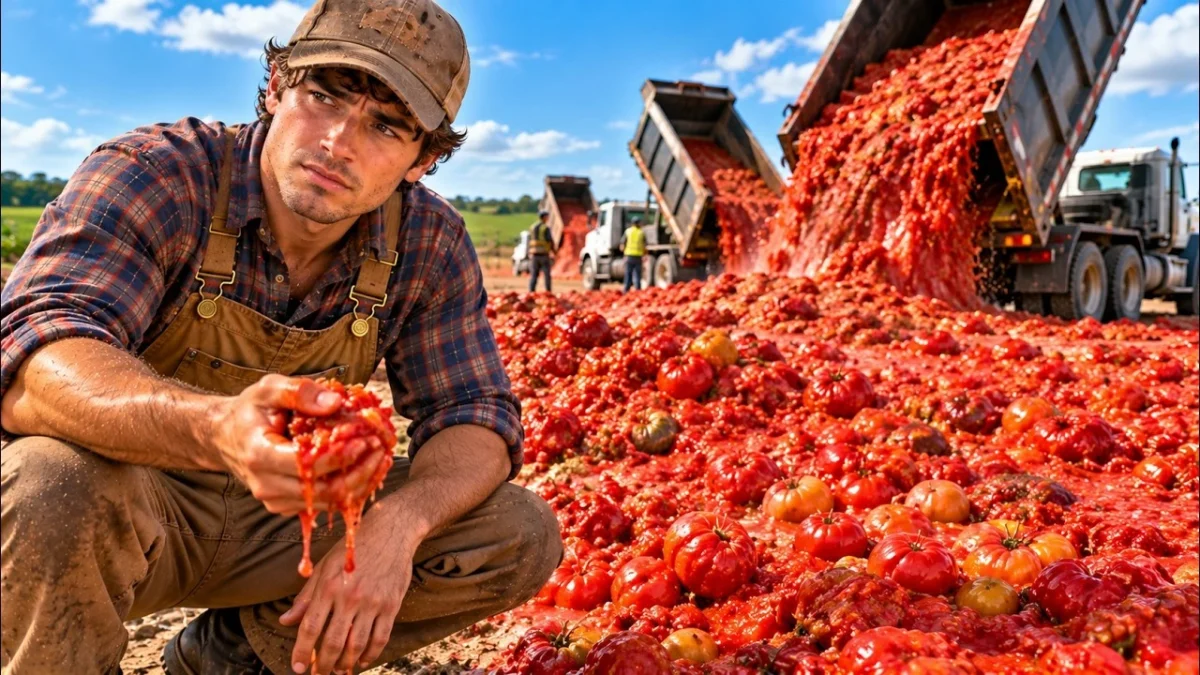
The overcast sky over Knox County, Indiana, hung heavy with the promise of rain, but the storm that arrived at noon on the second Tuesday of April carried no water.
Instead, it arrived in the form of forty-eight commercial dump trucks, their diesel engines roaring as they backed up to the edge of an abandoned five-acre parcel along County Road 7.
With loud hydraulic groans, the steel beds tilted upward, discharging fifty tons of fermenting, crushed liquid tomato waste directly onto the cracked, gray clay.
The stench was an aggressive, suffocating force.
It was not the sweet smell of ripe gardens, but an acidic, biological slurry of discarded skins, pulverized pulp, and bubbling juice that had festered in factory holding tanks for days.
Within three hours, twenty-two formal complaints had been filed at the county courthouse.
By mid-afternoon, a crowd of neighboring landowners had gathered along the gravel shoulder, holding soaked handkerchiefs over their noses and shouting over the idling engine of Deputy Sheriff Miller’s cruiser.
“This is an outrage, Miller!” shouted Harold Vance, a local grower whose hands were stained with dust. “You can’t let a corporate plant dump hazardous biological waste in a residential farm zone! That smell is going to rot my winter wheat!”
Deputy Miller held up two fingers, attempting to calm the growing mob. “Now hold on, Harold. I’m waiting on the township trustee right now. We’re checking the zoning ordinances.”
A shiny, dual-cab pickup truck pulled up to the edge of the crowd, kicking up a plume of white limestone dust.
Arthur Vance, the region’s premier commercial tomato grower, stepped out of the cab.
Arthur managed six thousand acres of uniform hybrid Roma tomatoes for national supermarket chains, operating with a fleet of air-conditioned tractors and computerized fertigation systems.
He adjusted his immaculate leather work gloves, walked to the edge of the property, and looked down at the steaming sea of red crimson mud.
Then, Arthur threw his head back and laughed—a booming, chesty sound that echoed across the open field.
“Look at him!” Arthur shouted, pointing toward a lone figure standing near an old wooden fence post. “Look at the boy praying to a pile of rot!”
Standing quietly at the center of the storm was twenty-two-year-old Cole Evans.
He wore a faded canvas work jacket with frayed cuffs and oil-stained leather boots.
While the surrounding farmers owned thousands of acres of heavily subsidized corn and soybeans, Cole owned only these five acres of heavy, alkaline gray clay.
The land had sat fallow for fifteen years, so packed with mineral salts and dense clay pans that county agricultural appraisers officially listed its commercial value at zero dollars.
Arthur walked right up to the boundary wire, his boots pristine compared to the muck on the field.
“Hey, Cole!” Arthur called out, his voice dripping with condescension. “Are you planning on farming maggots, or are you just opening a public sewer for Midwest Canning?”
The gathered farmers chuckled nervously, eager to stay on Arthur’s good side.
Cole turned slowly. His face was calm, his gray eyes steady. “It’s just organic matter, Mr. Vance.”
“Organic matter?” Arthur snorted, wiping a tear of amusement from his eye. “Midwest Canning was facing twenty thousand dollars in municipal environmental disposal fines to haul that sludge to an incinerator in Indianapolis. Instead, they found an idiot who’d let them dump twenty truckloads of bio-sludge on his dirt for free. You saved them a fortune, boy, and all you got was a health hazard.”
“The soil needed carbon,” Cole said softly, unbothered by the laughter.
“The soil needs a bulldozer and ten loads of lime, you fool!” Arthur sneered. “You’ve ruined what little value this county had left.”
Before Cole could answer, Township Trustee Richard Bradley pushed his way through the crowd, holding an official yellow carbon slip.
“Cole Evans,” Bradley said strictly, handing the paper over the wire fence. “This is a formal public nuisance citation. If this rotting waste isn’t completely cleared or plowed under within thirty days, the county will send municipal dozers to bury it, and we will attach the excavation costs to your property tax assessment.”
Cole took the paper with a calm hand. “I understand, Mr. Bradley.”
“Do you?” Bradley asked, shaking his head. “Because the stench is peeling the paint off old tractors two miles downwind.”
Cole folded the yellow carbon paper neatly, slipped it into his jacket pocket, and offered not a single word of self-defense.
To every farmer in Indiana, the situation was crystal clear: a naive kid had been tricked by a corporate canning facility looking to dodge waste disposal fees.
They saw fifty tons of stinking garbage on five acres of worthless dirt.
They laughed all through April.
They shook their heads through May.
What none of them knew was that Cole Evans was executing a precisely calculated, multi-stage biological transformation.
The knowledge guiding Cole had not been taught in any university business course.
It was preserved inside thirty years of handwritten journals left to him by his late grandmother, Dr. Clara Evans, a pioneer in independent soil microbiology who had spent her life studying pre-industrial horticultural chemistry.
Clara’s notes detailed two foundational realities that modern industrial agriculture had long forgotten.
The first was the chemical profile of Cole’s gray clay.
The soil on his five-acre parcel was dense, impermeable alkaline clay with a pH reading of 8.4.
In such high alkalinity, essential micronutrients like phosphorus, iron, and zinc were locked in rigid, insoluble mineral bonds.
Standard commercial fertilizers could not dissolve in that environment; they simply sat on the surface until rain washed them into the public ditches.
To break down the alkaline clay using traditional agricultural inputs would have required forty tons of pure elemental sulfur and thousands of pounds of commercial nitrogen—costing over thirty thousand dollars that Cole did not possess.
The industrial tomato slurry, however, was a concentrated biological acid.
Decomposing tomato pulp carries a low pH of approximately 4.1, saturated with citric, malic, and active acetic acids produced by wild lactobacillus fermentation.
When fifty tons of that acidic mash met the alkaline clay, a massive neutralization reaction began at the microscopic level.
The acid fractured the mineral bonds of the hard clay pan, converting locked calcium into bioavailable calcium citrate.
Simultaneously, the decomposing skins and pulp delivered twenty thousand pounds of pure organic carbon, while the cellular breakdown released massive quantities of natural potassium and slow-release nitrogen.
Without spending a single dollar, Cole had turned the canning factory into his personal logistics crew, delivering forty thousand dollars worth of precision organic soil amendments directly to his field.
Yet the soil chemistry was only the first half of Cole’s strategy.
The true prize was suspended inside the rotting pulp itself.
Two weeks prior to the disposal, Cole had quietly monitored the production schedules at Midwest Canning.
The facility had taken on a specialty contract for a European heritage food conglomerate, processing private trial batches of forty rare, open-pollinated nineteenth-century heirloom tomato varieties gathered from seed banks across Italy, France, and the American South.
Modern commercial tomatoes, like the hybrid Romas Arthur Vance grew, were F1 monocultures—bred for thick skins, mechanical picking, and a thirty-day shelf life, while sacrificing ninety percent of their flavor and natural disease resistance.
The heirloom varieties in that specialty run were legends: true Brandywine, Cherokee Purple, Radiator Charlie’s Mortgage Lifter, San Marzano Lungo, German Pink, and Green Zebra.
Under normal conditions, purchasing enough certified heirloom seeds to plant five acres would have cost upwards of forty-five thousand dollars.
Furthermore, heirloom tomato seeds possess a natural defense mechanism: every seed is encased in a gel-like placenta containing chemical germination inhibitors.
In nature, the fruit must rot completely so that natural bacterial fermentation can dissolve the gel, sanitize the seed coat from bacterial canker, and signal the embryo to break dormancy.
The canning plant believed they were discarding spent industrial waste.
In truth, their massive heated holding tanks had created the most perfect large-scale automated seed fermentation and sterilization bath in botanical history.
Inside that fifty-ton mountain of acidic slurry were an estimated four million fully primed, disease-sanitized, high-germination heirloom seeds.
While the town mocked him, Cole went to work under the cover of darkness.
Using a battered 1972 John Deere tractor borrowed from his uncle, Cole spent three weeks disking the field.
He did not allow the slurry to sit in exposed heaps.
Every night, between midnight and four in the morning, he cut deep fourteen-inch furrows into the subsoil, folding the acidic tomato mash deep beneath the clay surface.
He blended twenty tons of old wheat straw into the soil to balance the carbon-to-nitrogen ratio and prevent the compost from overheating.
Equipped with an eight-inch brass temperature probe, Cole monitored the subterranean progress daily.
By early May, the microbial activity beneath the surface had stabilized.
The internal soil temperature held at a steady seventy-two degrees Fahrenheit, while the soil pH across all five acres had shifted from an unplantable 8.4 down to an optimal, nutrient-rich 6.5.
On May 21st, following three days of gentle spring rain, the property produced a sight that stopped traffic on County Road 7.
It did not sprout weeds.
Across five unbroken acres of dark, restored earth, a uniform emerald carpet of hundreds of thousands of vigorous, thick-stemmed heirloom tomato seedlings broke through the surface simultaneously.
The seed density was so massive and the root growth so aggressive that invasive weeds could not find space or sunlight to take root.
Where the county had expected a toxic field of dead waste, a thriving sea of heritage vegetation was rising from the dirt.
As the summer of 1992 unfolded, two simultaneous crises hit the Midwest agricultural region.
The first was economic.
Global supply disruptions caused the price of synthetic nitrogen and petroleum-based fungicides to jump by sixty-five percent.
Commercial growers relying on heavy chemical inputs saw their operating costs skyrocket.
Arthur Vance was forced to secure a two-hundred-thousand-dollar emergency line of credit just to keep his computerized chemical pumps running.
The second crisis was biological.
An aggressive strain of early tomato blight swept through the county, carried by humid southern winds.
The hybrid monocultures planted across thousands of local acres had zero genetic diversity.
Because every plant in Arthur Vance’s fields was an identical genetic copy, the fungal blight swept through his six thousand acres like wildfire.
Glossy green vines turned into blackened, rotting decay in less than two weeks, despite continuous chemical spraying.
One afternoon in late June, Arthur pulled his truck up to Cole’s fence line once again.
His own fields behind him were dying, the air thick with the smell of scorched foliage and chemical spray.
Across the wire fence, Cole’s field was a towering, dense jungle of dark green foliage, standing eight feet tall on sturdy cedar posts and braided twine.
Arthur stepped out of his truck, his face pale and drawn. He stared at the lush green leaves, completely devoid of yellow blight spots.
“How?” Arthur demanded, his voice raspy. “How do you not have the blight? I’ve sprayed three rounds of systemic fungicide, and my crop is fifty percent dead! What chemicals are you using?”
Cole walked slowly down the row, a wooden basket in his hand. He stopped at the fence line.
“I don’t use chemicals, Mr. Vance,” Cole said quietly.
“Don’t lie to me, boy!” Arthur snapped, his fists clenching. “Nobody grows tomatoes in this county without spraying! You must be dumping unregistered sulfur!”
“I’m not lying,” Cole replied, picking a small leaf and holding it out. “There are forty different heritage varieties in this ground. Some have thick cellular walls; others produce natural antifungal enzymes. Because they aren’t clones, the blight can’t leap from plant to plant. Besides, the biological compost from April filled the soil with beneficial fungi that protect the roots from infection.”
Arthur stared at the leaf, then looked up at the towering vines. “It… it doesn’t make sense. You planted garbage.”
“I planted history,” Cole said simply, turning back to his work. “Nature already solved these problems a long time ago.”
By the first week of July, the vines were bowing under the immense weight of the fruit.
And the fruit was extraordinary.
These were not the uniform, pale, cardboard-like tomatoes found in plastic grocery store boxes.
They were massive, irregular, multi-colored botanical treasures.
There were two-pound Brandywines with fluted pink shoulders and a deep, sweet acidity; Cherokee Purples with dark mahogany skins and complex smoky tones; brilliant yellow Pineapple tomatoes marbled with crimson streaks; and elongated San Marzano paste tomatoes packed with thick, seedless flesh.
While Arthur Vance dumped thousands of pounds of blighted hybrid fruit into drainage ditches at forty cents a pound, news of Cole’s harvest reached the emerging farm-to-table movement in Chicago and Indianapolis.
On July 14th, a sleek black sedan pulled up the gravel driveway.
A man in a tailored suit and a crisp white chef’s coat stepped out.
It was Chef Jean-Luc Laurent, the executive chef of a renowned Michelin-starred Italian establishment in downtown Chicago, who had driven four hours after hearing rumors from a produce distributor.
Cole met him near the edge of the field.
“Are you Cole Evans?” the chef asked, scanning the towering green canopy with sharp eyes.
“I am,” Cole said.
“They tell me you have true San Marzano and Cherokee Purple growing in open clay,” Jean-Luc said, sounding skeptical. “May I see?”
“Help yourself,” Cole gestured to the open row.
Jean-Luc walked into the field, pulled a small antique folding knife from his pocket, and knelt beside a heavy vine loaded with dark purple fruit.
He sliced a sun-warmed Cherokee Purple directly from the vine, inspected the deep crimson interior, and placed a piece in his mouth.
He closed his eyes for three long seconds.
When he opened them, his skeptical expression had vanished.
“Mon Dieu,” Jean-Luc whispered. “The acidity… the sugar balance. It tastes of real earth and mineral depth. Modern hybrids are plastic compared to this.”
He wiped his knife, reached into his suit jacket, and pulled out a leather checkbook.
“I don’t need to see the rest,” Jean-Luc said firmly. “I will pay you twelve dollars and fifty cents a pound for every Grade-A heirloom you can harvest from these center rows. I want two deliveries a week.”
He wrote a company check on the hood of his sedan and handed it to Cole.
It was for five thousand dollars—a deposit to secure the first harvest.
“I will see you on Thursday, Mr. Evans,” Jean-Luc said, shaking Cole’s hand with genuine respect. “Do not let anyone else buy this row.”
Within ten days, the narrow farm lane that had once been blocked by angry, protesting neighbors was continuously lined with refrigerated courier vans, boutique wholesalers, and high-end restaurant suppliers.
Cole hired fourteen local college students and out-of-work farmhands, establishing a precise daily harvest routine.
Every morning at dawn, the crew hand-picked five thousand pounds of pristine heirloom fruit, carefully packing them into cedar bushel crates lined with soft paper.
The financial results were staggering.
Over the twelve-week summer season, Cole sold sixty-two thousand pounds of premium heirloom tomatoes directly to top-tier culinary buyers across three states at an average price of eight dollars and fifty cents per pound.
The produce sales alone generated five hundred and twenty-seven thousand dollars in gross revenue.
In addition, Cole extracted and ferment-cleaned eighty pounds of pure, non-hybrid heirloom seeds from prime-selected mother fruits.
He packaged them for specialty heritage seed companies at forty-five dollars per ounce, bringing in an additional fifty-seven thousand six hundred dollars in seed sales.
In a single summer, the abandoned five-acre clay lot that the county had branded a public hazard generated over five hundred and eighty thousand dollars in total revenue.
By late August, the social dynamic in Knox County had completely flipped.
Arthur Vance’s operation posted a devastating net loss of three hundred and twenty thousand dollars due to crop blight, heavy debt, and falling commodity prices.
Every afternoon, Arthur had no choice but to drive his truck past Cole’s property on his way into town.
He watched in silence as transport vans loaded thousands of pounds of high-value fruit from the very soil he had called a sewer.
He saw the county commissioners—the same men who had threatened Cole with fines—posing for photos beside Cole near a state agricultural innovation banner.
On the morning of September 3rd, a black corporate town car pulled into Cole’s driveway.
A tall man in a tailored gray suit stepped out, holding a thick leather briefcase.
It was Marcus Thorne, the Senior Director of Operations for Midwest Canning Corporation—the same executive who had authorized dumping the waste five months earlier.
Thorne did not carry municipal nuisance notices or legal threats.
He looked around the pristine property, noted the quiet efficiency of the harvesting crew, and walked over to the wooden picnic table where Cole was reviewing yield logs.
“Mr. Evans,” Thorne said smoothly, extending a hand. “I’m Marcus Thorne. Thank you for taking the time to meet me.”
Cole shook his hand calmly. “Mr. Thorne. What brings Midwest Canning back to my dirt?”
Thorne cleared his throat, unzipped his briefcase, and pulled out a forty-page legal document.
“I’ll be direct,” Thorne said, resting his hands on the contract. “The European food consortium that contracted our trial run five months ago ran into a major crisis. Their central seed storage facility in France suffered a catastrophic fire three weeks ago. Their entire baseline genetic stock for seven of those heritage heirloom varieties was destroyed.”
Cole leaned back, listening attentively.
“When their botanical investigators traced the supply chain,” Thorne continued, “they realized that the only surviving, viable, field-tested seed stock for those seven historic varieties in the Western Hemisphere is currently growing right here on your five acres.”
Thorne opened the binder to the final execution page.
“The board has authorized an immediate master agreement,” Thorne said. “We are offering you a five-year exclusive contract to direct our proprietary seed preservation program. We will fully fund the construction of a two-acre climate-controlled seed facility on your land, handle all transport logistics, and pay you a guaranteed annual retainer of three hundred and fifty thousand dollars.”
Cole looked at the corporate executive, took a quiet sip of water, and smiled softly.
“I will accept the contract, Mr. Thorne,” Cole said quietly. “On one condition.”
Thorne leaned forward, his pencil poised over the signature line. “Name it.”
Cole stood up and pointed across the road toward a dry, neglected ten-acre parcel stretching over the ridge.
“Next spring, when your factory cleans out its seasonal processing tanks,” Cole said, “you deliver every single ton of that biological waste directly to my farm gate.”
Thorne blinked in astonishment, let out a breathless laugh, and signed his name at the bottom of the page.
“Done, Mr. Evans,” Thorne said. “It’s a deal.”
In the years that followed, the five-acre lot on County Road 7 became the global research headquarters of Evans Heritage Seed and Agricultural Bioworks.
Cole expanded the operation across four hundred acres of restored heartland soil, creating one of the most respected heirloom seed banks and biological soil regeneration facilities in the nation.
He never purchased synthetic commercial fertilizers.
He never took on high-interest chemical loans.
He continued to use natural fermentation, organic waste valorization, and traditional soil science to transform what industrial society discarded into sustainable wealth.
Arthur Vance still farms in Knox County.
However, whenever his hybrid crops show signs of mineral deficiency or soil compaction, his farm trucks can be seen driving down County Road 7.
Arthur now pays cash to load tons of organic biological compost produced by the very man he once mocked.
In agriculture, as in life, conventional minds often focus only on surface appearances.
They view waste as a costly burden and broken ground as a permanent failure, spending vast fortunes trying to force nature to perform what it was designed to do naturally.
Where the crowd saw fifty tons of stinking garbage, the thoughtful farmer recognized millions of dormant miracles waiting for the right conditions to build an empire.








