They Introduced Every Daughter Except Her—The Duke Asked Her Name Anyway
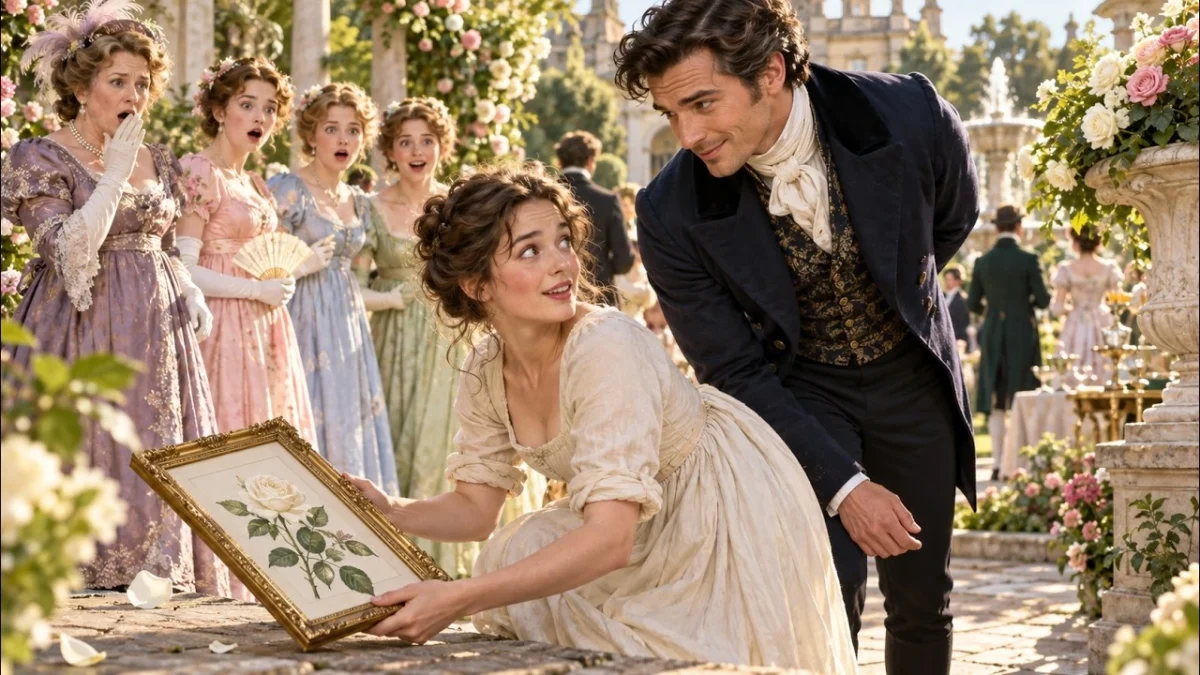
Lady Bellweather had presented Arabella in blue silk, Jane in green, and Lucy with a yellow ribbon that simply would not stay tied.
Duke Nicholas Harrow had greeted each daughter with the exact measure of polite, practiced attention expected of a man of his standing.
He smiled at Arabella’s polished tilt of the head, inclined his neck to Jane, and offered a reassuring nod to little Lucy as she frantically tucked the fluttering ribbon back into her sash.
The receiving line was arranged with mathematical precision, positioned in the shade of the garden terrace where the light best flattered the young ladies.
Then, a sudden, sharp gust of wind swept through the garden display.
A heavy, framed botanical drawing caught the air, slipped from its easel, and slid rapidly toward the edge of the stone terrace.
Before the heavy glass could strike the flagstones and shatter, a young woman in a plain cream dress stepped forward with astonishing swiftness.
She caught the frame in her right hand, steadying it instantly, even as her left hand precariously balanced a spilled, dripping pot of black ink.
She held her ground, her fingers dark with wet pigment, her breath entirely steady.
No one offered her name.
Lady Bellweather took a step forward, her silk skirts rustling loudly, and attempted to gesture toward Arabella to draw the Duke’s attention back to the line.
Duke Nicholas Harrow, however, turned completely away from the arranged daughters.
He looked directly at the woman standing beside the rocking display table.
“And who saved the drawing?” he asked, his voice calm, clear, and carrying across the quiet terrace.
Lady Bellweather’s practiced smile stiffened until it appeared almost painful.
“That is our Clara,” she said quickly, her tone light and dismissive. “She helps with everything around the estate.”
The young woman looked up, her gray eyes meeting the Duke’s over the top of the wooden frame.
“Clara Fenwick,” she said, her voice firmly cutting through the air before anyone could reduce her to a mere household task.
Nicholas repeated the name aloud, pronouncing each syllable as though it naturally deserved a prominent place at the reception.
“Miss Clara Fenwick,” he said.
A week earlier, Clara had spent three long afternoons repairing that exact drawing in the dusty quiet of the attic while her cousins practiced their curtsies in the drawing room below.
The illustration showed a rare white winter rose from the famous Wickham Conservatory, its delicate petals tinted with subtle, layered watercolor washes.
Her late father had drawn the original botanical study years before his death, back when he served as the primary artist for the region’s grand estates.
Clara had carefully restored a torn corner using matching period paper and delicate wheat paste, signing nothing.
Lady Bellweather had insisted the picture be displayed prominently today because she knew the Duke’s late mother had cherished winter roses.
Yet she had deliberately omitted Clara from the formal introductions because Clara was an unmarried, penniless niece, and the family’s social energy was strictly reserved for placing its own daughters.
Clara understood the cold arithmetic of her aunt’s household perfectly.
She also knew how easily that arithmetic could be multiplied into bitter anger if she permitted herself to dwell on it.
Instead of brooding, she had carried the heavy display boards into the garden that morning and tried to secure them against the unpredictable coastal breeze.
Lucy had asked if she might help carry the heavy twine.
Lady Bellweather had immediately called Lucy back to the terrace line, reprimanding her for risking her gloves.
Clara had been left alone with the string, the ink, and a folding table that rocked dangerously on uneven cobblestones.
Nicholas had arrived to a scene arranged for him with extravagant care.
Yet he had noticed the three brightly dressed daughters, the fresh floral arrangements, and the single person working continuously in the background to ensure those arrangements remained upright.
In truth, he had been watching Clara long before the picture frame slipped.
Her movements were remarkably quick, economical, and exact.
When the heavy frame fell, she had caught it with the reflexive calm of someone thoroughly accustomed to preventing small disasters that no one else would ever acknowledge.
Nicholas stepped away from Lady Bellweather and approached the display table.
“Tell me about this drawing, Miss Fenwick,” he said, indicating the rescued artwork.
“It is a study of the Wickham Winter Rose,” Clara replied, wiping a stray drop of ink from her wrist with a plain cloth. “A variety bred specifically at your family’s estate two decades ago.”
Nicholas’s gaze sharpened instantly.
“The Wickham Rose,” he said, his voice dropping slightly. “The original stock was lost from our conservatory after a severe winter storm broke the glass roof years ago. I did not expect anyone at this gathering to recognize it, let before possess a direct study of it.”
Lady Bellweather quickly glided over, her fan fluttering nervously.
“Oh, it is a lovely old picture, Your Grace! We thought it added such a charming, historical touch to the garden. But perhaps you would care to step inside the drawing room? Arabella has prepared a delightful piece on the pianoforte.”
Nicholas did not look at Arabella.
His eyes remained fixed on the lower right corner of the paper Clara was holding.
“Who saved the paper itself?” he asked quietly, noticing the seamless repair work along the frayed margin. “This corner was severely degraded.”
Lady Bellweather answered smooth as silk, “We had it properly attended to, of course. We ensure our collection is maintained.”
Clara could have remained quiet.
She had spent years being quiet in ways that kept the Bellweather household running smoothly, quietly mending linens, balancing ledger discrepancies, and cataloging forgotten drawers.
However, Nicholas looked directly into her eyes and explicitly waited for her response.
“I repaired it,” Clara said clearly. “The paper was almost gone, but the drawing wanted to stay.”
Jane, standing in her bright green gown, raised an eyebrow at the unusual phrasing.
Nicholas smiled, a genuine warmth breaking through his reserved aristocratic posture.
“Then I am profoundly glad you listened to it, Miss Fenwick,” he said.
Clara had not expected a duke to sound as though he genuinely meant every word he said.
Lucy, the youngest cousin, watched the interaction with sharp eyes.
She noticed that Nicholas had already spoken to Clara for longer than he had spoken to any of the presented daughters.
Lucy tugged gently at her untied ribbon and grinned widely behind her mother’s back.
Jane noticed as well, though her expression was far more guarded and calculating.
Arabella simply glanced anxiously toward their mother, whose jaw had tightened perceptibly.
The formal introductions had been planned for weeks like a delicate, high-stakes dance, and Clara had stepped straight into its center without ever asking for permission.
Clara observed all three cousins’ reactions and felt a sudden weight in her chest.
She wondered whether giving one honest answer would cost her the small, tenuous place she still retained in the Bellweather house.
Carefully, she placed the heavy wooden frame back down onto the table.
As she adjusted the backing, her thumb brushed against a loose piece of backing paper, revealing that the adjacent drawing had her father’s distinct, microscopic initials hidden beneath a newly pasted paper label.
After the long reception finally concluded and the guests departed, Clara carried the heavy portfolio of drawings upstairs to her small room under the eaves.
Lady Bellweather met her in the narrow second-floor hallway, blocking the passage.
“Thank you for avoiding an embarrassing scene in the garden, Clara,” her aunt said, her tone laced with cool disapproval.
Clara paused on the runner, the portfolio resting against her hip. “What scene do you mean, Aunt?”
“Speaking so excessively about those old pictures to the Duke,” Lady Bellweather replied sharply. “Duke Nicholas possesses significant influence and an extensive interest in local land management. Our family desperately requires his goodwill. Arabella’s future prospects could improve immensely if he chooses to visit us again.”
Clara stared at her aunt for a moment.
She wanted to say that stating one’s proper name was not a scene.
She wanted to say that being acknowledged as an artist was not an insult to the family.
Instead, she reached down, peeled back the corner of the top paper, and showed Lady Bellweather the fresh label covering her father’s original initials.
“My father drew these,” Clara said quietly. “Every single one of them.”
Lady Bellweather barely glanced at the paper. “Old botanical sketches often pass through many hands, Clara. Your uncle acquired your father’s papers upon his death. It is family property now.”
“Property, perhaps,” Clara said softly. “But not your creation.”
“Do not grow overly ambitious, child,” Lady Bellweather warned, leaning closer. “You live under this roof by our grace.”
Clara carried the portfolio into her small room and set it on her worktable.
She had learned enough from analyzing her father’s extensive portfolio over the years to recognize his fine, precise gray ink lines beneath any secondary wash of color.
If the Bellweathers were systematically presenting her late father’s lifetime work as their own family collection to impress high-ranking suitors, the issue was far larger than a simple social slight at an afternoon party.
Early the next morning, a uniformed footman arrived from Wickham Manor bearing a formal letter.
Lady Bellweather intercepted the message in the vestibule and opened it before Clara even knew it had arrived.
When Clara entered the breakfast room, her aunt threw the parchment onto the table with a look of utter disbelief.
“The Duke has written to you,” Lady Bellweather said, her voice trembling with indignation. “He asks whether ‘Miss Clara Fenwick’ would be willing to inspect the damaged Wickham Conservatory and advise him on restoring its botanical collections.”
Clara picked up the letter.
Nicholas’s secretary had written her full name correctly, clearly, and without title ambiguity.
“I shall tell him that Arabella will accompany you,” Lady Bellweather declared, pacing near the window. “It would be entirely improper for you to go alone, and Arabella can oversee the social arrangements.”
Clara looked up from the letter, her expression surprisingly firm.
“I will not visit Wickham Manor as an undefined helper, Aunt,” Clara said.
Lady Bellweather stopped cold. “What did you say?”
“His Grace’s letter mentions no formal arrangement,” Clara explained calmly. “If I go merely as your poor relative, the entire county will invent a patronizing meaning for every hour I spend there. I will not compromise my father’s memory or my own reputation.”
“You are being extraordinarily difficult and ungrateful!” Lady Bellweather snapped.
“A written commission would make the matter entirely transparent and professional,” Clara answered.
Sitting down at the small secretary desk in the corner, Clara composed her response.
Her letter to Duke Nicholas was courteous, precise, and completely devoid of false modesty.
She listed the exact hours required for a preliminary conservatory inspection, quoted a fair professional rate for ink and paper restoration, and added a non-negotiable condition: her name and her father’s authorship must be fully credited on any drawing or catalog she worked on.
“You cannot send that!” Lady Bellweather gasped when she heard Clara’s terms. “A duke does not pay a young lady of good family for labor!”
“He is not paying a lady of leisure,” Clara said, sealing the envelope with red wax. “He is hiring an archivist.”
Clara fully expected a polite, icy refusal by nightfall.
Instead, a carriage arrived from Wickham Manor that very afternoon.
The messenger delivered a signed response from Nicholas.
He accepted every single term without alteration, enclosed a formal contract, and offered the personal company of his head conservatory keeper, Mrs. Pritchard, for the duration of her visits.
Lucy, who was sitting on the window seat, read the letter over Clara’s shoulder and let out a delighted gasp.
“Clara! You actually charged a duke!”
“I quoted a professional fee, Lucy,” Clara corrected with a small, rare smile. “There is a very significant difference.”
When the carriage brought Clara to Wickham Manor, the air inside the giant glass conservatory smelled heavily of damp earth, rusted iron, and old glass.
A severe storm years prior had shattered the entire northern glass wall, leaving the delicate interior beds vulnerable to frost, weeds, and neglect.
Nicholas met Clara near a long row of empty terra-cotta planters.
He wore no formal coat, no silk cravat, and no aristocratic ornamentation.
Instead, his sleeves were rolled up to his elbows, his boots were scuffed with dirt, and he looked far more like a dedicated gardener than a peer of the realm.
“Miss Fenwick,” he said, offering a brief, respectful bow. “Thank you for coming under such clear terms. I prefer clarity in all structural matters.”
“As do I, Your Grace,” Clara replied, setting her wooden box of tools on a clean stone bench.
Mrs. Pritchard, a sharp-eyed woman in a heavy apron, joined them, holding a stack of faded wooden plant markers.
Clara carefully compared the faded markers with the notes in her father’s notebook.
“Look here,” Clara said, kneeling on the damp stone path beside a tangled, overgrown bed. “This label was moved after the northern roof collapsed. Someone placed the marker for the rare winter rose over a standard wild briar.”
Nicholas immediately knelt beside her in the dirt to inspect the exposed root systems.
His hand brushed near hers, but he was entirely focused on the plant, taking care not to pull or crush the frail main stem.
“The rootstock is still alive,” Nicholas observed, his voice tinged with quiet awe. “It has been suffocating beneath this invasive vine for nearly ten years.”
“Your mother would certainly approve,” Clara said softly, examining the bark.
“Approve of what?” Nicholas asked, looking up at her.
“Of the rose surviving,” Clara said, “and of your restraint in not ripping the bed apart blindly.”
Nicholas laughed aloud, a warm, resonant sound that echoed off the high glass roof.
Clara found herself smiling back at him, the tension in her shoulders melting away completely.
Their quiet moment was suddenly interrupted by a footman delivering a folded note on a silver tray.
“From Lady Bellweather, Your Grace,” the footman announced. “She inquires whether you might honor her household by joining them for dinner this evening.”
Nicholas read the note quickly, then handed it back to the footman.
“Express my sincere regrets to Lady Bellweather,” Nicholas said smoothly. “I have engaged Miss Fenwick to inspect a damaged conservatory, not to provide an excuse for social calls.”
When Clara finished her initial assessment late that afternoon, Mrs. Pritchard led her into a dry back workroom filled with tall wooden cabinets.
“His Grace thought you might wish to see this,” Mrs. Pritchard said, pulling out a thick leather portfolio that had been salvaged from the collapsed section years ago.
Clara opened the heavy cover, and the smell of aged paper filled her senses.
She felt the air in her chest freeze.
There, on the very first page, written in a clear, sweeping copperplate hand, was her father’s full name and signature.
Without hesitation, Clara sat at the worktable, pulled out a fresh sheet of paper, and began writing a meticulous inventory of every single drawing contained within the portfolio.
Mrs. Pritchard watched her silently, nodding in quiet approval.
When the inventory was complete, Mrs. Pritchard took the pen and firmly signed her name at the bottom as a witness.
Nicholas walked into the workroom just as Clara was finishing.
He looked at the document, picked up the quill, and signed his own bold signature beneath Mrs. Pritchard’s.
“This document will remain in this room,” Nicholas said softly. “It ensures that no page can ever be quietly removed, relabeled, or claimed by secondary hands.”
Clara carefully folded her copy of the signed inventory and slipped it into her satchel.
“Paid work is entirely new to me, Your Grace,” Clara admitted, looking at the ink on her palms. “A formal written record, however, is not. My father taught me early on that human memory is often overly generous to itself, but paper can be examined by cold strangers.”
“A wise man,” Nicholas said quietly.
“He also taught me to look closely,” Clara added, turning to a page inside the portfolio. “Look here, Your Grace. Beneath his original signature, someone pasted a decorative label reading ‘Bellweather Family Estate Collection’.”
Nicholas’s eyes darkened as he inspected the pasted paper.
“Who applied this label?” he asked sternly.
“My aunt sold three botanical studies to an art dealer in London five years ago during a difficult winter,” Clara said, keeping her voice completely steady. “She told me at the time that they were merely decorative copies made by a student. Now I must ask myself whose name was attached to those sales.”
Nicholas immediately stood upright. “I can have my personal solicitor travel to London tomorrow morning to initiate a formal inquiry against Lady Bellweather.”
Clara held up her hand, her tone gentle but unwavering.
“First, Your Grace, I need to know exactly what belongs to my father’s estate and what belongs to mine,” she said. “I must establish the facts before I allow legal threats to speak for me.”
Nicholas heard the explicit boundary she had drawn and bowed his head slightly, respecting it without question.
“Then let us find the facts together,” he said simply.
For the next three hours, the Duke of Harrow and the penniless restorer sat side by side at the narrow wooden table.
Using small, precise scalpels, damp cotton swabs, and warm breath to soften aged glue, they painstakingly lifted the false Bellweather labels from the delicate historical paper.
A small, sharp restoration knife rested continuously between their hands on the felt mat.
“How did you learn such extraordinary precision with fragile paper?” Nicholas asked as he held a magnifying glass steady for her.
“My father taught me that saving what other people call ‘worn out’ requires more patience than building something new,” Clara said.
She paused, suddenly thinking of her own precarious, overlooked position in the Bellweather household, and wished she had phrased the thought differently.
Nicholas noticed the subtle shift in her expression, but he did not make the awkward connection aloud.
Instead, he quietly handed her a clean, dry cloth just as the oldest layer of brittle glue finally gave way.
That evening at the Bellweather supper table, Lady Bellweather announced with grand satisfaction that the Duke had taken an unprecedented personal interest in the family’s local heritage.
Arabella looked delighted, her eyes shining with renewed romantic hope.
Jane looked deeply skeptical, cutting her meat with sharp, efficient movements.
Lucy looked around the table and asked innocently, “Did His Grace learn Clara’s full name while she was at the estate?”
Lady Bellweather set her fork down with a loud, metallic clatter.
Clara set her napkin beside her plate and looked around at her family.
“Yes, Lucy,” Clara said clearly. “He knows my name, and he has formally retained my services for paid restoration work.”
The word *paid* traveled around the dining table like a heavy porcelain plate dropped onto marble.
Jane leaned forward instantly. “Paid? How much is he paying you, Clara?”
Clara stated the exact figure per hour without hesitation.
Jane nodded slowly, making a quick calculation in her head. “That is… remarkably fair. In fact, it is quite generous for archival work.”
Arabella frowned slightly, looking concerned. “But Clara, if you are spending all your days working at Wickham, will you still have time to help us prepare the embroidery and banner displays for the summer fair?”
“I will have time,” Clara answered, “provided my work on those banners is credited properly under my own name, rather than presented as a joint family effort.”
Lady Bellweather’s face flushed red. “Clara Fenwick! You are making cold, vulgar business out of family generosity! We have sheltered you for years!”
Clara looked around the dining room she had kept meticulously clean for half a decade.
She thought of the botanical drawings her father had rendered, which had quietly paid off family debts without her ever receiving a word of thanks.
“Family generosity, Aunt,” Clara said, her voice dropping to a low, powerful resonance, “ought to be robust enough to survive a written accounting.”
No one spoke a single word for a long, heavy moment.
Finally, Lucy broke the suffocating silence by holding up her plate and asking, “May I please have another potato?”
The very next morning, Nicholas sent a messenger to Clara containing certified copies of the historical Wickham payment ledgers.
The old records proved beyond any doubt that Clara’s father had been paid fairly for his initial, direct studies, but had received nothing for the subsequent, lucrative reproductions sold through Lady Bellweather’s London agent.
The money involved was not enough to make Clara an heiress.
However, the documentation proved a clear, indisputable pattern of misrepresentation.
She could now prove the truth without having to accuse her aunt of outright physical theft.
Along with the ledgers, Nicholas enclosed a new proposal.
He suggested hosting a specialized historical exhibition at the upcoming village summer fair.
It would feature the restored botanical drawings, their true original dates, explicit credit to her father, and—if they could save the rootstock in time—the living Wickham Winter Rose itself.
Clara read the proposal carefully, added two minor clauses regarding the safety of the paper during transport, and signed her name.
She carried the document back to Wickham Manor that afternoon.
Nicholas signed it immediately. Mrs. Pritchard added her signature as an official witness.
Nicholas stepped back from the desk and extended his hand to Clara.
“It seems we are partners in a botanical crime, Miss Fenwick,” he said, his eyes crinkling with amusement.
“Partners in undoing one, Your Grace,” Clara corrected firmly.
He smiled, accepting the correction, and took her hand.
Their gloved fingers touched for less than a second, yet a distinct, unmistakable warmth lingered in the cool air of the workroom long after he let go.
In the days that followed, Clara spent every morning in the Wickham workroom.
The portfolio contained not only finished drawings, but also detailed technical notes regarding winter glass angles, soil humidity, and solar shading, all written in her father’s unmistakable hand.
Clara carefully compared those notes with her father’s old personal diaries, which she had kept hidden in her trunk.
The dates, observations, and weather records matched with absolute perfection.
She did not need Duke Nicholas to tell her that her legal and moral position was unassailable.
What she needed was time to decide how much of her family’s dishonesty should be exposed to the public eye, and what specific restitution she would require from her aunt.
Nicholas recognized her internal conflict without needing to be told.
He formally offered her the quiet, uninterrupted use of the conservatory workroom to make her decisions.
Clara accepted the room gratefully, but maintained absolute control over her choices.
Nicholas deliberately kept the master portfolio in the open workroom rather than locking it inside his private mansion library.
This meant Clara could access the documents at any hour of her working day without ever having to request a key from a servant.
It was a small, quiet gesture, but one that treated her as an equal professional carrying out essential duties.
Neither of them pretended not to notice the profound trust implied by the arrangement.
The restoration work provided Clara with a legitimate reason to leave the suffocating environment of the Bellweather house every morning.
It also gave her a reason to return home in the evenings with dark ink stains on her fingertips and firm opinions she no longer felt compelled to suppress.
At Wickham, she and Mrs. Pritchard worked tirelessly to clean the long-neglected glass panes directly above the fragile rose bed.
When heavy structural ladders were needed, Nicholas insisted on fetching them himself.
Clara ordered him to hold the tall wooden frame steady while she climbed up to inspect the iron latches.
The Duke of Harrow obeyed her instructions with more earnest, focused seriousness than he had ever displayed at any high-society ball.
Beneath a thick tangle of wild, invasive ivy, Clara finally uncovered the main rootstock of the true Wickham Winter Rose.
She did not make dramatic promises to Nicholas.
Instead, she meticulously pruned away the competing vines, enriched the soil with bone meal and leaf mold, adjusted the overhead shade cloth, and gave the plant time.
Nicholas understood that quiet, unglamorous form of hope deeply.
His mother had cherished the conservatory above all else on the estate, but after her passing, Nicholas had kept its iron doors locked for years because every empty planter had felt like a painful accusation of neglect.
Clara never offered him shallow platitudes about grief, nor did she tell him that pain ought to be easily forgotten.
Instead, she showed him practically how to open one window pane to let fresh air in without risking a draft that might shatter the surrounding glass.
When they laughed together now, it was usually over ordinary, everyday missteps.
One morning, Nicholas attempted to help by carrying a heavy wooden tray of freshly lettered botanical markers across the garden.
He tripped over a garden hose, sending the entire tray upside down into a pile of damp mulch.
Standing amid the scattered labels, he looked up at her and declared with complete gravity, “I regret to inform you, Miss Fenwick, that the roses have suddenly become entirely unreadable due to aristocratic incompetence.”
Clara dropped to her knees, carefully rescuing the labeled wooden pegs from the mud.
“The roses are not unreadable, Your Grace,” she said, looking up at him through her lashes. “They are merely displaying extremely sound judgment by ignoring your direction.”
Mrs. Pritchard, standing near the doorway, suddenly coughed violently into her apron to conceal a loud snort of laughter.
Yet beneath their growing ease, the looming reality of the stolen drawings remained unresolved.
A prominent art dealer from London sent a formal letter confirming that the three botanical studies sold by Lady Bellweather years ago matched the descriptions and dates in Clara’s father’s master catalog.
Faced with this damning evidence, Lady Bellweather broke down at the breakfast table, insisting tearfully that she had honestly believed the family owned full rights to all papers left in the house.
Clara stood near the sideboard and replied coldly, “Physical possession of a paper, Aunt, does not grant you the right to erase the name of the man who died creating it.”
Arabella, who had been listening silently from the doorway, stepped into the room.
“I never asked where those drawings came from, Clara,” Arabella admitted, her voice trembling with genuine shame. “Mother always said they were just old house decorations. I… I should have asked.”
Jane sat down at the table, pulled out a sheet of paper, and said, “We need to know exactly how much money was received, and where it went in the ledger.”
Lucy quietly brought fresh quills and ink from the study desk before anyone even asked her to fetch them.
In that moment, Clara realized something crucial: her cousins were not her enemies.
They had simply enjoyed the comfortable benefits of her invisible, unacknowledged labor for years without ever understanding its true human cost.
Lady Bellweather had acted out of a desperate, clawing fear of financial ruin after her husband’s death, desperate to secure respectable marriages for her daughters.
That fear made her actions understandable, but it did not make them fair.
Clara handed her aunt the London art dealer’s detailed letter.
“I require a formal, written settlement before the summer fair begins,” Clara stated calmly.
Lady Bellweather wept into her handkerchief. “A public exposure will utterly ruin us! Arabella’s suitor will withdraw! We shall be disgraced across the entire county!”
“We can completely avoid public disgrace,” Clara replied, “by choosing to tell the exact truth ourselves, quietly and formally.”
Nicholas offered the use of a private drawing room at Wickham Manor for the family to hold their legal discussions, but Clara immediately declined the offer.
“The decision belongs strictly to my family and my father’s name,” she told Nicholas later in the conservatory. “I will not hide behind your authority to settle a family debt.”
Nicholas looked at her with deep respect. “I understand, Clara.”
He paused, leaning against the wooden worktable, his tone turning reflective.
“I must confess something to you,” he said quietly. “When I first invited your aunt and her daughters to the garden reception, I did so because my estate steward insisted that finding a suitable wife was the most sensible way to settle my household.”
Clara raised an eyebrow, a slight tilt to her lips. “And is your steward’s judgment your own, Your Grace?”
Nicholas smiled wryly. “His judgment is exceptionally useful for calculating slate roof repairs. Choosing a life partner, however, clearly requires a far different kind of specialist.”
He stepped closer to her, his expression growing serious.
“I noticed you at the reception long before the picture frame fell,” he said softly. “I watched you because you were the only person in that entire crowded garden who was actually paying attention to whether the display would survive the wind. You looked directly at the real problem.”
Clara looked down at the tiny, delicate green rose cutting resting in her hand.
Being truly seen for her skill and her mind felt far more dangerous, and infinitely more welcome, than ever being admired for the color of a ballgown.
Outside the village, bright silk banners were being erected for the annual summer fair.
One afternoon, Arabella walked all the way to Wickham Manor, expecting to find Clara engaged in some secret, romantic flirtation with the Duke.
Instead, she found Clara bent over a table, covered in dust, carefully moistening a sheet of brittle paper while Mrs. Pritchard held a bright oil lamp steady.
Arabella stood near the door for a moment, then quietly took off her fine gloves and sat down to help sort clean drying cloths.
“I thought His Grace would marry someone like me,” Arabella admitted softly as she folded a square of linen. “Mother talked of almost nothing else for two years.”
Clara looked up from her work, her eyes soft. “You deserve a future, Arabella, that is based on something far greater than serving as a financial solution to this family’s debts.”
The two cousins did not magically resolve years of built-up resentment and comparison in a single afternoon, but Arabella left the conservatory that day finally understanding why Clara’s work mattered so deeply to her.
Jane later sent a private note to Clara asking for exact copies of the historical Wickham invoices.
Jane had begun quietly auditing the Bellweather household accounts herself, determined to uncover every financial discrepancy.
Clara provided the copies willingly, on the strict condition that the delicate original documents remained safely stored in the Wickham archive.
The deadline Clara had set for her aunt’s formal response arrived on a rainy Thursday morning.
Lady Bellweather did not yield easily.
Instead of signing the agreement, she went directly to the summer fair organizing committee and demanded that Clara’s restored drawings be removed entirely from the main exhibition tent, claiming the Bellweather family had not authorized their public display.
Clara received the formal notice of exclusion while standing in the workroom, holding a heavy gilded frame she had spent twelve painstaking hours cleaning.
She carefully set the frame down on a soft felt pad before her rising anger could cause her hands to shake and damage the paper.
Nicholas read the committee’s notice and immediately reached for his coat. “I will speak to the fair committee chairman at once. He will not override my authority.”
“No,” Clara said firmly, stopping him with a gentle hand on his arm. “I will handle the committee myself. I possess signed contracts and documented provenance. What I need from you, Nicholas, is simply the use of the Wickham Conservatory gallery space you already promised me.”
Nicholas looked into her determined eyes and smiled. “The space is entirely yours.”
Together, Clara, Nicholas, and Mrs. Pritchard carried the heavy framed drawings from the main house down to the glass conservatory gallery—a beautifully lit space where all fair visitors would naturally pass after the official flower judging concluded.
Mrs. Pritchard meticulously hand-lettered fresh display labels featuring Clara’s full name alongside her father’s.
An hour later, Jane arrived at the gallery carrying a thick leather ledger containing the art dealer’s verified transaction receipts.
Arabella arrived shortly after, bringing a neatly written list of prominent county families who had already agreed to visit the private conservatory display.
Lucy arrived last, carrying a large basket of fresh sandwiches, declaring emphatically that “no legal or artistic dispute was ever successfully resolved on an empty stomach.”
Clara accepted all three offers of help with a full heart.
Receiving assistance felt entirely different when it did not demand that she erase her own identity in return.
Back at the Bellweather house, Lady Bellweather wept, accusing her daughters of betraying their own mother.
Clara stood before her aunt in the parlor and said gently, “They have not turned against you, Aunt. They have simply chosen to look at the truth.”
Cornered by the evidence, Lady Bellweather finally confessed the whole truth.
She had sold the initial drawings years ago to settle an urgent debt left behind after Clara’s father died.
She had convinced herself at the time that placing the Bellweather family name on the receipt was a harmless necessity, and had repeated the lie for so long that she had almost come to believe it herself.
Clara listened to the tearful confession without wavering for a single second.
“I require three things,” Clara said calmly. “A signed legal acknowledgment of my father’s sole authorship, gradual repayment to his estate from any future sales, and an immediate end to unpaid restoration work disguised as family duty.”
Lady Bellweather looked up, her eyes red. “Do you mean to abandon us entirely, Clara?”
“I mean to choose my own life, Aunt,” Clara replied.
The subtle distinction brought fresh tears to Lady Bellweather’s eyes, but Clara remained standing with her pen ready.
Tears could not serve as a legal signature.
Realizing she had no remaining leverage, Lady Bellweather finally took the quill and signed the agreement.
They scheduled a formal meeting with a neutral solicitor for the day after the fair.
On the morning of the grand summer fair exhibition, Mrs. Pritchard hurried into the workroom early and called out for Clara.
Clara and Nicholas rushed to the corner bed together.
There, nestled beneath fresh green leaves, the salvaged Wickham Winter Rose had opened a single, pristine white bloom.
For a long moment, none of them spoke a word.
The solitary flower was not a magical guarantee that every past wound could be effortlessly healed.
It was simply undeniable physical proof that patient care could reach a forgotten root everyone else had long since written off as dead.
Clara carefully placed her father’s original botanical drawing directly beside the living plant.
The match was delightfully imperfect; the real flower possessed its own subtle, unique curl to its petals that the drawing had not captured.
Clara smiled, liking the living variation even better than the static paper.
Visitors soon began streaming into the glass gallery from the main fairgrounds.
Nicholas could easily have taken the center stage, introduced the collection himself, and made his own noble patronage the primary story of the day.
Instead, he stepped back, looked at Clara, and asked softly, “Would you like to speak first, Clara?”
Clara ran her fingers lightly along the wooden edge of the display frame.
She had spent years quietly waiting for someone to invite her into rooms.
Now, through her own labor and refusal to yield, she had built a room of her own.
“Yes,” Clara said clearly. “I would.”
The fair committee secretary, when presented with Clara’s legally binding contract and the Duke’s explicit authorization, had been forced to admit that Lady Bellweather’s private objection could not stop an independent exhibition on Wickham land.
When the secretary offered to move the display back to the central tent to avoid gossip, Clara politely declined.
She preferred the steady, natural northern light of the conservatory gallery anyway.
Nicholas offered to announce the new gallery attraction to the main crowd outside.
“Announce the drawings and the restorer, Nicholas,” Clara requested gently. “Do not announce a family quarrel.”
“As you wish,” he agreed without hesitation.
When they arranged the crowd space, Clara deliberately positioned herself standing directly where visitors would naturally stop to view the living rose, refusing to let Nicholas place her on an elevated platform like a prized exhibit.
A well-meaning local visitor suggested quietly that Clara should hide the dated financial ledgers to spare her family public awkwardness.
Clara refused firmly.
The public display would remain strictly factual, dignified, and measured, but she would not make it so conveniently gentle that her father’s work vanished into obscurity once again.
Nicholas supported her stance entirely, quietly arranging additional display tables whenever she indicated they were needed.
The fair committee realized very quickly that they were witnessing a rigorous, highly professional archival exhibition, rather than a dramatic family scandal.
Clara walked forward to address the gathering crowd, her full name printed clearly on every catalog and frame label.
Her voice was steady, clear, and confident as she explained the complex science of paper restoration—how a torn, yellowed drawing could be meticulously cleaned and structural integrity restored without ever painting over the original master’s hand.
She showed the crowd the dated portfolio, the original payment marks, and the living white rose blooming beside its historical illustration.
A young girl in the front row looked up at the plant and asked, “Miss Fenwick, was the flower hiding all these years?”
“It was simply growing where nobody thought to look,” Clara replied with a warm smile.
Nicholas stood quietly near the back of the crowd, listening intently.
He did not take the floor until the fair organizers explicitly asked him to introduce the restoration gallery to the arriving county dignitaries.
Nicholas stepped forward, raised his hand for silence, and said clearly, “Miss Clara Fenwick has restored these invaluable historical works through her extraordinary skill, and has made their true history visible to us all today. Please ask her to explain her process. The achievement belongs entirely to her.”
It was a concise, modest introduction, but a massive public correction.
Lady Bellweather entered the gallery moments later, accompanied by Arabella, Jane, and Lucy.
She stood near the back glass doors and listened as Clara publicly credited her late father by name.
She watched as prominent county collectors praised the meticulous restoration work without a single person mocking or disparaging the Bellweather family.
The public disgrace Lady Bellweather had spent weeks terrifying herself over was utterly non-existent.
The harm caused by her years of silent deception, however, had been very real.
After the public presentation concluded, Lady Bellweather approached Clara privately near the workroom door.
She handed Clara a signed legal document and a small leather pouch containing the initial repayment installment from the recent London sale.
Clara read the document carefully, checked the contents of the pouch, and looked at her aunt.
The payment was not a grand, fairy-tale ending to years of unrecognized labor.
It was, however, a solid, honest beginning.
Arabella stepped forward and said softly, “I promise I will always ask your permission before borrowing any drawing or design again, Clara.”
Jane added, “I have organized the rest of the household accounts, Clara. You will not need to worry about the ledger anymore.”
Lucy smiled bright and wide. “May we all look at the winter rose together now?”
Clara looked at her family and smiled genuinely. “Yes, Lucy. We may.”
She realized then that she did not need to sever every family bond to claim her own name and independence.
Later that afternoon, Nicholas and Clara walked together through the vibrant flower stalls of the main fairgrounds.
Locals greeted her respectfully as “Miss Fenwick, the restorer.”
A few shopkeepers greeted her as “the Duke’s companion.”
Clara was quick to answer to the first title herself every single time.
Nicholas observed her quick responses with quiet admiration.
“Do you regret holding the exhibition, Clara?” he asked as they strolled past the pottery displays.
“My only regret,” Clara replied thoughtfully, “is waiting so long to stand openly beside my own work.”
They stopped at a small stall selling young potted plants.
Nicholas picked up a small, healthy winter rose cutting and looked at her. “Tell me, Miss Fenwick, will this survive if I keep it in my private study?”
“If the light is sufficient and someone remembers to water it consistently,” Clara said, her eyes twinkling. “It is a rather demanding arrangement.”
“Most living things worth keeping are,” Nicholas said softly.
He purchased the cutting immediately.
As they walked back through the crowded market, their hands brushed lightly against one another around the edge of the earthenware pot.
Nicholas wanted desperately to tell her how deeply she had transformed his quiet, lonely conservatory, and how much she had come to mean to his daily life.
Yet he held his feelings back for the moment, understanding that her newly established independence deserved time and space to breathe before his personal emotions filled her horizon.
The following week at Wickham, the very first independent restoration inquiry arrived from a grand estate in the neighboring county.
The letter was addressed directly to Miss Clara Fenwick.
Clara took the letter home to her small desk, reviewed the requested work, and wrote out her own professional fee schedule.
Lady Bellweather walked into the room, saw Clara working at the table, and quietly refrained from asking whether she was available to arrange dinner seating.
The entire household was adapting to a new, respected arrangement.
So was Duke Nicholas Harrow.
He had started by asking her name at a crowded reception when no one else would speak it.
One afternoon, a young girl visiting the conservatory gallery asked Clara whether she had drawn the magnificent winter rose herself.
“My father drew the original study many years ago,” Clara explained patiently, bending down to the child’s eye level. “I simply helped his lines remain visible when time tried to fade them.”
“Does helping lines stay visible count as real art?” the child asked innocently.
Clara guided the girl’s small hand toward the repaired corner of the paper, which was virtually invisible until the frame was tilted slightly toward the sunlight.
“Sometimes, my dear,” Clara said softly, “the very best work we can do is simply helping another person be truly seen.”
Nicholas heard her words from the doorway and held them in his memory.
He remembered those exact words later that evening when he deliberately resisted the urge to interrupt or speak on her behalf during a spirited discussion at the dinner table.
The corrected display labels were read aloud by numerous visitors over the following weeks, including several elderly local botanists who had known Clara’s father personally.
One old gentleman recalled fond memories of her father teaching him how to illustrate the delicate underside of a leaf without flattening its natural curve.
Another remembered how her father had strictly refused to sell an unfinished study because he believed compromised work insulted the subject.
Clara listened to stories about her father that she had never been told in the Bellweather house.
The new stories did not replace her precious childhood memories; they broadened and enriched them immeasurably.
Nicholas always stood close enough to offer support if needed, but far enough away that visitors were forced to address Clara first.
He understood completely that the fair’s greatest gift to Clara was not his aristocratic praise or protection, but her own established authority.
Now, he knew his task was to show her, day after day, that he could cherish her talent without ever trying to claim it as his own.
The exhibition accomplished far more than merely correcting a series of false labels.
It permanently changed where people in the county went when they needed a damaged, precious object saved.
A local landowner brought Clara an ancient, decaying estate map with a torn coastline.
A local miller brought a cherished family letter that had been badly spotted by rain.
Clara quickly realized she could not accept every single request that arrived, and learned that refusing a commission politely was a professional skill all its own.
Jane offered to help her manage her formal calendar and correspondence.
Arabella asked if she could be trained to mount fragile paper without causing damage.
Lucy offered to deliver messages across the village, confessing with a grin that she mostly wanted an excuse to visit the conservatory cat.
Clara assigned them specific, paid tasks when she genuinely needed assistance, and firmly declined when she did not.
That new, professional boundary felt strange at first, especially to Lady Bellweather, who had treated Clara’s constant availability as a permanent, static feature of the house—like a door that always stood open.
Now, her aunt had to knock politely and wait for a response.
And more often than not, she did.
The family solicitor eventually drew up a comprehensive legal settlement that explicitly named every sold drawing, corrected their historical provenance in public records, and established a realistic payment schedule that the Bellweather family could actually afford.
Clara had no desire to bankrupt her cousins simply to prove that her father had mattered.
Equally, she refused to trade legal acknowledgment for a superficial, emotional apology.
The final agreement allowed for both absolute truth and a viable future for everyone involved.
When Nicholas read the finished document, he noted, “It contains no private, hidden clauses.”
He looked up at Clara and asked only whether she felt she had received completely fair legal advice.
“I hired my own solicitor, Nicholas,” Clara said with quiet pride.
His warm smile told her instantly how thoroughly he approved of the decision.
As the summer progressed, Mrs. Pritchard nursed the delicate winter rose through an unexpected, scorching heatwave.
Clara checked the heavy canvas shade cloths daily and recorded the plant’s moisture requirements in her ledger.
Nicholas arrived one afternoon carrying two heavy pails of water, but stopped in his tracks when both women turned and informed him sternly that the soil was already completely saturated.
He set the pails down carefully and asked, “What else may I do to be useful?”
Mrs. Pritchard handed him a long straw broom without cracking a smile.
Clara bit her lip, trying desperately not to laugh as the Duke of Harrow swept the stone conservatory path with the absolute, solemn gravity of a diplomat signing an international treaty.
Nicholas caught her amused expression, paused, and executed a grand, sweeping bow with the broom.
The glass house instantly filled with light, genuine laughter.
Later, they sat together on a wooden bench surrounded by green leaves and spoke quietly of Clara’s father.
“He used to spend hours drawing the undersides of flower petals,” Clara recalled softly, looking up at the high glass ceiling. “He said beauty had no reason to face only the public eye.”
“My mother would have loved him for that,” Nicholas said softly.
They fell quiet, a peaceful silence settling between them without a trace of awkwardness.
Their affection for one another grew naturally around the work, rather than overshadowing it.
Clara knew he admired her deeply.
She liked him enough to want that admiration to survive a day when she inevitably disagreed with his judgment.
When he proposed hosting a second, larger exhibition showcasing her restoration process to visitors from London, Clara did not instantly agree just to please him.
“I will decide after I test the lighting and space requirements,” she told him.
Nicholas accepted the delay without a single complaint.
A week later, she returned with a far superior layout plan that preserved both the artwork and the visitor flow.
He gave her complete control of the gallery space.
She gave him a firm, humorous lecture about moving heavy oak tables without scratching the historical wood floors.
When a client brought a rare historical map that Clara realized she could not repair without risking permanent damage to the original ink, she unhesitatingly recommended a specialized restorer in London and explained the technical reasons why.
The client thanked her profusely for her absolute honesty.
Nicholas, who had been waiting quietly near the door, remarked as they walked out, “I admire your willingness to forfeit a substantial fee rather than risk damaging a page.”
“Honesty is significantly cheaper, Nicholas,” Clara said, looking at him, “than trying to rebuild trust after a careless mistake.”
They walked through the busy market square together, enjoying an ordinary afternoon without any grand social expectations, and bought fresh bread for Mrs. Pritchard.
The simple, everyday errand felt like a beautiful glimpse into a shared future—one that comfortably included both meaningful work and deep companionship.
That evening, Clara reviewed her new restoration contracts in her quiet room.
Every single document bore her name, printed clearly and proudly at the top.
She thought back to that first garden reception, when even a simple verbal introduction had been spitefully withheld from her.
The profound contrast brought a soft, confident smile to her face.
They had each gotten what they needed, and neither had been forced to make a bitter sacrifice.
In the first month following the fair, Clara turned down a lucrative offer from a wealthy collector who wanted her to erase a previous restorer’s historical mark to make a drawing appear older.
The offered fee would have paid her living expenses for an entire year.
Nicholas asked her gently whether she regretted turning the money down.
“I regret the lost income, certainly,” Clara admitted candidly, “but I do not regret the refusal.”
Nicholas did not offer to replace the lost money with a handout, knowing it would insult her professional pride.
Instead, he recommended her services to a prominent museum director who deeply respected historical integrity, while making it abundantly clear that she remained entirely free to decline that commission as well.
After reviewing the strict ethical terms herself, Clara accepted the project.
As late summer deepened, Clara’s new independent workshop in the village took shape.
She discovered a sturdy, beautifully made oak worktable at a local estate auction and managed to carry it home with the enthusiastic help of Jane, Lucy, and two local porters.
Arabella arrived later that afternoon bearing a set of handmade linen curtains she had sewn herself from repurposed fabric.
Even Lady Bellweather visited, bringing a fine, framed portrait of Clara’s late father.
Clara accepted the gift, carefully inspected the paper backing out of habit, and then warmly embraced her aunt.
The embrace did not magically erase years of feeling invisible, but it meant they could finally build a far more honest relationship moving forward.
Nicholas visited the workshop only after Clara had fully settled into the space.
He paused respectfully on the threshold, refusing to intrude uninvited, and held up a small pot.
“Where would you like the winter rose cutting, Miss Fenwick?” he asked.
Clara pointed toward the brightest window in the room.
He carefully placed the pot on the sill, taking great care to keep his hands completely away from her delicate tools.
That quiet, thoughtful respect pleased her far more than any elaborate, grand compliment ever could.
They walked to the village market together afterward.
A local merchant addressed Nicholas first, asking whether the Duke required fresh flowers for his manor.
Nicholas immediately stepped aside, turning the merchant’s attention toward Clara.
“You must ask Miss Fenwick,” Nicholas said smoothly. “She oversees our botanical selections.”
Clara selected a modest bundle of ordinary drying herbs for her workshop, paying for them directly out of her own earnings.
Nicholas purchased a small basket of fresh plums.
He offered her half, and they ate together as they browsed the vibrant stalls.
Townspeople stopped and stared at the Duke walking casually beside the village restorer, but Clara found she could bear being seen quite comfortably when she was fully permitted to remain herself.
“Will you attend the upcoming county reception with me next month, Clara?” Nicholas asked gently as they reached the edge of the market square.
Clara looked at him, a playful spark in her gray eyes. “I will attend, Your Grace, provided I may arrive under my own name, and leave the moment I wish to do so.”
Nicholas agreed so instantly that Clara laughed aloud.
“You did not even listen to my second condition!” she accused playfully.
Nicholas stopped walking, turned to her, and repeated her exact words verbatim, his eyes filled with warmth and devotion: “‘Provided I may arrive under my own name, and leave the moment I wish to do so.'”
Clara smiled, her heart full.
They were learning to practice small, daily honesty until it felt as natural as breathing.
Back at the Wickham Conservatory, bathed in the soft gold of the late afternoon sun, a second healthy green bud appeared on the stem of the winter rose.








