They LAUGHED at her for planting THOUSANDS of OAK TREES on barren soil — until 1987…
The gravel crunching beneath the tires of Harlan Voss’s state truck sounded like dry bones grinding together.
It was a chilly Tuesday morning in late May when he pulled up to the fence line of the Vance place in Comstock, Nebraska.
For nearly a century, the sixty acres sitting on a low rise south of the Vance farmhouse—a barren stretch known simply as the flat—had remained an open wound on the landscape.
The land had been broken by the plow in the 1890s and had never quite recovered.
The topsoil had blown or washed away decades ago, leaving behind a thin coat of pale dirt over an impenetrable hardpan of caliche.
Wheat grown on the flat came up thin and yellow, and in dry years, it didn’t come up at all.
Dale Vance had stopped planting it seriously years ago, leaving the cracked ground choked with Russian thistle and stubborn patches of buffalo grass.
Harlan stepped out of his truck into the biting wind, clutching a clipboard and a soil probe.
He was a soil conservationist for the extension office in Broken Bow, and he was surveying the devastating aftermath of the storm that had slammed into Custer County six days earlier.
Six inches of relentless rain had fallen in eighteen hours, washing away decades of topsoil across three counties.
Creeks had burst their banks, county roads had washed out, and forty acres of newly planted milo on the neighboring Whitlock place had simply slid downhill into a sea of mud.
Yet, as Harlan looked across the Vance boundary, his jaw went slack.
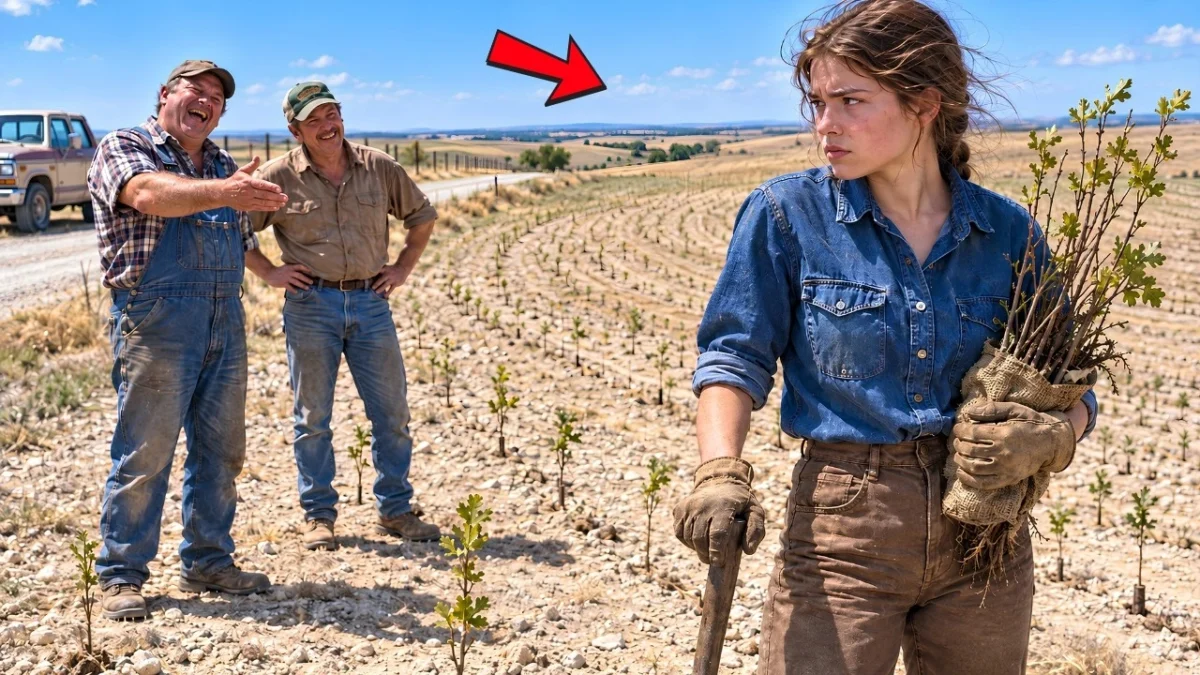
Rising before him was an undulating forest of four thousand bur oaks.
Their canopies, standing six to seven feet tall, interlocked gracefully across the slope.
The trees weren’t planted in rigid, conventional north-to-south rows like a standard shelterbelt.
Instead, they swept across the terrain in long, elegant curves that perfectly followed the natural contour of the land.
Between the rows of oaks, a dense, shimmering carpet of native switchgrass and little bluestem held the earth in a firm, unbreakable grip.
Where every other field in the county had been stripped raw by sheet erosion, the flat showed almost no damage at all.
The torrential runoff had hit the upper row of trees, slowed down, spread out, and sank deep into the ground.
Harlan walked the planted rows for two full hours, taking soil samples and recording measurements in utter disbelief.
The caliche layer that had stopped every root for a hundred years had been pierced by the relentless taproots of the bur oaks.
Water that used to sheet off the crusted surface in minutes was now soaking deep into the subterranean water table.
Finally, Harlan packed away his tools, drove his truck up the long gravel driveway toward the white clapboard farmhouse, and killed the engine.
The old windmill beside the house groaned softly in the northwest breeze.
Dale Vance stepped out onto the front porch, wiping his grease-stained hands on a rag.
“Morning, Harlan,” Dale said, his voice cautious. “You assessing the storm damage?”
“I am, Dale,” Harlan replied, stepping up the wooden stairs. “I just spent two hours walking your south sixty. I need to speak with Opal.”
Dale blinked, a look of subtle embarrassment flickering across his weathered face. “Opal? What did she do now?”
Before Harlan could answer, the screen door creaked open, and a twenty-three-year-old woman stepped onto the porch.
Opal Vance possessed quiet, steady eyes and hands that bore the light calluses of hard physical labor.
“I’m right here, Mr. Voss,” Opal said evenly.
Harlan looked at the young woman and shook his head in quiet awe.
“Opal, the state is putting together an emergency erosion report for the entire region,” Harlan said. “Your sixty acres is the only ground I’ve surveyed in three counties that survived that flood essentially untouched. How on earth did you design those contour plantings?”
Opal didn’t offer a boastful smile.
Instead, she turned around, went back inside the house, and returned a moment later carrying a worn, green-covered spiral notebook.
She opened it to reveal seven years of meticulously hand-written entries: rainfall totals, infiltration rates, seedling mortality, and precise contour measurements.
“It started with the pamphlets you sent me back in 1980,” Opal said softly, gesturing toward the kitchen table. “Would you like to see the data?”
—
The story of the flat had begun seven years earlier, in the spring of 1981, when Opal was just seventeen years old.
Back then, the men who gathered every morning at the grain elevator in Comstock had insisted that Opal Vance had lost her mind.
They sat on wooden crates around the counter, drinking bitter black coffee while waiting to weigh in their loads.
Among them was Hank Vance, a distant uncle who operated the local hardware store, and Earl Renfro, a retired corn farmer who wore a faded seed cap.
“Did you hear what Dale’s girl is doing out on the south rise?” Hank had announced one morning, chuckling into his mug. “She’s out there with a spade, digging holes in that dead caliche.”
Earl Renfro had snorted, shaking his head in pity. “What’s she putting in? Christmas trees? At least those might be worth a nickel in ten years.”
“Worse,” Hank replied. “Oak trees. Four thousand bur oak seedlings she ordered from a nursery outside Lincoln. Planted ’em in crooked, curving lines like she didn’t know how to run a straight string.”
The laughter that rippled through the grain elevator wasn’t entirely cruel, but it was patronizing—the kind of laughter men reserved for things they had already decided were completely useless.
“That flat has beaten every real farmer in this county since the Dust Bowl,” Earl said, setting his cup down hard on the counter. “A seventeen-year-old girl with a coffee-can rain gauge isn’t going to change that. She’s wasting her summer wages on dirt that won’t ever grow a thing.”
Dale Vance had been standing near the register that morning, paying for his fertilizer.
He hadn’t defended his daughter, nor had he joined in the laughter.
He had simply adjusted his cap, grabbed his receipt, and walked out to his truck in uncomfortable silence.
Truth be told, Dale hadn’t understood Opal’s plan either when she had brought it up to him at the kitchen table four months prior.
It was January 1981, and the cold wind had been howling through the cracks of the kitchen window.
Opal had laid out a series of government pamphlets on the table alongside her grandmother Ruth’s old weather journals.
“Dad,” Opal had said, her voice quiet but firm. “The flat is losing what little soil it has left. Every time it rains, the water carries the dirt right off the rise and dumps it into the county road. We’re losing the land.”
Dale had sighed, holding a cup of black coffee that was rapidly going cold in his hands.
“Opal, that ground isn’t worth the seed you’d waste on it,” Dale had told her gently. “Your grandfather tried to farm it, and I tried to farm it. The caliche is too hard. Nothing breaks it. Just leave it be.”
Opal hadn’t argued.
She had learned from her grandmother Ruth that arguing with a man who had already made up his mind rarely moved him an inch.
Instead, she had looked her father dead in the eye and asked a simple question.
“If you aren’t going to crop it anyway, Dad, can I have the flat to do with as I like?”
Dale had looked at his daughter, seeing the fierce determination inherited from his mother, Ruth.
Knowing it would cost him nothing, he had nodded. “Fine. It’s yours. Do what you want with it.”
Opal had spent three hundred dollars—money she had saved from two grueling summers of detasseling corn—to buy four thousand bare-root bur oak whips.
When the cardboard boxes arrived that April, smelling of damp earth and pine shavings, the seedlings were no thicker than wooden pencils.
For eleven exhausting days, Opal had labored on the flat from dawn until dusk.
Her grandmother Ruth, who had lived through the harrowing Dust Bowl storms of the 1930s, sat on a folding chair near the edge of the field, offering encouragement and hand-wrapping the delicate roots.
“The land doesn’t forget what we did to it, Opal,” Ruth had told her granddaughter as the girl wiped sweat and mud from her brow. “It just waits for someone patient enough to notice.”
A eighteen-year-old boy from down the road named Kurt Ostrander had also showed up on the weekends, eager to help.
Kurt carried heavy buckets of water and operated a steel dibble bar alongside Opal, his hands blistering as he drove the metal tool into the stony ground.
Everyone in Comstock knew Kurt had a deep, quiet crush on Opal, though Opal herself seemed far too focused on her green notebook to pay attention.
“Why bur oaks, Opal?” Kurt had asked one afternoon as they planted row thirty-two under a light spring snowfall.
“Because bur oaks are native to the tallgrass prairie,” Opal had explained, her breath misting in the cold air. “They don’t give up. They send down a taproot that can drill straight through caliche. And if we plant them along the contours of the hill, every row will catch the rain instead of letting it wash the earth away.”
Together, they had put all four thousand seedlings into the ground.
When they finished, the flat looked from the county road like a complete failure—just thousands of tiny, leafless sticks standing in winding rows, barely reaching a person’s knees.
—
The first three years had tested Opal’s resolve to its absolute limits.
In the summer of 1981, a severe drought swept across the High Plains, baking the soil and killing nearly six hundred seedlings outright.
While the men at the grain elevator whispered that her project was officially dead, Opal spent her savings on six hundred replacement whips and spent November digging them into the frozen ground.
In the winter of 1982, hungry field rabbits invaded the rows, gnawing the tender bark off another two hundred trees.
Acting on her grandmother’s advice, Opal spent three full weekends in the freezing wind wrapping every single tree trunk in protective wire mesh.
Meanwhile, she seeded native switchgrass and little bluestem between the curving rows of oaks.
In the first year, the grass came up patchy and thin.
By the third summer, however, the deep-rooted prairie grass had knitted itself into a dense, protective green blanket over the bare earth.
Nobody driving by on the county road noticed the grass; they only saw the waist-high trees and continued to shake their heads.
Kurt Ostrander’s father had eventually forbidden his son from going over to the Vance place to help.
“Stop wasting your time over there, Kurt,” his father had grumbled over dinner one night. “It sends the wrong message to the neighbors about what a serious farming operation looks like.”
Despite the social pressure, Opal kept going.
Every week, she walked the rows with her green notebook, performing water infiltration tests using a simple steel cylinder her grandmother had given her.
She would pound the cylinder into the soil, pour in a measured amount of water, and time how long it took to soak through.
Outside the tree rows, on the bare, crusted flat, the water sat pooled on the surface for over twelve minutes before slowly disappearing.
Inside the tree rows, beneath the growing canopy of oaks and the rotting layer of leaf litter, the exact same amount of water vanished in under ninety seconds.
She wrote every single number down in her green notebook.
She didn’t share the data with anyone in town because no one was asking.
—
Back on the porch in May 1987, Harlan Voss sat at the kitchen table while Grandmother Ruth poured fresh black coffee into three stoneware mugs.
Ruth sat in the corner chair, saying nothing, simply smiling into her cup as Harlan flipped through Opal’s notebook with rising astonishment.
“Look at these infiltration rates,” Harlan muttered, running his finger down the columns of handwritten figures. “Opal, you’ve completely changed the hydrology of this rise. The taproots have shattered the caliche hardpan beneath the surface.”
“That’s why the floodwater didn’t wash the hill away,” Opal said quietly. “The soil was able to breathe and drink.”
Harlan looked up, his eyes shining with professional excitement. “I’m writing the official state damage report this week. I want to include your sixty acres as a primary case study for contour agroforestry.”
He paused, looking at Dale Vance, who was standing quietly near the kitchen stove.
“I’m listing you as the sole designer of the system, Opal,” Harlan added firmly. “Your name is going on the state document.”
When the official agricultural report was published that autumn, the news spread through Custer County like a prairie fire.
The document credited a twenty-three-year-old local woman with designing the only effective erosion-control system in three counties.
By the following spring of 1988, the atmosphere at the grain elevator in Comstock had changed entirely.
The old men no longer laughed when Dale Vance walked in to buy supplies.
Instead, several local farmers began driving out to the county road bordering the Vance farm, pulling their pickup trucks over to the shoulder.
They would stand beside their vehicles with their hats pushed back on their heads, staring in silent reverence at the seven-foot-tall oak trees fluttering in the spring breeze.
They went quiet the way rural men tend to go quiet when they realize they have been wrong about something for a very long time.
One afternoon in April 1988, a truck pulled into the Vance driveway.
Kurt Ostrander stepped out of the cab, looking older, broader, and carrying a spade in the back of his truck.
Opal walked out from the barn to meet him.
“My father lost forty acres to gully erosion during the ’87 flood,” Kurt said, looking down at his boots before meeting Opal’s eyes. “He sent me over to ask if you might need another set of hands… and if you could help us plan a tree planting on our north field.”
Opal looked at Kurt, a soft, genuine smile finally breaking across her face.
“I’d be glad to help, Kurt,” she said gently. “Grab your spade.”
Word of the Vance success moved through Nebraska farm country—slowly at first, and then all at once.
By 1990, eleven major contour agroforestry projects had been planted across three counties, every single one of them modeled directly after the sixty acres the locals had once called the stupidest idea since raising ostriches.
Opal Vance never left the land she had saved.
She married Kurt Ostrander in the summer of 1991, in a small ceremony held beneath the shade of the growing bur oaks on the flat.
Together, they took over the management of the farm from Dale as the years rolled on.
Decades passed, and the four thousand bur oak seedlings grew into a majestic, towering forest, reaching forty, then sixty feet into the Nebraska sky.
Their broad canopies closed over the old caliche scar so completely that anyone driving past on the county road today would never guess that a bare, cracked wasteland had ever existed there.
The flat, once considered the most worthless piece of dirt in the county, became the most valuable ground on the entire operation.
It held millions of gallons of rainwater that used to wash away in an afternoon, and it anchored tons of fertile topsoil that used to blow away in the March winds.
Now in her sixties, Opal still walks the tree rows early every morning before the summer heat rises over the High Plains.
She carries a new green notebook in her jacket pocket, adding to a stack that spans more than forty years of ecological history.
Sometimes, young university researchers and visitors from the extension office walk alongside her, looking up at the towering canopy in wonder.
“Mrs. Ostrander,” a young student asked her recently, looking out over the lush, bird-filled sanctuary. “What made you so sure this would work back when you were seventeen and everyone said you were crazy?”
Opal stopped walking, resting her hand against the thick, rugged bark of a sixty-foot bur oak tree that she had planted as a tiny pencil-sized whip decades ago.
She looked out over the deep green prairie grass waving in the wind and smiled softly.
“I wasn’t sure,” Opal replied, her voice calm and steady. “I was just paying attention longer than anyone else had bothered to. The ground had been trying to tell its story for fifty years… I was just patient enough to listen.”








