They Laughed At Two Apache Sister’s Mended Dress — Until The Rancher Stood Up
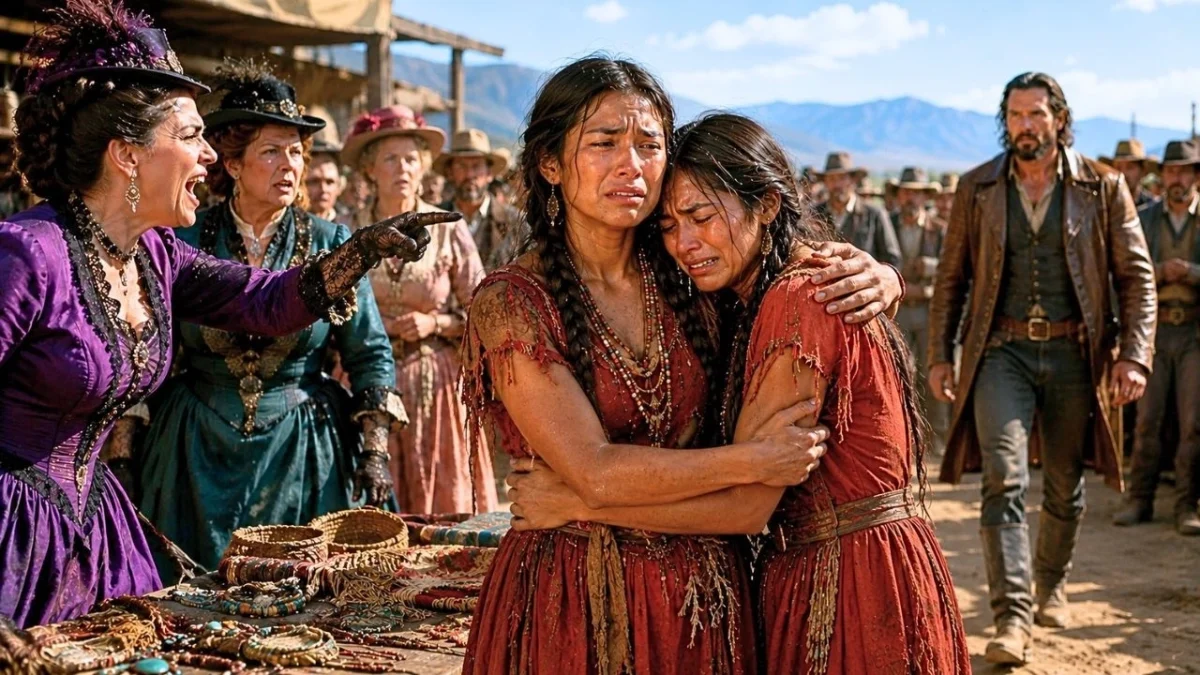
PART 1: THE DRESS AND THE LAUGHTER
At four o’clock in the morning, the small town of Dry Fork was still wrapped in total darkness.
In a rented room above the feed store, the iron stove pipe clicked softly as the fire took hold.
Hannah Mercer stood at the wooden table, her hands covered in flour as she worked the bread dough with steady, rhythmic pressure.
She had built the fire early because the six loaves required a slow oven, and a slow oven required patience.
Patience was the one thing Hannah had never run short of in her twenty-five years.
Her hands remembered the folding naturally, taught to her by her mother, Dileia, who had learned it from her Chiricahua mother before that.
In the far corner of the room, her younger sister Cassie slept soundly on a straw mattress, one worn boot still on her foot.
At twenty-two, Cassie slept like a dropped saddle, her thick black hair loose across the ticking.
Her brown cotton dress hung on a iron nail by the door, patched so many times that three distinct shades of brown fought across the skirt alongside a strip of gray flannel.
Cassie wore her poverty like a challenge to the world, but Hannah preferred quiet resilience.
Across the back of a wooden chair lay Hannah’s own blue dress, washed on Thursday and carefully pressed with a flat iron the night before.
It was the only garment she owned that could be worn into a public road without an unspoken apology.
Every stitch on that dress held a memory of survival.
A dark square of cotton at the left elbow had been salvaged from an old coat lining during the third cold winter after their father died.
Along the right seam ran four inches of cream-colored thread, placed there on a freezing Tuesday when a spool of blue thread cost eleven cents—the exact price of a small bag of flour.
Hannah had chosen the flour, and the contrasting thread remained as an honest testament to her choice.
By five o’clock, the smell of fresh baking filled the room, and Cassie stirred from her sleep.
Cassie sat up, squinting through the dim lamp light at her sister, who was already fully dressed and combed.
“Don’t go today, Hannah,” Cassie said, her voice raspy from sleep.
Hannah did not turn from the small mirror where she was pinning back her hair.
“I have bread to sell,” Hannah replied simply.
“You have bread to sell every Saturday,” Cassie argued, pulling on her other boot.
“Today is the day Mrs. Ashcroft comes back from her trip to Tucson.”
“Then she can eat fresh bread, too,” Hannah said, ending the discussion.
Cassie pulled her thick braid together, watching her sister’s straight back with quiet concern.
An hour later, they walked the mile-and-a-half packed dirt road into Dry Fork as the sun rose over the mountains.
Sorrel, their nineteen-year-old mule, walked quietly behind them on a lead rope to carry the heavy basket back home.
Dry Fork was home to three hundred and forty souls, most of whom had lived within a mile of each other for twenty years.
They knew each other’s debts, failures, and soft spots, and for the Mercer sisters, being known had rarely been a kindness.
Their father, Amos Mercer, had come out from Tennessee after the war with a wagon, a plow, and a determination to farm.
He had filed on a hundred and sixty acres along East Creek, built a solid home, and married Dileia, an Apache woman born in that same valley long before it appeared on territorial maps.
Together, they had paid nineteen years of territorial taxes on their land, raising two daughters in the shade of the cottonwoods.
Then pneumonia took Amos three weeks into a bitter January, and Dileia followed him a year later.
Hannah took the final table at the market—Table Seven, located at the far end of the row where the light was poorest.
She laid out her six loaves on clean white cloth, squared the corners carefully, and stood behind them with her chin level.
Her father had taught her that a good thing never needed to beg for a buyer.
She sold two loaves in the first hour, earning enough to keep their small household running for another week.
At eight o’clock, a slight shift went through the crowded market row as people parted to make way for a familiar figure.
Silas Thorne walked slowly down the middle of the road, wearing a heavy black frock coat buttoned tight despite the July heat.
At sixty-one, Thorne was a prosperous man who owned the local land office and held mortgages on half the basin.
He stopped directly in front of Table Seven, examining the bread before turning his cold, appraisal look on Hannah.
“You’re Amos Mercer’s daughter,” Thorne said smoothly, his voice carrying clearly to the nearby tables.
“I am,” Hannah replied, her hand resting flat on the wooden table.
“He was a decent man,” Thorne said, letting the words settle over the watching crowd.
“Debt isn’t decent, but he was.”
A cold stillness went through Hannah, but she remained silent, refusing to give him the scene he desired.
Thorne reached into his vest, pulled out a silver dollar, and set it on the table beside the bread with a deliberate click.
He did not take a loaf; he simply touched the brim of his flat hat and walked away, leaving the money behind like an act of public charity.
Cassie lunged forward to grab the coin, but Hannah caught her wrist instantly.
“Let go of me!” Cassie hissed, her arm shaking with rage.
“He put money on your table like you were a beggar in the street!”
“I know what he did,” Hannah said, her voice low and firm.
“Forty people just watched him pretend to be gracious to a poor woman.”
“If you throw it at him, forty people watch a wild girl throw money at a gentleman.”
“Which story do you think they’ll tell tonight?”
Cassie pulled her arm free, but she stayed at her sister’s side.
Hannah picked up the silver dollar, turned it once in her palm, and slipped it deep into her apron pocket.
She knew that a kept token was something that could be returned when the proper time came.
At nine o’clock, the Ashcroft party strolled down the row.
Vivien Ashcroft, the wealthy wife of the town’s primary store owner, walked with a lace parasol, accompanied by Harriet Pike, the bank manager’s wife.
Vivien stopped near Table Seven, her eyes drifting from the loaves of bread to the hands that made them, and finally up Hannah’s arm to her sleeve.
She paused mid-sentence, staring intently at the mended blue fabric.
“Is that meant to be a dress?” Vivien asked aloud, speaking to her companion but pitching her voice so the entire street could hear.
Harriet Pike smiled quickly, having her response ready.
“It looks like something a person might line a chicken coop with,” Harriet remarked.
A sharp laugh broke out from a woman nearby, and within seconds, the laughter spread down the market row like fire through dry grass.
Nearly forty people turned to look, joining in the cruel entertainment at the expense of the two sisters.
Cassie stepped up beside Hannah, her dark eyes flashing with anger as her braid came loose.
“Say it again louder!” Cassie called out to the crowd.
“There are folks at the end of the row who didn’t catch it!”
Vivien Ashcroft took a small step back, her mouth curving into a dismissive smile.
“This one is even wilder than her sister,” Vivien sneered, using the word to remind everyone of the sisters’ Apache heritage.
Hannah pressed her palm flat against the sun-warmed boards of the table, keeping her face completely expressionless.
“I sewed it myself,” Hannah said in a clear, steady voice that cut through the noise.
“I’ve found that most of the work worth anything in this world doesn’t come out of a store.”
Vivien raised an eyebrow mockingly.
“Work?” Vivien repeated, as if handling a dirty object.
“Yes,” Hannah said, refusing to blink or look down.
“Work.”
PART 2: THE COAT AND THE OFFER
Harriet Pike broke the momentary silence with a forced laugh, but before the crowd could join in again, an sudden hush fell over the entire market.
It was not a gradual quiet, but a sudden drop in pressure that caused forty people to stop talking at once.
Hannah looked up toward the shade of a large fence post twenty steps away.
Standing there was Gideon Ward, a man who had remained a quiet, imposing presence in the valley for seven years.
At thirty-nine, Gideon was tall and broad-shouldered, wearing a wide-brimmed felt hat, a cowhide vest, and resoled boots.
He owned the Twin Posts outfit up the valley, a prosperous ranch built through relentless hard work.
Over his left forearm, he carried a heavy leather coat he had taken off earlier in the morning.
Gideon did not look angry, but his dark eyes moved slowly across the crowd, taking inventory of every face that had laughed.
The laughter died completely before he took a single step forward.
Gideon walked steadily toward Table Seven, stopping right beside Hannah.
Without a word of dramatic flair, he shook out his heavy leather coat and gently placed it around Hannah’s shoulders.
The coat was heavy and warm, carrying the clean scent of wood smoke, horses, and aged leather.
Hannah felt the unexpected weight settle over her patched blue dress, her throat tightening against an emotion she had not permitted herself to feel in years.
Gideon turned his back to Hannah and looked directly at Vivien Ashcroft.
“Anybody who laughs at somebody working honest has forgot what respect looks like,” Gideon said.
His voice was not raised, nor was it harsh with temper.
It was simply a flat, absolute statement delivered with total authority.
Vivien Ashcroft opened her mouth to speak, but no words came out.
She stood frozen under his steady gaze while every person in the market watched her silence.
Gideon turned back to Hannah, his demeanor shifting back to calm business.
“Ma’am, you got more bread to sell?” Gideon asked gently.
Hannah stared at him, still adjusting to the sudden turn of events.
“Four loaves,” she managed to reply.
“I’ll take them for the hands,” Gideon said.
He reached into his pocket, pulled out several silver coins, and set them down on the wooden boards.
Hannah looked down at the money, realizing immediately that he had paid nearly double the usual price.
“That’s too much,” Hannah said firmly, looking up into his eyes.
“No, it isn’t,” Gideon answered calmly.
Cassie looked on from the side, a dry smirk touching her lips.
“You want the mule, too?” Cassie asked.
“He’s getting looked at.”
A faint twitch appeared at the corner of Gideon’s mouth—not quite a smile, but close to one.
“I’ll take the bread,” Gideon said, accepting the wrapped bundle from Hannah.
He gave her a respectful nod of his head and walked toward his supply wagon at the end of the row.
Slowly, the normal noise of the market returned, though a distinct awkwardness hung over the crowd as people returned to their own business.
Vivien Ashcroft and her companions quickly left the row without purchasing a single item.
Cassie watched them go, then leaned close to her sister.
“Did you see it?” Cassie asked, her voice dropping all mockery.
“See what?” Hannah asked.
“He looked at Thorne first,” Cassie whispered.
“Before he ever looked at those women, he came around that fence post and looked right at Silas Thorne going up the street.”
Hannah stood under the July sun with the heavy leather coat still resting on her shoulders.
After ten minutes, she carefully folded the coat over her arm and walked down the row to find Gideon Ward.
He was standing near his wagon, speaking with an older ranch hand who had gray in his mustache.
When Hannah approached, Gideon stopped his conversation and turned to face her.
Hannah held the coat out to him with both hands.
“Thank you, Mr. Ward,” Hannah said plainly.
“I can’t keep it.”
Gideon took the coat without argument, draping it back over his arm.
“What’s your name?” he asked.
“Hannah Mercer,” she replied, keeping her eyes directly on his.
“I know who you are,” Gideon said quietly.
He looked past her toward the busy street for a brief moment before turning his full attention back to her.
“I need somebody to run the kitchen out at my place,” Gideon stated clearly.
“Steady wages, and a clean room if you want it.”
Hannah’s posture stiffened instantly, her pride reacting against what sounded like another offer of pity.
“I don’t take charity, Mr. Ward,” Hannah said coldly.
“Good,” Gideon replied without a second’s hesitation.
“I’m not handing any out.”
He leaned slightly closer, speaking in a measured, honest tone that changed her understanding of the entire situation.
“The woman who kept my kitchen before was Mrs. Coyle,” Gideon explained.
“She left me last month after somebody rode out to her place at night and told her it wasn’t wise to work for me.”
Hannah felt the statement land like a stone dropped into a deep well.
“Who?” Hannah asked quietly.
“Can’t prove it,” Gideon answered, looking squarely at her.
“So I don’t say the name.”
“I need somebody who won’t run,” Gideon continued.
“I just watched you stand in front of forty people and not move an inch.”
“That’s not pity, Miss Mercer. That’s hiring.”
PART 3: THE COVENANT AND THE THREE MONTHS
Hannah stood silent in the dusty street, her mind racing as she evaluated his proposal.
For six long years, she had survived by building strong emotional walls—refusing help, avoiding debt, and asking for nothing from the town.
Yet Gideon Ward had just offered her the one arrangement her pride could not reject.
He had not expressed sympathy, nor had he offered a handout; he had simply presented a hard operational problem and identified her as the solution.
She thought of their drafty room above the feed store, the approaching winter, and the eleven cents needed for thread.
She thought of Cassie breaking wild horses for two dollars a head and being cheated out of half her pay.
“I have terms,” Hannah said, watching his reaction closely.
Gideon’s eyebrows lifted a fraction of an inch, but his expression remained attentive.
“Say them,” he instructed.
“Fair wages paid on the first of every month in full,” Hannah listed, counting the points off on her fingers as her father used to read a bill of sale.
“No unexpected deductions made on a whim.”
“A room with a solid door that locks.”
“Sunday afternoons are mine, and nobody’s business.”
“And my sister comes with me.”
Gideon listened without interrupting.
“Doing what?” he asked regarding Cassie.
“Horses,” Hannah answered firmly.
“Not the kitchen. She’s no good in a kitchen, and she’d be wasted in one.”
“Paid separate,” Hannah added, raising her chin.
“Her wage is hers, not part of mine.”
“Done,” Gideon said immediately.
Hannah blinked, surprised by his rapid agreement.
“You haven’t asked how good she is with stock,” Hannah noted.
“I watched her walk that mule through a boiling crowd of forty people and never let him spook,” Gideon answered smoothly.
“I know enough.”
Hannah hesitated, taking a breath before stating her final condition.
“There is one last thing,” Hannah said, her voice quiet but firm.
“I earn my place or I leave it. I am not a favor.”
“If the day comes where you keep me on because you feel some way about how I got here, tell me, and I’ll leave that afternoon.”
Gideon looked at her for a long moment, evaluating the depth of her resolve.
“Agreed,” Gideon said simply.
He did not offer insincere reassurances or long speeches, giving her only his word.
“You can start Monday if that suits,” he added.
“I’ll need a week,” Hannah corrected.
“I have to settle our rent and give proper notice.”
“Take the week,” Gideon agreed.
Over the next three months at the Twin Posts ranch, Hannah and Cassie proved their worth every single day.
Hannah transformed the ranch kitchen into an efficient, well-run operation, serving good food to the ranch hands while keeping strict records of every expense.
Cassie worked alongside the wranglers, handling difficult horses with a quiet skill that earned the immediate respect of every man on the outfit.
Gideon treated both sisters with consistent fairness, keeping his distance while ensuring they had every resource they required.
Yet beneath the surface of their quiet routine, the conflict with Silas Thorne was reaching its inevitable conclusion.
Gideon had been quietly working with a federal investigator from Santa Fe, gathering evidence regarding Thorne’s fraudulent land claims across the basin.
Thorne had forged land deeds and manipulated debts to strip local families—including the Mercers—of their legal property.
In October, three months after the market morning in Dry Fork, the confrontation finally arrived.
A federal marshal arrived in town with official warrants, arresting Silas Thorne on the courthouse steps in front of a hundred gathered citizens.
Thorne was led away in iron handcuffs, his long reign of intimidation over the valley permanently broken.
Among the documents recovered from Thorne’s office was the original, unblemished federal land patent for the Mercer family’s one hundred and sixty acres along East Creek.
The land was officially restored to Amos Mercer’s estate, securing a permanent home and financial independence for Hannah and Cassie.
On the afternoon following Thorne’s arrest, Vivien Ashcroft stood outside the general store as Hannah walked past.
In front of several watching townspeople, Vivien turned to Hannah and spoke in a clear, humbled voice.
“Miss Mercer,” Vivien said publicly, “I was wrong about you and your sister.”
Hannah stopped, looked at the woman calmly, and gave a brief nod of acknowledgment before continuing on her way.
Later that evening, Hannah walked out to the quiet corral at Twin Posts, where Gideon was leaning against the top rail, watching the horses in the twilight.
She reached into her apron pocket, pulled out the silver dollar Silas Thorne had placed on her table three months earlier, and held it out to Gideon.
“I carried this for ninety days,” Hannah said softly.
“Now it belongs to the estate.”
Gideon looked down at the coin, then up into her eyes, a warm smile finally breaking across his face.
“You kept your word, Hannah,” Gideon said softly.
“And so did you, Mr. Ward,” Hannah replied, stepping up to stand beside him against the fence rail as the stars began to appear over the valley.








