They Left His Farm to Die Without Water… Then His Little Girl Made an Incredible Discovery
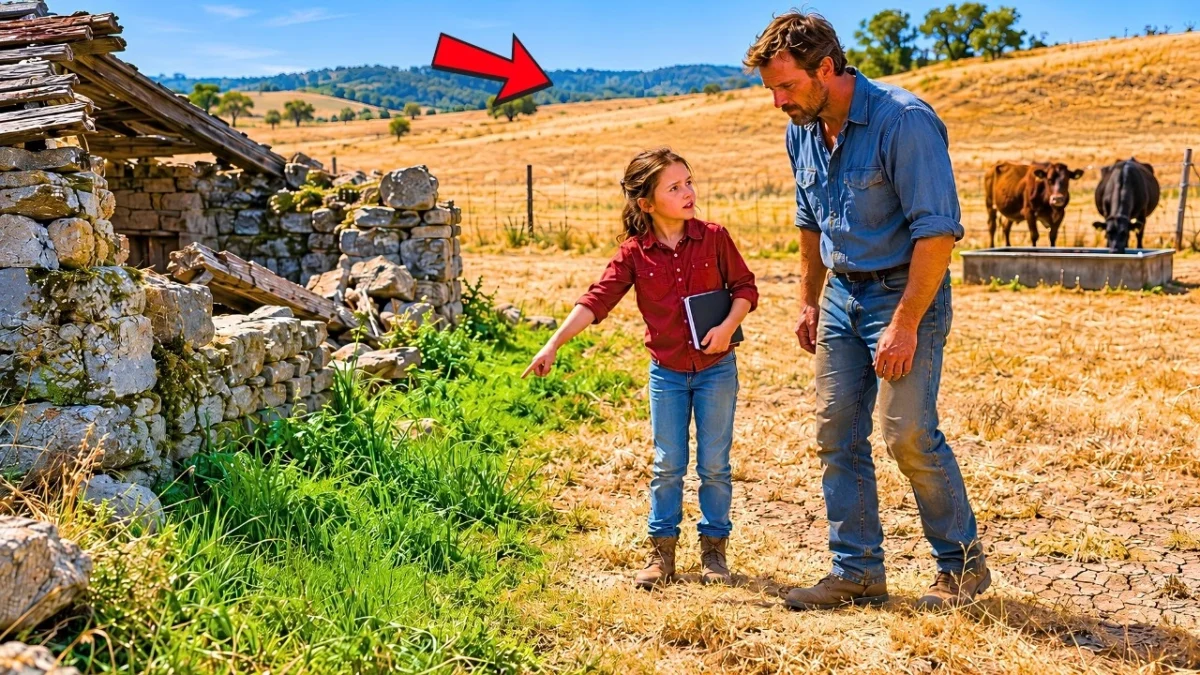
The morning sun crept over the horizon, casting a harsh, pale glare across the sprawling 40 acres of the Marsh family farm.
The air was already thick with the dry heat of an unrelenting summer drought that had dragged on for weeks.
Elias Marsh stood near the head gate at the edge of his property line, his arms crossed over a broad chest, his jaw set in a hard, silent line.
He watched in stony silence as a young man from the county water office snapped a heavy brass padlock shut on the main irrigation valve.
The official did not meet Elias’s gaze as he clicked the lock into place and jotted something down on his clipboard.
“It’s about relocation priorities, Mr. Marsh,” the man muttered under his breath, adjusting his cap against the rising glare.
“Orders came straight from the district office.”
Elias said nothing.
He was 39 years old, built like a man who spent his life working livestock rather than wasting words on things that didn’t need saying twice.
He simply stood there as the county worker climbed back into his shiny pickup truck—a vehicle that still bore the dealership tags on its rear window—and kicked up a cloud of pale dust as he sped off down the dirt road.
Over by the fence, the cattle had stopped walking toward the empty water troughs out of habit.
They gathered near the wire boundary, heads hung low, eyes dull, waiting on something they knew wasn’t coming.
Elias turned his back on the locked gate and looked toward the upper slope of his land.
Two hundred yards up the hill sat the ruins of an old stone springhouse.
Its roof had caved in decades ago, and wild brush had long since reclaimed its crumbling walls.
Nobody had touched that structure in over half a century.
Crouched low in the yellowed weeds behind the ruin was Elias’s eight-year-old daughter, Ren.
She had an open composition notebook resting on her knees and a wooden pencil gripped tightly in her small hand.
While everything around her had turned the color of dry, brittle rope, Ren was staring intently at a narrow strip of grass that had somehow stayed surprisingly green.
She didn’t call out to her father.
She didn’t say a word to anyone.
She simply kept looking at that green streak in the dirt, examining it with the intense focus of someone solving a puzzle no one else had even realized was there.
—
The Marsh farm had been handed down through three generations.
Elias’s grandfather, Otis Marsh, had come west after the war with little more than a couple of worn tools and a determination to carve out a life on 40 acres of scrub ground.
Otis had passed the land to his son, Denny, who had later passed it to Elias.
In this dry valley, survival didn’t rely on predictable rainfall; it relied on an old water-sharing agreement forged decades ago.
Otis Marsh had struck a verbal deal and a handshake with the grandfather of Garrett Voss, the wealthy owner of the massive ranch next door.
For generations, both families had shared the same ditch and the same head gate.
However, over the last thirty years, the Voss family had quietly bought up almost every senior water right in the entire basin.
While the smallholder farmers were focused on keeping their crops alive, Garrett Voss had been building an empire.
The long-standing goodwill vanished the moment Garrett signed an lucrative supply contract with a regional bottling corporation.
Suddenly, Garrett’s water was worth far more pumped into tanker trucks and plastic bottles than it was running through Elias’s alfalfa fields.
That evening, the rumble of an engine echoed across the valley.
Garrett Voss pulled his heavy silver pickup right up to the boundary fence near Elias’s barn, leaving the engine idling.
He leaned his elbow out the open window, resting his chin in his hand as he looked down at Elias.
“Drought’s hard on everybody, Elias,” Garrett said smoothly, his tone sounding as if he were reading a canned statement off a index card.
“I’ve got corporate obligations now that I didn’t have five years ago. The county understands the economic reality of the situation. Maybe you should, too.”
Elias walked slowly up to the driver’s side door, his hands thrust deep into the pockets of his dusty canvas work pants.
“That water’s been running to this farm since before either one of us was born, Garrett,” Elias said, his voice deep and steady.
“Paper doesn’t care about ‘before’, Elias,” Garrett replied with a faint, tight smile.
“Paper cares about ‘now’. And right now, that water is fully spoken for.”
Garrett let the statement hang in the dusty air, examining Elias’s face for any sign of breaking.
When Elias remained silent, Garrett leaned closer to the window.
“Look, I’m not a cold man,” Garrett continued, shifting his weight.
“I’ll give you a fair number for the whole forty acres. More than fair, considering where things are heading for small operators. It’s a hell of a lot better than watching the bank take it from you in a year.”
Elias looked Garrett squarely in the eye.
“My grandfather built this place with his bare hands, Garrett,” Elias said softly.
“It isn’t for sale.”
Garrett shook his head with a patronizing sigh, reading Elias’s refusal as mere stubbornness rather than resolve.
“Suit yourself,” Garrett said, putting the truck in gear.
“Reality doesn’t care whose fault the drought is, Elias. You can’t farm dust.”
With a flick of his wrist, Garrett rolled up his window and drove off, leaving a cloud of exhaust behind him.
—
What followed over the next month was not one catastrophic moment, but a hundred small disasters stacked on top of each other.
The summer heat intensified, cracking the earth into wide, dry fissures.
Elias had to rent a large water tank and mount it to the back of his secondary trailer.
Twice a day, he made the forty-minute round trip into town to purchase municipal water.
It was a crushing expense that burned through fuel and savings they didn’t have.
To keep up with the mounting bills, Elias made the heartbreaking decision to sell his father’s old flatbed truck.
Every morning and evening, he carefully rationed every gallon he hauled, dividing it between the thirsty cattle and his wife Dana’s vegetable garden.
Dana took on extra night shifts at the local clinic, returning home exhausted with dark circles under her eyes, just to prevent their mortgage payment from slipping backward.
The local community offered little relief.
Garrett Voss had cultivated deep ties with the county water board and held immense political sway.
Neighbors who had known Elias for decades suddenly kept their distance.
One rancher two properties over stopped returning Elias’s phone calls entirely after Garrett dropped a subtle hint that a crucial winter grazing lease might not be renewed if he supported the Marsh family.
Every two weeks, Garrett sent a revised purchase offer through the mail.
Each offer was slightly lower than the last, accompanied by a brief, typed letter emphasizing the worsening climate forecasts.
One afternoon, Garrett stopped by the edge of the property again, watching Elias fill a livestock trough from his haul tank.
“Eighty thousand,” Garrett called out over the sound of the pump.
“That’s the figure next month. You’re negotiating against a drought, Elias.”
Elias set the hose down and walked over to the fence.
“I’m negotiating against a drought you’re profiting from, Garrett,” Elias replied.
“I’m negotiating with reality,” Garrett countered coldly.
“And reality says you’re running out of time.”
Elias went to bed every night running impossible calculations in his head, staring at the darkened ceiling while Dana slept fitfully beside him.
Before dawn, he would rise, pull on his boots, and walk the perimeter fences—less out of any functional need and more out of an ingrained habit of vigilance.
—
It was during these early morning walks that Elias began to notice a curious pattern.
The cattle, desperate for relief from the heat, kept drifting toward the lower corner of the upper pasture.
They gathered near the ruined stone springhouse, standing shoulder to shoulder near the collapsed wall.
They would stand there for hours, pressing their dark noses against the dry earth and pawing gently at the dirt.
Elias noticed it, but in the crush of his financial worries, he logged it mentally as just another odd behavioral quirk of heat-stressed animals.
Ren, however, saw something more.
Ren was not an ordinary eight-year-old child.
She was quiet, observant, and spent hours carrying around her worn composition notebook.
She didn’t write stories or paint pictures; she cataloged the physical world around her.
She wrote down which shade of trees lost their leaves first, how long the morning dew lasted on different patches of grass, and how the earth smelled near different fence lines.
Weeks before the county had shut off the main valve, Ren had already made several entries about the springhouse.
*June 12: Cows stay by old stone house.*
*June 14: Ground is cool behind the broken wall.*
*June 20: Patch of grass is still dark green. Rest of pasture is brown.*
Three days after the water shut-off, Ren walked up the hill alone.
She knelt in the dry weeds behind the collapsed structure, reaching out to press her small palm flat against the dark soil.
Even under the blazing afternoon sun, the earth beneath her hand was cool to the touch.
Two days later, she returned with a small hand trowel.
As she cleared away a layer of dead leaves and gravel, she noticed a soft, shallow dip in the ground that hadn’t been there the week before.
The earth had settled slightly, as if something beneath it had moved.
Ren leaned down, pressing her ear close to a crevice between two large foundation stones.
In the quiet dusk, holding her breath, she caught the faint, unmistakable sound of liquid moving underneath the rock—a tiny, rhythmic trickle that vanished whenever the wind blew through the dry brush.
She scrambled to her feet and ran down the hill, her knees stained with dark earth.
She burst through the screen door into the kitchen, where Elias was sitting at the table, staring at a stack of unpaid bills.
“Daddy!” Ren panted, catching her breath.
“The ground by the old stone house is sinking! I heard it! I think there’s water under there!”
Elias rubbed his tired eyes, feeling the crushing weight of his fatigue.
His first instinct was to gently brush her observation aside.
“Ren, sweetie, that old springhouse went dry before your grandfather was born,” Elias said quietly, his voice heavy with exhaustion.
“There’s nothing up there but old rocks and rattlesnakes.”
“No, Daddy, you have to look!” Ren insisted, holding up her notebook.
“The grass is green, and the soil is cold! I felt it! Please come look!”
Something in the steady determination of her small voice made Elias pause.
He looked at her earnest face, then down at the scribbled pages of her notebook.
He reached for his heavy flashlight sitting on the counter.
“Alright,” Elias said, pushing himself up from the chair.
“Show me.”
—
They walked up the hill together under the darkening sky.
When they reached the ruined springhouse, Ren pointed directly to the base of the broken rear wall.
Elias knelt, shining the beam of his flashlight onto the dirt.
He pressed his fingers into the soil.
It was undeniably cool, almost damp beneath the surface crust.
Standing there in the quiet night, a long-buried memory suddenly surfaced in Elias’s mind.
He remembered a conversation he had heard years ago between his father, Denny, and his grandfather, Otis.
They had been sitting on the porch, watching a summer storm roll in.
*“Your grandfather never would let us pull down those old springhouse stones,”* Denny had told a young Elias.
*“Even when the roof fell in. He said there was a reason that building was put right where it sits.”*
The next morning, before the heat became unbearable, Elias climbed the pull-down ladder into the dusty farm attic.
He navigated past stacks of old furniture until he found a heavy iron-bound trunk that had belonged to Otis Marsh.
It hadn’t been opened since Otis’s funeral decades ago.
Elias lifted the heavy lid, sending a cloud of dust floating into the morning light.
Inside were stacks of old feed receipts, faded photographs, a pocket watch, and at the very bottom, a slim, leather-bound ledger with water-stained edges.
Elias carefully took the ledger down to the kitchen table and began flipping through its yellowed pages.
Most of the entries were routine records of livestock sales, seed purchases, and equipment repairs from the 1930s and 1940s.
However, near the back of the book, written in thick, dark blue ink that looked as though it had been penned all at once, was a short entry:
*“Built the springhouse over the seep at the base of the hill because it never once ran dry, not even in the bad years of ’36. If this land ever goes hard again, remember it’s there. Don’t let anybody cap it, and don’t let anybody talk you out of what it’s worth.”*
Elias read the lines four times, his chest tightening.
He walked out onto the front porch, where Ren was sitting on the steps, swinging her legs.
He looked down at her, a strange, new energy surging through him.
“Get your boots on, Ren,” Elias said, a faint smile touching his face for the first time in months.
“We’re going to dig.”
—
The work was grueling, backbreaking labor.
The heavy granite stones of the old springhouse had caved inward over sixty years, locking together like a natural puzzle buried in concrete-hard dirt.
Elias worked with a pickaxe, a crowbar, and a heavy iron shovel, clearing away heavy debris by hand in 90-degree heat.
He had to manage the effort while still making his twice-daily water runs to town to keep his herd alive.
Ren stayed right beside him, using a light garden trowel to clear away smaller gravel and dirt, carefully packing it into buckets.
On the fourth day of digging, disaster struck.
Elias was trying to pry loose a large foundation stone near the base of the rear wall when the earth beneath his feet shifted.
A section of the collapsed masonry gave way without warning, sliding downward into a hidden void.
Elias threw himself backward to avoid being crushed, but a heavy stone caught his shoulder, knocking him hard against the dirt bank.
A sharp, agonizing pain shot through his arm and neck.
He lay there for a moment, gasping for air, clutching his injured shoulder while dust settled around him.
Ren rushed to his side, her eyes wide with fear.
“Daddy! Are you okay?” she cried, kneeling beside him.
Elias sat up slowly, his face pale and slick with sweat.
He tried to lift his left arm, but the movement brought a searing surge of pain.
That night, the physical and emotional toll finally caught up to him.
Elias sat at the kitchen table, an ice pack strapped tightly to his swollen shoulder with an elastic bandage.
A fresh bill for water haulage sat opened on the table next to an estimate for a replacement shovel handle he had broken during the cave-in.
He stared at the phone on the wall.
He came closer than he ever had to picking it up, calling Garrett Voss, and asking what kind of price was still on the table for the farm.
Dana sat next to him, gently wrapping her hand over his good knee.
“We can’t keep destroying ourselves, Elias,” she whispered softly.
“If it’s time to let it go… we can find another way.”
Elias closed his eyes, feeling the crushing weight of defeat.
Just then, small footsteps sounded on the hardwood floor.
Ren walked quietly into the kitchen.
Without saying a word, she reached up and placed her open composition notebook on top of the stack of unpaid bills.
Elias looked down.
The page was open to an entry from mid-June, written in her neat, childish handwriting:
*June 18: Ground is still cold. The water wants to come out.*
Elias looked from the notebook up into his daughter’s steady, clear eyes.
There was no doubt in her face, no defeat—only a quiet, absolute certainty.
Elias took a deep breath, letting it out slowly.
He reached out and gently patted her hand.
“Alright,” Elias said softly.
“Tomorrow morning. We keep going.”
—
The next day, despite the throbbing ache in his shoulder, Elias was back at the ruin.
He worked more carefully now, using wooden braces to support the surrounding stone as he cleared the deeper earth.
On the second afternoon following the accident, his shovel struck something hard that didn’t sound like natural bedrock.
It was a flat, dense ring of hand-laid channel stone, carefully fitted together without mortar—crafted in the traditional style of an early 20th-century spring box designed to collect and direct water rather than block it.
Elias dropped to his knees, using his bare hands to scoop away the remaining layer of damp silt.
At the bottom of a shallow, carved stone basin, preserved exactly as his grandfather had crafted it sixty years earlier, something glinted in the sunlight.
Water was moving.
It wasn’t a trickle; it was a clear, icy stream rising steadily out of a deep fissure in the underlying bedrock.
The water pooled rapidly in the basin, overflowed the stone rim, and began carving a tiny, dark channel through the dry dust toward the lower pasture.
Ren dropped down beside him, gasped, and cupped both of her hands under the flowing stream.
She lifted the water to her mouth, drinking deeply before splashing the cold liquid onto her warm face.
“Is this ours, Daddy?” she asked, looking up at him with wide, shining eyes.
“Is it actually ours?”
Elias looked at the rising water, feeling an overwhelming surge of relief, but he tempered his expression.
“It’s on our land, kiddo,” Elias said carefully, wiping a drop of cold water from his forehead.
“Now we just have to make sure nobody can take it away from us.”
—
Within three days, Elias hired an independent well contractor from two towns over to inspect the discovery.
The contractor lowered testing equipment down into the spring box and ran a flow test.
The results were astonishing.
It was a genuine, high-volume natural seep fed by an underground fractured limestone aquifer deep beneath the hillside.
More importantly, the hydrological pressure was completely independent of the surface ditch system Garrett Voss controlled.
The spring was flowing at a steady, reliable rate of nearly 30 gallons a minute—an incredible output during the height of a regional drought.
For the first time in months, a heavy burden lifted from the Marsh household.
Elias and Ren spent the weekend clearing brush and building a sturdy timber fence around the old stone site.
They watched with immense satisfaction as their main stock tanks filled on their own land, the cattle drinking deeply and peacefully without crowding.
For a few short days, Elias allowed himself to believe the worst was behind them.
However, news travels fast in a small agricultural valley.
The contractor’s assistant, a young local man named Denny Cobb, happened to mention the remarkable spring discovery to his cousin during a weekend barbecue.
His cousin did contract fence work over at the Voss Ranch.
Word moved quietly, quickly, and directly to the one man Elias least wanted to hear it.
Three days later, the sound of a heavy diesel engine signaled Garrett Voss’s return.
He pulled his truck up to the boundary fence, but this time he didn’t leave the engine idling, nor was he smiling.
He stepped out of the vehicle, slamming the door shut, his face tight with controlled frustration.
“I hear congratulations are in order, Elias,” Garrett said, walking up to the fence line with his hands on his hips.
“Word is you found yourself some wet ground up by the old ruin.”
“We found our water, Garrett,” Elias said, standing his ground.
“Your water?” Garrett chuckled dryly, though his eyes remained cold.
“You might want to consult a real water rights attorney before you get too comfortable, Elias.”
“That aquifer runs beneath this whole ridge, including my upper pasture.”
“Under state law, unrecorded underground flows attached to an established basin are subject to shared allocation.”
“You can’t just throw a pump on a shared resource during an active drought emergency.”
Elias looked at him calmly.
“This spring isn’t part of your ditch, Garrett. It’s coming out of bedrock on my property.”
“We’ll see what the County Water Board has to say about that,” Garrett said coldly, turning back toward his truck.
“Paper still rules this valley, Elias. Don’t forget it.”
—
The legal attack began less than a week later.
A formal legal notice was delivered to the Marsh farm by a process server.
Garrett Voss’s attorneys had filed an emergency injunction with the county water board, seeking to cap the spring and place its output under the management of the regional water district—which Garrett effectively controlled.
The legal argument was clever and multi-layered.
They claimed that without a historic state permit or formal survey documentation proving the spring’s origin was strictly localized to the Marsh acreage, the water automatically defaulted to a shared regional basin resource.
Garrett didn’t limit his efforts to legal paperwork.
He used his political connections to put pressure on the family from every angle.
He informed county officials that Elias was engaging in “unregistered water extraction” during a declared drought crisis.
He began spreading rumors at the local feed store that Elias was hoarding water for himself while neighboring ranches were being forced to cull their herds.
Within days, a county water inspector arrived at the farm.
Though polite, the inspector was firm, conducting a formal assessment and asking Elias for historical permits that simply did not exist in the farm’s current records.
Elias felt the walls closing in once again.
Legal fees were already mounting, and Garrett’s high-priced town lawyers were threatening to drown them in paperwork before a formal hearing could even be scheduled.
That evening, seeing her father staring helplessly at the legal summons on the kitchen table, Ren went back to work.
She pulled Otis’s heavy old trunk out into the middle of the attic floor, taking out every book, pamphlet, and scrap of paper it contained.
She sat on the floor for hours, going through old farm manuals, yellowed newspapers, and vintage almanacs page by page.
Late into the night, she found something stuck between the faded pages of a 1961 Farmer’s Almanac.
It was a torn, folded fragment of a hand-drawn land survey map.
Ren brought it down to the kitchen and smoothed it out on the table in front of her father.
“Look, Daddy,” she said, pointing to a section of aged tracing paper.
“It shows the springhouse.”
Elias examined the fragment under the light.
It was a partial survey drawing from 1938, clearly showing a “protected spring structure” located within the Marsh property lines.
However, the paper was torn right along the crucial boundary mark, cutting off mid-sentence where it appeared to define the exact property coordinates.
“There’s more of this somewhere,” Ren said, staring at the torn edge.
“This isn’t the whole drawing.”
—
The next morning, Elias drove into town to track down the one person who knew more about the valley’s history than anyone else: Louise Pruitt.
Louise was the county’s retired head land surveyor.
She was a sharp-minded woman in her late 70s who still kept four decades of official county survey records stored in heavy metal cabinets in her dry basement, long after the county had transitioned to digital files.
When Elias explained his situation, Louise put on her reading glasses and led him down into her archive.
“Otis Marsh was a smart man,” Louise said, pulling open a heavy filing drawer labeled *1950-1960 Basin Maps*.
“He never trusted the county water board even back then. If he had a formal survey done, I’ll have a record of it.”
It took two visits and an entire afternoon of digging through dusty cardboard boxes, but Louise finally pulled out a thick, blue-bound folder.
She spread a large, pristine map across her work table.
“Here it is,” Louise said, tapping her finger against the map.
It was a complete, certified property survey performed in 1958.
The map clearly documented the natural spring and the stone springhouse structure, positioning them squarely inside the official Marsh property boundary line—drawn three full years before the regional water district had even been legally created.
“That’s piece number one,” Louise said, her eyes flashing with satisfaction.
“This structure existed and was legally documented on your private land before the authority trying to regulate it even came into existence.”
Driven by a renewed sense of hope, Louise kept digging through related historical records.
An hour later, she uncovered a second crucial document: a 1990s county hydrological assessment report.
The technical report proved that the fractured limestone pocket feeding the spring was completely isolated hydrologically from the main valley channel that Garrett Voss drew from.
It was an independent, deep-rock aquifer system that did not draw a single drop from the shared surface basin.
“That’s piece number two,” Louise said, smiling tightly.
“It isn’t shared water dressed up as a discovery. It never was.”
Then, as Louise was repacking a box of archived correspondence from the county planning commission, she pulled out a long manila envelope.
Inside was a formal letter dated twelve years prior, addressed directly to Garrett Voss.
It was a private engineering report Garrett had commissioned himself when he was evaluating expanding his cattle operations.
Elias read the highlighted paragraph near the middle of the page:
*“…Note: Property boundary inspection reveals an unregistered, highly reliable natural spring source located on the adjacent Marsh parcel. Source is currently uncapped and underutilized by owner…”*
Elias sat back in his chair, a cold wave of clarity washing over him.
Garrett had known about the spring for over a decade.
He had simply waited for a drought severe enough to starve the Marsh family out, planning to buy the land for pennies on the dollar and claim the water for his bottling contract.
When that strategy failed, he had fabricated a legal battle he thought he could win through sheer financial intimidation.
“That’s piece number three,” Elias whispered, clutching the document.
“Intent.”
—
The fourth and final piece of evidence arrived from an unexpected direction two days before the county water board hearing.
At dusk, a knock sounded at the Marsh front door.
Elias opened it to find young Denny Cobb standing on the porch, looking deeply uncomfortable and shifting his weight from foot to foot.
“Mr. Marsh,” Denny said quietly, holding his work hat in his hands.
“Can I talk to you for a minute? I… I feel terrible about how all this started.”
Elias stepped aside, inviting him in.
“Sit down, Denny,” Elias said.
Denny sat at the kitchen table, looking down at his boots.
“My dad did seasonal pipe and valve maintenance for the Voss Ranch for over fifteen years before he passed,” Denny began, his voice tight with emotion.
“A few years back, he told me something about that shared head gate on your boundary line.”
“He said Mr. Voss had him go out there and manually lock down the secondary flow valve weeks before the county ever issued an official drought restriction order.”
“My dad asked him why, and Mr. Voss told him to shut his mouth and just do what he was paid for.”
Denny looked up at Elias, his eyes full of remorse.
“It wasn’t a broken valve, Mr. Marsh, and it wasn’t the drought that cut off your main ditch flow first.”
“Garrett shut it off manually on purpose to dry your fields out early.”
“I signed an affidavit with a notary town this afternoon detailing everything my dad told me,” Denny added, placing a folded paper on the table.
“It’s time somebody stood up to him.”
—
The emergency hearing of the County Water Board was held in a packed room at the county courthouse.
Garrett Voss arrived looking impeccably dressed, flanked by two high-priced attorneys carrying leather briefcases.
He sat at the front table with a calm, confident expression, nodding politely to the board members.
Elias sat at the opposing table alone, wearing his best work shirt.
On the table in front of him sat a neat, organized folder that Ren had helped him assemble the night before, her careful handwriting labeling each tab.
The board chairman knocked his gavel on the wooden block.
“We are here to resolve the emergency petition regarding unregistered water diversion on parcel 404, owned by Mr. Elias Marsh,” the chairman announced.
Garrett’s lead attorney stood up first, delivering a polished, smooth presentation.
He spoke at length about regional crisis management, public interest, and the legal necessity of managing shared basin aquifers under unified county oversight.
When the attorney finished, the chairman turned to Elias.
“Mr. Marsh, do you have a response to the petitioner’s claim?”
Elias stood up slowly.
He didn’t use flowery language or legalese; he simply presented the facts, handing copies of his documents to the board clerk one by one.
First, he presented the 1990s hydrological assessment report.
“This technical report proves the spring is fed by an isolated limestone formation,” Elias stated clearly.
“It has no connection to the shared valley basin or Mr. Voss’s water lines.”
Garrett’s attorney frowned, quickly whispering to Garrett, whose smile began to fade.
Next, Elias presented the certified 1958 property survey.
“This survey proves the spring structure was established and recorded on private Marsh land decades before this water board was created,” Elias continued.
“It falls entirely outside of district jurisdiction.”
Garrett shifted uncomfortably in his seat, the muscle in his jaw tightening.
Then, Elias produced the twelve-year-old engineering letter addressed to Garrett Voss.
“Furthermore, this document proves the petitioner has known the spring was private property for twelve years,” Elias said, looking directly at Garrett.
“This petition wasn’t filed out of concern for regional water management. It was an attempt to take land he couldn’t buy.”
A low murmur rippled through the audience in the courtroom.
The board members leaned forward, examining the letter with sharp interest.
Finally, Elias submitted Denny Cobb’s notarized affidavit.
The clerk read the statement aloud, detailing how Garrett Voss had ordered the shared head gate manually locked weeks ahead of any official conservation mandate to deliberately create an artificial crisis for his neighbor.
When the clerk finished reading, Garrett stood up so fast his heavy wooden chair scraped loudly against the floor.
“That statement is unverified hearsay from a disgruntled former employee’s son!” Garrett barked, his face turning red as his composure completely shattered.
“This whole thing is an absurd distortion of—”
“Sit down, Mr. Voss,” the board chairman interrupted coldly, slamming his gavel down.
“You will speak when you are called upon.”
The room went completely silent.
In that single moment of anger, Garrett had revealed more desperation than a confident, innocent man ever needed to show.
—
The board’s formal ruling was issued two weeks later.
The decision was an absolute victory for the Marsh family.
The board ruled that the natural spring belonged entirely to the Marsh farm, legally protected under the historic 1958 survey and completely exempt from district control.
Furthermore, the board found that Garrett Voss had unlawfully tampered with a shared head gate, ordering him to immediately restore Elias’s full ditch rights and issuing a formal warning into county water records regarding the unlawful manipulation of shared agricultural resources.
Elias didn’t win a massive fortune, nor had he sought one.
What he gained was far more valuable: absolute water security, a legally binding record that no one could ever challenge again, and the simple, unfamiliar ability to look at his land and plan for the future.
The following summer, the drought tightened its grip across the entire valley with even greater severity.
Garrett Voss’s massive operation, stretched thin over thousands of acres to fulfill his corporate bottling contract, found itself facing severe shortages.
For the first time in his life, Garrett Voss drove up to Elias’s fence line not to make threats or predatory offers, but to ask for help.
Elias didn’t gloat.
He didn’t need to.
He stood at the fence and offered Garrett the exact same fair, reasonable terms he offered every other neighboring family that difficult season—terms based strictly on actual agricultural need rather than leverage, history, or greed.
—
Over the year that followed, Elias put the spring’s steady flow to good use.
He installed an efficient drip irrigation system across his most vulnerable fields, cutting his total water usage nearly in half while producing healthier, fuller crops than the farm had seen in decades.
Near the property boundary, he constructed a shared emergency reserve tank fed by the spring’s overflow, making it freely available to any small farmer in the valley during declared drought periods.
Elias also began walking neighboring farms in the evenings.
He showed other families how to look for the subtle, quiet signs his eight-year-old daughter had taught him to pay attention to: patches of soil that stayed cool under the midday sun, grass that retained its color long after the rains stopped, and livestock gathering near forgotten corners of land for no obvious reason.
Using that simple method, two other local families discovered modest natural springs on their own property that very same year.
On a cool, pleasant evening the following spring, Ren walked up the hill to the springhouse.
The structure had been fully rebuilt now, resting solidly on its original stone foundation.
Clear, cold water moved steadily through the stone channel, flowing smoothly into a broad concrete trough where the cattle drank peacefully without crowding—drinking the way animals do when they trust the water will still be there tomorrow.
Ren knelt by the edge of the stone basin and dipped her hand into the water, just as she had the very first time when it was nothing more than a faint trickle in the dirt.
Elias walked up behind her, stepping quietly over the green grass, and stood at her side.
He looked down at the flowing water, then at his daughter.
“You saw it before any of us did, Ren,” Elias said softly.
Ren shrugged her shoulders in the humble, unbothered way nine-year-olds do when they aren’t sure how to hold a compliment that big.
“I wasn’t doing anything special, Daddy,” she said, looking up at him with a small smile.
“I was just paying attention.”
Elias rested his broad hand gently on her shoulder, watching the crystal-clear water flow past the ancient stones that had hidden it for sixty years.
“Sometimes, sweetie,” Elias said, his voice rich with quiet pride, “that’s the whole difference.”








