WHEN I GROW UP, I’LL MARRY YOU—SHE SAID TO THE SCARRED DUKE…18 YEARS LATER, SHE FOUND HIM AGAIN
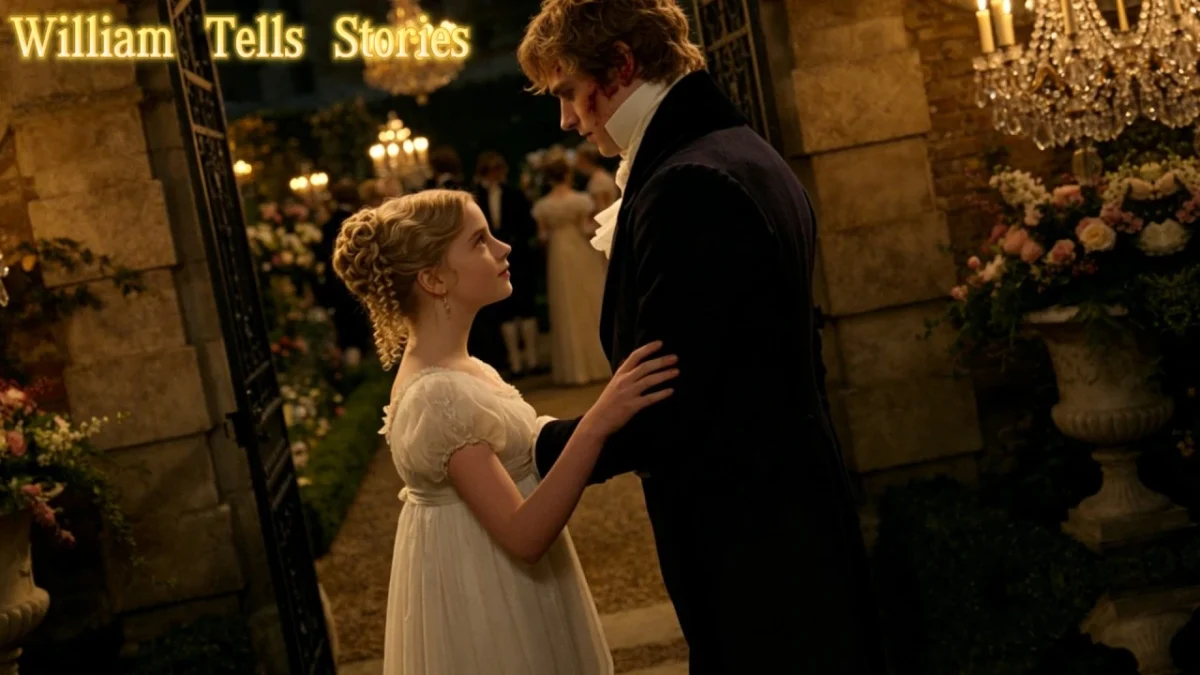
The afternoon sun hung low over the manicured grounds of the Hartley Estate in upstate New York, casting long, golden shadows across the emerald turf.
Beneath white canvas tents, women in pastel silk dresses laughed over silver teacups, while men in tailored suits discussed railways, copper mines, and the soaring market.
Children played in neat, supervised groups, their laughter carefully managed by attentive nannies who ensured white lace remained spotless and decorum was preserved.
Six-year-old Eliza Hartwell did not care for decorum.
Her high collar pinched her neck, and her leather dress shoes squeezed her toes every time she took a step.
While the other children chased a velvet ball across the lawn, Eliza slipped away toward the edge of the grounds, where the manicured gardens gave way to ancient oak trees and quiet stone paths.
She preferred watching birds build nests or observing bugs navigating the roots of trees to sitting in rigid circles learning how to hold a fan.
As she rounded a thick stone wall near the perimeter of the estate, the polite chatter of the party faded into the background.
There, beneath the grandest oak on the property, sat a boy.
He was alone, curled into himself on a weathered stone bench as though trying to merge with the rock beneath him.
Heavy cotton bandages wrapped around his forehead, his neck, and half of his face.
Where the bandages ended, raw red skin and severe burn scars stretched tight, glistening under the filtered sunlight.
His hands were pulled tightly against his chest, the fingers stiff and curled from damaged tendons.
Eliza stopped a few paces away.
Earlier in the day, she had overheard the adults talking about him in muted, heavy tones.
“The Winterborn boy,” a lady had whispered behind her hand.
“A terrible fire at their town residence.”
“A miracle he survived at all, but poor thing… he is entirely ruined.”
“They shouldn’t have brought him out; it frightens the young ones.”
Eliza did not feel frightened.
She saw the way his shoulders trembled beneath his dark wool coat, not from cold, but from the exhausting effort of holding back tears while conscious of the stares around him.
She walked toward him with light, unhurried steps.
The rustle of her dress on the grass made the boy flinch.
He pulled his chin lower, turning his head away so only his uninjured profile was visible.
“Go away,” he muttered, his voice raspy and cracked from smoke damage.
“My mother said I shouldn’t be near people.”
Eliza did not go away.
Instead, she sat down on the far end of the bench, smoothing her itchy white dress over her knees.
“Does it hurt?” she asked gently.
The boy stiffened, refusing to look at her.
“Everything hurts,” he replied through clenched teeth.
“It always hurts.”
“I fell off the porch step last month and scraped my knee,” Eliza said, her tone conversational and entirely free of pity.
“It burned for three whole days.”
“It’s not the same,” the boy snapped, turning his face toward her slightly.
The visible skin on his cheek was a mosaic of pink and pale tissue, and his left eye was partially occluded by scar tissue.
“I’m ugly now.”
“People look at me like I’m a monster.”
Eliza studied his face with serious, open eyes.
She reached into the deep pocket of her dress and pulled out a long strip of pale blue silk ribbon.
It was smooth and clean, something she had tucked away earlier simply because the color reminded her of the sky after rain.
She held it out to him on her flat palm.
“My mama says when things are very hurt or sad, having something soft and pretty helps you remember that nice things still exist,” Eliza said.
“You can have it.”
The boy stared at the ribbon.
His single clear eye widened in genuine shock.
For minutes, he did not move, as if expecting her to yank it away or burst into cruel laughter.
“Take it,” she encouraged, shifting closer.
Slowly, painfully, the boy extended his right hand.
His stiff, scarred fingers clumsily closed around the silk.
He held it gently, as if it were made of thin glass.
“Why are you giving this to me?” he asked quietly, his harsh tone dissolving.
“Because you look lonely,” Eliza said with simple, unwavering logic.
She leaned toward him and smiled, her bright eyes fixed on his face.
“When I grow up, I’ll marry you.”
“Take that ribbon.”
“It’s a promise.”
The boy stared at her, his lips parting slightly.
For the first time in months, the burning pain in his skin and the heavy weight in his chest seemed to fade into nothing.
Before he could answer, a sharp, panicked screech shattered the quiet.
“Eliza!”
Mrs. Hartwell marched down the path, her skirts rustling aggressively, her face pale with horror.
She reached the bench in three wide strides and grabbed Eliza’s upper arm, yanking the young girl off the bench with enough force to make her stumble.
“What on earth are you doing?” Mrs. Hartwell demanded, pulling Eliza behind her dress as if defending her from a wild animal.
“Get away from him!”
“Mama, no!” Eliza cried out, reaching back toward the bench.
“He wasn’t doing anything!”
“Be quiet, Eliza!” her mother snapped, her knuckles white as she gripped her daughter’s arm.
“You do not touch him.”
“You do not speak to him.”
“Have you no sense?”
Mrs. Hartwell glared at the injured boy with a mixture of revulsion and panic before turning on her heel and dragging her weeping daughter back toward the tented lawns.
“I gave him my ribbon!” Eliza sobbed, looking back over her mother’s shoulder.
“I promised!”
The boy stayed on the stone bench, frozen.
He watched the little girl in the white dress get dragged away until she vanished behind the high hedge.
He looked down at his right hand.
The pale blue silk was squeezed tightly in his fist.
Around him, the whispers of the returning adults began to echo again, light and distant, full of judgement and feigned sympathy.
His jaw tightened.
The warmth in his chest turned cold and hard.
He tucked the blue ribbon deep into the inner pocket of his coat, hiding it away where no adult could ever take it.
He learned two lessons that afternoon beneath the oak tree.
Kindness was a rare, fragile thing that people would try to crush.
Fear, on the other hand, was ultimate power.
Eighteen years passed.
By the autumn of 1893, the scarred boy of Hartley Estate had become one of the most formidable figures in the country.
Sebastian Winterborn was now the Duke of Winterborn, ruler of an industrial empire anchored by a massive stone estate in the Hudson Valley.
He owned railways, shipping yards, coal mines, and controlling stakes in three major Manhattan banks.
In the financial districts, men spoke his name in quiet, cautious tones.
Some spoke it with outright terror.
Sebastian did not host grand balls.
He did not attend high-society galas, nor did he allow his photograph to appear in newspapers.
The scars from his childhood fire had never disappeared.
They ran in jagged, pale ridges from his left temple down across his jawline, disappearing into his linen collars, and covering the backs of his hands.
When men sat across from him in boardroom negotiations, they often struggled to look him directly in the face.
Sebastian recognized their discomfort and used it ruthlessly.
He would sit in silence, letting his harsh appearance and unnerving, steady gaze unnerve his opponents until they began making hasty concessions just to shorten the meeting.
He destroyed rivals without ever raising his voice.
At Winterborn Hall, however, his reputation was vastly different.
His staff feared his high standards, but they revered his fairness.
He paid twice the standard wage, provided healthcare for injured workers, and treated loyalty as a sacred contract.
Cross him, and your career in the state was over.
Serve him well, and your family was protected for life.
Despite his vast fortune, Sebastian lived a quiet, isolated life.
Late at night, when the grand stone halls of Winterborn Manor grew silent, he would sit in his dark mahogany study, open a small brass-bound oak box on his desk, and run his rough fingers over a faded, fraying strip of pale blue silk ribbon.
He told himself it was merely a relic of his own past naivety.
A reminder of the day he had allowed himself to feel pitied.
He told himself the little girl with the bright eyes had grown up, married a wealthy lord, and forgotten the strange boy on the stone bench long ago.
That belief collapsed on a crisp October afternoon.
Harrison, the middle-aged estate manager, knocked on the heavy oak doors of the study and stepped inside with unusual hesitation.
“Your Grace,” Harrison began, clearing his throat.
“There is a small matter in the East Gallery.”
Sebastian did not look up from the ledger he was auditing.
“State it, Harrison.”
“An artist has arrived from Manhattan,” Harrison said carefully.
“She claims to have been commissioned by the Historical Preservation Society to paint a portrait of the current master for their regional archive.”
Sebastian stopped writing.
His quill hovered over the paper, dropping a small blot of black ink onto the page.
“I approved no such commission,” Sebastian said, his voice cold and flat.
“Send her away.”
“I attempted to do so, Your Grace,” Harrison replied nervously.
“However, it appears a clerk in our city office signed the contract three months ago and accepted the advance fee.”
“She has already set up her canvas, easels, and oil paints.”
“She is… remarkably persistent.”
Sebastian’s jaw set hard.
He hated portraits.
He hated the idea of an artist staring at his ruined flesh for hours, trying to figure out how to paint around the disfigurement or, worse, pitying him as they mixed their colors.
“Tell her to leave her payment on the table and return to the city,” Sebastian ordered.
“If she refuses, have the grooms escort her off the grounds.”
Harrison bowed.
“Very well, Your Grace.”
An hour passed.
Sebastian tried to return to his financial reports, but the distraction lingered.
The thought of an intruder standing in his gallery, making demands on his time, agitated him.
Driven by an irritated curiosity, he rose from his desk and walked out into the long corridor.
He moved silently across the thick Persian carpets, making no sound as he approached the grand double doors of the East Gallery.
He pushed one door open an inch and looked inside.
A woman stood near the towering windows, flooded in the gray, indirect light of the autumn afternoon.
She was relatively small, wearing a simple, dark gray dress splattered with dried oil paint at the cuffs.
Her dark hair was pinned up in a sensible, unpretentious nod, with a few stray curls framing her neck.
She was adjusting a large canvas on a wooden easel, moving with absolute focus and confidence.
Sebastian stepped into the gallery, his heavy boots making a firm sound against the polished hardwood floor.
The woman turned around smoothly.
Sebastian braced himself for the familiar subtle reactions.
The quick intake of breath.
The widening of the eyes.
The subtle backward step.
The momentary hesitation before forcing a polite mask.
None of those things happened.
The woman looked directly into his eyes, her expression remaining entirely composed.
She curtsied neatly, her movements graceful and calm.
“Your Grace,” she said, her voice rich, clear, and steady.
“I am Eliza Hartwell.”
“I apologize if my presence was not properly announced, but I intend to execute the portrait as commissioned.”
Sebastian froze where he stood.
The name echoed in his ears like thunder in an empty valley.
Hartwell.
He looked at her face, searching her features.
The small girl from the Hartley Estate was gone, replaced by an accomplished, striking woman whose dark eyes held a profound depth of quiet strength.
“You,” Sebastian managed to say, his throat feeling dry.
Eliza tilted her head slightly, studying him with professional interest.
“I require three sittings,” she continued smoothly, as though speaking to any standard client.
“The morning light in this gallery is exceptional.”
“I work quickly, so I shall not burden your daily affairs longer than necessary.”
Sebastian took two steps forward, bringing his left side into the full light of the window, exposing the deep, jagged scars that stretched across his face.
“Look at me, Miss Hartwell,” he demanded, his voice dropping into a harsh register.
“Are you certain you wish to sit in a room with me for hours?”
“Most people find the sight… unpleasant.”
Eliza did not blink.
She looked at the scars on his cheek, then at his hands, and finally back to his eyes.
“I am an artist, Your Grace,” she replied without a trace of flinching.
“I paint reality, not fairy tales.”
“Your face holds character and history.”
“It is far more interesting than the smooth, dull faces of the men in the city.”
“Shall we begin tomorrow at eight?”
Sebastian stared at her, caught completely off guard by her absolute composure.
“Tomorrow at eight,” he repeated quietly.
That night, Sebastian did not sleep.
He paced his bedchamber, the name Eliza Hartwell repeating in his thoughts.
Did she remember him?
Or was her lack of fear simply the professional detachment of an artist who had seen all manner of subjects?
He told himself it did not matter, yet when morning arrived, he found himself standing before his mirror, carefully arranging his necktie with a level of attention he had not paid to his appearance in nearly twenty years.
At precisely eight o’clock, he entered the East Gallery.
Eliza was already there.
She had set up her palettes, arranged her charcoal sticks, and positioned a high-backed wooden chair near the northern window.
“Good morning, Your Grace,” she said, offering a polite nod.
“Please, take a seat.”
Sebastian walked over and sat down.
Eliza approached him without hesitation.
She stepped within arm’s reach, her presence carrying a faint scent of turpentine and fresh lavender.
Reaching out, her fingers lightly touched his right shoulder to adjust his posture.
Her touch was warm, gentle, and firm.
“Turn your chin slightly toward the light,” she instructed.
“No, a bit more to the right.”
“There.”
“Hold that posture.”
Sebastian sat rigid as she stepped back to her easel and began making fast, decisive strokes with a piece of charcoal.
The sound of charcoal scratching against stretched canvas filled the quiet gallery.
For nearly an hour, neither of them spoke.
The silence was not tense; it was calm, settled, and remarkably comfortable.
“You do not ask how it happened,” Sebastian said suddenly, breaking the quiet.
Eliza paused her hand, looking at him over the top of her canvas.
“Would you like to tell me?” she asked softly.
“Most people are curious,” Sebastian remarked, looking out the window toward the autumn trees.
“They construct grand, tragic stories about my youth.”
“It was an oil lamp in the library,” Eliza said gently.
“You were seven.”
“You tried to pull your younger sister out of the room before the curtains caught fire.”
“She survived unharmed because of you.”
Sebastian turned his head to look at her, genuine shock breaking through his stoic mask.
“How do you know that?”
Eliza lowered her charcoal stick.
Her dark eyes softened, lose of all professional distance.
“Because I never stopped asking about you, Sebastian,” she said quietly.
The use of his given name sounded like a long-dormant bell ringing in his mind.
“You remember,” he whispered.
“I never forgot,” Eliza replied, stepping out from behind the easel.
“Not for a single day.”
“My mother dragged me away that afternoon, but I cried for three days straight.”
“When I grew older, I searched through historical records, estate registries, and news archives trying to find out what had become of the boy under the oak tree.”
“When I learned you had taken your father’s title and isolated yourself here, I looked for a way to reach you.”
“It took me two years to secure a commission through the Historical Society that would bring me to this house.”
Sebastian stood up from the wooden chair.
The floorboards creaked under his weight.
His heart pounded against his ribs with a force he had not felt since childhood.
“Why?” Sebastian asked, his voice shaking slightly.
“Why would you waste years searching for a broken man?”
“Because you were not broken to me,” Eliza said, taking a step toward him.
“You were a brave boy who was suffering alone, and the world was cruel to you.”
“I made a promise beneath that tree.”
“I intended to keep it.”
Sebastian reached into his coat pocket.
With trembling fingers, he pulled out the small brass-bound oak box he carried with him.
He popped the latch open and held it out to her.
Resting inside, neatly folded against velvet, was the faded, fraying strip of pale blue silk ribbon.
Eliza gasped, her hand flying to her mouth.
A single tear escaped her eye, tracing a path down her cheek.
“You kept it,” she whispered.
“I kept it to remind myself that kindness was real,” Sebastian said, his voice deep and thick with emotion.
“Even if it only lasted for five minutes.”
Eliza stepped across the remaining distance between them.
She did not look at his scars, nor did she hesitate.
She reached up and placed her small palms flat against his cheeks, her thumb brushing over the rough, scarred tissue of his left jaw line.
“It wasn’t five minutes, Sebastian,” she said firmly.
“It was the beginning of everything.”
Sebastian looked down into her eyes, seeing no pity, no disgust, only deep, unyielding affection.
The walls he had built around his heart for eighteen years crumbled in an instant.
He wrapped his large, scarred hands around hers, holding them against his face, before pulling her close and pressing his lips to hers.
The kiss was tentative at first, filled with the hesitation of a man who had spent a lifetime avoiding human touch.
Eliza leaned into him, her arms wrapping around his neck, anchoring him to the present.
When he pulled back, his breath came quickly.
“I am a harsh man, Eliza,” he warned softly.
“The world fears me.”
“Then let them fear you,” Eliza replied with a faint, fierce smile.
“I know who you are when the doors are closed.”
Over the next three weeks, the East Gallery ceased to be a place of formal work and became the heart of Winterborn Hall.
The portrait progressed rapidly.
Eliza painted Sebastian not as a tragic victim, nor as an idealized, unblemished lord, but as he was.
She rendered every scar with precise, dark brushstrokes, but she captured the intelligence in his dark eyes and the quiet strength of his jaw.
It was a painting of a survivor, powerful and unyielding.
Sebastian spent hours sitting for her, talking more than he had in two decades.
He spoke of his business strategies, his vision for the estate, and the loneliness that had consumed his youth.
Eliza listened, offering her own stories of her struggle to be recognized as an independent female artist in a male-dominated city.
Their quiet world was interrupted in late November by the unexpected arrival of Lord Arthur Ashford.
Ashford was a minor nobleman from New York City who held small investments in Sebastian’s railway lines.
He was young, handsome, impeccably dressed, and possessed the easy, arrogant charm of a man who had never faced hardship.
He had come to negotiate a lease extension on a rail depot, but his attention shifted the moment he walked into the East Gallery and saw Eliza.
“My dear lady,” Ashford said, lingering near her easel during an afternoon tea break while Sebastian was reviewing papers at the far table.
“A woman of your exquisite talent should not be buried in this gloomy countryside manor.”
“You should have a studio in Fifth Avenue.”
“I have prominent connections in the city art circles.”
“I could introduce you to patrons who would appreciate your work far more than…”
He trailed off, casting a subtle, dismissive glance toward Sebastian.
Eliza set her paint palette down with a firm click.
“My work is fully appreciated here, Lord Ashford,” she said coldly.
“And my studio arrangements are entirely my own concern.”
Ashford chuckled, taking a step closer and placing a smooth hand on the back of her chair.
“You are far too soft-spoken, Miss Hartwell.”
“A beautiful woman like you deserves a patron who can escort you into proper society, not hide you away in dark galleries.”
Before Eliza could reply, a tall shadow fell across the floor.
Sebastian stood behind Ashford.
His massive frame towered over the younger nobleman, his scar-marked face illuminated by the gray light.
His eyes were cold as ice.
“Lord Ashford,” Sebastian said, his voice dropping into a register that made the teacups on the tray rattle slightly.
Ashford jumped, stepping back quickly and removing his hand from Eliza’s chair.
“Your Grace!” Ashford stammered, forcing a quick laugh.
“I was merely expressing my admiration for Miss Hartwell’s exceptional artistic talents.”
“You are dismissed,” Sebastian said simply.
“Our business regarding the rail depot is concluded.”
“My secretary will mail you the rejected contracts tomorrow.”
Ashford’s face flushed red.
“Your Grace, surely you won’t terminate a lucrative business agreement over a simple conversation!”
“Leave my house,” Sebastian repeated, his tone entirely devoid of passion, which made it infinitely more terrifying.
“If you are still on the grounds in ten minutes, my head groom will remove you.”
Ashford bowed stiffly, glaring at Sebastian with hidden resentment before hurrying out of the gallery.
When the heavy doors clicked shut, Sebastian turned to Eliza.
A rare emotion flickered in his eyes.
“I apologize,” Sebastian said, his knuckles white as he gripped his cane.
“I am not used to watching other men speak to you.”
“It brought out an unpleasant temper.”
Eliza walked over to him, a soft, bright smile touching her lips.
“You were jealous,” she noted gently.
“I was protective,” Sebastian corrected stiffly.
Eliza reached up and smoothed his lapel.
“I liked it,” she admitted quietly.
That evening, as firelight flickered in the main drawing room, Sebastian stood by the mantelpiece.
He looked at Eliza, who was sketching in a leather-bound book near the hearth.
“Eliza,” he called softly.
She looked up.
“Yes, Sebastian?”
He walked over and knelt on one knee before her chair, despite the stiffness in his left leg.
He took her right hand in his scarred fingers.
“I have spent eighteen years building an empire so no one could ever hurt me again,” he said slowly, his voice thick with sincere devotion.
“But it means nothing if I am in it alone.”
“Will you fulfill the promise you made under the oak tree?”
“Will you marry me?”
Eliza dropped her sketch pencil.
She did not laugh, nor did she hesitate for a single second.
“Yes,” she said softly, wrapping her arms around his shoulders and pulling him close.
“I have been waiting eighteen years to say yes.”
Their engagement was announced privately, but news spread through New York society like wildfire.
The reclusive, ruthless Duke of Winterborn was marrying an unknown, working artist.
Three weeks later, Sebastian and Eliza attended a high-society reception in Manhattan to finalize the legal paperwork for Eliza’s grand estate transfer.
The grand ballroom of the Astor Hotel was filled with crystal chandeliers, playing orchestras, and hundreds of wealthy elites dressed in fine velvet and diamonds.
As Sebastian stepped into the room with Eliza on his arm, the music seemed to lose its energy.
Whispers rippled through the crowd.
Stares followed them from every corner.
Sebastian held his head high, his dark suit tailored to perfection, his scars fully exposed without shame.
Beside him, Eliza walked with effortless grace, her emerald silk gown complimenting her dark hair.
Halfway across the ballroom, the crowd parted.
An older woman stepped forward, dressed in elaborate purple silk and pearl necklaces.
Her face was hardened with age and aristocratic pride.
It was Mrs. Hartwell.
She stared at Sebastian, her eyes widening in horror as she recognized the scarred face of the boy she had dragged her daughter away from eighteen years prior.
“Eliza,” Mrs. Hartwell said sharply, ignoring Sebastian entirely.
“What is the meaning of this madness?”
“You have ignored my letters for weeks, only for me to discover you are parading around Manhattan with… with him?”
Eliza stopped.
She did not pull back, nor did she lower her eyes.
“Mother,” Eliza said calmly.
“I am attending a reception with my fiancé.”
“Fiancé?” Mrs. Hartwell gasped, her face turning pale.
“Have you lost your mind?”
“He is a ruined creature!”
“I pulled you away from him once to protect your future, and now you throw yourself into this disaster?”
Before Eliza could speak, Sebastian stepped forward, placing himself slightly in front of her.
His vast frame blocked Mrs. Hartwell’s view of her daughter.
“Madam,” Sebastian spoke, his voice low, deep, and carrying across the quieted ballroom with lethal precision.
“You pulled a child away from a suffering boy eighteen years ago because you were a coward who feared anything you could not control.”
“You will not speak to my future wife in that tone again.”
Mrs. Hartwell drew back, trembling with anger.
“I am her mother! You cannot dictate—”
“I am the Duke of Winterborn,” Sebastian interrupted, his dark eyes narrowing into slits of pure steel.
“I control the mortgages on your husband’s shipping company.”
“I own the bank that holds your family’s estate notes.”
“If you utter one more disrespectful word to Eliza, I will ruin your family financially before sunrise.”
“Now turn around and leave.”
The entire ballroom was deathly silent.
Mrs. Hartwell looked into Sebastian’s eyes and saw absolute, unshakeable certainty.
There was no bluff in his voice, no wild rage—only cold, absolute power.
She swallowed hard, her mouth opening and closing like a fish, before she turned on her heel and fled toward the exit, her skirts rustling frantically.
Eliza looked up at Sebastian, her eyes shining with pride and affection.
“Thank you,” she whispered.
Sebastian looked down at her, the harshness in his face instantly melting away into soft warmth.
“No one will ever make you feel small again, Eliza,” he promised.
“Not while I breathe.”
They were married two weeks later at Winterborn Hall.
There were no massive crowds, no reporters, and no high-society spectators.
Only a quiet gathering in the small stone chapel on the estate, surrounded by autumn flowers and the loyal staff who had cared for the estate for years.
They spoke their vows beneath the soft light of stained-glass windows, their promises firm and absolute.
Marriage did not make Sebastian a weak or soft man in the financial world.
If anything, it sharpened his focus.
He remained a formidable force in business, but his life at Winterborn Hall transformed completely.
The dark, silent estate became alive with light, laughter, and art.
Eliza converted the upper sunroom into a massive studio, where she painted daily.
Patrons and galleries across Europe and America requested her works, and Sebastian supported her career fiercely.
When a prominent gallery owner in London suggested that the Duchess of Winterborn should retire from painting to fulfill traditional noble duties, Sebastian bought a controlling share in the gallery chain and promptly replaced the manager with someone who valued women’s art.
They lived their lives on their own terms, indifferent to the opinions of high society.
Years passed into decades.
The story of the Duke and Duchess of Winterborn became legendary in the Hudson Valley—a tale of immense power, unyielding loyalty, and a love that defied the cruelty of the world.
On a quiet autumn evening, twenty years after their wedding, Sebastian sat in his study before a roaring fireplace.
He was older now, silver touch hair at his temples, but his eyes remained sharp and clear.
Eliza walked into the room, carrying two cups of warm tea.
She sat beside him on the deep leather sofa, resting her head against his shoulder just as she had done thousands of times before.
Sebastian reached over and opened the small brass-bound oak box that sat permanently on his side table.
Inside lay two items.
The original, faded pale blue silk ribbon from their childhood meeting, and a matching strip of pristine white silk ribbon Eliza had given him on their wedding day.
Eliza smiled, touching the soft silk with her fingertip.
“Do you ever think about that day at Hartley Estate?” she asked quietly.
Sebastian pulled her closer, resting his cheek against her dark hair.
“Every single day,” he replied softly.
“I spent years believing that the world was built only on fear and cruelty.”
“I thought kindness was a weakness that destroyed people.”
Eliza turned her face and kissed his scarred cheek without the slightest hesitation.
“And what do you believe now?”
Sebastian looked down at the two ribbons resting side by side in the box, then looked into the eyes of the woman who had walked toward him when everyone else had stepped away.
“I believe that kindness is the strongest force in the world,” Sebastian said, his voice rich and full of absolute certainty.
“It gave me a life no fire could ever burn away.”
Disclaimer: This story is fictional and created for entertainment purposes only.
Any names, characters, places, or events are fictitious or used fictitiously.
No real person or organization is intended to be portrayed.








