A 6 Year Old Came to Work for Her Sick Mother—Then the Duke Saw Her Tiny Hands

A 6 Year Old Came to Work for Her Sick Mother—Then the Duke Saw Her Tiny Hands
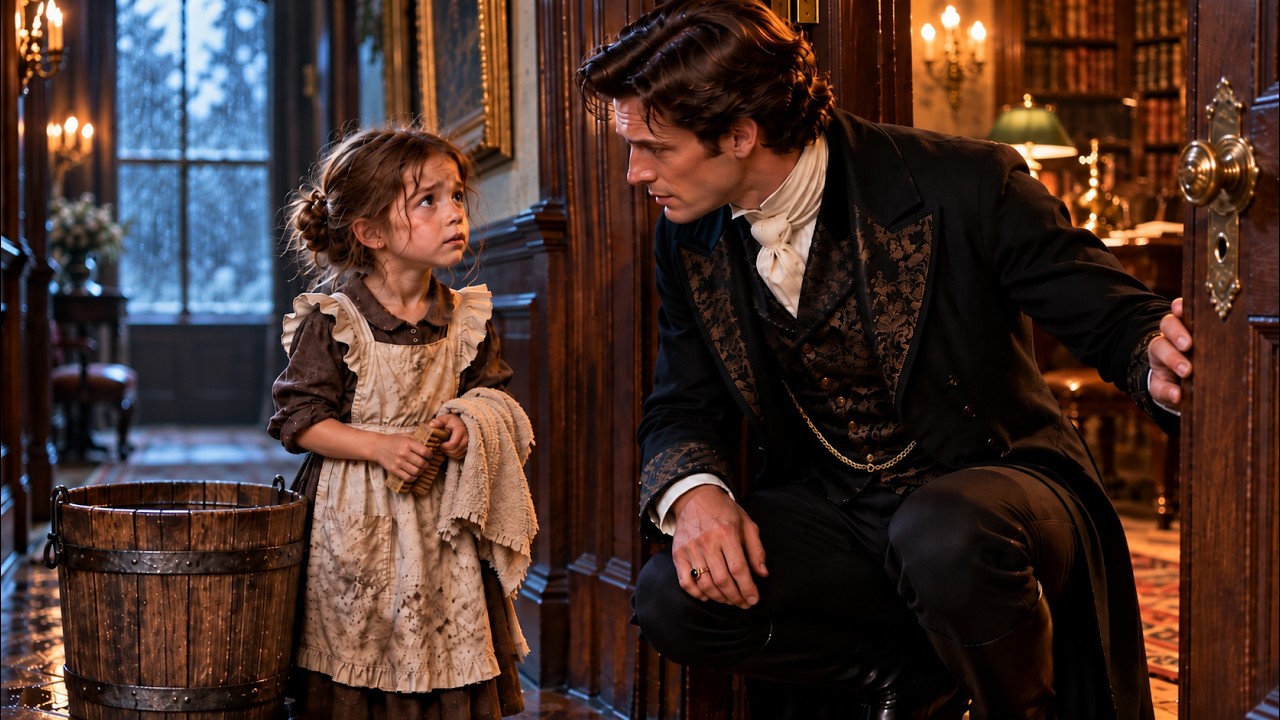
“Mama’s ill, so I came instead.” The little girl said it so quietly that for a moment Duke Alexander Ravenscroft thought the storm had put words into the room.
Rain struck the tall windows of Ravenscroft Hall in silver sheets, driven sideways by a hard Yorkshire wind.
It was not yet 6:00 in the morning. Most of the household still slept below stairs, and the long eastern corridor lay in shadow except for the light spilling from the Duke’s study.
Alexander had been awake since before dawn as he often was. 10 years of carrying an old title, a troubled estate, and a family name people seemed eager to measure had taught him that silence was easiest to find before the house remembered its own weight.
He had been reading tenant accounts when he heard the faint scrape of a wooden pail outside his door.
Then came a soft knock. When Alexander opened the study, he found a child standing in the corridor.
She could not have been more than six. A servant’s brown apron hung from her shoulders nearly to her shoes.
The sleeves of the gray dress beneath it had been rolled several times so her hands could emerge.
She held a folded cloth in one hand and a small brush in the other.
And beside her sat a bucket half full of soapy water that looked much too heavy for her to have carried up the servants’ stairs alone.
Alexander stared at her. The little girl lifted her chin as if she had practiced being brave on the walk there.
“Mama is ill, your grace,” she said. “So I came instead.” Alexander’s eyes narrowed, not in anger but confusion.
“Instead of what? To work?” The answer was so serious that he almost believed he had misunderstood her.
“What is your name?” “Clara Hartley.” “And how old are you, Miss Hartley?” “Six.” She hesitated, then added, “Nearly seven.”
Alexander glanced at the bucket, the cloth, and the apron swallowing her narrow shoulders. “And where is your mother?”
Clara’s fingers tightened around the brush. “In her bed in the servants’ cottage. Mrs. Finch said she has a fever.
Mama could not stand this morning. Then why are you here? A crease appeared between Clara’s brows.
Because Mama missed yesterday, too. Alexander waited. Clara swallowed. If she misses another day, Mr.
Pike might send her away. Mama said she must not lose her place. She said we have nowhere else to go.
Alexander knew Mr. Pike. Pike was a junior steward responsible for the cleaning crews in the East Wing.
A man who obeyed rules precisely enough to avoid ever whether the rules deserved obedience.
And your mother told you to come in her place, Alexander asked. Clara shook her head quickly.
No, your grace. She told me to stay beside her. But she was sleeping, and I know what she does.
I watched her. I can dust the tables, polish the brass, and carry ashes if they are not too hot.
She looked down at the bucket. I spilled some water on the back stairs, but I wiped it up.
Alexander did not speak. The child’s courage wavered in the silence. Please do not be angry with Mama.
Something old and painful shifted beneath his ribs. Years ago, before the title had been his, Alexander had been 12 when his own mother collapsed during a winter fever.
His father had been abroad. The household physician came late because a senior guest had complained of gout.
Alexander remembered standing beside his mother’s bed, useless and furious, watching servants whisper as though rank could make illness less dangerous.
His mother survived, but the memory never left him. The knowledge that systems often protected order before people.
Now, a six-year-old child stood before him wearing her mother’s apron because she believed hunger waited on the other side of one missed shift.
Alexander stepped into the corridor and knelt so that they were eye to eye. Clara, listen to me carefully.
Your mother will not lose her place because she is ill. Clara searched his face with the suspicion of a child who had already learned that adults made promises more easily than they kept them.
You are not in trouble, he continued. Neither is she. Clara looked past him into the study.
Her eyes settled on the edge of his writing desk where a faint ring of tea stained the polished wood.
Before Alexander could ask what she was doing, she walked in, stretched as high as she could, and wiped the ring away with two determined circles of her cloth.
There, she said, now I did some work. Alexander stared at the clean patch of wood.
For the first time in weeks, perhaps months, the corner of his mouth moved. Clara noticed.
You smile very small, she said. Before he could reply, hurried footsteps sounded from the corridor.
Tobias Bennett, Ravenscroft’s chief steward and Alexander’s most trusted household officer, appeared with Mrs. Finch, the housekeeper, behind him.
Both stopped abruptly at the sight of the duke kneeling beside a child with a cleaning cloth.
Your grace, Tobias began, we have been looking for her. Mrs. Finch discovered Miss Hartley missing from the cottages, and No one is to scold her, Alexander said.
Mrs. Finch pressed one hand to her chest. Certainly not, your grace, we were only frightened.
Alexander stood. Send for Dr. Hale. Have him go to Mrs. Hartley’s cottage at once.
Tobias inclined his head. Yes, your grace. And tell Mr. Pike that if any servant in this house believes illness is grounds for dismissal, I would like the exact rule placed on my desk before breakfast.
Tobias’ eyes flickered with understanding. I suspect, your grace, that no such written rule exists.
Then by luncheon, no unwritten version will exist, either. Clara watched the exchange, still clutching her brush.
Alexander looked down at her. Have you eaten? She hesitated too long. Mrs. Finch’s face softened.
I can take her to the kitchen. No, Alexander said, surprising even himself. “First I’m taking her back to her mother.”
Clara’s shoulders dropped slightly as if she’d carried the entire weight of Ravenscroft Hall until that moment and had finally been told she could put it down.
The servants’ cottages stood beyond the kitchen garden. A row of stone dwellings built generations earlier along the lower wall of the estate.
By the time Alexander reached Elena Hartley’s cottage, the rain had thinned to a cold mist.
Clara walked beside him, one small hand wrapped around two of his fingers. Tobias followed several paces behind, holding an umbrella neither Alexander nor Clara seemed to notice.
Inside, the cottage smelled of damp wool, lavender water, and fever. Elena Hartley lay in a narrow bed near the hearth.
She was younger than Alexander expected, perhaps 30, with dark chestnut hair loosened across a pillow and a face made pale by exhaustion.
Dr. Edmund Hale had already arrived and was placing his instruments back into a leather case when the Duke entered.
Elena’s eyes opened. She saw Clara first. Relief passed over her so visibly that Alexander felt it like a change in the room’s temperature.
Then she saw him. She tried to sit up. “Your Grace.” The attempt immediately sent her into a coughing fit.
Alexander crossed the room. “Do not rise.” “I can explain.” Elena managed. “Clara should never have gone to the house.
She must have heard me speaking to Mrs. Finch. I did not send her, please believe me.
I do. I will return to work tomorrow.” Dr. Hale made an impatient sound. “You will do no such thing.”
Elena ignored him. “I only need one day, perhaps two.” “You need at least a fortnight.”
Hale said, “The fever has settled in your lungs. If you continue working before it clears, you may turn a manageable illness into a fatal one.”
Elena’s face tightened, not at the word fatal, but at the word fortnight. “I cannot miss a fortnight.
Alexander pulled the only chair closer to the bed and sat rather than standing over her.
Mrs. Hartley, your place is secure. Her expression changed very little, but disbelief hardened behind her eyes.
You will receive your usual wages while Dr. Hale orders you to rest. Eleanor stared at him.
I did not know such an arrangement existed. She said carefully. It does now. Your grace.
I cannot accept charity. It is not charity. It is payment to a member of my household who became ill while serving this estate.
That is not how things are usually done. No, Alexander said. That is becoming increasingly clear to me.
Clara climbed onto the edge of the bed and curled beside her mother. Eleanor kissed the top of her head and closed her eyes briefly.
Alexander noticed her hands. They were not the hands he expected from a housemaid. The skin was rough from work, but the fingers bore faint ink stains near the nails.
He glanced at the small table beside the bed. Beneath the sewing basket lay several sheets filled with neat columns of numbers.
What are those? He asked. Eleanor followed his gaze and looked almost embarrassed. Nothing important.
Numbers are rarely nothing. She gave him the first hint of a smile. Old habits.
Dr. Hale closed his case. Mrs. Hartley, if you have enough strength to argue with the Duke, you have enough strength to drink the broth Mrs.
Finch is sending. Nothing more. When the physician left, Alexander remained. He did not know why.
Perhaps because Clara’s hand had found her mother’s and stayed there. Perhaps because the cottage was so small that one could see every part of the life being held together inside it.
Two dresses hung behind a curtain, three books stacked near the hearth, a child’s carved horse with one missing wheel, and a jar containing only a few copper coins.
Or perhaps because Eleanor hardly looked at him without the practiced deference he received from everyone else.
She was respectful because he was a duke, but she was not dazzled by it.
Your Grace, she said after a while, may I ask something plainly? Yes. Why are you doing this?
Alexander knew what she meant. Because when I was a boy, I watched my mother become ill in a house where everyone knew their duty and almost no one remembered their humanity.
I promised myself I would not become a man who confused rules with justice. Eleanor studied him.
And have you kept that promise? The question should have offended him. Instead, Alexander looked around the cramped cottage belonging to a woman who had believed fever might make her homeless.
Not well enough, he said. For the first time, Eleanor’s guarded expression softened. Before he left, Alexander paused at the table and touched the top sheet of figures.
You said these were old habits. My father kept accounts for a wool merchant in Leeds, she said.
He believed daughters should understand figures as well as sons. When I was young, he made me balance his ledgers before he would let me read novels.
Alexander looked more closely. The sheet showed household expenses, but not merely copied figures. Eleanor had reorganized them into categories and marked several repeated charges.
What is this? She hesitated. I noticed the East Wing receives the same quantity of lamp oil every month, even in summer when half the rooms are closed.
Alexander’s gaze sharpened. You keep your own copy of estate expenses? Only what passes through the cleaning stores.
I like numbers. They behave better than people. That time, Alexander laughed. It surprised all three of them.
Clara beamed as though she had personally accomplished something difficult. I told you, she said to her mother.
He smiles very small. Alexander left the cottage with the strange sensation that something in his life had shifted by an inch.
Too little to name, but too much to ignore. He had no idea that before the season changed, that same cottage, that same child, and those same columns of numbers would place Ravenscroft estate at the center of a scandal powerful men had spent years arranging.
Three days later, Lord Alister Crowe arrived at Ravenscroft Hall. Crowe had been a friend of Alexander’s late father.
At least in the way wealthy men often use the word friend when business interests and family influence overlapped.
He was in his late 50s, silver-haired, impeccably dressed, and possessed of the particular confidence of a man who had spent decades entering rooms certain someone else would offer him the best chair.
He also controlled several loans attached to outlying Ravenscroft properties. Alexander disliked him. Crowe knew it and seemed to enjoy the fact.
They met in the library after luncheon. Rain had finally stopped, but clouds pressed low over the moors.
“I hear you have become sentimental,” Crowe said, accepting brandy without invitation. Alexander did not look up from the letter he was finishing.
“That rumor must have traveled quickly. A duke personally escorting a servant’s child through his own grounds is not the sort of detail a household keeps to itself.”
Alexander sealed the letter. “Is there a purpose to this visit?” “There is always a purpose to my visits.”
Crowe smiled. “That is why your father valued them.” “My father valued many things I have since learned to question.”
The smile thinned. Crowe set down his glass. “Then question this. Your estate accounts are due for review in 6 weeks.
The northern wall leases remain underperforming. Two creditors have asked whether Ravenscroft can meet the winter obligations without extending the note.”
“We can.” “So confidently said. I have seen the accounts. Have you?” The question landed with just enough weight to be deliberate.
Alexander’s eyes lifted. Crowe smiled again. “Only reminding you that estates are built on more than good intentions.
A noble house that begins confusing charity with management soon discovers it can afford neither.
Alexander’s voice cooled. Mrs. Hartley’s wages will not bankrupt Ravenscroft. No, but the principle might.
Then I will choose my principles carefully. Crow rose. Do that. He left with the same unhurried confidence with which he had entered.
Alexander stood by the library fire long after the door closed. It was Tobias who finally spoke from near the bookcase.
He knows something, the steward said. Alexander glanced at him. You heard. Lord Crow has never learned to lower his voice when servants are nearby.
He does not consider us an audience. Alexander looked toward the window. Pull every account involving the northern leases, lamp oil, coal deliveries, and storage contracts for the last 5 years.
Tobias raised an eyebrow. Because of Mrs. Hartley’s notes? Because Crow just warned me not to look too closely without realizing he had done so.
For the next 2 weeks, Eleanor recovered slowly. Alexander did not visit every day. He was careful not to create gossip.
And Eleanor would have hated being treated as an invalid under noble supervision. Instead, Mrs.
Finch carried broth and medicine. Dr. Hale reported her progress. Tobias ensured wages reached the cottage on schedule.
But every evening Clara appeared somewhere near the great house. At first, she came to return a book Alexander had lent her.
Then to collect another. Then because Mrs. Finch discovered she could be trusted to shell peas in the kitchen without eating all of them.
Soon the household grew accustomed to seeing a small girl with chestnut braids sitting on the lower step of the servants staircase with a book in her lap.
Alexander encountered her in the west gallery one afternoon while she studied a portrait of his grandfather.
He looks angry, she said. He usually was. Why? No one ever explained. Clara considered this.
Maybe his shoes hurt. Alexander looked at the grim painted face of the seventh Duke of Ravenscroft and laughed so unexpectedly that a footman at the end of the gallery nearly dropped a tray.
Clara nodded in satisfaction. Bigger smile. When Elina finally returned to Ravenscroft Hall, she did not return with a cleaning pail.
Alexander summoned her to the estate office instead. She entered wearing her plain gray dress, her hair pinned neatly, and the expression of a woman preparing to refuse whatever favor was about to be offered.
“I am well enough to resume my former duties.” She said before he could speak.
“So, Dr. Hale tells me then I should report to Mrs. Finch.” “You could.” Elina waited.
Alexander slid a ledger across the desk. “Or you could explain why Ravenscroft paid for 400 gallons more lamp oil last year than the household stores received.”
Her eyes dropped to the page. She stepped closer. Within seconds, the servant from her posture.
Her attention sharpened. She traced two entries with one finger. “These invoices use different handwriting.”
She said. “Yes.” “But the same merchant’s mark.” “Yes. And this number has been carried twice.”
Alexander leaned back. “I noticed that only after Tobias pointed it out.” Elina scanned the next page.
“The coal accounts have the same pattern.” “You see why I asked you here.” She looked at him slowly.
“What exactly are you asking?” “For 3 weeks, you will assist Tobias in reviewing household supply ledgers.
You will be paid clerk’s wages.” “No.” Alexander blinked. Elina folded her hands. “Your grace, if you place a housemaid behind an account desk because her child wandered into your study, everyone in this household will assume one of two things.
Either I am being rewarded for pity, or I am being rewarded for something worse.”
Alexander’s jaw tightened because she was right. What would make you accept a test? A test.
Give me a set of accounts without names. Do not tell me which estate they belong to.
If I find errors Tobias has not already marked, then you may say I earned 3 weeks at the desk.
Alexander studied her for a moment. Then he turned toward a cabinet, removed a bundle of old tenant ledgers from a minor property in Derbyshire, and placed them before her.
You have until tomorrow. Eleanor lifted the bundle. I have until supper. She returned 4 hours later with 11 irregularities, three arithmetic errors, two suspicious duplicate charges, and one lease payment that had been incorrectly classified for 6 consecutive years.
Tobias read her notes in silence. Then he looked at Alexander. If she returns to polishing silver after this, your grace, I shall consider it a personal insult.
Eleanor tried not to smile. That evening, Alexander issued a formal household notice. Eleanor Hartley had been appointed temporary assistant in the estate office on the recommendation of Tobias Bennett after successful review of historic accounts.
No mention was made of Clara, the rainy morning, or the duke. It mattered to Eleanor.
Alexander understood that. Over the next month, she earned the position so completely that even those who had whispered at first stopped doing so.
She reorganized storeroom records, matched deliveries against signed receipts, and discovered that Ravenscroft had been paying two different merchants for the same carriage route.
She found a pattern of inflated charges linked to companies recommended years earlier by Lord Crow.
None of the sums alone were large enough to cause alarm. Together, they represented hundreds of pounds disappearing every year.
Tobias became openly impressed. Alexander became quietly furious. Eleanor did not celebrate the discoveries. One evening, after Tobias had gone to inspect the granaries, Eleanor remained at the estate desk comparing receipts.
The fire burned low, and Alexander noticed her rubbing warmth into her fingers. “You are cold.”
“I am working.” “Those are not opposites.” He placed his coat over the empty chair beside her and returned to his letters.
10 minutes later, when he looked up, she was wearing it. The dark wool nearly swallowed her.
Eleanor caught him looking. “Not a word.” Alexander lowered his eyes, smiling. “I said nothing.”
A little later, both reached for the same invoice. Their fingers touched. Neither moved at once.
It lasted only a second, but Eleanor read the next line twice before understanding it.
“These are not random errors,” she said one evening as the three of them worked in the estate office after supper.
“Someone has been making small thefts look ordinary.” Alexander stood behind her chair, studying the figures.
“For how long?” “At least seven years. My father was alive for five of them.”
Eleanor looked up. “Then whoever arranged this expected no one to question familiar names.” Tobias tapped one column.
“Most of those names trace to men associated with Crow.” The room went still. Alexander felt the old estate shift beneath him.
Not physically, but in meaning. Ravenscroft’s financial weakness had always been explained as misfortune. Poor harvests, wartime prices, repairs, old debts.
But if even part of Eleanor’s pattern was deliberate, someone had been profiting from the family’s decline.
“Do not speak of this outside this room,” he said. Eleanor nodded. Tobias closed the ledger.
None of them noticed the shadow that paused briefly beyond the frosted glass of the office door before moving away.
Two days later, Thomas Reed returned to Yorkshire. Eleanor had not seen him in six years.
He appeared outside the servants’ cottages near dusk, leaning against the stone wall as though he had every right to be there.
He was still handsome in the careless way he had been at 25. With sandy hair and an easy smile that once convinced Eleanor he possessed more courage than he truly did.
Clara was inside with Mrs. Finch. That was the only reason Eleanor did not panic immediately.
Thomas straightened when he saw her. Ellie. No one calls me that anymore. His smile faltered.
You look well. You have no right to know how I look. Six years and that is your greeting.
Six years is the reason for my greeting. Thomas glanced toward the cottage door. I heard about the girl.
Eleanor’s blood went cold. You heard about your daughter. You never wrote. I wrote three times to the address you gave me.
The last letter came back because you had left without telling anyone where you went.
He looked away. Eleanor stepped closer. Why are you here? Thomas slipped his hands into his coat pockets.
I thought perhaps we could begin again. No. You did not even think. I had six years to think.
His smile vanished. I have rights, Eleanor. To what? To my child. The words struck like a slap.
You do not know her favorite color. That can change. You do not know what frightens her in thunderstorms.
You do not know she hates boiled turnips or that she reads words backward when she is tired.
You do not know she lost her first tooth beside the mill stream and cried because she thought the fairies would not find it.
Do not stand here and tell me you have rights to a child you never bothered to know.
Thomas’s jaw tightened. I did not come to fight. Then leave. He studied her for a long moment.
People say you have done well for yourself. Working close to the Duke now. Eleanor heard the change in his tone.
There it was. Not regret. Not fatherhood. Interest. Who told you that? Thomas shrugged. People talk.
No one you know lives near Ravenscroft. His gaze moved past her toward the great house rising beyond the gardens.
Powerful men have long memories, he said. Sometimes they have use for old friends. Elena’s stomach tightened.
“Who sent you?” Thomas smiled again, but this time there was no warmth in it.
“No one sends me anywhere.” He left before she could stop him. That night Elena told Alexander everything.
He listened without interruption, his expression becoming colder with each sentence. “Did he threaten Clara?”
“Not directly, but he mentioned rights.” “Yes.” Alexander turned to Tobias. “Find out where Thomas Reed has been living and who paid for his journey north.”
Elena looked at him. “You do not need to involve yourself.” Alexander faced her. “A man disappears for 6 years, returns within weeks of our finding irregularities connected to Crow, and begins asking questions about my household.
I am already involved. This is my daughter.” “Yes.” His voice softened. “And I will not forget that.”
Elena held his gaze. The distance between duke and servant had changed over the past month.
Neither had named it. They spoke too easily now, worked too late, trusted each other in ways that could become dangerous if examined closely.
Elena broke eye contact first. “I do not want Clara becoming part of whatever is happening with Crow.”
“Neither do I.” But by then she already had. Later that night, Elena noticed ink along Alexander’s hand.
Without thinking, she caught his wrist and wiped it away with the corner of a cloth.
Both went still. She released him first. “There.” Alexander glanced at the clean skin. “Now it is fair.”
She recognized Clara’s words and smiled despite herself. “Do not become sentimental, Your Grace. Crow assures me it is already too late.”
The next attack came through paper. Three mornings later, Tobias entered Alexander’s study carrying a ledger and looking as though he had swallowed iron.
“We have a problem.” Alexander took the book. It was one of the estate’s restricted lease registers, kept in a locked room accessible only to Tobias, Alexander, and two senior clerks.
Several pages had been altered. Entries tied to Crow associated merchants had been marked as reviewed and approved in a new hand.
Eleanor Hartley’s name appeared beside them. Alexander stared at the signature. It was an excellent imitation.
Too excellent. When was this discovered? This morning. Where is Eleanor? In the account room.
She has not seen it yet. Alexander’s eyes hardened. Who had access? The door was opened with a proper key.
Eleanor has no key? No. Alexander looked again at the forged signature. The trap was obvious precisely because it had been designed for people who wanted to believe it.
A former housemaid suddenly promoted by the Duke given access to sensitive accounts then discovered apparently altering records that concealed theft.
It was not merely an accusation of fraud. It was a story, and stories were dangerous because people preferred them to evidence.
Before noon, Lord Crow arrived. Alexander almost admired the timing. Crow entered the library with a grave expression carefully arranged for the occasion.
I received troubling news. From whom? A gentleman concerned for Ravenscroft’s reputation. A gentleman remarkably well informed about events discovered 3 hours ago.
Crow ignored that. You placed a vulnerable woman of questionable background into your private account rooms.
Now falsified entries bearing her name have been discovered. You must see how this appears.
Alexander stood behind his desk. It appears someone forged her signature. Of course you would say that.
What does that mean? Crow sighed. Alexander, you’re too close to the matter. The use of his Christian name was deliberate.
Crow continued. People are already whispering that Mrs. Hartley’s advancement had less to do with arithmetic than with affection.
Alexander’s hands curled slowly against the desk. Be very careful. Crow smiled faintly. You see, to too close.
The door opened. Eleanor stood there. She had heard enough. Her face was pale, but composed.
“May I see the ledger?” She asked. Alexander hesitated, then handed it to her. Eleanor studied the forged entries for less than a minute.
“This is not my handwriting.” Crow tilted his head. “It is remarkably similar. It is meant to be.”
“Convenient.” Eleanor ignored him and pointed to the ink. “This page was written recently.” Alexander looked closer.
“How can you tell?” “The paper absorbed it differently. The older entries have faded into the fibers.
These sit darker on the surface.” Crow’s expression did not change. Eleanor turned several pages.
“And whoever copied my hand made a mistake.” “What mistake?” Tobias asked. “I make my capital H with an open lower stroke.
This closes.” She pointed. “They copied from my formal signature on wage receipts, not from my ordinary working notes.”
Alexander looked at Crow. For the first time, something cold flickered behind the old man’s eyes.
Then he smiled. “Very clever.” Eleanor closed the ledger. “Yeah.” Crow left 20 minutes later, but the damage had already begun.
By evening, two creditors had sent letters requesting clarification regarding irregularities in Ravenscroft’s books. Someone had moved faster than rumor should have been able to move.
By the next morning, a scandal sheet circulating in York carried a thinly disguised account of a duke who had elevated a servant woman, and then found his estate accounts compromised.
No names were printed. None were necessary. Alexander’s first instinct was fury. His second was restraint.
He wanted to publish every piece of evidence that cleared Eleanor. But doing so would also publish her name, her history, and Clara’s existence to men who treated private lives as entertainment.
Eleanor understood the choice before he explained it. You should defend yourself. She said. They were alone in the estate office after dark.
Rain tapped against the panes. A single lamp burned between them. I can defend myself without offering you to the public as proof.
Your creditors may not wait. Then they may learn patience. Your title cannot protect the estate from arithmetic.
No. Alexander said. But neither will I protect it by sacrificing you. Eleanor looked down at the papers.
That is a dangerous thing to say to a woman who works for you. What?
That you would sacrifice something for her. Alexander went still. The silence between them changed.
Eleanor lifted her eyes. For one reckless second, neither was Duke nor servant, employer nor employee, protector nor protected.
They were simply two tired people who had spent too many evenings sharing ledgers, worries, and truths no one else had been permitted to see.
Alexander stepped closer. Then Clara’s voice sounded from the corridor. Mama. The moment broke. Eleanor breathed again.
Clara entered carrying a sheet of paper and looking pleased with herself. I drew something for His Grace.
Alexander crouched beside her. The drawing showed three figures beneath a large crooked roof. One was tall and black-haired.
One wore a blue dress. One was very small and held both their hands. What is this?
He asked. Home. Alexander’s throat tightened. Eleanor looked away toward the window. Clara frowned at the tall figure.
I made your smile bigger because you’re improving. Alexander folded the drawing carefully. Thank you.
He placed it inside the inner pocket of his coat. Neither adult spoke about the fact that Clara had drawn them as a family.
Thomas Reed made his next move 2 days later. A solicitor’s letter arrived for Eleanor declaring Thomas’s intention to to legal recognition of his paternal claim and to argue that Clara should be removed from an unstable household.
The document cited Eleanor’s recent illness, her lack of property, the accusations concerning the estate accounts, and rumors of an improper relationship with the Duke.
Eleanor read it once, then again, her hands began to shake. Alexander found her in the small records room behind the office, sitting on a stool with the letter open across her knees.
“What happened?” She handed it to him. His expression changed as he read. “He cannot simply take her.
He does not need to win.” Eleanor whispered. “He only needs to frighten people into believing she is safer anywhere but with me.
He abandoned both of you, and now he has a solicitor I could never afford.”
Alexander folded the letter carefully. “You have one now.” Eleanor looked up sharp. “No.” “Yes.
I cannot let you pay for a uh You are not letting me do anything.”
Samuel Bellamy has represented my family for 20 years. He will advise you because I am instructing him to investigate whether this petition is part of an effort to manipulate Ravenscroft’s affairs.
That is a very elegant way of disguising charity. It is an equally elegant way of making you stop arguing.
Despite everything, a broken laugh escaped her. Alexander knelt before her, not caring that dust from the records floor would mark his trousers.
“Eleanor.” It was the first time he had used her given name. She froze. “He is not taking Clara.”
Her eyes filled. “How can you promise that?” “I cannot promise what a court will do.
I can promise you will not stand before it alone.” That was enough to break something she had been holding inside for years.
Eleanor covered her mouth, but the tears came anyway. Alexander did not touch her immediately.
He waited. When she reached for his hand, he closed his fingers around hers. Outside the records room, Tobias quietly turned away and made certain no servant came down that corridor for the next 10 minutes.
Samuel Bellamy arrived the following morning. He was a compact silver spectacled solicitor whose mild voice had deceived generations of men into underestimating him.
He listened to Elena’s history, examined Thomas’s petition, and asked questions with surgical precision. Were you ever married to Mr.
Reed? No. Did he provide regular support for Clara? None. Any letters? Not after she was born.
Witnesses to his departure? Half the street where we lived. Bellamy nodded. Good. Elena blinked.
Good. Evidence is good. Abandonment is not. He looked toward Alexander. The petition itself is weak.
What concerns me is the money behind it. Thomas has none. Elena said, “Precisely.” Bellamy opened a second folder.
“I made inquiries before coming. Mr. Reed arrived in York with debts in London and no visible means of paying them.
Yet his solicitor has already received a substantial retainer.” Alexander leaned forward. “From whom?” “Not directly traceable yet.
The funds passed through a merchant’s account.” “Which merchant?” Bellamy named him. Elena and Alexander looked at each other.
The same merchant appeared repeatedly in the falsified Ravenscroft accounts. Crow. They could not prove it yet, but the shape of the plan was becoming clear.
Crow had spent years weakening Ravenscroft through inflated contracts and quiet diversions. Elena discovered the pattern.
Crow responded by attacking her credibility, using Thomas to create personal scandal around Alexander, and attempting to force the Duke into a choice between protecting his estate and protecting the woman who could expose what had been done to it.
What Crow failed to understand was that Alexander had spent most of his life being told what Ravenscroft required of him.
For the first time, he was beginning to decide what Ravenscroft meant. The legal hearing was scheduled 3 weeks later before Sir Charles Wickliff, a county magistrate known for despising theatrics and wealthy men who assumed titles counted as evidence.
In the days before it, Eleanor prepared with Bellamy while continuing her work on the estate accounts.
She refused to hide. That impressed Alexander more than any dramatic display of courage could have.
One evening, he found her alone in the library copying figures by candlelight. You should sleep.
So should you. I am a duke. We are famous for poor judgment. She smiled without looking up.
That explains several generations of these accounts. Alexander sat opposite her. For several minutes they worked in silence.
Then he said, I was engaged once. Eleanor’s pen stopped. He had not planned to tell her.
To Lady Margaret Ashcombe, he continued. Our families arranged it when we were young. She was kind, intelligent, entirely unsuited to the life everyone expected us to build together.
What happened? She fell in love with someone else. Eleanor looked at him carefully. Were you angry?
At first, mostly because I had been trained to consider rejection an insult. He gave a humorous smile.
Then I realized she had done what I had never been brave enough to do.
She chose a life instead of an arrangement. And since then? Since then, I have been very good at being alone.
Eleanor lowered her eyes. Until a 6-year-old invaded your study. Apparently. A softer silence followed.
Alexander leaned back. And you? Thomas was my lesson in poor judgment. You loved him?
I loved the person I believed he was. She paused. There is a difference. Yes.
He promised we would marry after he found steady work. When I told him I was carrying Clara, he was frightened.
Then he was absent. Frightened I could have forgiven. Absent became harder. Alexander looked at her hands.
You did all of it alone. Not all. My father helped until he died. Mrs.
Finch helped when I came here. Clara helped more than a child should ever need to.
Her expression changed. That is what frightens me most. She tries so hard not to be a burden that sometimes I forget she is sick.
Alexander thought of the enormous apron and the bucket of water. She should never have believed she needed to save your job.
No. Then we make certain she never believes it again. Eleanor looked at him. There it was again.
That dangerous wordless thing between them. Alexander reached across the table and placed his hand over hers.
Eleanor did not pull away. The night before the hearing someone broke into the estate office.
Tobias found the door open shortly after midnight. The lock splintered and two cabinets searched.
One ledger was missing. The original register connecting Crow’s merchants to years of duplicate payments.
Alexander arrived fastening his coat. Who was on watch? Two footmen in the main hall.
Neither saw anyone. Then whoever entered knew the servants passages. Eleanor stood by the cabinet, pale with anger.
They took only one book. The one we need most. Tobias said. Alexander examined the damp floor.
No. The one they think we need most. He explained that copies of every important page had already been sealed and sent to Bellamy in York.
Before Eleanor could answer, the stable yard warning bell rang twice. A footman rushed in.
Someone crossed the kitchen garden and went over the lower wall toward the mill road.
Alexander took a lantern. Tobias and two footmen followed. Eleanor caught his sleeve. Do not be foolish.
He met her eyes. Lock the door behind us. Rain had softened the ground leaving a clear trail of hurried boot prints.
The men followed it through the lower garden and onto the abandoned mill lane. Ahead, a horse started hard and a rider vanished between the hedges near the old stone bridge.
Another figure stumbled from the ditch carrying a leather satchel. A footman caught him before he reached the road.
Tobias raised the lantern. Thomas Reed stopped struggling. The satchel contained the missing ledger. Back at Ravenscroft, Eleanor waited with Mrs.
Finch. “You?” She whispered. Thomas could not meet her eyes. “Crow’s man told me where the key would be.
I had to take the book and leave it beneath the bridge.” Tobias demanded a name.
Thomas shook his head. Alexander’s voice went quiet. “The rider has already abandoned you. Silence protects no one now.”
Thomas broke. He admitted he had been promised payment to make Eleanor appear unstable, press the claim for Clara, and withdraw once the scandal frightened Alexander away.
“I needed the money.” Eleanor looked at him. “For gambling.” His lowered eyes answered. “Take him somewhere secure.”
Alexander told Tobias. As Thomas was led away, he whispered, “I am sorry.” Eleanor did not answer.
The hearing the next morning took place in a modest chamber in York before Sir Charles Wickliffe, a county magistrate with little patience for theatrics.
Eleanor sat beside Samuel Bellamy. Alexander remained behind them, silent by choice. Thomas arrived under supervision with his solicitor.
Lord Crow did not attend. His absence felt less like surrender than careful distance. Thomas’s solicitor began with facts chosen for their ugliest shape.
Eleanor owned no property, had recently been seriously ill, had risen quickly from household cleaning to the Duke’s account rooms, and had repeatedly remained at Ravenscroft late into the evening.
He called a local widow who had once seen Eleanor leave the great house after 10 with Alexander beside her.
“We need not prove scandal,” the solicitor said, “only ask whether the child’s security depends upon a relationship the mother cannot control.
Eleanor felt the room turn toward her. Bellamy rose. “Did you see Mrs. Hartley neglect her daughter?”
He asked the witness. “No.” “Did you see improper conduct?” “No.” “Then you saw a woman leaving her employment after working late.”
Sir Charles turned to Eleanor. “If your position at Ravenscroft ended tomorrow, where would the child sleep?”
The question struck harder than the gossip. “With me, sir.” Eleanor said. “I have wages saved.
Mrs. Finch has offered temporary rooms if needed. I would take any honest work before surrendering my daughter because my circumstances embarrass someone wealthier than I am.”
For a moment, Crow’s design almost worked. A poor mother tied to a powerful duke, an unresolved forged ledger, and a father claiming repentance.
Then Bellamy questioned Thomas. “What support had he provided in six years? None.” “Letters? None.
Gifts? None.” “When had his concern begun? Three weeks earlier.” Bellamy laid out the payment records and the footman’s statement from the Mill Road.
Tobias testified about the stolen ledger, the forged signature, and the copy safely deposited in York.
Only then did Eleanor stand. “My daughter has never made my life unstable.” She said.
“She is the reason I kept building one.” “Mr. Reed may regret leaving, but he cannot return after six years because another man paid him to frighten me and call that fatherhood.”
Sir Charles looked at Thomas. “Is that true?” Thomas closed his eyes. “Yes.” He admitted Crow’s intermediary had paid his debts, instructed him to press the paternal claim, and ordered the ledger stolen.
The claim was dismissed and any future application concerning Clara would require fresh consideration by the court.
The payments and theft were referred for further inquiry. Sir Charles looked directly at Eleanor.
“This chamber has heard much about your poverty, as though poverty were a moral defect.
I have heard nothing showing that your daughter lacks care, safety, affection, or instruction. Those matters weigh more heavily than the size of your purse.
Outside, Clara ran straight into her mother’s arms. Mama, do I still come home with you?
Eleanor held her tightly. Always. Clara looked at Alexander. And him? Alexander crouched. If I am invited.
Clara considered him gravely. You may come. I am honored, he said. For one brief moment, the world became very small.
A stone courtyard, a relieved mother, a laughing child, and a duke who discovered he no longer knew where duty ended and love began.
Then, a carriage door slammed at the curb. Lord Crow sat inside. He lowered the window.
Well done, he said to Alexander. You rescued the servant and embarrassed a fool. Alexander’s expression hardened.
Crow continued, “Tomorrow your creditors meet. The forged accounts will become public. They will ask whether Ravenscroft remains under competent management.”
Eleanor straightened slowly. Crow’s gaze shifted toward her. “And they will ask whether a duke who risks his estate for a woman beneath his station understands judgment at all.”
Alexander stepped toward the carriage. Eleanor touched his sleeve. He stopped. Crow smiled. Tomorrow then.
The carriage pulled away. Alexander watched it disappear into the York traffic. Eleanor spoke first.
He wants you angry. I am angry. Yes, but he wants you foolish. Alexander looked at her.
Clara tugged his coat. Do not be foolish tomorrow. For the first time that morning, Alexander smiled.
I will try. The meeting at Ravenscroft began at 9:00 the following day. Three principal creditors, two family trustees, Samuel Bellamy, Tobias Bennett, Lord Crow, and Alexander gathered in the a dining room because the estate office was too small for the number of documents involved.
Eleanor was not initially invited. Alexander changed that. Crow objected immediately. She is central to the allegations, he said.
Exactly, Alexander replied. The first hour was brutal. Crow’s representatives laid out Ravenscroft’s debts, declining revenues, and recent scandal.
They suggested Alexander had allowed personal affection to cloud his management. They questioned Eleanor’s rapid promotion.
They hinted at impropriety without stating anything directly enough to challenge. Alexander answered every financial question.
He refused every personal one. Then Crow made his mistake. He produced a copy of the altered ledger.
As you can see, he said, “Mrs. Hartley’s own handwriting appears beside payments later found questionable.”
Eleanor leaned toward Bellamy. “Ask him where he got that copy.” Bellamy’s eyes sharpened. He stood.
Lord Crow, this document, who provided it? Crow waved one hand. A concerned employee. Which employee?
That is irrelevant. No, Eleanor said. Every face turned toward her. She stood slowly. With respect, it is the only relevant thing you have said.
Crow’s expression froze. Eleanor walked to the table. The forged ledger was discovered inside Ravenscroft Hall.
We did not publish copies. We did not circulate them beyond Mr. Bellamy. Yet you possessed a copy before the original was stolen.
Silence. One trustee leaned forward. Crow’s face remained calm, but not relaxed. Eleanor continued. The copy you’re holding includes a blot beside the September coal entry.
That blot appeared only on the forged page. It was not present in any older register.
Which employee gave you a copy? Crow looked at Alexander. This is absurd. Tobias placed another document on on table.
Then perhaps this is clearer. It was a sworn statement from Thomas Reed naming Crow’s intermediary.
Bellamy placed merchant payment records beside it. Then came copied ledgers showing years of inflated invoices.
Then letters obtained from one of the merchants after he learned Thomas had confessed. Each piece alone might have been explained.
Together, they formed a chain. Crow had recommended merchants. Those merchants overcharged Ravenscroft. Portions of the excess passed through accounts controlled by his associates.
When Eleanor began identifying the pattern, she was framed. Thomas was paid to create scandal and pressure Alexander.
The ledger was stolen to weaken the evidence. One of the creditors removed his spectacles and stared at Crow.
Is any part of this inaccurate? Crow’s silence became the first honest answer he had given.
Alexander stood. He did not raise his voice. You spent years telling my father this estate was failing because the world had changed.
Crow said nothing. You lent money against properties while men connected to you inflated our costs.
Then you used the weakness you helped create to acquire influence over Ravenscroft. Crow finally looked at him.
Your father agreed to every contract. My father trusted you. Then his weakness was trust.
Alexander’s face went still. No, Eleanor said quietly. Yours was believing no one beneath you could count.
Crow looked at her with open hatred. That was the moment he lost. Not legally.
Not financially. Those consequences would take months. But everyone at the table saw him clearly.
The creditors suspended demands pending formal review. The trustees voted to remove Crow from all advisory authority connected to Ravenscroft.
Bellamy delivered the evidence to the appropriate authorities for investigation into fraud and theft. Crow left before luncheon.
He did not say goodbye. When the great doors closed behind him, Alexander remained standing in the dining room.
The silence felt larger than victory. For years he had imagined saving Ravenscroft would feel triumphant.
Instead, it felt like finally seeing how much damage had been hidden beneath polished surfaces.
Eleanor began gathering papers. Alexander watched her. “You knew the block mattered.” “I spilled the ink.”
He stared. She almost smiled. “Not intentionally.” Tobias laughed first, then Bellamy, then Alexander laughed until he had to sit down.
The sound startled servants in the corridor. Clara, waiting outside with Mrs. Finch, immediately pushed open the door.
“What happened?” Alexander looked at her. “Your mother defeated a lord with arithmetic and spilled ink.”
Clara nodded as though this confirmed something she had always known. “Mama is very good at numbers.”
“Yes,” Alexander said. “I am beginning to understand that.” The weeks that followed were quieter.
Investigators examined Crowe’s accounts. Several merchants returned funds rather than risk prosecution. Ravenscroft’s creditors agreed to restructure the remaining debts once the true financial position became clear.
For the first time in years, the estate had room to breathe. Alexander used part of that room immediately.
The old servants’ rest chamber near the kitchens was rebuilt with proper beds for anyone taken ill on duty.
A small household fund was established. So servants and estate laborers struck by serious illness would not lose their places merely because they could not report for duty.
Widowed servants with children were given predictable hours whenever possible. Tobias called it the Hartley rules.
Eleanor objected. Clara loved the name. “It sounds important,” she said. “It sounds embarrassing,” Eleanor replied.
Alexander, pretending to read, said, “Then it is settled.” Eleanor threw a folded cloth at him.
It was the first time anyone in Ravenscroft Hall had thrown anything at the Duke of Ravenscroft in living memory.
Tobias witnessed it and chose to preserve the moment by never mentioning it to anyone.
By autumn, Eleanor was formally appointed assistant estate manager. This time she did not ask for a test.
She had already passed too many. Her salary allowed her and Clara to move from the smallest servants cottage into a modest house near the kitchen garden.
Eleanor [clears throat] protested that it was unnecessary until Clara discovered the attic window overlooked the orchard.
After that, the matter was decided. Alexander found reasons to walk past the house more often than was efficient.
Sometimes Clara would spot him and drag him inside for tea. Sometimes Eleanor would be reading by the fire while Clara slept and Alexander would stay longer than either intended.
Their conversations changed. They still discussed estate matters, but now there were books, childhood stories, absurd household incidents, and long silences that felt comfortable rather than unfinished.
One snowy evening, Clara fell asleep on the rug in front of the fire while drawing.
Alexander lifted her carefully. She opened one eye. “Are you going home?” She murmured. “I should.
Why?” He looked toward Eleanor. She was standing by the table, very still. Alexander answered the child because answering the woman felt more dangerous.
“Because my house is over there.” Clara frowned sleepily. “This is your house, too. It is on your land.”
“That is not quite how homes work.” She thought about this. “Then you should fix how they work.”
Her eye closed again. Alexander carried her upstairs. When he returned, Eleanor was standing by the fire.
“She likes you,” she said. “I like her.” “She trusts you.” “I know. That frightens me.”
Alexander stopped. Eleanor wrapped her arms around herself. “Not because I think you would hurt her intentionally, because people leave.
Thomas left. My father died. Every time Clara loves someone, part of me begins preparing for what happens if they disappear.
Alexander moved closer. I cannot promise I will never die. That is a terrible beginning.
Terrible. He smiled faintly. I can promise I will not choose to disappear. Eleanor’s eyes filled.
Do you know what you are promising? Yes. Alexander. It was the first time she had spoken his name without title.
He reached for her hand. This stopped being gratitude a long time ago. She did not pretend not to understand.
Me, too, she whispered. He kissed her then. Not like a duke claiming something. Not like a rescuer expecting reward.
He kissed her like a man who had finally found the one place in his life where power meant nothing and truth meant everything.
When they separated, Eleanor rested her forehead against his. This will cause talk. Yes. Terrible talk.
Almost certainly. She smiled. You seem very calm about it. I have recently survived fraud, creditors, attempted theft, a custody petition, and Clara’s opinion of my smile.
Society no longer frightens me as it once did. Eleanor laughed. Upstairs, a small floorboard creaked.
They both looked toward the ceiling. Clara’s whisper floated down the stairwell. I knew it.
Eleanor covered her face. Alexander began laughing again. The following spring, Ravenscroft Hall changed in ways visitors noticed and ways they did not.
The roof still rose dark against the moors. The portraits remained severe. Formal dinners still required too many forks.
But servants no longer feared losing their place because illness confined them to bed. Tenant complaints were reviewed monthly instead of disappearing into lower offices.
For large orders, merchants were required to submit competing written estimates before any agreement was signed.
Eleanor created a system of cross-checking deliveries against invoices that Tobias declared so sensible it will offend half the gentlemen in Yorkshire.
The estate’s finances improved faster than expected. More importantly, the household itself became lighter. Alexander became lighter.
People noticed that most of all. He still woke early, but no longer because sleep avoided him.
Some mornings he walked to the small house near the kitchen garden and found Clara already awake waiting to accompany him to the stables.
She had begun calling him Alexander when Eleanor was listening and your grimness when she was not.
One morning, while brushing a patient gray mare, Clara asked, “If Mama marries you, do I have to become a Duchess?”
Alexander nearly dropped the brush. “Your mother has not agreed to marry me.” “Have you asked?”
“No.” “Then that seems to be your mistake.” Alexander looked at the 7-year-old child who had once walked into his study with a cleaning bucket.
“When did you become an authority on marriage?” “Mrs. Finch says men make simple things difficult.”
“I will speak with Mrs. Finch.” “She says you will.” Three days later, Alexander wrote to York alone.
He returned with a small velvet box containing his grandmother’s sapphire ring. He kept it locked in his study for nearly a week because every plan he imagined felt too elaborate for Eleanor and too ordinary for what she had become to him.
In the end, Clara solved the problem. She insisted on a picnic near the old oak at the edge of Ravenscroft’s upper meadow, the same hill from which one could see the hall, the tenant farms, and the river cutting silver through the valley.
The afternoon was clear and cool. Eleanor brought bread, cheese, apples, and far too much cake because Clara had packed the basket without supervision.
For an hour, they did nothing important. Clara chased butterflies. Eleanor read. Alexander lay back against the trunk of the oak and listened to them argue about whether clouds could look like ducks if one wanted badly enough.
The ordinariness of the moment moved him more deeply than any ceremony could have. This, he realized, was what he wanted.
Not rescue, not gratitude, not a grand romantic story told by strangers. He wanted ordinary Tuesdays, rainy breakfasts, arguments over ledgers, muddy shoes in the entrance hall, and a child correcting the size of his smile.
When Clara ran down the hill after a yellow butterfly, Alexander sat beside Eleanor. “I used to believe Ravenscroft was the thing I was required to save.”
He said. Eleanor closed her book. “And now, now I think a house is only worth saving if the people inside it are allowed to become a family.”
Her breath caught. Alexander took the velvet box from his coat. Eleanor stared at it.
“I have no speech prepared.” He said. “That may be the most convincing thing you have ever said.”
He smiled. Then he opened the box. The sapphire caught the afternoon light. “I love you.”
Alexander said. “I love Clara. I love the life we have somehow built between account books and disasters.
I do not want to be your rescuer. I want to be your partner. If you will have me.”
“I would like every ordinary day that comes next.” Eleanor’s eyes filled. “You understand?” She whispered, “that half the county will say I trapped you.
Then the other half will say you saved me.” “Did I?” Alexander looked toward Clara racing back up the hill.
“Yes.” Eleanor laughed through tears. Then she held out her hand. “Yes.” Clara heard the word from 20 paces away.
She screamed. “Is that the marrying yes?” Eleanor laughed harder. Alexander called back. “Apparently it is.”
Clara sprinted the rest of the hill and threw herself between them. “We are getting married.”
“You are not marrying anyone.” Eleanor said. “I am part of it.” Alexander wrapped one arm around each of them.
“Yes,” he said, “you are.” They married in the Ravenscroft Chapel 6 weeks later. It was not a grand London event.
The Chapel held tenants, servants, Dr. Hale, Bellamy, Tobias, Mrs. Finch, a handful of friends, and more children than Alexander expected because Clara had taken charge of invitations.
Clara carried the rings and nearly dropped them once. Eleanor wore a simple ivory gown and her father’s silver locket.
When she reached Alexander, she whispered, “You are smiling too much.” “I have been told to improve.”
Clara hid a laugh behind them. One year later, Eleanor, now Duchess of Ravenscroft, stood in the long gallery before neighboring landowners and estate stewards.
Beside her lay account books, delivery records, and household duty rosters. Ravenscroft’s new rules had kept more servants in their posts, reduced fraud in the supply accounts, and improved the collection of rents without increasing what tenants owed.
A household that protects only its silver and not its servants eventually loses both. Eleanor told them.
Alexander watched from the doorway and let the room belong to her. When the gathering ended, 8-year-old Clara appeared with another drawing.
Three figures stood beneath a great house. This time the proportions were better. Alexander was still too tall.
Eleanor’s dress was bright blue. Clara stood between them holding both their hands. Beneath the picture she had written one word in careful letters, “Family.”
Eleanor pressed her lips together. Alexander looked at Clara. “You are trying to make us cry.”
“Yes, it is working.” Eleanor admitted. Clara smiled proudly. That evening, Alexander carried her upstairs after she fell asleep in the library with a book open across her chest.
It had become an ordinary habit. That was what made it precious. He placed her in bed and pulled the blanket to her chin.
Clara stirred. “Alexander?” “Yes.” Her eyes remained closed. “Do you remember when I came to work for Mama?”
“I remember.” “I was scared.” “I know.” “I thought if I cleaned enough they would let us stay.”
Alexander sat beside her. “No child should ever have to earn the right to feel safe.”
Clara’s small hand found his. “But we stayed.” “Yes.” “Good.” She fell asleep again. Alexander remained there for a while.
On the wall beside her bed hung the first drawing she had ever made of the three of them beneath a crooked roof.
He still carried the memory of that rainy morning with him. A bucket too heavy for a 6-year-old, a servant’s apron nearly touching the floor, and a child brave enough to walk into a duke’s study because love had convinced her she must become an adult before breakfast.
He had believed that morning he was saving Eleanor’s position. Then he believed he was protecting Clara.
Later, he believed he was defending Ravenscroft. Years would pass before he fully understood the truth.
Clara had opened a door none of them knew existed. Eleanor had taught him that dignity was not something a powerful man bestowed on the powerless.
It was something he either recognized or failed to recognize. And Ravenscroft, the ancient house he had spent his life trying to preserve, had only truly become worth preserving when it became a place where a frightened child no longer needed to carry a bucket to deserve a home.
Downstairs, Eleanor waited near the fire with two cups of tea. Alexander entered the room.
“She asleep?” “Completely.” Eleanor handed him a cup. Outside, rain began tapping softly against the windows, almost exactly as it had on the morning they first met.
Eleanor noticed it, too. “Do you ever think about that day?” She asked. “Every time it rains.”
“She should never have gone to your study.” “No.” “She disobeyed me.” “Terribly.” “She carried a bucket up three flights of stairs, reckless.
Eleanor smiled into her tea, and if she had not Alexander looked around the room at the fire, at Eleanor, at the folded child’s drawing on the table, at the life he once would not have known how to want.
I would have spent the rest of my years believing an empty house was the same thing as a peaceful one.
Eleanor leaned her head against his shoulder. The rain continued. This time it did not sound lonely.
Some stories begin with a grand inheritance, a royal ball, or a promise made beneath chandeliers.
Theirs began with a sick mother, a frightened little girl, and a cleaning cloth in a quiet hallway before dawn.
It began when Clara Hartley looked at one of the most powerful men in the county and said, “Mama is ill, so I came instead.”
And it endured because the Duke finally understood that the most important thing he could do was not rescue her, but build a world in which she would never again believe she had to rescue herself.








