A Wealthy Rancher Wanted To Own Her — But Her Heart Chose A Silent Apache Warrior.
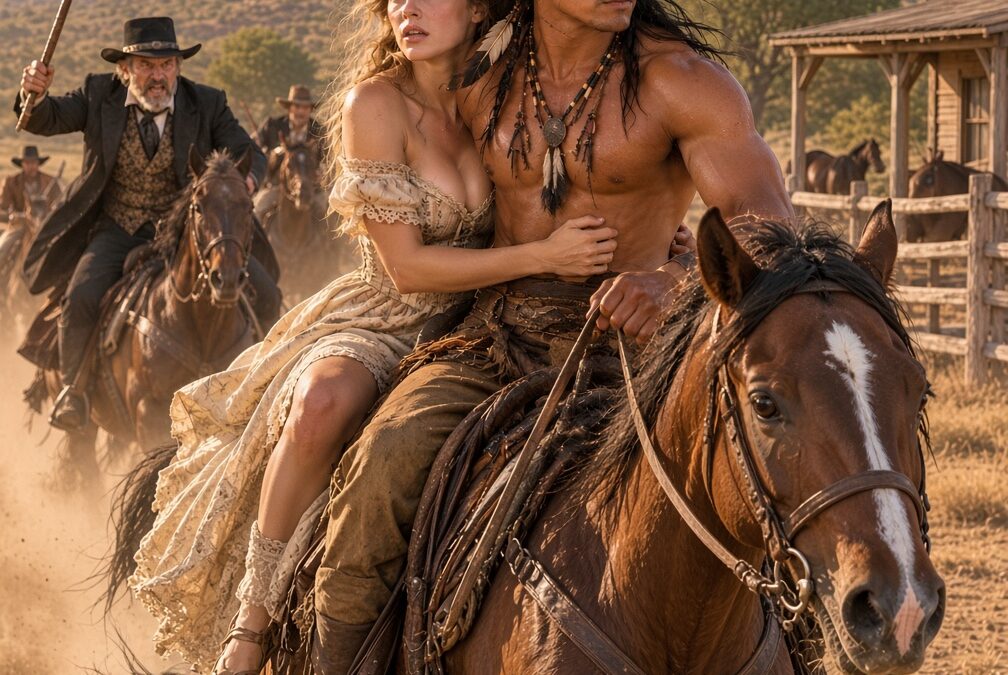
A Wealthy Rancher Wanted To Own Her — But Her Heart Chose A Silent Apache Warrior.

Arizona territory, 1884. By sundown, Sadi Mara would either be dragged back to the ranch that had become her prison or die free beneath the open sky.
The heat had already taken most of what strength she had left. Dust clung to the hem of her torn dress.
Her lips were split, every breath scraped. Behind her, somewhere beyond the wavering grass, men were searching the Mule Creek basin with horses, rifles, and one simple purpose.
Bring her back to Harland Vain. Sadi stumbled once, caught herself on both hands, and kept moving.
Then her knees gave out. She lay still while the prairie wind pushed dry grass against her cheek.
No water, no shade, no strength to stand. Marorrow Ranch was still close enough that she could almost picture the porch posts, the kitchen window, her father’s silver watch ticking in his palm.
Freedom, she had learned, could kill a person, too. A shadow crossed the ground. Sadi opened her eyes.
A man stood above her, bronze skinned, long black hair tied back, a bow resting easy in one hand.
Apache. The word should have frightened her. It didn’t. The men she knew were the ones she feared.
He lowered himself beside her without reaching for a weapon. His eyes moved over the burns on her face, the torn cloth at her shoulder, the hollow beneath her cheekbones.
Then he took a small water skin from his belt. Sadi flinched when he leaned closer.
The stranger stopped. He waited. Only when she gave the smallest nod did he lift the water to her mouth.
“Why?” She whispered. He did not answer. His fingers touched the old scar crossing his throat.
Sadi stared at it, then at him. “You can’t speak.” The man’s expression did not change.
He mixed crushed leaves into a little water, held the cup where she could see it, and waited again.
No command, no bargain. That frightened her more than force would have. Far off, a horse winnied.
The Apache man turned his head. Stillness entered him all at once. Sadi saw his hand settle near his knife, not drawing it, only ready.
Another sound carried across the basin. Hoof beatats. More than one rider. He looked at Sadi, then toward the sound.
For the first time since she had crawled out of that cellar, someone else was being hunted because of her.
He held out his hand. Sadi had spent weeks refusing to let one man own her.
Now staying alive meant choosing whether to trust another. She put her hand in his, and Caro pulled her into the tall grass just before the riders came over the ridge.
3 months earlier, Marorrow Ranch had looked peaceful enough from the road. A whitewashed fence bordered the property.
Cottonwoods bent in the dry wind. Horses shifted lazily beneath the shade of the barn.
Inside the house, Joel Marorrow wound his silver pocket watch. Sadi heard the faint click of its mechanism from across the kitchen.
Her father did everything by time. Meals, work, church, decisions, even people. Come sit down, Edith Marorrow said quietly.
Sadi stayed near the window. Mac passed behind her and squeezed her shoulder once. Just get through supper, he whispered.
That was when she knew. Harland Vain is coming. Sadi turned. Her mother looked down at the table.
Joel closed his watch. You’ve refused two good men already. They weren’t good for me.
That isn’t yours to decide forever. Hooves sounded outside before Sadi could answer. Harland Vain entered carrying the smell of tobacco and dust.
He was older than Joel, dressed too carefully for a working ranch, with a silver wolf’s head set into the top of his cane.
At supper, he barely looked at Sadi while discussing cattle, grazing land, and money with her father.
Then dessert was cleared. Harlon placed a velvet box on the table. Inside lay a heavy gold ring.
“My house needs a woman,” he said. Sadi looked at the ring, then at him.
“No.” Joel’s chair scraped hard against the floor. Harlon’s smile did not move. Sadi folded her hands to keep them from shaking.
“You deserve a wife who wants to be there, Mr. Vain. I would not.” Silence filled the room.
Joel waited until Harlon had gone. Then he struck her. Sadi hit the wall beside the doorway.
Edith gasped. Max stepped forward. Joel raised one finger. Stay out of it. Sadi touched her cheek.
Her father’s face was cold, almost calm. You’ll accept him next week. No. Joel stared at her.
Then you will learn what refusal costs. That night, Sadi was locked in her bedroom without supper.
She sat beside the window with her grandmother’s old journal open across her knees. One line had been underlined years ago.
A woman without choice is already in chains. Sadi read it twice. Then footsteps stopped outside her door.
The lock turned. Joel did not enter. He only said through the wood, “We’ll see how long pride lasts when hunger begins.”
Sadi looked toward the dark window. For the first time, she understood that her father did not intend to change her mind.
He intended to break it. Back in Mule Creek Basin, the riders crossed the ridge just as Carol pulled Sadi into the tall grass.
He lowered her carefully behind a dry bank and pressed one finger to his lips.
Sadi could barely breathe. The hoof beatats grew louder. Voices followed. Spread out. She knew that voice.
Joel. Her whole body tightened. Another writer answered. Harlon vain. Sadie. He called across the grass.
Come out. This foolishness is over. Carol watched her. He did not hold her down.
He did not cover her mouth. He simply waited. That frightened her in a different way.
He was leaving the choice with her. Sadi heard her father again. You come home now and we forget this happened.
Home? The word almost made her laugh. Her fingers closed around the dry grass. She said nothing.
The riders passed close enough that dust drifted through the stems above her face. Caro did not move until the last hoofbeat faded north.
Then he lifted his hand. They waited longer. Only when the prairie fell quiet again did he help her sit up.
Sades strength was gone. Carol studied her face, then pointed west. She nodded. He carried her until darkness.
For the next 3 days, they stayed beneath a shelter of branches and hide near a narrow creek.
Caro gave her water in small amounts. Bitter herbal tea. Soft roots broth. Never enough to make her sick.
Never too fast. When he cleaned the burns on her skin, his hands were careful and efficient.
Sadi watched him work. You’re some kind of healer. Caro glanced up. No answer. She pointed toward the scar across his throat.
You really can’t speak. He touched the scar, then looked away. Sadi accepted that. By the fourth morning, she could stand without falling.
Caro handed her a simple buckskin dress he had prepared for her. Sadi held it against herself.
You made this? A faint curve touched the corner of his mouth. It was the first thing close to a smile she had seen.
They began walking west slowly. Carol never moved faster than Sadi could manage. He showed her where to find clean water, which roots eased pain, and how to stop before exhaustion became collapse.
Soon they built a language from small movements. Two fingers toward the eyes. Watch a flat palm.
Stop. A hand near the mouth. Water. Sadi added one herself. She touched her chest, then opened her palm toward him.
Thank you. Carol watched the gesture, then repeated it. For the first time in weeks, Sadi smiled.
She had escaped men who wanted her obedience. Now she walked beside one who was teaching her how not to need him.
The next days changed Sadi in small ways first. Her steps grew steadier. Her hands stopped trembling when she lifted a cup.
Color returned to her face, though the hollows beneath her cheekbones remained. Caro never praised her with words.
He did it with patience. At a willow creek he cut reeds and shaped a small flute.
That night, while the fire burned low, he played beneath a sky gone deep blue with stars.
The sound was rough in places, mournful in others. Sadi did not understand the song, but she understood what it did to the silence.
Later, when a nightmare pulled her awake, Caro was already sitting across the fire. He did not come closer.
He did not ask what she had seen. He simply stayed. By morning, Sadi had slept again.
The lessons became harder after that. Caro showed her how to move without frightening birds from the grass, how to feel the wind before choosing a direction, how to hold a bow without fighting its weight.
Her first arrow missed badly. The second struck dirt. Carol only reset her shoulders and handed the bow back again.
Days later, Sadi crouched behind a patch of scrub with a rabbit feeding 10 yards ahead.
She drew, released. The arrow struck clean. For a long moment, she stared at what she had done.
Carol knelt beside the animal, placed a hand against his chest, and murmured a quiet prayer in Apache.
Nothing was wasted. That night, the meat tasted different, not because it was good, because she had earned it.
The next afternoon, everything changed. They passed near a small settlement where laundry snapped in the wind.
Carol remained hidden while Sadi traded a carved wooden cup for clothes left on a line.
When she returned, he was standing beneath a cottonwood. A sheet of paper had been nailed to the trunk.
Sadi saw the drawings first, her face, his, then the words. White woman abducted. Apache male wanted, dead or alive.
The notice carried Sheriff Merryill Knox’s name, but Sadi knew whose hand had shaped the lie.
Harlon Vain. He made you the criminal, she whispered. Carol folded the poster and tucked it away.
That night they traveled without fire. Near dawn, hoof beatats drove them into a narrow creek.
Caro pulled Sadi beneath an overhang where cold water rose to her ribs. Riders thundered directly above.
Sadi heard Joel’s voice. Then Harlon’s Carol’s hand found hers beneath the water. For the first time, Sadi was not afraid they would find her.
She was afraid they would find him. They did not stop until the riders were miles behind them.
By dusk, Carol led Sadi into a hidden valley where a narrow river bent beneath cottonwoods and a shallow cave opened behind brush.
For the first time in days, they allowed themselves a fire. That night, Caro knelt in the dirt and drew the sky.
He marked the stars with a charred stick, connecting them into shapes Sadi did not recognize.
Then he drew a curling cloud and touched his chest. Sadi frowned. “Cloud?” A small smile reached his eyes.
She took the stick and wrote the English word beside the drawing. He copied the letters slowly.
Sadi watched his hand move. “You’re learning from me.” Caro looked up, then pointed towards the river, the moss on a tree, and the fading sun.
His answer was plain enough, and you are learning from me. The next afternoon, Sadi asked what had been troubling her.
Why teach me to survive alone? Carol went still. He touched his chest, pointed toward her, then toward the open country.
Sadi understood. Because one day you may choose to leave. The realization hurt. He had saved her, fed her, taught her, hidden her from armed men, and still he was preparing her for a life that might not include him.
Sadi reached for his hand. Carol lifted their joined fingers and pressed a quiet kiss to the back of hers.
Before dawn, a sharp whistle cut through the valley. Carol was on his feet instantly.
He led Sadi through the brush to a wounded Apache scout slumped against a rock, blood darkening one shoulder.
The stranger reached for his knife when he saw Sadi. Carol stopped him with a series of quick signs.
Together, they cleaned the wound, packed it with crushed herbs, and bound it with cloth.
Hours later, the man finally spoke broken English. His name was Relo. His eyes moved from Sadi to Caro.
You think he cannot speak? Sadi looked at Caro. Relo shook his head. Three winters, sacred silence.
The valley seemed to tighten around them. Relo explained that Caro had returned from a vision quest with a vow.
He would not speak until he found a woman between two worlds. One who could hear his heart before hearing his voice.
Sadi looked at Carol. He did not look away. I hear him, she said quietly.
Then Rao gave them the harder truth. White riders were hunting Caro for a bounty.
An Apache camp lay several days west. If they meant to live, they could not stay hidden much longer.
Rao traveled with them for three more days. They moved mostly before sunrise and after dusk, when the heat loosened its grip on Mule Creek Basin.
Caro chose the route carefully, avoiding wagon roads and open ridges where riders might spot them.
On the third morning, they reached the Apache summer camp. Sadi stopped at the edge of the rise.
Below them, lodges circled the bend of a river. Smoke lifted from cooking fires. Children ran between dogs and horses.
Women worked hides beneath stretched frames while men returned from the water carrying fish and bundles of wood.
Then someone saw Carol. Voices rose. Relief swept through the camp when Rao appeared beside him.
That relief changed when they noticed Sadi. No one threatened her. That almost made the silence harder.
Ko stayed beside her as an older woman stepped through the gathering crowd. Nema. Carol<unk>s mother touched his face first, then studied Sadi.
Her gaze dropped to Sadi’s hands. The blisters, the calluses, the dirt packed beneath nails that had once known little harder work than ranch chores.
Nema said nothing. She simply took Sadi inside her lodge and handed her clean buckskin clothing.
Acceptance did not come all at once. Sadi worked for it without asking. She scraped hides until her shoulders burned.
Learned to braid river reads. Helped crush roots for salves. Some women spoke to her.
Others only watched. Caro was watched too. The elders sought him out. Hunters waited for his signs.
Children followed him through camp. Sadi began to understand how much he had risked by bringing her there.
Then three traitors arrived. One stared at Sadi as though he had seen a ghost.
He reached inside his coat. I was told to give you this. The handwriting on the folded letter belonged to Mack.
Sadi opened it beside the fire. Joel was dead. His heart had failed 3 weeks after her disappearance.
Before Mack returned from Chicago, Harland Vain had produced a marriage agreement supposedly signed by Joel.
The document gave Haron control of Marorrow Ranch. Edith was still alive. But she was not free.
Sadi stopped reading. Caro<unk>’s hand settled beside hers. The traitor lowered his voice. There’s more.
Vain is selling rifles to settlers, telling them the Apache are preparing to attack. Relo<unk>’s expression hardened.
And he’s supplying another Apache group. The traitor continued, telling them the settlers mean to burn their winter camps.
Sadi looked toward Carol. Harlon did not want a marriage anymore. He wanted a war and her mother was sitting inside the house from which he meant to profit.
That night the council argued until the fire burned low. At dawn, Sadi stood before Carol.
I have to go back. He closed his eyes for one long moment. Then he placed his hand over his heart and nodded.
Nema met them before sunrise. She carried a small beaded pouch in both hands. Sadi bowed her head as Nema tied it around her neck.
Relo translated quietly. Medicine, prayer, protection. Sadi touched the pouch. Nema looked toward Caro, then back at her.
She says you carry her son’s heart now. Sadi swallowed hard. No blessing could make the road safe, but leaving without it suddenly felt impossible.
Caro knelt before his mother. Nema rested one hand on his head before painting two dark lines across his face.
Not decoration, camouflage. Carol did the same for Sadi. Then they rode southeast. For two days they stayed off the main trails.
On the third morning, voices carried through a stand of scrub oak. Caro raised his bow.
Three men stepped into view. Two settlers, one Apache. Then another figure emerged behind them.
Mack. Sadi ran before she could stop herself. Her brother caught her hard enough to lift her from the ground.
For several seconds, neither spoke. When Mac finally stepped back, his eyes moved over the buck skin.
The sun darkened skin, the bow at her shoulder. You’re not the girl I left behind.
No, Sadi said. She looked toward Carol. I’m not. Mack introduced the others. Clyde Ser, his son Roy Orin.
They took Sadi and Carol to a hidden settlement tucked between the hills where cabins stood beside Apache lodges and families from both sides lived without asking the outside world for permission.
There they met Sir and Tuma. Tuma recognized Caro immediately. Yaro<unk>’s son. The old man clasped Caro<unk>’s arm.
For the first time, Sadi saw grief cross Carol’s face at the mention of his father.
That evening, Max spread a map across a rough table. Harlland’s properties formed a pattern around the disputed country.
Water crossings, grazing routes, an abandoned mine, a weapons cache. Clyde tapped the map. If fighting starts, Vain buys what’s left after everyone else bleeds.
Governor Hugh Talbot had called a peace council at Fort Wuka. In 3 days, they had one chance.
Mack would enter the militia camp. Ciro would warn Chief Vaia. Clyde and Roy would search the mine.
Carol would scout Marorrow Ranch. By the following night, the plan had already begun to fail.
Roy stumbled into camp bleeding from the forehead. They took my father. Harlland’s men had been waiting at the mine.
Clyde was now in Sheriff Mel Knox’s custody, accused of supplying weapons to the Apache.
Carol returned hours later. Edith was alive. Weak armed guards surrounded the ranch. Sadi stared at the map.
Everyone was still trying to move around Harlem. She finally understood that he would keep closing every path until one remained.
I’m going home. Mac looked at her as if she had lost her mind. Sadie stood.
No hiding this time. Carol<unk>s jaw tightened. She met his eyes. I’m not the girl who ran away.
By sunset, Sadi had put on a settler’s dress again. Then she walked openly toward Marorrow Ranch.
And when Harland Vain opened the door, the color left his face. Haron Vain stood in the doorway of Marorrow Ranch as if the dead had returned to accuse him.
For one brief second, the confidence vanished from his face. Then the smile came back.
Sadie. She stepped onto the porch. I came to discuss what you believe belongs to you.
His eyes sharpened. The ranch, the agreement. That was enough. Greed did what fear could not.
Haron opened the door. Inside, everything looked almost unchanged. Joel’s chair still stood at the head of the table.
The same clock ticked against the wall, but the house no longer felt like Sadi’s childhood home.
It felt occupied. Before we speak, she said, I want to see my mother. Harlon hesitated, then motioned towards the kitchen.
Edith Marorrow stood beside the stove. Sadi nearly stopped breathing. Her mother had grown painfully thin.
Her shoulders seemed smaller beneath the faded dress, and the gold wedding band she had worn for 25 years was gone.
Edith dropped the wooden spoon. Sadie. Sadi crossed the room and held her. I’m here.
Harlon watched from the doorway. Sadi leaned close to her mother’s ear. Mac is alive.
Carol is nearby. Tonight we leave. Edith’s fingers tightened around hers. He has men everywhere.
Not everywhere. At supper, Sadi sat across from Haron. Outside the open window, Mac waited in darkness with a notebook.
Farther behind the house, Caro moved toward the cellar. Sadi kept her voice calm. I heard there may be trouble with the Apache.
Harlon swirled whiskey in his glass. There will be. You sound certain. I paid enough to be certain.
Sadi lowered her eyes as if afraid. Harlon leaned back. That was the mistake she had been waiting for.
Settlers need rifles, horses, ammunition, safe routes. Fear is expensive, Miss Marorrow. And profitable? He smiled.
War always is. Below the house, Caro opened the cellar door. Crates filled the darkness.
Rifles, ammunition, supplies marked for settler militia. Other crates intended for the rival Apache group.
Everything Mack needed. Everything Governor Hugh Telbot would need. Then metal struck wood outside. A guard shouted, “Someone’s in the cellar.”
Harland stopped smiling. The chair scraped backward, his hand closed around Sadi’s wrist. “You brought him here.”
Sadi looked directly into his eyes. For the first time, she saw no gentleman hiding behind the expensive coat.
Only the man she had escaped. Haron dragged open a desk drawer. The pistol inside caught the lamplight.
Outside, another voice shouted, “They’ve got Mac.” Harlon pressed the gun against Sadie’s ribs. “Call your Apache!”
Sadi did not move. Harlon shoved her toward the porch. “Call him!” Sadi stared into the darkness.
She knew Carol was out there, and she also knew the most dangerous thing she could do now was exactly what Harlon expected, so she said nothing.
Harlon forced Sadi onto the porch with the pistol pressed against her side. Two armed men dragged Mack into the yard.
Blood ran from his temple. His wrists were tied, but he remained standing. “Come out!”
Harlon shouted into the darkness. “Or I kill them both.” Nothing moved. Only wind passed through the dry grass.
Harlland’s grip tightened. “Your silent hero is a coward.” Sadi watched the treeine. She knew better.
Caro was not hiding from fear. He was waiting for the one moment when violence might prevent something worse.
A whisper cut through the dark. An arrow struck the pistol. Metal flew from Harlland’s hand.
Sadi drove her elbow backward and broke free. Carol came from the shadows. Behind him appeared Sierro, Orin, Roy, and settlers from the hidden valley.
More riders closed in from the opposite side. Harlland’s guards looked around. For the first time that night, they understood they were outnumbered.
Mack twisted away from the man holding him. It’s finished, Vain. Harlon staggered backward. You have nothing.
We have the rifles, Max said. The ledgers, your roots, your own words. Harlon’s face changed.
Not fear. Rage, he seized the silver wolf-headed cane leaning beside the door. Sadi saw the motion before she understood it.
A narrow blade snapped from inside the shaft. Harlon lunged at her. Caro moved between them.
The blade entered his shoulder. Sadi heard herself scream. Caro barely made a sound. He caught Harlon’s wrist, twisted the cane free, and drove him to the ground.
For one heartbeat, Caro stood above him. He could have ended it there. Everyone knew it.
Harlon knew it most of all. Caro stepped back. Roy tied Harlland’s wrists. Hooves approached from the road.
Sheriff Merryill Knox rode into the yard with several deputies. Beside him was Governor Hugh Talbet.
Harland laughed bitterly. You have no authority to take me. Merryill dismounted. That’s where you’re wrong.
Hugh Talbot entered the cellar himself. When he returned, his expression had gone cold. The weapons are enough.
Mack held up the notebook and the confession. Harlon was taken away, still shouting that everyone would regret crossing him.
No one answered. Sadi was already on her knees beside Coro. Blood soaked the buckskin at his shoulder.
She pressed cloth against the wound. You almost died. Carol looked at her. No smile, no triumph.
Around them. Men who had nearly become enemies lowered their weapons. The militia would surrender by morning.
The evidence would go to Fort Wuka. A war had been stopped, but Joel was still dead.
Edith had still been imprisoned. Clyde had still been taken. And Caro would carry the scar of that night for the rest of his life.
Sadi looked toward the road where Harland disappeared. Winning had not restored anything. It had only stopped them from losing more.
By noon the next day, the weapons from Harland Vain’s cellar were on their way to Fort Wuka.
The militia, once they understood how they had been used, surrendered the rifles Harlon had sold them.
The ledgers, supply routes, letters, and Mac’s account followed. No one called it peace yet.
Too much had happened for that word to come easily. Sadi sat with Caro beside the river, washing blood from his shoulder.
The wound was deep, but clean. You almost died because of me,” she said. Caro shook his head.
He reached for a scrap of paper and charcoal. His hand moved slowly. “Two hearts, one path.”
Sadi read the words twice. Then she heard something she had never heard before. “Sadie?”
She froze. Carol<unk>’s voice was low and rough from years of silence. He touched the scar at his throat.
“The vision showed me a woman between two worlds,” he said carefully. I swore I would not speak until I found the one who could hear my heart before my voice.
Tears filled Sades eyes. I heard you a long time ago. Carol placed her hand over his heart.
No oath could erase what had happened. Joel was still gone. Edith would carry the memory of captivity.
Carol would carry a new scar beside the old one, but Harland had failed to turn fear into war.
A year later, spring came soft over Mule Creek Basin. Sadi and Carol lived in a round timber house between settler land and Apache country.
Herbs dried beneath the porch roof. Children from both communities crossed the yard without asking which side it belonged to.
Sadi stood barefoot in the doorway, one hand on her pregnant belly. Inside, Edith needed bread while Nema prepared buffalo meat for drying.
They still did not share a language, but they laughed like sisters. Mack rode in that afternoon carrying papers from Governor Hugh Talbet’s office.
He served as a go-between for the territorial council and Apache elders. The agreement at Fort Wuka held, he said.
Sadi looked toward Ko. He was teaching two children how to read the wind. Nothing was repaired completely.
That was not what peace meant. Peace meant there was still something left to protect.
That evening, Sadi asked the question she had asked many times. “What will we name her?”
Carol placed his hand beside hers on the unborn child. “When we see her eyes, we’ll know.”
No ceremony followed. No promise that the future would be kind. Only the long grass moving beneath the sunset.
Nema watching from the doorway and Carol<unk>’s hand holding Sades. “Two hearts,” Sadi whispered. “One path,” Carol answered.
If Sadi and Carol’s journey stayed with you, thank you for watching all the way to the end.
Stories like theirs remind us that courage is not always loud and that sometimes the strongest choice is simply refusing to become what fear expects of us.








