Abandoned by Her Fiancé, She Married a Feared Duke… Then Learned Why He Chose Her
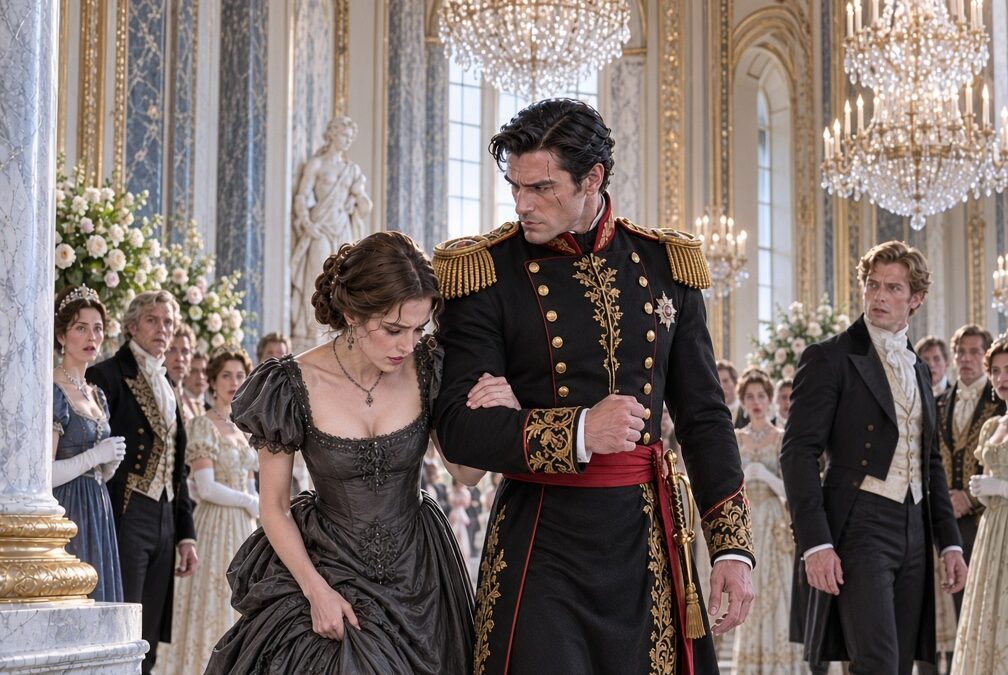
Abandoned by Her Fiancé, She Married a Feared Duke… Then Learned Why He Chose Her

Some men destroy you with a heavy hand. Others do it with a smile, a bow, and a whispered apology in a crowded ballroom.
When Simon broke their engagement, he didn’t just break her heart. He threw her to the wolves of London society.
She was ruined, penniless, desperate enough to accept a lifeline from the devil himself. But marrying the terrifying Duke of Ashborne wasn’t the end of her story.
It was the moment she realized she was the trap. The Castair’s ballroom smelled of melting beeswax, crushed liies, and polite desperation.
Beatric Croft stood near a towering column of faux marble, letting the chilled glass of lemonade sweat through the silk of her glove.
She was waiting for Simon. It had been 3 weeks since her father’s funeral. 3 weeks since the solicitor, a small, nervous man smelling of peppermints and old dust, had sat in their parlor and explained that Arthur Croft had died, not just penniless, but catastrophically in debt.
The fortune was gone. The estate was mortgaged twice over. The dowy Beatatrice had relied upon since childhood was vapor.
She had written to Simon Harkort immediately. He had not replied. He had not called at the house.
Tonight was her first public appearance since the morning period officially allowed her to attend small gatherings.
She had come solely to find him. The orchestra struck up a waltz. The floor became a swirling mass of pastel muslins and dark broadcloth.
And then she saw him. Simon looked exactly as he had the day he proposed, goldenhaired, impeccably tailored, wearing a waist coat of deep sapphire silk that caught the chandelier light.
He was laughing at something Lord Hastings was saying. He did not look like a man whose fiance was standing on the edge of financial and social ruin.
He looked entirely infuriatingly unbburdened. Beatrice stepped forward, moving out of the shadow of the pillar.
Simon’s eyes caught hers across the room. The laugh died on his mouth. A muscle ticked in his jaw.
For a second she thought he might turn and walk out the double doors. Instead, he excused himself from Hastings and made his way toward her.
He did not smile. He did not offer his arm. He stopped 2 ft away, keeping a barrier of empty air between them.
Beatrice, he said. His voice was pitched low, the tone of a man speaking to a stranger who had asked for directions.
Simon. She gripped her glass tighter. I had hoped to hear from you. My letters were received.
He cut in. He glanced over his shoulder. The daagers on the velvet setis were already watching.
The whisper network of the tawn never slept. “This is not the place, Beatress. My father is dead,” she said, keeping her voice entirely flat.
“My home is being audited by the crown. I do not have the luxury of choosing the proper place.”
“Are we still to be married?” Simon flinched. Not out of guilt, she realized with a sickening drop in her stomach, but out of distaste.
He found her directness vulgar. “I cannot marry you, Beatatrice,” he said quickly. “The words felt rehearsed, practiced in front of a mirror.”
“My father caught wind of the shipping disaster. He knows about the loans your father took from the High Court bank to cover his losses.
The scandal, it is too much. My family requires stability. You must understand. She stared at him.
The music swelled, a bright, cheerful crescendo that mocked the sudden roaring in her ears.
“I see,” she said. Her voice sounded thin. “Far away.” “Your family requires stability, and my family requires a home.
A promise was made, Simon. A promise made under different circumstances. He shifted his weight, eager to flee.
You have nothing, Beatrice. No dowy, no standing. If I marry you, my father will cut my allowance entirely.
I would be a martyr, and I have no talent for martyrdom. He offered a short, stiff bow.
I am sorry for your loss. I truly am. But you must release me. He didn’t wait for her to agree.
He simply turned and walked away. He walked back to the bright center of the room, back to Lord Hastings, back to the safety of his wealth.
Beatrice stood entirely still. She did not cry. Crying was for women who had someone to catch them.
The silence around her was immediate and suffocating. The people standing nearby had heard enough.
A broken engagement. A ruined fortune. Within seconds, the invisible perimeter around her expanded. No one wanted to stand too close to bad luck.
Lady Kalpa walked past, making a deliberate point of turning her face toward the opposite wall.
The cut direct. It had begun. Beatrice set her glass on a passing footman’s tray.
Her hand trembled just once. She needed to leave. She needed to walk down the grand staircase, out the front doors, and into the cold London fog before her knees gave out.
She took a step. Her heel caught on the heavy hem of her morning gown.
She stumbled, putting a hand out to catch the pillar. A hand caught her elbow.
The grip was iron hard. Through the silk of her sleeve. The fingers felt hot, calloused, and utterly unyielding.
“Stady, Miss Croft,” a voice grated. It was a voice like stones grinding together, deep, rough, and entirely devoid of polite society’s polished veneer.
Beatatric jerked her head up. The man standing beside her was tall, uncomfortably tall. He wore black, stark, and unadorned, devoid of the fashionable crevat pins, or embroidered waist coats the other men sported.
His face was a harsh landscape of sharp angles, a heavy jaw, and a jagged, pale scar that pulled at the corner of his left eye.
Gideon Rothwell, the Duke of Ashbborne. He was a man the ton invited out of fear, not affection.
He rarely spoke. He never danced. He owned half the coal in England and operated with a ruthless efficiency in the House of Lords that left old estatesmen sweating in their seats.
There were rumors, of course, that he had made his fortune through illicit trades in the east, that he had killed a man with his bare hands in a tavern brawl, that he was entirely incapable of human emotion.
He did not let go of her arm, his pale gray eyes, the color of winter ice, fixed on her face.
“They are waiting for you to run,” the Duke said softly, his gaze flicking to the daagers who were leaning forward like vultures on a branch.
“Do not give them the satisfaction.” “I am leaving your grace,” Beatatrice said, trying to pull her arm away.
His grip did not loosen. You are retreating. There is a difference. The Duke turned his massive frame, effectively blocking her from the view of the worst gossip.
Breathe. Count to three. Then you will walk out of here on my arm, and they will spend the next week wondering what it means rather than pitying you.
Beatrice looked at him. The cold rationality in his eyes cut through her panic like a knife.
He wasn’t offering pity. He was offering a tactical advantage. “Why would you do that?”
She whispered. “Because I detest Simon Harkort,” the Duke replied smoothly. “And I find the sight of him looking smug entirely offensive to my evening.”
He offered his arm. It wasn’t a request. It was a command. Beatrice took it.
His forearm felt like carved granite beneath his sleeve. Together they walked across the ballroom floor.
The Duke walked with a slight heavy limp, his boots striking the polished wood with a rhythmic thud that seemed to silence the room.
The music played on, but no one was listening. Every eye was on the ruined daughter of a dead dter being escorted out by the most dangerous man in London.
At the door, he handed her over to the footman. He didn’t say good night.
He didn’t bow. He merely met her eyes once more, a calculating, entirely unreadable expression on his scarred face before turning his back and walking away.
But the following morning, the scavengers arrived. Beatrice sat in the center of the drawing room, a ledger open on her lap, watching two burly men carry her mother’s prized mahogany pianoforte out the front door.
The house was cold. The fires had not been lit. They could not afford the coal.
Her mother, Lady Croft, was upstairs in bed with a compress over her eyes, weeping softly into a linen handkerchief.
She had been weeping since midnight when Beatatrice had returned from the ball and delivered the news of Simon’s defection.
The baiffs had arrived at dawn. Arthur Croft’s debts had been called in. The creditors were not willing to wait for the estate to be sorted by the crown.
They wanted their money, and they were taking it in silver, in furniture, in paintings.
Miss Croft, Beatatrice looked up. A thin man with a clipboard stood in the doorway.
The library is cleared. We’ll be moving to the dining room next. The silver service is listed on the manifest.
Take it, Beatatrice said. Her voice was hoarse. Take all of it. Just leave the bed my mother is currently occupying.
The man nodded, looking uncomfortable, and scured away. Beatrice closed the ledger. It didn’t matter how many times she added the columns.
The mathematics of their ruin were absolute. They had one week before the house was seized entirely.
After that, it was the charity of distant relatives who had already stopped answering letters or the workhouse.
A heavy knock echoed through the empty hallway. Beatrice ignored it. She assumed it was another creditor, come to claim a mirror or a rug.
But heavy footsteps sounded on the hardwood, slow and deliberate, accompanied by a rhythmic, dull thud.
The drawing room doors opened. Gideon Rothell stood on the threshold. He looked even larger in the stripped down, desolate room.
He wore a dark riding coat, dust clinging to the hem, and carried a leather portfolio under one arm.
His silver tipped cane, which he apparently only used when out of society’s watchful eye, rested heavily in his right hand.
He surveyed the room, the empty spaces on the walls where portraits had hung, the rolled up carpets, the lone threadbear armchair Beatatrice was sitting in.
Your grace, Beatatrice said, too exhausted to stand or feain shock. If you have come for the furniture, you are late.
The creditors have a system. The Duke’s scarred mouth twitched. It wasn’t a smile exactly, but it was close.
I have no need of secondhand chairs, Miss Croft. He walked further into the room, leaning his weight onto the cane with every second step.
He stopped a few feet from her, staring down with those pale dissecting eyes. Your situation is entirely untenable, he stated.
A statement of fact. No apology. Your powers of observation are staggering, Beatrice replied, her chin lifting.
Cynicism was the only armor she had left. Did you come to gloat or merely to observe the mechanics of poverty?
I came to offer you a position. Beatrice froze. A position? A governness? A wife?
The word dropped into the cold room like a lead weight. Beatrice stared at him, waiting for the punchline, waiting for the cruel joke to reveal itself.
But the Duke of Ashborne did not look like a man who told jokes. He looked like a general outlining a battle strategy.
Pardon me,” she breathed. Gideon pulled a single sheet of heavy parchment from his leather portfolio and tossed it onto her lap right over the ledger.
“My terms,” he said. “I will clear your father’s debts entirely. By noon today, the baiffs will leave.
The house will remain in your mother’s name. She will receive an annual stipend of £500, sufficient to maintain her comfortably.
In exchange, you will marry me by special license by the end of the week.
Beatrice looked down at the paper. It was a legal contract, neatly written, sharply defined.
Why? The question tore out of her throat. I am ruined. I have no dowy.
My name is currently dirt in the mouths of every gossip in London. You are a duke.
You could have any desperate debutant in the city. I do not want a debutant, Gideon said.
He leaned heavily on his cane, leaning forward slightly. The the sheer physical presence of the man was overwhelming.
I require a duchess. I require a woman to manage my northern estates, to sit at the end of my table, and to ask absolutely nothing of my heart.
I do not want sering affection. I do not want tears. I do not want a love match.
He gestured to the empty room. You have just learned the brutal reality of this world, Miss Croft.
Romance is a fiction invented to sell poetry. Survival is the only truth. You are pragmatic.
You did not weep in the ballroom last night. You stood your ground. I need a woman with iron in her spine.
You need a shield. It is a mutually beneficial transaction. Beatric’s hands shook as she picked up the paper.
The numbers were staggering. Enough money to wipe away the terror of the last three weeks with a single stroke of a pen.
To save her mother, to save herself from the gutter. A transaction, she repeated, tasting the bitterness of the word.
You’re buying me. I am securing an asset, he corrected coldly. Just as you are securing a future, do not pretend to be insulted, Miss Croft.
Simon Harkort abandoned you because your monetary value dropped to zero. I am offering to raise it to an unassalable height.
As the Duchess of Ashbborne, the people who cut you last night will break their necks bowing to you tomorrow.
He was entirely right and it made her hate him just a little. He stripped away all the polite illusions of their society and exposed the ugly transactional skeleton beneath.
“And what of an air?” She asked, forcing herself to be as brutal and clinical as he was.
Her cheeks burned, but she held his gaze. Gideon’s jaw tightened, the scar beside his eye pulled stark white against his skin.
That is an obligation of the title. It will be fulfilled. But beyond the bedroom door, you will have your life, and I will have mine.
We will reside primarily at Rook Hall in Yorkshire. I have business that requires my attention there.
We leave immediately after the ceremony. He reached into his coat and pulled out a silver fountain pen.
He held it out to her. “I have a meeting at Parliament in an hour,” he said, checking a heavy gold pocket watch.
“I need your answer.” Beatrice looked at the pen. She looked at the empty spaces where her life used to be.
She thought of Simon’s retreating back. She thought of the fear that had kept her awake for 21 nights.
She took the pen. The metal was warm from his body heat. I loathe the Yorkshire, she said softly.
You will learn to tolerate it, he replied. Beatrice signed her name at the bottom of the parchment.
The ink was black and sharp. With a single stroke, Beatatrice Croft ceased to be a ruined spinster and became the property of the devil of Ashbborne.
Gideon took the paper, reviewed the signature, and nodded once. “My solicitor will be here in 10 minutes with the funds to dismiss the baiffs.
Pack your trunks, Beatatrice. We marry on Thursday.” He turned and walked out. He didn’t say goodbye.
The marriage lasted exactly 14 minutes. It took place in a drafty, empty chapel in Mayfair.
Beatatrice wore a gray traveling dress. Gideon wore his customary black. When the vicar prompted them, Gideon slid a heavy square cut emerald onto her finger.
It was cold. It felt like a manacle. They did not kiss. Within the hour, they were in a dark velvetlinined carriage, thundering north toward Yorkshire.
The journey took three agonizing days. They spoke perhaps a dozen words to each other.
Gideon spent the daylight hours reading through stacks of dense parliamentary reports and leatherbound ledgers, a pair of steel rimmed spectacles perched on his nose, ignoring her entirely.
Beatrice spent the time staring out the window, watching the polite green fields of the south warp into the jagged, windtorn moors of the north.
It was raining when they finally arrived at Rookh Hall. Beatatrice had expected a crumbling gothic monstrosity fitting for a man of his reputation.
Instead, Rookh Hall was terrifyingly modern and violently austere. Built of dark, unforgiving stone, it was a massive, symmetrical fortress, sitting on the edge of a cliff overlooking a violently churning gray sea.
There were no ivy covered walls, no romantic gardens, just harsh lines, glass, and rain.
[clears throat] Inside, the estate ran with a silent military precision. The servants did not smile.
They moved like ghosts, anticipating every need before it was voiced. Her bed chamber was vast, draped in heavy silks of midnight blue and silver.
It was connected to Gideon’s chambers by a heavy oak door, a door that remained locked for the first three nights.
True to his word, he demanded nothing of her. He was gone before she woke, riding out onto the moors, or locked in his study, and they only saw each other at dinner.
Dinner was its own unique torture. They sat at opposite ends of a mahogany table long enough to seat 30.
The distance between them required them to raise their voices to be heard, so they simply chose not to speak.
The silence stretched tight, filled only by the clinking of silver on porcelain and the relentless howling of the wind outside the glass.
On the fourth night, Beatatrice reached her breaking point. She was a pragmatic woman, but she was still human.
The isolation, the coldness of the house, and the terrifying silent proximity of her new husband were wearing down the iron spine he had supposedly married her for.
She felt like a ghost haunting her own life. It was past midnight. The house was dead quiet.
Beatrice couldn’t sleep. The emerald ring felt heavy on her hand. She threw off her blankets, pulled a thick wool shawl over her night dress, and took a candle into the dark corridors.
She needed a book, something to quiet her mind. She found her way to the library on the ground floor.
The room was immense, smelling of old paper and leather. A dying fire glowed in the massive hearth.
Beatrice moved along the shelves, her candle flickering over titles in Greek and Latin. She reached the back of the room near a large mahogany desk, and stopped.
A ledger lay open on the desk. It wasn’t one of Gideon’s usual mining reports.
It was older. The pages yellowed. The handwriting was painfully familiar. Beatatrice stepped closer, lowering the candle.
It was her father’s handwriting. Her breath hitched. She set the candle down and pulled the heavy book toward her.
It was a private accounting ledger. Dates, sums, and names. But it wasn’t a record of her father’s investments.
It was a record of transfers, massive sums of money moved from the Croft estate into an account under the name Harkort.
Simon’s father, Beatatrice traced the ink with a trembling finger. Her father hadn’t lost his fortune in bad shipping investments.
The ledger told a different story entirely. Extortion, embezzlement. Lord Harkort had systematically bled her father dry over 5 years using a fabricated scandal from her father’s youth as blackmail.
Her father hadn’t died a fool. He had died a hostage. You should not be down here.
Beatrice gasped, spinning around. Gideon stood in the shadows near the doorway. He was in his shirt sleeves, his crevat gone, a glass of amber liquid in his hand.
The fire light caught the harsh scar on his face, making him look demonic in the gloom.
“What is this?” Beatatrice demanded, her voice shaking with sudden violent fury. She pointed to the ledger.
“This is my father’s private book. Why do you have it? Why does it say Lord Harkort was bleeding him dry?
Gideon stepped into the light. He moved slowly, his limp more pronounced in the late hour.
He looked at the ledger, then at her. He didn’t look surprised. He looked resigned.
“I purchased that ledger from your father’s solicitor,” Gideon said smoothly. He took a sip of his drink.
The man is a coward, easily bought. I required proof of Harkort’s embezzlement. Simon’s father ruined my family.
Beatatrice breathed, the horror of it sinking in. Simon knew. When he broke the engagement, he knew his family held the money.
He threw me away while standing on my father’s grave. “Yes,” Gideon said simply. Beatrice stared at the cold, calculating man she had married.
The puzzle pieces suddenly snapped together, forming a picture so ugly she felt sick. “You hate Simon Harkort,” she whispered, recalling his words at the ball.
“You said you found his smuggness offensive. But it’s more than that, isn’t it? This isn’t just about my father.
This is about you. You didn’t marry me because I have iron in my spine.”
Gideon set his glass down on a side table. The soft clink sounded like a gunshot in the quiet room.
10 years ago, Gideon said, his voice dropping to a low, dangerous gravel. Lord Harkort engineered a land dispute that resulted in the ruin of my older brother.
My brother, lacking your pragmatic nature, put a pistol in his mouth rather than face debtor’s prison.
I have spent the last decade tearing the Harkort Empire apart piece by piece, shipping lines, coal contracts, political alliances.
But the old man always insulated himself. I needed direct proof of a crime severe enough to send a peer of the realm to the gallows.
He walked toward her, stopping only when he was inches away. The sheer heat radiating from him was a stark contrast to the freezing room.
Your father’s ledger is that proof. Gideon continued softly, his pale eyes burning into hers.
But the law dictates that a husband controls his wife’s property. If I merely bought the ledger, Harkort’s lawyers would tie it up in court, claiming it was stolen.
But as your husband, I have the legal right to execute your father’s estate. I have the legal right to demand the stolen funds be returned with interest in open court.
Beatatrice stepped back, hitting the edge of the mahogany desk. I am a weapon, she said.
The realization was a physical blow. You didn’t save me. You weaponized me. I am a legal loophole for your vengeance.
You were drowning, Gideon said, his voice devoid of apology. I pulled you into my boat.
The fact that I require you to help Row does not make the rescue any less real.
I bought your debt, Beatrice. Now we are going to use them to destroy the family that destroyed yours.
We are going to bleed the Horts until they beg in the streets.” He reached out, his large, rough hand suddenly gripping her chin, tilting her face up to meet his intense gaze.
“You asked why I chose you,” he murmured. “I chose you because I knew the moment you’d learned the truth, you would not weep.
You would want blood.” Tell me I am wrong. Beatatrice stared up into the eyes of the devil of Ashborne.
Her heart hammered against her ribs, not with fear, but with a sudden, terrifying rush of adrenaline.
She thought of Simon’s mocking smile. She thought of her mother weeping in an empty house.
She looked at her husband. “You aren’t wrong,” she whispered. Gideon’s thumb brushed against her jawline.
A fleeting, dangerous touch. Good. Then let us begin. The heavy oak door connecting their bed chambers remained locked, but the invisible wall between them had shattered.
The morning after the revelation in the library, Beatatrice did not wait for the servants to bring her breakfast on a tray.
She dressed quickly in a dark wool gown, pinned her hair back with ruthless efficiency, and marched downstairs.
She found Gideon exactly where she left him, at the massive mahogany desk, surrounded by stacks of financial reports and legal precedents.
He looked up as she entered. The harsh morning light off the moors threw the scar on his face into sharp relief.
He did not ask how she had slept. He simply slid a stack of banking records across the polished wood toward the empty chair opposite him.
Harkort funneled the extorted funds through three separate shell companies, Gideon said, his voice a low rasp.
A shipping firm in Bristol, a textile mill in Manchester, and a landholding company in Cornwall.
He was thorough. Beatrice pulled the chair out and sat. She picked up the top sheet.
The numbers swam for a moment before snapping into sharp, damning focus. He was arrogant,” she corrected, tracing a column of figures with her fingertip.
“He assumed my father would never tell anyone, let alone keep a secondary ledger. He used the same holding company to absorb the Croft estate’s liquid assets, as he did to purchase his new town carriage.”
Gideon paused, his pen hovering over a parchment, his pale eyes flicked to her face, assessing.
You understand double entry bookkeeping? I spent the last 3 years trying to keep my father’s sinking ship afloat.
Your grace. I know how to read a ledger. She met his gaze squarely. And I know my father’s accounts better than your solicitors do.
Give me the Bristol manifests. For a long, silent moment, the Duke of Ashbborne just looked at her.
It was a look that would have sent a seasoned politician sweating out of the room.
Beatrice did not flinch. She simply held out her hand. A corner of Gideon’s mouth hitched upward.
The ghost of a smile. He handed her the manifests. For the next 10 days, the library at Rook Hall became a war room.
They worked side by side, locked in a rhythm of cold logic and mathematics. They ate their meals at the desk, ignoring the vast, empty dining room.
The silence between them was no longer the heavy, suffocating quiet of strangers forced together.
It was the humming, charged silence of two predators stalking the same prey. Beatatrice discovered that Gideon was entirely relentless.
He required little sleep, operating on black coffee and a grim burning energy. But she also learned the subtle mechanics of his physical pain.
When the damp coastal winds battered the stone walls of Rookh Hall, his limp grew worse.
He never complained. He simply leaned heavier on his silver tipped cane and set his jaw until the bone turned white.
On the eighth day, he dropped a heavy file onto the desk, leaning his weight on his good leg.
A sudden spasm of pain caused his hand to clench on the edge of the mahogany.
Beatrice stood up. She didn’t ask if he was all right. That would have been an insult to his pride.
Instead, she walked to the sideboard, poured two fingers of brandy into a heavy crystal glass, and set it near his right hand.
The Cornwall accounts are finalized,” she said evenly, pretending to focus on a piece of paper in her hand.
“He transferred £60,000 in total over 5 years. It is enough to break the Hardcourt bank entirely if we demand immediate repayment.”
Gideon stared at the glass of brandy. Then slowly he picked it up. His large, rough fingers brushed against hers for a fraction of a second.
The contact was brief, yet it sent a sharp electric jolt up her arm. “We leave for London tomorrow,” he said, taking a sip.
The liquor warmed the gravel in his voice. “The season is at its peak. Lord Harkort is hosting a ball on Friday.
It is time the Ton remembered that the Duke of Ashbborne does not merely exist in the north, and it is time they met his Duchess.”
Beatrice looked out the window. The gray sea was violently thrashing against the cliffs. She felt the same churning energy in her own chest.
“They expect me to hide behind you,” she noted. “Let them expect it.” Gideon stepped closer, towering over her.
He smelled of ink, brandy, and cold rain. “You are not a shield, Beatatrice. You are the sword.
I will simply provide the leverage to swing it. London had not changed, but Beatatrice had.
When the Ashbborne carriage pulled up to the Harkort townhouse in Mayfair, the murmurss began before the footman even opened the door.
The carriage was black, unadorned, except for the silver crest of the Duke on the door.
It looked like a hearse arriving at a festival. Beatatrice stepped down onto the cobblestones.
She was not wearing the muted apologetic half morning grays expected of a woman in her situation.
Gideon’s modist in York had worked miracles in a week. Beatrice wore a gown of deep or saturated midnight blue silk that shifted like a bruised sky when she moved.
Around her neck sat the ashbor sapphires, heavy, cold, and dripping with an ancient, terrifying wealth.
Gideon stepped down behind her. He wore stark black evening clothes. He did not carry a cane tonight.
He stood tall, a towering monolith of dark intent, and offered her his arm. “Shoulders back, Duchess,” he murmured, his breath brushing her ear.
“My shoulders are perfectly straight, Ashborn,” she replied, gripping his forearm. I know, but I enjoy reminding you.
They walked up the steps and into the crowded ballroom. The Major Domo banged his staff against the marble floor.
His grace, the Duke of Ashborne, and the Duchess of Ashbborne. The music did not stop, but it seemed to falter.
The collective gaze of 300 members of the Ton swiveled toward the entrance. Fans paused midflutter.
Conversations died in throats. Beatatrice swept into the room on Gideon’s arm. She felt the weight of their stairs, the frantic mental calculations.
A month ago she had stood in a similar room, ruined and discarded. Now she returned, wearing a king’s ransom in jewels, anchored to a man who could buy and sell everyone in the room before breakfast.
She saw Lady Kalper, the woman who had given her the cut direct, turn pale and abruptly drop her gaze to the floor.
Beatrice felt a vicious, deeply satisfying thrill curl in her stomach. “Do not smile yet,” Gideon instructed softly, guiding her through the parting crowd.
People were stepping back, giving them a wide birth. “Let them sweat. I am merely admiring the architecture.
Beatatrice lied smoothly. They reached the edge of the dance floor and then the crowd parted and Simon Harkort was standing there.
He looked exactly the same, golden, polished, wearing a coat of immaculate green velvet, but the smug confidence that usually radiated from him had completely evaporated.
He stared at Beatatrice as if she were a ghost holding a loaded pistol. Beside him stood his father, Lord Harkort, an older, heavier version of Simon with a fid face and a sharp, calculating eyes.
Those eyes darted from the ashbor sapphires on Beatric’s neck to the jagged scar on Gideon’s face.
The older man recognized the danger immediately. Simon, however, was a fool. He detached himself from his father and stepped forward, pasting a stiff, incredibly fake smile onto his mouth.
Beatrice, Simon said. He caught himself. Your grace. This is an unexpected surprise. We had not heard you returned to town.
Beatrice let the silence stretch. She looked at him. Really looked at him. She saw the weak line of his chin, the panicked sweat gathering at his temples.
He wasn’t a golden god. He was a coward who had built his life on stolen money.
“Mr. Harkort,” Beatatrice said, her voice carried clear and ringing in the quieted room. “I do not believe I owe you my itinerary.”
Simon’s smile strained. He tried to project an air of tragic intimacy. I understand you are angry, Beatatrice.
The circumstances of our parting were difficult, but surely we can remain civil. I see you have found a comfortable arrangement.
He glanced at Gideon, a poorly concealed sneer on his face. It was a mistake.
Gideon did not raise his voice. He did not move abruptly. He simply shifted his gaze to Simon.
The physical temperature in their small circle seemed to drop 10°. Mr. Harkcourt, Gideon rasped, the sound like a shovel dragging over gravel.
You address my wife as your grace. If you forget her title again, I will have your tongue removed and nailed to my carriage door.
Simon physically recoiled, his face draining of blood. He took a stumbling step backward. Lord Harkort hurried forward, his fed face tight with panic.
Ashbborne, please, my boy misspoke, a lapse in manners. We are honored to host you and the new duchess in our home.
Gideon looked at the older man. The hatred in the Duke’s pale eyes was so absolute, so ancient and frozen that Beatrice felt it radiating through the heavy broadcloth of his sleeve.
Enjoy your ball, Harkort,” Gideon said softly. “It will be your last.” He turned on his heel, pulling Beatatric smoothly with him, leaving the Harkourts, standing in a suffocating cloud of public humiliation.
They did not stay for supper. They had made their appearance. The snare was set.
The following Tuesday it rained. It was a miserable gray London morning, matching the mood inside the private offices of the Hardcourt Bank in the city.
Beatatrice sat in a highbacked leather chair, her hands folded neatly in her lap. The damp chill of the room barely registered.
Across the wide mahogany desk sat Lord Harkort. Simon stood by the window, looking out at the rain, nervously gnawing on his thumbnail.
Gideon stood behind Beatric’s chair. He did not sit. He simply loomed, an immovable shadow.
I must admit, Ashborn, I am confused by this meeting, Lord Harkort began, adjusting his cuffs with false bravado.
If you are looking to secure a loan, our terms are quite competitive. But given the suddeness, I am not here for a loan, Gideon interrupted.
He reached inside his coat and withdrew the leatherbound ledger. He tossed it onto the desk.
It landed with a heavy final thack. I am here for a withdrawal. Lord Harkorts stared at the spook.
A bead of sweat broke out on his forehead. I do not recognize that ledger.
You should, Beatatrice said. She leaned forward slightly, resting her elbows on the armrests. It belonged to my father, Arthur Croft.
It details every transaction you forced him to make. The extortion, the blackmail, the 60,000 you siphoned from his accounts into your shell companies over the last 5 years.
Simon spun around from the window. What? Father, what is she talking about? Quiet, Simon.
Harkort snapped, his voice trembling. He looks back at Gideon, attempting a scoff. This is preposterous.
Arthur Croft was a known gambler and a terrible investor. You cannot prove this book is anything but the frantic scribblings of a ruined man.
It would never hold up in chancery. It does not need to hold up in chancery, Gideon said quietly.
I am not taking you to court, Harkort. I am taking you to the grave.
He placed both hands on the back of Beatatric’s chair, leaning forward. “As Beatatric’s husband, I am the legal executive of the Croft estate,” Gideon explained, his voice entirely devoid of emotion.
“I am calling in the stolen funds. £60,000. I want it delivered to the Ashborne vaults by noon tomorrow in gold bullion.”
Harkort’s face went completely gray. He looked like a man who had just been informed he had a terminal illness.
60,000. Ashborne. You know the bank doesn’t keep that kind of liquidity on hand. It is tied up in investments in shipping.
I know exactly where it is tied up. Gideon countered smoothly. I know your shipping lines are currently stranded in the West Indies due to a hurricane you failed to ensure against.
I know your textile mills are operating at a loss. I know that if I walk out of this office and casually mention to a few key investors at Whites that the Harkort Bank cannot produce £60,000 there will be a run on this bank by 3:00 this afternoon.
The silence in the office was total. Only the sound of the rain lashing against the glass broke the quiet.
You will ruin me, Harort whispered. I already have, Gideon corrected. 10 years ago, you ruined Thomas Rothell.
You drove my brother to put a pistol to his head in a squalid boarding house.
Did you think I had forgotten? Did you think I would let it rest? Simon stepped away from the window, his face a mask of horror as he finally understood the sheer scale of the trap they had walked into.
“Beatric, please,” he begged, his voice cracking. “You cannot let him do this. You are a reasonable woman.
We were to be married. I care for you.” Beatatrice looked at the man she had wept over for 21 nights.
She felt nothing. No anger, no sorrow, just a cold, clean emptiness. You care for your allowance, Simon, she said softly.
You threw me to the wolves because you thought I had no teeth. You were wrong.
She stood up, smoothing the front of her skirt. My father died believing he was a failure because you bled him dry.
You have until noon tomorrow. She turned and walked toward the door. Gideon picked up the ledger and followed her.
They did not look back. They stepped out of the bank and into the waiting carriage, the door shut, sealing them in the quiet gloom of the leatherlined interior.
As the carriage lurched forward into the London traffic, the adrenaline that had been carrying Beatrice for the last hour suddenly vanished.
Her hands began to shake. She clasped them tightly together in her lap, staring down at her emerald ring, fighting the sudden, overwhelming urge to shatter into a million pieces.
She had done it. She had avenged her father. She had destroyed Simon. But the victory felt heavy, leaving a hollow cavity in her chest.
A large, warm hand covered hers. Beatatrice flinched, looking up. Gideon was watching her. The cold, demonic general who had just annihilated a banking empire was gone.
In his place was a man who looked exhausted, bearing the weight of a 10-year crusade that had finally come to an end.
He didn’t say anything. He didn’t offer empty platitudes or tell her she was brave.
He simply unclasped her trembling hands, took her right hand in his, and held it.
His thumb rubbed a slow, steady rhythm across her knuckles. It was a grounding touch, an anchor in the violent storm they had just created.
Beatrice let out a long, shaky breath and leaned back against the squabs. She did not pull her hand away.
For the first time since her father died, she didn’t feel like she was fighting the world alone.
She closed her eyes, listening to the rain, safely tethered to the devil in the dark.
The grandfather clock in the Ashborne townhouse parlor struck noon. Each chime was a heavy, resonant strike of brass that vibrated through the floorboards.
Beatrice sat by the window, watching the street. The rain had cleared, leaving the London cobblestones slick and gleaming like fresh oil.
She held a cup of tea. It had gone entirely cold. Gideon stood by the fireplace.
He was already dressed for the afternoon, his severe black coat tailored sharply to his broad shoulders.
He held his pocket watch, his thumb resting over the crystal face, waiting for the final chime.
12. The silence that followed was absolute. No courier arrived with a drafted note. No heavy wagons pulled by draft horses clattered into the courtyard bearing crates of gold bullion.
The harquarts had failed. Gideon snapped the watch shut. The sharp metallic click echoed in the quiet room.
He slid the timepiece into his waist coat and looked at Beatatrice. “It is done,” he said.
An hour later, the news hit the city. It started as a whisper in the coffee houses and exploded into a roar on the trading floor.
The Harkort bank was insolvent. The Duke of Ashbborne had called in a massive debt and the vaults were empty.
The panic was instantaneous. Carriages jammed the streets outside the bank’s headquarters. Men beat their fists against the locked brass doors.
By 3:00, the Hardcourt shipping lines were seized by secondary creditors. By four, their textile mills in Manchester halted production.
A 50-year-old empire built on extortion and polite smiles burned to the ground in a single afternoon.
Beatrice did not feel the triumphant rush she had anticipated. She felt hollowed out, a vessel scraped clean.
She spent the afternoon reading in the parlor, unable to focus on the words, her mind drifting to her father’s grave.
He could finally rest. At dusk, a commotion at the front door shattered the quiet, voices raised in the foyer, the heavy thud of boots.
Beatatrice set her book aside and walked out to the landing. Simon Harkort was standing in the entryway.
He looked like a man who had been dragged behind a galloping horse. His immaculate crevat was torn.
His golden hair was plastered to his forehead with nervous sweat. Two massive ashbor footmen had him pinned by the arms, their faces entirely impassive.
Gideon stood at the bottom of the stairs, leaning on his cane, watching Simon with the detached curiosity of a man observing a dying insect.
Let him go,” Beatatrice said, her voice cut through the scuffle. The footmen immediately stepped back, though they kept their massive frames between Simon and the stairs.
Gideon glanced up at her. He did not object. He simply waited. Beatrice descended the stairs slowly.
The silk of her skirts hissed against the runner. She stopped on the bottom step, looking down at the man she had once planned to marry.
Beatatrice! Simon gasped, lurching forward. He stopped when Gideon’s cane tapped sharply against the marble floor, a singular, terrifying warning.
Simon swallowed hard, his eyes wide and frantic. Beatrice, you have to stop this. My father is ruined.
The bank is gone. The creditors are taking the townhouse tomorrow morning. We have nothing.
I am aware of how bankruptcy operates, Simon, Beatatrice said softly. I experienced it three weeks ago.
Did you come here to ask for a tutorial on how to pack a trunk?
Simon flinched. It was my father. It was all his doing. I didn’t know the extent of the blackmail.
I swear it. When I broke the engagement, he forced my hand. He threatened to cut me off.
I had no choice. He was begging. The golden boy of the London season was standing in her foyer, throwing his own father to the wolves to save his skin.
It was pathetic. It was sickening. “You always have a choice,” Beatatrice said, her voice entirely flat.
“You chose your comfort over my life. You chose your allowance over my father’s memory.
You looked at me across that ballroom, Simon, and you saw nothing but a liability.
I was a fool, Simon cried, reaching out. He didn’t dare touch her, but his hands grasped at the empty air.
Please talk to him. Talk to Ashbborne. He will listen to you. Have him release the Cornwall holding.
Just enough for me to flee to France. If I stay in London, they will throw me in fleet prison.
I won’t survive it. Beatatrice stared at him. She searched her chest for the old affection, the girlish admiration she had harbored for him.
There was nothing. Just ash. The Duke of Ashbborne does not take orders from me, Beatatrice said coldly.
And even if he did, I would not ask for your salvation. You are exactly where you belong, Simon.
On your knees. She turned her back on him and began to walk up the stairs.
“You bitch!” Simon spat, his voice cracking with sudden venomous despair. “You sold yourself to a crippled monster just to ruin me.”
“You think you won? You have to live with him.” Gideon moved so fast it defied his injury.
Before Simon could draw another breath, Gideon crossed the foyer, dropping his cane. He grabbed Simon by the throat of his ruined crevat and slammed him backward into the heavy oak door.
The impact shook the glass panes. Simon choked, his hands scrabbling uselessly against Gideon’s iron grip.
Gideon’s face was inches from Simon’s. The scar beside his eye pulled tort, white, and terrifying.
If you ever speak to my wife again,” Gideon whispered, the gravel in his voice grating like broken glass.
“I will not bother with ledgers or courts. I will simply tear you apart with my hands and throw you into the tempames.
Nod if you understand me.” Simon nodded frantically, his face turning purple. Gideon released him, stepping back in disgust.
He did not pick up his cane. He signaled to the footman, “Throw this trash into the street.
If he approaches this house again, break his legs.” The footman dragged a weeping Simon out the door, tossing him onto the damp cobblestones before slamming the heavy oak shut.
Silence fell over the foyer again. Gideon stood near the door, breathing heavily, his weight shifted entirely to his good leg.
His hands were clenched into fists at his sides. Beatatrice stood on the landing, her hand gripping the banister.
She watched the tension humming through his massive frame. He didn’t look like a monster to her.
He looked like a man who had carried a war inside himself for a decade and was finally standing on the quiet battlefield.
She descended the stairs, picked up his silver tipped cane from the marble floor, and walked over to him.
She held it out. Gideon looked at the cane, then at her. He took it, his rough fingers brushing hers.
“We are done here,” Beatatrice said quietly. “Yes,” Gideon replied, his voice dropping its violent edge, softening into something exhausted.
“We leave for Yorkshire in the morning.” The journey north was different this time, the heavy, suffocating silence of their wedding trip was gone.
In its place was a quiet functioning truce. They sat in the carriage reading, occasionally trading a newspaper or a political pamphlet without speaking.
When they stopped at ins, Gideon ensured she had the best room, the hottest water, the warmest fire.
It was a mechanical care, precise and efficient. But Beatatrice found herself watching him when he thought she wasn’t looking.
She noticed the way he rubbed his left thigh when the carriage hit a deep rut.
She noticed that the dark circles under his pale eyes, the exhaustion he refused to acknowledge.
He had avenged his brother. He had fulfilled his life’s dark purpose. And now he seemed entirely unmed when Rookh Hall finally loomed on the horizon.
Its dark stone cutting a jagged silhouette against the bruised Yorkshire sky. Beatrice did not feel the dread she had upon her first arrival.
She felt a strange sense of relief. London was a theater of ghosts and gossips.
Rook Hall was honest. It was brutal, cold, and entirely real. For the first two weeks back at the estate, Gideon retreated into himself.
He spent his days riding the moors alone, returning late in the evening smelling of rain and horse sweat.
Beatrice did not wait for him to engage her. She had made a deal. She was the Duchess of Ashbborne, and she intended to earn her keep.
She took control of the household. She dismissed the corrupt steward who had been skimming from the household accounts, replacing him with a younger, sharper man from the village.
She audited the estate’s pantries, ordered new linens to replace the moth eataten silks in the guest wings, and began managing the correspondents for the local tenant farms.
The servants, who had initially treated her like a temporary ghost, quickly realized they were dealing with a woman who had navigated the complete collapse of a London estate.
She was fair. She was ruthless with inefficiencies, and she missed nothing. Within a fortnight, Rookh Hall was running with a hum of quiet, respectful energy.
Gideon observed all of this from a distance. One evening, late in November, a massive storm blew in off the North Sea.
The wind shrieked around the stone turrets of the manor, rattling the heavy glass panes.
Beatrice was in the library, sitting at the mahogany desk, reviewing a stack of tenant leases by the light of a roaring fire.
The door opened. Gideon walked in. He was soaked to the bone. He had been out on the moors, caught in the sudden squall.
His dark hair was plastered to his skull, and his clothes clung heavily to his massive frame.
He was not using his cane. He was leaning heavily against the doorframe, his face entirely gray, a sheen of cold sweat on his forehead.
Beatatrice stood up immediately, dropping her pen. Gideon. It was the first time she had used his Christian name.
He looked up, his pale eyes entirely unfocused. He took a step into the room and his left leg simply gave out.
He didn’t cry out. He caught himself on the edge of a heavy leather armchair, his knuckles turning white as he gripped the upholstery, his breathing shallow and rapid.
Beatrice crossed the room in seconds. She didn’t hesitate. She slid her shoulder under his arm, wrapping her arm around his waist.
Lean on me. Gideon tensed, trying to pull away. I am fine. I simply lost my footing.
You are a terrible liar and you weigh 14 stone. Beatrice snapped, a voice brokering no argument.
Stop being a martyr and lean your weight on me. For a second his pride fought her.
Then, with a harsh exhale, he let his weight drop slightly against her side. He felt like a furnace radiating heat through his soaked coat.
Together they awkwardly navigated the few feet to the sofa near the fire. He collapsed onto it with a heavy thud, stretching his bad leg out with a suppressed groan.
Beatatrice knelt on the rug in front of him. She didn’t call for a servant.
She reached out and began unbuttoning his soaked coat, peeling the heavy soden wool off his shoulders.
He let her do it, his head falling back against the leather cushions, his eyes closed.
It was crushed in a mining collapse. Gideon grated quietly, breaking the silence. 12 years ago, before Thomas died.
I went down to inspect a new seam. The timber gave way. Beatric gently pulled his wet boots off, setting them aside.
She kept her eyes on her work. It is a miracle you did not lose the leg entirely.
The doctors wanted to take it. Thomas stood at the foot of the bed with a loaded fouling piece and told them he would shoot the first man who brought a saw into the room.
Gideon opened his eyes looking at the fire. The flames cast dancing shadows over the sharp angles of his face.
Thomas was the good one. Beatatrice. He said softly. The raw vulnerability in his voice was startling.
He was kind. He was optimistic. He trusted people. Harkort saw that trust and weaponized it against him.
When Thomas died, I didn’t just lose my brother. I lost the only anchor I had to humanity.
I became what people expected me to be, a monster, a machine. Beatrice moved to sit beside him on the sofa.
The space between them, usually so carefully guarded, vanished. “You are not a monster, Gideon,” she said.
He turned his head to look at her. His eyes were dark, haunted by a decade of solitary confinement within his own mind.
“I bought you, Beatrice. I traded a fortune for your father’s ledger and I used you to destroy a man.
That is not the action of a good man. It is the action of a man who loved his brother.
Beatatrice corrected. She met his gaze squarely, letting him see the absolute certainty in her eyes.
“You gave me the power to avenge my father. You gave my mother a home.
You shielded me from a society that wanted to watch me starve. You did not buy me, Gideon.
You armed me. Gideon stared at her. His chest rose and fell in a slow, deep rhythm.
He reached up, his rough fingers brushing a stray lock of hair away from her face.
His touch was hesitant, as if he expected her to shatter or to pull away.
She didn’t either. She leaned slightly into his palm, a sharp breath hitched in his throat.
He dropped his hand, sitting up slightly. It is late. You should go to bed, Beatatrice.
It was a retreat. He was terrified of the Thor, terrified of wanting something beyond vengeance.
Beatatrice stood up. She looked down at him, sitting in the fire light, bruised and exhausted, and fiercely protective of his own isolation.
She didn’t push him. She picked up a shawl from the desk. “Good night, Gideon,” she said.
She walked out of the library, leaving him alone with the fire. An hour later, Beatatrice lay in her massive, dark bed.
The wind was still howling outside. She stared at the ceiling, sleep entirely elusive. She thought of the heavy oak door connecting their rooms.
It had been locked since the day they arrived. A symbol of their transaction. Suddenly, a sound cut through the noise of the storm.
Click. It was a heavy metallic sound, the sound of a key turning in a brass lock.
Beatrice sat up, her heart hammering in her chest. She looked across the shadowy room.
The handle on the heavy oak door turned slowly, and the door swung open a few inches, leaving a gap of black space between their chambers.
He didn’t step through. He didn’t call out to her. He simply unlocked the door.
It was an invitation, an admission of defeat. He was dismantling the wall, but he was leaving the final choice to her.
Beatrice didn’t hesitate. She pushed the heavy quilts aside and swung her legs out of bed.
The stone floor was freezing against her bare feet, but she didn’t care. She crossed the room in the dark, her white linen night dress catching the faint moonlight filtering through the storm.
She pushed the heavy oak door open and stepped into his chambers. Gideon’s room was stark, devoid of the heavy silks and tapestries that decorated hers.
It smelled of cedar, wood smoke, and him. He was standing by the window wearing dark trousers and a loose white shirt unbuttoned at the throat.
He was leaning heavily on his cane, watching the violent sea crash against the cliffs below.
He turned when she entered. He looked entirely stripped of his terrifying armor. He looked like a man standing on the edge of a precipice, waiting to fall.
Beatrice walked toward him. She didn’t stop until she was a foot away. Close enough to feel the heat radiating from his skin.
Why did you unlock the door? She asked quietly. Gideon gripped the silver head of his cane.
His knuckles were white. Because I am tired of locking you out. That is not an answer.
Beatrice stepped closer. She tilted her head back to look at his face. The scar, the harsh lines, the guarded eyes.
You could have stolen that ledger, Gideon. You could have bribed my father’s solicitor for the original documents.
You did not need to marry me to ruin the hard courts. It was an excuse.
Why did you choose me? Gideon closed his eyes for a fraction of a second.
A muscle jumped in his jaw. When he opened them, the icy restraint was gone.
The pale gray was burning. Because I watched you in that ballroom,” he rasped, his voice dropping into the quiet space between them.
“I watched your fiance abandon you. I watched your world collapse. And you didn’t weep.
You didn’t faint. You stood there bleeding out in front of 300 vultures, and you lifted your chin.”
He let go of the cane. It clattered against the stone floor, ignored. He raised his hands, hesitating for a second before wrapping his large, rough palms around her waist.
He pulled her flush against his body. “I have spent 10 years surrounded by people who smile at me while wishing me dead,” Gideon said, his voice a low rumble against her chest.
“I chose you because you were the first honest thing I had seen in a decade.
You looked at me, Beatatrice, and you didn’t see a duke. You didn’t see a monster.
You saw a man. And I realized I didn’t want a business partner. I wanted you entirely.
Beatric’s breath caught. The pragmatism, the cold survival instinct that had kept her alive for the last two months, melted away, leaving something warm and dangerously fragile in its wake.
She reached up, her hands tracing the broad line of his shoulders, moving up to frame his face.
Her thumb brushed over the jagged scar beside his eye. He didn’t flinch away. He leaned into her touch, closing his eyes, a shudder running through his massive frame.
“I am not a transaction, Gideon,” she whispered. “No,” he agreed fiercely, opening his eyes.
He wrapped his arms fully around her, burying his face in the crook of her neck.
You are my anchor. You are my wife. When he kissed her, it wasn’t hesitant.
It was a collision. It was a kiss born of a decade of starvation, of two people who had built fortresses out of ice, finally finding a fire hot enough to melt them down.
His mouth was demanding, desperate, tasting of brandy and desperate relief. Beatatrice kissed him back with equal ferocity, her fingers tangling in his dark hair, pulling him closer.
He swept her up into his arms, entirely ignoring the pain in his leg, carrying her toward the massive four poster bed in the center of the room.
There was no polite society here. No ledgers, no debts, no ghosts of the past.
As they fell into the dark, heavy sheets, tearing away the remnants of their clothing, Beatatrice realized the truth.
Simon had thrown her to the wolves, hoping she would be devoured. Instead, she had found the alpha of the pack, and he was hers.
They did not speak of hardourts or bankruptcies again. In the dark of the Yorkshire night, the Duke of Ashbborne finally laid down his sword, and Beatatric Croft found a home that could never be taken away.








