Forced to Marry the ‘Blind’ Duke — On Their Wedding Night, He Looked Straight Into Her Eyes
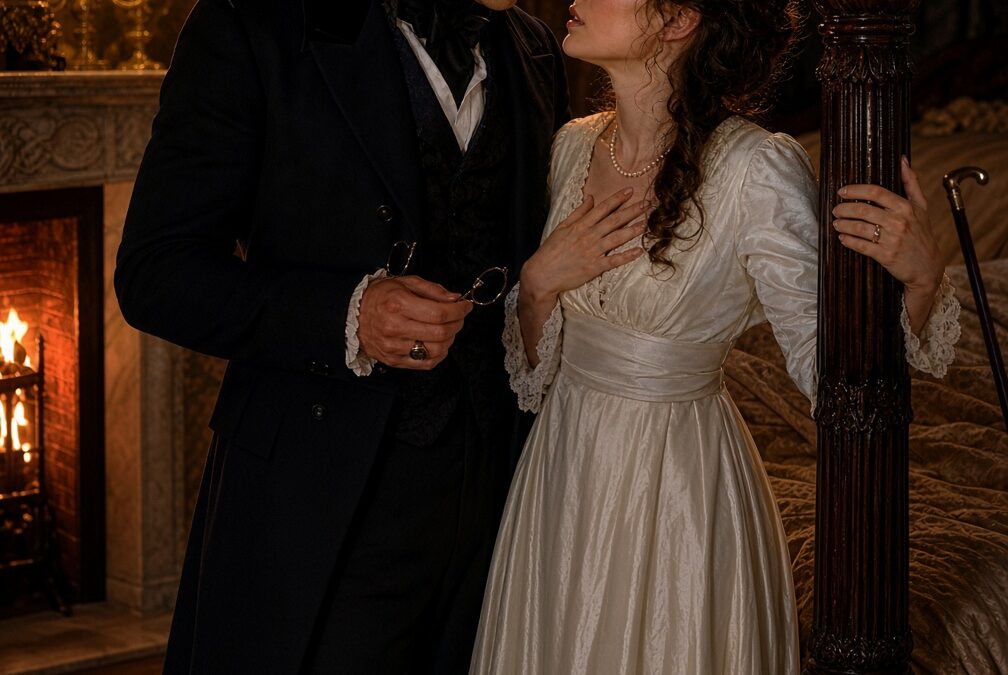
Forced to Marry the ‘Blind’ Duke — On Their Wedding Night, He Looked Straight Into Her Eyes

Repeat after me, said the clergyman. I, Gideon Ravensworth, Duke of Renfield, take the clemency veil.
He said the words to a point 6 in above her left shoulder, cuz a blind man does not find a face, and he had been a blind man for 11 months.
But he saw her. He saw the small pearl button at her throat that had been sewn back on with thread of the wrong shade.
He saw her hands shaking around a bunch of white heather that some kind soul in the village had cut for her because no one had thought to order flowers.
He saw that she had been crying and had stopped and had lifted her chin and that her eyes when she looked at him were not frightened but sorry, sorry for him, and that was the moment the vow turned in his chest like a knife going in slow.
To have and to hold, he said, from this day forward. Her voice came after his, low and steady, and she did not once falter, and she put her hand into his hand as though she were laying something down at the door of a house she did not expect to be admitted to.
Behind him from the second pew, a voice said quite a, “Well, she has bought herself a title and a in one bargain.
Cheap at the price.” That was Silus Kell, cousin, the man who had been killing him since the spring before last.
Gideon did not turn his head. That was the whole art of it, not to turn his head.
11 months of letting his gaze drift wide of every speaker, of walking with a cane he did not need into rooms he could see perfectly, of holding out his hand for a cup he had already counted the steps to.
11 months of hearing what men say in front of a blind man, which is very nearly everything.
But he heard too the smal clemency veil made a breath drawn sharp through the nose and he felt her fingers tighten on his once hard as though she would have liked to strike someone with that hand and had settled for holding his instead.
She thought he had not heard. She was shielding him from a thing he had spent 11 months paying to be told.
You may kiss the bride, said the clergyman. He bent his head and found her cheek, which was cold, and touched it with his mouth for the space of a heartbeat and thought.
She does not know that tonight she will hate me, and she will be right.
The marriage had been made in a room she never entered, by men who never asked her.
Her uncle, Mr. Silus Vale, had come into money the way weak men come into money by borrowing it, and by January he was in debt to four houses and a bank.
And one of those debts, through a quiet solicitor, who asked no questions and was paid not to, had been bought up entire by the Duke of Renfield, who signed the paper himself in the dark at 3:00 in the morning, knowing precisely what he was doing and doing it anyway.
He had needed a wife, not for tenderness, for the terms of a will. His father’s will provided that if Gideon died unmarried and without issue.
Ashcom, the whole Renfield estate passed to the nearest male of the blood to Silus Kell, son of his father’s sister, who had grown up on the estate, who knew every field and rent roll of it, and who had spent 30 years watching another man walk about in what he considered his own coat.
Gideon had learned about the arcenic in March from a country physician who came at midnight, examined the tremor in his hands and the ruin of his stomach and the gray light going out of his sight and said very quietly, “Your grace, forgive me.
How much of your food is prepared by persons of your own choosing.” The blindness had been real at the start.
That was the thing nobody understood and nobody could be told. For nine days he had lain in the great blue bed chamber and seen nothing at all, not the window, not his own hand, nothing but a gray sea with a hot coal at the center of it.
And he had listened to his cousin walk about the room and speak of him in the past tense.
He will not last the month. Kel had said to someone in the doorway, and when he is gone, we shall have this place put right at last.
Pull down that gaudy library, sell the pictures. He never looked at them. Gideon had lain with his eyes open, seeing nothing, and had understood that he was a dead man, unless he made himself a useful one.
He stopped taking the tonic. He ate only what came from the hands of Mrs. Ardley, who had been his mother’s woman, and who wept when he told her why.
And slowly, over 3 weeks, like a coast coming back through fog, he began to see, and he told no one, not the physician, who was sent away with a fee and a lie.
Not the magistrate, Sir Peter Halloway, who had looked at the ledgers and said, “Your grace, suspicion is not evidence, and a duke’s word against the stewards is a scandal, not a conviction.
Get me his own tongue. Get me his hand.” So Gideon bought a cane of black malaca and a pair of dark spectacles, and taught himself to let his eyes go loose and unfocused in his head like two windows in an empty house.
And Silas Kell, who had failed to kill him, was given a better prize. A duke who could not read a ledger, could not see a signature, could not tell whether the man boowing to him was smiling.
By the autumn, Gideon had 11 pages of the man’s hand and a problem. The problem was Kel’s other design, a young lady, Miss Hanoria French, a connection of his, pale and patient and wellchooled, who had been brought to Ashcom three times and sat at the piano and praised.
Kel wanted the Duke married to her. Blind Duke, a compliant Duchess, a cousin at the elbow of both.
It was neater than poison and no rope at the end of it. And Gideon could not simply refuse.
A blind man who refuses too cleverly is a man who is thinking. So he did a colder thing.
He went out and got himself a wife of his own. A wife with no connections, no protector, no interest in Ashkcom but escape.
And he got her the only way a man in his position could get her quickly and quietly.
He had never met her. He had chosen her from a solicitor’s paragraph. Clemency veil 4 and 20 orphaned resident in her uncle’s house of no fortune.
He had told himself, signing in the dark, that he was rescuing her. Then she came to Ashcom in October in a gray traveling cloak worn thin at the elbows, and was shown into the long drawing room where he sat by the fire with his dark spectacles on and his cane across his knees.
And she stood a long moment in the doorway before she said anything at all.
He heard the breath go out of her. “Your grace,” she said. “They did not tell me.
They did not tell you what, Miss Veil, that you were.” And she stopped, and he watched her through the smoked glass, put her hand flat against her own breast bone as though to keep something down.
Forgive me. That was unpardonable. You may say it that you were blind. A pause.
They told me only that you were feared and that no one would have you.
He had almost laughed. It was the first true thing said in that room in a year.
And now you have seen me, he said. Do you find the bargain worse or better?
She came three steps into the room. He watched her look at him. Really look the long unguarded look people give a blind man because they believe it costs nothing.
And her face changed. Not with pity, with something else. Recognition almost. The look of one prisoner meeting another.
Better, she said, because you asked me. Asked you what? How I found it? My uncle has not asked me a question in six years.
And Gideon Ravensworth, who had sat unmoving through a year of being poisoned, insulted, and buried alive by degrees, felt something shift under his ribs that he had no name for and no use for and no right to.
She was to remain at Ashcom until the wedding, six weeks off, chaperoned by his old aunt, Lady Ren, who was deaf and slept a great deal.
Six weeks in which the Duke of Renfield, who saw everything, was obliged to sit still and be pied by a woman he had bought.
He had thought it would be simple. It was the worst 6 weeks of his life, and he would not have given up one hour of them.
On the second morning, she moved the foottool. He was in the doorway of the small library came out doing the slow, careful sweep of a man who has learned a room by counting.
And he saw her cross to the hearth and take up the little tapestry foottool that had sat there since his mother’s time, the one he had barked his shin against a hundred times as a boy, and carry it to the window, and set it out of the way beneath the curtain.
She did it quickly and glanced round afterward to be sure he had not noticed.
And when she saw the cane still sweeping, she let out a breath and turned back to her book.
She never mentioned it, not that day nor after. He waited a week for her to say what people always said in such cases, that she had taken a liberty, that she hoped his grace would forgive it, and she never did.
That was the beginning. She read to him in the afternoons, and when she came to a page of engravings, she stopped dead.
And he heard the paper lift, and he watched her look at the picture, and then at him, and then at the picture again, and then she began haltingly to describe it, the minorit, the dust, the color of the water, which she said was the green of a bottle held up to a window.
Nobody had described anything to him in 11 months. They had simply stopped. She wept once in the library on a wet Thursday when she believed herself alone.
He came to the door and stopped in the shadow of the frame and looked at her with his own two eyes over the rim of the smoked glass.
And she sat with her uncle’s letter open in her lap and her fist pressed against her mouth making no sound at all.
The way women learn to weep in houses where weeping is punished. He could have gone in.
He could have told her then and there that he saw her. He went away down the passage instead, walking loudly, tapping his cane against the skirting so that she should hear him coming and have time to dry her face.
And he thought that a coward is a man who wants a thing very much and takes it in the dark.
On the 15th day she straightened the portrait of his father. It had hung crooked over the great stair since the funeral, because the servants would not touch it, and Gideon would not look at it.
She stopped on the landing with her candle and looked up a long moment at that hard-painted face, and then set the candle on the sill and reached up on her toes and put the frame straight with both hands and said to it quite clearly in the empty stairwell, “You were unkind to him.”
“I hope you know it.” Gideon stood in the dark of the upper corridor with his hand on the new post and could not move.
She did not know he was there. She could not know. That was the whole of the bargain he had made with himself, that every kindness she gave him would be given to a blind man, unseen, unpaid, unrewarded, and would therefore be true.
He was the only man in England who knew precisely what Clemency Veil was worth, and he had come by the knowledge dishonestly, and he could not give it back.
Meanwhile, Silas Kell walked about the house and talked. That was the horror of it and the use of it.
Before a blind man, Kell’s face came off like a coat. He came into the study each Tuesday with the rent book and read out sums, and the sums were false.
And Gideon sat with his head cottisly inclined, and memorized them, and later at 2:00 in the morning, with the door bolted, and one candle, compared them against the true book copied him by a clerk in the county town, £340 gone in the quarter.
The home farm’s timber sold twice. Two tenants turned off the Marley holding in the snow and their rents still entered as paid.
And Kel spoke of the wedding. “You are certain of this, cousin,” he said one evening, stirring the fire with his boot, while Gideon sat 6 ft away with his eyes on the middle distance.
A veil, a nobody. Anoria would have been better. Anoria is biddable. This one has a look about her.
She watches. She has been into the munament room. Gideon’s hand did not move on the arm of the chair.
He counted to four. She reads to me, he said. She has been sent for books.
H the boot again in the coals. Women of that sort come into a house with nothing and take an interest in everything.
It is I who look after you, Gideon. It has always been I. So it has, said the Duke of Renfield.
And Kel laid his hand on his cousin’s shoulder, the same hand, the very hand that had carried a cup up the blue stairs for nine days running, and said with a warmth that would have deceived any man who could not see his face, poor fellow, God knows what you would do without me.
Gideon smiled at the fire he was not supposed to be able to see, and thought, “Hang, that is what you will do without me.”
Sir Peter Halloway the magistrate came in November ostensibly to shoot and read the 11 pages at midnight with a face growing longer and colder and said that ledgers hang no man for murder.
He must have kell’s own voice in a room before witnesses the man did not know were there believing himself safe which meant that the Duke of Renfield must go on being blind a little longer through his own wedding if need be.
The last week was the worst. She had taken to walking with him. Her arm under his, her hand at his wrist, telling him what was there, the frost on the U, a hair on the lawn, sitting up a rook that had got into the ha and could not get out, which she went down and freed with her own hands, and came back with her cuffs black and her cheeks scarlet, laughing, and put a feather into his palm, and folded his fingers over it, and said, “There, now you have seen it, too.”
He kept the feather. It was in his coat pocket at the altar. Once he came very near to telling her, she stopped before the glass of the orangery and said half to herself that the light came green and gold through the lemon leaves and lay upon the floor like water and that it was the loveliest thing in the house and he would never see it.
And then she was appalled at herself and begged his pardon. He stood 4 ft from her in his smoked spectacles, looking straight at the green gold water on the floor and at the light of it on her throat, and the truth came up into his mouth so hard that he had to turn away and cough.
The night before the wedding, she came to the door of his study at 11:00, improper, and she knew it, and she came anyway, and stood there with a candle and said, “Your grace, may a woman ask you a question the night before she is sold?”
He set down his pen. He had been signing nothing. He had been writing to Halloway.
She may ask anything. Why me? Because he said slowly, “You have no one to bargain for you and no one to protect you, and I judge that you would come.
That is honest. You did not ask for kind. You asked why.” She was quiet.
He watched her turn the candlestick round and round in her hands, and the wax ran over her knuckles, and she did not seem to feel it.
“There is a thing I must say,” she said at last. And if I do not say it tonight, I shall never have the courage.
Cousin Kel hates you. He speaks of you as a man speaks of a dog he means to have shot.
He speaks of Ashcomies as though it were already his. And I have looked at the rent book.
Yes, I have. And you may be angry, and I will not be sorry. And the figures he reads to you on a Tuesday are not the figures in the book.
Her voice was shaking now. You cannot see him. And so he has grown careless in front of you and it is wicked and there is nobody in this house who will tell you.
So it must be the nobody who is marrying you. The clock ticked 11 times before he trusted himself.
Miss Vale, he said, tomorrow you will be my wife. And tomorrow night when we are alone, there is something you must be told and you will not thank me for it.
Is it worse than being married for pity? Very much worse, said the Duke of Renfield.
The blue bed chamber had a fire in it and 11 candles, and she stood by the boast in a white gone with her hair down her back, and she was so frightened that her hands had gone quiet, which is the last thing fear does.
Gideon closed the door. He put the cane against the wall. “Your grace,” she said, “I do not know how this is done.
You must tell me what you wish. Sit down.” She sat on the edge of the great chair by the hearth, her back straight as a wall.
He took off the dark spectacles. He folded them and laid them on the mantel with the small click of horn on marble.
And then he turned and lifted his head and looked at her for the first time in her sight directly wholly into her eyes.
She did not move. He watched the understanding come up through her face the way water comes up through sand slow and then all at once.
Clemency, he said. She stood so fast the chair barked on the boards. Look at the candle, she said.
Her voice had no air in it. Look at my hand. How many fingers? Three.
He did not move. You have wax on your knuckles from last night, and you have not scrubbed it off.
Your left slipper is dawned across the toe. There is a freckle at the corner of your mouth, and when you are angry, it goes white.
Stop. You moved my mother’s foottool on the second morning so that a blind man should not strike his shin, and you never told a living soul.
You wept in the library on a Thursday with your uncle<unk>’s letter in your lap and I stood in the doorway and saw you and walked away banging my cane so that you should hear me coming.
You straightened my father’s picture on the stair. You said to it you were unkind to him.
I hope you know it. His voice broke and he let it break. I stood 8 ft above you in the dark.
I have seen everything you did when you believed no one was looking. Everything. She had put her hand out behind her and found the bedpost and she held it as though the room were pitching.
How long since April? 9 days I was blind in this room and I was not shamming and I lay here and heard my cousin plan the sale of my mother’s pictures over my body.
Then it came back and I did not tell him and once a man is not told he cannot tell.
He kept his hands at his sides. He wanted more than he had ever wanted anything to cross the four feet between them and did not.
He put our senic in what I ate for a year. Clemency. He has stopped only because he believes he has won.
He speaks freely before me because I am furniture. Every word he has said since April is written down.
And in 3 days a magistrate will sit behind a screen in my study. And my cousin will put a rope around his own neck with his own tongue.
And none of it will happen if he learns tonight that blind man can see.
And me? She said you. You bought my uncle’s debts. She was very white now and very calm, and that was worse than shouting, “Do not imagine me a fool.
I have known since October that no man buys a stranger’s paper out of charity.”
I told myself, “He is blind and alone and cruy used. And if a wife is all he wants, let me be some used to somebody once in my life, I was glad.”
Do you understand me? I was glad to be bought because I believed I was being bought by a man who could not fend for himself.
Clemency. And instead you saw her voice went at last and she pressed the back of her wrist hard against her mouth.
You sat behind that glass with your good eyes and let me describe pictures to you.
You let me tell you the color of the water. You let me put a feather in your hand and say now you have seen it too.
You let me make a fool of myself for 6 weeks every day and you watched and said nothing.
Yes, said Gideon. That is exactly what I did. He did not defend it. He stood and let her look at what he was.
Why did you not tell me? She cried. Because I am a coward, he said.
And because it was the only honest thing that happened to me in a year, and I could not bring myself to end it.
Every kindness you gave me, you gave to a man who could give you nothing back, and would never even know of it.
Do you understand what that is worth? I have been given a thing no other man in England has ever been given to be loved with nothing on.
No ties, no use. And I sat in my chair and drank it like a thief.
The fire, the 11 candles stood. Say what you came to say, she whispered. I love you, said the Duke of Renfield.
I have loved you since the 15th day on the stair when you told my father he had been unkind to me.
I did not marry you for the will or for my cousin or for any reason on God’s earth, but that I could not endure the thought of this house without you in it.
I lied to keep you here, and I will not lie to you again as long as I live.”
He drew a breath. “You are my wife. You may sleep in this room, and I will lie in the dressing room on the floor.
Or you may go tonight to the daer house with Mrs. Hardley, and I will not come near you.
4,000 a year is settled on you, whatever you choose, and it is yours if you never speak to me again.
I have taken enough from you. I will not take your choice as well, she looked at him a long time.
You will sleep in the dressing room, she said. And you will not touch me.
And tomorrow you will show me the box beneath the mument room floor and every page in it, and you will not soften one word of what he has done.
And then, Gideon, I will decide what I think of you. Yes, he said. He had his hand on the door when she spoke again.
Low, “Keep the spectacles on before the servants.” He stopped. “You cannot let him win because I am angry with you and I am angry with you.”
She lifted her chin and her eyes were red and steady. But he tried to kill you.
And if I break your disguise, I have finished his work for him. So I will go down to breakfast tomorrow and cut your meat for you, and you will let me.
And every time I do it, you will remember what it costs me.” Gideon Ravensworth bowed to his wife deeply as a man bowed to a sovereign and went out and shut the door and stood in the passage with his hand flat against the wood a long while.
They were three days in that house, and it was the finest and hardest piece of play acting he ever saw done.
She led him into dinner on her arm. She described the soup. She put his glass into his hand, and not once, not by a flicker, did her eyes come to his.
And Kel, who saw everything except what signified, laughed and said, “You have trained her admirably, cousin.
She is quite a little nurse. She is a great deal more than that,” said Gideon.
At night she bolted the door of the blue room and he lay on the dressing room floor with his coat rolled beneath his head and h through the wall the sound of her crying and did not go in because he had promised.
On the second day she read the 11 pages and the apothecaries boy statement and the physician’s letter and the false rent book against the true.
And when she had done she sat with her hands in her lap and said he turned the Marley tenants off in the snow.
There was a woman there with a little one at her breast. Yes, and you knew and let it stand because to stop him was to show him you could read.
Yes, said Gideon. I have paid their rent this 12 month out of my own pocket and lodged them in Marley and told them to say nothing.
It does not make it clean, and I have not slept well in a year.
She looked up at him then. It was the first time in 3 days she had let herself look at him, and something in her face had shifted.
Not forgiveness yet, but the beginning of the ground on which forgiveness might one day be built.
Then finish it, said the Duchess of Renfield. Sir Peter Halloway came at 4:00 on the Thursday with his clerk and a cuntstable, and they were set behind the tall Spanish screen in the study before Kell was sent for.
And Clemency stood at the window with her back to the room and her hands folded because a blind man’s wife may be present anywhere.
Kel came in with the rent book under his arm. Gideon sat with the dark glass over his eyes and said quite mildly, “Sas, there is a rumor in the parish that arenic was bought at Marley last spring in my name.”
He heard the pause. He had waited 11 months for that pause. Rats cousin, said Kell easily.
The granary was overrun. You complained of it yourself. I recall nothing. I was ill.
You were very ill. A chair creaked as Kel sat. You are a fortunate man.
You had the best of care. Was I? They say a man may be poisoned by degrees and never know it.
The silence went thin and bright like ice. And Silas Kell, who had talked freely before that chair for 11 months, who had grown so used to the empty windows of those eyes that he had ceased to believe there was a house behind them, laughed and stretched his boots to the fire, and said the words the magistrate had asked for.
He may indeed, and you might have been rid of the whole tedious business in a fortnight, had you been a stronger man, and I should have Ashcom by now, and the pictures in London, and no one the wiser, and you would be under the chapel with your father, where you have belonged since you were 9 years old.
But you would not die, Gideon. Four months of it, and you would not die.
It is the one thing in your life you ever did well. Gideon took off the spectacles.
He looked up and let his cousin see him, the whole of him cleareyed level, entirely present, and had the pleasure, which he did not much enjoy, and did not regret of watching the blood go out of Silus Kell’s face like wine out of a cracked glass.
“Sir Peter,” he said, “did you hear it.” “Every word, your grace,” said the magistrate, coming out from behind the screen.
Kel went for the door. The constable stood in it. Kel turned wild and found the Duchess of Renfield between him and the window with a poker in her two hands and an expression that stopped him more surely than the constable did.
“Sit down,” she said. “Cousin,” he sat. They took him out at 5, and the sun was going down red behind the U’s, and the house was quiet in a way it had not been quiet in years.
She did not come down to dinner that night, and he did not send for her.
He sat alone at the long table with the covers laid for two and the candles burning down and understood with a calm that surprised him that he might have saved his life and lost the only thing in it worth the saving and that he would have no ground whatever to complain if he had.
At 9 he took the box of papers and carried it up to the blue room and knocked.
“It is open,” she said. She was sitting by the fire with her hair down and a shawl about her reading not a book.
The marriage settlement spread across her knees. The 4,000 a year in the solicitor’s hand.
You meant it, she said. Every word of it. Then you are either a very great fool or a very honest one, and I have not decided which.
She folded the paper. Sit down, Gideon. You are swaying on your feet. He sat on the edge of the same chair she had sat in on the night he showed her his eyes and set the box on the floor between them.
There is a thing you have not asked me, she said. There are a hundred, only one that signifies.
She looked into the fire, whether I would have come. If you had written to me in September and said plainly, “Miss Vale, a man is murdering me by inches, and I must have a wife or lose everything, and I can offer you nothing but a great cold house and a part to play, whether I would have come.”
Gideon said nothing. He had asked himself that in the dark for three nights running and had not dared to want an answer.
I would have come, she said, I would have come in the same hour. That is what you took from me, do you see, not my pride, my chance to give it.
You made me a thing you rescued when I would have been something you asked.
Her voice was quite steady now, and the steadiness was the most frightening thing he had ever heard.
You spared me the truth as though I were made of glass. I have been made of glass all my life in my uncle<unk>’s house, and I would rather be broken than kept upon a shelf.
Then ask me now, he said, and I will answer and go on answering as long as there is breath in me.
Anything or in 40 years? She turned her head and looked at him. Did you ever pretend to stumble?
She said, to make me take your arm. The fire cracked between them twice, said Gideon.
The step down to the terrace and the passage by the gun room which is perfectly straight.
He watched her mouth. He watched it fight and lose and go crooked. And then Clemency Ravensworth, Duchess of Renfield, put her face in her hands and laughed until she cried.
And he sat 4 feet away with his hands open on his knees and did not touch her because he had promised and because a man who is being forgiven does not reach.
She dried her eyes on the shawl. I am still angry, she said. Be angry, angry for years.
I have deserved years. No, she said, you have deserved one winter. She stood, and the settlement slid off her lap onto the boards, and she left it there.
But I will have three things, and they are not to be argued. Name them.
You will never again decide what I am strong enough to hear. No, you will make the Marley tenants whole.
The woman first and to her own house. And you will go yourself and say what was done and by whose hand and that you knew of it and were silent.
It will cost you your dignity in this parish and I do not care. It shall be done on Monday.
And the third she stood before him now close enough that he could see the pulse going in her throat and her voice lost its steel altogether.
You will put away the spectacles for good. And you will look at me every day.
Not once at the end of everything like a man producing a card. Every day at breakfast and at the gate and across the room when there is company, and you cannot say a word to me.
You have been watching me from behind glass for 6 weeks. I want to be looked at Gideon to my face by you.
He got to his feet. He was ahead taller than she was, and he had been feared in three counties.
And he stood before his wife in the blue room where he had once lain dying, and kept his hands at his sides because they were not steady.
“Clemency,” he said. “Look up.” She looked up. He looked at her. He did not speak, and he did not move, and he let her see the whole undefended country of it.
A year of poison, 11 months of playing dead, six weeks of watching a woman be good to a man she believed could not see her, and the thing that had grown in him in the dark and had no cure.
He watched her eyes fill and did not look away. Oh, she said very softly.
Oh. She lifted her hand and touched the corner of his eye with two fingers where the skin was thin and traced down to his cheekbone.
And he closed his eyes at last and stood there and let himself be touched.
And his breath went out of him like a man setting down a weight he has carried up a mountain.
You are shaking, she whispered. Yes. Then say it again. The thing you said on our wedding night.
You said it to a woman too angry to hear it. And I have thought of nothing else for 3 days.
I love you, said Gideon. I have no eloquence left. It is only that. It is not only that, said Clemency, and she went up on her toes and kissed him.
He put one hand one against her hair and the shaw slipped and lay on the boards beside the settlement and the fire went down to a red heart in the great and the last of the candles gutted out and the great house at Ashcom kept its own council as great houses do.
Silas Kell was tried at the springizes and was not hanged. He was transported for life on the strength of the ledgers and 11 pages of his own hand and one afternoon’s conversation with a blind man.
The Duke did not attend the sentencing. He was in Marley that day, standing bare-headed in the wet street outside a cottage he had bought back, saying to a thin woman with a bundle in her arms exactly what his wife had told him to say, and it cost him everything she had promised it would cost, and he found that he did not miss it.
The dark spectacles were put away in a drawer of the munament room with the black malaca cane laid beside them and they were not thrown out because clemency said that a house should keep its history where it can look at it.
He looked at her everyday. He looked at her at breakfast over the coffee until the footman learned to leave the room and the length of a crowded drawing room in the winter when the county came calling and could not think why the Duke of Renfield who had been such a formidable frightening man now spent a whole evening turned toward a small woman at the piano fort with the plainest expression on his face that any of them had ever seen upon a duke.
He looked at her in the orangey in the spring when the light came green and gold through the lemon leaves and lay on the floor like water and she stood in the middle of it and said, “Well, tell me what you see.
You have never once told me.” A woman, said Gideon Ravensworth, who put a foottool out of a blind man’s way when there was no one in the world to praise her for it.
Everything this house has and everything I am. It has because of a thing you did in an empty room believing it would never be known.
She came and put her hand in his. It was known. She said it was known.
He agreed. It will be known as long as as I live. And I intend to live an unconscionably long time.
And I shall tell it at every dinner in this county until you beg me to stop.
And the Duchess of Renfield, who had been sold in a solicitor’s office for the price of an old man’s debts, laughed aloud in the green and gold light and did not beg him to stop.
And her husband, who had spent a year teaching himself not to see, looked at her and looked at








