HE MARRIED HIS PREGNANT MISTRESS IN MY DEAD MOTHER’S DIAMONDS.
HE MARRIED HIS PREGNANT MISTRESS IN MY DEAD MOTHER’S DIAMONDS. He only smiled because he thought the prenup in his safe was real.
PART 1: THE WEDDING HE THOUGHT HE HAD WON
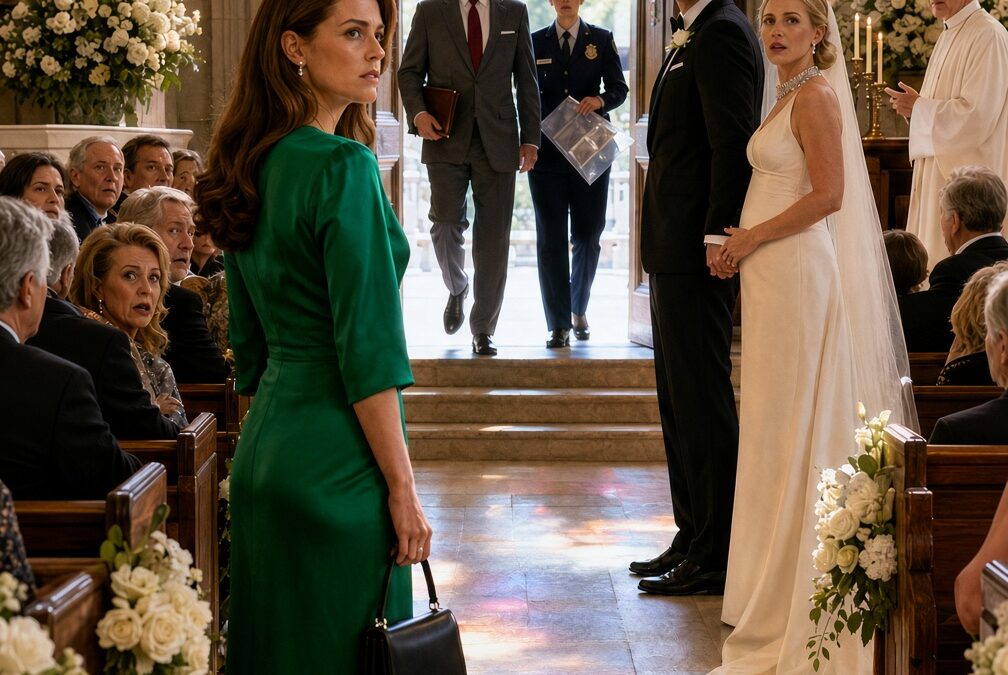
My ex-husband stood at the altar with his pregnant mistress wearing my dead mother’s diamonds and smiled when the priest asked if anyone objected.
That smile was the reason I knew Wells still had no idea.
Not about the prenup.
Not about the court order.
Not about the backup.
And certainly not about what was about to happen to him in front of half the families in Newport.
The chapel was full.
Not crowded.
Full.
There was a difference in Newport.
Crowded meant people had come because they cared.
Full meant people had come because they wanted to witness something.
The Whitcombs sat three pews behind me. The Radcliffes were across the aisle. Two Mercer House board members sat near the front beside their wives. Wells’s mother, Vivian Ashford, occupied the first pew wearing dove-gray silk and the expression of a queen presiding over the correction of an unfortunate mistake.
The unfortunate mistake was apparently me.
Six years earlier, Wells and I had married beneath that same carved stone arch.
My father had walked me down that aisle.
My mother had already been dead for seven years by then, so before we entered the chapel, Dad had fastened her pearl earrings into my ears with hands that trembled.
“Something of hers should be with you,” he’d said.
Now my father was gone too.
And Wells had brought his mistress to the same altar.
Camille Arden stood beside him in a custom ivory gown with one hand curved over the small but unmistakable swell of her stomach.
Around her throat glittered my mother’s diamond collar.
Forty-three diamonds.
Platinum setting.
Edwardian.
Insured separately because my mother had inherited it from her grandmother.
I knew every stone.
I knew the slight unevenness near the clasp where my mother had once dropped it against the marble floor of a hotel in Paris.
I knew the way it caught candlelight.
I knew how cold it felt when she had let me try it on at thirteen.
And I knew that Camille was wearing it for one reason.
She wanted me to see it.
Three days earlier, she’d made sure I would.
A photograph had arrived from an unfamiliar number.
Camille in profile before a gilt mirror, her blond hair swept up, the diamonds at her throat.
Underneath were four words.
Wear something pretty too.
I never answered.
On the morning of the wedding, I wore emerald silk.
My mother’s pearls.
My wedding ring was gone.
There were no swollen eyes beneath concealer.
No black dress.
No veil of mourning.
I sat in the third row where Wells could see me clearly.
He noticed me before the ceremony began.
His eyes traveled over my dress, my face, my empty ring finger.
Then his mouth curved.
He looked at me the way a man admires a grave he personally dug.
He thought I had come to watch him win.
He thought the divorce decree entered twelve days earlier had ended our marriage.
He thought my silence meant surrender.
He thought the accusation he had thrown at me less than forty-eight hours after I gave birth to Rose had weakened me enough to make me disappear.
He thought that once the final corporate filings were completed, he could force a transfer of the voting authority attached to my Mercer House shares.
And he thought the copy of our prenuptial agreement taken from the safe in our old bedroom proved he could do it.
Wells had always been good at remembering outcomes.
He was less careful about details.
That was why he remembered the prenup.
But he did not remember every page.
The priest reached the part of the ceremony everyone had been waiting for.
“If anyone present knows of just cause why these two should not be joined in marriage—”
Wells turned his head.
Directly toward me.
And smiled.
It was subtle.
Most people probably didn’t notice.
Camille did.
She followed his gaze and found me sitting perfectly still.
Her fingers tightened around his hand.
The room seemed to hold its breath.
I could almost hear what they were thinking.
Poor Eleanor.
This would be the moment she finally broke.
The postpartum wife.
The abandoned wife.
The woman whose husband had found happiness elsewhere before the hospital flowers from the birth of their daughter had wilted.
Surely I had come to cause a scene.
Surely I would stand.
Scream.
Cry.
Beg.
Accuse.
Wells wanted that.
Even now, after the decree, he wanted one more public display he could describe later as proof that I had been unstable all along.
So I stayed seated.
For one second.
Two.
Three.
The priest looked down at his book.
Wells’s smile widened.
Then the chapel doors opened behind me.
Heavy oak struck stone with a low boom.
Every head turned.
Grant Ellison entered carrying a dark leather folder beneath one arm.
He was sixty-eight, silver-haired, precise, and constitutionally incapable of looking hurried.
I had known him since childhood.
He had handled my father’s estate.
My parents’ trusts.
Mercer House governance.
My prenup.
And, for the previous three months, the careful destruction of nearly every assumption Wells had built his victory on.
Beside Grant walked a court officer.
The silence in the chapel changed.
People no longer looked entertained.
They looked alert.
Wells’s smile vanished.
Camille looked from the officer to me.
“What is this?” she whispered.
Grant stopped halfway down the center aisle.
“Reverend,” he said, “you cannot continue this ceremony.”
The priest lowered his book.
Wells stepped away from the altar.
“The divorce is final.”
Grant opened the leather folder.
“It was.”
A murmur moved through the chapel.
Wells stared at him.
Grant removed a certified order.
“At eight seventeen this morning, the Superior Court granted an emergency motion to vacate the judgment based on material misrepresentation to the court and newly authenticated controlling documents.”
He turned the first page toward Wells.
I watched my husband’s face.
The color left it slowly.
Not dramatically.
That would have been easier.
Instead, it drained from him in stages.
First confusion.
Then recognition.
Then fear.
Camille stared at the page.
“What does that mean?”
Grant’s eyes never left Wells.
“It means the judgment dissolving Mr. and Mrs. Ashford’s marriage has been vacated pending further proceedings.”
The chapel became so quiet I could hear someone behind me inhale sharply.
Camille’s hand fell away from Wells’s.
“You’re still married?”
Wells looked at me.
For the first time that day, he did not look amused.
“What did you do?”
I rose.
My knees were steady.
That surprised me.
For three months, I’d imagined this moment.
In some versions, I had a speech.
In others, I walked up the aisle and tore my mother’s diamonds from Camille’s throat myself.
But when it finally came, I discovered that revenge did not feel like fire.
It felt like ice.
Clean.
Hard.
Exact.
“I corrected the record.”
His jaw tightened.
“This is some kind of stunt.”
“No.”
Grant handed the certified order to the court officer.
“This is a judicial order.”
Wells looked around the chapel as if one of his friends might laugh and break the tension.
No one did.
His mother stood.
“This is outrageous.”
Vivian’s voice carried beautifully.
It always had.
She had spent three months telling anyone who would listen that I was suffering from “postpartum emotional difficulties.”
She never called me crazy.
Vivian was too polished for that.
She said fragile.
Overwhelmed.
Not herself.
Concerned.
Words that sounded compassionate until they were repeated often enough to become a diagnosis.
Grant glanced toward her.
“Mrs. Ashford, I strongly suggest that everyone allow the officer to complete service without interference.”
Vivian’s mouth closed.
The officer stepped forward and held out documents to Wells.
“You’ve been served.”
Wells did not take them.
The officer remained where he was.
Eventually, Wells snatched the papers.
His eyes moved quickly across the first page.
I watched him reach the second.
Then the third.
He stopped.
There it was.
The notation referring to the original prenuptial agreement and the notarized property schedule held with the Mercer family trust records.
His gaze snapped to Grant.
“Where did you get this?”
Grant almost smiled.
“From where it has been for six years.”
I saw the exact moment Wells remembered.
The bank vault.
My father.
The final meeting.
The property schedule.
His own lawyer’s initials.
“No,” he said.
It was barely audible.
Camille turned toward him.
“What?”
Wells ignored her.
He looked at me.
“You knew.”
“Yes.”
“How long?”
“Since the hospital.”
Something dangerous flickered in his face.
“You let me file.”
“Yes.”
“You let the decree go through.”
“I followed my attorney’s advice.”
“You let me plan this wedding.”
That almost made me laugh.
“I didn’t plan your wedding, Wells.”
Someone behind me coughed to hide what might have been a laugh of their own.
Camille’s cheeks flushed.
Wells took one step toward me.
The officer shifted between us.
Grant spoke calmly.
“Mr. Ashford, I would advise you not to create a second problem while being served with the first.”
Wells stopped.
Camille touched the necklace at her throat as if suddenly aware of its weight.
“What does the prenup have to do with the divorce?”
I looked at the diamonds.
Then at her.
“More than that necklace does.”
Her hand froze.
Grant removed another document.
“This is a property-preservation order identifying certain Mercer separate assets that were removed from Mrs. Ashford’s possession during the pendency of the divorce.”
Camille looked at Wells.
He said nothing.
Grant continued.
“The diamond collar you are currently wearing is specifically listed.”
The expression on Camille’s face changed.
For the first time since she had entered my marriage, she looked unsure.
“Wells gave this to me.”
“No,” I said. “He gave you something that wasn’t his.”
She stared at him.
“You told me it belonged to you after the divorce.”
Wells lowered his voice.
“Not here.”
I nearly smiled.
Not here.
That had been his rule for me for three months.
Don’t argue here.
Don’t cry here.
Don’t make a scene here.
Don’t embarrass me here.
As if humiliation became respectable when delivered privately.
Camille reached behind her neck.
Her fingers shook against the clasp.
For a moment, I thought she might refuse.
Then the court officer held out an evidence pouch.
The diamonds came free.
Without them, Camille suddenly looked younger.
Less armored.
She placed the necklace into the pouch.
The officer sealed it.
I had expected that moment to satisfy something in me.
It didn’t.
The diamonds were only objects.
Beautiful, expensive objects.
The real wound had happened in a hospital room.
The real theft had been Wells looking at our daughter and deciding that her legitimacy was useful leverage.
That was what I had come to collect payment for.
Not jewelry.
Not pride.
Truth.
Wells folded the order once.
Then again.
His movements were controlled, but I could see a pulse beating in his temple.
“This changes nothing about Mercer House.”
Grant closed the folder.
“Actually, that’s the principal thing it changes.”
Wells stared at him.
Grant’s voice remained mild.
“The property schedule expressly excludes any transfer, assignment, proxy, marital claim, or derivative voting authority over Eleanor Mercer’s shares.”
The room erupted in whispers.
Wells looked at me with genuine disbelief.
“You don’t know what you’re doing.”
There it was.
The sentence he always reached for when control slipped away.
You don’t understand.
You’re emotional.
You’re tired.
Let me handle it.
I thought of Rose asleep in her hospital bassinet.
I thought of the folder he’d placed beside my water cup.
I thought of Camille’s cream cashmere.
I thought of Vivian explaining my supposed instability over charity luncheons.
I stepped into the aisle.
“I know exactly what I’m doing.”
The priest cleared his throat.
No one looked at him.
Camille was still staring at Wells.
“Did you know about this?”
“No.”
She searched his face.
“Did you know there was another copy?”
Wells said nothing.
Her voice sharpened.
“Did you?”
That was when Grant looked at me.
He gave the smallest nod.
There were still things Wells believed we didn’t have.
Things he believed were gone.
I had spent three months letting him believe that too.
I turned toward him.
“The prenup isn’t your biggest problem.”
For the first time, fear moved openly across his face.
“What are you talking about?”
I picked up my purse from the pew.
“The company backup.”
Wells went completely still.
And that was when I knew he remembered every word.
PART 2: FORTY-EIGHT HOURS AFTER ROSE WAS BORN
Three months earlier, I had been wearing a hospital gown when my husband told me he wanted a divorce.
Rose was thirty-nine hours old.
I remember that because the clock above the door read 10:14 a.m., and I had slept perhaps twenty minutes since 6:53 the previous evening.
My body hurt everywhere.
My milk had come in.
There was dried blood beneath the edge of one bandage.
A bouquet from the Mercer House design department covered half the windowsill.
Rose slept in the clear bassinet beside my bed, one tiny fist tucked beneath her chin.
She had Wells’s mouth.
I had already decided that.
His lower lip, especially.
The same slight fullness.
Wells had spent the pregnancy pretending to be terrified of becoming a father and then secretly reading newborn books after midnight.
He designed the nursery himself.
He chose the pale green wallpaper.
He made a spreadsheet comparing strollers.
At our twelve-week ultrasound, he cried.
At twenty weeks, when we learned we were having a girl, he bought a ridiculous pink cashmere rabbit and carried the sonogram picture in his wallet.
That was the man I thought would walk into my hospital room.
Instead, Wells entered carrying a legal folder.
Camille entered behind him.
Cream cashmere.
Camel trousers.
Hair perfect.
No coat despite the cold.
On her wrist was a diamond bracelet charged to an account bearing my name.
At first, my mind refused to understand what I was seeing.
Camille had been around our social circle for two years.
She worked in luxury brand consulting.
She had attended two Mercer House launches and one Christmas party.
She was the kind of woman who remembered everyone’s preferred drink and never seemed to sweat.
I knew Wells liked her.
I had once teased him about it.
He’d rolled his eyes.
“She’s exhausting.”
Now she stood three feet behind my husband while I still had a catheter bag hidden beneath my blanket.
Wells placed the folder on my bedside table.
“I wanted to do this before you went home.”
I looked at the folder.
Then at Camille.
Then at him.
“What is she doing here?”
His face was composed.
Too composed.
“Eleanor.”
“What is she doing here?”
Camille looked at the floor.
Not ashamed.
Just patient.
As if I were delaying a meeting.
Wells opened the folder himself.
“I’ve filed for divorce.”
There are sentences that arrive as sound.
And there are sentences that arrive physically.
That one struck my chest.
I looked toward Rose.
She shifted in her sleep.
I had the absurd thought that no one should say words like divorce near a newborn.
Not because she could understand.
Because they were ugly.
Because everything around her should still have been soft.
“You filed when?”
“Yesterday.”
I stared at him.
Yesterday.
While I was learning how to feed his daughter.
While a nurse taught me how to swaddle her.
While I was texting him from the hospital because he’d told me he had gone home to shower and sleep.
My throat tightened.
“You’re with her.”
He did not answer immediately.
He didn’t need to.
Camille’s silence answered for him.
“For how long?”
“Eleanor, this is not productive.”
I laughed once.
It sounded wrong.
Thin.
“What would be productive, Wells?”
He pulled out the chair by the window.
He didn’t sit.
“Keeping this civil.”
“Civil.”
“We have significant financial matters to resolve.”
My daughter made a tiny noise.
Wells glanced at her.
Only glanced.
Then he looked back at me.
That was the moment something inside me began to change.
Slowly.
Not break.
Harden.
He continued.
“My attorneys are seeking temporary control of the voting authority connected to your Mercer House position until the ownership questions are resolved.”
I blinked.
“Ownership questions?”
“The marital estate is complicated.”
“My Mercer shares are not complicated.”
“That’s what your father wanted you to believe.”
I stared at him.
My father had been dead fourteen months.
Wells had given the eulogy.
He had stood beside me at the grave with one arm around my shoulders.
Now he was using him in a financial argument beside my newborn daughter’s bassinet.
“You signed a prenup.”
“Yes.”
“The agreement does not give you my company.”
“I’m not saying it gives me the company.”
“You just said you want my voting authority.”
“Temporarily.”
“Why?”
His expression shifted.
Pity.
Manufactured pity.
“The board is concerned.”
My stomach tightened.
“About what?”
“Your condition.”
I looked down at myself.
My hospital gown.
My IV.
My swollen hands.
“My condition is that I gave birth yesterday.”
Camille looked away.
Wells lowered his voice.
“There have been questions about your emotional stability.”
“From whom?”
“People close to the situation.”
“Wells.”
“I’m trying to protect the company.”
I looked at Rose.
Then at him.
“You mean from me?”
“You’ve been under enormous pressure since your father died. Then the pregnancy. The expansion. Now childbirth.”
He spoke gently.
That made it worse.
If he’d shouted, I could have fought him.
Instead, he was building a case.
Calm husband.
Unstable wife.
Concerned executive circle.
Poor newborn.
Family business at risk.
Every phrase chosen so carefully that even outrage could be used against me.
Then he looked toward the bassinet.
And delivered the knife.
“I also have concerns about paternity.”
For several seconds, I genuinely believed exhaustion had distorted the sentence.
“What?”
His eyes didn’t move.
“I think we should establish paternity before discussing custody.”
The room changed.
The light.
The air.
Everything.
I pushed myself upright despite the pain.
“You think Rose isn’t yours?”
“I’m saying there are questions.”
“What questions?”
“Please don’t raise your voice.”
I hadn’t.
Not yet.
A nurse standing just inside the doorway froze.
I saw Wells notice her.
Of course he did.
That was when I understood.
He needed an audience.
He had brought Camille into the room.
He had chosen daytime.
He had chosen a moment when hospital staff were moving in and out.
He wanted me exhausted.
Humiliated.
Hormonal.
Bleeding.
He wanted me to scream.
If I screamed while his mistress stood beside him and he questioned my daughter’s paternity, people would understand why.
But later?
Later, people would remember only that I screamed.
Wells continued.
“The board is already concerned about your emotional stability. Fighting this publicly will make that worse.”
The nurse’s eyes widened.
I looked at her.
Then at Camille.
Camille smiled.
Tiny.
Almost invisible.
But I saw it.
My hand moved toward the call button.
I pressed it.
Wells’s brow furrowed.
“What are you doing?”
I looked at the nurse.
“Please have them removed from my room.”
Wells stared at me.
“Eleanor.”
“I am withdrawing permission for both of you to be here.”
Camille’s smile disappeared.
A second nurse entered.
Then a security officer.
Wells leaned over the bed while they approached.
His voice dropped low enough that only I could hear.
“You’re tired, Eleanor. You’re alone. You’re not built for a fight.”
I looked at Rose.
Her fist had opened.
Five impossibly small fingers rested against the blanket.
Then I looked back at him.
“You’re right.”
He smiled.
That was his first mistake.
That night, after the nurses dimmed the lights and Rose finally slept against my chest, I called Grant Ellison.
He answered on the third ring.
“Eleanor?”
My voice broke the moment I heard his.
Not because I wanted it to.
Because he had known my father for twenty-seven years, and sometimes grief recognizes safety before pride can stop it.
“Wells filed for divorce.”
Grant was silent.
“Where are you?”
“The hospital.”
“What?”
“He served me here.”
Another silence.
“Is the baby all right?”
I looked down at Rose.
“Yes.”
“And you?”
I almost said yes.
Instead, I said, “No.”
Grant’s voice softened.
“Tell me everything.”
I did.
The divorce papers.
Camille.
The shares.
The paternity accusation.
The board.
When I finished, he asked for a photograph of the agreement Wells had attached.
I sent it.
Grant called back eleven minutes later.
His first question changed everything.
“Which prenup did he attach?”
“The one from the safe at home.”
“You’re certain?”
“I recognize it.”
“Does it include the property schedule?”
I scrolled through the filing.
“No.”
Silence.
Then Grant exhaled.
“Good.”
I frowned.
“Good?”
“Do not correct him.”
My hand tightened around the phone.
“Grant, what are you talking about?”
“The original agreement has never been in your house.”
I closed my eyes.
Then I remembered.
A bank conference room.
My father at one end of the table.
Wells beside me.
Two attorneys.
A stack of documents.
Dad insisting that all original Mercer family instruments remain with the trust records.
Grant continued.
“After Wells’s counsel reviewed the prenup, your father added the final notarized property schedule. Wells’s attorney reviewed it. Initialed every page. Wells signed the acknowledgment.”
I sat very still.
“What does the schedule say?”
“It identifies your Mercer House shares and all attached voting authority as separate property. It expressly bars transfer by marriage, divorce, proxy, constructive trust, or spousal claim.”
My heart began pounding.
“And the jewelry?”
“Also listed.”
I looked toward the dark window.
“What happens now?”
Grant answered immediately.
“Nothing.”
“What?”
“You are going to do nothing he expects.”
“Grant—”
“Listen carefully. Wells has filed using an incomplete copy. If this is accidental, he’ll correct it.”
“And if it isn’t?”
“Then he’ll build his own record.”
I understood.
Barely.
But enough.
“So I stay quiet.”
“You recover. You take care of Rose. You do not speak to reporters. You do not confront Camille. You do not argue with his mother. You do not warn the board. You forward me everything.”
My eyes burned.
“He questioned Rose’s paternity.”
“I know.”
“He knows she’s his.”
Grant paused.
“Then we will make him prove what he knows.”
That sentence stayed with me.
For three months.
We would make him prove what he knew.
PART 3: WHAT THEY MISTOOK FOR SURRENDER
Silence is unbearable to people who need a reaction.
That was the first thing I learned.
Wells expected anger.
When I gave him none, he became careless.
Vivian expected defense.
When I refused, she spoke more freely.
Camille expected jealousy.
When I didn’t compete, she kept escalating.
They thought I was disappearing.
I was listening.
Two weeks after I left the hospital, Vivian invited three members of the Mercer House social foundation to lunch.
By dessert, according to one of the women present, Vivian had sighed and said, “Eleanor has always been sensitive, but after the birth she’s simply not herself.”
Sensitive.
Such a useful word.
Wells told senior Mercer House executives that legal counsel was “in the process of regularizing temporary voting authority.”
I received that statement through a forwarded email.
He had copied people he had no business copying.
Grant told me not to respond.
Camille wore my mother’s sapphire earrings to dinner at Le Marché.
Photographs appeared online.
I said nothing.
She wore the diamond bracelet to a museum benefit.
Nothing.
Then the collar.
That photograph came directly to my phone.
Wear something pretty too.
I forwarded it to Grant.
He replied with two words.
Received. Good.
I stared at those words for a long time.
There was nothing good about seeing my mother around another woman’s throat.
But Grant meant evidence.
Insurance schedule.
Photographic identification.
Proof of possession.
Intent.
Wells had moved several pieces from the Mercer safe-deposit inventory after filing for divorce.
He apparently believed that if the missing property schedule wasn’t enforceable, the jewelry would fall into the marital estate.
Or perhaps he simply believed that possession was nine-tenths of humiliation.
Either way, he kept giving things to Camille.
And Camille kept documenting them.
Meanwhile, Wells demanded a paternity test.
I agreed before his attorney finished asking.
That confused him.
I could tell from his face during the video conference.
He had expected tears.
“You don’t object?” he asked.
“No.”
His attorney cleared his throat.
“We’ll arrange collection.”
“Do it.”
Wells stared at me through the screen.
I stared back.
The result came eleven days later.
Probability of paternity: greater than 99.99%.
Wells received the report.
He never apologized.
Not to me.
Not to Rose.
Instead, two days later, his lawyer filed a request suggesting that the paternity dispute had created “further emotional strain within the household.”
Grant read that sentence twice.
Then removed his glasses.
“He created the dispute.”
“I know.”
“He knew it would resolve in his favor.”
“I know.”
Grant looked at me across his desk.
“Don’t react.”
I laughed bitterly.
“That seems to be everyone’s favorite instruction.”
“It’s working.”
It didn’t feel like it was working.
That was the hardest part.
Strategy looks clean afterward.
While you’re living inside it, it feels like swallowing glass.
I was recovering from childbirth.
Sleeping in ninety-minute intervals.
Learning Rose’s cries.
Trying to keep breast milk cold during meetings with lawyers.
Reading filings in which my husband described me as emotionally fragile while his mistress posted photographs from the house where I had chosen our curtains.
There were nights I wanted to burn the strategy down.
I wanted to call Wells and tell him exactly what I knew.
I wanted to send Vivian the paternity result with one sentence:
Tell your friends.
I wanted to walk into every Mercer House office and say, He is lying to you.
But Grant kept asking the same question.
“Do you want relief, or do you want proof?”
Proof.
So I waited.
And Wells kept talking.
That was how we found the backup.
Mercer House had issued Wells a company-managed tablet three years earlier when I temporarily appointed him to a family advisory project during an overseas expansion.
He stopped using the device after the project ended.
At least, he stopped carrying it.
But the device remained enrolled in the company’s enterprise system until after our separation.
When counsel conducted a governance review to determine whether Wells had accessed Mercer House materials improperly, the IT department preserved the existing cloud backup.
Grant called me at 6:20 one morning.
“Are you awake?”
I was sitting on the nursery floor with Rose.
“Always.”
“We found messages.”
My whole body went still.
“What kind?”
“Not privileged. Personal exchanges sent through the managed device.”
“With Camille?”
“Some.”
“And?”
Grant hesitated.
“I need you to hear these in my office.”
By noon, I was sitting across from him.
Rose was with my nanny downstairs.
Grant placed printed pages on the table.
He didn’t push them toward me immediately.
“These are ugly.”
“I’ve had an ugly three months.”
“Eleanor.”
“I need to know.”
He handed me the first page.
The messages were from five weeks before Rose’s birth.
Camille:
Are you sure the board will actually move against her?
Wells:
They don’t have to move against her. They only have to hesitate.
Camille:
After the baby?
Wells:
Especially after the baby.
I stopped breathing.
Grant said nothing.
I kept reading.
Camille:
And if she fights?
Wells:
Then she proves the point.
My fingers turned cold.
Another conversation.
Camille:
What about paternity? That’s insane if she’s been faithful.
Wells:
I don’t need it to be true. I need it to be unresolved.
My vision blurred.
I blinked hard.
The next line was worse.
Camille:
And when the test says the baby is yours?
Wells:
By then the board question will already exist.
I put the page down.
For a moment, I couldn’t speak.
The room was perfectly quiet.
Finally, I said, “He knew.”
Grant’s jaw tightened.
“Yes.”
“He knew Rose was his.”
“He expected the test to confirm it.”
“He used her.”
Grant said nothing.
That was the moment I stopped mourning my marriage.
Not when I saw Camille.
Not when he filed for divorce.
Not when she wore my mother’s jewelry.
I stopped mourning when I read that sentence.
By then the board question will already exist.
Rose had been forty-eight hours old when Wells looked at her and pretended not to know whether she was his.
Not because he was jealous.
Not because he was hurt.
Not because he had reason to doubt me.
Because uncertainty was useful.
Our daughter had been leverage.
I wiped my face.
I had not realized I was crying.
Grant pushed a second set of pages toward me.
“There’s more.”
I almost laughed.
“Of course there is.”
These messages concerned the prenup.
Wells:
The house copy doesn’t include Mercer’s final schedule.
Camille:
Is there another one?
Wells:
Old man Mercer kept originals off-site. Ellison probably has access.
Camille:
Then how are you doing this?
Wells:
Eleanor hasn’t looked at any of it in years.
A later message:
Camille:
What if Ellison checks?
Wells:
Then we negotiate before it matters.
My breathing slowed.
The first shock had passed.
Something colder replaced it.
He hadn’t forgotten.
Not completely.
He knew another version existed.
He just believed he could move faster than I could.
Then came the message that changed Grant’s entire approach.
Wells:
Once the decree adopts the filed agreement, I have leverage. Nobody wants to reopen a final judgment.
Camille:
And the shares?
Wells:
Enough pressure and she gives me the proxy voluntarily. Her father’s board doesn’t trust instability.
I looked up.
“He wasn’t trying to win the shares through the prenup.”
“No,” Grant said.
“He wanted the incomplete prenup to create enough confusion that I’d sign them over to end the fight.”
“That’s my reading.”
I stared at the messages.
Every humiliation rearranged itself.
The hospital.
The paternity accusation.
Vivian’s whispers.
The board emails.
Camille’s photographs.
He had not been acting randomly.
He was applying pressure from every direction.
Financial.
Social.
Maternal.
Emotional.
He wanted me to believe resistance would cost me my reputation, my company, and perhaps even custody of Rose.
He wanted surrender to feel safer than truth.
“Can we stop him now?” I asked.
Grant leaned back.
“Yes.”
“Then let’s stop him.”
“Not yet.”
I stared at him.
He tapped the messages.
“Right now, we can establish an attempted strategy. But his lawyers are still pressing to finalize the decree based on the incomplete agreement. If they do that after we’ve given them every reasonable opportunity to verify the original—”
“We prove it wasn’t a mistake.”
“Exactly.”
My stomach tightened.
“So I let the divorce finalize.”
Grant’s gaze was steady.
“Temporarily.”
“And his wedding?”
He looked surprised.
“What wedding?”
I slid my phone across the desk.
Camille had posted a photograph twenty minutes earlier.
White roses.
Chapel steps.
A date.
Grant read it.
Then slowly looked at me.
“That’s twelve days after the decree hearing.”
“Yes.”
He was silent for a long moment.
Then he gave me the faintest smile.
“That is exceptionally unwise.”
For the first time in weeks, I smiled too.
“Can we use it?”
“No.”
He paused.
“But we can let him.”
PART 4: THE COPY IN THE SAFE
After Grant stopped the ceremony, nobody knew whether to leave.
That was the most Newport thing imaginable.
A wedding had just been legally halted.
The bride had surrendered disputed diamonds to a court officer.
The groom had learned he was still married to the woman sitting in the third pew.
And yet half the congregation remained in place because no one wanted to be the first person to admit they were enjoying it.
Wells solved the problem.
“Everyone out.”
His voice cracked through the chapel.
The priest flinched.
Vivian moved immediately.
“Please,” she told the guests with a strained smile. “There has clearly been an administrative misunderstanding.”
Grant actually looked at me.
I knew that look.
Administrative misunderstanding.
He would remember that one.
People began filing into the aisle.
Some avoided my eyes.
Some touched my arm.
One older woman I had known since childhood squeezed my hand and whispered, “Your mother would have been proud of that dress.”
I nearly broke then.
Not at Wells.
Not at the diamonds.
At kindness.
Grief was cruel that way.
It waited until someone touched the right bruise.
I thanked her.
Within ten minutes, only a small group remained.
Me.
Grant.
The officer.
Wells.
Camille.
Vivian.
The priest, who appeared to be reconsidering every life choice that had brought him to that morning.
Camille stood near the altar without the diamonds.
Her dress suddenly looked too elaborate for the room.
She kept staring at Wells.
“You knew there might be another prenup.”
Wells rubbed one hand over his face.
“Camille.”
“You knew.”
“It wasn’t that simple.”
“You told me the divorce settled everything.”
“It did.”
“No, apparently it didn’t.”
Vivian stepped between them.
“This is not the time.”
Camille rounded on her.
“When is the time, Vivian?”
I had never heard her call Wells’s mother by her first name.
Interesting.
Wells looked at me.
“This is what you wanted?”
I studied him.
“What?”
“This spectacle.”
I almost admired the reflex.
Even with a court order in his hand, he could still locate a way to make my reaction the problem.
“You scheduled a wedding twelve days after a contested divorce decree.”
“The divorce wasn’t contested.”
“Because your filing omitted the controlling schedule.”
“You had counsel.”
“And so did you.”
His eyes flashed.
Grant intervened.
“The judge’s order is clear. The court found sufficient evidence to reopen the judgment based on material omissions and representations concerning the governing marital agreement.”
Wells pointed at him.
“You coached her to sit on that document.”
“I advised my client not to interrupt your repeated sworn representations concerning a document you had a legal duty to present accurately.”
Wells’s face tightened.
Grant continued.
“Especially after we obtained evidence that you were aware another executed version existed.”
Camille turned sharply.
“What evidence?”
Wells looked at me.
I answered.
“Your messages.”
She went pale.
“What messages?”
“The company-device backup.”
Silence.
Camille’s eyes moved to Wells.
He didn’t deny it.
That told her enough.
Her voice dropped.
“How much?”
“Enough.”
“What exactly did you see?”
I thought of the message.
I don’t need it to be true. I need it to be unresolved.
For a second, I wanted to punish her.
I wanted to read every sentence aloud beneath the altar.
Then I remembered that punishment had already been Wells’s language.
I didn’t want to speak it.
So I told her only the part that mattered.
“I saw the two of you discussing how the paternity accusation would affect the Mercer board.”
Her lips parted.
Wells stepped forward.
“Those messages are out of context.”
“No,” I said. “They’re painfully clear.”
“You invaded my privacy.”
“It was a Mercer-managed device preserved during a corporate access review.”
“You went looking for something.”
“I went looking for unauthorized access to my company.”
“And conveniently found my personal messages.”
“You used a company device.”
His mouth opened.
Closed.
For the first time since I’d known him, Wells looked trapped by something other than emotion.
Fact.
Fact was new territory for him.
Vivian looked between us.
“What paternity messages?”
I turned to her.
Apparently Wells had not told his mother everything.
Good.
Let him explain it himself.
“Wells knew Rose was almost certainly his when he challenged paternity.”
Vivian’s face changed.
“Wells?”
He didn’t answer.
“He and Camille discussed it five weeks before she was born,” I continued. “He wrote that he did not need the accusation to be true. He needed it to remain unresolved long enough to make Mercer House directors question my stability.”
Camille looked sick.
Vivian whispered, “Is that true?”
Wells stared at me.
“You don’t understand what was happening.”
I laughed.
“No, I understand now.”
“You were shutting me out of every major Mercer decision.”
“It’s my company.”
“I was your husband.”
“That did not make you a voting shareholder.”
“Everything revolved around your father. Then after he died, everything revolved around preserving his legacy. There was no room for anyone else.”
There it was.
Finally.
Not remorse.
Not denial.
Justification.
I felt something inside me settle.
“So this was punishment?”
“No.”
“You questioned your daughter’s paternity because you felt excluded?”
“I was trying to secure my position.”
“At my expense.”
“Our future was tied to Mercer House.”
“No. Your desired future was tied to owning something that wasn’t yours.”
He stepped closer.
“You don’t know what it was like being married into your family.”
The sentence surprised me.
Not because it was false.
Because part of it was true.
My family was difficult.
Mercer House consumed people.
My father could dominate a room without lifting his voice.
Old money came with rules no one admitted were rules.
Wells had entered my world as an outsider and spent years feeling evaluated.
I knew that.
I’d defended him.
Promoted him socially.
Brought him into business conversations.
Ignored friends who said he cared too much about influence.
A believable motive did not make his choices acceptable.
That mattered.
“I know exactly what it was like,” I said. “I was born into it.”
His face hardened.
“You never had to earn your place.”
“No. I had to protect it from my husband while recovering from childbirth.”
Camille closed her eyes.
Vivian whispered, “Enough.”
I looked at her.
“No. You’ve said enough for three months. Now I get a turn.”
She drew herself up.
“Eleanor—”
“You told people I was unstable.”
“I told close friends I was concerned.”
“Based on what?”
“Based on what Wells told me.”
“What did he tell you?”
Vivian hesitated.
I waited.
Her eyes flicked toward her son.
“He said you were behaving erratically.”
“When?”
“During the final weeks of pregnancy.”
I almost laughed.
“I attended two board meetings, approved the European licensing agreement, and worked until nine days before Rose was born.”
“He said you were paranoid.”
“About his affair?”
That landed.
Vivian’s mouth tightened.
“He did not tell me about Camille until later.”
I looked at Wells.
Another layer.
Another lie.
Vivian slowly turned toward him.
“You told me she had become suspicious without cause.”
Wells said nothing.
Camille stared at him too.
Suddenly everyone around him had begun comparing notes.
That was the danger of building separate realities.
Eventually the people inside them spoke to one another.
Grant checked his watch.
“We have a board meeting at two.”
Wells looked at him.
“What board meeting?”
I answered.
“Mercer House.”
“You can’t call an emergency meeting without—”
“I can.”
His expression shifted.
Fear again.
“You’ve poisoned them against me.”
“No.”
I picked up my coat.
“I’m going to show them what you wrote.”
Mercer House headquarters occupied a limestone building overlooking the harbor.
My grandfather had purchased it in 1968.
My father had renovated it twice but refused to replace the old brass elevator because he said a family company should retain at least one inconvenience to remember what work felt like.
At 1:57 p.m., I stepped into that elevator with Grant.
For three months, I’d avoided the building except when necessary.
Partly because of Rose.
Partly because I knew Wells had been talking.
I could feel it in the way people looked at me.
Careful.
Kind.
Evaluating.
Was she all right?
Was she functioning?
Had childbirth changed her?
Was the divorce affecting her judgment?
Women are often told to ignore gossip.
In a family-controlled company, gossip can become governance.
At two o’clock, I entered the boardroom.
Nine people sat around the walnut table.
Three had attended the wedding.
None mentioned it.
The chairman, Arthur Bell, had worked with my father for thirty-one years.
He rose when I entered.
“Eleanor.”
“Arthur.”
Wells arrived four minutes later with his lawyer.
He had changed out of his tuxedo jacket but still wore the white shirt.
No tie.
He looked like a groom after a fistfight.
Arthur frowned.
“Mr. Ashford, this is a shareholder governance session.”
“My legal interests are being discussed.”
“Your counsel may remain for the preliminary portion.”
Wells sat across from me.
For six years, that had been his favorite seat at Mercer meetings.
Even before he had any reason to be there.
He liked looking directly at me while other people spoke.
It created the illusion that we shared power.
Grant distributed folders.
No one touched them until Arthur did.
He opened the first page.
“This is the original prenup?”
“Certified copy,” Grant said.
“The original remains in vault custody.”
Arthur read the property schedule.
His eyebrows lifted.
Another director adjusted his glasses.
The silence lasted nearly two minutes.
Wells finally spoke.
“The marital agreement is being litigated. This board has no business making legal conclusions.”
I looked at Arthur.
“Keep reading.”
The next section contained the message extracts.
Arthur read them.
The color rose in his face.
He turned a page.
Then another.
No one spoke.
Finally, he looked at Wells.
“Did you write these?”
Wells’s attorney answered.
“We dispute the context and admissibility—”
Arthur held up a hand.
“I asked him.”
Wells leaned back.
“Some messages appear to be mine.”
Arthur’s voice was colder than I had ever heard it.
“Did you tell Ms. Arden that a paternity challenge would make this board hesitate to support Eleanor’s voting authority?”
Wells glanced at me.
“That is an oversimplification.”
“Did you write it?”
Silence.
“Yes.”
Arthur stared at him.
I could see my father in his expression.
Not affection.
Disappointment.
That was worse.
One of the directors, Margaret Sinclair, turned toward me.
“Did you know he was planning this before Rose was born?”
“No.”
“And the paternity test?”
“Confirmed Wells as Rose’s father.”
Margaret’s jaw tightened.
“Was there ever evidence suggesting otherwise?”
“No.”
Wells interrupted.
“I had personal concerns.”
I opened my folder.
“No, you didn’t.”
I read his own words.
“I don’t need it to be true. I need it to be unresolved.”
Nobody moved.
Wells’s attorney leaned toward him.
He ignored the whisper.
I kept going.
“Five weeks before Rose’s birth, Wells understood that the likely paternity result would identify him as her father. He still planned to raise the accusation because he believed a dispute involving my newborn child would make the board question my judgment.”
Wells’s eyes locked on mine.
I had thought saying it aloud would hurt.
Instead, I felt stronger with every word.
“He also told Camille that if I fought publicly, I would ‘prove the point.’ That was why he served me in the hospital. That was why she came with him. That was why concerns about my mental state began circulating before I had made a single public statement.”
Arthur closed his folder.
“Wells, did you contact directors privately?”
Wells hesitated.
“Informally.”
“How many?”
“Arthur—”
“How many?”
“Four.”
Two directors shifted in their chairs.
Arthur looked at them.
One spoke immediately.
“He called me.”
Another nodded.
“Me too.”
Arthur’s mouth flattened.
“What did he say?”
The first director looked uncomfortable.
“That Eleanor was suffering from severe postpartum instability and had become suspicious of people around her.”
My hands went cold.
Even after everything, hearing the words hurt.
The second director added, “He suggested it might be prudent to establish an interim voting proxy until she recovered.”
There it was.
Not a misunderstanding.
Not concern.
A campaign.
Arthur turned to me.
“Did Wells ever ask you directly for a voluntary proxy?”
“Twice through counsel.”
“And you declined?”
“Yes.”
Margaret leaned forward.
“Then this was pressure.”
I looked at Wells.
“Yes.”
He shook his head.
“You are making this sound sinister because it suits you.”
I almost admired the persistence.
“You questioned your newborn daughter’s paternity as a corporate tactic.”
“I was protecting my future.”
I stared at him.
“Thank you.”
He frowned.
“For what?”
“For finally saying it plainly.”
His face changed.
He realized too late what he had done.
Arthur took off his glasses.
“This board has no authority over the marital litigation. But we do have authority over access to Mercer House systems, confidential information, advisory participation, and corporate governance.”
Wells’s shoulders tightened.
Arthur continued.
“Effective immediately, any residual advisory access granted to Mr. Ashford through his marriage to Ms. Mercer is revoked.”
Wells stood.
“You can’t—”
“We can.”
“This is retaliation.”
“No,” Arthur said. “This is risk management.”
That phrase almost made me smile.
For months, Wells had wrapped every attack on me in the language of business.
Concern.
Stability.
Continuity.
Risk.
Now those words belonged to someone else.
Arthur looked around the table.
“Does anyone object?”
No one did.
Not one person.
Wells looked at me.
In his face, I saw the thing he had feared from the beginning.
Not losing me.
Losing access.
He had mistaken proximity for ownership.
To my family.
To my company.
To my inheritance.
To my trust.
Maybe even to my body.
Now the boundaries were becoming visible.
He gathered his papers.
“This isn’t over.”
I met his eyes.
“No.”
I thought of the court order.
The original prenup.
The messages.
Rose.
“Not yet.”
PART 5: THE TRUTH WAS THERE FROM THE BEGINNING
The reopened divorce hearing took place three weeks later.
There were no white roses.
No cathedral.
No emerald dress.
Just fluorescent courthouse light and a wooden bench that squeaked every time Wells shifted his weight.
Camille did not attend.
Vivian did.
She sat behind Wells and looked ten years older than she had at the wedding.
The judge began with the prenup.
The original agreement was authenticated through the bank custodian, the notary record, Grant’s files, and the acknowledgment signed by Wells and his attorney.
The property schedule was not ambiguous.
My Mercer House shares were mine.
The voting rights were mine.
The family jewelry identified in the schedule was mine.
No divorce proceeding could transform them into Wells’s property.
No spouse could claim proxy authority by marital status.
No temporary transfer could be presumed.
Any proxy had to be knowingly and separately executed by me.
I had never executed one.
Wells’s attorney tried to argue that the house copy had created a genuine misunderstanding.
Then Grant introduced Wells’s messages.
The courtroom changed.
My favorite was not even the one about paternity.
It was the message Camille had sent after asking whether another prenup existed.
Then how are you doing this?
And Wells’s answer.
Eleanor hasn’t looked at any of it in years.
He had counted on my ignorance.
More accurately, he had counted on my trust.
I had believed the document in our safe was complete because my husband had never given me reason to inspect it.
Or perhaps he had.
Perhaps I’d simply confused love with permission not to look.
The judge asked Wells directly whether he knew an off-site original existed.
Wells answered carefully.
“I remembered that Mr. Mercer kept many original documents off-site.”
“Did you disclose that belief when representing the house copy as the operative marital agreement?”
“No.”
“Why not?”
“My understanding was that the copy in our residence reflected the agreement between Eleanor and me.”
Grant stood.
“Your Honor, may I direct the court to page ninety-three of the exhibit?”
Wells closed his eyes.
I knew before Grant read it.
It was Wells’s message.
Old man Mercer kept originals off-site. Ellison probably has access.
The judge looked at Wells.
His expression did not change.
That was somehow worse than anger.
“Mr. Ashford, your understanding appears to have been considerably more nuanced than your filing suggested.”
No one moved.
The judge reinstated the divorce proceeding from the point before entry of judgment.
The incomplete filing was set aside.
The original prenup would govern.
The financial claims based on the missing schedule were withdrawn within forty-eight hours.
Not because Wells suddenly became reasonable.
Because there was nothing left to argue.
Then came Rose.
Wells did not contest the paternity result.
He couldn’t.
His attorney attempted to characterize the earlier accusation as a private marital concern.
Grant introduced the messages again.
I don’t need it to be true.
I need it to be unresolved.
I watched Wells while the sentence was read aloud.
He looked down.
For the first time since the hospital, he seemed ashamed.
I wish I could say that healed something.
It didn’t.
Shame was not repair.
The court established temporary custody arrangements that protected Rose’s stability while allowing Wells appropriate parental time.
I did not try to keep her from him.
People were surprised by that.
Vivian especially.
After the hearing, she approached me in the corridor.
“You could have destroyed him.”
I looked at her.
“No.”
“You could have asked for supervised visitation.”
“On what basis?”
“After what he did?”
“What he did to me does not automatically make him dangerous to Rose.”
Vivian stared at me.
I shifted Rose’s diaper bag higher on my shoulder.
She was downstairs with the nanny.
Vivian’s expression cracked.
Just slightly.
“I misjudged you.”
I almost laughed.
“Yes.”
Her mouth tightened.
“I was trying to protect my son.”
“So was I.”
She frowned.
“My daughter.”
Vivian looked away.
For a second, she had no answer.
Then she said quietly, “I should not have repeated those things about you.”
“No.”
“I believed him.”
“You wanted to.”
That hurt her.
I could see it.
But it was true.
She had known Wells his entire life.
She had known his pride.
His resentment toward my father.
His obsession with status.
She had watched him become increasingly involved in Mercer House conversations.
When he told her I was unstable, believing him was easier than asking why he needed that to be true.
Vivian nodded once.
“I suppose I did.”
It was not an apology.
Not fully.
But it was more honesty than Wells had given me.
She walked away.
I watched her disappear around the corner.
Then Grant stepped beside me.
“You all right?”
“Ask me in ten years.”
He smiled.
“Fair.”
I leaned against the wall.
“What happens now?”
“Now we finish the divorce properly.”
Properly took two more months.
The second decree was less dramatic than the first.
No one celebrated.
No one announced a wedding twelve days later.
The Mercer House shares remained exactly where my father intended them to remain.
With me.
The jewelry was inventoried and returned.
Every piece.
The sapphire earrings.
The bracelet.
The diamond collar.
When Grant’s office sent the final confirmation, I drove to the bank alone.
The vault attendant placed the gray velvet case in front of me.
I opened it.
Forty-three diamonds.
For several seconds, I could see Camille wearing them at the altar.
Then the image changed.
My mother stood in front of her bedroom mirror.
I was thirteen.
Barefoot.
She was laughing because the necklace was much too serious for the T-shirt I was wearing.
“Beautiful things make people foolish,” she’d told me.
At thirteen, I thought she meant people spent too much money.
Now I understood.
People confused possession with worth.
Wells had.
Camille had.
Maybe I had too.
I touched the clasp.
Then closed the case.
I didn’t take the diamonds home.
I left them in the vault.
Someday, if Rose wanted them, I would tell her the entire story.
Not the version society told.
Not that her father left me for another woman.
Not that her mother fought to keep a company.
Not that a wedding was stopped.
I would tell her the part that mattered.
That someone once tried to make me doubt my right to stand where I was standing.
And that I survived because I stopped arguing with lies and started documenting them.
Six weeks after the final divorce decree, Wells asked me to meet him.
I almost refused.
Then I agreed because there were still details involving Rose that required us to learn how to speak without lawyers.
We met in a quiet restaurant near the harbor.
No Camille.
No Vivian.
No Grant.
Just us.
Wells looked thinner.
He had lost the polished certainty that once filled every room before him.
He stirred coffee he never drank.
For several minutes, we discussed Rose.
Her sleep schedule.
Her pediatrician.
A mild rash.
The practical things.
Then the conversation ended.
Neither of us left.
Finally, Wells said, “Camille moved out.”
I looked at him.
I hadn’t asked.
He gave a humorless laugh.
“You don’t care.”
“About whether she lives with you?”
“No.”
“You’re right.”
He looked toward the window.
“She says I lied to her.”
“You did.”
“So did she.”
“Probably.”
He frowned.
“You really don’t hate her?”
I thought about it.
“I hated what she did.”
“That’s not what I asked.”
“No.”
I looked at him.
“I don’t hate her.”
“After the necklace?”
“The necklace was yours to steal before it was hers to wear.”
That landed.
He looked down.
“I’m sorry about your mother’s things.”
I waited.
He continued.
“I shouldn’t have taken them.”
“No.”
“I thought once the property issue was settled—”
“They weren’t yours before it was settled.”
“I know that now.”
“You knew it then.”
Silence.
His jaw tightened.
There was the old Wells.
Still trying to find the narrowest version of guilt he could survive.
He stared at his coffee.
“I was angry.”
“At me?”
“At your father.”
That surprised me.
Wells continued.
“He never trusted me.”
“My father trusted almost no one.”
“He thought I married you for Mercer House.”
I said nothing.
Wells laughed bitterly.
“Maybe after enough years of being treated like that’s what you are, you start wondering if you should take what everyone already thinks you want.”
I studied him.
There it was.
The wound beneath the motive.
Pride.
Humiliation.
Envy.
My father’s suspicion.
None of it excused what he did.
But for the first time, I understood how Wells had narrated himself into becoming exactly the man my father feared.
“You could have left me,” I said.
“I know.”
“You could have divorced me.”
“I did.”
“You could have loved Camille.”
His eyes flicked upward.
“You could have built a life with her. None of that required you to question Rose’s paternity. None of it required taking the jewelry. None of it required trying to frighten me into signing away my vote.”
He looked at me.
“I thought you’d fight me on everything.”
“So you attacked first.”
“Yes.”
It was the cleanest answer he’d ever given.
I felt no triumph.
Only sadness.
“You told me in the hospital that I wasn’t built for a fight.”
His mouth tightened.
“I remember.”
“Do you know why I told you that you were right?”
He shook his head.
“Because I wasn’t going to fight you the way you wanted.”
He frowned.
“You wanted emotion. You wanted screaming. You wanted me to give everyone a performance they could use against me.”
I leaned back.
“So I stopped performing.”
He looked away.
“I underestimated you.”
“No.”
His gaze returned to mine.
“You misunderstood me.”
There was a difference.
For years, Wells had mistaken quiet for dependence.
Kindness for weakness.
Trust for ignorance.
Grief for instability.
Marriage for access.
He had not underestimated my capacity.
He had never understood what it was.
I stood.
He looked up.
“Eleanor.”
I waited.
“Are you ever going to forgive me?”
For a moment, I saw the man I had married.
Not the one at the altar.
Not the one in the hospital.
The younger Wells.
Nervous at our rehearsal dinner.
Holding my shoes while I danced barefoot at two in the morning.
Painting the nursery ceiling because he didn’t trust contractors with the clouds.
The man had existed.
That was what made betrayal hurt.
Monsters are easy to leave.
People are harder.
“I don’t know,” I said.
It was the truth.
“Maybe.”
His face softened.
“But forgiveness won’t give you back what you lost.”
“What did I lose?”
I looked at him.
“Me.”
Then I left.
PART 6: WHAT MY DAUGHTER INHERITED
One year after Rose was born, Mercer House held its annual shareholder dinner.
I almost skipped it.
Then I remembered how much energy I had spent making myself smaller after the divorce.
How carefully I had entered rooms.
How I had watched people’s faces.
Who believed Wells?
Who believed Vivian?
Who still thought I had suffered some mysterious breakdown after childbirth?
Eventually, I got tired of checking.
Truth had already survived the room.
I didn’t need to keep escorting it.
So I went.
I wore navy.
No diamonds.
My mother’s pearls.
Arthur Bell gave the annual remarks.
Revenue was up.
The European expansion had exceeded projections.
A licensing problem my father worried about for years had finally been resolved.
Then Arthur raised his glass.
“To Eleanor Mercer, who reminded this company that continuity does not mean refusing change. It means knowing what must never be surrendered.”
People applauded.
I wanted to disappear.
Instead, I stayed standing.
That was growth too.
After dinner, I stepped outside.
The harbor air was cold.
My phone vibrated.
A photograph from Rose’s nanny.
Rose asleep in her crib, one leg shoved through the bars, her stuffed rabbit beneath her cheek.
The same ridiculous pink cashmere rabbit Wells bought after the twenty-week ultrasound.
He still saw her.
He was not the father I had once imagined he would be.
But he was trying.
Some weeks better than others.
I had learned that justice was not the same as annihilation.
I did not need Wells ruined.
I needed him unable to ruin me.
There was a difference.
Camille gave birth to a son that spring.
I heard through people who still enjoyed delivering information as if it were currency.
Wells was the father.
They did not marry in Newport.
Whether they stayed together permanently, I never asked.
That story no longer belonged to me.
Mine did.
A month later, I took Rose to the bank vault.
She was too young to understand any of it.
She sat on my lap and tried to eat the corner of the velvet jewelry case.
I laughed.
“Your grandmother would have loved you.”
Rose slapped both hands against the box.
I opened it.
The diamonds caught the sterile vault light.
She stared.
Babies understand sparkle.
Nothing else.
I touched the necklace and thought about wearing it again someday.
Maybe I would.
Maybe I wouldn’t.
Then I saw something tucked beneath the velvet.
A small folded card.
I frowned.
The vault attendant said, “That has always been there.”
My fingers trembled as I opened it.
My mother’s handwriting.
Not a legal document.
Not a secret.
Not a new twist waiting to alter my life.
Just a note I had forgotten existed.
She used to tuck them into gifts.
Inside were seven words.
For Eleanor. Wear it only when you’re happy.
I closed my eyes.
For one second, I could hear her.
I looked down at Rose.
She had grabbed one strand of my pearls in her fist and was laughing.
I laughed too.
Then I did something I could not have done a year earlier.
I left the diamonds where they were.
I did not need to wear them to prove they were mine.
That had been Wells’s mistake.
His entire life, he had believed ownership had to be displayed.
The right house.
The right table.
The right surname.
The right company.
The right woman.
The right shares.
The right diamonds around someone else’s throat.
But my father had understood something Wells never did.
That was why he kept the original agreement in the bank.
That was why the shares could not be transferred through marriage.
That was why the property schedule existed.
He had not been protecting money.
He had been protecting the difference between love and access.
I used to resent him for that prenup.
When Wells and I were engaged, I had cried after signing it.
I told Dad it felt unromantic.
He said something that irritated me so much I did not speak to him for two days.
“A good contract doesn’t predict betrayal, Ellie. It makes sure betrayal doesn’t get to rewrite history.”
For years, I thought that was cynical.
Standing in the vault with Rose on my lap, I finally understood.
The prenup had not saved me.
Paper cannot save anyone.
Grant had not saved me either.
Neither had the judge.
Neither had the board.
They helped.
They gave structure to the truth.
But I was the one who had to stay quiet when screaming would have been easier.
I was the one who had to walk into rooms knowing people were whispering.
I was the one who had to read Wells’s messages and choose evidence over rage.
I was the one who had to sit in the third row of that chapel while my mother’s diamonds glittered around another woman’s neck.
Wells had smiled when the priest asked whether anyone objected because he believed I was trapped.
He believed the divorce was final.
He believed my silence meant defeat.
He believed the copy in his safe was the truth.
But truth does not become weaker because someone files the wrong version.
It waits.
Sometimes in a bank vault.
Sometimes in a company backup.
Sometimes inside a woman everyone has mistaken for too tired to fight.
I kissed Rose’s hair.
Then I closed the velvet case.
“Come on,” I whispered. “Let’s go home.”
The vault door shut behind us with a heavy metallic sound.
For once, it did not sound like something being locked away.
It sounded like something finally safe.
And as I carried my daughter into the sunlight, I understood exactly what Wells had lost at that altar.
It wasn’t Mercer House.
It wasn’t the shares.
It wasn’t my mother’s diamonds.
It wasn’t even the public victory he had expected.
He had lost the one thing he believed would always protect him.
My willingness to trust his version of the truth.
And that was something no court could ever order me to give back.








