Her Stepsister Pushed Her From the Cliff Path — Unaware the Duke of Pemwick Was on the Sand Below
Her Stepsister Pushed Her From the Cliff Path — Unaware the Duke of Pemwick Was on the Sand Below

The Duke of Pemwick rode the tide line below his own house every week of his life that the weather allowed it at low water on the gray mare his father had left him.
And he had never once in 9 years of the habit been able to give a satisfactory account of why his steward assumed it was for the exercise.
His mother, before she died, had assumed it was grief, since the habit had begun in earnest the year he buried his father, and taken over an estate he had not expected to inherit for another two decades.
Pemwick himself had stopped troubling to explain it to anyone at all. The sand at low tide was hard and flat and empty for two miles in either direction.
The gulls wheeled and complained overhead in a way that asked nothing of him, and for the length of that ride, he was simply a man on a horse rather than a duke with 40 tenant families and a dwindling patience for London, depending on his every decision.
It was the only hour in his week that belonged entirely to himself. He was 36, a widow these six years passed.
His wife Caroline had died of a fever in the second year of their marriage before they had managed to have children, and he had grieved her properly, and then, with the particular thoroughess he brought to everything, closed that chapter of himself, and declined to reopen it.
He remembered her now mostly in fragments rather than any complete portrait, her laugh at the head of his own dinner table, the particular impatience she had shown with anyone who wasted her time, the empty half of the bed he had for the first year after been quite unable to make himself sleep in at all.
He did not think of her often anymore, which he had once mistaken for healing, and had since come to suspect was simply distance, the ordinary erosion of years, doing what grief itself had never quite managed.
He had been urged to remarry more times than he cared to count by ants and by men of business and once memorably by his own bishop over dinner, who had observed not unkindly that a duke without an heir was a duke leaving his estate’s whole future to chance and distant cousins, and had declined every overture with a courtesy that had over the years hardened into something closer to a wall.
He rode the sands each week and told himself he wanted nothing more from his life than the estate ran well and the tenants were fed and the tide came in and went out exactly as it had for a thousand years before he was born.
He knew in the vague way a landowner knows the families on the edges of his holding that a cottage above the western end of the sands belonged to a widow named Mrs.
Pharaoh crawed some years back to a man now also dead, and that her stepdaughter Emiline lived there still, gathering kelp along the shore each morning for a living that did not, by anyone’s estimation, amount to very much.
He had exchanged perhaps a dozen words with the girl in as many years, touching his hat to her on the sands the way he touched his hat to any tenant he passed, and had formed no particular opinion of her beyond, a vague awareness that she walked the same stretch of shore at nearly the same hour he rode it most mornings, with a basket and a good deal of quiet purpose.
He had noticed, if he were entirely honest with himself, rather more than a dozen words worth of her over the years, the particular steadiness of her walk along ground that shifted underfoot with every tide, the way she stopped sometimes at the water’s edge, and simply stood, facing out toward the horizon with an attention that seemed to have nothing to do with kelp at all.
The small economical grace with which he stooped and gathered and moved on without once glancing toward the rider a hundred yards off.
He had told himself each time he noticed it that it signified nothing beyond the ordinary interest a landowner takes in a tenants’s habits and had for 9 years mostly succeeded in believing himself.
What he did not know, what no one troubled to tell a duke, since it was precisely the sort of thing a respectable household kept carefully behind its own doors, was that Emiline Craw’s situation above that cottage had grown considerably more dangerous than a morning’s kelp gathering would suggest.
Her own mother, dead now four years, had left her the cottage outright, the fishing rights that went with it, and a legacy of 600 pounds, payable to Emiline upon her marriage, or upon her 5 and 20th birthday, whichever should come first.
A provision her mother had drawn up with unusual foresight, specifically to ensure that no husband and no stepfaline herself came into her majority and her own judgment.
That birthday was three weeks away. Her stepmother, Mrs. Craw and her stepmother’s own daughter, Diana, had spent the whole of that final winter making the weight considerably harder than it needed to be, remarking within Emiline’s hearing, and without it that a girl so plainly simple, so given to wandering the shore alone, talking to gulls, and gathering weed like a mad woman, had no business being trusted with 600, and that some kinder arrangement meaning, though neither of them said it aloud.
Some arrangement that placed the money in Mrs. Craw’s own keeping would serve everyone considerably better.
Emmaine was not simple. She had a quietness to her that a family accustomed to Diana’s chatter mistook deliberately or otherwise for slowness.
And she had learned young that the shest way to be left in peace by a household that wished her ill was to give it as little to react to as possible.
She had heard Mrs. Cross say it plainly enough more than once over the supper table as though she were not present at all, that the girl was simple, unfit, would want managing her whole life through, and had learned to let the words pass over her the way she let a cold wind pass, because answering them had only ever seemed to feed whatever appetite produced them in the first place.
Each morning she walked the cliff path down to the sands below to gather kelp for the little income it brought her.
A habit that had begun as necessity in the thin months after her mother died and become over the years something closer to the one unguarded hour of her own day.
The wind off the water. The gulls wheeling and complaining overhead in a way that asked nothing of her.
The long empty stretch of sand where no one in that house could reach her with a remark designed to wound.
She had grown in those hours into a kind of private fluency with the shore itself, which pools held the best weed after a spring tide, where the rock shelf turned treacherous underfoot.
The particular quality of light that meant the weather was about to turn. Knowledge no one in her stepmother’s house had ever thought worth asking her about, though it was in its own quiet way as considerable a mastery as any young lady’s watercolors or French.
The evening before Mrs. Craw had raised the matter of the legacy again over supper with Diana seated beside her wearing the particular expression of a girl rehearsing a grievance she meant to deliver properly the following day.
3 weeks Mrs. Craw had said not quite to Emiline not quite to the room and then it is all quite out of anyone’s hands but yours and God knows what will become of it or of you once it is.
Emmaine had said nothing, cleared the plates as she always did, and gone up to bed with the sentence sitting in her chest like a stone, she could not quite set down.
It was on a bright March morning, 3 weeks before her birthday, and the 600 lb that came with it, that Diana followed her down the cliff path for the first time in longer than either of them could readily recall.
The path narrowed sharply where it crossed a shoulder of exposed rock above the highest point of the tide line.
A stretch every local child was warned about from the cradle. And it was there, with the gulls wheeling overhead, and the sea a hard bright blue below, that Diana caught up with her and began, without preamble, to argue about the legacy in the flat, agrieved tone of someone who had rehearsed the conversation many times already in private.
Mother says it isn’t right. Diana said that you should have the whole 600 and we nothing when we have kept you these four years since your own mother died and had precious little thanks for it.
You have had the rent from the cottage’s second field the whole of those four years.
Emiline said mildly, not slowing her pace along the narrow ledge, which I have never once begrudged you, though I notice you have never once mentioned it in return.
It was not, by any reasonable measure, an unforgivable thing to say. It was, Diana would later claim to anyone who asked, the final provocation in a long line of them, and whatever combination of resentment and desperation had been building in her that whole final winter came to its point on that narrow stretch of path with a suddenenness that surprised in the end.
No one so much as Diana herself. You have never once thanked us for anything,” Diana said, her voice rising now, color coming up hot in her face.
“Not the roof over your head, nor the food on your plate, nor four years of my mother’s patience with your strangeness.
And in 3 weeks, you mean to take that money and give us nothing, as though we had not earned some share of it a hundred times over.”
I have given you a home in that cottage as much as you have given me one,” Emiline said, still walking, still not raising her voice to match her stepsisters, which seemed perversely to enrage Diana further than any answering heat could have done.
“The money was my mother’s to leave as she chose, and she chose to leave it to me.
I am sorry that displeases you. I do not know what further sorrow I can offer that would satisfy you.”
She put both hands against her stepsister’s shoulder and pushed hard before either of them had quite registered that the argument had crossed from words into something else entirely.
And Emiline went off the path where it narrowed above the rocks, 20 ft down onto wet sand and shingle, with a cry that the wind off the water carried away before it had properly finished leaving her throat.
She had time in the strange slowed length of the fall to see the sky wheel past and the gulls scatter, and to twist instinctively so that her shoulder rather than her skull took the worst of the landing, an instinct that would, in the surgeon’s later opinion, very likely have saved her life.
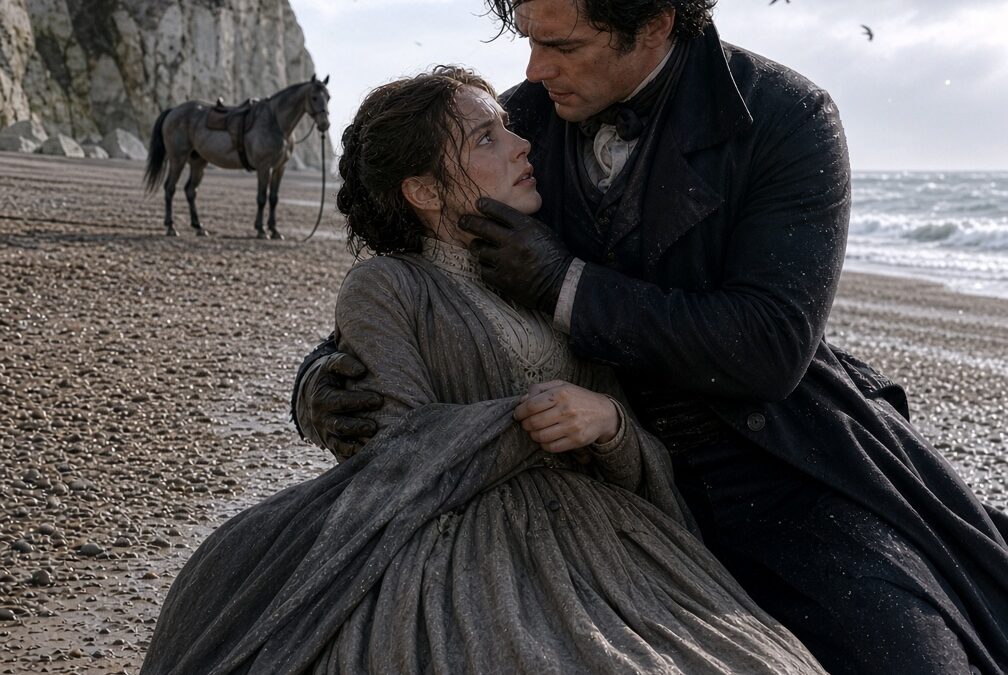
Pemwick was riding the tide line that morning exactly as he rode it every week the weather allowed, a 100 yards off at low water, and he saw the whole of it happened.
The two figures on the path above, the sudden violent motion, the fall itself, which seemed to take an impossibly long time and no time at all.
Emmaine’s basket of kelp gathering tools scattering across the rocks a full second before she landed.
He was off the mayor and running before he had consciously decided to move. The horse left standing with its res loose on the sand in a way he would never ordinarily have permitted.
His boots skidding on wet shingle as he covered the hundred yards faster than he had covered any ground in years.
His chest burning with a fear so total it left no room in it for anything else.
Not dignity, not the mud already soaking through his good boots, not the fact that he was by any measure about to make an enormous and public spectacle of himself on his own sands, he reached her while Diana was still frozen at the top of the path, too shocked by what her own hands had done to manage the climb down, and knelt in the wet sand beside a girl who was not moving, and for one long unbearable moment believed, with a clarity that frightened him more than anything had frightened him since Caroline’s fever, that he was too late.
She was not dead. She stirred as he reached her, a small sound of pain escaping her, and he understood in the same instant that her collarbone had taken the worst of the fall, the shoulder sitting wrong under her soden cloak, her face white with shock, and stre with sand where she had turned it instinctively at the last moment to protect herself.
I have you, he said, and did not entirely recognize his own voice, roughened with something he had not let it carry in six years.
Do not try to move. I have you. He gathered her as gently as the urgency in him would allow, cradling the injured shoulder against his own chest, and carried her the full mile back along the sands to pemwick himself, rather than trust the delay of sending for a cart.
Diana’s voice calling something after them from the cliff path above that he did not trouble to hear.
He had the surgeon at her bedside within the hour and stood in the doorway of the room throughout the setting of the bone, unable to make himself leave, and unwilling to examine too closely why that should be so.
Watching a girl he had exchanged perhaps a dozen words within as many years gripped the bed sheet white knuckled and not once cry out and found himself absurdly prouder of that small silent courage than he had been of anything in a very long while Mrs.
Crawl arrived at Pemwick that same afternoon, and did not come, as any properly frightened stepmother might, to sit at her stepdaughter’s bedside.
She came with a physician’s certificate already in hand, procured with a speed that told Pemwick, even in his first anger, at the sight of it, precisely how long this particular document had been sitting ready in a drawer, waiting for its occasion.
A certificate declaring Emiline unsound in mind and unfit to manage her own affairs, and naming Mrs.
Craw herself the proper guardian of the legacy, until such time, unspecified and conveniently distant, as her stepdaughter’s health might improve.
The fall, Mrs. Craw explained with a composure that struck Pemwick as considerably too well rehearsed, had very likely been nothing more than one of the girls own fits of giddiness, to which she had always been unfortunately prone.
Diana wept very pritily throughout the whole of this recitation, seated near the window with a handkerchief pressed to eyes that produced tears with an ease Pemwick found watching her faintly obscene given what he had witnessed with his own from a 100 yards off.
She said nothing at all that directly contradicted her mother’s account and everything in her manner.
The trembling, the broken little sentences about how she had tried to catch Emiline. How she had always known the path was dangerous and begged her stepsister not to walk it alone, was calculated expertly to invite exactly the sympathy it received.
Pemwick, watching her dab at eyes that had not so much as glanced toward the cliff path in the moment her own hands did their work, found himself, for the first time in longer than he could recall, genuinely and coldly furious rather than merely troubled, a feeling he had not permitted himself since the year Caroline died, and had assumed wrongly he had lost the capacity for entirely.
I watched you from a hundred yards off, Miss Craw,” he said to Diana directly, cutting through her mother’s recitation, with a quiet that carried more weight in that room than any raised voice could have managed.
“I saw your hands on your stepsister’s shoulder before I saw her fall. I would ask you to consider, before you weep further, whether you wish to be the one who taught me that a duke’s own eyes count for nothing at all in this county.”
Diana’s tears did not stop, but something in her composure flickered briefly before her mother’s hand found her arm and steadied her back into performance.
Pemwick told them both in terms that left no ambiguity whatsoever, that he had seen the fall from a 100 yards away with his own eyes, and would swear to what he had seen before any court in the kingdom.
Mrs. Craw received this with a composure that infuriated him more than open defiance would have.
Your grace was a 100 yards off. By your own account, she said, folding her hands with the mild patience of a woman correcting a child’s arithmetic.
100 yards is a considerable distance to be certain of anything at all, let alone the exact motion of two young women’s hands on a windy morning.
I do not doubt you believe what you saw. I only observe that belief and certainty are not in a court of law quite the same article.
It did him considerably less good than he expected to press the matter further. The county, he discovered over the following days with a bitterness that surprised him, was fond enough of its duke, but deeply reluctant to credit the word of a poor girl.
However much that word was backed by a duke’s own eyes over the certificate of a physician and the tears of a respectable young woman, and more than one neighbor he called on found some polite reason to change the subject rather than commit an opinion to the matter at all.
The magistrate before whom the matter would properly have been laid, a Mr. Adley, turned out to be Mrs.
Craw’s own cousin by marriage. A connection Pemwick learned of only after he had already spent a fruitless morning at the man’s house, trying to have the matter opened, sitting across a desk from a magistrate who nodded and made careful notes and produced at the end of an hour nothing whatsoever in the way of action.
It explained with unwelcome clarity why every avenue he tried in those first weeks seemed to close a little more firmly than the last.
Each refusal delivered with just enough procedural correctness that he could find no single threat of it to properly seize hold of and pull.
He tried three other avenues before he gave the matter up as blocked for the present.
A letter to a barristister acquaintance in exit, a quiet inquiry to the bishop’s own court over the physician’s conduct, an attempt to have a second doctor examine Emmaine independently that Mrs.
Crawl refused outright, citing her step-daughter’s fragile nerves and the impropriy of subjecting her to further stranger scrutiny.
Each attempt cost him days and yielded nothing, and he began to understand, with a frustration that sat uneasily on a man accustomed to his word carrying weight, precisely how carefully the whole scheme had been constructed to survive exactly this kind of scrutiny.
Every document proper on its face, every witness either sympathetic to Mrs. Craw or two frightened to speak against her, every official channel leading back eventually to some connection of her own.
He kept her at Pemwick through the worst of the recovery regardless, installing her in a guest room with a fire kept lit through the cold March nights, and a maid assigned to her comfort, and visited her each day with a formality that fooled neither of them about the depth of what lay beneath it.
He brought her on the third day a small volume of poems from his own library, and on the fifth a chessboard, having noticed in the stiff, careful way she thanked him for the first gift, that she was the kind of person who would rather be given something to occupy her hands and mind than be asked, yet again, how she felt.
“You need not perform gratitude for me, Miss Craw,” he told her. The first time she began the careful little speech of thanks she had plainly prepared in advance.
I did not carry you off that beach to be thanked for it. I did it because the alternative was unthinkable, and I would ask that you spare us both the formality of pretending it was a kindness requiring repayment.
She looked at him for a long moment after that, something in her face loosening very slightly, and said, “Then I shall only tell you that I am glad it was you riding the sands that morning, and let that stand instead,” which he found, turning it over that evening in his own study, had settled somewhere considerably deeper in his chest than any more conventional expression of thanks would have managed.
She was quiet in those weeks in a way that troubled him more than tears would have, not sullen, but watchful, weighing.
He came slowly to understand exactly how much danger her stepmother’s campaign actually posed to her, and arriving alone in that fire lit room, while her collarbone knit, and the county gossiped.
At a conclusion, Pemwick would have given a great deal to have prevented her reaching.
The terms Mrs. Craw brought to end the talk arrived a fortnight later, delivered not to Pemwick, but directly to Emiline while he was away at Taunton on estate business.
He could not in conscience postpone a second time, a document offering to let the matter of her soundness of mind quietly drop, and to let her keep the cottage her own mother had left her, on the single condition that she signed the 600 over to her stepmothers, keeping entirely, and quit the parish within the month.
“You will have noticed, I think,” Mrs. Cross said, drawing a chair close to the bed with the unhurried confidence of a woman who had timed her visit precisely for the Duke’s absence.
How very little good his championing of you has actually done either of you. A duke’s name dragged through the county courts over a matter of 600 and a stepdaughter’s fall, however he means it kindly, is not the sort of talk that fades quickly.
Emmaine men in his position are ruined by exactly this species of scandal slowly over years in ways a girl with nothing to lose in the first place is spared entirely.
I am offering you the cottage and your freedom from this whole unpleasant business in exchange for sparing him that I should think if you care for him at all the bargain would recommend itself.
It was that parting argument more than the document itself that Pemwick would later understand had done the actual damage.
Not a threat aimed at Emiline’s own safety, which she might have weighed and refused, but one aimed with considerable cunning at the one thing Mrs.
Craw had rightly guessed she would not risk. His name, his standing, the ordinary, steady dignity of the life he had built since Caroline’s death.
Mrs. Cra did not need Emiline to love her, or even to believe her. She needed her frightened enough on the Duke’s behalf as much as her own, to sign quietly and go, and she had judged her stepdaughter’s character with a precision that would have troubled Pemwick, had he known of it in time, rather more than the fall itself.
Emiline signed. She told no one at Pemwick what had been offered, or what she had agreed to.
Refused when Pemwick returned from Taunton and came at once to her room to see him at all and had her one box packed and was gone on the Bristol coach 2 days later with her arm still bound in its sling before he had managed to force a single explanation out of anyone in the house who might have given him one.
He had come to her door himself the moment he returned from Taon, still travel stained, and been met by silence.
And when he pressed, a message relayed through the maid that Miss Craw was not well enough to receive visitors.
He had not believed it. She had been mending steadily all week, walking the corridor unassisted the very morning he left, and had stood outside that door for a long, foolish while before his own pride finally overruled his instinct and sent him back downstairs, telling himself that a woman recovering from a broken bone was entitled to her privacy, and that pressing further would help no one.
He learned only the bare shape of it from his own housekeeper the following evening who had watched Mrs.
Craw’s carriage come and go and piece together enough from a weeping undermade to give her master the outline if not the substance of what had passed.
Pemwick stood in the empty guest room that evening, the fire he had ordered kept burning now gone cold.
The chessboard he had brought her still set out on the small table with a game abandoned midplay, and understood, with a fury that had nowhere left to be directed, since its object had already boarded a coach for Bristol, that she had left believing herself to be protecting him, sparing him the ruin Mrs.
Craw had promised would follow if he went on defending her, and that this more than the fall itself, more than the false certificate, was the thing he could not forgive.
He had stood outside her door the very evening she needed him to knock on it, and his own correctness had cost them both a fortnight, neither could easily get back.
He went a taunting himself the following week, not on the estate business that had kept him away before, but on the single purpose of finding a way past a magistrate who would not hear him.
And it was there, in a public house two miles from the Asis that he found the shepherd.
The man’s name was Josiah Kum, and he grazed a flock along the clifftop above Pemwick Sands most mornings, close enough to the path that March day to have seen, from his own considerable distance, precisely what Diana Craw’s hands had done.
He had said nothing at the time, out of the ordinary reluctance of a poor man to involve himself in the business of gentle folk, and had gone on saying nothing through weeks of county gossip that reached even his solitary hillside, telling himself each time that it was none of his affair, and that a shepherd’s word would carry no particular weight against a physician’s certificate.
Regardless, I’ve no wish to stand up in a courtroom against a magistrate’s own cousin, your grace.
And that’s the truth of it, Kum admitted, turning his cap over in work hands in the lowbeam public house.
For a man in my position, that’s a fine way to find himself without grazing rights come Miklmiss.
Whatever the rights and wrongs of the matter, I will see to your grazing rights myself on my own land, for as long as you or your family have need of them,” Pemwick told him.
“And I will not ask you to say one word beyond exactly what you saw with your own eyes.”
But a girl who has done nothing but gather kelp and mind her own affairs is at this moment sitting in lodgings above a Chandler’s shop in Bristol, robbed of 600 and her own good name besides, because every other man who might have spoken has found some quiet reason not to.
I am asking you not to be one more of them. It took the better part of that evening, and rather more patience than Pemwick generally allowed himself, but Kum agreed before the night was out, and arrived at the Taonin assizes some weeks later in his one good coat, plainly terrified and entirely unwavering, once the questions actually began.
Kum’s account laid before the asizes at Taton some weeks later corroborated Pemwick’s own in every particular a court could ask for the two figures on the path the argument he had been too far off to hear the words of but near enough to see the shape of the push unmistakable even at his distance and the fall that followed it delivered in a plain unpolished voice that carried the presiding judge remarked afterwards consider considerably more weight for its evident lack of rehearsal than a more practiced witness’s testimony might have.
Mrs. Craw’s own council, plainly unprepared for a second witness to have materialized at all, could shake nothing loose of the shepherd’s account under cross-examination, and the courtroom’s mood shifted palpably somewhere in the course of that hour.
The physician’s certificate, examined properly for the first time under questioning that Mrs. Craw had plainly never expected to face, collapsed within the hour.
The doctor who had signed it, sweating visibly under the judge’s steady gaze, admitted at last that he had examined Emiline for perhaps 5 minutes in a hurried visit, and been handsomely paid for his trouble beforehand, his hands shaking so badly by the end of his testimony that he could barely sign the transcript put before him.
Diana, confronted at last with a corroborating witness, and a mother, whose composure had entirely deserted her under the weight of it, broke down in the dock, and admitted the whole of it in open court, weeping now with none of the practiced prettiness she had once managed so well, and was bound over for transportation before the month was out.
The magistrate cousin, Mr. Adley was conveniently and permanently removed from any further authority over the matter by the scandal of his own connection to it.
His career in the district finished as thoroughly as Diana’s freedom. Pemwick did not wait for the formal conclusion of the case to go to Bristol.
He had spent the weeks of preparation for the asizes writing to every coaching office and lodging house registry between Taon and the Bristol docks.
A tedious, unglamorous labor his steward privately thought beneath a duke’s dignity, and never once said so aloud, because he had seen his master’s face on the evening, the guest room was found empty, and had no wish to be the one to test its patience.
The trail led him at last through a coaching offic’s careful records of fairs paid and destinations named to a narrow room above a Chandler’s shop on a steep street not far from the docks.
The kind of lodging a woman took when she had very little left and meant to make it last as long as it could be made to.
He climbed the stairs slowly, for once in his life uncertain of exactly what he meant to say, turning over and discarding a dozen opening sentences between one step and the next, each of them sounding in his own head, either too formal for what he actually felt, or too much like exactly the kind of pressure Mrs.
Craw had warned her against accepting. In the end, he arrived at her door with no prepared speech at all, only the deed and the purse and the plain fact of having come.
She opened the door still in her sling, thinner than he remembered, a smear of ink on one finger from whatever small mending or copying work she had found to keep herself, and went very still at the sight of him, standing in the corridor with a folded document and a small leather purse in his hands.
I have brought you the voided deed, he said before she could find a way to send him off again.
And your £600 paid in full exactly as your own mother intended it. The certificate was worthless.
The magistrate has been removed from his post and Diana Craw will not trouble you again in this life.
I ask nothing in return for bringing it. I would have brought it to you regardless of anything else between us, because it was always yours, and I could not rest easy knowing you believed you had traded it away to spare me a scandal.
I would gladly have worn a hundred times over rather than let you walk to that coach alone.
I went to your door the very night you needed someone to knock on it, and I did not, out of a foolish deference to your privacy that I have regretted every day since, he said, before she could retreat behind the same polite distance she had kept in that Pemwick guest room.
I am not making that error twice. Whatever answer you give me, you will have it from my own mouth and not from a housekeeper’s report or a solicitor’s letter.
She looked at the deed and the purse and then at him for a long moment in the narrow doorway, the wind off the Avon rattling the window glass behind her.
You did not have to come yourself, she said. A solicitor could have brought this as easily.
A solicitor could have brought the money, Pemwick said. He could not have told you that I have written that tideline every week for 9 years telling myself I wanted nothing for my life.
But the tide coming in and out exactly as it always had, and that I did not understand how much of a lie that was until I watched you fall from that path and thought for one unbearable moment, that I had lost something I had not even let myself know I wanted to keep.
She gave him her answer, standing there in the doorway above the Chandler’s shop, with her arm still in its sling and the deed, and the purse both still unopened in his hands.
And he would say afterward to anyone who asked how a duke had come to be married in a fishing parish rather than a cathedral that he had asked for nothing at all that day and been given in return considerably more than he had ever thought to ask for.
She gave him her answer standing there in that narrow Bristol doorway quietly and without hesitation.
And Pemwick would say afterward to anyone who asked how a duke had come to propose above a Chandler’s shop rather than in a drawing room that he had never in his life been so glad to have a plan go entirely differently than he had rehearsed it.
They returned to Pemwick together within the week, and the county that had so recently doubted her word over a physician certificate found itself.
In the months that followed, obliged to reconsider a great many of its earlier certainties.
Mrs. Craw, having quit the parish entirely, rather than face her neighbors after the asises, and Diana’s fate, having settled the question of whose account had been the true one, rather more thoroughly than any drawing room gossip ever could.
They married that summer at Pemwick Church, with the whole village turned out along the sands below.
Exactly. As it turned out, every low tide to watch the Duke ride the shoreline he loved, fishing boats hung with ribbon in the bay, and the church bells carrying clear across the water to reach even the furthest cottages on the western point.
Old Josiahkum stood near the front of the church in a coat considerably finer than the one he had worn to the asises, grazing rights on Pemwick land now secured for his family for as long as they should want them, and watched the ceremony with the particular satisfaction of a man who had risked a great deal for a stranger’s sake, and lived to see it repaid many times over.
Emiline walked down to the water afterward in her wedding clothes, kelp gatherer’s basket forgotten at last on the cottage windowsill, where she had left it that final March morning, and stood at the edge of the tide with her husband’s hand in hers, watching the sea come in across the same stretch of sand that had once nearly taken everything from her.
Pemwick, watching her face rather than the water, found himself thinking of nine years of solitary rides along that same shoreline, certain he had wanted nothing more from his life than the tide steady, in different rhythm, and understood now, with his wife’s hand warm in his own, and the whole village calling out its blessings behind them, precisely how much of that certainty had simply been the absence of anything better to want.
She was not afraid this time of what the water might carry away, because for the first time in longer than she could readily recall, there was nothing left it could take from her that she was not glad to have already given freely.








