I was tired of my family assuming I would host, cook, and clean for everyone every Christmas. When my daughter-in-law invited twenty-five people to my house without asking me, I finally said no and made her handle the work herself.
I was tired of my family assuming I would host, cook, and clean for everyone every Christmas. When my daughter-in-law invited twenty-five people to my house without asking me, I finally said no and made her handle the work herself.

PART 1: THE WORD SHE DIDN’T EXPECT
“You already invited twenty-five people into my house without asking me?”
I kept one hand flat against the kitchen counter because I did not trust the other one not to shake.
Across from me, Tiffany stared as though I had asked the strangest question she had ever heard.
“I told them Christmas would be here,” she said. “That part is already settled.”
Settled.
The word hung between us.
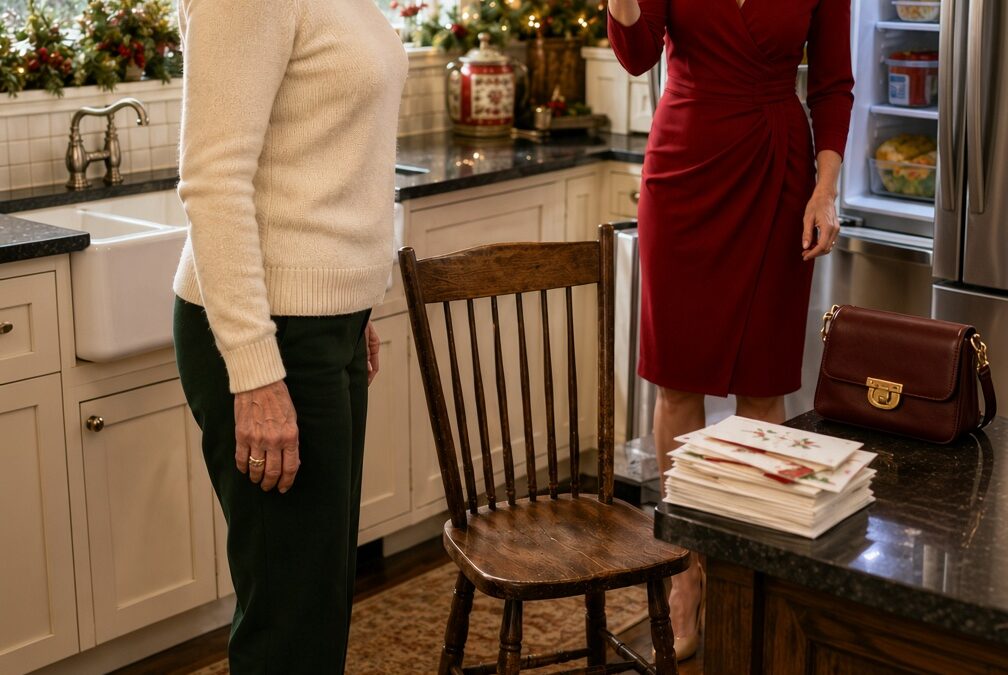
I looked at her red dress, her polished heels, the gold buckle on the purse she had dropped beside my unopened Christmas cards.
She had come into my house dressed for lunch.
Apparently I was supposed to spend the next four days dressed for labor.
“Settled by whom?” I asked.
Tiffany’s smile tightened.
“Margaret, please don’t make this difficult.”
The refrigerator hummed behind her. Soft instrumental carols drifted from the little speaker beside the kitchen window. Outside, a thin December rain glazed the backyard silver.
Everything looked peaceful.
That almost made it worse.
I reached for my coffee.
Tiffany crossed the kitchen before I could take a sip and opened my refrigerator.
She bent forward, inspected the shelves, and frowned like a customer disappointed by poor service.
“You barely have anything in here.”
I stared at the back of her carefully curled blond hair.
“I live alone.”
“Well, I’ll text you a list tonight.”
She straightened and began counting on manicured fingers.
“Three pies. A turkey. Ham. Potatoes. Green beans. Rolls. Something vegetarian because Aunt Denise isn’t eating meat again. And probably a roast, because Uncle Mark doesn’t really like turkey.”
I watched her.
For years, I had watched Tiffany do small things like this.
Open cabinets without asking.
Move serving dishes because she liked them better somewhere else.
Tell me what David preferred, as though I had not raised him.
Correct my holiday schedules.
Invite herself early.
Stay late.
Leave with leftovers.
None of those moments had been large enough to fight over.
Not individually.
But standing there four days before Christmas, listening to her assign me a feast for twenty-five people I had never invited, every small moment suddenly felt connected.
Like beads on a string.
Like a chain.
“No,” I said.
Tiffany blinked.
The word seemed too small for her to understand.
“What?”
“No.”
I lifted my coffee, carried it to the sink, and set it down.
The ceramic cup made a hard little click against the porcelain.
Tiffany laughed.
Not because anything was funny.
It was the laugh of someone certain reality would correct itself.
“Excuse me?”
I turned toward her.
“You invited them.”
Her eyebrows rose.
“So?”
“So you can cook.”
The laugh disappeared.
I picked up the Christmas card with the red cardinal on the front and slipped it into my purse.
“You can clean, too.”
Tiffany gripped the back of the old wooden chair beside the table.
Tom’s chair.
He had sat there almost every morning for twenty-eight years, reading the sports page beside a bowl of oatmeal and pretending not to hear me whenever I reminded him the trash needed to go out.
For one strange second, seeing Tiffany’s fingers wrapped around the top rail made anger move through me hotter than anything she had said.
“You cannot be serious.”
“I am.”
“Christmas is four days away.”
“I know.”
“My family is coming.”
“I heard you.”
“Twenty-five people are coming here, Margaret.”
“That sounds like a busy day for you.”
Silence fell so fast even the music seemed embarrassed.
Tiffany stared at me.
I held her stare.
Then I reached for my keys.
“Where are you going?”
“Out.”
“You can’t just walk away.”
I slipped my purse over my shoulder.
“That is exactly what I am doing.”
Her face changed.
Only slightly.
But I saw it.
For the first time since she had walked into my kitchen, confidence left her.
“You’re being childish.”
I stopped beside the garage door.
I looked back once.
“You invited them,” I said. “You cook and clean.”
Then I opened the door and left.
The garage door shut behind me with a mechanical thud.
I did not see what Tiffany did after that.
I was already inside my Buick with both hands resting on the steering wheel.
May you like
THEY RISKED MY SON’S LIFE BEFORE ASKING ME TO SIGN THEIR MORTGAGE
Twenty Minutes Before I Said “I Do,” I Found His Best Friend in My Wedding Dress. Then I Saw My Grandmother’s Ring on Her Hand.
THE PHOTOGRAPH MY SISTER DIDN’T WANT HER HUSBAND TO SEE
The garage smelled faintly of concrete, old cardboard boxes, and Tom’s fishing gear.
My heart was beating much faster than my face had shown.
For almost a minute, I did not start the engine.
I simply sat there.
The rain ticked softly against the garage door.
My breathing sounded too loud.
Then, from somewhere deep inside my chest, a laugh escaped me.
One short breath of disbelief.
I had said no.
I was sixty-three years old, and somehow saying one syllable to my daughter-in-law felt more dangerous than the day I signed the papers to sell the business Tom and I had built together.
My phone buzzed inside my purse.
I ignored it.
It buzzed again.
Then again.
I already knew who it would be.
David.
My only son.
Tiffany’s husband.
The person who, for fifteen years, had perfected the sentence, “Can we all just get along?”
I started the car.
I did not know where I was going.
I only knew I could not stay in that garage while Tiffany stood on the other side of the door waiting for me to change my mind.
So I drove.
Past the elementary school where David had once played a tree in a Christmas pageant.
Past the pharmacy.
Past the grocery store with a banner advertising holiday turkeys.
Past St. Luke’s, where Tom’s funeral had been held eighteen months earlier.
That was where my hands turned the steering wheel before my mind had made a decision.
The cemetery sat behind the church.
Rain had darkened the grass, and the bare maple branches trembled in the cold wind.
I parked near the gate and sat for another minute.
Then I took the umbrella from the back seat and walked to Tom.
His headstone still looked too new.
THOMAS ELLIS
BELOVED HUSBAND AND FATHER
The earth around it had settled.
I had not.
“I finally did it,” I said.
Rain tapped against the umbrella.
“I said no.”
My throat tightened.
There had been a time when Tom would have found this entire thing ridiculous.
Not my anger.
The fact that it had taken me so long.
Tom had been generous, but generosity had rules.
He would give you his last twenty dollars.
He would also ask why you had not brought your own wallet.
For the first twenty years of our marriage, we hosted Christmas together.
I cooked.
He cleaned.
I planned the meal.
He moved furniture, carried extra chairs from the basement, kept drinks filled, took bags of trash outside before they overflowed.
After dessert, while I sat with coffee, Tom would roll up his sleeves and say, “Kitchen’s closed. Chef’s off duty.”
Everyone laughed.
Then he did the dishes.
People remembered my turkey.
They remembered my pecan pie.
They remembered the candles, the music, the wrapped gifts beneath the tree.
They did not remember the man quietly filling the dishwasher at eleven o’clock at night.
But I did.
After Tom died, I kept hosting.
At first because I could not bear the thought of changing anything.
If the table looked the same, maybe the empty chair would hurt less.
If I cooked the same turkey, maybe David would stay a little longer.
If the house filled with voices, maybe the silence afterward would not swallow me whole.
The first Christmas without Tom had nearly broken me.
Tiffany had arrived at ten in the morning and announced that David had forgotten batteries for one of the children’s toys.
Then she had asked whether I had made the cranberry sauce from scratch.
She had never asked whether I was all right.
I had told myself not to be sensitive.
Grief makes you raw, I thought.
She probably does not know what to say.
So I smiled.
I cooked.
I washed.
I packed leftovers.
I thanked everyone for coming.
By midnight, my feet were swollen and Tom’s chair was empty.
The next year was easier.
Not because I missed him less.
Because I had learned how to perform being fine.
And apparently my performance had been convincing enough that everyone had started believing Christmas simply happened in my house.
No invitation required.
No permission necessary.
No labor worth mentioning.
My phone buzzed again.
This time I took it out.
Six missed calls.
Three from David.
Two from Tiffany.
One from my sister, Ruth.
I opened David’s message.
Mom, what happened? Tiffany is really upset. Call me.
Another message arrived while I was reading.
She says you’re refusing to do Christmas.
There it was.
Not refusing to cook for twenty-five uninvited people.
Refusing to do Christmas.
I stood beside Tom’s grave with rain blowing cold against my legs.
For a moment, the old instinct rose inside me.
Call David.
Explain.
Calm him down.
Tell him there had been a misunderstanding.
Offer a compromise.
Maybe two pies instead of three.
Maybe Tiffany could bring the ham.
Maybe I could start the turkey at five in the morning and—
I stopped.
That was exactly how it always happened.
Someone pushed.
I stepped back.
They pushed again.
I called it peace.
Tom had once called it surrender with good manners.
I typed one sentence.
Christmas is not canceled. I am simply not hosting a party I was never asked to host.
Three dots appeared immediately.
Then disappeared.
Then returned.
My phone rang.
David.
I watched his name flash across the screen until it stopped.
Then another text came.
Mom, please. Can we talk about this like adults?
I stared at the message.
The anger I had felt in the kitchen changed shape.
It became colder.
Cleaner.
Because apparently saying no made me childish.
But inviting twenty-five people into someone else’s home did not.
I put the phone back into my purse.
Then I looked down at Tom’s name carved into stone.
“You know what?” I whispered. “I think I’ve been talking enough.”
My phone buzzed one final time.
This message was from Tiffany.
We will be there Christmas morning at nine. Once you calm down, I’m sure you’ll understand why this is important.
I read it twice.
Then I smiled.
Not because I was amused.
Because for the first time, I understood exactly what I was going to do.
If Tiffany wanted to host Christmas in my house, I would let her discover what hosting actually meant.
And this time, I would not rescue her.
PART 2: THE THINGS PEOPLE STOP NOTICING
I returned home forty minutes later.
Tiffany was gone.
Her perfume still lingered faintly in the kitchen.
So did the shape of her visit.
The refrigerator door had not been closed properly.
One chair was pulled away from the table.
My unopened Christmas cards had been pushed into a crooked pile beside the fruit bowl.
I shut the refrigerator.
Pushed the chair back.
Straightened the cards.
Small things.
That was the trouble with small things.
If you fixed them quickly enough, everyone eventually forgot someone had made the mess.
I stood in the center of the kitchen and looked around.
For years, this room had been the heart of my home.
Tom had remodeled it himself when David was in college.
White cabinets.
Dark counters.
A wide farmhouse sink.
Two ovens because Tom said, “If I’m going to listen to you complain about Thanksgiving oven space for the rest of my natural life, I might as well solve the problem.”
I had laughed at him for buying two ovens.
Then used both every holiday.
The kitchen had memories in every corner.
Flour on David’s nose when he was eight.
Tom stealing pieces of pie crust.
My mother teaching me how to make gravy without lumps.
Tiffany standing beside the stove our first Christmas together, saying she wished her mother had a kitchen this large.
Back then, it had sounded like admiration.
I wondered when admiration had become assumption.
My phone rang again.
This time, I answered.
“Hello, David.”
“Mom.”
He sounded exhausted already.
I pictured him standing somewhere away from Tiffany, probably in the garage of their house or the parking lot outside his office.
“What happened?”
“She invited twenty-five people here.”
“I know.”
“Without asking me.”
A pause.
“She thought it was understood.”
“That what was understood?”
“That we always do Christmas at your place.”
“We?”
Another pause.
I leaned against the counter.
“David, when was the last time you cooked Christmas dinner here?”
“That’s not what I meant.”
“When was the last time you cleaned this house before everyone came?”
“Mom.”
“When was the last time you stayed after everyone left and washed dishes?”
“Okay. I get it.”
“No, I don’t think you do.”
His breathing changed.
I knew my son.
I knew when he was frustrated.
I also knew when he was trying to decide which woman in his life would require less effort to disappoint.
“Mom, nobody is saying you have to do everything.”
“Tiffany handed me a menu.”
“She said she was going to help.”
“She told me what to cook.”
Silence.
“She may have been stressed,” he said.
I closed my eyes.
There it was.
Stress.
One of those magical adult words that explained bad behavior without requiring anyone to change it.
“Tiffany is trying to make Christmas nice for her family.”
“At my house.”
“Yes, but—”
“Did you know she invited them?”
Another silence.
That one answered me before he did.
“I knew some of them were coming.”
“How many?”
“I don’t know. Fifteen? Maybe twenty.”
“Twenty-five.”
“She has a big family.”
“I know she has a big family.”
“Mom, I’m not defending how she handled it.”
“You are doing nothing else.”
He sighed.
“What do you want me to do? Call everybody four days before Christmas and tell them it’s canceled?”
“No.”
“Then what?”
“Tell your wife she invited them, so she is responsible for them.”
“You really expect her to cook for twenty-five people by herself?”
The question came out so quickly that I almost laughed.
“Interesting.”
“What?”
“You find that unreasonable.”
“Of course it’s unreasonable.”
“But you did not find it unreasonable when she expected me to do it.”
He said nothing.
My fingers tightened around the phone.
I did not enjoy hurting David.
That was the thing people never seemed to understand about boundaries.
Sometimes they hurt the person setting them, too.
“I’m not trying to punish her,” I said.
“Then what are you doing?”
“Stopping.”
“Stopping what?”
“Doing things because everyone assumes I will.”
David was quiet for several seconds.
Then he said, softer, “Is this about Dad?”
The question hit exactly where he expected it to.
That made me angry again.
“Do not use your father to make this easier to dismiss.”
“I’m not.”
“Yes, you are. If I’m grieving, then I’m emotional. If I’m emotional, then I’m unreasonable. If I’m unreasonable, then nobody has to listen to what I’m actually saying.”
“That is not fair.”
“No. It isn’t.”
He inhaled.
I could hear traffic in the background.
Then he said, “What happens Christmas morning?”
“You and Tiffany arrive.”
“And?”
“She cooks.”
“Mom.”
“She cooks. You help her. You both clean afterward. I will provide the house because apparently that part was already settled.”
“That sounds passive-aggressive.”
“No. Passive-aggressive would be me smiling, cooking everything, then resenting all of you for the next six months. This is direct.”
That silenced him.
I almost heard Tom laughing.
David finally said, “I’ll talk to her.”
“Good.”
“She’s going to be upset.”
“She already is.”
“I mean really upset.”
“Then I suggest you listen to her.”
I ended the call before he could ask me to solve the feelings created by my own refusal to be used.
For the next hour, I did something I had not done in years.
I sat down at my kitchen table before dinner.
Not to make a list.
Not to fold napkins.
Not to calculate thawing time for a turkey.
I made tea.
Then I opened the cardinal Christmas card I had put in my purse.
It was from Ruth.
My younger sister lived forty minutes away with her husband, Glen.
Inside, she had written:
Maggie, I know this season still hurts. Come over Christmas Eve if the house feels too quiet. You never have to pretend with me. Love, Ruth.
I read it twice.
Then I cried.
Not hard.
Not dramatically.
Just enough to make the words blur.
My phone rang while I was wiping my face.
Ruth.
I answered.
“Did David call you?” I asked.
“He called Glen.”
“Of course he did.”
“And Tiffany called me.”
I groaned.
“What did she say?”
“That you had a grief episode.”
For two seconds, I was completely silent.
Then Ruth said, “Before you murder anyone, I told her grief did not make you forget who owned your own house.”
A laugh burst out of me.
A real one this time.
“Thank you.”
“She says you embarrassed her.”
“How?”
“By refusing.”
“That is apparently very humiliating.”
Ruth became quieter.
“What happened?”
I told her.
All of it.
The refrigerator.
The menu.
The twenty-five people.
The word no.
When I finished, Ruth said, “Good.”
“That’s all?”
“That’s enough.”
“You don’t think I’m overreacting?”
“No.”
“You don’t think I should help?”
“I think helping is what you do after someone asks.”
I looked toward Tom’s chair.
Ruth continued.
“Maggie, do you remember Mom’s eightieth birthday?”
“Yes.”
“Who planned it?”
“I did.”
“Thanksgiving the year before Tom got sick?”
“I did.”
“David’s graduation party?”
“Tom and I.”
“Your first Christmas after Tom died?”
“I did.”
“And last Christmas?”
I said nothing.
Ruth knew.
She had been the only person who stayed until nearly midnight helping me scrub roasting pans.
“You have trained them,” she said.
The words stung.
“That sounds like this is my fault.”
“No. It means you made something difficult look easy, and they stopped noticing the difficult part.”
I stared through the window at the wet backyard.
A single red ornament hanging from the maple tree spun slowly in the wind.
“What if this ruins Christmas?”
Ruth snorted.
“You know what ruins Christmas? Resentment and dry turkey. Everything else is survivable.”
I smiled.
After we hung up, I walked through the house.
Twenty-five people.
I imagined coats piled on the guest bed.
Children running down the hallway.
Wineglasses on the end tables.
Wet shoes near the door.
Someone asking where I kept aluminum foil.
Someone else asking whether the coffee was decaf.
Tiffany telling me we needed more ice.
David disappearing into the living room after dinner because football was on.
And me standing at the sink.
Again.
Always standing at the sink.
My phone chimed.
A message from Tiffany.
A photograph appeared.
It was a handwritten grocery list.
Turkey.
Ham.
Potatoes.
Cream.
Butter.
Green beans.
Mushrooms.
Rolls.
Pie crust.
Apples.
Pecans.
Pumpkin.
Cranberries.
Two kinds of wine.
Coffee.
Ice.
At the bottom she had written:
Please make sure you get everything by Friday so we aren’t scrambling.
I stared at it.
Then I typed:
No.
The typing bubble appeared instantly.
Margaret, seriously?
I answered:
Seriously.
Another message.
We cannot feed everyone without groceries.
I smiled at my phone.
Then I suggest you buy groceries.
Three dots.
Gone.
Back again.
You’re acting like I did something terrible. I thought you loved having everyone over.
That one made me pause.
Because there was truth inside it.
I did love having people over.
I loved full tables.
I loved children tearing wrapping paper.
I loved hearing laughter from every room.
I loved watching people I cared about eat something I had made.
Tiffany had mistaken love for obligation.
Maybe I had, too.
I typed slowly.
I love hosting when I choose to host. You removed the choice.
This time, she did not answer immediately.
Ten minutes passed.
Then:
Fine. We’ll handle the food.
I felt my shoulders loosen.
Then another message arrived.
But we’ll need to be there by nine Christmas morning to use your ovens. Please have the counters cleared.
I laughed again.
Not because it was funny.
Because she still did not understand.
I looked around my kitchen.
Then I sent one final reply.
The counters will be exactly as I choose to leave them. If you need workspace, arrive early enough to make it. And bring trash bags.
She did not respond.
For the first time in days, the house was quiet.
I should have felt guilty.
Instead, standing in the middle of my own kitchen, I felt something I had almost forgotten.
Ownership.
PART 3: CHRISTMAS DOESN’T COOK ITSELF
By Christmas Eve, Tiffany had stopped texting me.
David had not.
His messages arrived like peace offerings.
Do you have enough folding chairs?
Tiff bought the turkey.
Do you know where the big roasting pan is?
Mom, please answer about the roasting pan.
I answered the final one.
Lower cabinet beside the stove.
I was setting a boundary.
I was not hiding cookware.
There was a difference.
At six on Christmas Eve, I drove to Ruth and Glen’s house.
For the first time since Tom died, I did not spend Christmas Eve preparing food.
No potatoes peeled in bowls of cold water.
No pies cooling on racks.
No table extended with extra leaves.
No butter softening on the counter.
I arrived at Ruth’s carrying one bottle of wine and a box of chocolates I had bought that afternoon.
That was all.
When Ruth opened the door, she looked behind me.
“Where’s the casserole?”
“I didn’t bring one.”
She pressed a hand to her chest.
“A Christmas miracle.”
I laughed.
Inside, Glen had burned one corner of the lasagna.
Ruth had forgotten to chill the white wine.
Their tree leaned slightly left.
Nothing matched.
Nothing was perfect.
And nobody died.
We ate at seven.
At eight-thirty, Glen started telling the same story about getting stranded in Denver in 1994.
At nine, Ruth and I washed dishes together.
At ten, I found myself sitting on their couch with my feet tucked beneath me, realizing I had enjoyed Christmas Eve more than I had in years.
Not because I loved my family less.
Because nobody had needed me to make the evening happen.
Before I left, Ruth hugged me tightly.
“Call me if tomorrow turns into a hostage situation.”
“I’ll be fine.”
“Do not save them.”
“I know.”
“No, I mean it. You have a disease.”
I leaned back.
“A disease?”
“Competence.”
I laughed.
She pointed at me.
“You see a problem and fix it. Tomorrow, do not fix every problem.”
“That might kill me.”
“Build character.”
I drove home beneath clear black skies.
The rain had stopped.
Christmas lights glittered along the neighborhood streets.
Tom had always loved driving around to see them.
He rated each house.
Too many inflatables lost points.
Blue lights were acceptable in moderation.
Flashing lights were, according to Tom, “an assault on civilized society.”
I could almost hear him beside me.
For the first time, remembering did not feel entirely like losing.
Christmas morning, I woke at seven.
At seven-fifteen, I made one cup of coffee.
At seven-thirty, I took a shower.
At eight, I dressed in dark green slacks and the cream sweater Ruth had given me the year before.
At eight-thirty, I put on earrings.
No apron.
No house shoes.
No flour.
No panic.
At eight-fifty-three, David’s SUV pulled into my driveway.
A second SUV followed.
Then a sedan.
I walked to the kitchen.
The counters were clean.
Not because Tiffany had ordered it.
Because I liked them clean.
The door opened at nine exactly.
Tiffany came in carrying two grocery bags.
She stopped when she saw me.
Her eyes moved over my clothes.
“You’re dressed.”
“Yes.”
“I mean dressed dressed.”
“I usually wear clothes at Christmas.”
David came in behind her carrying a cooler.
“Morning, Mom.”
He kissed my cheek.
His eyes looked tired.
“Merry Christmas.”
“Merry Christmas.”
Tiffany placed the bags on the counter.
“Where’s the turkey?”
“I assume with you.”
She stared.
“I thought David brought it.”
David froze halfway to the pantry.
“You said you put it in the trunk.”
“I said to put it in the trunk.”
“I thought you did it.”
Their eyes met.
I lifted my coffee.
Ruth’s voice echoed in my head.
Do not save them.
Tiffany turned toward me.
“Do you have one?”
“No.”
“You don’t have a turkey?”
“No.”
She looked personally betrayed by my refrigerator.
David closed his eyes.
“I’ll go back.”
“It’s forty minutes each way.”
“I know.”
“People will be here at eleven.”
“I know.”
“David—”
“I said I’ll go.”
He left.
Tiffany stood very still.
Then she began unpacking.
Potatoes.
Green beans.
Butter.
Cream.
Rolls.
Two frozen pies.
A ham.
A roast.
I noticed the pies.
Only two.
I said nothing.
At nine-twenty, her mother, Linda, arrived.
Linda was sixty-eight, silver-haired, neatly dressed, and carrying a large bowl covered in foil.
“Merry Christmas!”
She hugged me warmly.
“Margaret, your house looks beautiful.”
“Thank you.”
Then she saw Tiffany slicing potatoes.
“Good heavens. You’re cooking?”
Tiffany’s knife stopped.
“Yes, Mom.”
Linda looked at me.
Then back at her daughter.
“Well. That’s new.”
I turned my face away before Tiffany saw my smile.
More relatives arrived early.
Aunt Denise brought a vegetarian casserole.
Uncle Mark carried two bottles of wine.
Tiffany’s cousin Sarah brought cookies.
Nobody had told them they needed to contribute.
They simply did.
By ten-fifteen, six people were in my kitchen.
By ten-thirty, Tiffany was sweating.
Her curls had started to loosen around her face.
She opened the wrong cabinet three times looking for foil.
She could not find the potato peeler because she had put it in a different drawer the previous Thanksgiving.
She burned one batch of rolls.
Then she discovered the roast would not fit beside the ham in the smaller oven.
“Margaret?”
I was in the living room arranging cards on the mantel.
“Yes?”
“Which rack position do you use for the roast?”
“Middle.”
“There isn’t enough space.”
“Then you’ll have to rearrange it.”
She stared at me from the kitchen doorway.
For a moment, I could see the request forming behind her eyes.
Not a question.
A surrender.
Can you just do this?
She did not say it.
Neither did I.
At ten-forty-five, David returned with the turkey.
Frozen.
Tiffany touched it.
Her face drained.
“This is frozen.”
“It was the only one they had.”
“We can’t cook this.”
“I know that now.”
“What are we supposed to feed people?”
“There’s ham.”
“Ham for twenty-five people?”
“You bought a roast.”
“The roast is for Uncle Mark.”
From the kitchen table, Linda said, “Mark can eat ham.”
Uncle Mark raised his wineglass.
“I have survived worse.”
A few people laughed.
Tiffany did not.
I watched her look around the kitchen.
At the potatoes.
At the green beans.
At the frozen bird sitting like a monument to poor planning.
At the clock.
At the doorway where more guests were arriving.
For the first time, I saw something beneath her anger.
Fear.
Not fear of me.
Fear of failing publicly.
I understood it.
I had lived inside that fear for years.
If dinner was late, I felt responsible.
If someone did not like the pie, I felt responsible.
If two relatives argued, I somehow wondered whether I should have seated them farther apart.
Hosting had become a performance I judged myself by.
Maybe Tiffany had seen the performance and wanted the applause without understanding the work.
That did not excuse her.
But it made her human again.
At eleven-fifteen, twenty-three people were inside my house.
Two more were on the way.
Coats filled the guest bed.
Children ran through the hallway.
Someone turned on football.
Someone else asked for coffee.
I smiled, greeted everyone, and answered questions about where the bathroom was.
But I did not cook.
At eleven-forty, Tiffany dropped a serving spoon.
It clattered across the tile.
“Damn it.”
The kitchen went quiet.
Linda looked at her daughter.
“Tiffany.”
“What?”
“You’re wound tighter than a clock.”
“I’m trying to feed twenty-five people.”
Linda looked around.
“Why didn’t Margaret cook this year?”
Silence.
I was standing near the doorway.
Tiffany’s back stiffened.
David looked at the floor.
Then Linda turned to me.
“Are you not feeling well?”
“I feel fine.”
“Oh.”
Her eyes moved back to Tiffany.
Tiffany began stirring green beans unnecessarily hard.
Linda waited.
“Maggie?” she asked.
Tiffany cut in.
“Mom, please.”
“No, I’m just asking.”
“I told you Margaret wanted a break.”
I looked at Tiffany.
That was the first thing she had said all day that surprised me.
Not because it was some great betrayal.
Because it was carefully incomplete.
Linda nodded.
“Well, of course she deserves one.”
Tiffany’s shoulders loosened slightly.
Then Linda added, “It was nice of her to let you host here.”
The spoon stopped.
I looked at David.
David looked at Tiffany.
Linda noticed.
“What?”
Nobody answered.
Linda’s expression changed.
“Tiffany.”
“Mom.”
“Did Margaret ask you to host?”
Tiffany put the spoon down.
“No.”
“Did you ask Margaret whether you could invite everyone?”
Tiffany’s cheeks reddened.
“It’s complicated.”
Linda stared at her.
“No. That is not a complicated question.”
Every sound in the kitchen seemed to sharpen.
The bubbling pot.
The television in the next room.
A child laughing down the hall.
Tiffany looked toward me.
I said nothing.
I had promised myself I would not rescue her.
That included rescuing her from the truth.
“I assumed,” she said finally.
Linda blinked.
“You assumed what?”
“That Christmas would be here.”
“And Margaret agreed?”
“We always have Christmas here.”
“That isn’t what I asked.”
Tiffany’s voice tightened.
“I was trying to keep the family together.”
Linda glanced around my kitchen.
Then at me.
Then back at her daughter.
“You invited twenty-five people into this woman’s home without asking her?”
Nobody moved.
Tiffany looked at me again.
This time there was no anger in her eyes.
Only embarrassment.
And for once, I did not absorb it for her.
I let it remain exactly where it belonged.
PART 4: I SAT DOWN
Lunch became dinner.
Not because Christmas was ruined.
Because cooking for twenty-five people was difficult.
Imagine that.
At twelve-thirty, Sarah took over the potatoes.
Aunt Denise reheated her casserole.
Linda glazed the ham.
David sliced vegetables.
Uncle Mark discovered I had a card table in the basement and brought it upstairs without being asked.
The teenagers set plates.
Someone opened wine.
Someone else made coffee.
The frozen turkey remained in the laundry sink, useless and innocent.
At one point Tiffany stood in the middle of the kitchen with both hands on her hips while half a dozen relatives moved around her.
“This is not how I planned it,” she whispered.
I was close enough to hear.
I almost answered.
Then I decided not to.
Plans were not sacred simply because someone had made them.
Especially when the plan belonged to someone else’s house.
By one-thirty, food covered every available surface.
It was not my Christmas dinner.
The potatoes were slightly lumpy.
The ham was darker around the edges than I would have allowed.
The green beans had too much garlic.
There was no homemade cranberry sauce.
The rolls came from a bag because Tiffany had burned the first batch.
And everyone ate.
They ate happily.
They laughed.
Uncle Mark told a terrible joke.
The children argued about who got the largest roll.
Linda complimented Sarah’s potatoes.
Nobody died because my pecan pie was missing.
I sat at the end of the table.
Tom’s old place was beside me.
For years after he died, I had avoided that chair.
Then I had started using it for serving dishes.
Anything to keep it from looking empty.
That afternoon, the chair stayed empty.
But for the first time, I did not feel responsible for filling the space.
Halfway through the meal, David leaned toward me.
“You okay?”
“Yes.”
He studied my face.
“You’re really okay?”
“I am.”
He looked around the table.
“I thought this was going to be a disaster.”
I smiled.
“It was never going to be a disaster.”
“The turkey is frozen in your laundry sink.”
“That is inconvenient. It is not a disaster.”
He laughed despite himself.
Then his expression changed.
“I’m sorry.”
I looked at him.
“For what?”
He rubbed his thumb against the edge of his napkin.
“For assuming.”
That word again.
This time it sounded different.
“I knew Tiffany invited everyone,” he said quietly. “I didn’t know she hadn’t actually asked you.”
“You never asked me either.”
He nodded.
“No.”
“Why?”
His eyes moved toward the room.
Because he knew.
“I guess because we always came here.”
“That explains why you assumed. It doesn’t make the assumption respectful.”
“I know.”
I studied my son.
He looked older than forty-one in that moment.
Not old.
Just grown in a way children sometimes become grown only when they finally see their parents as people.
“Your father and I loved hosting,” I said.
“I know.”
“No. You knew I loved hosting. Your father did half the work.”
David frowned.
“Dad?”
“Who do you think cleaned while you watched football?”
He glanced instinctively toward the kitchen.
Memory moved across his face.
“Oh.”
“Yes. Oh.”
“I never thought about it.”
“I know.”
That was the whole problem.
David looked ashamed.
I reached over and touched his hand.
“I’m not asking you to feel terrible.”
“Kind of seems like I should.”
“I’m asking you to notice.”
He nodded.
Across the room, Tiffany was laughing at something her cousin said.
Her face had softened.
Her hair was messier.
A stain marked one sleeve of her red sweater.
She looked tired.
She also looked more real than she had in my kitchen four days earlier with her list.
After the meal came dessert.
Two store-bought pies.
Sarah’s cookies.
A box of chocolates someone found in the pantry.
The children did not care.
Neither did most of the adults.
At four, some of the relatives began collecting coats.
At four-fifteen, Aunt Denise carried her empty casserole dish into the kitchen.
“Leave it,” Tiffany told her.
“I can wash it.”
“No, it’s fine.”
That sentence caught my attention.
Leave it.
I watched Denise set the dish beside the sink.
Then another relative put glasses on the counter.
Someone else left plates stacked beside the dishwasher.
The living room held wrapping paper, napkins, cups, crumbs, and enough discarded packaging to fill three trash bags.
I waited.
Tiffany stood at the front door saying goodbye.
David walked Uncle Mark to his car.
People left.
The noise drained from the house in stages.
Twenty-five became twelve.
Twelve became seven.
Seven became four.
At five-ten, Linda put on her coat.
“You want me to stay and help?”
Tiffany looked around.
Her eyes met mine.
For the briefest second, I saw the old habit return.
Margaret would handle it.
Of course Margaret would handle it.
I waited.
Tiffany opened her mouth.
Then closed it.
“Yes,” she told her mother. “Please.”
Linda took her coat back off.
I smiled to myself.
Progress.
Not transformation.
Progress.
At five-thirty, I went upstairs.
I changed into soft pants and a cardigan.
When I returned, Tiffany was loading the dishwasher.
David was carrying trash bags through the garage.
Linda had cleared the dining table.
I made myself tea.
Tiffany watched me.
“You’re really not going to help?”
Linda stopped wiping the table.
David froze near the doorway.
The question was not vicious.
Tiffany sounded exhausted.
That made it more dangerous.
Because exhaustion often turned unreasonable requests into sympathetic ones.
I held my mug.
“I have helped.”
Her eyes narrowed.
“How?”
“I provided my home.”
She gave a tired laugh.
“I mean with this.”
“I know what you mean.”
“Margaret, there are dishes everywhere.”
“Yes.”
“It’s going to take hours.”
“Yes.”
Her voice rose.
“You can see I’m exhausted.”
“Yes.”
That one hurt her.
I could tell.
But I did not look away.
“I have been exhausted after Christmas for years, Tiffany.”
“That’s different.”
“How?”
“You’re used to it.”
The moment she said it, she knew.
Linda closed her eyes.
David looked away.
I set my tea on the counter.
“No,” I said quietly. “That is exactly the problem.”
Tiffany pressed her lips together.
“I didn’t mean—”
“You did.”
“I meant you know how to do this.”
“Yes. Because I have done it over and over while everyone else went home.”
“That isn’t fair. We help.”
“Sometimes.”
“I have helped.”
“You have carried plates into the kitchen.”
Her face reddened.
“I’m not going to stand here and be attacked after everything I did today.”
I almost admired the instinct.
Even cornered, she reached for offense.
But I was too tired to play that game.
“I am not attacking you.”
“It feels like it.”
“I am telling you why I stopped.”
Tiffany’s eyes shone suddenly.
Not with tears exactly.
With the threat of them.
“I thought you liked it.”
The room became quiet.
That sentence was different.
Not defensive.
Not sharp.
Just honest.
I looked at her.
“I did.”
“Then why are you acting like we took advantage of you?”
“Because both things can be true.”
She frowned.
“I loved cooking for my family. I loved seeing this house full. I loved making Christmas special.”
I glanced toward the dining room.
“But I loved it when it was a gift.”
Tiffany said nothing.
“The moment you walked into my house and told me twenty-five people were coming, it stopped being a gift.”
Her shoulders dropped slightly.
“You made it an assignment.”
Linda looked down.
David leaned against the doorway.
I continued.
“And when I said no, nobody asked why. You called me childish. David asked me to be reasonable. You told your mother I wanted a break because saying you never asked me would have sounded bad.”
Tiffany looked toward Linda.
Her mother said nothing.
“You knew,” I said.
“Knew what?”
“You knew that if you told people the whole truth, they might think what you did was rude.”
“That isn’t why I—”
“Then why didn’t you tell her?”
Tiffany opened her mouth.
Nothing came out.
I let the silence answer.
Then I picked up my tea.
“I am not angry because Christmas happened here. I am angry because you decided my time, my work, and my home belonged to you before you ever spoke to me.”
Tiffany looked down at the sink.
When she spoke again, her voice was smaller.
“I was under pressure.”
“I believe you.”
“My family kept asking where we were doing Christmas. My mother’s house is too small. Denise has her renovation. Sarah has the baby. Everybody looks at me like I’m supposed to organize things now.”
“I believe that, too.”
“And your house is big.”
“Yes.”
“And you always make everything look easy.”
There it was.
The truth Ruth had already given me.
I made it look easy.
So they stopped seeing the work.
“I know,” I said.
Tiffany wiped her palms against her jeans.
“I thought you’d complain a little and then be fine.”
That hurt more than the menu.
Because it was probably the most honest thing she had said.
“You counted on me giving in.”
She looked at me.
“Yes.”
I nodded.
“Thank you for saying it.”
Tears filled her eyes then.
I did not rush to comfort her.
Not because I wanted her to suffer.
Because I wanted both of us to remain in the truth for more than five seconds.
Finally she whispered, “I’m sorry.”
David looked at me.
Linda looked at me.
Everyone waited.
The old Margaret would have rescued the room.
It’s okay.
Two words.
Simple.
Kind.
False.
I did not say them.
Instead, I said, “I appreciate the apology.”
Tiffany swallowed.
“Are we okay?”
“Not yet.”
Her face fell.
“But we can be.”
That was all I could honestly promise.
I picked up my tea.
Then I walked into the living room.
Behind me, water began running in the sink.
Nobody called me back.
And for the first time in years, after a Christmas meal in my own house, I sat down.
PART 5: WHAT BELONGED TO ME
The house was clean by eight-thirty.
Not Margaret clean.
Nobody wiped the baseboards.
A few water spots remained on the glasses.
Someone put the large serving spoon in the wrong drawer.
I survived.
Linda left first.
At the front door, she hugged me longer than usual.
“Next year,” she whispered, “they can come to my house in shifts.”
I laughed.
“You may regret saying that.”
“I already do.”
Then she kissed Tiffany’s cheek and drove home.
David took the last trash bag outside.
When he returned, he found me sitting at the kitchen table with the cardinal Christmas card open in front of me.
Tiffany stood at the sink washing the roasting pan.
Her shoulders slumped.
The red sweater she had worn so confidently that morning was spotted with water.
David looked from her to me.
“Everything outside is done.”
“Thank you,” I said.
He nodded.
Then he picked up a towel and began drying what Tiffany washed.
For several minutes, no one spoke.
The kitchen was nearly restored.
Christmas music played softly from the speaker near the window.
The same speaker that had been playing four days earlier when Tiffany told me the party was already settled.
A lifetime seemed to fit between those two moments.
Tiffany finished the roasting pan.
David dried it.
She opened the cabinet.
“Lower shelf,” I said.
She slid it into place.
“Thanks.”
Another minute passed.
Then Tiffany sat across from me.
David remained standing.
“Can I ask you something?” she said.
“You can ask.”
“When did you start resenting me?”
The question was so direct that I respected it.
“I don’t resent you.”
“You did.”
“I was angry with you.”
“That isn’t the same?”
“No.”
She looked unconvinced.
I folded my hands around my mug.
“Resentment is what happens when anger sits too long without being spoken.”
Tiffany glanced at me.
“I was getting there.”
That earned the smallest smile from her.
“So this wasn’t just Christmas.”
“No.”
David lowered himself into the chair beside her.
I looked at both of them.
This was the conversation we should have had years earlier.
Maybe I had been partly responsible for that.
Not for their assumptions.
But for never correcting them.
“I think things changed after Tom died,” I said.
David’s eyes lowered.
“I needed you both around. I needed the noise. I needed reasons to get up and cook and clean and plan things.”
My throat tightened, but I kept going.
“Every time you came over, I felt less alone.”
Tiffany’s face softened.
“So when you asked for things, I said yes.”
“You never seemed upset.”
“I wasn’t always upset.”
I looked toward Tom’s chair.
“That’s what makes it complicated.”
I had spent days telling them things did not need to be complicated.
But feelings were different from manners.
Feelings could hold two truths at once.
“I could be happy you were here and exhausted by what you expected from me. I could love feeding you and wish somebody else would wash the pan. I could want Christmas in this house and still want someone to ask first.”
David rubbed his hands together.
“I should have seen it.”
“Yes.”
He winced.
I almost softened the word.
I did not.
Then I added, “But I should have spoken sooner.”
He looked up.
“That doesn’t make what happened your fault.”
“No. It means silence helped the problem grow.”
Tiffany stared at the table.
“I honestly thought you liked being needed.”
I considered that.
“Maybe I did.”
The admission surprised even me.
After Tom died, being needed had given my days shape.
People needed birthday cakes.
Babysitting.
Sunday dinners.
Airport rides.
Holiday meals.
Advice.
Spare keys.
The guest room.
My usefulness had become proof that I still belonged somewhere.
It was possible I had clung to that harder than I understood.
Then one day usefulness had quietly become availability.
And nobody, including me, noticed the exact moment it happened.
“I think I liked being needed,” I said. “I just didn’t realize I was teaching everyone I was always available.”
Tiffany’s eyes filled again.
“I really am sorry.”
This time, I believed she understood what she was apologizing for.
Not dinner.
Not the menu.
Not the argument.
The assumption.
“I know,” I said.
She reached across the table.
She did not grab my hand.
She simply placed hers near mine.
Close enough that I could choose.
I looked at it for a second.
Then I covered her fingers with mine.
Not forgiveness wrapped in a bow.
Not everything fixed.
A beginning.
David exhaled as though he had been holding his breath for four days.
I gave him a look.
“This does not mean you are off the hook.”
He laughed.
“I figured.”
“Next Christmas, what happens?”
He looked at Tiffany.
Tiffany looked at me.
“We ask,” she said.
“Before inviting anyone.”
“Yes.”
“And?”
David sighed dramatically.
“We cook.”
“And?”
“We clean.”
Tiffany smiled faintly.
“And if you want to host, we help.”
I nodded.
“That sounds reasonable.”
David leaned back.
“Look at us. Communicating.”
“Don’t get cocky.”
He laughed again.
The sound warmed something inside me.
At nine-fifteen, they prepared to leave.
David carried the frozen turkey to their car.
Tiffany insisted she could thaw it and cook it later in the week.
“I paid sixty-two dollars for that thing,” she said. “We’re eating turkey until Valentine’s Day.”
At the front door, she paused.
“Merry Christmas, Margaret.”
“Merry Christmas.”
Then, awkwardly, “Did you have a terrible day?”
I thought about the question.
I remembered the burned rolls.
The frozen turkey.
Linda’s face when she discovered Tiffany had never asked.
The noise.
The mess.
The argument beside the sink.
Tom’s empty chair.
My tea.
The moment I sat down while somebody else cleaned my kitchen.
“No,” I said. “Actually, I think I needed this Christmas.”
Tiffany nodded.
“So did I.”
They left.
I closed the door.
The silence came quickly.
It always did after company.
For eighteen months, that silence had been the worst part.
I would stand inside it and hear everything missing.
Tom laughing.
Tom dragging garbage bags through the garage.
Tom asking whether I had seen his reading glasses while they sat on top of his head.
Tom kissing my temple when the last guest left.
Another one survived, Maggie.
The first Christmas after he died, I had cried beside the dishwasher until two in the morning.
Last Christmas, I had sat in his chair after everyone left and wished I had gone with him.
Not because I wanted to die.
Because I could not understand how a house could still contain so much of a person who was no longer inside it.
That night was different.
I walked through the living room.
One forgotten toy car sat beneath the coffee table.
A napkin had fallen beside the sofa.
I picked up the napkin.
Left the toy.
The tree lights glowed against the dark window.
I returned to the kitchen.
Tom’s chair stood exactly where it always had.
I ran my fingers along the worn wooden rail.
“You would have enjoyed today,” I said.
In my memory, he answered immediately.
I would’ve bought frozen pizza and watched the show.
I laughed.
Then I sat in his chair.
Not because I wanted to replace him.
Because it belonged to my house.
And I was still here.
I took Ruth’s Christmas card from the table and read it once more.
You never have to pretend with me.
I realized I had been pretending with more people than Ruth knew.
Pretending I did not mind.
Pretending I was not tired.
Pretending being useful was the same as being loved.
Pretending saying yes was the only way to keep everyone close.
The truth was simpler.
People who loved me could survive hearing no.
And if they could not, then the yes had never been as loving as I thought.
I turned off the kitchen light.
The room disappeared into darkness except for the glow from the Christmas tree.
On the counter sat no mountain of dishes.
No roasting pans soaking overnight.
No grocery list assigned to me.
No work waiting for morning.
Just my coffee maker.
My cards.
My house.
Before going upstairs, I opened the refrigerator.
Containers of leftover ham, potatoes, vegetables, and pie filled the shelves.
Tiffany had labeled them before leaving.
One container had a piece of masking tape across the lid.
In her handwriting were four words:
FOR MARGARET. DO NOT TOUCH.
I stared at it.
Then I laughed so hard I had to lean against the refrigerator door.
Tom would have loved that, too.
I closed the refrigerator.
Outside, the neighborhood had gone still.
A few distant Christmas lights blinked red and green against the dark.
I stood alone in the kitchen where everything had begun four days earlier.
Tiffany’s voice came back to me.
That part is already settled.
She had been wrong.
Nothing about my time, my work, my generosity, or my home was settled simply because someone else had decided it should be.
That did not mean I had to stop loving my family.
It meant love needed a door.
A door people knocked on before entering.
A door I was allowed to open.
A door I was allowed to close.
I touched the back of Tom’s chair one final time.
Then I turned off the Christmas music and walked upstairs.
For the first time since my husband died, the silence in my house did not feel empty.
It felt like mine.








